
Quick Answer
Start with a filing-first sequence: classify the partnership facts, decide whether Form 8865 and related reporting apply, then assess tax outcomes. U.S. reporting can still apply without distributions, and section 1446 withholding duties may still exist for foreign partners. If you plan to claim FEIE, document Bona Fide Residence Test or Physical Presence Test support first, then map only qualifying service income. Keep FBAR and Form 8938 checks separate, and use conservative treatment for unresolved items until technical review.
Start Here if You Have US Partnership Income Abroad#
Start by treating this as a filing-order problem, not a cash-movement problem. If you are a U.S. citizen or green card holder with an interest in a foreign partnership, filing duties can apply even when the partnership distributed no cash.
That matters because the costliest mistakes usually start in the wrong place. If you begin with a tax estimate before you know the filing list, one late form decision can force you to rebuild assumptions, reserves, and deadlines. If you leave classification until the end, you can also end up reworking forms drafted on the wrong premise. The cleaner approach is to settle the filing frame first, compute tax inside that frame second, and escalate anything still not technically solid before sign-off.
Use the same sequence every year:
- Confirm scope and entity treatment. Make sure the facts actually involve a U.S. person with a foreign partnership interest, and classify the entity under U.S. tax rules rather than local labels.
- Map filing duties before estimating tax. Build the filing list first. Form 8865 may be required, and if section 1446 conditions apply, withholding reporting can involve Forms 8804, 8805, and 8813.
- Separate immediate filing work from open technical analysis. Lock what must be filed now, then work through unresolved tax treatment questions with explicit assumptions.
In practice, that order avoids two common and expensive loops. The first is rebuilding numbers after a late form decision. The second is rebuilding forms after a late classification decision. Once the filing list is stable, reserve planning and review timing usually become much more predictable.
Keep your annual work reusable. One filing checklist and one evidence pack are usually enough if you maintain them well. The evidence pack should hold ownership history, partnership activity and financial detail, filed form copies, and dated notes for assumptions you could not fully resolve by filing time. That file becomes the backbone for review, amendment decisions, and next year's start-up.
Escalate early to a qualified professional when any of these are still open:
- You cannot confidently classify the entity under U.S. tax rules.
- You are unsure whether Form 8865 applies to your facts.
- Section 1446 withholding may apply, but records do not clearly support the filing position.
Most importantly, do not translate no distribution into no reporting. Reporting can still apply when current tax due is low, and section 1446 withholding duties can still apply where relevant. Missing those duties can create penalties and interest.
Next, get the file in order before you make the first classification call.
Prerequisites and Documents to Prepare Before Step 1#
Good preparation keeps the rest of this process controlled instead of reactive. Pull the file together before Step 1 so you can classify correctly, choose forms with support, and avoid rebuilding the return when late records arrive.
Start with the core return file. Gather the prior-year U.S. return and current-year income records first, so baseline reporting is complete before the cross-border decisions begin. If that baseline is thin or incomplete, every later decision gets slower and less reliable because you are trying to solve two problems at once.
Then pull the account records you will use for both FBAR and Form 8938. Use the same underlying account universe, but test each filing separately. Form 8938 does not replace FBAR, and FBAR is filed with FinCEN, not the IRS. Keeping those tracks separate from day one prevents end-stage cleanup and reduces the chance that one account decision gets copied into the wrong filing.
Before you get into FEIE, separate U.S.-source and foreign-source income and tag the income type. Mark each line as wages or self-employment income for services performed in a foreign country, or as income that is not clearly FEIE-eligible. This is not academic sorting. FEIE applies only to wages or self-employment income for services performed in a foreign country, and the income is still reported on a U.S. return even when FEIE is claimed.
A quick first-pass packet review helps more than you might expect. Sort records into four piles: baseline return support, account-reporting support, partner documentation, and unresolved items that could change filing status. That simple sort keeps the high-impact gaps visible while there is still time to close them.
Set up a filing workspace early and keep it simple. A structure like dated_copies, assumptions_log, and missing_items is enough if you actually keep it current. The folder names do not matter. What matters is that every item is marked verified, assumed, or unresolved.
Use these habits to keep the file moving:
- Pull your core tax file first. Gather the prior-year U.S. return and current-year income records before anything else.
- Pull cross-border account records next. Collect what you need for both FBAR and Form 8938, then test each filing independently.
- Separate source and income type before FEIE analysis. Keep potentially eligible service income distinct from lines that are not clearly eligible.
- Build one workspace for evidence and open items. Track dated copies, assumptions, and missing documents in one place.
Use consistent file names and date stamps from the start. When records appear late, you want to know exactly which version supported each decision at that point in time.
One practical rule: if a document can change a filing decision, either collect it now or log it as missing. Do not leave decision-critical items in memory or buried in email.
With that file in place, Step 1 becomes a classification exercise instead of a reconstruction project.
Step 1 Classify Your Partnership and Income Streams#
Get classification right before you do any tax math. A stable filing season starts with partner status and income-line mapping, not projections.
Start with a provisional classification based on documents. If records conflict, keep the classification provisional, tag the conflict clearly, and route it for technical review before filing. Leaving entity treatment until the end is one of the fastest ways to create avoidable rework.
Then verify partner status from documents rather than assumptions. A U.S. partner should provide Form W-9. A foreign partner should provide the appropriate Form W-8. The partnership must determine whether each partner is foreign, and if no Form W-9 or similar documentation is received, the partner must be presumed foreign until documentation is obtained.
Once partner status is documented, sort the income lines into working buckets. This is still an organizing step, not final tax treatment. The goal is to separate what is clearly identified from what still needs review. If a line is unclear, keep it reportable for now and escalate before submission rather than forcing a tax conclusion too early.
Keep your notes short and explicit. Record what is confirmed, what is inferred, and what is missing. A one-page classification note that states current treatment, unresolved points, and a target decision date is usually enough to keep later reviews focused. It also keeps the file from being reopened from zero every time a new document comes in.
Check likely section 1446 impact while the partner-status file is still open. If effectively connected taxable income is allocable to a foreign partner, section 1446 withholding can apply even when no cash was distributed and regardless of the partner's ultimate U.S. tax liability. Form 8805 is required for each foreign partner and must be attached to Form 8804, whether or not withholding tax was paid. Timing matters: Form 8804 is generally due by the 15th day of the 3rd month after year-end, with 15th day of the 6th month timing for partnerships made up of all nonresident alien partners.
| Partner documentation | Income-line status | Source status | Likely form impact |
|---|---|---|---|
| Form W-9 on file | Income buckets drafted, items still being confirmed | To be confirmed | Keep in return workpapers while final positions are reviewed |
| Appropriate Form W-8 on file | Income buckets drafted, items still being confirmed | To be confirmed | Check whether allocable ECTI may trigger section 1446 withholding and related reporting |
| No Form W-9 or similar documentation | Income buckets drafted, items still being confirmed | To be confirmed | Presume foreign partner until documentation is received, then assess section 1446 reporting requirements |
If partners changed during the year, track effective dates in the same classification note. Mid-year ownership changes can alter who is reportable and when, so date control matters as much as status control.
Do not push incomplete partner documentation past this step if you can avoid it. Section 1446 issues are easier to handle early than after filing, and noncompliance with reporting or withholding can lead to penalties and interest.
Once partner status and income mapping are stable enough to support filing decisions, you can move to the form list.
Step 2 Decide Which US Reporting Forms Apply#
Decide the filing tracks before you finalize any numbers. If you mix return reporting, account reporting, and partnership-specific filings too early, one unresolved question tends to bleed into everything else.
A filing matrix works best when you run the main tracks in parallel:
- U.S. income tax return requirements
- Form 8938 determination
- FBAR determination
- Form 8865 status, if ownership or partnership facts put it in play
Use the Form 8938 gate correctly. Form 8938 is attached to the tax return and applies when specified foreign financial assets exceed the applicable threshold. If you are not required to file an income tax return for the year, Form 8938 is not filed even if asset values are high. FBAR is different. It is FinCEN Form 114 and is filed with FinCEN rather than the IRS. Depending on the facts, you may need Form 8938, FBAR, or both.
One common mistake is treating one account decision as final for both forms. Use one account universe, but run two separate determinations so each filing stands on its own rules. That is especially important because the filing channel, thresholds, and supporting logic are not the same.
Avoid shortcuts on Form 8938 thresholds. Thresholds vary by filer profile and location, so profile matching is part of the decision itself, not a cleanup item to handle later.
Before sign-off, every required or pending decision should be tied to at least one source document, such as return records or bank records. If a status has no support, it stays pending review. A good matrix also shows the owner, the target date, and the escalation trigger, so unresolved items cannot drift into filing week unnoticed.
| Checkpoint item | What to confirm now | Why it matters |
|---|---|---|
| Form 8938 profile match | Filing status and location profile are correct | Thresholds are profile-specific |
| Form 8938 filing gate | Income tax return is required for the year | No return requirement means no Form 8938 filing |
| FBAR channel | FinCEN Form 114 is routed to FinCEN | Prevents filing in the wrong place |
| Decision evidence | Each status has a linked source document | Reduces missed or unsupported filings |
If a form remains unresolved, assign an owner and a decision date right away. Open items without accountable closure are one of the fastest paths to missed filings.
Before you move on, reconcile the matrix against the active return draft. Each item marked required should appear in your preparation checklist with an owner and date, and each item marked not required should carry a short reason tied to evidence. By the end of this step, you should have a filing matrix labeled required, not required, or pending review, with support attached to each entry.
Once that matrix is stable, you can evaluate tax reduction options without guessing about the filing base.
Step 3 Separate Reporting Duty From Tax Due#
Do not let a low projected tax result hide reporting obligations. Reporting analysis comes first. Tax reduction analysis comes second.
U.S. citizens and resident aliens are taxed on worldwide income. FEIE is claimed on a filed return and applies only when qualification is met and the income is reported, so excluded income is still reported. For foreign partners, section 1446 withholding and reporting can still apply even when the partnership made no cash distributions and even when the ultimate U.S. tax liability is modest.
Use this split to keep the work clean:
| Must report now | May reduce tax after reporting |
|---|---|
| U.S. tax return items supported by your records | FEIE, if you qualify and report the income |
Information-reporting items marked required in Step 2 | Eligibility checks for other claimed reductions |
| Section 1446 withholding and reporting items that apply to your facts | Final tax computation adjustments after eligibility checks |
Other information-reporting items already marked required | FEIE limit calculations after qualification is established |
Treat that table as a gate, not a forecast. Clear the left column before you spend serious time on the right column.
This sequencing also improves the quality of outside advice. If you involve an adviser, send the reporting matrix first and the tax-model questions second. That keeps technical advice tied to the correct filing facts instead of a moving target.
It also makes later corrections easier. When the baseline filing record is complete, amendments are usually narrower and easier to defend because you are not also reconstructing what should have been filed in the first place. Review becomes cleaner too, because a reviewer can challenge tax treatment without also wondering whether core reporting was skipped.
If facts are incomplete, use conservative filing with documented assumptions rather than silence:
- File required return and reporting forms using the best supported treatment available.
- Record missing facts and assumptions in the evidence pack.
- Flag each unresolved item for amendment review when records arrive.
Keep penalty awareness practical. IRS section 1446 guidance states that noncompliance may lead to penalties and interest, so open reporting items belong on the current execution list, not the post-filing wish list.
Once reporting obligations are locked down, the next question is whether FEIE actually fits your facts.
Step 4 Test FEIE Eligibility Without Overclaiming#
FEIE is often overclaimed because qualification and income type get blended together. Keep them separate. First prove that you qualify under a test, then identify which income lines fit, and only then calculate the exclusion.
Start with qualification because it drives every downstream number. The Bona Fide Residence Test and Physical Presence Test each have minimum time requirements, so document which test you are using and the qualifying period before assigning any FEIE amount. If qualification covers only part of the year, adjust the maximum exclusion by qualifying days. Limited waivers can apply for adverse country conditions, but only within IRS-published country and date limits and related conditions.
| Checkpoint | What to verify | Why it matters |
|---|---|---|
| Test selection | Which test you are using and the qualifying period | FEIE applies only if you are a qualifying individual |
| Qualifying period support | Day-count support and period evidence | Partial-year qualification requires a prorated limit |
| Exclusion cap math | 2026 maximum of $132,900 per person, adjusted for qualifying days | Prevents overclaiming |
| Service legality filter | Whether services were performed during a period that violates U.S. law in that country | Income from those periods is not foreign earned income |
Once qualification is set, move line by line through the income. FEIE applies to wages or self-employment income for services performed in a foreign country. Pass-through and other income lines still need individual review. Do not assume FEIE treatment from labels in partnership reports or local account statements.
When a line mixes qualifying and nonqualifying elements, draw the boundary explicitly. Mark what qualifies, what does not, and what still needs support before you calculate the exclusion. That single step prevents aggressive assumptions from being baked into the return and gives a reviewer a clean path to test your math without reopening every source document.
Keep income tax and self-employment tax on separate tracks. FEIE may reduce income tax exposure, but self-employment tax is still computed on Schedule SE for net earnings from self-employment, regardless of age or current Social Security or Medicare benefit status. In practice, that is where many rough estimates break down.
If facts are incomplete, use a conservative default:
- Claim only amounts supported by qualification and service-location facts.
- Keep uncertain lines taxable in the draft return and record the assumptions.
- Escalate when FEIE results depend on aggressive sourcing assumptions or unclear income characterization.
For partial-year claims, keep a dedicated day-count worksheet in the evidence pack and tie it to travel records and qualifying dates in your FEIE memo. If day-count support is weak, reduce claimed amounts in the draft and treat the difference as taxable until support is complete.
The goal is not to maximize exclusion at all costs. The goal is to claim what your file can support under review. Once those FEIE boundaries are clear, treaty analysis becomes much easier to handle without overlap.
Step 5 Check Treaty Relief and Saving Clause Limits#
Treaty analysis is worth doing only if you handle it line by line. Start from normal U.S. treatment, then allow treaty relief only where a specific income item is covered and your facts satisfy the conditions.
With certain exceptions, treaties generally do not reduce U.S. taxes for U.S. citizens or U.S. treaty residents. That is why a conservative first pass is the right default. Use IRS treaty guidance to answer two questions for each line item: does the treaty cover this income category, and do your facts meet the conditions? The answer can vary by country and by income type, so broad claims are usually where the errors start.
| Treaty triage item | What to check | Evidence to keep |
|---|---|---|
| Covered income item | Match each income line to a treaty income category before claiming relief | Income-line map tied to return workpapers |
| Residency fit | Confirm residency facts align with treaty conditions for that item | Residency memo with dates and status assumptions |
| Saving clause impact | Test whether relief is limited for U.S. citizens or U.S. treaty residents | Short note: allowed, blocked, or needs review |
| State conformity risk | Check whether your state follows the federal treaty outcome | State position note linked to the same income line |
Keep treaty notes compact and mechanical. For each line, record the condition tested and whether it was met, blocked, or pending. Short notes are easier to review than broad narrative, and they keep the analysis tied to actual income items rather than general impressions.
Run state treatment as a separate check even when the federal treaty analysis looks clean. Some states conform to treaty outcomes and some do not, so keep federal and state results side by side for the same line. If they diverge, flag that early while the facts are still fresh.
If you are claiming a treaty withholding rate through a withholding agent, confirm TIN requirements early. A reduced withholding claim generally requires a U.S. or foreign TIN.
When records are incomplete, use this fallback:
- Mark each line
treaty applies,saving clause blocks, orpending review. - Keep every
pending reviewline under normal tax treatment. - Record assumptions and missing documents, then escalate uncertain lines.
By the end of this step, your treaty sheet should show one status per income line, a linked state note, and any follow-up needed for withholding or TIN gaps. That gives you a clean handoff into reserve planning and cash-flow decisions.
Step 6 Price the Self-Employment and Cash-Flow Impact#
If reserve planning only works under perfect FEIE assumptions, it is too aggressive. Price self-employment exposure and cash-flow exposure separately before filing, so reserves are tied to supported facts instead of best-case outcomes.
FEIE can reduce income tax only when you qualify, the income is foreign earned income, and the income is reported on a U.S. return. It does not make every pass-through amount excludable. Keep relief analysis and exposure analysis as separate views, especially when partnership allocations and actual cash receipts do not match.
Start with qualification under either the Physical Presence Test or the Bona Fide Residence Test, then map each income line to those facts. Focus on what is supported, not just the headline cap. If qualification covers only part of the year, the exclusion maximum is adjusted by qualifying days. For tax year 2026, the maximum exclusion is $132,900 per qualifying person. For tax year 2025, two married individuals who both qualify and both work abroad may exclude up to $260,000 combined.
Then model the cash side, because timing risk changes based on distribution pattern:
| Scenario | Cash-flow risk | Practical response |
|---|---|---|
| Partnership cash is distributed during the year | Too much cash is treated as available before classification and qualification are stable | Hold back part of each payment using current draft liability, then update holdback on a consistent review cadence |
| Income is allocated but not distributed | Tax obligations can build before cash is received | Reserve from other available cash and document the funding gap clearly |
Reserve planning should be boring and repeatable. Use the same review cadence each period so holdbacks move with facts rather than optimism. Where facts are incomplete, keep a conservative reserve posture until uncertain lines are either supported or removed from claimed exclusions.
Before you set estimated payments, run one checkpoint pass:
- Reconcile year-to-date distributions, allocated income, and the current return draft.
- Reconfirm FEIE status and qualifying-day count.
- Recheck that each claimed line is wages or self-employment income for services performed in a foreign country.
- Confirm no claimed line was earned during a period that would make it nonqualifying under U.S. law restrictions.
- Save a dated snapshot of assumptions, calculations, and missing records.
In no-distribution years, add a short funding note that shows how required payments will be covered if cash timing stays delayed. The note does not need speculative modeling. It just needs a practical funding path tied to cash you actually control.
If the projection only works when uncertain lines are treated as excluded, treat that as a warning. Run a partial-claim scenario, increase reserves, and escalate unresolved lines before final filing. Once the cash pressure is priced honestly, you are in a much better position to address state exposure without surprises.
Step 7 Handle State Tax Risk Before You File#
State exposure can undo an otherwise clean federal file, so lock the state position before you finalize the return. If California facts are involved, use California as the working model and build support directly for that analysis.
Residency is a facts-and-circumstances determination, and the FTB does not issue written residency opinions for a specific period. Your records have to stand on their own. If the state file is thin, federal cleanup will not rescue it later.
Work the state issue in this order:
- Classify status early. Determine resident, part-year resident, or nonresident status for each period before locking treatment. Residents are taxed on all income regardless of source. Part-year residents are taxed on worldwide income during resident periods and on California-source income during nonresident periods. Nonresidents are taxed on taxable income from California sources.
- Source income line by line. Do not rely on the entity address alone. Services physically performed in California are California-source income, so tie each line to service location.
- Build a residency fact file when facts are mixed. Keep dated records such as move history, travel records, and address history, plus a short memo explaining why each period is treated as resident, part-year resident, or nonresident.
- Reconcile status, sourcing, and math before filing. For nonresidents and part-year residents, California uses an effective-rate method, so the residency timeline, allocation schedule, and return totals must agree.
Treat these red flags as stop signs until resolved:
- Residency indicators still point to California while you claim nonresident treatment.
- Return address fields conflict across partnership records and tax filings.
- You report foreign residence but maintain an ongoing in-state business footprint.
Any single red flag does not decide the outcome by itself, but unresolved conflicts should block final sign-off. State positions are much harder to defend after filing if your own records point in two directions.
Check state risk before final estimated-payment decisions as well. If state exposure changes late, reserve targets may need to move even when the federal estimate stays the same.
If two residency narratives still look plausible, do not default to the lower-tax result. Preserve both views, quantify the difference, and escalate before filing. Safe harbor may apply in some cases, but it is not automatic.
When federal and state positions tell the same story, the last major job is to lock the support behind that story.
Step 8 Build an Evidence Pack for Audit-Ready Filing#
An audit-ready position is really a file-control job. Build one evidence pack that tells one consistent story across workpapers, forms, and calculations before the numbers are locked.
At minimum, tie these items to your positions:
- Return workpapers and supporting schedules tied to in-scope income lines
- Source-of-income memo
- FEIE test support
- FEIE calculation worksheet, including any qualifying-day adjustment
- Waiver support file if you claim a time-requirement exception
- Dated assumptions log for unresolved items and conservative treatment choices
Make the pack easy for another reviewer to follow without extra explanation. This order usually works well:
- Collect records. Gather statements, supporting schedules, bank records, payment-system exports, and prior-return references.
- Classify records. Tag income lines by source and service location, then map records to the facts used in filing positions.
- Draft positions. Write a short FEIE memo with date ranges, supporting documents, and any uncertainty.
- Cross-form reconcile. Check amounts, dates, and descriptions across workpapers and FEIE support, then resolve or disclose mismatches before sign-off.
- Final review. Freeze a dated pack and include a one-page index showing each claim, its support, and remaining uncertainty.
Use consistent line labels across schedules, memos, and assumptions logs. If labels drift, reconciliation slows down and reviewer confidence drops quickly.
If payment systems provide tax-ready exports, keep both the raw export and the locked copy used in filing. That makes the numbers reproducible and gives you a clear answer if a later review asks which version fed the return.
Before filing, run this FEIE checkpoint:
- Confirm FEIE support reflects that income is still reported on the U.S. return.
- Confirm FEIE amounts are tied only to foreign earned income from services performed in a foreign country.
- Document whether you rely on the Bona Fide Residence Test or Physical Presence Test, and keep qualifying-day support for any partial-year claim.
- If filing for 2026, apply the per-person maximum of $132,900 and adjust for qualifying days when eligibility covers only part of the year.
- If using a time-requirement exception due to war, civil unrest, or similar adverse conditions, document the applicable IRS bulletin period and evidence of departure timing.
If conservative calls were used because facts were incomplete, label them clearly so a later amendment can target only what changed. A clear assumptions log is what turns a future amendment into a targeted update instead of a full rebuild.
Run one final tie-out before submission. Trace each major amount from return entries to supporting schedules, then to source records. If an amount cannot be traced in a straight line, mark it unresolved and fix it before filing.
Even strong files fail when facts conflict across forms. Before submission, read the full package once as if you did not prepare it. If the same income line is described differently in two places, fix it before filing. And if something still breaks after filing, the recovery path starts with the same evidence pack.
Common Failure Modes and How to Recover Quickly#
When something breaks, recover by correcting the facts first and then carrying that correction through every affected form, memo, and calculation. Speed comes from order, not from rushing one form at a time.
| Failure mode | Recovery path | Verification before refiling |
|---|---|---|
| A required international information return was skipped | Build a complete support package from the evidence pack, including records that support facts, dates, and reported income | Confirm the corrected filing narrative matches the same records used across related filings and return support |
| FEIE was applied to nonqualifying items | Recompute FEIE using only qualifying foreign earned income. Document whether you rely on the Physical Presence Test or Bona Fide Residence Test, and recheck downstream treatment | Confirm income is still reported on the U.S. return. For 2026, confirm the per-person FEIE amount does not exceed $132,900 |
| A cross-border tax position was taken without full legal review | Rework the position memo, recalculate the return on the corrected position, and document the final treatment you are taking | Confirm the return, memo, and assumptions log all reflect one consistent position |
| FBAR and Form 8938 do not match | Reconcile one account universe with ownership and signature-authority support, then map accounts to each filing requirement. Keep filings distinct: FBAR is filed with FinCEN, and Form 8938 does not replace FBAR | Confirm the same account set and facts were tested for both forms, then document whether you file Form 8938, FBAR, or both |
Use this order to reduce second-round errors:
- Freeze the original filing set and evidence pack with a date stamp.
- Correct the core memo and calculations first.
- Reconcile cross-form fields line by line.
- Finalize one corrected assumptions log that explains what changed and why.
Before refiling, have one reviewer read the corrected package straight through. The point is not writing style. The point is confirming that every part of the file supports the same factual story.
If minimum-time FEIE support is incomplete, keep conservative treatment until the evidence is complete. If you rely on a time-requirement exception due to war, civil unrest, or similar adverse conditions, keep departure-timing proof and applicable IRS guidance in the file. Also verify that presence in the foreign country does not violate U.S. law for qualifying status before finalizing the position.
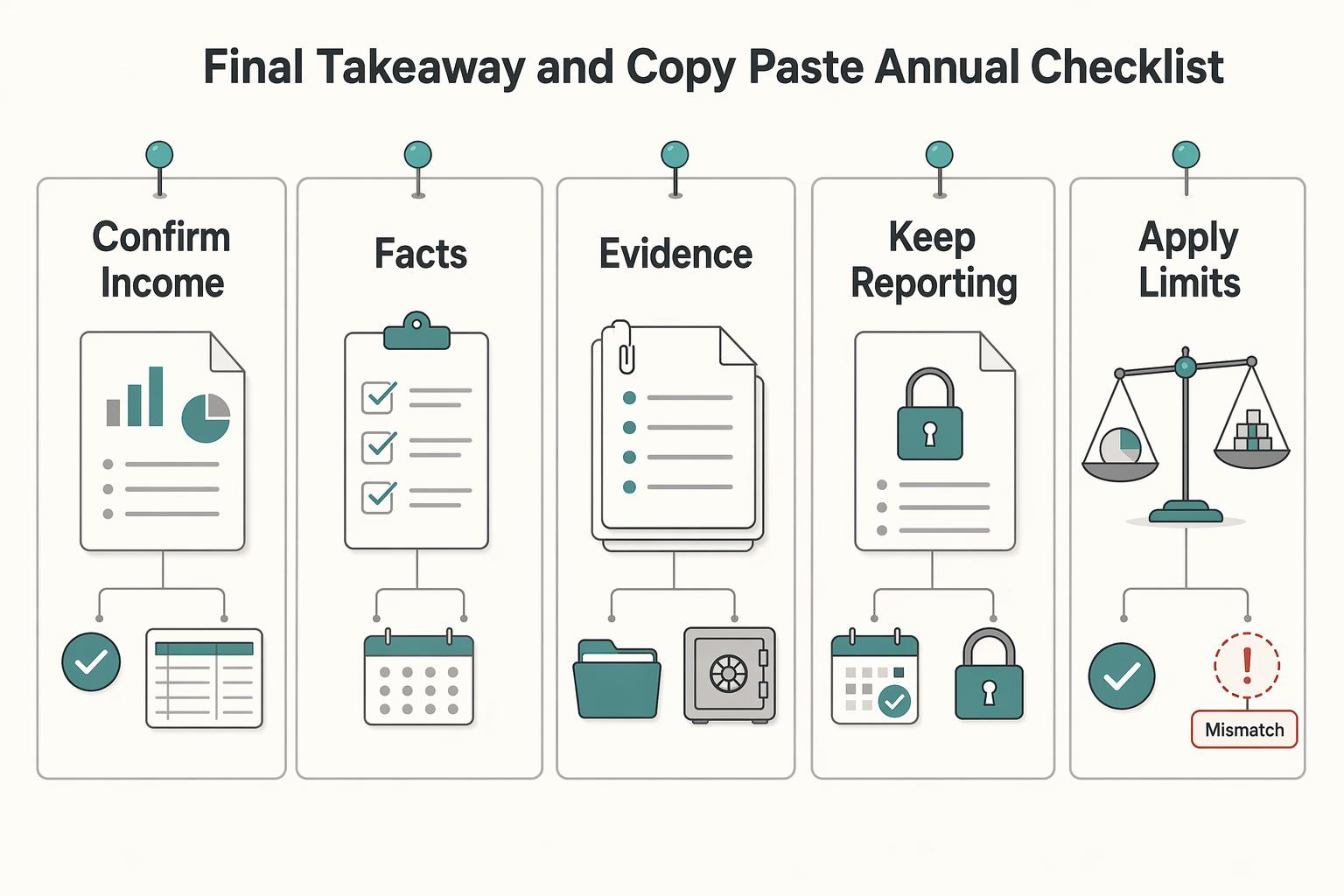
Final Takeaway and Copy Paste Annual Checklist#
Use one sequence every year so deadline pressure does not lower quality: lock reporting duties first, verify FEIE eligibility and limits second, and optimize only after the documentation is complete.
Think of this checklist as a final gate. If any line is unresolved, pause the optimization step and close the evidence gap first.
- Confirm the income is in scope for FEIE. Verify it is foreign earned income for services performed in a foreign country, generally wages or self-employment income.
- Map required filings from documented facts first. Confirm the U.S. return reports the income, and include the applicable FEIE form if claiming FEIE.
- Run FEIE qualification tests and keep support. Document whether the Bona Fide Residence Test or Physical Presence Test applies, and retain date-based records for the claimed period.
- Keep the reporting rule explicit. Excluded income is still reported on the U.S. return, and FEIE is claimed on the applicable FEIE form.
- Apply limits in order. If claiming a foreign housing exclusion, compute it first, then apply the FEIE cap and any qualifying-day adjustment for partial-year eligibility.
- Reconcile FEIE workpapers before filing. Qualifying dates, income amounts, and housing calculations should match return entries.
- Review any waiver basis before sign-off. If relying on a war or civil unrest waiver, keep documentation showing why departure occurred and count only actual days of residence or presence.
- Escalate unresolved eligibility questions. If FEIE qualification, timing, or income treatment is still uncertain, pause optimization and get technical review before submission.
Annual close note: archive the filed package with a version date and the final assumptions log. At the next cycle, start by reviewing what changed from the prior year instead of rebuilding from scratch. Reusing a clean prior file lowers miss risk and makes real changes easier to spot.
Final pre-submit FEIE check: confirm the claimed amount matches current-year limits and the qualifying period. For 2026, the per-person maximum is $132,900, adjusted when qualification covers only part of the year. If you rely on a waiver due to war or civil unrest, keep departure evidence and count only actual days of residence or presence.
This process works best when you repeat it the same way each year. Consistency in records, assumptions, and review checkpoints lowers risk and makes future updates easier to execute.
Frequently Asked Questions
Do U.S. expats always owe U.S. tax on partnership income, or is it mainly a reporting issue first?
Start with reporting, then determine tax due from the facts. U.S. citizens and resident aliens are taxed on worldwide income, so a U.S. return is still part of the process even when the final balance is low. Keep what I owe separate from what I must report.
If my partnership did not distribute cash, do I still report income on my U.S. tax return?
Yes. No cash distribution does not remove reporting obligations. If allocable effectively connected taxable income exists for a foreign partner, section 1446 withholding rules can still apply with no cash paid out. Missed withholding and reporting can lead to penalties and interest.
Who actually needs to file Form 8865, and what triggers it most often?
This section does not establish exact Form 8865 categories or thresholds. Confirm ownership and partnership-change facts early, then decide filing status before finalizing the return. If key facts are missing, treat filing as potentially required until you get a technical determination.
Can the Foreign Earned Income Exclusion (FEIE) reduce tax on partnership income in practice?
Sometimes, but only in specific cases. FEIE applies to qualifying foreign earned income, limited to wages or self-employment income for services performed in a foreign country, and the income is still reported on a U.S. return. For 2026, the per-person maximum is $132,900, subject to FEIE qualification rules.
Do U.S. income tax treaties remove tax on partnership income for U.S. citizens abroad?
Do not assume a treaty exists is the same as tax is removed; use a documented position and confirm with a qualified adviser whether any applicable treaty removes U.S. partnership tax for citizens abroad before filing.
What should I do first if I am unsure whether my facts fit Form 8865 categories?
Document uncertainty instead of guessing. List open facts, attach the records you have, and flag anything that could change filing obligations or FEIE treatment. Then take a conservative filing posture until a technical review confirms the final position.
Try a related tool
Researched and edited by the Gruv editorial team. Gruv builds cross-border billing, payouts, and finance-operations software for global businesses.
Sources
Educational content only. Not legal, tax, or financial advice.
Related Posts

The Freelance Payment Penalty: A Modeled Audit of Platform Fees, FX Spreads, and Payout Delays
The money rarely disappears through a single, easy-to-spot fee. The real loss is stacked. A marketplace takes its commission, a processor adds a charge for international cards, a bank or payment company converts the currency at a spread, a platform holds the funds before release, and a wire sheds a little to intermediaries on the way in. Each layer looks defensible on its own, but the worker feels the combined result as a smaller deposit and a later payday.

How to Respond to a Subpoena for Business Records
Move fast, but do not produce records on instinct. If you need to **respond to a subpoena for business records**, your immediate job is to control deadlines, preserve records, and make any later production defensible.
A US Expat's Guide to Investing in UCITS ETFs to Avoid PFIC Issues
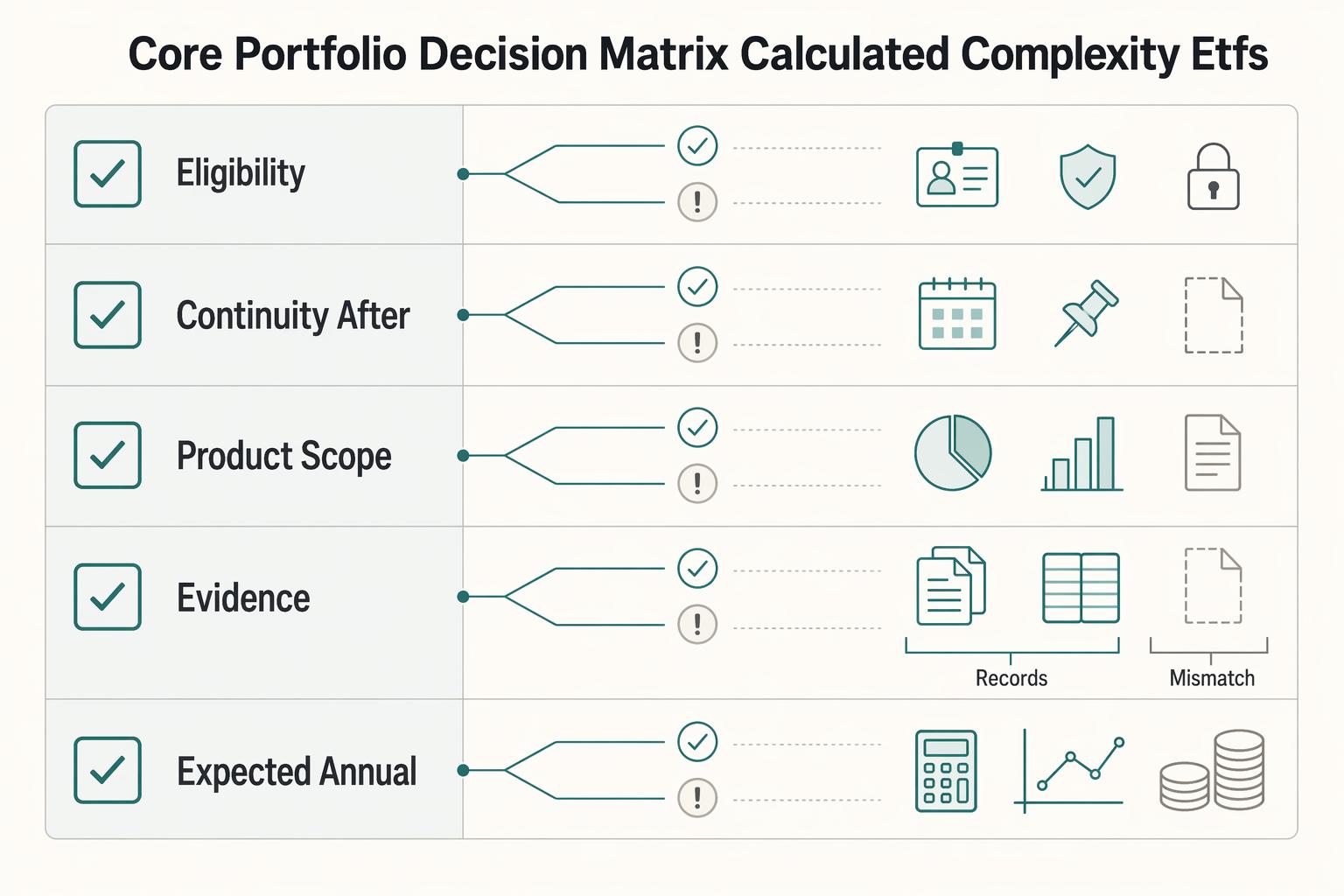
The real problem is a two-system conflict. U.S. tax treatment can punish the wrong fund choice, while local product-access constraints can block the funds you want to buy in the first place. For **us expat ucits etfs**, the practical question is not "Which product is best?" It is "What can I access, report, and keep doing every year without guessing?" Use this four-part filter before any trade: