
Quick Answer
For most profitable US-based agency owners without outside investors, the S-corp election offers a meaningful tax advantage by limiting FICA taxes to your W-2 salary rather than your total profit. However, the election only makes sense if your net profit is high enough to clear the added costs of payroll administration, Form 1120-S filing, and state obligations-and only if you meet IRS eligibility rules on shareholder type, count, and stock class. C-corp is the default when foreign investors, venture capital, or multiple share classes are in play.
S-Corp vs. C-Corp Tax Comparison for US-Based Agencies: A Decision Framework#
Start with this rule: choose the structure you can qualify for, operate cleanly, and defend under review.
For most US-based agencies, this is not a branding decision. It is an operating-system decision. Your entity choice changes how profit is taxed, what filings you must run every year, how payroll is handled, how ownership can change, and how painful it is to unwind mistakes later.
If you are profitable and owner-operated, an S-corp election often deserves the first serious look because it can align pass-through taxation with a payroll-plus-distribution operating model. If you need foreign owners, multiple stock classes, or investor-ready equity, the C-corp path tends to win before tax math even starts. The right move is not the one that sounds clever. It is the one you can run quarter after quarter without improvisation.
This guide gives you a decision framework with hard gates, breakeven logic, and clear escalation triggers. The end goal is simple: you should know whether to move forward with Form 2553, hold your current setup until the numbers justify the overhead, or route directly to a C-corp because ownership constraints make the choice for you.
What You're Actually Comparing#
Both structures start in the same place: limited liability. Shareholders are generally not personally responsible for corporate debts and obligations. After that, the tax and ownership mechanics split quickly, and those mechanics drive everything that follows.
S corporation (S-corp) is a federal tax election under Subchapter S. The corporation generally does not pay federal income tax on profit at the entity level. Income and losses pass through to owners and are reported on their personal returns.
C corporation (C-corp) is a separate taxpaying entity. Profit is taxed at the corporate level. If that profit is distributed as dividends, shareholders can pay a second layer of tax on those dividends personally.
That difference - pass-through versus entity-level tax with potential dividend tax - is the root of most agency outcomes: how you pay yourself, how you plan distributions, how you handle losses, and how flexible your ownership structure can be.
| Feature | S-Corp | C-Corp |
|---|---|---|
| Tax treatment | Pass-through, no federal entity-level income tax on profit | Entity-level tax plus potential dividend tax |
| Double taxation risk | No, by design of pass-through treatment | Yes, when profits are distributed |
| Shareholder limit | Restricted by IRS eligibility rules | No S-corp-style limit |
| Foreign shareholders allowed | No | Yes |
| Capital raising flexibility | Limited, one class of stock | High, multiple classes and broader investor fit |
| Governance burden | Lighter in many owner-operated cases | Typically more formal and investor-oriented |
Who This Framework Is For#
This framework is for US-based agency owners, consultants, and service operators who are deciding between S-corp election and C-corp treatment and who want an answer they can execute, not just a theory to debate.
It is most useful if your business is owner-led and already showing consistent profitability, because that is where the tradeoffs become real: you have enough profit to consider a salary-plus-distribution strategy, and enough operational load that extra filings and payroll processes actually matter.
If you are still deciding between sole proprietor, LLC, or corporation, solve that first with How to Choose the Right Business Structure for Your Freelance Business. This guide assumes the corporate question is live now, not hypothetical.
One warning before you go deeper: structure changes are not low-stakes paperwork. Changing too early, too late, or without sequencing can create friction that is harder to unwind than it is to avoid. The aim is deliberate selection with clear operating consequences, not quick optimization.
S-Corp or C-Corp? Here's How to Get to Your Answer Fast#
Use a two-gate test first: eligibility, then economics. If you fail either, stop forcing the election.
Most owner-operated agencies are better served by a direct decision path than by abstract tax debates. If you can legally elect S-corp status and your expected upside is still positive after the recurring overhead, keep going. If not, route to a C-corp when ownership demands it, or stay where you are until profit and process maturity change.
This sequencing also prevents the most common failure mode: electing for perceived savings before confirming ownership constraints, payroll discipline, and annual operating costs.
The Fast Filter: Who This Guide Is For#
You are the intended reader if your agency looks like a simple, profitable operator business rather than an investor-driven vehicle. In practice, that usually means most of the following are true:
- You are not planning venture capital funding. Institutional investors generally expect C-corp structure.
- Your owners are US persons and your cap table is simple. S-corp rules do not allow foreign shareholders or multiple economic stock classes.
- You run a profitable service business. The election tends to matter most when consistent profit creates room between salary and distributions.
- You can run the compliance stack. S-corp status works when documented and maintained, not when treated as "set it and forget it."
If those bullets fit, you are in the right place. If your ownership plan already conflicts with S-corp constraints, do not spend weeks trying to spreadsheet your way out of a hard rule. Accept the constraint early and move faster.
What the S-Corp Election Actually Requires#
S-corp treatment is an IRS election layered on top of state formation. Incorporating does not elect it.
You still form the entity under state law. Federal S treatment begins only after filing Form 2553, Election by a Small Business Corporation under IRC section 1362(a) and receiving IRS acknowledgment of acceptance and effective date.
This is where a lot of avoidable problems start. Owners form a corporation, operate as if S status is active, run distributions without clean payroll, and only later discover the election was late, incomplete, or not accepted. That is not a tax strategy problem. It is an execution problem.
Keep the mechanics explicit and controlled:
- File Form 2553 correctly and on time.
- Ensure required signatures are complete.
- Retain IRS acknowledgment in your records.
- If acknowledgment does not arrive, follow up at 800-829-4933 rather than assuming status is active.
Make this part of your system, not a one-time checkbox. State formation creates the company. Federal election defines tax treatment. Mixing those up is how agencies accidentally run the wrong playbook for an entire year.
| Situation | Likely Path | Why |
|---|---|---|
| Profitable service agency, US owners, simple cap table | Evaluate S-corp first | Pass-through mechanics can improve owner-operator efficiency |
| Venture or institutional raise planned | C-corp | Investor structure requirements usually override pass-through benefits |
| Any foreign shareholder or investor | C-corp | S-corp eligibility fails |
| Need preferred and common economics | C-corp | S-corp one-class rule blocks structure |
| Low-margin or pre-revenue phase | Hold or defer election | Added overhead can exceed near-term tax benefit |
| Stable profit with strong bookkeeping and payroll discipline | S-corp can be practical | Structure can be operated and defended consistently |
By the end of this guide, you should have three concrete outputs: a go or no-go signal on Form 2553, a cost-benefit model that includes real overhead, and a list of situations where professional support is not optional.
What Is the Core Tax Difference Between an S-Corp and a C-Corp?#
The core question is simple: are profits taxed once at the owner level or first at the entity level and then again when distributed?
A C-corp pays tax on earnings inside the corporation. If those earnings are later paid out as dividends, shareholders can owe personal tax on that distribution. The corporation does not deduct dividends, and shareholders cannot deduct corporate losses on personal returns.
An S-corp routes income and losses through to owners. The corporation generally does not pay federal income tax on profit at the entity level. Owners report passed-through items on their personal returns.
For agency operators, this is not academic. It changes how you think about profit each month, how you plan distributions, and how you decide whether to retain earnings or move cash out to the owner.
The Mechanics Behind the Election#
S-corp treatment exists only when the election mechanics are executed cleanly. This is procedural and date-sensitive, so the quality of your filings matters as much as your planning.
| Control point | Detail | Article note |
|---|---|---|
| Election vehicle | Form 2553 under IRC section 1362(a) | S-corp treatment only exists when election mechanics are executed cleanly |
| Short tax year window | November 8 through January 22 | Referenced by IRS guidance |
| Conversion sequencing | File the final Form 1120 by its due or extended due date before switching to Form 1120-S | Applies if moving from C-corp status |
| Signature requirement | Missing or improper signatures can cause timeliness or validity problems | Filing quality matters |
Run these like a checklist:
- Election vehicle: Form 2553 under IRC section 1362(a).
- Short tax year window referenced by IRS guidance: November 8 through January 22.
- Conversion sequencing: if moving from C-corp status, file the final Form 1120 by its due or extended due date before switching to Form 1120-S.
- Signature requirement: missing or improper signatures can cause timeliness or validity problems.
Late-election relief can be available in specific circumstances, but do not build your operating plan around relief. Treat timeliness, signatures, and acknowledgment retention as controls. If your controls are weak here, everything built on top of the election becomes fragile.
S-Corp vs. C-Corp: Feature Comparison#
| Criterion | S Corporation | C Corporation |
|---|---|---|
| Federal profit taxation | Pass-through to owners | Entity-level taxation applies |
| Dividend second layer | Not inherent to pass-through structure | Possible, because dividends are taxed to shareholders |
| Dividend deductibility | Not relevant in same way | Dividends are not deductible to corporation |
| Shareholder loss use on personal return | Pass-through framework allows owner-level reporting | Corporate losses stay at entity level |
| Election step | Form 2553 required | No S election filing |
| Core annual return path | Form 1120-S after valid election | Form 1120 |
| Ownership and investor flexibility | Constrained by S eligibility rules | Broadly flexible for outside capital structures |
If you are a profitable agency without investor constraints, pass-through treatment is usually the first path to pressure-test. If your ownership or funding needs already conflict with S rules, the decision often resolves quickly in favor of a C-corp, even before you model payroll.
Does an S-Corp Actually Save You Money on Self-Employment Tax?#
Yes, it can, but the savings come from how you split compensation and profit, and whether you can defend that split.
As a sole proprietor or single-member LLC, net profit is generally exposed to self-employment tax. The baseline used here is 15.3 percent, with 12.4 percent allocated to Social Security and the rest to Medicare, computed through Schedule SE (Form 1040).
The threshold used here is clear: if net earnings are 400 dollars or more, self-employment tax applies. That remains true even if you are already receiving Social Security benefits.
S-corp mechanics change what is exposed to payroll tax. As an owner-employee, you run payroll and pay FICA on W-2 wages. Remaining profit distributed as shareholder distributions is not treated as self-employment income in the same way.
That gap can produce real savings, but only if the salary is defensible and the payroll system is clean. If you treat salary as a lever you can turn down without support, the election becomes a compliance risk, not a tax win.
The Reasonable Compensation Requirement#
Reasonable compensation is the control point that keeps this structure legitimate. You cannot simply minimize salary to maximize distributions. Compensation must reflect what an unrelated employer would pay for comparable services under comparable conditions.
In practical agency terms, you want a repeatable way to answer one question: "If I hired someone else to do my job, what would I pay them?" Then you want to document why your answer makes sense given your role scope, time commitment, and responsibilities.
A defensible approach usually looks like this:
Define your role in writing. What do you actually do: sales, client delivery, operations, management, strategy, or some combination?
Tie pay to the role, not the entity. The point is not to pay low because it's an S-corp. The point is to pay what the work is worth under comparable conditions.
Update when reality changes. If you shift from hands-on delivery to leadership, or from part-time to full-time, your compensation position needs to move with it.
Treat this as compliance-first planning. If your documentation is thin, your savings are not durable. If your documentation is strong, the structure is easier to defend and easier to run without constant second-guessing.
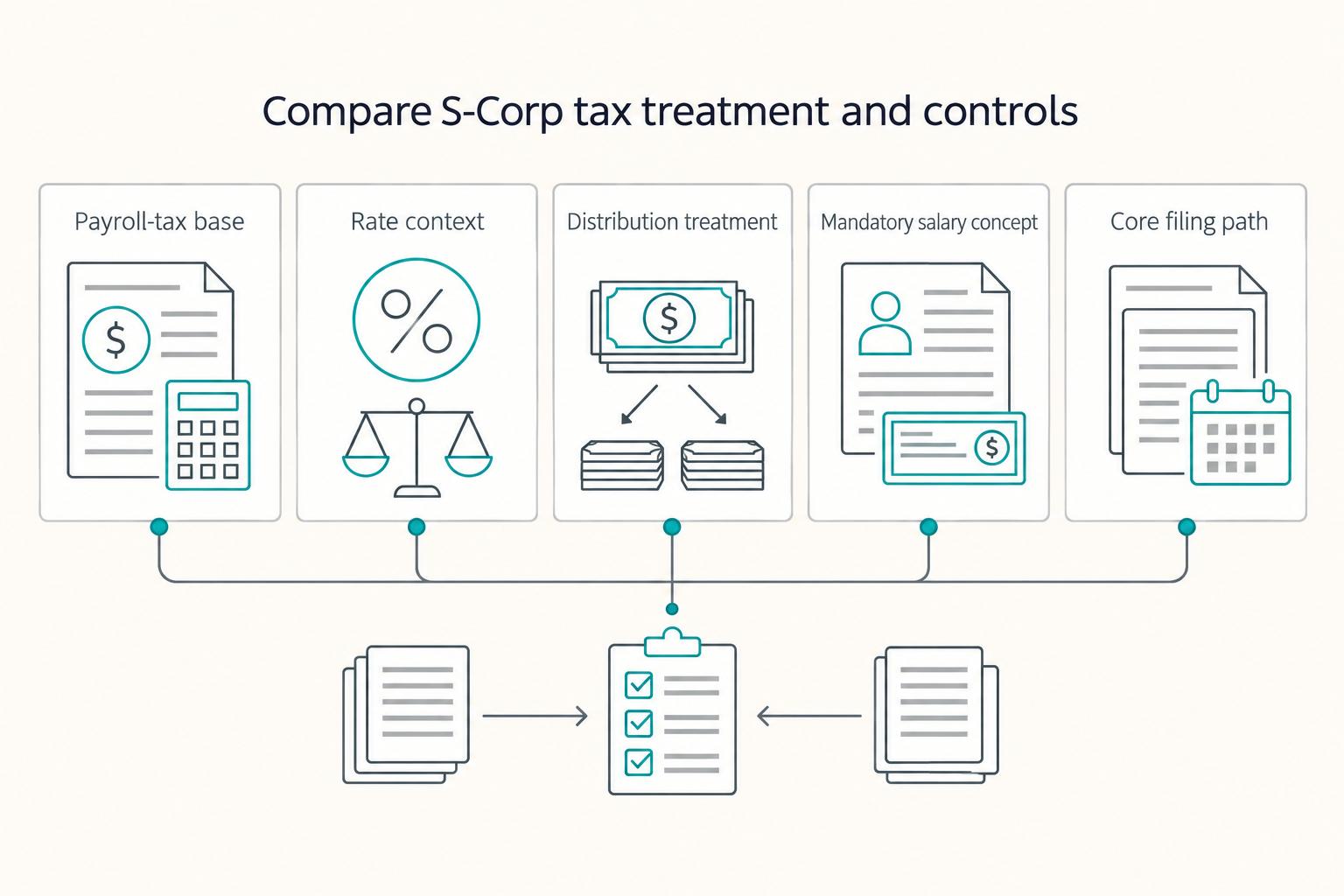
SE Tax: Sole Proprietor vs. S-Corp Structure#
| Factor | Sole Proprietor / Single-Member LLC | S-Corp Owner-Employee |
|---|---|---|
| Payroll-tax base | Net business profit | W-2 salary |
| Rate context | 15.3 percent SE tax framework | 15.3 percent FICA framework on salary |
| Distribution treatment | Not separated from net earnings in same way | Distributions generally not subject to SE tax |
| Mandatory salary concept | No | Yes, reasonable compensation required |
| Core filing path | Schedule SE with Form 1040 | Payroll filings plus Form 1120-S |
Before you elect, do the math in order and include the admin burden. First, calculate your current baseline under Schedule SE. Next, model a defensible salary and projected distributions. Then subtract payroll administration, tax prep, and state-level entity costs. The number left over, not the headline SE tax savings, is the decision metric that matters.
Is an S-Corp Actually Worth It? The Cost-Benefit Gate#
An election is only worth it when annual savings stay higher than annual overhead after realistic assumptions.
Many owners stop at the theoretical payroll-tax reduction and never run a full operating model. That is how an S-corp becomes an attention sink: you add payroll, filings, and bookkeeping complexity to chase a benefit that gets neutralized by recurring costs.
A good decision framework protects margin and operator time. It forces you to quantify what you are adding, not just what you might save.
The Real Cost Stack#
Electing S-corp status adds recurring workstreams. None are exotic. The issue is that you have to run all of them consistently, and they become background load that still costs money and attention.
| Cost area | Included items | Why it matters |
|---|---|---|
| Payroll operations | Recurring deposits, periodic filings, and year-end W-2 and W-3 handling | Becomes a standing system, not an occasional task |
| Incremental tax prep | Form 1120-S and integration into the personal return flow | Adds the corporate return path |
| State-level obligations | Annual reports, franchise tax exposure, minimum fees, and maintenance | Varies by jurisdiction and can narrow or erase expected upside |
| Registered agent and corporate upkeep | Registered agent and corporate upkeep | Belongs in the total because breakeven is only as honest as the costs you include |
Payroll operations become a standing system, not an occasional task. That includes recurring deposits, periodic filings, and year-end W-2 and W-3 handling.
Incremental tax prep is real. You add the corporate return path with Form 1120-S and then integrate that into the personal return flow.
State-level obligations can be the quiet dealbreaker. Annual reports, franchise tax exposure, minimum fees, and maintenance vary by jurisdiction, and they can narrow or erase expected upside even when the federal math looks positive.
Registered agent and corporate upkeep is often manageable on its own, but it still belongs in the total, because your breakeven is only as honest as the costs you include.
The right way to treat this stack is as fixed annual overhead. Once you quantify it, breakeven becomes visible and emotional decision-making drops.
The Cost-Benefit Gate in Practice#
Use this side-by-side view before filing Form 2553. The point is not to make the S-corp look good or bad. The point is to see whether the spread survives the real-world cost stack.
| Factor | Stay Sole Proprietor / LLC | Elect S-Corp |
|---|---|---|
| Payroll-tax base | Net profit | Salary only, with distributions treated separately |
| Potential payroll-tax relief | None beyond current baseline | Possible spread between salary and total profit |
| Payroll administration cost | Minimal or none in this context | Recurring and unavoidable |
| Tax return complexity | Personal return plus current business schedules | Form 1120-S, K-1 flow-through, payroll reporting |
| State compliance burden | Often simpler | Often higher, varies by jurisdiction |
| Operational fit | Early stage or low-margin periods | Profitable phase with discipline to maintain filings |
Decision rule: if projected annual savings do not clearly exceed payroll, tax prep, and state compliance costs, defer election. Revisit when profitability and process maturity improve.
Also run state math explicitly. Federal pass-through treatment does not guarantee state-level pass-through benefit. State franchise taxes or minimum charges can narrow or eliminate expected upside, and you want to see that before you commit to a recurring compliance load.
What Are the S-Corp Eligibility Requirements?#
Before you optimize anything, verify qualification. If you fail eligibility, the tax model is irrelevant.
S-corp status is not a preference. It is a federal tax designation with hard constraints. If you cannot qualify, you cannot elect. If you drift out of eligibility after electing, you can create a mess that is much harder than switching back.
This is why the first gate is ownership reality, not tax theory.
The IRS Eligibility Checklist#
Eligibility is straightforward but unforgiving. Based on the criteria used here, the corporation must satisfy all of the following to elect S status with Form 2553:
| Eligibility item | Rule in this guide | Why it matters |
|---|---|---|
| Domestic entity | Formed in the United States | Required to elect S status with Form 2553 |
| Allowable shareholders | Individuals, certain trusts, and estates | Eligibility is limited to these shareholder types |
| Prohibited shareholders | Non-resident aliens, partnerships, and corporations | One ineligible shareholder can block the election |
| Shareholder count | No more than 100 | Part of the eligibility criteria |
| Stock class | One class of stock | Preferential distribution or liquidation rights can create a second class of stock problem |
| Entity exclusions | Certain financial institutions, insurance companies, and domestic international sales corporations do not qualify | These entities cannot elect |
| Form 2553 execution | All shareholders must sign Form 2553 | This is an execution requirement |
- Domestic entity: formed in the United States.
- Allowable shareholder types: individuals, certain trusts, and estates.
- Prohibited shareholder types: non-resident aliens, partnerships, and corporations.
- Shareholder count cap: no more than 100.
- Stock class rule: one class of stock, meaning no second economic class created by preferential distribution or liquidation rights.
- Entity exclusions: certain financial institutions, insurance companies, and domestic international sales corporations do not qualify.
- Execution requirement: all shareholders must sign Form 2553.
The operator takeaway is simple: one ineligible shareholder can block the election, and one poorly structured equity arrangement can create a second-class-of-stock problem. Many agencies are not blocked by current ownership. They are blocked by what they plan to do next: advisor equity, partner changes, international ownership, or different economic rights. Run the checklist against your next two years, not just today.
S-Corp vs. C-Corp: Ownership Structure Compared#
| Eligibility Dimension | S Corporation | C Corporation |
|---|---|---|
| US domestic formation requirement in this context | Required for election | Standard state-law formation path |
| Non-resident alien shareholder | Not allowed for S election | Allowed |
| Corporate or partnership shareholder | Not allowed for S election | Allowed |
| Shareholder count cap | 100 | No S-style cap |
| Multiple classes of stock | Not allowed | Allowed |
| Pass-through profit treatment | Available with valid election | Not pass-through in same way |
| Dividend double-tax exposure | Not inherent to pass-through | Can apply when distributing dividends |
| Form 2553 requirement | Yes | No |
A clean way to use this table is to run ownership scenarios, not just current facts. If your next phase likely includes foreign equity, advisor arrangements with different rights, or institutional capital, forcing an S-corp now can create avoidable rework later.
Can a C-Corp Avoid Double Taxation? (And When Does That Matter for an Agency?)#
A C-corp does not eliminate double taxation, but your compensation and distribution behavior determines how much it matters in practice.
The structural issue is clear. Corporate profit is taxed at the entity level. If you distribute dividends, shareholders can owe a second layer of tax on those dividends. The operational question for agencies is usually: "Are we going to distribute profits regularly, or retain earnings for operating needs?"
For many owner-operated agencies, this becomes a cash-flow policy question more than a textbook question. How you pay yourself, how often you pull cash out, and whether you retain earnings to fund operations influences whether the dividend layer is a real recurring cost or a less frequent event.
How Owner-Operators Reduce the Double Tax Burden#
In an owner-operator context, there are a few straightforward levers that change outcomes, and each one is still a documentation-and-execution problem, not a loophole.
- Owner salary as deductible expense. Paying market-rate compensation can reduce corporate taxable income because salary is generally deductible to the corporation.
- Retaining earnings for reinvestment. Undistributed earnings defer the dividend layer because no dividend is paid at that point.
- Early exit-path planning where relevant. If IRC Section 1202 QSBS treatment is part of the long-range strategy, structure and timing decisions belong in early advisor planning, not late cleanup.
The key discipline is to align your behavior with the structure you choose. A C-corp can be workable for an agency, but if your plan is frequent profit extraction, you need to model the second-layer impact rather than assume it will be trivial.
C-Corp vs. S-Corp: Double Taxation and When It Actually Bites#
| Scenario | S-Corp Outcome | C-Corp Outcome |
|---|---|---|
| Entity-level tax on operating profit | Generally no federal entity-level income tax on passed-through profit | Yes |
| Personal tax on distributed dividends | Not the same two-layer pattern | Yes, potential second layer |
| Owner salary impact at entity level | Different pass-through dynamics | Salary can reduce taxable corporate income |
| Retained earnings and personal tax timing | Not centered on dividend layer | Retention can defer dividend-level tax |
| Exit framing via IRC Section 1202 | Not applicable in same way | Potentially relevant for qualifying situations |
| Fit for foreign ownership and institutional equity | Constrained | Strong fit |
This matters most when your ownership structure already points to a C-corp, when outside capital is likely, or when long-term planning requires C-corp-specific flexibility. If those constraints are absent and pass-through treatment is viable, the S-corp route often remains the first one to test.
Is an S-Corp or C-Corp Better for a Globally Mobile Agency Owner?#
If you are globally mobile, the entity label is rarely the hard part. The hard part is staying compliant across jurisdictions.
Federal entity choice still matters, but state nexus and cross-border Social Security coordination can dominate the real workload. If you operate across states or spend meaningful time abroad, treat structure selection and jurisdiction mapping as one integrated decision. Otherwise, you end up with a clean entity choice and a messy compliance reality.
State Nexus: Where Your Entity Is Registered Is Not Where You Owe Tax#
Registering in one state does not confine your obligations to that state. State nexus is based on business connection and activity, including where work is performed and where personnel operate.
This creates a predictable operator problem. Owners assume formation state equals tax footprint, then discover additional filing and tax exposure in other states where business activity occurred. That surprise is not bad luck. It is the result of skipping the mapping step.
Entity type does not remove nexus. It changes how the income shows up once nexus exists:
- With an S-corp, pass-through income can increase owner-level state filing exposure.
- With a C-corp, entity-level taxation changes where tax sits first, but filing obligations across nexus states can still be significant.
If your operating model includes travel, distributed team members, or clients tied to multiple states, run a nexus review before you lock in an entity strategy. You are not looking for perfection. You are looking for a realistic footprint that you can maintain without constant surprises.
International Operations: Totalization Agreements and Social Security Coverage#
Cross-border operations add another layer that many owner-operators address only after a notice arrives. Handle it upfront and treat documentation as part of your normal operating controls.
Totalization Agreements are bilateral Social Security agreements between the United States and certain countries. Their purpose is to avoid dual Social Security taxation by assigning coverage to one country. The example referenced here is the US-Canada agreement in effect since August 1, 1984.
For self-employed individuals in that framework, coverage is tied to country of residence. Residence in the United States points to US coverage. Residence in Canada points to Canadian or Quebec coverage under the agreement described here.
Execution matters. A Certificate of Coverage from the Social Security Administration supports exemption claims. The operating details referenced here are practical: the request is made through SSA online services, and processing follow-up can require up to 90 business days.
To keep this from turning into a scramble, use a simple operating checklist:
- Confirm which agreement applies to your countries involved.
- Confirm coverage assignment under that agreement.
- Request Certificate of Coverage early.
- Attach the certificate copy to the US return each year when required in your fact pattern.
- Keep payroll and entity documentation aligned with the treatment you claim.
| Factor | S-Corp | C-Corp | Practical Takeaway |
|---|---|---|---|
| State nexus impact | Can increase owner-level filing exposure through pass-through | Entity-level filings remain central | Neither structure eliminates nexus |
| Social Security coordination under agreements | Payroll wage record can be central for owner-employee setup | Different compensation profile, same agreement logic | Coverage follows agreement rules, not brand of entity |
| Certificate of Coverage process | Available | Available | Documentation is required either way |
| Foreign shareholder compatibility | Not eligible under S rules | Eligible | Hard ownership gate for globally oriented cap tables |
| Multi-state compliance pattern | Personal and entity filings can stack | Corporate and personal layers may split differently | Complexity shifts, it does not disappear |
For globally mobile agencies, there is rarely a universal winner. The practical winner is the structure that fits your ownership constraints and can be documented across state and cross-border systems without constant exception handling.
Your S-Corp vs. C-Corp Decision Checklist#
Run this checklist in order and stop when you hit a hard constraint. Speed comes from sequencing, not from skipping gates.
This is designed to get you to a decision you can act on. Each step reduces uncertainty and tells you what to do next. If you find yourself trying to argue with a gate, that is usually a sign you are about to pick a structure you cannot defend later.
Step-by-Step Decision Framework#
Step 1: Do you expect venture capital or foreign investors?
- Yes: Route to C-corp. S-corp eligibility conflicts with foreign shareholders, and investor structures often require flexibility that S rules do not allow.
- No: Continue to Step 2.
Step 2: Do you need multiple classes of stock?
- Yes: Route to C-corp. S-corp treatment requires one class of stock.
- No: Continue to Step 3.
Step 3: Does your projected net benefit from S-corp treatment remain positive after full operating costs?
Model this in three parts. Estimate payroll-tax savings from salary versus distribution treatment. Add expected payroll administration and filing costs. Add incremental accounting and state-level costs.
- Positive and durable: Continue to Step 4.
- Unclear or negative: Hold current structure and revisit when profit profile improves.
Step 4: Does your state environment reduce or neutralize federal pass-through benefit?
State law controls formation. Federal law controls election. Some states apply additional taxes or fees that narrow expected gains.
- Yes, meaningful state drag: Recalculate before proceeding.
- No material drag identified: Continue to Step 5.
Step 5: Do you have multi-state operations, international mobility, or foreign-source complexity?
- Yes: Escalate to professional review before filing. Nexus, payroll treatment, and cross-border compliance can alter outcomes.
- No: Continue to Step 6.
Step 6: Can you support reasonable compensation with documentation?
You need a defensible salary position tied to role, market comparables, and actual work performed.
- Yes: Move to filing timeline and execution planning.
- No: Do not elect yet. Build the documentation system first.
A useful discipline is to treat each step as a file in your operating binder. If someone asks why you chose this structure, your answer should not be memory-based. It should be documented, repeatable, and updated when the business changes.
S-Corp vs. C-Corp: Decision Gate Summary#
| Decision Gate | S-Corp Route | C-Corp Route | Constraint Type |
|---|---|---|---|
| Foreign investors or foreign shareholders | Not eligible | Eligible | Hard |
| Multiple stock classes needed | Not eligible | Eligible | Hard |
| Cost-benefit breakeven | Required for practical win | Not based on S payroll spread | Economic |
| State-level drag on pass-through benefit | Can reduce upside materially | Different state tax profile applies | Economic |
| Multi-state or cross-border operations | Can increase owner filing complexity | Different layering of entity and owner filings | Operational |
| Reasonable compensation support | Mandatory | Not in same S-specific form | Compliance |
| Form 2553 filing and acceptance | Required | Not required | Procedural |
After you route, execute cleanly. If the S-corp path wins, file Form 2553 on time, track acknowledgment, and confirm status rather than assuming. If the C-corp path wins and you are transitioning status, sequence final and new return filings correctly so you do not create year-end gaps that require cleanup.
When to Talk to a Pro: Specific Triggers, Not a Generic Disclaimer#
DIY is fine until complexity becomes expensive to fix. These triggers tell you when you are at that line.
You do not need advisory help for every decision. You do need it when the failure mode is costly, hard to reverse, or likely to create multi-year compliance drag. The triggers below are the specific high-risk zones reflected in this framework.
The Non-Negotiable Triggers#
1. You are trying to make a late or retroactive S election. Form 2553 deadlines are strict. Relief can exist in some cases, but it depends on facts and documented cause. If acknowledgment is delayed or unclear, resolve status directly before operating as if election is active.
2. You are converting from C-corp treatment to S-corp treatment. Return sequencing matters. The final C-corp filing on Form 1120 has to be handled before the Form 1120-S cycle applies. Mis-sequencing creates cleanup work and potential exposure.
3. Your compensation-to-distribution mix is aggressive and weakly documented. If salary is low relative to distributions and you cannot support the figure with role and market context, your risk profile rises quickly.
4. You operate across states and have not completed a nexus map. Formation state and tax footprint are not the same. Without nexus analysis, entity selection can produce avoidable multi-state filing obligations.
5. You are evaluating C-corp while expecting regular owner distributions. C-corp economics can be workable in some fact patterns, but distribution policy drives the second-layer impact. You need forward-looking modeling, not assumptions.
6. You received an IRS notice or had an audit recently. Prior scrutiny raises the cost of undocumented structural changes. If that history exists, your documentation and controls need to be tighter, not looser.
This list is not here to force advisory spend. It exists to prevent you from stepping into high-risk scenarios with incomplete planning and then paying for corrections later.
Trigger Comparison: What's at Stake#
| Trigger | Common DIY Failure | Likely Advisor Support |
|---|---|---|
| Late or retroactive Form 2553 attempt | Election timing error or failed relief path | CPA |
| C-to-S sequencing | Filing gap between Form 1120 and Form 1120-S cycle | CPA |
| Weak reasonable compensation support | Reclassification risk and payroll-tax exposure | CPA |
| No nexus analysis with multi-state operations | Surprise filing burden across jurisdictions | CPA with state tax focus |
| C-corp distribution planning without modeling | Underestimated total tax impact | CPA |
| Prior IRS notice or audit history | Elevated scrutiny without documentation controls | CPA and potentially tax attorney |
If none of these triggers apply, disciplined owners can often execute using a checklist and solid recordkeeping. If even one trigger applies, advisor cost is often smaller than correction cost.
The Right Structure Is the One You Can Operate and Defend#
The right entity is not the one with the cleanest spreadsheet. It is the one your business can run correctly every year.
Tax efficiency matters. So do process reliability, payroll execution, filing accuracy, and documentation discipline. If your structure repeatedly creates exceptions, late filings, or unsupported positions, the theoretical upside is not real in practice.
What you want is a structure that matches your ownership constraints, produces a clear operating playbook, and stays defensible as your agency grows.
Who Should Default to S-Corp Election#
An S-corp election is often the first route to evaluate for US-based agency owners when the operating profile is straightforward and profitable. The default holds when three conditions stay true at the same time:
- Sustained profit clears the breakeven gate. Savings remain above payroll, accounting, and state-level overhead.
- Reasonable compensation is documented and maintainable. Salary logic is evidence-based, not arbitrary.
- Ownership structure fits eligibility rules. US-person ownership, one stock class, and no near-term plan that conflicts with S constraints.
When those conditions are true, execute deliberately. File Form 2553 correctly, retain IRS acknowledgment, and run payroll and recordkeeping as standing operations, not ad hoc tasks you scramble through at year-end.
Who Needs Professional Advice Before Filing#
Escalate before filing when complexity is structural, not incidental. International footprint, multi-state operations, evolving ownership plans, or conversion sequencing issues can change the right answer and raise the cost of mistakes.
Common escalation signals include:
- Non-US ownership now or in near-term plans
- Multi-state activity without a completed nexus view
- Conversion from C-corp treatment requiring careful return sequencing
- Equity or ownership terms likely to change in the next few years
- Prior IRS notice or audit context that increases documentation standards
| Decision Factor | S-Corp | C-Corp | Sole Proprietor / LLC |
|---|---|---|---|
| Primary tax posture | Pass-through to owners | Entity-level taxation plus potential dividend layer | Pass-through with broad self-employment tax exposure on net profit |
| Payroll-tax profile for owner | Salary-based payroll tax, distributions treated differently | Owner salary subject to payroll tax | Self-employment tax framework applies to net earnings |
| Ownership constraints | Tight | Flexible | Flexible |
| Institutional investor compatibility | Limited | Strong | Limited |
| Annual admin load | Payroll, Form 1120-S, owner-level integration | Payroll plus Form 1120 and corporate formalities | Simpler filing and admin profile |
| Typical fit | Profitable owner-operated agency with eligible cap table | Investor-oriented or globally flexible ownership strategy | Early-stage simplicity or lower-profit period |
The operating foundation stays the same across all structures: complete records, consistent filings, and decisions you can explain with documents instead of memory.
Re-run this framework as your business changes. Structure is not a one-time identity choice. It is an ongoing operating choice.
Frequently Asked Questions
What is the main tax difference between an S-corp and a C-corp?
A C-corp pays corporate income tax on profits, then shareholders pay personal tax on dividends. That creates two layers of tax on the same dollar. An S-corp is a pass-through entity, so profits flow to owners' personal returns and are taxed once at the individual level.
Does an S-corp pay self-employment tax?
Not on all income. S-corp owner-employees pay FICA on their W-2 salary, not on shareholder distributions. That split is the core savings mechanism, and it's why the IRS requires reasonable compensation.
What are the S-corp eligibility requirements?
To elect S-corp status, the entity must meet several IRS criteria. Shareholder count, shareholder type, and stock class restrictions all apply, and violating these rules after election can terminate S-corp status. Confirm the current requirements with a tax professional before filing, as the details matter.
How do I know if I should elect S-corp status?
Estimate SE/FICA savings on profit above your reasonable salary, then subtract annual payroll administration, incremental accounting, and state-level entity costs. If savings exceed costs - and you can document reasonable compensation - S-corp election is worth pursuing. There's no universal threshold; the decision depends on your margins, your state, and your compliance costs.
What is a reasonable salary for an S-corp owner?
Reasonable compensation is what you would pay an arm's-length employee to do the same work. Benchmark it using comparable salary data for your role and geography, document the analysis, and update it as the business changes. There's no fixed IRS formula, but a salary materially below distributions is a known scrutiny point.
What happens if I don't pay myself a reasonable salary in an S-corp?
The IRS can reclassify distributions as wages and assess back FICA taxes. It can also add penalties and interest. The documentation burden is on you.
Can a C-corp avoid double taxation?
Not fully, but it can reduce exposure. Paying owner-employees a market-rate deductible salary reduces corporate taxable income before the first layer hits, and retaining earnings can defer the second layer. Exit strategies and other mitigation approaches exist, but the requirements are strict and the planning is complex enough to require a tax attorney.
Researched and edited by the Gruv editorial team. Gruv builds cross-border billing, payouts, and finance-operations software for global businesses.
Sources
Educational content only. Not legal, tax, or financial advice.
Related Posts

Sole Proprietorship vs LLC for Global Freelancers in 2026
For most freelancers in 2026, the practical default is still simple: use the simplest structure you can run cleanly, then formalize when risk actually rises. If your work is still in validation mode and the downside is contained, a sole proprietorship is often the practical starting point. When contract exposure, delivery stakes, or dispute risk starts climbing, forming an LLC deserves earlier attention.
How to Choose the Right Business Structure for Your Freelance Business
Most freelancers end up in a business structure by default rather than by design, but that accidental choice shapes taxes, personal liability, and payment operations in ways that compound over time. This guide walks independent professionals through four entity types — Sole Proprietorship, Single-Member LLC, S-Corp election, and Corporation — covering the tax treatment, liability exposure, and operational overhead of each. Rather than prescribing a single best answer, it provides a trigger-based framework: start with the structure that fits today, then upgrade when specific signals — indemnification clauses, enterprise KYB requirements, a first hire, or material net profit — make the switch worthwhile. The result is a deliberate, revisable foundation that keeps records clean, reduces onboarding friction, and avoids the expensive mismatches that come from letting structure lag behind business growth.

The Freelance Payment Penalty: A Modeled Audit of Platform Fees, FX Spreads, and Payout Delays
The money rarely disappears through a single, easy-to-spot fee. The real loss is stacked. A marketplace takes its commission, a processor adds a charge for international cards, a bank or payment company converts the currency at a spread, a platform holds the funds before release, and a wire sheds a little to intermediaries on the way in. Each layer looks defensible on its own, but the worker feels the combined result as a smaller deposit and a later payday.