
Quick Answer
You may avoid U.S. tax residency under the closer connection exception if you are in the United States for less than 183 days in the current year, keep a foreign tax home for the entire year, show stronger ties to one foreign country than to the U.S., and timely file Form 8840. The article also stresses keeping clear travel and tie records and resolving any mixed facts early.
The Closer Connection Exception: Your Framework for Avoiding US Tax Residency#
If your U.S. travel is increasing, the real risk is not your intent. It is drifting into the wrong filing posture because you waited too long to make a clear decision. Use this section as a practical framework to decide early, document your position, and avoid a last-minute scramble.
Step 1. Define the moving parts before you decide#
Use these as decision labels first, then verify the federal rules before you act: Substantial Presence Test, Closer Connection Exception, tax home, and Form 8840. This section does not supply the federal definitions, thresholds, or filing mechanics for those items, so do not fill in the gaps from memory. If your facts are mixed, treat that as an early signal to escalate to a qualified advisor.
| Decision path | If you do not support an exception claim | If your facts support the claim |
|---|---|---|
| Filing posture | Assume federal residency exposure may apply | Evaluate whether a nonresident posture is supportable under the applicable federal rules |
| Compliance burden | Less upfront sorting, with potential downstream filing impact | More upfront fact-checking and support gathering |
| Documentation expectation | Basic records may be weak if questioned | Keep a clear evidence file supporting the position you plan to take |
Step 2. Check exposure, then test whether your position is defensible#
For a business of one, a practical habit is simple: keep a current travel log, do not estimate day counts, and do not file from memory. First confirm whether your travel facts put this route in play. Then ask a harder question: are your facts strong enough to defend, not just explain informally?
Step 3. Cross-check state risk before you get comfortable#
Do not let a clean federal story make you too comfortable. You may still have state residency exposure. California is a clear example. It can treat you as a resident if you are in California for other than a temporary or transitory purpose, or if you are domiciled there and away only temporarily. California residents are taxed on all income regardless of source.
Before you finalize your filing posture, match filing status, age, and dependents to the published California tax-year tables. If income is above the applicable table amount, a return is required. If your facts point in two directions, escalate early. The next section starts with the first federal gate.
The Substantial Presence Test: A Hidden Trap for Global Professionals#
Treat the Substantial Presence Test as an early gate, not a side issue. Before you choose any path, confirm whether your U.S. presence could create tax exposure and verify the legal mechanics with current authority.
Step 1. Define the gate before you trust your instincts#
Use these only as working definitions, then verify legal details with current authority:
- Substantial Presence Test: a test connected to whether you may owe U.S. taxes.
- Calculator: a tool format that can help you screen risk, but not replace legal authority.
- Verified method: the exact rules and assumptions you document and date-stamp before relying on the result.
Do not run this from memory. Start with a worksheet and leave placeholders until verified:
- Current thresholds and formulas pending official IRS/source/adviser verification.
- Current exclusions or exception criteria pending official IRS/source/adviser verification.
Step 2. Calculate risk with a documented check, not intuition#
A quick gut check is not enough on its own. Use a simple risk screen first, then confirm the actual legal calculation with current authority.
| Initial signal | Record quality | Risk signal | Action |
|---|---|---|---|
| Light | Complete | May be lower risk, but unconfirmed | Run the full check and save it |
| Mixed | Incomplete | Uncertainty can change the result | Rebuild records before concluding |
| Any | Conflicting | Elevated review risk | Escalate for specialist review |
| Any | Undocumented method | Process risk even with a plausible result | Date-stamp your method and retain output |
This table is triage, not legal math. Its job is to interrupt false confidence and force a verified check.
Step 3. Classify unclear records before finalizing totals#
The common failure mode is not obvious travel, but unclear records. Review each trip and label every day as confirmed, needs review, or unresolved until verified.
- Missing arrival or departure details
- Last-minute itinerary changes
- Delays or diversions that changed physical presence
- Frequent short entries with thin documentation
- Conflicting records across passports, airlines, and calendars
Practical rule: if a day is unclear, do not force it into your final count. Track it separately and resolve it before filing.
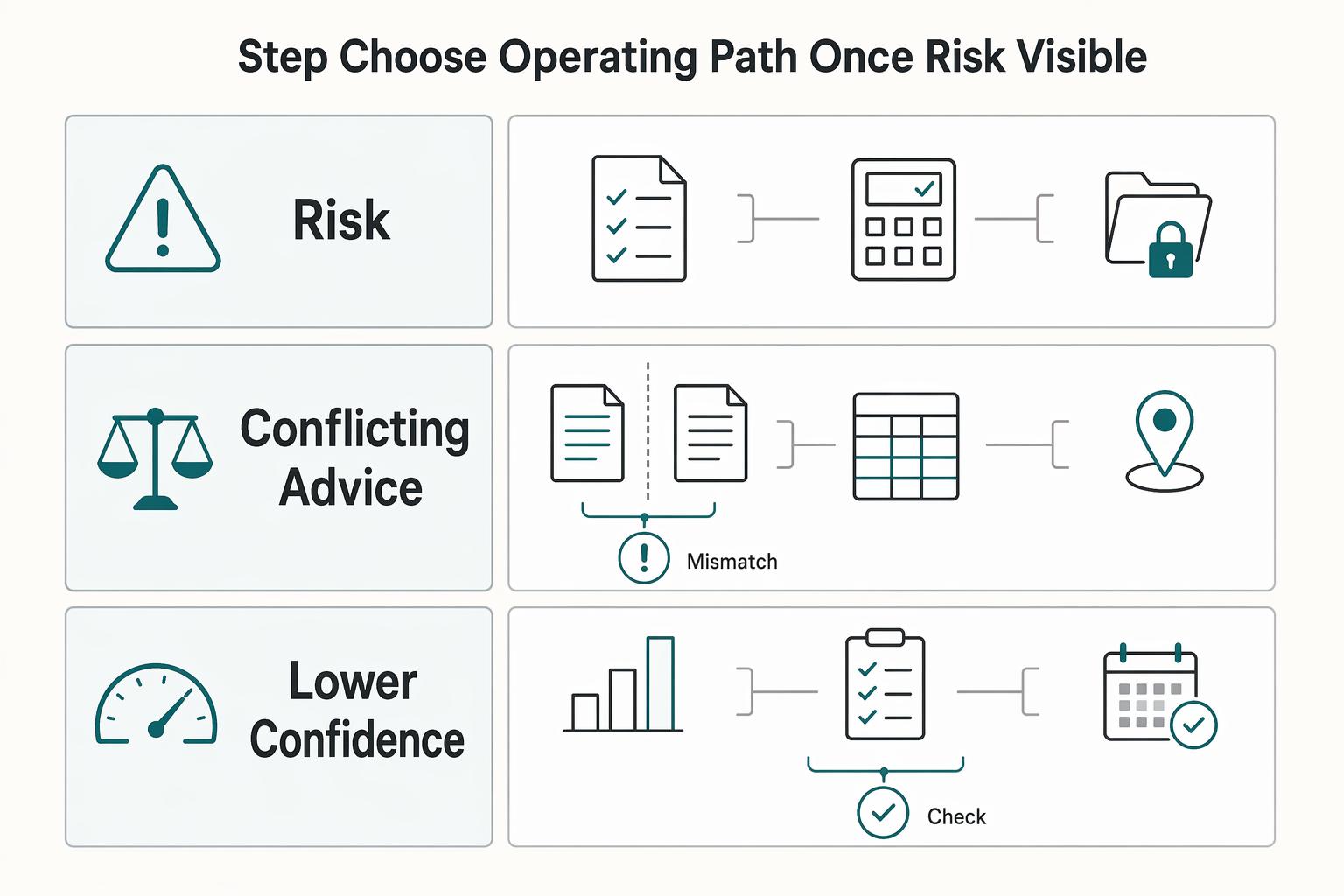
Step 4. Choose your operating path once risk is visible#
Once your preliminary check shows risk or uncertainty, pick a path while the facts are still fresh.
| If you defer review | If you escalate early |
|---|---|
| More late-stage reconstruction risk | More upfront work, more control while facts are fresh |
| Harder to explain conflicting records later | Earlier clarification of uncertain items |
| Lower confidence in your final position | Better documented decision trail |
Use tools as cross-checks, not legal authority. A public page labeled "Substantial Presence Test Calculator" and marked "Last Updated: July 22, 2025" is a good reminder to date-stamp your method and save your output. If risk or uncertainty remains, speak with a tax specialist now.
The Three Non-Negotiable Rules of the Closer Connection Exception#
These are hard-stop tests. If any one of them fails, this exception is generally unavailable.
| Rule | Requirement | If it fails |
|---|---|---|
| Stay under the current-year day cap | Be in the United States for less than 183 days in the current year | If you are in the United States for 183 days or more in the current year, this exception is not available |
| Keep your tax home in the same foreign country all year | Maintain a foreign tax home for the entire current year; the two-country route is limited to two foreign countries (not more than two) | If you did not maintain a foreign tax home for the entire current year, stop |
| Show stronger ties to the foreign country than to the U.S. | Your facts must show more significant contacts with the foreign country than with the United States | If your facts do not show more significant contacts with the foreign country than with the United States, stop |
Rule 1. Stay under the current-year day cap#
If you are in the United States for 183 days or more in the current year, stop. This exception is not available.
Keep this gate separate from your full SPT analysis. SPT still uses its own tests, including 31 days in the current year and a 183-day weighted 3-year total with prior-year weighting. This rule is narrower. It is current-year days only.
Use a strict tracking protocol:
- Log every U.S. entry and exit as it happens.
- Count any day with any U.S. presence unless a listed exclusion applies.
- Mark each day as
counted,excluded, orneeds review. - Reconcile regularly against your travel records and Form 8840 day fields for the 3-year lookback.
Rule 2. Keep your tax home in the same foreign country all year#
If you did not maintain a foreign tax home for the entire current year, stop.
For this exception, tax home generally follows your regular or principal place of business. If you have more than one regular place of business, the question is which one is principal. If you do not have a fixed principal place of business, the fallback is your regular place of abode in a real and substantial sense.
Your position is stronger when your records show continuity in one foreign country across the full year. If your base changes midyear or you cannot show a continuous foreign tax home, eligibility is at risk. A two-country route exists, but only for two foreign countries (not more than two).
Rule 3. Show stronger ties to the foreign country than to the U.S.#
If your facts do not show more significant contacts with the foreign country than with the United States, stop.
Use a structured self-check rather than a numeric score:
- Home and belongings: where your permanent home and personal belongings are.
- Family or household ties: where your family is based.
- Legal and administrative ties: where you hold a driver's license, where you vote, and whether your official forms align with your claimed status, including forms such as Form W-9.
- Social and professional pattern: where your routine affiliations and business activities are centered.
This is a facts-and-circumstances test. The question is whether your full record tells one coherent foreign-country story.
Quick disqualifier check before filing#
- You were present in the U.S. for 183 days or more in the current year.
- You did not maintain a foreign tax home for the entire year.
- Your tax home is not in the same foreign country you rely on for closer connection.
- You took steps toward lawful permanent resident status or had a green card application pending.
- You do not timely file Form 8840, with only limited late relief if you can show clear and convincing evidence of reasonable actions.
Escalate to a cross-border tax professional if your day count is disputed, your tax home changed during the year, your ties are split between countries, or immigration facts suggest permanent-residency intent. Related: 183-Day Rule Explained: Stop the Tax Myths Before They Cost You.
Building Your 'Compliance Dossier': How to Prove Your Closer Connection#
Your evidence file should follow Form 8840, not some generic stack of records. Aim to back each material answer on the form with a dated record you can find quickly.
Define the terms before you file#
- Tax home: the place you report as your tax home on Form 8840 for the year, and by date if you are using the two-country path.
- Closer connection: the foreign country you state on Form 8840 as having a closer connection to you than the United States.
- Dated records (working label): records created at or near the time events happened, not only a year-end rebuild.
Build the file around Form 8840 fields#
Start with the form layout and build folders to match it. That keeps your records usable at filing time and later if questions come up:
| Form 8840 area | What to include | Related note |
|---|---|---|
| U.S. day counts | 2025, 2024, 2023 | Reconcile your travel log to the form's day-count fields |
| Tax home | Tax home | Cross-check that entries tell one coherent country story |
| Regular or principal permanent home | Regular or principal permanent home | Cross-check that entries tell one coherent country story |
| Family location | Family location | Cross-check that entries tell one coherent country story |
| Routine personal banking location | Routine personal banking location | Cross-check that entries tell one coherent country story |
| Two-country section | Explanation or verification attachments, if needed | Do not leave the details for the end |
If you are filing this claim with a nonresident return, keep the file in the same order you would use when attaching Form 8840 to Form 1040-NR.
Use an evidence hierarchy with primary ties first#
A flat pile of documents is not enough. You want the strongest records at the center of the file and everything else reinforcing the same story. Primary ties and supporting ties are practical labels for organizing proof, not IRS terms.
- Primary ties: records that carry the core story of where your life was based, such as home base, family footprint, and routine personal banking activity.
- Supporting ties: additional records that align with the same country pattern and help explain the same answers.
Supporting ties help most when they confirm the same narrative; they are less useful when core facts conflict.
Run a proof-strength check before filing#
| Record area | Strong pattern | Weak pattern |
|---|---|---|
| Home base | Ongoing records across the year showing the same foreign location | One-off or late records that do not show continuity |
| Family footprint | Dated records that align with the same country pattern | Undated or inconsistent location trail |
| Routine personal banking | Recurring activity over time in the claimed foreign-country banking location | Minimal, dormant, or late-opened activity |
| Two-country explanations / verification | Required explanation or verification is prepared and matches the form answers | Missing or inconsistent explanation/verification where the form asks for it |
Handle two-country items explicitly#
If you are using the two-country section, do not leave the details for the end. Pre-check these items before submission:
- Where your tax home was on January 1, 2025
- Where the form requires verification for certain "Yes" answers
- Where the form requires an explanation for certain "No" answers, including a "No" closer-connection answer in that section
Keep record hygiene tight through the full file#
Good records do not just exist. They have to stay consistent across the whole file:
- Use consistent file names, such as date + document type + country or location.
- Keep stable final copies and a simple index mapping each file to a Form 8840 line.
- Reconcile your travel log to the form's day-count fields for 2025, 2024, 2023.
- Cross-check that tax home, home, family, and banking entries tell one coherent country story.
- Flag conflicts early and prepare an explanation where needed.
- Escalate to a qualified cross-border advisor if records conflict across countries or two-country attachments are unclear.
Before filing, organize your travel timeline and tie evidence in one place with the Tax Residency Tracker.
Red Flags That Can Weaken Your Claim#
A claim usually weakens when your records stop telling one consistent foreign-country story on Form 8840. For this exception, closer connection means more significant contacts with a foreign country than with the United States. Tax home means a foreign tax home for the entire year.
Step 1. Remove or downgrade contradictory ties#
A U.S. tie does not automatically disqualify you. The problem is when a U.S. tie looks primary while your form says your home base and routine banking were centered abroad. Review these points before you file Form 8840:
- Identity records
What triggers concern: your residence or primary address is listed as U.S. on key forms and account records. The IRS includes the country of residence you designate on forms and documents in its contacts analysis. What to do instead: align core records to the foreign country you are claiming and keep confirmation records. If you keep a U.S. mailing address, make sure it is clearly secondary.
- Financial center
What triggers concern: your routine personal banking activity is mostly in U.S. accounts even though you claim foreign-country ties. What to do instead: make sure routine personal banking actually occurs in the country you claim, then keep statements that show that pattern.
- Civic and official filings
What triggers concern: official filings or declarations identify the U.S. as your residence without a consistent explanation. What to do instead: keep country designations consistent. In the two-country path, prepare required verification for certain "Yes" answers and required explanations for certain "No" answers.
- Mailing and address footprint
What triggers concern: contracts and statements repeatedly use U.S. addresses while you claim your regular or principal permanent home was abroad. What to do instead: use your foreign address as the default footprint and document why any U.S. mailing address remains.
Step 2. Control travel-pattern risk before it controls you#
As your U.S. day count gets closer to the limit, consistency across your records matters more. You must be in the United States less than 183 days during the year to use this exception. Treat this as an internal planning tool, not an IRS rating scale:
| U.S. days in the year | Internal review band | What triggers concern | What to do now |
|---|---|---|---|
| Comfortably below your internal cap | Standard review | Conflicting address or banking records despite lower day-count pressure | Clean up conflicts and preserve evidence of changes |
| Approaching your internal cap | Elevated review | Your position relies on explanations instead of clear records | Reconcile travel log, addresses, and banking trail before drafting |
| Close to the less-than-183-days ceiling | Highest review | Any mismatch across day counts, home location, and banking location | Build a stronger evidence pack and pre-draft explanations |
Also reconcile U.S. day counts for 2025, 2024, 2023, because Form 8840 Part I asks for all three years.
Step 3. Complete Form 8840 to an execution standard#
Form 8840 should be specific, complete, and internally consistent. If you claim a foreign tax home for the entire year, your answers about your regular or principal permanent home in 2025, routine personal banking location, and country designations should all point the same way.
Common failure patterns include day counts for 2025, 2024, 2023 that do not reconcile, vague or incomplete answers where detail is needed, a two-country section missing required verification or explanations, and country designations that conflict across forms and records.
Escalate to a qualified tax professional if:
- you are close to the 183-day ceiling and records are mixed
- your tax-home facts require the two-country route
- you are unsure what to attach for required verification or explanations
- you have taken steps toward lawful permanent resident status, or have an application pending, which blocks this exception
Executing with Precision: Filing Form 8840#
The filing rule is simple, but mistakes usually happen in execution. If you file a U.S. federal income tax return, attach Form 8840 to that return. If no U.S. return is required, file Form 8840 as a standalone form. Common errors include choosing the wrong path, filing late, or submitting answers that do not match the record.
Step 1. Choose the filing path with clear definitions#
US-source income: for nonresident tax purposes, this is income from sources within the United States, and nonresidents are taxed on that U.S.-source income and certain U.S. trade or business connected income. Decision criterion: if your facts may trigger a Form 1040-NR filing requirement, resolve that first, because Form 8840 should be attached when you file a U.S. return.
Standalone filing: filing Form 8840 by itself, not with a U.S. tax return. Decision criterion: use this only when no U.S. return is required.
Timely filing: filing by the applicable 1040-NR due date after you verify current-year rules, including extensions where applicable. Decision criterion: if Form 8840 is late, you generally cannot claim the exception. If you want to claim the closer connection exception, filing Form 8840 is required.
Step 2. Verify location and deadline before filing#
Do not assume last year's instructions still apply. Check current IRS pages before you file. The Form 8840 instructions direct you to the latest Form 8840 information, and IRS where-to-file pages can change.
| Filing scenario | Where to file | Deadline |
|---|---|---|
| You are filing Form 1040-NR | Attach Form 8840 to Form 1040-NR | Current deadline pending official IRS/source/adviser verification. |
| No U.S. return is required (standalone filing) | Use the current IRS where-to-file guidance before mailing | Current deadline pending official IRS/source/adviser verification. |
| You are unsure whether Form 1040-NR is required | Stop and resolve return-filing status before choosing attachment vs standalone | Current deadline pending official IRS/source/adviser verification. |
Step 3. Run line-by-line quality control for Parts I-III#
Once the filing path is set, review the form the way an examiner would, line by line, checking whether each answer matches your underlying records.
| Form 8840 part | What to state | What must match | Common scrutiny trigger |
|---|---|---|---|
| Part I | Your U.S. presence days for 2025, 2024, and 2023, plus whether you applied for or took affirmative steps toward lawful permanent resident status | Your travel records and prior filings | Day counts or status answers that conflict with your own records |
| Part II | Your foreign tax home and the foreign country to which you had a closer connection during 2025 | Your compliance records should support one consistent country story | The form points to one country while your broader records point to the United States |
| Part III | Complete answers, with required explanation for certain "No" responses and required verification for certain "Yes" responses, including lines 12 and 13 | Your supporting records, especially official forms filed and location-based ties | Unanswered required explanation or verification, or unresolved contradictions |
Step 4. Stop and get professional review when facts are mixed#
Pause before filing if any of these apply:
- you are unsure whether your income is U.S.-source or whether Form 1040-NR is required
- your Form 8840 answers conflict with your travel records, official forms you filed, or location-based ties (such as licensing or voting jurisdiction)
- you are unsure what to include for required Part III explanations or verification
- you answered yes to affirmative steps toward lawful permanent resident status
- your position depends on a detailed explanation rather than a clean, consistent record trail
For a step-by-step walkthrough, see The 'First Year Election' for US Tax Residency: A Deep Dive.
Conclusion: Keep one coherent record and make Form 8840 reflect it#
The closer connection exception is not just a form exercise. It is an evidence-and-consistency exercise. If your facts support the claim, keep one coherent record all year and make sure Form 8840 reflects that record.
- Confirm the eligibility story before filing: your U.S. day count, foreign tax home, and closer foreign ties should point the same way. Rebuild your U.S. presence from source records and confirm the 2025, 2024, and 2023 day counts match your travel history, because Form 8840 asks for all three years.
- Keep your tax-home narrative aligned: the form asks where your tax home was during 2025 and where your regular or principal permanent home was located. If work, housing, and daily-life records point to different countries, resolve that inconsistency before filing.
- Reconcile contradictory ties: the form also asks about routine personal banking and voting. No single answer decides the outcome, but your answers should fit the same overall story as your tax home, home location, and travel record.
- Execute Form 8840 carefully: it is the IRS mechanism for claiming the closer connection exception, and the form says to attach it to Form 1040-NR. Before submission, verify you are using the current Form 8840 and instructions; the IRS page showed "Recent developments: None at this time" and was last reviewed on 23-Jan-2026.
Keep your records current, align them before filing, and make sure your filing story is consistent. If your facts are mixed, your ties changed midyear, or your filing path is unclear, get cross-border tax advice before you file.
If your residency facts are split across countries or changed mid-year, contact Gruv to confirm the right compliance workflow for your case.
Frequently Asked Questions
How do you prove a closer connection to a foreign country?
You prove a closer connection by showing more significant contacts with one foreign country than with the United States. The article says the core checks are fewer than 183 U.S. days in the current year, a foreign tax home for the full year, and stronger foreign ties shown through records on home, family, belongings, licensing, voting, travel, and housing. If the records point in different directions, get cross-border tax advice before filing.
What matters most for the exception?
Your tax home matters most because it is the anchor of the exception. It generally follows your regular or principal place of business and must be in a foreign country for the entire current year. Your work records, residence records, and timeline should all support the same country.
What are the most common Form 8840 mistakes?
The most common Form 8840 mistakes are late filing, day-count errors, and answers that do not match your records. If you file Form 1040-NR, attach Form 8840; if no U.S. return is required, verify the current applicable 1040-NR due date and extension treatment with official IRS instructions, source materials, or a qualified tax adviser before filing Form 8840 separately. The article also warns that late filing can block the exception unless you can show clear and convincing evidence that you took reasonable actions to become aware of the filing requirements.
Can you still claim it if you spend a lot of time in the U.S.?
Yes, possibly, but only if your current-year U.S. presence stays below 183 days. The closer you get to that limit, the more important clean records become. Your day count, full-year foreign tax home, and stronger foreign ties still all need to hold together.
Do you still need a U.S. tax return?
Sometimes. The article says you must first determine whether you independently have a Form 1040-NR filing requirement. Then you either attach Form 8840 to Form 1040-NR or file Form 8840 separately if no U.S. return is required.
Researched and edited by the Gruv editorial team. Gruv builds cross-border billing, payouts, and finance-operations software for global businesses.
Sources
- das.nebraska.gov/materiel/purchasing/6056/6056%20Z1%20Peerlac...trusted
- ecfr.gov/current/title-26/chapter-I/subchapter-F/part...trusted
- ecfr.gov/current/title-26/chapter-I/subchapter-F/part...trusted
- federalregister.gov/documents/2025/01/08/2024-31486/preventing-a...trusted
- ftb.ca.gov/file/personal/residency-status/index.htmltrusted
- ftb.ca.gov/forms/2023/2023-1031-publication.pdftrusted
- irs.gov/pub/irs-pdf/f8840.pdftrusted
- irs.gov/individuals/international-taxpayers/closer-c...trusted
Educational content only. Not legal, tax, or financial advice.
Related Posts

Digital Nomad Taxes in 2026 With a Defensible Filing Plan
With digital nomad taxes, the first move is not optimization. It is figuring out where you may be taxable, where filings may be required, and what proof supports that position.

183-Day Rule Tax Myths That Trigger Residency Filing Mistakes
If you are a mobile freelancer or consultant, start here: the "183 day rule tax" idea is not a single universal test. It is a shortcut phrase people use for different residency rules that do not ask the same question. If you mix federal and non-federal residency logic, you can create filing risk even when your travel calendar looks clean.
The Bona Fide Residence Test: A Deep Dive for US Expats
If your facts support a full, uninterrupted calendar year abroad, the residence route is often the cleaner way to claim the Foreign Earned Income Exclusion. For calendar-year filers, that means January 1 through December 31. If your year will not support that uninterrupted span, do not try to force it. Plan around the [Physical Presence Test](https://www.irs.gov/individuals/international-taxpayers/foreign-earned-income-exclusion-physical-presence-test) instead: 330 full days abroad within any 12-month period, with a foreign tax home during the period you claim.