
Quick Answer
Start by treating tax equalization for expats as a document test, not a benefit label: confirm the policy version, the hypothetical tax definition, and who owns remittance and reconciliation. Then map U.S. and host-country filing exposure before first payroll, including separate FBAR and Form 8938 review. If your travel plan is close to the FEIE physical presence rule of 330 full days, pause and get cross-border advice before signing.
You are not trying to pay less tax, you are trying to avoid tax surprises#
Tax equalization for expats is a tax-neutral framework, not a tax-cut strategy. Its job is to keep your assignment from leaving you better or worse off on tax than if you had stayed in your home country.
Step 1 define the promise in plain English#
Start with the promise itself. Under tax equalization, you are typically assigned a hypothetical home-country tax amount, or hypotax. The company then covers the actual home-country and host-country taxes triggered by the assignment.
That promise only works when it is written down clearly. Find the formal tax management policy or assignment guidelines, then confirm the version and effective date in writing. If you cannot point to formal wording such as "Long-Term Assignment Guidelines Effective January 1, 2022," treat that as a risk.
Step 2 read this as a document decision, not an HR perk#
The useful question is not whether the policy sounds generous. It is what you are actually agreeing to on payments, filings, and cash flow.
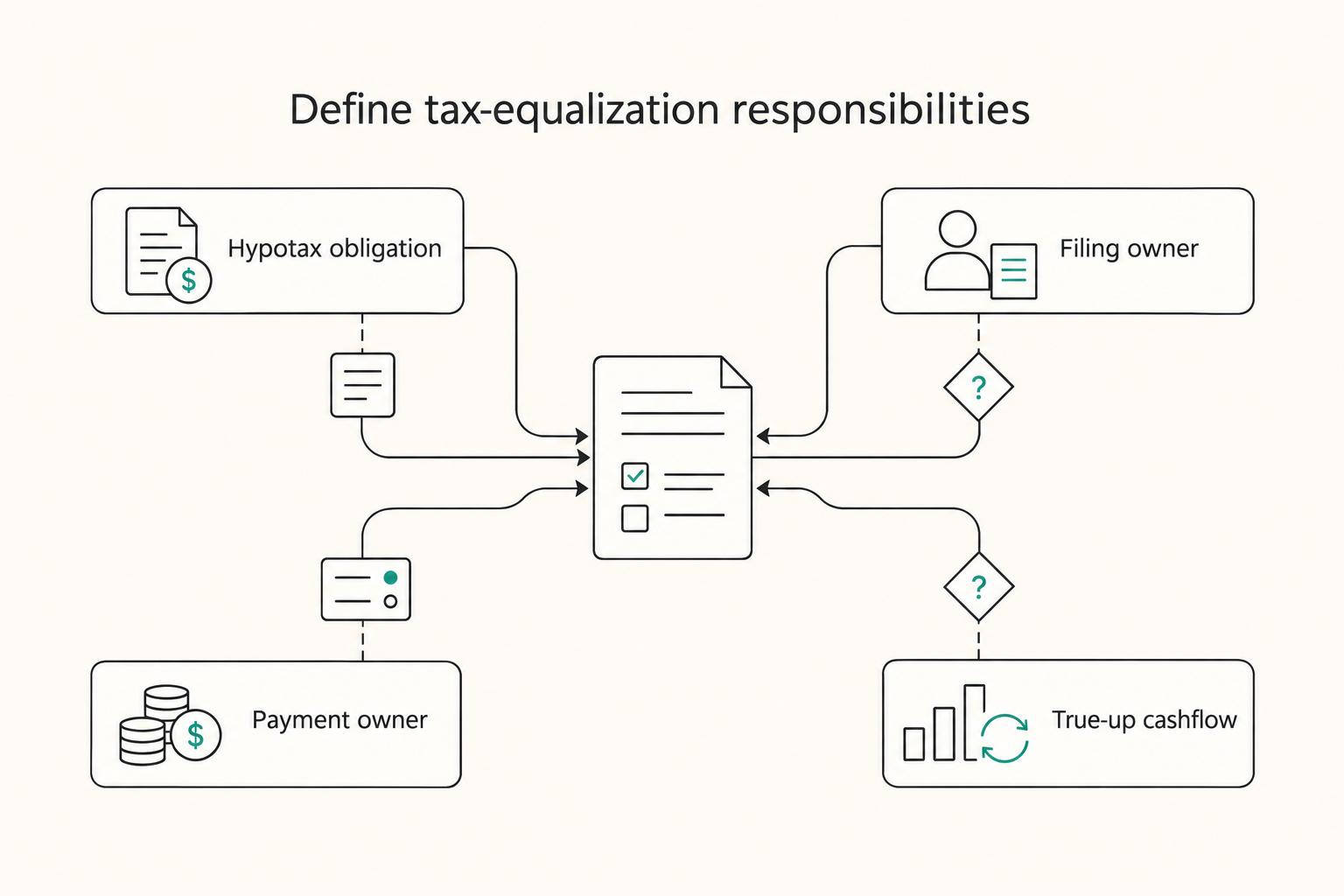
Treat this as an assignment-terms review, not an HR perk explainer. Read the document for operational clarity:
- What is your hypotax obligation?
- Who files and pays in each country?
- How do reimbursements or true-ups affect your cash flow?
If a policy says "tax equalized" but never defines your hypotax contribution, stop there and get that clarified before you rely on it.
Step 3 scope the risk before you travel#
Use this guide before departure and during the assignment to test three things: policy language, filing exposure, and cash-flow impact.
Equalization does not remove filing obligations. Home-country obligations may continue during the assignment, and U.S. citizens and green card holders still have filing obligations even when working abroad. If home-country residency continues while host-country tax also applies, overlapping obligations can still happen.
Also watch for a common failure mode. Tax paid by the company on your behalf may be treated as a taxable benefit. That can create more tax within the same arrangement, which is one reason equalization can become administratively difficult and expensive.
Before you move on, make sure you can answer three questions from the documents alone: Which policy version applies? What is your hypotax? Who owns filing and payment steps in each country? If you want a deeper dive, read our guide to a defensible 2026 filing plan.
What tax equalization actually covers and what it does not#
Tax equalization is meant to keep your tax outcome close to home-country tax. It does not eliminate filing work, payroll complexity, or admin risk.
Step 1 separate labels before you rely on them#
Do not rely on policy labels alone. Treat the label as secondary and verify the mechanics in writing: how the calculation works, what is withheld from your pay, and who pays actual taxes. If those points are missing, the policy is still too vague to rely on.
Step 2 trace the core money flow#
The fastest way to understand the arrangement is to follow the money. The core equalization flow is usually:
- Estimate your home-country tax and withhold that Hypothetical tax from your paycheck.
- Compare home-country tax with actual Host-country tax under the assignment.
- Settle the difference under the policy terms, including possible upward or downward adjustments.
This can stabilize your outcome, but it does not mean you keep every tax advantage from a lower-tax location. In some arrangements, the company keeps those savings.
Step 3 keep filing reality in view#
Even when equalization works as intended, the filing work does not disappear. Cross-border tax calculations can still be complex.
If you are a United States taxpayer, use this as a basic rule: equalization does not automatically remove parallel filing responsibilities. You may still need to file U.S. taxes even when no U.S. tax is owed. You might also find this useful: A Guide to Hypo-Tax (Hypothetical Tax).
What to gather before you evaluate any policy#
Do not evaluate a policy from its label. Build the file first, then review the policy against facts that can actually be filed and verified.
| File part | What to collect | Why it matters |
|---|---|---|
| Assignment packet | Assignment letter, compensation schedule, annexes, payroll attachments | Lets you reconcile written terms against what you were told verbally |
| U.S. tax baseline | Latest return; FEIE and possible FTC assumptions | FEIE does not apply automatically and day-count assumptions can change the answer |
| Mobility facts | Assignment start and end dates, split periods by jurisdiction, country plan | Small date changes can flip the tax result |
| Evidence folder | Returns, payroll records, travel logs, foreign tax documents | Supports later calculation and filing review |
Step 1 collect the full assignment packet#
Start with the full assignment packet, not the slide-deck version. Get the assignment letter, compensation schedule, and all annexes for your expat package, including any payroll attachments.
Then reconcile that packet against what you were told verbally. If any pay item is missing in writing, stop and get that page before you evaluate the policy.
Step 2 pull your baseline U.S. tax file#
Start with your latest return, then gather the assumptions behind any expected Foreign Earned Income Exclusion and possible Foreign Tax Credit.
Do not assume FEIE applies automatically. The physical presence test is based on time abroad, with a threshold of 330 full days in a 12 month period. A full day runs midnight to midnight, so day-level travel logs matter. Missing the 330-day minimum fails the test even when the interruption was for vacation, illness, family issues, or employer-directed travel.
Step 3 list the mobility facts that can change the answer#
Small date changes can flip the tax result, so write the facts down early. Record assignment start and end dates, split periods by jurisdiction, and your country plan. If day-count assumptions are unclear, flag them for review instead of guessing.
If you may rely on the bona fide residence test, confirm whether your foreign residence includes an entire tax year. For calendar-year taxpayers, that is January 1 through December 31. Living abroad for one year alone does not automatically establish bona fide residence.
Step 4 organize evidence before policy math is debated#
Set up one folder for returns, payroll records, travel logs, and foreign tax documents before anyone starts debating the calculation. If you may claim the Foreign Tax Credit, separate records by income category early because Form 1116 is filed separately by category. If FEIE is part of the plan, keep one checkpoint in view: excluded foreign earned income still must be reported on a U.S. tax return. This pairs well with our guide on Malaysia Tax for Expats Who Need a Defensible Filing Path.
Map your tax footprint before signing anything#
Map your exposure on paper before you sign. If you cannot show which reporting regimes may still apply and where each required record will come from, pause the signature process.
Step 1 build a two column country map#
Start with U.S. return/reporting obligations on the left and other-country tax obligations on the right. Mark any period where both may apply as "dual exposure," and map these items by date range:
- income tax return filing
- U.S. reporting regimes to evaluate (Form 8938 and FBAR)
- records you will rely on for each filing
- key periods you need to track
You are not trying to predict the final return at this stage. You are trying to spot overlap early so each assignment month is labeled "U.S. only," "other-country only," or "both may apply."
Step 2 add the U.S. reporting layer separately#
If you may need U.S. reporting, add a separate line for FBAR and Form 8938. Do not assume one form covers both.
For Form 8938, keep these checkpoints explicit:
- Form 8938 is attached to your annual return and filed by that return's due date, including extensions.
- Filing Form 8938 does not remove the need to evaluate whether FinCEN Form 114 (FBAR) is required.
- IRS notes a $50,000 aggregate value trigger in some cases, with higher thresholds for some filers, including some joint filers and some taxpayers residing abroad.
- If you do not have to file an income tax return for the year, you do not file Form 8938 for that year.
Track records now so filing is possible later:
| Item to track | Why it matters | Record source to confirm now |
|---|---|---|
| Maximum account value | Form 8938 asks for maximum values | Monthly statements, year-end statements, bank portal exports |
| Asset acquired or sold during year | Form 8938 asks whether foreign assets were acquired or sold | Transaction history, trade confirms, closing statements |
| Separate FBAR review | Form 8938 does not replace FBAR evaluation | Foreign account list and ownership records |
Step 3 pause if residency is not clear#
If residency or filing status is unclear, get cross-border tax review before signing. For a step-by-step walkthrough, see Child Tax Credit for U.S. Expats: Eligibility, FEIE, and Filing Checks.
Step 1 decode the policy language before you agree to it#
Treat the policy as incomplete until it defines scope and settlement mechanics in writing. A label like "tax equalized" is not enough.
Step 1 find the written definition of hypothetical tax#
Use the policy packet, not verbal summaries. Check the assignment letter, policy attachment, compensation annex, and payroll notes for the exact term Hypothetical tax.
Your aim is simple: confirm what the document says is included in that calculation. If the wording conflicts across documents, flag it before you proceed.
Step 2 map policy wording to your compensation items#
Once the definition is clear, line it up with your actual pay package. Match policy language to your Expat compensation package and any listed allowances or benefits (for example Housing allowance, Cost-of-living adjustment (COLA), or Education benefits). A quick two-column check is enough:
- compensation item in your package
- clause that states whether it is included, excluded, or unclear
If an item has no clear clause, request written clarification.
Step 3 confirm settlement ownership and timing#
Get explicit written answers to these points:
- who remits taxes
- who owns reconciliation
- when reconciliation happens
- whether the policy describes any year-end true-up or repayment obligation
If the employer cannot point to clear policy language, ask for an addendum.
Step 4 apply a strict sign-or-pause rule#
Be strict here. If reconciliation timing is missing or settlement ownership is not named, pause acceptance. Sign only after those points are documented in the same policy version you are agreeing to. Need the full breakdown? Read The Best Tax Havens for Digital Nomads (That Are Actually Legal).
Should you accept tax equalization, request tax protection, or opt out#
Choose the route with the fewest unverified assumptions, not the route with the best label. Be especially careful with self-managed plans that depend on FEIE or FTC execution going exactly right.
Step 1 compare routes using written terms only#
Put all three routes on one page and score what is explicit, not what people imply in meetings. For employer-managed routes, confirm in writing what is covered, what is excluded, and what documentation you will receive. If those points are missing, the label is not decision-ready.
For a self-managed route, the burden is higher. FEIE requires qualification, and you still file a U.S. return reporting the income. FTC has its own filing structure, and the work increases with multiple income categories or multiple taxing countries.
| Route | Downside protection | Upside retention | Admin burden | Payroll complexity | Documentation load |
|---|---|---|---|---|---|
| Tax equalization | Not established; depends on written policy terms. | Not established; depends on written policy terms. | Policy-dependent. | Policy-dependent. | Keep policy terms and year-end records. |
| Tax protection | Not established; depends on written policy terms. | Not established; depends on written policy terms. | Policy-dependent. | Policy-dependent. | Policy-dependent. |
| Self-managed with FEIE and FTC | You carry qualification and filing risk. | Depends on qualification and filing accuracy. | High personal burden. | Not established. | High; day counts, country records, tax-payment support, and Form 1116 details. |
Step 2 pressure-test self-management before opting out#
If you may opt out, test FEIE first. Under the physical presence test, you need 330 full days during any period of 12 consecutive months, and those days do not have to be consecutive. If you miss that day requirement, the test fails regardless of reason.
| Method | Key rule | Records to confirm |
|---|---|---|
| FEIE physical presence test | 330 full days during any period of 12 consecutive months; days do not have to be consecutive | Day counts and travel dates |
| FEIE bona fide residence path | Requires an uninterrupted period that includes an entire tax year; living abroad for one year alone is not automatic qualification | Real travel dates and tax-year boundaries |
| FTC on Form 1116 | Separate forms by income category; separate country lines or columns if taxes were paid to more than one country or U.S. territory | Payments by country and income mapped to the correct categories |
The bona fide residence path also has strict conditions: an uninterrupted period that includes an entire tax year. Living abroad for one year alone is not automatic qualification. This can become a failure point once real travel dates and tax-year boundaries are mapped.
Keep the FEIE cap realistic. For tax year 2026, the maximum is $132,900 per person, and if qualification is only part-year, the maximum must be reduced by qualifying days. Do not model a full-year exclusion when your timeline is partial.
Then test FTC readiness. Form 1116 requires separate forms by income category, and each Form 1116 uses only one category selection. If taxes were paid to more than one country or U.S. territory, use separate country lines/columns on the form. Before opting out, confirm you can document payments by country and map income to the correct categories.
Step 3 run scenario checks on your actual year#
Run the decision against your actual year, not a clean hypothetical. For a short assignment with stable residency facts, self-management can still fail if your dates are likely to miss the 330-day test. It can also fail if they do not include the required uninterrupted period with a full tax year. In that case, a clearly drafted employer-managed route may be easier to defend than a self-managed plan built on optimistic assumptions.
For a multi-country year, the documentation and classification load rises because Form 1116 separates income categories and country-level entries.
Step 4 decide with one rule#
Use one rule: pick the option with the fewest unverified assumptions. If predictability matters more than upside capture, an employer-managed route only works when the policy language is complete and clear.
If you opt out, do it only with a defensible file already in hand: date log, qualification window, country tax-payment trail, and a Form 1116 plan by category and country. If you cannot assemble that now, self-management is probably riskier than it looks. Related reading: Gift Tax for US Expats Without Filing Surprises.
Step 2 verify payroll and cash timing before first payout#
A tax-equalized assignment only works in practice when payroll and cash timing are clear before the first payout. Even with a sound policy choice, unclear timing can create avoidable cash stress.
Step 2.1 confirm the payroll path in writing#
Start with one written map of how payroll will run and where tax-related items are expected to appear in your records.
Your anchor document is the tax equalization policy, plus related payroll documentation. Your burden and any excess tax cost are assessed against that wording, so if payroll and tax teams describe the setup differently, stop and ask for one reconciled written explanation.
A practical checkpoint is a sample pay-period view showing where core pay items, policy-based employee tax burden, and employer-paid tax amounts are expected to be shown or tracked.
Step 2.2 test month-by-month cashflow, not just annual intent#
Do not accept "we will true up later" as the whole answer. Build a month-by-month cash map and ask payroll or mobility to mark where policy-based amounts may change cash position.
International assignments can create significant tax costs, and timing can change cash position before later reconciliation. If net pay may swing for months, treat that as a core decision factor. For clarity, get these points in one email:
- how policy-based employee burden and employer-paid tax amounts will be tracked during the assignment
- how payroll changes and reconciliation steps will be communicated
- who owns follow-up if payroll and policy calculations diverge
Step 2.3 lock exception handling before exceptions happen#
Set exception handling before the first payout. Ask, in writing, how exceptions and corrections are handled.
You do not need a long manual. You need a clear owner and a clear correction path. Since excess tax cost can arise when employer-paid taxes exceed your policy-based burden, weak correction handling can quickly turn into disputes over who absorbs the difference.
Step 2.4 require an audit trail if payments run through tooling#
If payments run through tooling, ask for a record trail you can actually use for reconciliation. You need enough detail to match payment events to payroll reporting and later tax support.
The operating rule is simple: if money movement cannot be matched to reporting, errors take longer to find and fix. Confirm before first payout that records can be retained or exported for later reconciliation. Related: A Guide to Global Mobility and Expat Relocation Packages.
Step 3 build your compliance evidence pack from day one#
The next control is documentation. Build one evidence folder from day one so your tax position is supportable later instead of reconstructed under pressure.
Step 3.1 create one source folder and keep it current#
Keep one source-of-truth folder that captures both policy intent and what actually happened in payroll. Include the assignment letter, the policy version you received, any addenda, payroll statements, proof of tax payments, and jurisdiction workday logs.
Update it as events happen, and name files so they sort by date and country. That makes it much easier to reconcile what was promised against what was withheld or paid if assumptions change mid-assignment. By month one, you should be able to open one folder and confirm:
- which policy version governs the assignment
- what each pay period showed
- what taxes were withheld or paid, and where
- how many days you were physically present in each jurisdiction
Step 3.2 preserve U.S. reporting artifacts while records are easy to get#
If you are a U.S. taxpayer, keep reporting support continuously instead of waiting for year-end. Maintain account statements, tax payment records, and ownership documentation in one place to support your U.S. return and related FEIE/FTC workpapers, where relevant. Do this early because older records can be harder to retrieve, and account details can change during the assignment.
Step 3.3 track FEIE and credit evidence continuously#
If FEIE may apply, start day-count evidence immediately. Under the physical presence test, the threshold is 330 full days in a 12-month period, and a full day is 24 consecutive hours, midnight to midnight.
Treat travel and day logs as core evidence, not optional admin. Missing the physical presence minimum is not excused by illness, vacation, family issues, or employer orders. If you are relying on the bona fide residence path, remember that living abroad for one year does not automatically establish bona fide residence. It is a facts-and-circumstances determination across an entire tax year (January 1 through December 31) for calendar-year taxpayers.
Keep income timing records too. FEIE is tied to when income was earned, not only when paid, and claiming FEIE still requires filing a U.S. return reporting that income. Keep any employer tax instructions or related written communications in the same folder.
For FTC support, organize records by income category and by country from the start. Form 1116 requires one income category per form, and taxes paid to multiple countries or territories require separate country lines or columns.
Step 3.4 prefer records you can export and defend#
Where possible, use systems that preserve timestamps and let you export record history. The point is practical: you can show what record existed, when it changed, and how the final filing position was supported.
Common failure modes and how to recover quickly#
When something breaks, recovery is usually fastest if you treat it as an operations problem, not a theory debate. Clarify the assumption, re-test the residency facts, and reconcile payroll to filing support by pay period.
Your Step 3 evidence pack is the control point. If policy version, pay slips, tax payments, and day logs are organized by date and country, you can isolate the break and ask for a specific correction.
Step 1 request the missing calculation basis in writing#
If the policy says you are "tax equalized" but key calculation terms are undefined, treat that as an active risk and pause sign-off.
Request the calculation basis in writing and the retro correction window if assumptions were wrong. Then tie that basis back to actual pay elements on payroll statements. If you cannot trace that basis to payroll, the result is not ready for approval.
If a revised outcome changes your net pay materially and the policy language is still ambiguous, involve a qualified advisor before signing amended forms.
Step 2 trigger a recalculation when residency assumptions change#
When residency assumptions change mid-year, ask for a recalculation immediately instead of waiting for year-end.
Re-check travel and presence records against home-country and host-country tax filing positions, then compare those facts to payroll treatment. A changed residency view can affect both withholding and filing positions, so do not treat it as a one-side update.
For U.S. taxpayers, use IRS Publication 54 as a timing checkpoint, especially its "Filing Information" and "Filing and Payment Due Dates" sections. Publication 54 also includes an automatic 2-month extension, which can buy time to file accurately when facts are still being resolved.
Step 3 reconcile payroll against filings pay period by pay period#
If assumptions were wrong, reconcile pay period by pay period first. Compare each cycle for:
- gross compensation on payroll
- withholding taken, if any
- tax withheld or paid by jurisdiction
- what filing support says should have happened
The checkpoint is simple: every pay period should reconcile without gaps. If annual totals look plausible but monthly records do not bridge cleanly, isolate the mismatch and correct it promptly.
Step 4 escalate early when ambiguity affects cash or signed filings#
Escalate when ambiguity affects your cash outcome or signed compliance documents. Escalation triggers include:
- your take-home changes materially after a "clarification"
- payroll asks you to sign amended forms before showing calculation basis
- residency facts changed but filing positions were not re-tested
- filing deadlines are close and payroll, tax, and policy records still conflict
At that point, informal explanations are not enough. Escalate while records are still fixable and before support issues spread further.
Copy and paste checklist before assignment start#
Use this before assignment start. If any item lacks a document, owner, or dated assumption, pause and resolve it first.
| Check | What to confirm | Pause or escalate if |
|---|---|---|
| Policy terms | Definitions for Tax equalization, Tax protection, and Hypothetical tax, plus the policy version and section for each term | Any item lacks a document, owner, or dated assumption |
| Assignment extras | Whether Housing allowance, Cost-of-living adjustment (COLA), and Education benefits are included, excluded, or handled separately | The treatment is not confirmed in writing |
| Payroll setup | Payroll setup before first pay, first-month cash timing, and the owner for payroll corrections | Setup or correction ownership is unclear |
| U.S. filing evidence plan | Chosen FEIE test, matching proof, and a filing folder for FBAR or FinCEN and Form 2555 records | You are short of 330 full days under the physical presence test |
| Escalation trigger | Escalation point and advisor handoff trigger | Residency facts, withholding, or written policy assumptions change |
- Copy the policy terms exactly
Write your employer's definitions for Tax equalization, Tax protection, and Hypothetical tax in one place, with the policy version and section for each term.
- Confirm assignment extras in writing
For Housing allowance, Cost-of-living adjustment (COLA), and Education benefits, get a written answer on whether each item is included, excluded, or handled separately in the equalization calculation.
- Validate payroll setup before first pay
Confirm payroll setup before first pay, and confirm first-month cash timing and the owner for payroll corrections.
- Build your U.S. filing evidence plan now
If you may use FEIE, choose your test and collect proof to match it:
- Physical presence test: 330 full days in a 12-month period * Countable full day: 24 consecutive hours, midnight to midnight * Bona fide residence test: based on your facts and must include an entire tax year; it is not automatic after one year abroad
If you are short of 330 full days, you do not meet the physical presence test. A waiver may apply if you must leave because of war, civil unrest, or similar adverse conditions.
Keep a filing folder for FBAR/FinCEN and FEIE support, including Form 2555 records. FEIE does not remove U.S. return filing. You still report the income on your return.
- Set the escalation trigger before facts change
Document your escalation point and advisor handoff trigger. Escalate early if residency facts, withholding, or written policy assumptions change.
Related reading: The Best Tax Software for US Expats. Before you sign, pressure-test your day-count assumptions with the Tax Residency Tracker so your policy and filing timeline stay aligned.
Make your decision in writing, then operate from evidence#
Choose the route you can document under stress, not the one with the nicest label. If your packet uses labels like Tax equalization, Tax protection, or Hypothetical tax, treat them as labels until the written assumptions, correction path, and evidence trail are explicit.
Record assumptions before you leave#
Save the exact policy version, assignment letter, and any side email that changes scope. Then create a one-page decision note with the date, the policy label you accepted, the tax-status assumptions in use, and the filings or forms you still expect to handle yourself.
The value here is not formality. It is having a dated record you can point to later. Some tax rules are date-dependent. The IRS says different rules apply based on expatriation date, and June 17, 2008 is a dividing line because expatriations on or after that date follow IRC 877A.
If your move could intersect with giving up U.S. citizenship or ending long-term U.S. residency, state that status clearly as out of scope, possible, or under review. A policy label does not fix a bad status assumption.
Check monthly against documents, not memory#
Once pay starts, run a short monthly evidence check. Waiting until year-end can let small mismatches turn into larger reconciliation problems.
Each month, check:
- Payroll statement against the written policy version you accepted
- Any tax notices, draft returns, or revised filing instructions received that month
- Your folder of submission receipts, advisor emails, and corrected calculations
Use one verification question: does this month still match the assumptions in your decision note? If a compensation item appears, a filing position changes, or wording around Tax protection or Hypothetical tax shifts, document the mismatch that week. A short email with the document attached creates a clearer record than a phone call.
Do not rely on summary writeups alone when the stakes rise. IRS bulletin highlights are reader aids and may not be relied upon as authoritative interpretations. Escalate any conflict between a summary, your signed policy, and the IRS page you are using.
Escalate early when status or filing facts change#
When status or filing facts change mid-year, pause and reopen assumptions before signing amended forms or accepting revised numbers.
Use concrete IRS checkpoints where relevant. That can include Form 8854, the 5-year compliance-certification context, and covered-expatriate triggers. Those triggers include the $2 million net-worth test and the average annual net-income-tax threshold shown as $206,000 for 2025. The IRS also flags significant penalties for not filing the expatriation form and notes changed deferral-election contact information, with Austin, TX 78741 listed as a mailing artifact.
Default action: freeze the old assumption, open a dated correction trail, and escalate to a qualified advisor early when policy language, residency facts, or filing treatment no longer line up.
If your policy language, payroll timing, and documentation flow still feel risky, talk to Gruv to confirm the right operating setup for your assignment.
Frequently Asked Questions
What is tax equalization for expats in one sentence?
Tax equalization for expats is an employer policy designed to keep your tax burden similar to what you would have paid in your home country during an overseas assignment. In practice, the employer compares home-country and host-country tax outcomes and reconciles toward that target.
How is tax equalization different from tax protection?
Tax equalization is a specific approach tied to keeping your burden aligned to home-country tax. Tax protection is another policy label, and the exact mechanics are policy-dependent. If both terms appear, rely on the written definitions in that policy version before you agree.
Who pays what under a hypothetical tax model?
Under a hypothetical tax model, an estimated home-country tax amount is deducted from your pay as hypotax. The employer then pays the actual taxes owed in the relevant jurisdictions. Confirm which compensation items are included in hypotax, since calculations can include salary, bonuses, and other compensation.
Does tax equalization eliminate double filing for US taxpayers?
No. Americans abroad still need to file a federal U.S. tax return. Equalization can change who bears tax cost, but it does not remove filing obligations.
When does opting out make sense, and when is it risky?
Opting out can be worth modeling in some low-tax-country situations where you plan to use FEIE or the foreign tax credit directly. It can be risky to decide without a written side-by-side estimate, because multi-jurisdiction tax, payroll, and filing rules can be complex. Use that estimate before deciding.
What documents should I confirm before accepting an assignment policy?
Confirm the assignment tax policy version and written definitions for tax equalization, tax protection, and hypothetical tax. Verify which pay items are included in hypotax, including salary, bonuses, and other compensation. Also confirm who owns reconciliation and how often hypotax is recalculated (some employers update quarterly).
Can I still end up worse off under a poorly drafted equalization policy?
Yes. Weak policy drafting or operations can still create administrative challenges and unexpected outcomes. One key risk is unclear treatment of tax savings when host-country taxes are lower, since some policies let the employer retain those savings. Another is an unclear recalculation cadence for hypotax, which can make outcomes less predictable over time.
Try a related tool
Researched and edited by the Gruv editorial team. Gruv builds cross-border billing, payouts, and finance-operations software for global businesses.
Sources
- cga.ct.gov/fin/related/20202501_State%20Tax%20Panel/201...trusted
- ecommons.cornell.edu/server/api/core/bitstreams/faa58c43-188c-448...trusted
- finance.senate.gov/imo/media/doc/hrg%2096-89.pdftrusted
- finance.senate.gov/imo/media/doc/HrgForinvest.pdftrusted
- fincen.gov/report-foreign-bank-and-financial-accountstrusted
- govinfo.gov/content/pkg/CHRG-117shrg47971/html/CHRG-117s...trusted
- irs.gov/individuals/international-taxpayers/figuring...trusted
- irs.gov/individuals/international-taxpayers/foreign-...trusted
Educational content only. Not legal, tax, or financial advice.
Related Posts

Digital Nomad Taxes in 2026 With a Defensible Filing Plan
With digital nomad taxes, the first move is not optimization. It is figuring out where you may be taxable, where filings may be required, and what proof supports that position.

183-Day Rule Tax Myths That Trigger Residency Filing Mistakes
If you are a mobile freelancer or consultant, start here: the "183 day rule tax" idea is not a single universal test. It is a shortcut phrase people use for different residency rules that do not ask the same question. If you mix federal and non-federal residency logic, you can create filing risk even when your travel calendar looks clean.
How to Negotiate Expat Relocation Packages for a Global Move
Do not start by negotiating the number at the top of the offer. With a strong relocation package, the better sequence is to lock in move-critical support, model the real net impact, and then negotiate upside that fits the assignment.