
Quick Answer
Use livret a france as a dedicated emergency buffer, not as your operating account. Open it only after you verify one-account status, align your documents, and get the bank’s onboarding steps in writing. Then fund in a controlled way, keep proof of opening and first transfer, and maintain a monthly routine for rate updates, ceiling headroom, and statement checks. That gives you a practical shock absorber when invoices are late or payouts are held.
You are setting up Livret A as a cashflow shock absorber#
Treat your Livret A in France as a reserve layer rather than your day-to-day operating account. Its role is to cushion short cashflow disruptions when invoices arrive late, payouts are held, or client terms slip.
Keep that boundary tight:
- Reserve role only: keep this money separate from invoicing, supplier payments, and routine card spending.
- Timing protection, not profit repair: a buffer can bridge delays, but it will not fix weak terms, slow invoicing, or inconsistent collections.
- Verify first: start with official anchors, then confirm with your bank how account setup and transfers work before you move funds.
- Practical check before funding: confirm the account is open and usable, how to initiate transfers, and how to reach support if account status is unclear.
French banking context supports a cautious approach with regulated institutions. ACPR reported that the prudential situation strengthened, with an aggregate solvency ratio of 16.3% at the end of 2021. Treat that as background, not as a substitute for bank-specific confirmation.
This is not investment advice, and it does not replace your invoicing and collections process. It is one protective layer in a broader payment discipline.
What to prepare before you open anything#
Do the prep first. You want four things in place before you open anything: a complete document file, a reserve target, a one-account check, and the bank's exact onboarding process.
| Step | Focus | Grounded detail |
|---|---|---|
| Step 1 | Document file | At minimum, expect to provide your passport and proof of address; a utility bill under three months old is given as an example of recent proof of address. Confirm exactly which documents the bank accepts. |
| Step 2 | Reserve target | Set a defined cashflow buffer before funding. The cited individual ceiling is €22,950, and the same excerpt says you can open with at least €10. |
| Step 3 | One-account check | The provided rule is one person, one account, and opening a second one at another bank is described as impossible. Banks are also said to check with the Banque de France. |
| Step 4 | Bank process | Confirm what to bring, whether opening is done in person or online, and when funds become available after opening. |
Step 1 Build one clean document file before you start forms#
Build one clean document file before you start any forms. At minimum, expect to provide your passport and proof of address, and treat recent proof of address, for example a utility bill under three months old, as a key pass/fail item.
Before any meeting or online submission, confirm exactly which documents the bank accepts so you do not show up with a file it cannot process. Keep one final version of each document in a single folder, and if details look inconsistent across documents, ask the bank in advance how they want you to present them.
Step 2 Set your reserve target before you fund the account#
Set your reserve target before you fund the account. This should be a defined cashflow buffer, not a place for leftover cash.
The account is capped, and the excerpt lists the individual ceiling at €22,950. The same excerpt says you can open with at least €10, so you can start small and build toward your target.
Step 3 Clear the one-account issue as the first gate#
Check for conflicts before you apply. The stated Livret A rule is one person, one account, and it says opening a second one at another bank is impossible.
List your existing and past French savings accounts, then ask the bank to confirm your status before you go further. The bank-account guidance also says banks are obliged to check with the Banque de France. Do this before you spend time comparing interfaces or transfer features. If there is any uncertainty, treat clearing the one-account issue as the first gate, because everything else is wasted work until that point is settled.
Step 4 Lock down the process details with your bank#
Lock down the process details with your bank before opening. Confirm what to bring, whether opening is done in person or online, and when funds become available after opening.
Rely on your bank for the exact execution steps on your file. Ask what counts as a complete submission, what event changes the status from "requested" to "open," and whether a first transfer should wait for a specific confirmation message. Those details matter more than general product summaries, because they determine whether your reserve is actually usable when you need it.
Is Livret A the right cash buffer for your freelance business#
Livret A can work as a reserve layer, not as your all-purpose savings engine. If you are assessing Livret A in France for freelance finances, the practical test is simple: use a reserve account when your priority is cashflow resilience and spending discipline, and pair it with other options if long-term growth is your main goal.
Step 1 Define the job before you pick the account#
Define the job before you pick the account. Your buffer is there to absorb timing shocks, not to chase maximum return. One cited excerpt says 60% of freelancers face monthly income swings above 30%, so a separate reserve bucket can be useful when invoices or payouts land unevenly.
If volatility is the real problem, a reserve setup fits. If long-term capital growth is the main goal, a reserve-first setup may not carry the whole plan on its own.
Step 2 Separate operating cash from reserve cash early#
Separate operating cash from reserve cash early. Keep client receipts, bill payments, and tax set-asides in your day-to-day flow, and keep emergency funds apart so they are harder to spend by accident.
Set your checking floor from recent statements. Review recurring debits and regular outflows, then leave enough for essentials plus a small safety cushion. The guidance in the excerpt is to keep only near-term needs in checking and treat true surplus as reserve candidates. Use real statement history, not a rough guess from memory. If your cashflow includes irregular or seasonal outflows, include those in the checking floor before you automate any sweep into reserve.
Step 3 Stress-test the setup against a bad month#
Stress-test the setup against a bad month before you automate transfers. The same evidence set notes that payment-platform holds can run 21 days, so sweeping too much into reserve can create a liquidity gap.
Use a hard rule: if a delay would block essential payments, that amount stays in operating cash. If you are dipping into reserve every week, your checking floor is too low or your reserve target is the wrong size. A useful self-check is to look at your last difficult month and ask whether the proposed split would still have let you pay core obligations without an immediate reverse transfer. If the answer is no, fix the operating floor first rather than pretending the reserve is larger than it really is.
Step 4 Keep the cashflow decision separate from product-rule debates#
Keep the cashflow decision separate from product-rule debates. If you want to rely on official claims about product rules, return-setting, or public-purpose allocation, verify the current wording in primary government or central-bank sources before you rely on summaries.
For most freelancers, the structural benefit is simple: operating funds stay in the payment flow, reserve funds stay separate, and each account has one clear job.
What the law fixes and what banks can still vary#
Treat the product rules and the user experience as two different layers. Core Livret A terms are nationally set, but day-to-day execution can still differ by bank.
| Fixed national rule (or official wording to verify) | What can still vary by bank |
|---|---|
| One-account rule: secondary material indicates one Livret A per person, but treat this as an official-text verification item before relying on it. | How the bank handles account checks and how clearly it explains refusals. |
| Tax treatment: interest is described as exempt from impôt sur le revenu and prélèvements sociaux. | How clearly the bank communicates that status in account statements and views. |
| Core account constraints: this is a savings account, not a current account, and no cheque book or bank card is issued. | Whether routine operations such as standing orders or direct debits are accepted or refused. |
| Deposit ceiling: reported at €22,950 per person, plus accrued interest. | Day-to-day handling of deposits and withdrawals, and how clearly remaining room is shown. |
| Savings-purpose framing: this account is framed for savings or private-individual use, not current-account activity. | How strictly the bank applies internal policy when usage looks like current-account activity. |
| Regulated product distributed by banks: banks offer the same regulated product. | Onboarding friction and overall operational handling. |
When you compare banks, focus on operational differences first. In practice, the key checks are whether routine operations are accepted, how refusals are handled, and what the bank's policy says about using Livret A in business cash routines.
If bank wording conflicts with official wording, pause and get written clarification before moving more money. Keep copies of the policy text you relied on and the bank's written reply so you have a clear evidence trail if guidance changes later.
Related: Can Digital Nomads Claim the Home Office Deduction?.
Open your Livret A in one sitting#
The safest fast path is to remove ambiguity before you submit. Check duplicate-account handling first, make a controlled first funding, then archive proof while everything is fresh.
Step 1 Choose the bank and ask the duplicate-account question first#
Start with the bank you can actually use for routine transfers. Some operational steps can vary by bank.
Ask the duplicate-account question before you submit anything. The material says a second Livret A can be refused if one already exists, so ask the bank to explain its process in writing. If legacy Livret Bleu history may apply to your case, raise it early and ask how they want it disclosed.
Ask for three concrete answers:
- How they check for an existing Livret A
- If relevant, how they want potential legacy Livret Bleu history declared
- What event marks the account as fully opened: submission, identity approval, or first funding
If the reply stays general, ask again in narrower terms until you can tell exactly what you are waiting for at each stage. A vague "we will review your application" is not enough when you are trying to time first funding and keep your reserve available.
Step 2 Submit the request and keep first funding controlled#
Once you have written answers, submit the opening request and follow the bank's funding instructions exactly. One cited opening baseline is a minimum deposit of €10, but treat that as a reference point, not a universal bank promise.
If you are using La Banque Postale, confirm minimum-transaction handling directly with the bank before you send money. Use a small first transfer, confirm active status, then move larger funds once the account is clearly live. That first small movement is not just about caution. It lets you verify the transfer path, the account reference used by your bank, and whether the posted entry appears the way support described.
Step 3 Get written confirmation of opening date, status, and first interest timing#
Do not stop at a generic "opened" message. Ask for written confirmation of:
- Opening date
- Current account status
- Date used for the first funded balance
For timing, ask the bank to explain how your first movement was booked. The details available here include a fortnight convention and annual interest credit on December 31, so the practical goal is to confirm how your first deposit was treated in their system, in plain language. If support answers with product boilerplate instead of the actual booking treatment on your account, ask them to restate it using the date of your first transfer so you can file a usable record.
Step 4 Archive proof so the process is repeatable#
Before you move on, save everything in one folder:
- Application confirmation or reference
- Account status and opening-date screenshots
- First funding proof
- Written answers on duplicate-account handling, Livret Bleu disclosure, and first interest timing
- Terms shown at opening
This keeps a clean audit trail and cuts rework if support guidance changes later. It also helps if you need to explain why you waited before funding more, why you treated a transfer as pending, or why you changed your sweep timing after the first month.
Related reading: A Guide to Filing Your First Tax Return in France.
Fund and withdraw without breaking your reserve logic#
Liquidity only helps if you keep a strict rule for using it. Treat your Livret A as a reserve layer, not as a convenient spending buffer.
Step 1 Set a fixed sweep order after each client payment#
Use the same sequence every time cash lands: receive payment, cover near-term business obligations, then sweep only true surplus into your Livret A on a fixed cadence.
The exact day matters less than consistency. A repeatable weekly or twice-monthly sweep is usually easier to maintain than ad hoc transfers, and it reduces avoidable withdrawals from your reserve. The goal is not to move money as fast as possible. The goal is to make sure the same decision rule applies whether the month feels calm or messy.
Step 2 Define withdrawal triggers before you need them#
Treat withdrawals as a response to operating stress, not convenience spending. Because access is immediate, a short written trigger list helps you stay disciplined.
Keep the list practical and tied to real cashflow pressure. When you do withdraw, log the reason, amount, and refill plan so the reserve does not quietly turn into routine spending. If a transfer out is followed by a second transfer a few days later for the same kind of routine expense, that is usually a sign that your operating account is carrying too little cash and your reserve rule needs to be reset.
Step 3 Keep the routine simple before you optimize#
Before you fine-tune sweep dates, make sure you understand how your account statements record transfers.
Discipline matters more than micro-optimization. If anything is unclear, ask your bank for written clarification and archive it. A simple repeatable routine that you understand will usually protect cashflow better than a more "optimized" routine you abandon after two months.
Step 4 Respect the ceiling and avoid churn#
For individuals, the cited Livret A ceiling is €22,950. Once that ceiling is reached, balance growth is described as coming only from capitalized interest, so route excess cash according to your broader plan.
Avoid in-and-out churn. Even when withdrawals are available without penalty, frequent deposits and routine withdrawals weaken reserve discipline and make your real buffer harder to track. If you keep moving the same money back and forth, the account stops functioning as a clean shock absorber and starts acting like a second operating account without the clarity of one.
Run a monthly control routine for rates, limits, and exceptions#
Once your sweep habit is running, a monthly control routine keeps decisions tied to current information, your ceiling position, and any documented exceptions.
| Check | What to review | Grounded detail |
|---|---|---|
| Rate | Latest official publication and page date | Re-verify the current rate monthly; a past reference to 3% fixed until January 2025 is a reminder that rates change, not evidence of today's figure. |
| Ceiling and overflow | Balance against the ceiling and where overflow cash will sit | The cited personal Livret A ceiling is €22,950 per person. Promotional offers can be short-lived, for example 4% for three months, and taxable savings income is described as 30% (12.8% + 17.2%). |
| Reconciliation | Statement movements and evidence pack | Reconcile each movement against the reserve log. Keep a statement PDF or export, a screenshot of the rate page you relied on, a balance-versus-ceiling note, and any written bank support clarification. |
Step 1 Confirm the published rate before you reuse any old number#
Check the latest official publication you rely on, and confirm the publication or update date before you reuse any rate from old notes or media.
Rate references can be time-bounded. For example, a past reference to 3% fixed until January 2025 is a reminder to re-verify monthly, not evidence of today's rate. Save the page date, capture a screenshot or PDF, and record the exact figure you used.
If the sources you review appear out of sync, pause changes to your sweep amount until you identify the most current publication, and keep dated copies of what you reviewed.
Step 2 Check your distance to the ceiling and decide where overflow should sit#
Run a monthly balance check against the personal Livret A ceiling of €22,950 per person. If one normal incoming payment could create ceiling friction on your next sweep, treat that as an immediate routing decision.
Decide in advance where overflow cash will sit for operating liquidity instead of forcing avoidable in-and-out transfers. That keeps your reserve logic clean.
For overflow options, review exception risk before you chase headline rates. The details here note that promotional offers can be short-lived, for example 4% for three months, and describe taxable savings income as bank-withheld tax at 30% (12.8% + 17.2%), so compare post-promo and after-tax outcomes.
Step 3 Reconcile statement movements and keep an audit trail#
At month end, reconcile each movement against your reserve log: transfer date, posted statement entry, and written reason for any withdrawal. Flag mismatches while details are still fresh.
Keep a small monthly evidence pack:
- Statement PDF or export
- Screenshot of the rate page you relied on
- Balance-versus-ceiling note
- Any written bank support clarification
This routine stops quiet drift from reserve use into routine operating use and gives you a dated record if explanations change later. If a statement label, booking date, or balance movement does not match your log, note the difference immediately instead of assuming you will remember it next month. Small unresolved mismatches are exactly how reserve handling becomes hard to explain later.
For a step-by-step walkthrough, see A Guide to the CAF and Housing Allowance in France.
Common mistakes freelancers make and how to recover fast#
When a setup stalls, the safest recovery is to stop guessing and switch back to written evidence, organized paperwork, and dated source checks.
Step 1 Do not treat broad eligibility language as guaranteed approval#
Broad public guidance can help you prepare, but it may not map cleanly to your onboarding outcome. Ask for the exact blocker in writing where possible, then fix that point before you reapply.
If the response is vague, send one follow-up asking which document or record must be corrected. Keep that reply with the rest of your file so you do not repeat the same failed submission path later.
Step 2 Rebuild your paperwork file before you submit again#
A documented failure mode is reaching an administrative appointment with an incomplete or inconsistent file. Reset your file: list required documents, verify each one is current, and keep one dated bundle you can reuse.
That reset helps you avoid another round of avoidable admin. It also gives you a cleaner way to answer support if they ask what changed since the previous attempt.
Step 3 Re-check status fit before you optimize the rest#
A freelance status can sound attractive on charges but still fail as a residency path for foreigners. If that underlying status fit is unclear, verify it first before you spend more time on downstream account or admin steps.
If you already started on the wrong track, regroup your documents for the next appointment and switch to a route that matches your residency requirements.
Step 4 Re-anchor to primary official sources when guidance conflicts#
Third-party summaries can drift or leave out context. When you verify a rule, save the dated official page you used and keep it with your notes.
If a source is about prudential supervision, for example leverage-ratio treatment of regulated savings exposures, treat it as policy context, not as a consumer onboarding checklist.
Keep a simple evidence pack for compliance and continuity#
Keep one small, dated folder so you can quickly explain what you relied on and why your handling changed over time. Treat it as a practical continuity record, not a legal checklist.
Step 1 Save the opening file#
Create one folder for this account and keep only the core setup records: opening confirmation, your bank's product terms, and dated captures of the pages you checked when you set the account up.
Checkpoint: you should be able to answer "what did you rely on at opening?" in under two minutes.
Step 2 Capture a monthly balance trail#
Once a month, save the balance view and transfer history together. A statement PDF works well. If you do not have one, keep a dated screenshot plus a simple log with amount, date, and reason so your reserve decisions stay explainable.
Try to save the same items in the same order each month. Consistency makes the file useful later, especially if you need to trace when a reserve withdrawal started to become routine rather than exceptional.
Step 3 Note policy-page changes in plain language#
When wording changes on a page you rely on, add a short dated note covering what changed, when you saw it, and what you changed in your process.
Keep it brief and operational so future you can follow the decision path quickly. One line on the change and one line on the action taken is usually enough.
Step 4 Keep these records separate from tax files#
If you work cross-border, store this evidence pack separately from tax returns, invoices, and residency paperwork.
That reduces retrieval mistakes and makes continuity checks faster. It also keeps this account's operating logic easy to review without pulling in unrelated files.
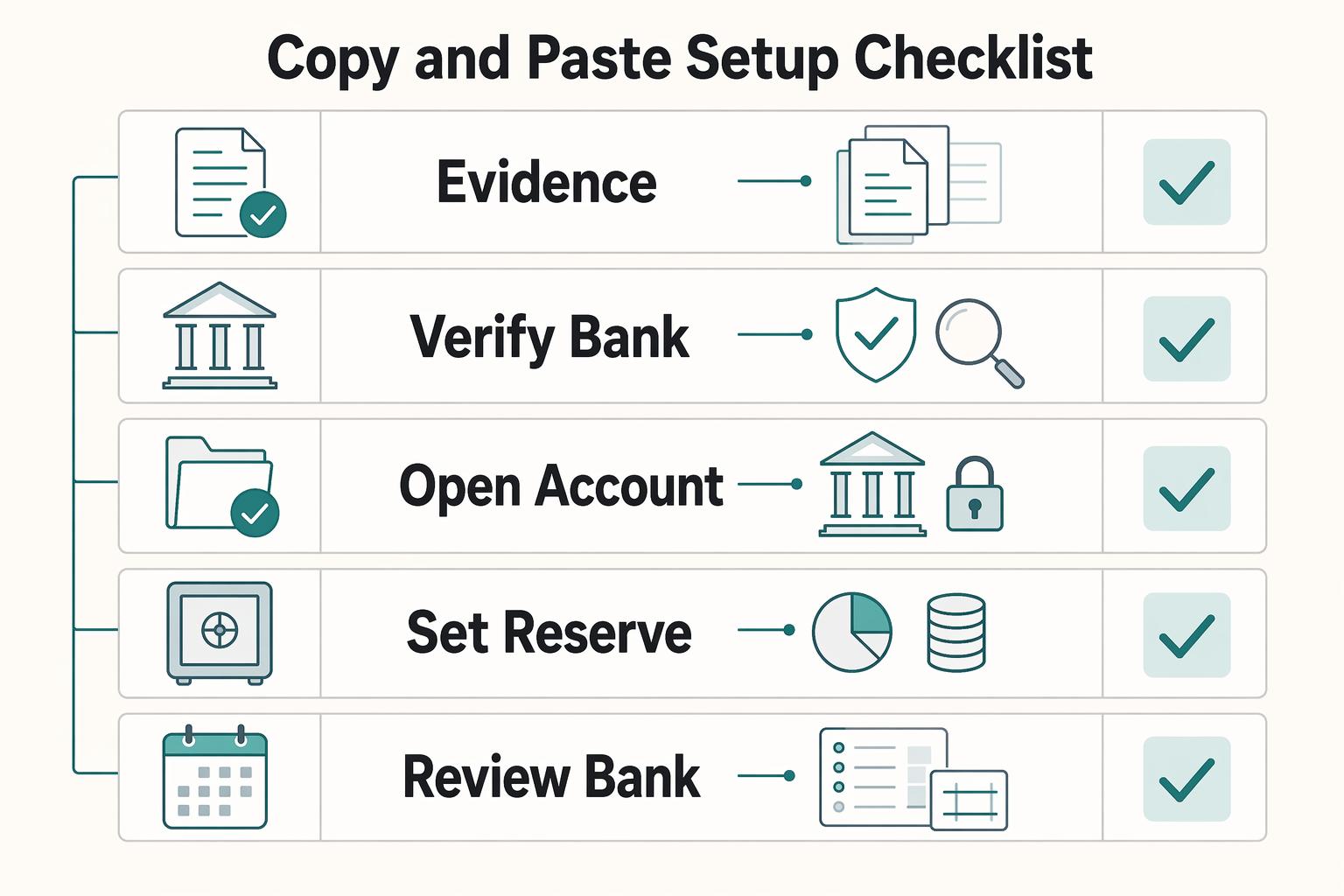
Copy and paste setup checklist#
Use this as a live setup note. Get each step confirmed in writing before you move to the next one.
- Confirm with the bank whether any existing savings-account record must be handled before a new Livret A opening request.
Keep the written reply, form, or message so you are not relying on memory or forum hearsay.
- Verify the bank's opening process against the official guidance pages you use.
Save dated screenshots or PDFs, and ask for written clarification if the process and those pages do not align.
- Open the account and save proof of opening and first funding.
Keep the confirmation, the terms you received, and proof of the first transfer, including date and amount.
- Set reserve-only operating rules.
Create one monthly sweep and a short written list of withdrawal triggers so the account is used for real cashflow pressure, not routine spending.
- Review your bank's latest rate information on a regular schedule and update your reserve plan.
Log the page date and any change in plain language before you adjust your sweep amount or reserve target.
Once your Livret A checklist is set, tighten your invoicing workflow with this free invoice generator so fewer late payments hit your reserve layer.
Final takeaway for your get paid system#
Use Livret A as your reserve layer, not as your full cashflow system. It is useful for an accessible buffer, but it is still a capped, regulated savings product with limited return upside.
Step 1 Give the account one job: absorb shocks#
Give the account one job: absorb shocks. Use it for short cash-flow gaps, not as your main operating cash account.
The tradeoff is clear. It is capped at €22,950 for an individual, withdrawals are allowed, and interest is posted once per year on December 31. That makes it strong as a reserve bucket, but weak as a growth tool or day-to-day treasury account.
Rate timing matters too. The rate is described as adjusting on February 1 and August 1, so it can lag faster economic changes. Stability is the feature; limited real return potential is the cost.
Step 2 Decide in advance how money moves, and document those rules#
Execution discipline is where this either works or fails. Decide in advance how money moves, and document those rules.
A practical setup is simple: client funds land in your operating account, obligations are covered, then a fixed amount or percentage is swept into the reserve on a set date. Write down valid withdrawal reasons as well, and pause before transfers that do not match those reasons.
Use a short monthly check: confirm distance to the €22,950 ceiling, verify whether the published rate changed around February 1 or August 1, and at year-end confirm interest was credited on December 31 and save the statement. If that review starts to feel hard to maintain, simplify the sweep rule before the process drifts.
Step 3 Tighten the rest of your get-paid system in parallel#
As cross-border volume grows, tighten the rest of your get-paid system in parallel. A reserve account can cushion volatility, but it cannot fix weak invoicing, slow collections, payout delays, or messy reconciliation.
Keep the controls concrete: clear invoice tracking, explicit payout timing, and a statement trail you can reconcile quickly. Maintain a simple evidence folder with opening confirmation, key screenshots, monthly balance snapshots, and transfer logs.
One final framing point: this is a regulated French savings product, and deposits are described as helping fund social housing through the Caisse des Dépôts. Use that rule-bound steadiness for what it does best: protect your buffer while your operating payment workflows carry the rest.
If your cross-border client flow is growing, evaluate Gruv Payouts for compliance-gated payouts with clear status tracking and audit-ready operations.
Frequently Asked Questions
Who can open a Livret A in France?
The broadest excerpt says Livret A is available regardless of age, nationality, or tax residency, which suggests wide access, including minors. Another excerpt frames it around people settled in France, so eligibility is not fully clear across sources. If your situation is not straightforward, get a written eligibility answer from the bank before you apply.
How many Livret A accounts can one person hold?
One person can hold only one Livret A in France. The same conflict check also covers a Livret Bleu with Crédit Mutuel. Before opening, ask the bank how it checks for any existing Livret A or Livret Bleu records in your name.
Is Livret A interest taxed?
The excerpted wording says interest is tax free for French residents. It also says non-residents must declare interest earned to their local tax authorities. If your tax position is cross-border, confirm your own reporting treatment separately.
Can I withdraw money anytime?
The account is described as instant access, with capital accessible at all times. One stated condition is a minimum withdrawal amount of 10€. After opening, a small test withdrawal can confirm how access works at your bank.
What is the Livret A ceiling?
The stated maximum is 22 950€ for an individual account. Once that ceiling is reached, additional payments are blocked, although interest may still be added. If you are close to the cap, verify the current limit before making a large transfer.
What rate should I use in planning?
Use the most current rate publication you can verify before planning. The 1,50% shown here is a snapshot marked subject to change, with an effective date of 01/02/2026 and a page update date of 02/02/2026. Treat older saved pages as historical context, not as your default planning rate.
When is interest actually counted and paid?
One excerpt says interest is calculated on the 1st and 16th of each month. It also says interest is paid annually on 31st December. If you plan around these dates, rely on the latest wording from your bank documents and saved page copy.
Try a related tool
Researched and edited by the Gruv editorial team. Gruv builds cross-border billing, payouts, and finance-operations software for global businesses.
Sources
Includes 1 external source outside the trusted-domain allowlist.
- curia.europa.eu/juris/document/document.jsf;jsessionid=B5709...trusted
- faculty.georgetown.edu/wilsong/Tools/HTD_LLR.txttrusted
- fdic.gov/system/files/2024-07/cfcm-165-1512.pdftrusted
- govinfo.gov/content/pkg/GOVPUB-W-c78087c4fca2980d4034515...trusted
- oecd.org/content/dam/oecd/en/publications/reports/201...trusted
- oecd.org/en/publications/housing-reforms-in-czechia-a...trusted
- state.gov/report/custom/649571d35dtrusted
- arpp.org/wp-content/uploads/2017/12/ARPP-code.pdfexternal
Educational content only. Not legal, tax, or financial advice.
Related Posts
Should Your Freelance Business Accept Credit Cards?
Offer card payments, but stay in control of how money reaches you. The goal is not a smoother checkout screen. It is predictable cash you can use to run the business.

Can Digital Nomads Claim the Home Office Deduction?
Claim the deduction only when your facts and records can carry it. With the home office deduction for digital nomads, the real decision is usually a three-way call: claim it, do not claim it, or pause and get help because your file is not ready.
How to Network with Journalists on Social Media
Networking with journalists works best when first contact feels useful, not transactional. You are building trust over time so a reporter can recognize you, reach you quickly, and use your input under deadline pressure.