
Quick Answer
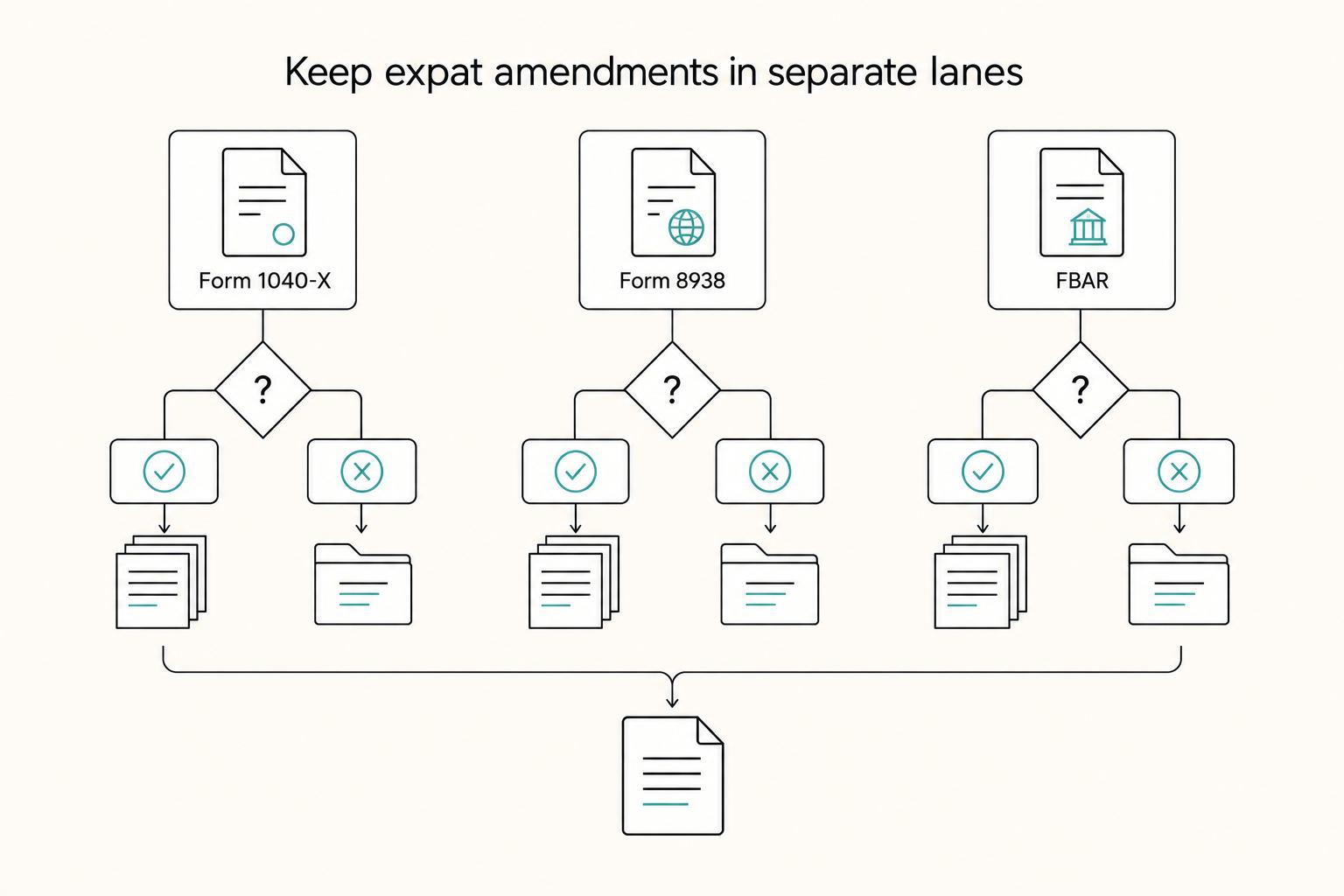
Yes. Use Form 1040-X when corrected facts change tax results on a filed U.S. return, then submit one complete amendment instead of patching issues in pieces. Start with a line-by-line change log and supporting documents, finalize FEIE and FTC work before form entry, and keep Form 1116 separated by income category. Keep offshore reporting on its own track, because FBAR (FinCEN Form 114) and Form 8938 are not replaced by an amended income tax return.
You can fix an expat return without making a second mistake#
If you need to amend an expat tax return, work in one controlled sequence: confirm scope, prepare the amendment once, and keep proof for every changed number.
This piece is for U.S. freelancers and consultants correcting a filed federal return. Keep your position easy to verify if the Internal Revenue Service (IRS) asks follow-up questions, and treat this as a quality-control exercise instead of a speed exercise.
The filing itself is only one step. The bigger win is a package that still makes sense six months later when you revisit your notes.
Before You Start#
- Confirm scope and target return.
Record the tax year, the originally filed form, and each line item you expect to change. Add one short reason for each line item so you do not lose context when you start calculations. Checkpoint: you can show filed numbers and corrected numbers before drafting the amendment.
- Prioritize compliance over speed.
For U.S. citizens and resident aliens abroad, core filing and estimated tax expectations generally follow the same rules as in the U.S., and worldwide income remains in scope. Benefits like FEIE require a U.S. return. Work in the same order each time: facts first, numbers second, filing steps last. Failure mode: rushing a filing with thin support, then filing a second amendment to fix the first one.
- Build a traceable evidence pack before editing forms.
Keep one folder with the filed return, revised calculations, and support for each changed figure. Add a short note for each change: what changed, why, and which document supports it. Keep note titles simple so anyone reviewing later can scan them in minutes. Checkpoint: every changed figure maps to one supporting document.
- Separate federal return work from foreign account reporting.
An amended federal return does not replace foreign account reporting. Some foreign accounts must be reported to the U.S. Treasury even when they produce no taxable income. If your case includes FBAR uncertainty or possible non-willful issues, pause and escalate before filing.
Once this setup is complete, the next moves are mechanical: decide whether an amendment is required, map each change to the right form, and submit one coherent package.
Decide if you should amend or leave it alone#
Use corrected facts to decide whether an amended return is appropriate or whether a notice response may be enough in your situation. Make that call early and write it down in one sentence so you do not second-guess yourself when you are deep in the calculations.
Step-by-Step Triage#
- Compare filed amounts to corrected facts.
Review filing status, income, deductions, credits, dependents, and total tax first. If those do not appear to change, check whether you only need to answer an IRS notice or provide missing support. Write down which category triggered the decision so your next step is clear.
- Handle expat-sensitive errors first.
Start with omitted foreign income, missed Foreign Earned Income Exclusion (FEIE), or missed Foreign Tax Credit (FTC). FEIE still requires the income to be reported on a U.S. return. If one of these items is involved, move it to the top of your change log before touching lower-impact cleanup items.
- Check FTC structure before deciding no amendment is needed.
If foreign tax was omitted or misclassified, review Form 1116 by income category and keep categories separate. Category mixing can affect the credit calculation and resulting liability. If category labels are unclear in your files, pause and fix the labels before calculating.
- Use a stop rule when the scope widens.
If the same correction creates uncertainty beyond FEIE/FTC treatment, pause and confirm scope before filing. Aim for one complete filing with consistent positions. If you cannot explain the boundaries of the amendment in plain language, you are not ready to submit.
Gather your evidence before touching Form 1040-X#
Build the file first, then draft the amendment once so the calculations, schedules, and explanation stay aligned from the start.
Before You Start#
Set up one folder for the tax year with two labeled lanes: return corrections and information reporting. Return corrections should include the filed return (for example, Form 1040), corrected calculations, and changed schedules. Information reporting should hold records and supporting statements, clearly separated from the return-correction file set.
- Create an original vs corrected baseline.
Preserve the filed return exactly as submitted, then create a corrected set of calculations. Add a change log with line item, original amount, corrected amount, and support document. Keep one status column, such as open or verified, so you can see what is unresolved at a glance. Checkpoint: every planned change appears in the log before any Form 1040-X entry.
- Document FEIE eligibility before drafting exclusion changes.
If FEIE is part of the correction, keep records showing qualifying status and foreign earned income. If qualification depends on day counts, save the day-count support used in your calculation notes. If you are using a waiver of minimum time requirements, count only actual days of residence or presence in-country. Keep these records near the calculation tab so you can cross-check without searching separate folders. Use year-specific caps already in your file checks: up to $130,000 per qualifying person for 2025 and $132,900 for 2026, with housing expense limits generally tied to 30% of the FEIE maximum. Failure mode: excluding income in calculations while forgetting that the income still appears on the U.S. return.
- Build FTC support by category.
For FTC corrections, prepare Form 1116 support by income category instead of one combined worksheet. Keep each category in a separate mini-pack with the worksheet and document references together. Checkpoint: each planned Form 1116 has one category and one matching document stack.
- Add dependent and credit support only when it changes outcome.
If a dependent-related credit is part of the correction, capture it in the same before-and-after format. Keep scope tight to items that change return results. If an item does not move a line on the return, park it in notes instead of cluttering the amendment package.
- Freeze a ready-for-filing folder before form entry.
Create a ready-for-1040x folder with the change log, support documents, and a one-page summary of what changed and why. Do not rely on nonbinding IRS practice-unit text as legal authority. Use this folder as your single source when you fill forms and draft the explanation. If X, do Y: if any changed number has no matching support, stop and close that gap before editing Form 1040-X. If you want a deeper dive, read our guide to a defensible 2026 filing plan.
Confirm your filing window and special-rule risk#
Timing is a gate, not a final formatting step. Confirm your window with current IRS material first, then check whether FTC special rules change your filing strategy before you draft the narrative.
Step-by-Step Timing Check#
- Step 1: Anchor the timing review to current IRS guidance before drafting your amendment package.
Use IRS material for the exact tax year you are amending, then record what you relied on and the date you checked it. FTC claim-period and relief treatment have changed over time, including updates dated January 4, 2022, July 21, 2023, and December 11, 2023. Keep this record in the same folder as your change log, not in a separate note app. Verification checkpoint: your folder shows tax year, instruction set, and verification date.
- Step 2: Flag FTC special-rule exposure before choosing the filing path.
If foreign tax is part of the correction, treat FTC as an eligibility gate, not just a math line. Foreign taxes must meet IRS qualification rules, and individuals generally claim the credit on Form 1116 attached to Form 1040, Form 1040-SR, or Form 1040-NR. Keep FEIE interaction strict: do not claim FTC on income excluded under FEIE or foreign housing elections. If this interaction is present, annotate it clearly in your one-page summary so reviewers do not miss it. Failure mode: filing quickly and discovering later that the same income was both excluded and credited.
- Step 3: Check form-structure requirements that create rework if missed.
For FTC corrections, prepare Form 1116 separately by income category. For 2025 instructions, complete Part IV lines 25 through 32 even if you file only one Form 1116. Before moving on, compare your category count in the log against the number of forms prepared. Verification checkpoint: each income category in your evidence pack maps to its own Form 1116 file set.
- Step 4: Apply a stop rule when timing is tight or unclear.
If timing is close, file once with a complete package rather than rushing a partial amendment. Check the latest IRS guidance for your tax year when you are unsure whether your timing analysis still holds, and save what you relied on in the file. If your notes and the latest instructions conflict, pause and document why before taking the next step. If X, do Y: if timeliness depends on an FTC exception you cannot document clearly, pause and confirm scope before filing.
Map each error to the exact form changes#
A change map is your control sheet. It keeps one correction from breaking totals across the income tax return, schedules, and offshore reporting documents. Use one row per issue with error type, affected line item, form or schedule to revise, supporting evidence, and expected tax effect.
- Build the map from the filed return, not memory.
Mark each changed line on the filed return, then list every downstream form tied to that line before editing anything. Add a final column for review status so you know which rows still need a second check. Checkpoint: each changed line has evidence and a destination form or schedule.
- Include related schedule effects early.
If corrected income changes other parts of the return, map those schedule effects at the same time so stale values are not left in place. Include these effects in your expected tax-effect column so they are not treated as side notes.
- Keep offshore reporting on a separate track.
Treat Form 8938 and FBAR as related but separate paths. Form 8938 is attached to the annual income tax return when thresholds are met, and it does not replace FBAR when FBAR is otherwise required. Keep a separate note for this boundary so amendment scope remains clear.
- Apply
Form 8938thresholds by taxpayer context.
Do not use one universal threshold. Thresholds vary by filing status and residence. For specified domestic entities, thresholds include more than $50,000 on the last day of the tax year or more than $75,000 at any time during the year. If you map FBAR values, record maximum account values in U.S. dollars rounded up to the next whole dollar.
- Lock the map, then edit forms in one pass.
If one issue touches multiple forms, finish the full map first and revise everything together. Resist ad hoc edits once form entry begins; route new edits through the change map. If X, do Y: if a new affected form appears mid-edit, stop, add it to the map with evidence, and restart the pass. For another example of clean decision criteria, see A Guide to Trademarks for Your Freelance Business Name and Logo.
Complete Form 1040-X in the right order#
Run one controlled pass: calculate first, populate Form 1040-X from finalized figures, then write the explanation after the math is settled so the wording stays aligned with the final numbers.
- Calculate corrected amounts off-form first.
Start from the filed return and your change map. Recalculate affected lines and schedules before entering values on Form 1040-X, and tie each amount to supporting records. Keep the calculation sheet versioned so you can trace revisions if totals shift.
- Populate
Form 1040-Xwith strict reconciliation.
Enter each changed line from finalized worksheets so every value maps to support and to the related revised form. If FTC is the trigger, generally complete and attach Form 1116 as required, use one Form 1116 per income category, and check only one category box per form. If taxes were paid to multiple countries or territories, keep those entries separated on Form 1116.
- Write the explanation after numbers are final.
State the trigger clearly, such as a missed FTC, and list attached forms. Keep the wording short and factual. If FEIE or housing exclusion is involved, do not describe FTC as applying to excluded income. Use your one-page summary as the source so language and numbers stay aligned.
- Run one last consistency check before filing.
Confirm totals, tax direction, and payment or refund expectation match across all revised documents. For 2025 FTC filings, verify Form 1116 Part IV lines 25 through 32 are complete even when only one Form 1116 is filed. Base your narrative on forms and instructions, not IRS international FAQ text. If any line fails this check, return to calculations before changing narrative text.
Choose e-file or paper with a clear rule#
For U.S. citizens and resident aliens abroad, filing rules are generally the same as in the United States. There is no one-size-fits-all Form 1040-X e-file vs paper rule here, so decide case by case using current IRS instructions and your software or preparer workflow.
- Check eligibility before submission.
Confirm acceptance for your exact amendment facts in current IRS instructions and in your software or preparer process. Treat IRS international FAQ language as general context, not legal authority, for filing-path decisions. Save a dated note or screenshot showing how you confirmed eligibility.
- If you use a preparer, complete required workflow steps first.
Before transmission, complete any signature or authorization steps required in that workflow. Keep signed records and submission proof in the amendment file.
- Use the permitted method for your case.
If electronic submission is not available for your scenario, follow the current paper process in IRS instructions and include the required forms/statements. Keep mailing and delivery proof with your filed copy for status follow-up.
- Keep one tracking folder and separate FBAR handling.
Store filed Form 1040-X, submission proof, payment proof if applicable, and status notes in one place. Handle FBAR separately through the BSA e-filing system.
Handle expat edge cases without mixing systems#
Treat edge cases as a separation task: keep tracks distinct, then reconcile shared facts before submitting anything. When multiple cross-border issues overlap, the biggest risk is inconsistency, not arithmetic.
| Item | How it is handled | Boundary noted |
|---|---|---|
| Form 1040-X | Federal amended return | Does not replace foreign account reporting |
| Form 8938 | Attached to the annual income tax return when thresholds are met | Thresholds vary by filing status and residence; it does not replace FBAR |
| FBAR / FinCEN Form 114 | Handled separately through the BSA e-filing system | Triggered when aggregate foreign account value exceeds $10,000 at any point in the calendar year |
- Split corrections into separate tracks.
Keep income-tax amendments separate from FBAR and FATCA questions. Do not assume one filing resolves another. If Form 8938 scope is unclear, review your records first, then use How to Handle Tax Form 8938 (Statement of Specified Foreign Financial Assets) as a focused refresher.
- Recompute FEIE from eligibility facts.
When FEIE is part of the correction, report the income on the U.S. return and confirm qualifying status before applying exclusion amounts. If qualification covers only part of the year, adjust by qualifying days. For 2026, the listed maximum is $132,900 per person. Keep the day-count support in the same file as the calculation to speed verification.
- Rebuild FTC support by category.
When FTC changes are included, keep FTC and FEIE positions aligned across revised forms. Form 1116 requires one checked category box per form and a separate form for each income category. Before submission, confirm your attached Form 1116 set matches your category count. This is a simple but high-impact quality gate.
- Escalate early when issues overlap.
If one year combines FEIE recalculation, FTC recategorization, and FBAR or FATCA uncertainty, get cross-border review before filing. Pause for review if time-requirement exceptions may apply, and remember that presence in a foreign country in violation of U.S. law is not treated as qualifying presence for these tests. Write a short escalation memo so the reviewer sees scope, open questions, and current documents.
Decide whether you also need a state amendment#
Run state triage only after federal numbers are stable. A Form 1040-X change may or may not require a California amendment, but it can affect California taxable-income and residency analysis, so sequence matters.
| California status | Taxed on | Section note |
|---|---|---|
| Resident | All income regardless of source | Residency is a facts-and-circumstances determination |
| Part-year resident | Worldwide income while resident | Use one before-and-after sheet tied to a single federal snapshot |
| Nonresident | California-source taxable income | Check California-source services, real-property rent or sales, and California business income |
- Step 1: Freeze federal numbers first.
Start state work only after amended federal income, deductions, credits, and filing status are locked. Use one before-and-after sheet so the state analysis ties to a single federal snapshot. If the federal snapshot changes, mark the old one as superseded and start a fresh state pass.
- Step 2: Reassess California residency from facts.
Residency is a facts-and-circumstances determination. In California, residents are taxed on all income regardless of source. Part-year residents are taxed on worldwide income while resident. Nonresidents are taxed on California-source taxable income. Keep your residency reasoning in writing so your filing position and documentation match.
- Step 3: Re-test California-source items and tax effect.
Check whether federal corrections change California-source items, including services performed in California, California real-property rent or sales, or California business income. For nonresidents and part-year residents, apply the FTB prorated approach that uses California taxable income and an effective tax rate. Track each affected item in the same change sheet used for federal mapping.
- Step 4: Choose filing order and document it.
Consider filing the state return after federal figures are final. If timing forces parallel filing, keep dated versions and a short reconciliation note so temporary differences are explicit. This note should state which values are provisional and when they were last checked. If residency facts changed, reassess federal and state positions before filing either amendment.
Pay, track, and document after submission#
Submission is not the end of the job. Close the file with payment proof, status tracking, and a final package that can stand on its own. Keep this documentation standard the same for every amended return.
- Pay and store proof together.
If the amendment shows tax due, make the payment and keep confirmation with your Amended U.S. Individual Income Tax Return file set. Save payment date, amount, method, and confirmation in the same folder as the filed return. This keeps payment and return records tied together during any later review.
- Track status with dated notes.
Check amended-return status through IRS channels and log each check with date and status text. IRS instructions include both filing an amended return and checking amended-return status, so tracking belongs in the completion process. Keep the note format consistent so updates are easy to scan.
- Keep one final package copy.
Save submitted Form 1040-X, filing proof, payment proof if applicable, and supporting documents in one final folder. Organize it so the filing history is clear without memory gaps. A future reviewer should be able to reconstruct the case without extra context.
- Apply a stop rule before filing again.
Do not file a second amendment unless you confirm a real new issue. If the IRS corrects simple math errors or missing forms, another amendment may not be required. Record what changed, then refile only when the underlying facts changed. This protects you from avoidable duplicate filings.
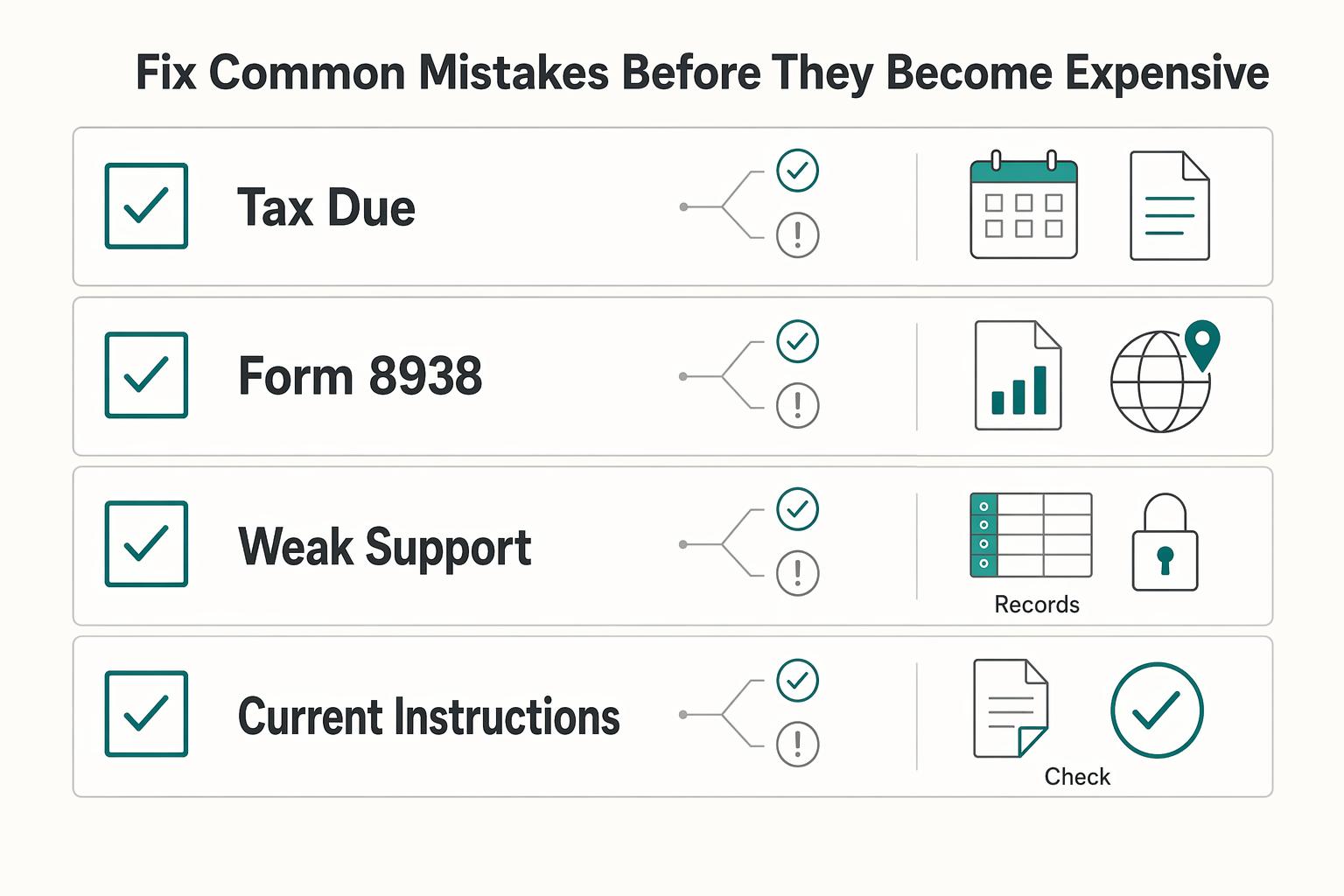
Common mistakes and how to recover quickly#
Most rework starts when tasks get mixed, so use this section as a diagnostic checklist before you submit again.
| Mistake | Recovery | Key note |
|---|---|---|
| File Form 1040-X before the support file is complete | Pause filing, rebuild the change map, and confirm each changed line ties to a worksheet and supporting document | Do not resume form entry until every open item is resolved or removed |
| Blend FBAR and FinCEN fixes into the federal amended-return narrative | Split income-tax corrections from account-reporting corrections | Form 1040-X does not replace FBAR; FBAR is filed on FinCEN Form 114 |
| Patch one line without rechecking connected schedules and credits | Rerun full return logic and confirm related schedules and Form 1040-X totals align | Return to the change log instead of patching by hand if totals do not reconcile |
| Assume separate filing obligations update automatically after federal corrections | Review separate obligations in their own workflow and document changes in a dedicated note set | Keep that note set next to the final filing package |
| No tracking discipline after filing | Keep a post-submit log with check date, current status text, and next action | Store it with the final amendment package |
- Mistake: filing
Form 1040-Xbefore the support file is complete.
Recovery: pause filing, rebuild the change map, and confirm each changed line ties to a worksheet and supporting document before submission. Do not resume form entry until every open item is either resolved or removed.
- Mistake: blending
FBARandFinCENfixes into the federal amended-return narrative.
Recovery: split income-tax corrections from account-reporting corrections. Form 1040-X does not replace FBAR, and FBAR is filed on FinCEN Form 114. Use a separate FBAR checklist: filing is triggered when aggregate foreign account value exceeds $10,000 at any point in the calendar year, even when an account produced no taxable income. Date check: FBAR is generally due April 15 with an automatic extension to October 15. A further extension to April 15, 2027 applies only to certain signature-authority filers; for other individuals in that notice context, the due date remains April 15, 2026.
- Mistake: patching one line without rechecking connected schedules and credits.
Recovery: rerun the full return logic rather than patching one line, then confirm related schedules and Form 1040-X totals align to one final version. If totals do not reconcile, return to the change log instead of patching by hand.
- Mistake: assuming separate filing obligations update automatically after federal corrections.
Recovery: after federal numbers are final, review separate obligations in their own workflow and document changes in a dedicated note set. Keep that note set next to your final filing package.
- Mistake: no tracking discipline after filing.
Recovery: keep a post-submit log with check date, current status text, and next action, then store it with the final amendment package. If your log has gaps, add a catch-up note before taking new action.
If two or more mistakes appear in one case, treat that as a stop signal and escalate before filing again.
Final checklist you can copy and use#
Use this final pass to confirm your package is consistent, documented, and ready before filing. The goal is one set of numbers, forms, and support that stays coherent during later review.
- Confirm what changed and why.
Reconcile the filed return against corrected amounts and mark each change that affects income, deductions, credits, or tax. For each marked item, keep a short reason note and matching support record. If any reason note is vague, rewrite it before submission.
- Build one evidence pack before preparing your amendment.
Keep the filed return, corrected worksheets, and source documents together. If FEIE is involved, include qualifying-day records, and keep in mind that excluded foreign earned income is still reported on a U.S. return. Place this pack in the same folder as your amendment notes so nothing is split across locations.
- Check FEIE limits and sequencing.
If FEIE qualification covers only part of the year, adjust the exclusion maximum by qualifying days. For 2026, the FEIE maximum is $132,900 per person. If you claim foreign housing exclusion, compute housing first because it affects the FEIE limit, and note the general housing-expense limit is 30% of the FEIE maximum ($39,870 for 2026). If your numbers move after this step, rerun dependent calculations before finalizing.
- Check FTC form structure before finalizing.
Use a separate Form 1116 for each income category, check only one category box per form, and use separate country lines or columns when taxes were paid to more than one country or territory. Confirm that your form count and category list match exactly.
- Run one FEIE failure-mode check.
Minimum time requirements can be waived if you must leave because of war, civil unrest, or similar adverse conditions. Income earned while in violation of U.S. law does not qualify as foreign earned income, and related housing expenses from that period cannot be included in foreign housing calculations. Keep this check visible in your final review notes.
- Submit only after a current-instructions check.
Confirm filing and payment details against current IRS instructions for your facts, then keep complete copies of what you filed and how corrected amounts were computed. Form 1040-X procedural details (including filing method, attachments, and timelines) are not covered in this checklist, so verify those directly in current IRS instructions. Before you close the file, verify that payment proof and amendment copy are stored together.
Frequently Asked Questions
Do expats use `Form 1040-X` for most federal return corrections?
There is no universal answer for every case. Use current IRS instructions for your filed return type to decide whether an amended return is required. If a correction would change reported amounts, credits, or tax outcomes, verify the amendment step before submitting anything.
What mistakes require an amended return instead of waiting for the `IRS` to adjust it?
FEIE or FTC eligibility and calculation issues are generally substantive corrections, so document them fully. Do not rely on partial records for complex cross-border items. Check current IRS guidance tied to your notice or filing status before acting.
What is the filing window for an amended return, and when do special rules apply?
This article does not set a single filing-window rule, so verify timing in current IRS instructions. FEIE guidance includes two exceptions to minimum time requirements, including cases where you must leave because of war, civil unrest, or similar adverse conditions. Time in a country while in violation of U.S. law does not count toward bona fide residence or physical presence treatment.
Can I amend to claim missed `Foreign Tax Credit (FTC)` or `Foreign Earned Income Exclusion (FEIE)`?
Potentially, if records support eligibility and calculations. FEIE applies only to qualifying individuals, and excluded foreign earned income is still reported on the U.S. return. For 2026, the FEIE maximum is $132,900 per person, part-year cases require a qualifying-day adjustment, and FTC reporting uses separate Form 1116 filings by income category.
Should I e-file or mail my amended return as a US expat?
There is no blanket e-file versus mail rule for all expat amendments. Confirm the current filing method for your exact return facts at submission time. Keep complete submission records and filing proof regardless of method.
Do I need to amend my state return if I amend federal, including in `California` with `FTB`?
This article does not establish state amendment requirements, including FTB rules in California. After federal figures are final, review current state guidance for your filing position. Keep state decisions documented separately from federal amendment workpapers.
Can I file more than one amended return for the same tax year?
Possibly, but this section does not set a blanket rule for multiple amended returns in one year. Reconcile prior changes first and document the new unresolved trigger. One complete correction package is usually easier to validate than fragmented follow-up filings.
Try a related tool
Researched and edited by the Gruv editorial team. Gruv builds cross-border billing, payouts, and finance-operations software for global businesses.
Sources
Educational content only. Not legal, tax, or financial advice.
Related Posts

Digital Nomad Taxes in 2026 With a Defensible Filing Plan
With digital nomad taxes, the first move is not optimization. It is figuring out where you may be taxable, where filings may be required, and what proof supports that position.
When Freelancers Should Trademark a Business Name and Logo
Start with one practical decision: `file now`, `file later`, or `hold for now`. Base it on actual client-facing use, brand stability, and whether your work is moving beyond one state, not on how much you like the name.
How to Handle Tax Form 8938 Without Missing FBAR
Start with one decision: are you filing an income tax return for the year? Form 8938 attaches to that return, and this guide is meant to help you handle Statement of Specified Foreign Financial Assets reporting under FATCA without guesswork. Treat current IRS instructions as something you check live, not as a one-time read, because the Form 8938 materials are updated as needed.