
Quick Answer
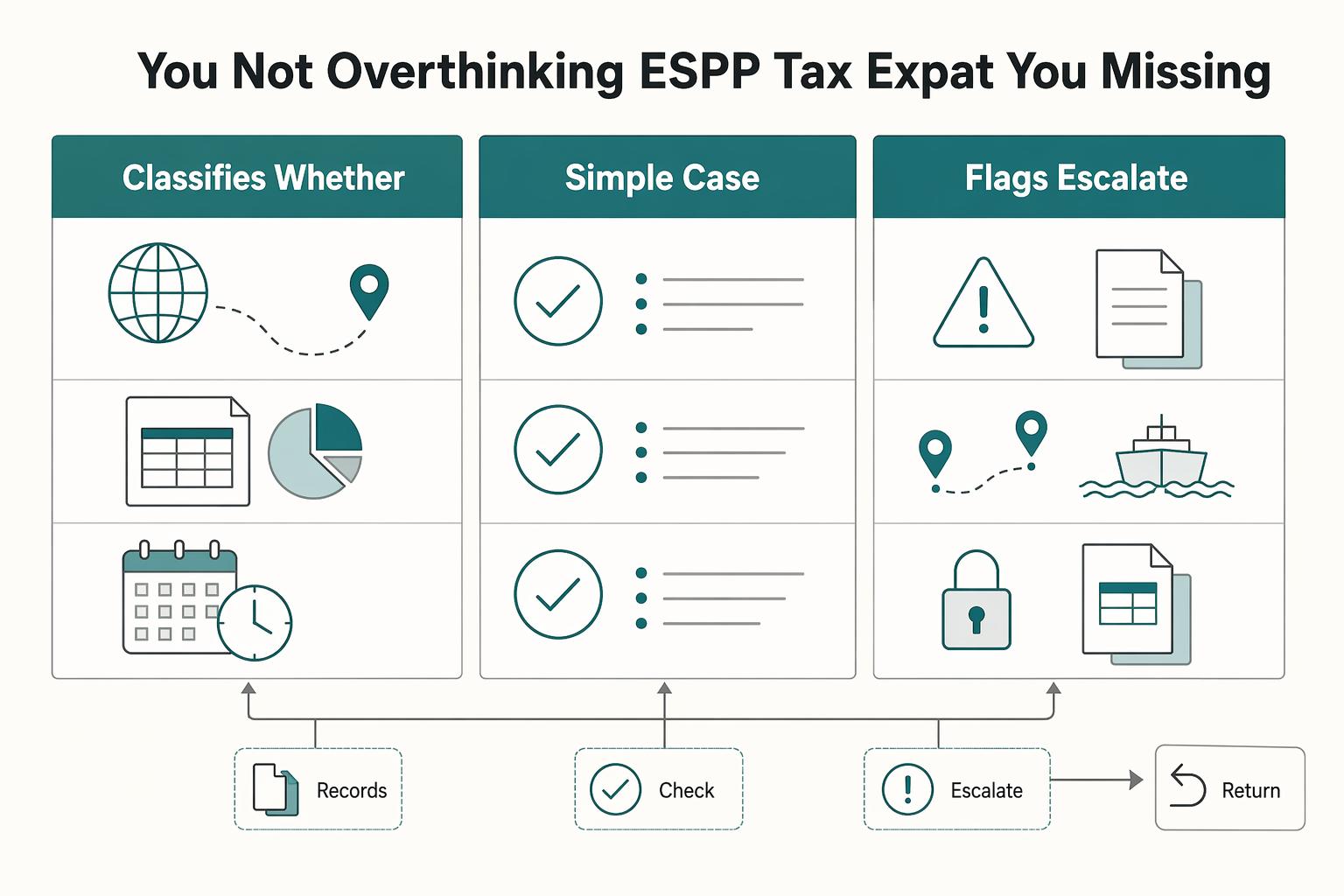
For espp tax for expats, the safest approach is to run a compliance-first decision system before you file or sell. First classify the plan as Section 423 qualified or nonqualified, then map where you actually performed services, then clear IRS and FinCEN reporting checks. If classification, sourcing, or treaty issues are unclear, pause trading and escalate to a licensed cross-border tax professional.
You are not overthinking ESPP tax as an expat you are missing a system#
If you want cleaner ESPP tax outcomes as an expat, stop collecting theory and run a repeatable decision system before you file or sell. You need a process you can run on demand, especially when your life crosses borders.
An Employee Stock Purchase Plan (ESPP) lets you buy employer shares, often at a discount, but the tax treatment shifts with plan design, mobility history, and sale timing. That is why U.S. expat tax decisions around an ESPP break when you copy domestic-only playbooks.
When your facts cross borders, the hard part is not memorizing rules. It is labeling your plan correctly, tying it to where you actually worked, and making sure your filings match the story your documents tell.
Set aside a short block of time and run this playbook for safe defaults, not aggressive positions. The goal is to avoid expensive unforced errors, then escalate only when you hit a real ambiguity.
| This framework does | This framework does not do |
|---|---|
| Classifies whether your ESPP path looks like a qualified ESPP under Section 423 or a nonqualified path | Replaces country-specific legal or tax advice |
| Forces a simple pre-sale and pre-filing decision gate | Guarantees identical treatment across jurisdictions |
| Flags when to escalate before you trade or file | Drafts treaty positions for your exact return |
Before You Start#
- Define your objective. Choose one immediate decision: file now, sell now, or pause. Verification point: you can state that decision in one sentence.
- Commit to compliance-first defaults. If core facts conflict, pause action and escalate. Verification point: you accept no-trade as a valid outcome.
- Set your escalation trigger. If plan type, mobility facts, or disposition status stays unclear, route it to a licensed cross-border tax professional. Verification point: you know exactly when you stop self-solving.
Hypothetical example: you moved countries during an offering period and want to sell quickly. This system forces you to classify plan type and mobility facts first, then act.
If residency rules still feel fuzzy, review 183-Day Rule Explained: Stop the Tax Myths Before They Cost You before you lock assumptions in. For a broader reset, read our guide to a defensible 2026 filing plan.
What should you prepare before you touch your ESPP shares?#
Prepare a complete evidence packet before you touch your shares, because plan type, residency, and records drive every high-stakes decision.
You have the system. Now gather clean inputs so you are deciding from documents, not memory.
Small prep mistakes in an Employee Stock Purchase Plan (ESPP) create bigger cleanup later. Build one file that lets you (1) classify qualified ESPP versus non-tax-qualified ESPP, (2) map cross-border exposure, and (3) decide whether you can act now or need professional review.
Run this preparation checklist#
| Packet item | Why it matters now | Verification point |
|---|---|---|
| Plan documents and employer notes | Confirms whether you are in a Section 423 track or a non-tax-qualified structure | You can point to exact plan language and save it in your file |
| Form 3922 plus purchase and transfer records | Supports later gain or loss calculation at sale and ties facts to legal-title transfer | You can match each transfer to your own ESPP records |
| Residency timeline by country | Anchors United States and United Kingdom periods for residence analysis | You can map grant, purchase, transfer, and intended sale timing to location |
| Prior return workpapers and treaty notes | Surfaces unresolved treaty residence and reporting assumptions | You can list open treaty questions before you file or sell |
- Collect plan-status evidence. Pull grant notices, purchase confirmations, and employer communications that identify Section 423 status. IRS instructions for Form 3922 state that you do not recognize income when you exercise an ESPP option, and that you should keep the form to figure gain or loss later.
- Build a residency and work-location timeline. Map where you lived and worked during each ESPP phase, especially United States and United Kingdom periods. If UK facts matter, apply the Statutory Residence Test and save support.
- Assemble your compliance file. Add prior return workpapers, tax residency records, and any tax treaty notes. Treat treaty residence as a threshold issue, and flag unresolved contracting-state positions before you claim benefits.
- Set your safe default. If your classification or residency and treaty documentation is still unclear, consider pausing discretionary sale actions until your file is internally consistent. If a deadline forces a move, escalate quickly to a licensed cross-border tax professional.
Hypothetical scenario: you moved during an offering period and want to sell soon. A complete file lets you check whether qualifying disposition timing could matter before you place the trade.
Step 1 Which ESPP regime are you actually in?#
Classify whether your ESPP is Section 423 qualified, non-qualified, or something else before you do any tax math.
Everything downstream depends on that label. With your evidence packet ready, classify the regime before you run calculations. The wrong label sends you down the wrong logic from day one.
In a cross-border context, classification matters more than speed. A qualified ESPP under Section 423 can follow statutory rules, while a non-qualified ESPP can look similar but not carry the same tax preference.
Also keep ESPPs separate from Incentive Stock Options (ISOs) under Section 422, because that is a different regime.
| Regime check | What to confirm | Immediate implication |
|---|---|---|
| Section 423 statutory ESPP | Plan documents explicitly tie the award to Section 423 | Keep statutory ESPP path and test holding periods |
| Non-qualified ESPP | Employer materials describe ESPP mechanics without Section 423 statutory treatment | Treat as non-statutory risk until an advisor confirms details |
| ISO under Section 422 | Records indicate ISO treatment under Section 422; if exercised, IRS reporting is Form 3921 | Do not apply ESPP rules; route to ISO workflow |
| ESPP transfer reporting | You receive Form 3922 for Section 423 ESPP transfer reporting | Keep ESPP classification and prep disposition analysis |
Run the classification gate#
| Gate | What to do | Verification |
|---|---|---|
| Label the award | Pull the plan text, grant notices, and employer memos, then assign one regime label only | Your file shows one clear label with supporting documents |
| Separate ESPP from ISO | If records point to Section 422 or Form 3921, stop treating that award as an ESPP case | You can explain why the award is ESPP or ISO in one sentence |
| Test disposition timing | Check whether your expected sale can satisfy both checkpoints: at least 1 year from transfer and 2 years from grant | Your timeline marks both dates and your planned action |
| Apply a hard stop | If documents disagree on regime, treat that as unresolved cross-border risk and escalate before filing or selling | You log the conflict and assign professional review |
- Start with primary documents. Pull the plan text, grant notices, and employer memos, then assign one regime label only. Verification point: your file shows one clear label with supporting documents.
- Separate ESPP from ISO immediately. If records point to Section 422 or Form 3921, stop treating that award as an ESPP case. Verification point: you can explain why the award is ESPP or ISO in one sentence.
- Check the holding-period checkpoints before you set sale intent. Test whether your expected sale can satisfy both markers: at least 1 year from transfer and 2 years from grant. Verification point: your timeline marks both dates and your planned action.
- Use a hard stop when evidence conflicts. If documents disagree on regime, treat that as unresolved cross-border risk and escalate before filing or selling. Verification point: you log the conflict and assign professional review.
Hypothetical: you planned a quick sale, but your file shows mixed ESPP and ISO signals. You pause, classify correctly, and avoid importing the wrong rule set into your disposition analysis.
Step 2 Are you exposed to U.S. tax on this stock-based compensation?#
U.S. exposure usually turns on where you performed services, not your mailing address or payroll assumptions.
Treat U.S. exposure as a sourcing question first. If your services tie to the United States, you likely have U.S.-source compensation to analyze. You already classified the plan. Now map where you performed services, then test what falls inside U.S. federal tax scope.
For a nonresident alien, the core rule is direct: you generally pay U.S. tax on U.S.-sourced income. For personal service income, source usually follows where you performed the work. That makes your location record the key input here.
| Decision gate | What you do | What you need before moving on |
|---|---|---|
| U.S. nexus check | Mark stock-compensation service periods in the grant-to-vesting window with U.S. and non-U.S. work locations | A clean timeline tied to grant and vesting dates |
| Allocation check | Split compensation using a time basis, often a U.S. workday fraction over total workdays | A defensible percentage with supporting travel and work records |
| Treaty check | Review whether a tax treaty could reduce or exempt U.S. tax, then flag unknown treaty mechanics | A written yes, no, or unclear status with escalation notes |
- Build the work-location attribution log. Tie each relevant grant-to-vesting period to where you actually worked. Verification point: you can show a day-level or period-level split for United States versus non-U.S. service.
- Calculate a first-pass sourcing split. Use the workday fraction approach when services span countries. Verification point: your file shows the formula and the assumptions you used.
- Stress-test with a treaty lens. A treaty can change outcomes, but it does not automatically eliminate U.S. tax. Verification point: you list which treaty article you need to confirm, or you mark it unresolved.
- Set a withholding reality check. If U.S.-source compensation remains, default NRA withholding can be 30 percent unless an exception applies. Verification point: you document expected withholding and open questions.
In practice, the allocation rule is simple: if personal services are performed both inside and outside of the United States during the vesting period of NSOs, an apportionment must be made.
Hypothetical: you changed countries mid-period and payroll treated everything as non-U.S. Your log catches the mismatch early. You pause, validate the treaty position, and avoid a preventable filing error.
Step 3 Which filings and records should you control first?#
Control your filing calendar and evidence trail before any trade by tracking IRS and FinCEN obligations in parallel.
Once you have a sourcing view, turn it into an operating checklist with clear ownership and proof. Clean execution depends on handling IRS and FinCEN obligations at the same time.
A filing control sheet is a single tracker that links each filing lane to one owner, one deadline, and one evidence folder. The point is practical: keep your Employee Stock Purchase Plan (ESPP) activity tied to your return and your overall filing posture, so nothing drifts.
| Control lane | Owner and channel | What to verify now |
|---|---|---|
| IRS return lane | You and your return file | ESPP transactions, plan type, basis records, and timing markers for later disposition checks |
| FBAR lane | FinCEN Form 114 via BSA E-Filing System | Whether your facts trigger FBAR filing for the year |
| FATCA lane | Form 8938 attached to return when required | Whether your fact pattern meets Form 8938 thresholds (separate test from FBAR) |
| Self-employment lane | Schedule SE (Form 1040) | Whether Schedule SE applies based on your net earnings profile |
Build your control sheet in four moves#
| Move | What to add | Verification |
|---|---|---|
| Assign ownership and deadlines | Put IRS items and FinCEN items on separate lines, then assign one accountable owner for each line | Every filing line has an owner and a due-date field |
| Run dual foreign-account checkpoints | Test FBAR and Form 8938 separately, because one does not replace the other | Your sheet says file, do not file, or review |
| Anchor the FBAR calendar | Add the April 15 due date and Oct 15 automatic extension endpoint to your calendar | Your calendar includes both dates |
| Attach proof files | Save offering, purchase, and sale records in the same folder as your filing sheet so you can support basis and reporting positions | Each control line links to documents |
- Assign ownership and deadlines first. Put IRS items and FinCEN items on separate lines, then assign one accountable owner for each line. Verification point: every filing line has an owner and a due-date field.
- Run the foreign-account checks separately. Test FBAR and Form 8938 on their own terms, because one does not replace the other. Verification point: your sheet says file, do not file, or review.
- Anchor the FBAR calendar. Add the April 15 due date and Oct 15 automatic extension endpoint to your calendar. Verification point: your calendar includes both dates.
- Attach proof files right away. Save offering, purchase, and sale records in the same folder as your filing sheet so you can support basis and reporting positions. Verification point: each control line links to documents.
Mark unknowns before you trade#
List unresolved items directly in the tracker before you enter an order, especially threshold decisions and missing records. If a line still says review, treat that as a live risk rather than a housekeeping item.
Hypothetical: you prepare to sell, but your tracker shows an unresolved Form 8938 decision and a missing ESPP sale record. You pause, close both gaps, then move forward with control instead of guesswork.
Step 4 Should you hold sell or sell to cover right now?#
Choose hold, full sale, or sell to cover only after your plan status, sourcing, and filing checks are clear.
Run the pre-trade gate first, then choose your path. Once your records and filing tracker are in place, this should be an execution decision, not a debate.
This is an execution step. Match trade timing to plan status, sourcing, and residency evidence across the United States and United Kingdom. Do not try to optimize every edge case in one pass.
| Path | Use it when | Stop and escalate when |
|---|---|---|
| Hold | Key facts stay unresolved and you need clean classification first | Sourcing, residency, or payroll data conflicts remain open |
| Full sale | Your regime, sourcing, and reporting path align and you want full exit | You cannot confirm disposition status or basis records |
| Sell to cover | You need a partial sale for obligations and your records support the method | Payroll and personal records disagree on reportable amounts |
Run the pre-trade gate#
- Confirm regime and disposition status. Use the plan label and holding checkpoints you already marked in Step 1. Verification point: your trade date clearly maps to your disposition status.
- Recheck U.S. exposure. For a nonresident alien, U.S. tax generally applies to U.S.-source income, and service location is a core sourcing factor for compensation. Verification point: your work-location log supports the current trade decision.
- Add UK move-year risk notes. UK residence can change year to year, and move years can split into resident and non-resident parts. Verification point: your file states whether SRT or split-year treatment could affect this sale.
- Compare execution paths only after status is clear. Evaluate hold, full sale, and sell to cover against your confirmed facts, not a generic rule.
Use a conservative fallback when records conflict#
If payroll reporting and your own records do not match, pause and reconcile before settlement.
Hypothetical example: you moved from the United States to the United Kingdom, payroll classified income one way, and your timeline shows different service locations. You stop, reconcile, then execute.
Common failure points and what to re-check before you trade#
Many errors happen when you trade before plan classification, U.S. sourcing, and filing ownership are aligned.
Before you execute any Step 4 decision, run this recovery playbook. Treat any open item as a no-trade signal.
- Re-run classification before you touch tax math. Do not apply domestic-only ESPP guidance to an international fact pattern. Put
Section 423status andnonresident alienstatus side by side and confirm which ESPP treatment path applies. If expat status is NRA, start with U.S.-source determination rather than blanket worldwide assumptions. Verify whether disposition status could change treatment. - Rebuild filing dependencies before any sale. Do not treat Form 8938 as a substitute for FBAR. They are separate checks, and FBAR goes to FinCEN (Form 114), not to the IRS return channel. Rebuild one checklist with explicit owners for IRS return items, Form 8938 (FATCA reporting), and FBAR. Verification point: every line has status, owner, and a due workflow before you place the trade.
- Replace anecdotes with documented positions. Internet shortcuts fall apart quickly when
tax treatyinterpretation matters. A treaty can reduce or exempt some U.S. tax, but only after you map income type and residency facts to treaty mechanics. Hypothetical: you move mid-offering period, payroll labels the income one way, and your timeline says something else. You pause, map service locations, and resolve treaty treatment before filing or selling. - Make reconciliation a hard policy. If purchase history, residency timeline, employer reporting, and Form 3922 data do not match, do not trade. Form 3922 gives dates and values you need to separate ordinary and capital components, so mismatches create avoidable errors. Decision rule: no reconciliation, no execution.
If you keep mixing ESPP rules with other equity frameworks, stop and reset. Review Tax Implications of Receiving Stock Options as a Freelancer before your next trade decision.
Run this checklist before every ESPP sale#
Run this checklist before every ESPP sale to classify the plan, map service location, and clear IRS/FinCEN reporting gates before you trade.
| Check | What to verify | Key detail |
|---|---|---|
| Plan status | Confirm whether the plan is qualified ESPP (Section 423) or nonqualified ESPP based on plan documents | Save those documents with your tax file |
| Residency and work-location timeline | Map United States and non-U.S. periods across grant, purchase, and sale windows | Each period has a defensible location trail |
| U.S. nexus and NRA assumptions | If nonresident alien treatment may apply, anchor compensation sourcing to where services were performed | IRS guidance also describes a 30% withholding baseline for U.S.-performed services, subject to exceptions |
| Treaty-sensitive decisions | Mark each item where a tax treaty could change treatment | Treat unresolved treaty interpretation as a stop signal until reviewed |
| IRS, FBAR, and FATCA/Form 8938 | Check FBAR and Form 8938 separately | They are separate obligations with different filing channels |
| Threshold and deadline controls | Test FBAR against the $10,000 aggregate trigger, file through FinCEN, and track April 15 plus automatic extension to October 15 | For Form 8938, apply the threshold set that matches your filing status and whether you live outside the U.S. |
| Disposition timing | For Section 423 cases, confirm whether qualifying disposition timing is met | Use the 1 year + 2 years holding-period tests before any sell to cover or sale |
| Record reconciliation | Match Form 3922, employer reporting, and your records before trading | If compensation is not fully reflected on Form W-2, report it as required instead of assuming payroll handled it |
This framework reduces uncertainty by forcing classification, jurisdiction mapping, and filing controls before action. It is built to catch preventable errors in move-year and cross-border fact patterns, especially when employer reporting and your records do not line up cleanly.
- Confirm plan status and save evidence. Confirm whether the plan is
qualified ESPP(Section 423) ornonqualified ESPPbased on plan documents, then save those documents with your tax file. - Build a residency and work-location timeline. Map United States and non-U.S. periods across grant, purchase, and sale windows so each period has a defensible location trail.
- Test U.S. nexus and NRA assumptions. If
nonresident alientreatment may apply, anchor compensation sourcing to where services were performed. IRS guidance also describes a 30% withholding baseline for U.S.-performed services, subject to exceptions. - Flag treaty-sensitive decisions early. Mark each item where a
tax treatycould change treatment, and treat unresolved treaty interpretation as a stop signal until reviewed. - Check IRS, FBAR, and FATCA/Form 8938 separately. Do not treat FBAR and Form 8938 as substitutes; they are separate obligations with different filing channels.
- Run threshold and deadline controls. Test FBAR against the
$10,000aggregate trigger, file through FinCEN, and track theApril 15due date plus automatic extension toOctober 15. For Form 8938, apply the threshold set that matches your filing status and whether you live outside the U.S. - Verify disposition timing before any trade. For Section 423 cases, confirm whether
qualifying dispositiontiming is met under the1 year + 2 yearsholding-period tests before anysell to coveror sale. - Reconcile records before execution. Match Form 3922, employer reporting, and your records before trading. If compensation is not fully reflected on Form W-2, report it as required instead of assuming payroll handled it.
If any classification, sourcing, or filing item is uncertain, escalate to a qualified cross-border tax professional before filing or selling.
Frequently Asked Questions
How is Employee Stock Purchase Plan (ESPP) tax typically determined for expats?
Start with two anchors: whether the plan is under Section 423 and where you lived and worked across the earning period. In a Section 423 plan, you do not recognize income when you exercise. You recognize gain or loss when you sell or otherwise dispose of the stock, so Form 3922 and your trade records become the backbone of the calculation.
Are nonresident alien employees taxed in the United States on all ESPP income or only some of it?
A nonresident alien generally faces U.S. tax on U.S.-sourced income, not automatically on all ESPP-related amounts. For compensation sourcing, use where you performed services as the anchor. If you cannot defend your work-location timeline, you cannot defend your sourcing position.
What is different for non-U.S. employees in a qualified ESPP versus a nonqualified ESPP?
The difference is not cosmetic. Section 423 plans use specific disposition-timing rules, while plans outside Section 423 can follow different treatment based on plan terms and jurisdiction. If employer documents do not clearly identify plan type, treat that as a stop signal and escalate before filing or trading.
When does a qualifying disposition matter for an expat who moved countries after purchase?
It matters when you are in Section 423 territory and your sale timing determines whether you meet the holding requirement: the later of 1 year after transfer or 2 years after grant. If you changed countries between grant, purchase, and sale, your sourcing analysis can change even when the trade date looks straightforward. Treat move-year facts as a required review gate.
What should I verify before using sell to cover as an expat?
Verify plan classification, disposition status, Form 3922 data, and employer reporting before you run sell to cover. Then verify your filing control sheet covers the IRS return lane and any separate reporting workflows (including FinCEN). If one control stays unresolved, hold instead of forcing execution.
When should I escalate to a professional for tax treaty or cross-border allocation questions?
Escalate when tax treaty interpretation could change whether income is taxable, reduced, or exempt and you cannot map the right treaty article with confidence. Escalate when payroll treatment conflicts with your service-location timeline. If residency logic still looks uncertain, use 183-Day Rule Explained: Stop the Tax Myths Before They Cost You as a reset before your professional review.
Which compliance items should I check first for FBAR, FATCA, and Form 8938 exposure?
Start with filing channel and ownership: FBAR (FinCEN Form 114) goes to FinCEN, while Form 8938 sits in the IRS filing stream under FATCA rules. Do not treat one as a substitute for the other, because your facts may trigger separate obligations. Track each item independently in your controls.
Try a related tool
Researched and edited by the Gruv editorial team. Gruv builds cross-border billing, payouts, and finance-operations software for global businesses.
Sources
Educational content only. Not legal, tax, or financial advice.
Related Posts

Digital Nomad Taxes in 2026 With a Defensible Filing Plan
With digital nomad taxes, the first move is not optimization. It is figuring out where you may be taxable, where filings may be required, and what proof supports that position.

183-Day Rule Tax Myths That Trigger Residency Filing Mistakes
If you are a mobile freelancer or consultant, start here: the "183 day rule tax" idea is not a single universal test. It is a shortcut phrase people use for different residency rules that do not ask the same question. If you mix federal and non-federal residency logic, you can create filing risk even when your travel calendar looks clean.
Tax Implications of Receiving Stock Options as a Freelancer
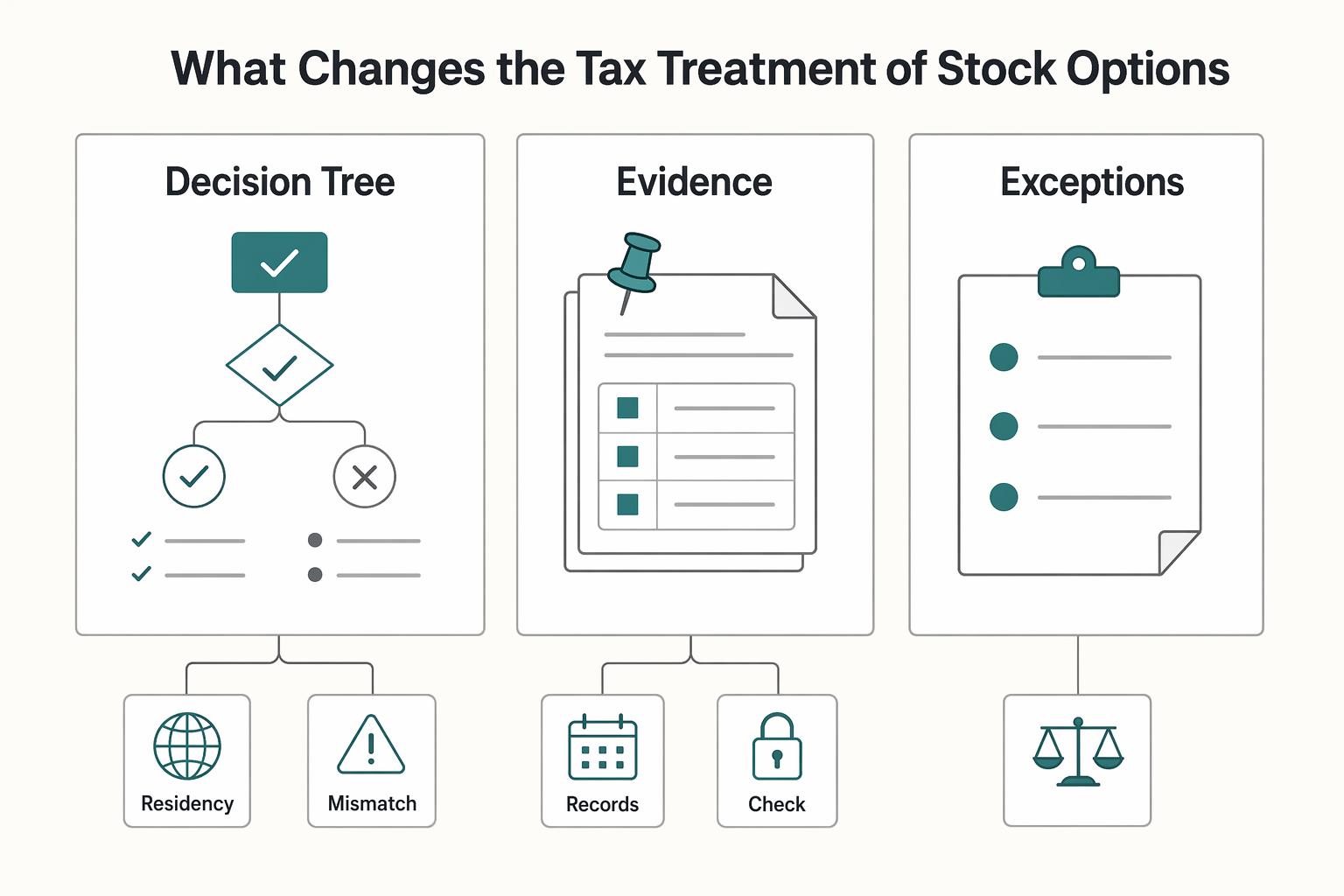
Stock options can create tax exposure at multiple moments, so sequence matters more than guesswork. Use a compliance-first order for grant, stock option exercise, and stock disposition so decisions are made before money moves.