
Quick Answer
Handle overdue invoices by verifying the record first, sending calm reminders, and escalating in stages only when the facts support it. Check the invoice, payment terms, ledger balance, and payment status before outreach, then classify the account and choose the lightest workable step, such as reminders, a payment plan, a deposit requirement, or a credit hold. Use a formal collection letter only after earlier steps fail.
A practical approach to late payment collection#
Late payments are easiest to recover when you treat them as a control process, not just a collections task. Start with clear Payment terms, send calm reminders first, move to a formal Collection letter only if reminders fail, and keep Ledger journals plus supporting records aligned so finance, ops, and legal work from the same facts.
Step 1 Treat delinquency as a cross-team control issue#
Late invoices usually signal multiple gaps at once: missed reminders, unclear invoices, loosely agreed dates, or teams acting on different account statuses. So late-payment handling should be managed across invoice setup, follow-up logic, and account controls.
Clear Payment terms are the front-end control. They are part of the sales contract, define how and when the customer pays, reduce risk, and help preserve trust. When terms are vague, every later escalation is harder to defend.
Step 2 Follow the escalation order that holds up under review#
Use the lowest-friction step first: a polite reminder by phone or email. Many late payments are simple misses, and a calm, factual tone can recover payment without harming the relationship.
If reminders fail, escalate in order: when to automate reminders, when to tighten terms, when to use smarter retry logic, and when to move to stronger recovery channels. Keep two guardrails in view: reminders come before formal demand, and B2B debt outreach still has legal obligations. Also avoid misapplying consumer-debt rules to business debt; for example, the U.S. FDCPA does not cover business debts.
Where jurisdiction changes outcomes, follow local rules exactly. In the UK, if no payment date was agreed, payment is due within 30 days of receiving the invoice or the goods or service. UK rules can also allow fixed-sum recovery charges of £40, £70, or £100 by debt band, but that is jurisdiction-specific, not a universal default.
Step 3 Preserve evidence while you chase cash#
Recovery slows down when records are weak. Keep Ledger journals current, and ensure entries are backed by the overdue Invoice, agreed terms, communication history, and related documents. Journals and ledgers are core records, and audit conclusions depend on evidence that can corroborate or contradict your position.
A practical checkpoint at the start of each delinquency cycle: confirm invoice amount, contract terms, and ledger balance match before contacting the customer. Chasing an amount that was already partly paid, credited, or disputed damages trust and creates avoidable cleanup work for finance and legal.
This guide gives you a controlled path for late-payment collections: recover cash, keep workable client relationships intact, and maintain records that support each escalation decision.
What to prepare before you chase a late invoice#
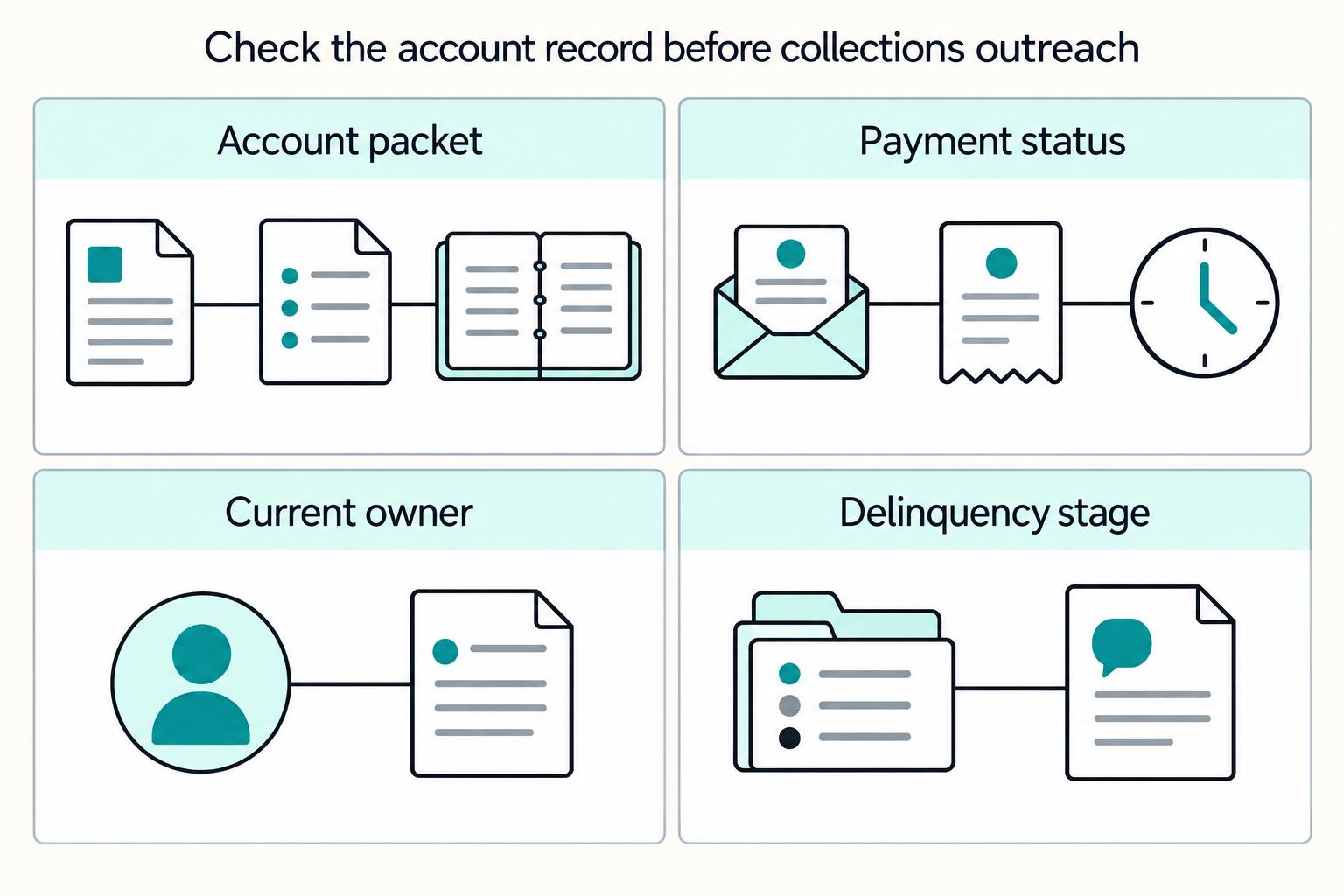
Do not send a reminder until your records and payment status match. Most avoidable mistakes happen when teams treat an invoice as overdue before checking the full account state.
Step 1 Pull one account packet#
Build one packet before outreach: the overdue invoice, written Payment terms, current balance from Ledger journals, and full communication history. We recommend keeping that packet in the same place finance and ops already review before outreach starts.
That packet should confirm two basics without interpretation: how much is due, and when it was due. If those are missing or inconsistent, fix the record first.
Step 2 Verify payment status in the product, not just in finance#
Confirm status directly from your API events and webhook-driven payout automation before collections outreach. For Stripe-based flows, this helps teams respond correctly to successful, failed, and pending states.
If you use Virtual Accounts (virtual bank account numbers), also check unmatched transfers and pending credits or returns. In Stripe invoice bank-transfer flows, transfers that cannot be auto-reconciled can remain in customer balance until manually reconciled, which is why teams need a repeatable payout reconciliation workflow.
Step 3 Assign owners before escalation starts#
Set ownership before dunning starts. A practical split is finance owns dunning, ops owns account controls, and legal reviews Collection letter triggers.
Use a simple checkpoint: each delinquent account has one current owner and one next handoff.
Step 4 Keep one delinquency stage for every team#
Use one authoritative delinquency stage across teams. Conflicting stage views create conflicting messages and weak auditability.
Require stage updates in that single record before any reminder, control action, or formal letter is sent.
Set one collections policy finance and product can both enforce#
Your collections policy should be enforceable in the product and defensible in the contract. If a stage cannot be executed reliably in-system and supported by contract language, do not ship it. We recommend removing weak stages early instead of improvising them on live accounts.
Step 1 Write each stage in plain language#
Define reminder stages, escalation stages, and allowed interventions at each stage: Late fee clause, Finance charge clause, Credit hold, or Payment plan.
State what is automatic vs optional, and who decides. For each stage, make sure everyone can answer the same three questions: what message is sent, what account action is allowed, and what evidence must be recorded. We recommend using one short decision rule per stage so handoffs stay consistent.
Step 2 Map every stage to one product action#
Tie each stage to one system action: a status tag in your API, a notification trigger through Webhooks, and a required note in Ledger journals.
Do not treat payment state as purely synchronous. Webhooks are built for asynchronous events, and for Connect implementations, webhook coverage should be required. Require idempotency for retryable collections actions and exact-key reuse on retries, since undelivered webhook events can be retried for up to three days.
Step 3 Add relationship guardrails before you need them#
Set tone standards for reminders and escalations, and define who can approve exceptions.
Document when a Payment plan is preferred over immediate penalties, and when stricter controls such as Credit hold are allowed. This keeps client communication consistent and prevents ad hoc enforcement.
Step 4 Run a legal sanity check by jurisdiction#
Before you go live, have legal confirm enforceability by jurisdiction and contract wording.
| Jurisdiction context | Grounded policy check |
|---|---|
| UK B2B late payment | Statutory interest is 8% + Bank of England base rate, but it cannot be claimed if the contract sets a different rate. |
| UK payment terms | Terms can exceed 60 days only if fair to both businesses. |
| EU commercial transactions | Creditors are entitled to interest and compensation, with at least 8 percentage points above the ECB reference rate and a minimum fixed sum of €40. |
| U.S. terminology caution | Finance charge is a consumer-credit term under Regulation Z; do not assume it governs B2B invoice terms. FDCPA references are scoped to consumer debt and third-party collectors. |
Final readiness check: legal approves contract language, finance approves ledger evidence requirements, and product confirms each stage can be triggered and reversed cleanly. We use that checkpoint to catch stage logic that looks reasonable on paper but fails once reminders and account controls run together.
Classify late payers before you escalate#
Do not run every overdue account through the same escalation path; classify first using signals you can defend in your records.
Step 1 Build three internal buckets from observable signals#
Use three operating buckets for triage: likely forgetful, temporarily constrained, and non-responsive or avoidant. Treat these as internal labels, not legal standards.
Start from criteria-based customer lists or an aging snapshot, not inbox memory. Use measurable signals: days overdue, overdue amount, account status, disputed transactions, and aging history (for example, balances already sitting in a 30 days past due bucket).
Separate first-time misses from repeat behavior by checking Ledger journals and prior Invoice aging patterns. One late invoice after a strong payment history should not be handled the same way as balances that keep rolling forward.
Step 2 Match the next action to capacity and cooperation#
Choose the action that fits both risk and cooperation:
- Likely forgetful: use a light reminder path.
- Temporarily constrained: offer a structured
Payment planwith clear installment amounts, due dates, approvals, and missed-payment consequences. - Non-responsive or avoidant with repeated delay: move to
Credit holdto restrict new credit transactions until overdue invoices are paid or the hold is manually released.
A Payment plan is an agreement to pay over an extended timeframe, so use it when there is a credible path to full payment. Use Credit hold when continuing credit would increase exposure.
Step 3 Record why you chose the path#
Document the decision in the account note or Ledger journals when you classify the account. Capture the aging snapshot date, invoice IDs, overdue amount, days overdue, dispute count (if relevant), contact history, and the selected path (Payment plan, Credit hold, or reminder-only).
This keeps enforcement consistent and makes disputes easier to defend. If your operation is covered by FDCPA/Reg F, retain these records for 3 years after the last collection activity on the debt.
Run the first seven days with structured reminders and proof of contact#
After classification, run a tight, predictable first week: three progressively firmer reminders, one owner per message, and payment-state reconciliation after every touch. This keeps the process consistent and reduces the risk of chasing invoices that are already settled or sending conflicting messages.
Step 1 Set the three reminder stages before anyone sends anything#
Do not let finance, ops, and account teams improvise from separate inboxes. Define three contacts up front: initial reminder, firm follow-up, and final pre-escalation notice, each tied to a clear delinquency-stage trigger.
| Stage | Purpose | Minimum proof to log | Required check before next action |
|---|---|---|---|
| Initial reminder | Assume delay or oversight first | Timestamp, channel, owner, invoice ID | Reconcile invoice status in Ledger journals |
| Firm follow-up | Confirm non-payment is still unresolved and request action | Timestamp, channel, owner, reply status, any payment commitment | Reconcile again before sending anything else |
| Final pre-escalation notice | Signal movement to the next intervention | Timestamp, channel, owner, prior contact references | Confirm balance, disputes, credits, and any settled entries |
Keep this centralized. If collections stage lives in the API, every reminder action should read that same stage value before firing.
Step 2 Use channel redundancy, but keep one message owner#
Use more than one contact path when needed. A grounded pattern is multi-channel follow-up (for example, email, WhatsApp, SMS, or post in documented follow-up systems). If your product supports it, you can also pair email with an in-app or account notice, as long as all messages come from the same stage logic and are tracked through your Webhooks.
The tradeoff is reach versus confusion. Multiple channels help only when message content stays aligned: same ask, same invoice references, same next-step deadline. If you offer a self-service payment status page, keep it aligned with the same message set. Assign one owner to draft the message set, even if delivery is multi-channel.
Your log should capture contact person, date/time, channel, Invoice reference, and any promise to pay. If a customer makes a payment commitment, record it in the account note immediately.
Step 3 Reconcile after every reminder before sending the next#
Before the next touch, verify payment state in Ledger journals and check whether an API event or Webhook already marked the invoice paid, partially paid, credited, or disputed.
Use this checkpoint each time:
- Has the invoice been fully settled?
- Has a partial payment changed the balance due?
- Has a credit, return, or dispute changed what you should request?
- Is there a documented promise to pay that should pause or adjust outreach?
At each checkpoint, either advance to the next reminder stage or exit the reminder path because the facts changed.
Step 4 Build duplicate protection into reminder triggers#
The main failure mode is duplicate or contradictory notices from retries. Webhook delivery can be retried after failures, and API requests can be retried by systems or operators. Without safeguards, one overdue event can produce multiple sends or stage changes.
Use Idempotency keys for reminder-producing create/update calls so retries do not repeat the underlying action. Operationally, tie each reminder request to a unique business identifier (invoice + stage) and confirm repeated attempts resolve to one side effect in delivery logs.
Step 5 Add a call-frequency guardrail if phone outreach starts#
If you move from digital reminders to calls, add a compliance check before dialing begins. In contexts covered by U.S. Regulation F, a threshold includes more than 7 calls within 7 consecutive days. This is not a universal B2B rule and does not apply in every jurisdiction, but if your process could fall under that regime, call counts should be controlled and logged.
By the end of the first seven days, you should have a consistent message trail, verifiable proof of contact, and a current payment-state record in Ledger journals. If those are missing, fix the evidence before escalation.
Decide between payment plan deposit requirement or credit hold#
After first-week reminders are reconciled, change terms, not tone: use a Payment plan to recover overdue cash from responsive accounts, a Deposit requirement to limit risk on new work, and Credit hold when delinquency is chronic.
Step 1 Match the control to the account pattern#
Do not decide from overdue Invoice size alone. Use Ledger journals and account notes to check aging, promises to pay, partial settlements, credits, disputes, and near-term order exposure. Pick the control based on the risk you need to manage next: recovery of old cash, prevention of new risk, or both.
| Option | Best fit | Likely relationship effect | Operational burden |
|---|---|---|---|
Payment plan | Strategically important client who is responsive and acknowledges the debt | Usually preserves goodwill by giving a path forward | Highest follow-up load (installment tracking and default handling) |
Deposit requirement | Client is still buying, but risk is rising on new work | Moderate friction from tighter terms | Medium burden (quotes, orders, and billing terms must change) |
Credit hold | Repeated/chronic delinquency or non-responsive behavior | Highest tension because new credit purchases can be blocked | Lower day-to-day discretion once active, but exceptions need control |
Use Credit hold when you must stop unsecured exposure. In Oracle Receivables and NetSuite, hold controls can block or restrict new credit sales until overdue invoices are paid or the hold is released.
Step 2 Choose the intervention with explicit if-X-do-Y rules#
If the client is strategic and still engaging, start with a Payment plan. It should be a formal agreement to pay over time, not an open-ended promise.
If new work is increasing exposure faster than old debt is shrinking, move to a Deposit requirement. This tightens risk without fully ending the relationship.
Apply Credit hold when delinquency is chronic, explanations keep shifting, or earlier accommodations failed. In Dynamics 365 Credit management, blocking rules can react to days overdue, account status, and Payment terms.
Before you apply any option, confirm you can show from Ledger journals and account notes why this account is being treated differently from a first-time late payer.
Step 3 Rewrite terms in your controls, not just in email#
Once you reach agreement, update Payment terms, invoice schedules, and missed-payment consequences immediately. If old terms remain active, teams will create inconsistent exceptions.
Check contract-modification requirements before relying on informal agreement. If your contract requires signed modifications, treat signed changes as required evidence in practice. Keep the overdue Invoice, valid amendment, updated billing schedule, and approver/date together.
If you approve a plan, also decide new-work posture at the same time: continue normal terms, require deposit, or pause.
Step 4 Reactivate cautiously and log every exception#
For high-risk reactivation, use tighter terms such as Cash-on-delivery terms until behavior improves. C.O.D. requires payment at delivery and can reduce nonpayment risk, but it does not remove risk.
Record approvals and exceptions in the same audit trail as the Invoice and Ledger journals. Log decision reason, approver, effective date, review date, and release condition so hold bypasses or deposit waivers are visible and reviewable.
Send a collection letter that can survive legal review#
When reminders and negotiated term changes fail, use a formal Collection letter based on policy, not frustration. It should read like a factual record you could hand to counsel or a court. If your team needs a starting point, compare it with how to send a demand letter for an unpaid invoice before legal review.
Step 1 Trigger the letter from a defined escalation point#
Send the letter only after your pre-set escalation conditions are met. Confirm the account status against Ledger journals, and clear unresolved credits, returns, or disputes before you draft.
Before sending, verify the overdue balance, exact Invoice IDs, governing Payment terms, and dates of prior contact attempts. Sending a formal demand after payment posts or while internal records conflict creates avoidable credibility risk.
If you operate in the UK, apply scope carefully. A Letter of Claim is expected before proceedings for covered debt claims, but the Pre-Action Protocol for Debt Claims does not apply to all B2B debt; it does not apply to business-to-business debts unless the debtor is a sole trader. Where it does apply, the protocol includes standard response documents and a 30 days reply window.
Step 2 State only facts you can prove#
A review-safe letter is factual, complete, and narrow. Include only what you can evidence and the cure you require.
Include:
- overdue
Invoicenumbers and amount due - agreed
Payment terms - when payment became overdue
- prior contact attempts with dates and channels
- whether interest or other charges are continuing, where your terms and jurisdiction support them
- the exact cure action and deadline
Avoid assumptions about intent or bad faith. State what happened, what is owed, and what resolves it.
Step 3 Keep the tone firm, professional, and inside your legal position#
Use professional language and clear consequences. Say what you need and what comes next, but do not threaten action you cannot legally take or do not intend to take.
That boundary is explicit in U.S. debt-collection standards: no harassment or abuse (15 U.S.C. 1692d) and no false or misleading representations, including empty legal threats (15 U.S.C. 1692e). Even when those rules do not govern your exact workflow, the drafting discipline still helps: stay factual, avoid pressure tactics, and avoid bluffing.
If legal action is genuinely plausible, route the draft to counsel before it is sent.
Step 4 Route legal-risk drafts through counsel and preserve the evidence pack#
If the next step may be proceedings, counsel review is usually worth the delay. Attorney demand letters can be firm, but your file still needs to support every factual statement.
Store the final package with the account record:
- final approved letter
- overdue
Invoicecopies - signed contract or accepted
Payment terms - contact log with dates, channels, and owners
- current balance support from
Ledger journals - counsel comments or approval record, if used
If that packet is incomplete, fix the file before escalating.
Use platform controls to reduce manual chasing#
Once you have a formal escalation path, reduce manual chasing by making stage changes event-driven and verifiable. The goal is to move accounts between reminder, restriction, and recovery states based on confirmed events, not team memory.
Step 1 Automate stage changes from API rules and Webhooks#
Make your API the stage-of-truth, and use Webhooks to advance work when real events occur. Webhook endpoints receive real-time event payloads, which fits late-payment operations where bank confirmations, failed transfers, and status updates happen asynchronously.
Trigger stage changes from evidence, not assumptions. If payment is confirmed, clear reminder state; if an invoice crosses your policy threshold without cure, trigger the next notice or Credit hold. Where supported, use transaction rules that auto-approve or auto-decline authorizations so hold/allow decisions are consistent.
Set one hard checkpoint: each stage-changing event should reconcile to the same account record and Ledger journals entry before the next action fires. Treat duplicate or out-of-sequence events as expected failure modes, and design for safe handling rather than exactly-once assumptions.
Step 2 Reduce bank-transfer friction with Virtual Accounts or Virtual Bank Accounts (VBAs)#
If bank transfer is a meaningful payment rail, use Virtual Accounts or Virtual Bank Accounts (VBAs) to lower collection friction. Virtual accounts can automate payment processing, and VBAs let customers pay to a provided virtual account number instead of reusing manual wire instructions.
This helps most when delays come from process friction, not unwillingness to pay. Dedicated virtual account details can improve matching and reduce manual collection effort, and some providers offer local account details that make cross-border collection feel more like a local transfer flow.
Keep the limitation explicit: availability is provider- and region-dependent. Validate country/currency support before building dunning paths around these rails, and confirm incoming transfers map cleanly to the right customer and overdue Invoice without manual investigation.
Step 3 Gate risky actions with KYC, KYB, and AML checks#
Collections pressure should not bypass compliance controls. Route risky account actions through your existing checks, especially when delinquent accounts request payout-detail changes, show unusual movement, or try to expand payment activity while overdue.
In U.S.-regulated programs, Customer Identification Program (CIP) is part of the AML compliance program. For legal entities, beneficial-owner identification and verification can be required at account opening, with rule-based exclusions, and AML obligations include ongoing monitoring for suspicious transactions.
Operationally, keep identity, business verification, and monitoring controls active even when an account is trying to settle quickly.
Step 4 Keep retries safe with Idempotency keys#
Use Idempotency keys on create or charge-like actions so retries after timeouts or connection errors do not duplicate recovery actions. The practical rule is simple: store the key with the action record and reuse that same key for retries of that same operation.
If you generate a new key on each retry, you can create duplicate penalties, duplicate holds, or duplicate objects. On Stripe, idempotency keys can be up to 255 characters, and keys can be removed once they are at least 24 hours old, so align retry logging and retention to that window.
This control stack reduces late-payment exceptions created by your own platform and keeps finance effort focused on real recovery work.
Handle cross-border constraints before final escalation#
Do not treat cross-border non-payment as refusal until you clear compliance blockers. Before legal escalation, verify tax documents, VAT status, and payout holds that can stop funds from moving.
Step 1 Check tax-document gaps first#
Start by confirming the tax forms needed for correct reporting and withholding are complete. For U.S.-reportable payments, Form W-9 provides the taxpayer identification number, and missing or incorrect TIN data can trigger backup withholding; if no TIN is provided, backup withholding must begin, at 24 percent.
For foreign individuals, Form W-8BEN is used to establish foreign status for U.S. withholding purposes. Also resolve Form 1099 confusion early: payment-card and third-party network transactions may be reportable on Form 1099-K by the payment settlement entity, not on Form 1099-MISC or 1099-NEC.
Step 2 Validate VAT status where the invoice depends on it#
If the invoice depends on EU cross-border VAT treatment, validate VAT status before escalating. VIES can be used to check whether a business is registered to trade cross-border within the EU, and VAT numbers identify customer tax status in that context.
Record the result in the account file with a timestamp. In the UK, the VAT checker can also be used to prove when you checked a UK VAT number. Keep this country-specific: VAT validation requirements and acceptable evidence are not identical everywhere.
Step 3 Inspect payout holds before blaming the counterparty#
If the payment flow uses platform Payouts or Payout batches, check hold reasons directly in platform or processor records before you treat it as refusal. Payouts can be paused when required tax-status information is missing, and verification requirements such as KYC checks can block processing or payout.
Review requirement queues, compliance notices, and payout status fields (paused, pending, blocked). On Stripe Express, payouts may be paused for missing tax-status information and should be unpaused within two business days after successful W-8/W-9 submission if no other requirements remain.
Step 4 Escalate only with an audit-ready evidence pack#
Escalate to legal only after compliance and documentation checks are complete. Build one evidence pack with the overdue invoice, signed terms, ledger position, contact history, tax-form request history, VAT-check evidence, and payout-hold records.
That prep matters in cross-border recovery. EU EAPO filings require relevant supporting documents, and UK civil procedure expects pre-action steps before proceedings. If key evidence is missing, complete the file before final escalation.
Common mistakes and how to recover quickly#
Once tax, VAT, and payout blockers are cleared, most avoidable losses come from four operator errors: wrong treatment, split system state, weak terms, and late formal review.
Step 1 Classify the payer before you act#
Treating every late payer the same is the fastest way to compound risk. Use rule-based classification first, then match the intervention to account history at the customer, account, bill-to, or delinquency level.
If the issue looks temporary and the payer is responsive, use a Payment plan. If lateness is recurring, limits are exceeded, or risk is elevated, move to Credit hold. Base that choice on prior aging and Ledger journals, not only the latest explanation.
Step 2 Centralize delinquency stage in one place#
Separate collections and product workflows create contradictory actions. Keep delinquency stage in the API as the live status, and reconcile every reminder, hold, and release through Ledger journals so finance, ops, and support are working from one state.
Build recovery actions to handle duplicate webhook deliveries and retries. Use idempotent handling so the same event does not trigger duplicate notices or conflicting account controls.
Step 3 Tighten contract language on the next paper cycle#
Weak terms should be fixed at renewal or onboarding, not after default. Set Payment terms in advance and in writing, and clearly reserve any Late fee clause and Finance charge clause rights that apply to the agreement.
Keep jurisdiction scope explicit. UK commercial late-payment rules may allow statutory interest at 8% plus the Bank of England base rate, but that is not a global default.
Step 4 Force earlier formal-letter review#
Escalating late usually means legal gets an incomplete file. Set mandatory trigger points for Collection letter review using dunning level or repeat-lateness criteria, not collector discretion.
When a trigger is hit, review for concrete claim facts: basis of claim, summary of events, debt amount, and whether interest or other charges continue. Also keep scope straight: the UK Debt Protocol is not a blanket rule for all B2B debt cases.
Copy and paste checklist for your next delinquency cycle#
Use this sequence, and pause escalation when a checkpoint fails so you can fix record quality first.
-
Gather the evidence packet first. Pull the overdue
Invoice, signedPayment terms, contact log, and current delinquency status fromLedger journals. Confirm the balance, due date, and account status match across invoice records, ledger state, and received payment events before you proceed. -
Classify the account, then choose one path. Route to reminder only, a
Payment plan, aDeposit requirement, orCredit holdbased on account history, prior aging, and responsiveness, not just the latest explanation. -
Send staged communications with duplicate-safe execution. Track notices through your
API, assumeWebhooksmay deliver duplicate events, and deduplicate by processed event ID. Use anIdempotency keyon retryable actions so timeouts do not create duplicate reminders, duplicate holds, or conflicting status updates. -
Run tax and compliance checks before legal escalation. Use
W-9when you need a U.S. person TIN for IRS information-return workflows, andW-8BENfor a foreign individual when requested by the payer or withholding agent. Validate EU VAT via VIES, and use the UK VAT checker for UK numbers because VIES stopped validating UK (GB) VAT numbers on 01/01/2021. If KYB or AML review is part of your controls, confirm it is complete before treating the case as non-cooperation. -
Close the loop so the next cycle is cleaner. Record what failed (for example weak
Payment terms, missing VAT validation, noIdempotency key, late legal review, or wrong path selection), then update policy, contract language, and automation rules in the same operational system your team uses for collections.
Conclusion#
Make collections more consistent, not more aggressive. To improve your late-payment approach, focus on one enforceable policy, one clean source of truth, and one event-driven way to apply each stage without guesswork.
Step 1 Define the few decisions your team must make#
Define the few decisions your team must make, then stop there. Your rule set should cover what happens after a missed due date, what evidence must be checked before outreach, who can approve a payment plan or credit hold, and when legal review is required.
Late payment is not always refusal to pay: UK DBT research reports administrative errors as a cited cause for 24% of surveyed businesses, and it also notes supply-chain ripple effects from cash-flow pressure. Before escalating, verify the overdue invoice, signed Payment terms, contact trail, and current balance in Ledger journals. If records do not align, fix the record first.
A simple test: review five recently overdue accounts and check whether finance, ops, and product place each one in the same stage using only the written rule. If they do not, the policy is still too vague to enforce.
Step 2 Drive stage changes from payment events#
Instrument that policy in your API stack so stage changes come from payment events, not memory. A Webhook endpoint can receive real-time events and trigger the next action automatically, helping keep reminders, holds, and account status aligned.
Control retries so automation does not create new errors. Without retry controls, teams can send duplicate notices, apply duplicate holds, or reopen settled issues after timeouts. Use an Idempotency key on retryable write actions so transient failures do not perform the same operation twice.
Set an explicit verification check after each automated action: confirm account stage and ledger state still match. If a reminder fires after settlement, or ledger state changes without downstream updates, your event handling needs tightening.
Step 3 Tighten commercial terms and document why#
Tighten commercial terms when account behavior supports it, and document why. Repeated lateness after reminders and cooperative outreach is different from a first miss caused by an administrative error; responses should differ accordingly.
Keep legal context specific to debt type. Consumer-debt communications can be regulated, and scope differs by context, so do not assume consumer rules map directly to B2B flows. If a formal collection letter or legal action is being considered, get counsel to confirm applicability before standardizing templates, especially if you automate late fees by country.
Before you lock the workflow, re-test it against 2025 and 2026 customer contracts and confirm whether late charges, payment-plan terms, or hold notices reuse examples such as 40 EUR, 70 GBP, or 100 GBP only in the jurisdictions that actually allow them. That check keeps finance, ops, and legal from enforcing a rule that reads one way in the playbook and another way in the signed agreement.
If you do one thing next, choose one overdue stage, define its exact trigger, and wire it to a webhook-driven action with a supporting note in Ledger journals. That gives teams a rule they can apply consistently and review with confidence.
Frequently Asked Questions
What is the best way to handle late payments without damaging client relationships?
Verify the invoice, payment terms, and ledger balance before outreach. Then use a professional, respectful tone and start with a light reminder. If the records do not align, fix them before escalating.
When should we offer a payment plan instead of applying a credit hold?
Offer a payment plan when the client acknowledges the debt and can commit to a realistic repayment schedule. Apply a credit hold when lateness is recurring, exposure is rising, or the client is non-responsive. If you approve installments, document dates, amounts, and missed-payment consequences.
When should a deposit requirement replace standard payment terms?
Use a deposit requirement when you want to continue the relationship but limit new exposure while overdue balances are being worked down. It is tighter than standard terms without fully shutting off activity through a credit hold. Update the written payment terms so every team enforces the same rule.
At what point should we send a formal collection letter?
Send a formal collection letter after the reminder sequence fails and your defined escalation trigger is met. Verify the balance, invoice IDs, payment terms, and prior contact history first. Get legal review where timing or scope is jurisdiction-specific.
How do we prevent repeat late payments across many accounts, not just one?
Treat repeat lateness as a system problem, not a one-off case. Use one stage logic across accounts and automate blocking rules with criteria such as days overdue, account status, payment terms, expired credit limit, and overdue amount. Use idempotency keys on retryable actions so reminders, holds, and status changes do not duplicate.
What should finance check in ledger records before escalating to legal action?
Confirm that invoice records, ledger journals, payment events, and account status all match. Verify the contact trail is complete and consistent, and clear any credits, returns, or disputes. Legal should receive a clean evidence packet, not a file that still needs rebuilding.
How do compliance checks like KYC, KYB, and AML affect collections timing?
These checks can create legitimate delays, so a delay is not automatically refusal to pay. Missing W-9 or W-8BEN documentation can stall processing or trigger backup withholding, and payout or verification requirements can also block processing. Keep compliance checks active even when an account is trying to settle quickly.
Researched and edited by the Gruv editorial team. Gruv builds cross-border billing, payouts, and finance-operations software for global businesses.
Sources
- consumer.ftc.gov/articles/debt-collection-faqstrusted
- consumerfinance.gov/rules-policy/regulations/1006/100trusted
- consumerfinance.gov/rules-policy/regulations/1006trusted
- ecfr.gov/current/title-31/subtitle-B/chapter-X/part-1...trusted
- ecfr.gov/current/title-12/chapter-X/part-1006trusted
- federalreserve.gov/supervisionreg/topics/mgmt_n_internal_contro...trusted
- ftc.gov/legal-library/browse/statutes/fair-debt-coll...trusted
- irs.gov/payments/payment-plans-installment-agreementstrusted
Educational content only. Not legal, tax, or financial advice.
Related Posts

The Freelance Payment Penalty: A Modeled Audit of Platform Fees, FX Spreads, and Payout Delays
The money rarely disappears through a single, easy-to-spot fee. The real loss is stacked. A marketplace takes its commission, a processor adds a charge for international cards, a bank or payment company converts the currency at a spread, a platform holds the funds before release, and a wire sheds a little to intermediaries on the way in. Each layer looks defensible on its own, but the worker feels the combined result as a smaller deposit and a later payday.

How to Respond to a Subpoena for Business Records
Move fast, but do not produce records on instinct. If you need to **respond to a subpoena for business records**, your immediate job is to control deadlines, preserve records, and make any later production defensible.

A US Expat's Guide to Investing in UCITS ETFs to Avoid PFIC Issues
The real problem is a two-system conflict. U.S. tax treatment can punish the wrong fund choice, while local product-access constraints can block the funds you want to buy in the first place. For **us expat ucits etfs**, the practical question is not "Which product is best?" It is "What can I access, report, and keep doing every year without guessing?" Use this four-part filter before any trade: