
Quick Answer
Use a decision table that links each processor code and payment state to a permitted action, timing, message and owner. Resolve unknown outcomes before another charge, stop prohibited retries and send clear remediation requests when customer action is needed. Coordinate collection paths and compare net recovery with the actual baseline.
Smart dunning is a systems decision not a billing toggle#
Step 1 Treat smart dunning as an operating model#
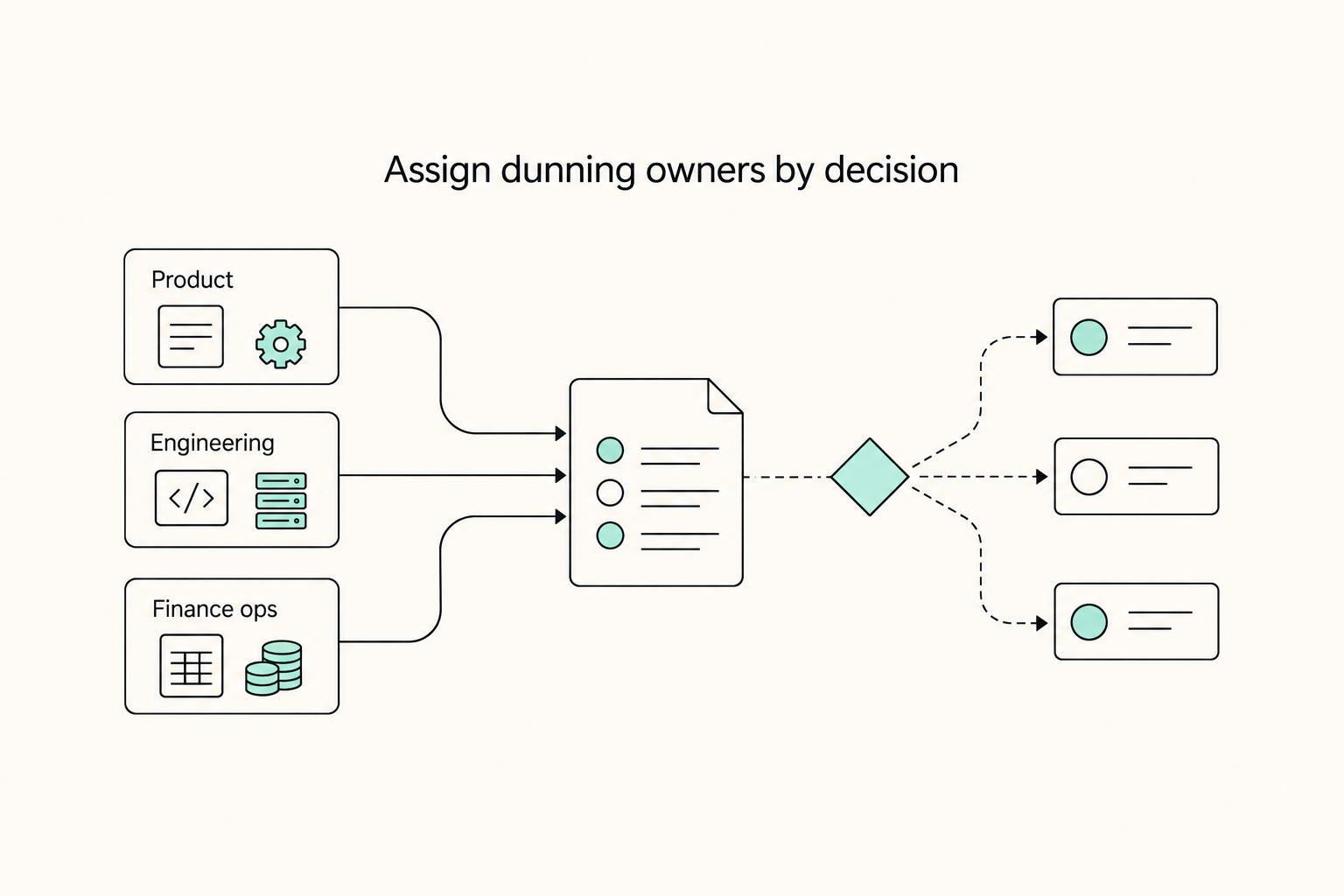
If you treat retry logic as a billing setting, you may get some upside and still create hidden operational gaps. A better starting point is shared ownership across teams. Product decides customer treatment. Engineering controls retry execution and event integrity. Finance ops owns reconciliation and audit-trail review.
Failed renewals affect both collections and continued access. Measure their actual frequency and downstream churn in your own subscription cohorts before choosing a recovery policy; a broad vendor benchmark cannot tell you the recoverable share of your failures.
Step 2 Define the tradeoff before you tune anything#
Your job is to recover more valid payments without turning a temporary failure into customer frustration. In practice, that means separating temporary technical or issuer conditions from permanent card failures or states where the customer needs to act. If you do not split those lanes, you can end up retrying when you should be asking for a new payment method.
A simple decision rule works well at the start: retry more aggressively only when the failure reason suggests the payment could still clear. Stop earlier when the decline points to a hard failure or customer action. That is why vendor lift claims should be treated as inputs, not proof that your setup will perform the same way. Reported lifts vary, and they are vendor specific, not universal.
Step 3 Decide what this guide will help you build and verify#
This guide is not a vendor feature tour. The practical outcome is a retry sequence with stop rules, instrumentation, and verification checkpoints you can defend internally. That means attempt-level logging, reason-code classification, clear escalation ownership, and evidence that every retry outcome can be reconciled later.
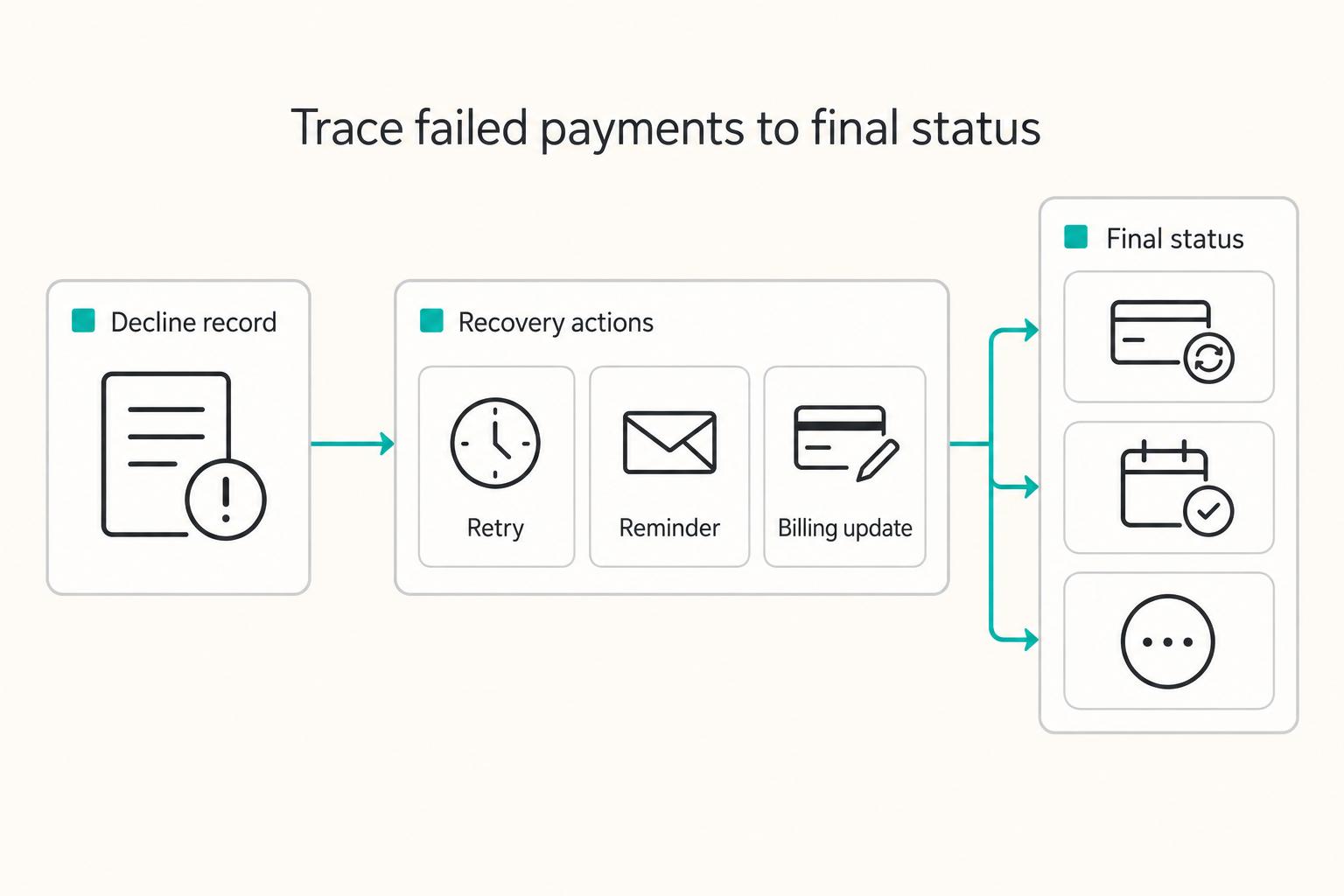
Your first checkpoint is operational, not statistical. Can you trace one failed payment from the initial decline through each retry attempt, customer message, and final outcome without stitching together screenshots? If not, your audit trail is too weak to trust any recovery claim. A common risk is a black-box setup where billing says recovery improved, engineering cannot explain execution order, and finance cannot match provider outcomes to ledger entries.
Success fits on one line: higher recovered revenue, lower involuntary churn, and a cleaner audit trail. The next step is getting the evidence pack in place before you change any rules. Related: A Guide to Dunning Management for Failed Payments.
What to prepare before you touch retry rules#
If you cannot explain your current failure paths on one page, pause before changing retry rules. You need a clear baseline first so you can separate real recovery from noise.
Step 1 Assemble the minimum evidence pack#
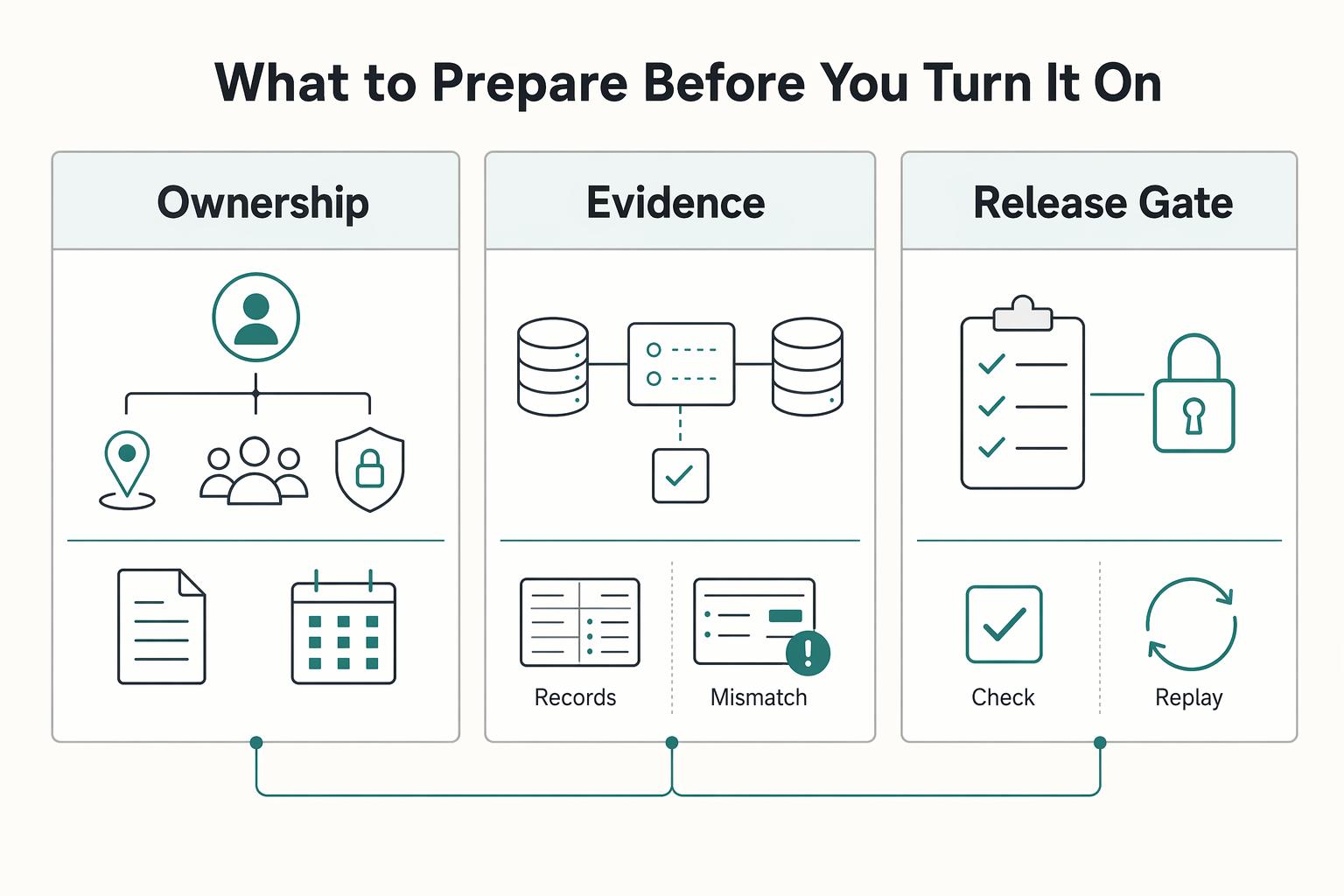
Collect three inputs before you change anything: your payment processor decline taxonomy, your current subscription-billing retry settings, and a baseline for recovery and involuntary churn. Split failures into hard and soft declines, since soft declines are often the recoverable lane.
| Preparation item | Instruction | Reason |
|---|---|---|
| Payment processor decline taxonomy | Collect before you change anything | Split failures into hard and soft declines |
| Current subscription-billing retry settings | Collect before you change anything | Establish a clear baseline |
| Baseline for recovery and involuntary churn | Collect before you change anything | Separate real recovery from noise |
| Retry timing | Export as a separate track | Understand what actually drove recovery |
| Customer messaging | Export as a separate track | Understand what actually drove recovery |
Export retry timing and customer messaging as separate tracks. Automated dunning works through two coordinated components, retries and messaging, and you need both views to understand what actually drove recovery.
Step 2 Verify the primitives, do not assume them#
Confirm how retries are executed, how payment events are delivered, and how outcomes are recorded for reconciliation. Run a practical check: trace one failed payment from first decline through retries and final outcome without ambiguity.
If that path is unclear, fix observability before tuning logic. Otherwise you will not be able to trust performance changes.
Step 3 Assign owners by decision type#
Keep ownership explicit. Product owns customer policy, including when to retry versus when to ask for customer action. Engineering owns retry execution and event integrity. Finance ops owns reconciliation, post-recovery record updates, and audit-trail review.
| Owner | Owns | Article detail |
|---|---|---|
| Product | Customer policy | When to retry versus when to ask for customer action |
| Engineering | Retry execution and event integrity | How retries are executed and how payment events are delivered |
| Finance ops | Reconciliation, post-recovery record updates, and audit-trail review | How outcomes are recorded for reconciliation |
Step 4 Set scope boundaries before phase one#
Write down where merchant-initiated transactions apply, where automatic downtime retries already run, and which flows are out of scope in phase one. If gateway-level retries already exist, confirm execution order before adding app-level retries. Related reading: Subscription Billing Platforms for Plans, Add-Ons, Coupons, and Dunning.
Table stakes every credible retry strategy must include#
At minimum, do not run one retry path for every decline, and do not rely on dunning emails alone. Your strategy should combine retry timing, customer messaging, routing where supported, and explicit stop rules.
Compare the right baselines. Traditional dunning can include both scheduled retries and customer messages. Compare the actual current configuration with a proposed change, such as adaptive timing, rather than defining the baseline as email-only. Keep payment method, decline mix and observation window comparable.
Split failure lanes in your retry management system. Use separate paths for transient processor or network failures and customer-action-required failures. If expired cards and network glitches trigger the same sequence, your logic is too blunt.
Add routing only on an eligible, authorized path. Confirm credential portability, recurring-payment consent and processor/network rules. Resolve the original attempt before a new gateway can charge; a timeout is not a decline. Choose one owner for the collection path and prevent concurrent provider and application retries.
Define hard stops in dunning management policy. Stop criteria should be based on customer experience and risk, not just attempt count. Document when to pause retries, when to switch messaging to payment-update requests, and when exceptions move to finance or support review.
Build your retry sequence by failure reason and customer state#
Build a decision table from the actual processor decline code, advice and payment state. Retry only where the selected program permits it. Customer-action, authentication, revoked-authority and do-not-retry failures take their required remediation path; unknown outcomes require lookup before any new charge.
Step 1: Create a usable decision table. Use recent failed payments and map each decline group to next-attempt timing, channel action, and escalation owner, then document the stop condition for each path. Keep it aligned to your subscription billing policy, not default vendor settings.
| Decline pattern | Next attempt timing | Channel action | Escalation owner |
|---|---|---|---|
| Timeout or uncertain processing | Retrieve original result; exact supported replay only | Status message if needed; avoid a new charge | Payments ops/Engineering |
| Insufficient funds with retry permission | Use approved schedule and actual processor limits | Reminder at a defined checkpoint | Finance ops/Product |
| Expired credentials or required authentication | Use supported updater or customer remediation; obey processor advice | Specific payment-update or authentication request | Product/Support |
| Revoked authority, prohibited retry or risk block | Stop prohibited charges; obtain required remediation/approval | Explain the permitted next step | Compliance/Support |
Separate retry eligibility from remediation. A soft label does not override processor advice, consent or a risk block. For example, Stripe Billing does not execute retries after its listed hard declines until a new payment method is obtained; scheduled attempt counters can still increase without a new charge.
Vary timing within eligibility and consent. Value and risk can inform a permitted retry policy, but high invoice value never authorizes bypassing a no-retry instruction or an unresolved original outcome.
Optimize inside the actual boundaries. Record the network, processor, decline/advice code, observation window and required stop action for each lane. There is no universal 15-in-30 rule for every payment or decline. Respect tighter prohibitions and any account-specific attempt limit before testing timing.
You might also find this useful: How to Build a Dunning Campaign for Your Platform: Sequence Timing and Messaging.
Decouple payment attempts from messages and escalation paths#
Configure message rules separately from attempt timing. Contact should have a purposeful trigger and respect consent and required notices, rather than fire mechanically because every retry ran. Send required customer remediation promptly; useful status or receipt information can also be appropriate without an action.
Step 1 Separate retry events from communication events#
Treat a payment attempt and a customer message as different events with different triggers. Failed payments can come from different causes, including insufficient funds, expired cards, outdated details, account or data issues, and system failures, so one message cadence for every retry creates avoidable noise.
Keep separate fields for retry outcome and communication trigger. Audit each sent or suppressed message against its purpose, the current payment state and applicable notice or consent rules; a cohort need not contain silent retries to be valid.
Step 2 Escalate when customer action is actually required#
When customer action is required, send the specific remediation request promptly rather than waiting for another retry checkpoint. For an eligible transient failure, use planned timing and status-message rules. Avoid repeated generic prompts that do not explain the next step.
Step 3 Measure retry impact and message impact separately#
Do not treat recovery as one blended outcome. Track and review separate labels for:
- retry-driven recovery
- message-driven recovery
- manual-escalation recovery
Use one mutually exclusive primary recovery-path label per invoice, plus separate flags for updater activity and customer contacts. A message can precede a successful retry, so summing overlapping labels would double-count recovery. Compare the changed policy with a matched baseline or holdout before attributing uplift.
Engineer the control plane for retries you can trust#
You can trust a retry program only when each attempt is explainable from trigger to outcome to finance record. Keep retries and messaging coordinated, but run them as separate components so temporary failures can recover without unnecessary escalation.
Link the obligation and each authorized attempt. Keep one durable invoice or subscription-cycle ID, with separate attempt IDs and provider references. Atomically claim execution so only one collection path can run. Persist the provider key, payload and scope before submission; exact request replay recovers that attempt’s result and does not authorize a new charge.
Verification point: pick one failed payment and confirm you can trace one attempt identity from app trigger to final internal status.
Process verified events durably. Verify signatures, persist receipt before acknowledgement, deduplicate event and business effects, and serialize versioned state changes. An older failure must not reopen a paid invoice or overwrite a later outcome. Retrieve current provider records when an event is incomplete or arrives out of order.
Verification point: replay the same webhook payload twice in staging and confirm you still end with one attempt and one final state.
Make reconciliation a first-class output of retry handling. For each retry outcome, write an accounting or reconciliation record that links back to the same attempt identity and billing reference. Finance should be able to match provider outcomes to internal decisions without manual stitching across screenshots, inboxes, or dashboards.
Verification point: ask finance ops to reconcile a sample day of recovered payments without engineering intervention.
Choose one collection owner. Coordinate every provider-managed and app-managed recovery path, not just downtime retries. Before a new attempt, prove the original cannot still collect and verify the obligation is still due. While a result is unknown, investigate its provider reference or replay the exact request only within supported scope and retention.
Verification point: review a sample downtime window and confirm each obligation followed one intentional retry path.
Measure recovery quality not just recovery volume#
Recovered revenue alone is not enough to judge retry quality. Measure whether recovery improves without adding customer friction, finance cleanup, or unresolved exceptions.
Step 1 Build a scorecard that shows both lift and damage#
Use one shared minimum scorecard for every retry variant:
| Metric | Detail | Why it matters |
|---|---|---|
| Net recovered value | Collected amount less refunds, disputes and recovery-related fees/support cost, in one observation window | Shows economics rather than gross collections |
| Executed retry success by attempt band | Successful executed attempts divided by eligible executed attempts in each band; report counts | Do not count scheduled but unexecuted attempts as charges |
| Invoice recovery rate | Recovered originally failed invoices divided by originally failed invoices in the defined cohort | Deduplicate invoices and separately report amount recovery |
| Time to recovery | Elapsed time from first failure to collection, with pending cases reported | Recent unfinished cohorts can look artificially weak |
| Involuntary churn and contacts | Failed-payment losses and contact/support rates using stated denominators | Track customer cost and define exclusions consistently |
This keeps product, engineering, and finance ops aligned on the same outcome quality. Dunning combines payment retries and customer messaging, so collections can improve while retention outcomes worsen if the experience breaks down.
Verification point: for one recent week, confirm each recovered payment maps to an attempt band and a customer state, not just a top-line recovery label.
Step 2 Compare cohorts under matched conditions#
Only compare traditional dunning and Smart Dunning retries when processor and segment conditions are closely matched. Keep processor, payment method, region, customer type, and failure class as consistent as possible so the result is decision-useful.
Track both cohorts in the same review document: cohort dates, retry depth, message rules, processor setup, and any provider-managed retries suppressed at app level. A fixed-delay baseline, for example retrying 24 hours later, can still work as a control, but not if the cohorts differ materially.
Use the same mature observation window for every cohort. Recent failures still in recovery cannot be compared directly with completed cohorts; include failed invoices once, retain their amounts, and report exclusions and pending outcomes.
Step 3 Add reliability gates before you scale#
Put reliability checks beside recovery metrics before expanding sequence depth. Review reconciliation completeness in ledger journals, webhook failure rates, and exception aging in your audit-trail process on every deeper sequence test.
Use one strict decision rule: if recovery lift appears with rising complaints or reconciliation breaks, roll back sequence depth before scaling.
Common failure patterns and how to recover fast#
When a retry program starts creating confusion, mistrust, or finance cleanup, fix the trust break first, then retest sequence depth under the same scorecard from the last section.
Step 1 Separate payment attempts from customer messaging#
A retry and a customer message need separate triggers. This avoids unnecessary repeated notices while allowing required communications, prompt remediation and useful status information where appropriate.
For transient, eligible failures, apply the planned timing and message checkpoints. When customer action is required, stop prohibited attempts and send the specific remediation request. Review a sample of failed invoices for eligibility, consent, attempt counts, final outcomes and contact frequency rather than assuming a universal attempt cap.
Step 2 Enforce replay safety before chasing more recovery#
Duplicate charges can arise when an unresolved original is replaced or independent retry systems act together. Preserve one collection obligation, atomically authorize each permitted attempt and reconcile provider results before allowing another collection. Provider idempotency alone does not coordinate different gateways.
Pause new sequence tests until engineering and finance can show clean outcomes in logs and settlement results. A practical weekly check is simple: look for repeated successful captures on the same invoice and amount, then stop deeper retries if you find them.
Step 3 Make each attempt explainable#
If nobody can explain how a recovery happened, the result will not survive review. Log each attempt and tie outcomes to ledger journals and your audit trail, not just a final recovered flag.
Because different failure reasons need different retry strategies, your records should show which rule fired and why. Keep one evidence pack per payment: payment ID, attempt number, timestamp, decline reason, customer state, whether a dunning email was sent, final outcome, and journal reference. Verification point: finance should be able to trace one recovered payment end-to-end without manual stitching.
Step 4 Validate vendor configuration before promising outcomes#
Do not assume Checkout.com, Chargebee, or any other payment processor account has the retry and messaging behavior from your planning docs enabled. Confirm live settings, suppression rules, and provider-managed retry behavior in the exact account under test.
Confirm the actual configured retry-and-message policy before comparing it with the proposed change. Record which collection path owns retries, which provider features are enabled and which messages customers receive. Until that configuration and outcomes are traceable, keep lift claims provisional.
Copy-paste launch checklist for the next 30 days#
Start with a narrow, auditable launch before you scale. Small recurring-billing configuration mistakes can compound churn and cash-flow risk, so the goal for the next 30 days is controlled recovery, not maximum retry volume.
Step 1. Confirm prerequisites and owners#
Define your decline taxonomy, owner map, retry approach, webhook dependencies, and how finance traces outcomes in ledger journals. Keep phase-one scope explicit so teams know which flows are in and out. Verification: sample recent failed payments and confirm product, engineering, and finance classify and route them the same way.
Step 2. Publish one decision table for retries#
Create a table with processor code/advice, payment state, permitted next action, timing, customer message, owner and stop condition. Resolve unknown outcomes before new charges and route customer-action cases to their required remediation; a generic temporary label is not enough to authorize retry.
Step 3. Decouple email cadence from retry cadence#
Set message triggers separately from retry events. Respect applicable consent and notice requirements, send prompt remediation when action is needed, and allow useful status communications. Verify each contact has a documented purpose and current payment state.
Step 4. Launch one controlled cohort and review weekly#
Run one cohort against a baseline and assign a weekly owner. Track recovered revenue, retry success by attempt band, complaint or support signals, and whether finance can trace outcomes cleanly in the audit trail. Tradeoff: wider rollout may recover faster, but it also makes reconciliation drift and policy mistakes harder to spot.
Step 5. Scale only when quality stays clean#
Expand only if recovery improves without complaint spikes, reconciliation drift, or policy violations. Recurring payments can carry higher decline risk than one-off payments, so more retries alone are not proof of progress.
Frequently Asked Questions
What is smart dunning retry logic in practical platform terms?
It is two things working together: payment retries timed to when a charge is more likely to succeed, and customer communication that supports recovery without spamming the customer. In practice, your retry management system decides whether to retry first, message first, or stop and escalate based on failure reason, customer state, and any routing options your processor supports.
How many retries should we run before escalating to customer action?
Use the actual processor/network rules for the payment and decline code, with any tighter program limit. Stop immediately when authorization is revoked, a no-retry instruction applies or customer action is required. For Stripe Billing, scheduled hard-decline retries do not execute until a new method is obtained; attempt_count is not always an executed-charge count.
Should payment retries and dunning emails run on the same schedule?
Use separate rules for attempts and communications. A retry need not automatically trigger a message, but required notices, useful status information and prompt customer remediation still apply. Audit the purpose and timing of every contact rather than requiring silent retries.
Which metrics prove we are getting maximum recovery and not just more retry noise?
Start with recovered revenue, retry success by attempt band, time to recovery, and impact on involuntary churn. Then add quality checks that catch fake wins, like rising support contacts or cases where recovered payments are hard to trace through your own attempt history. If later attempts add volume but not meaningful recovery, or they increase complaints, you are creating noise.
What constraints can limit retries even when the model predicts success?
Consent, revoked authority, no-retry advice, required authentication, risk controls, credential portability and account-specific processor/network limits all matter. A predicted approval does not override them. Unknown original outcomes block new collection until resolved.
Can smart retries reduce involuntary churn for merchant-initiated transactions?
Yes, they can help, because recurring charges do fail and smarter timing can recover some payments before accounts lapse. But do not sell this internally as a guarantee or as a retries-only fix. The stronger answer is that retries plus helpful messaging can reduce churn pressure for merchant-initiated transactions when the failure is recoverable and the customer does not need to intervene immediately.
What is still unknown when a vendor claims large recovery gains?
Ask for cohort definitions, denominators, observation windows, exclusions, actual configuration and net collections after refunds, disputes and recovery costs. Compare the proposed policy with the real existing retry-and-message baseline. Report measured results separately from vendor benchmarks and account for failures still in recovery.
Try a related tool
Researched and edited by the Gruv editorial team. Gruv builds cross-border billing, payouts, and finance-operations software for global businesses.
Sources
Includes 2 external sources outside the trusted-domain allowlist.
Educational content only. Not legal, tax, or financial advice.
Related Posts
The $1 Billion Revenue Recovery Opportunity in Subscription Dunning
Treat dunning as an operating decision, not a copy tweak. The goal is simple: recover revenue with low friction and enough traceability that product, support, and finance can all trust what happened.

A Guide to Dunning Management for Failed Payments
If you run recurring invoices, failed payments are not back-office noise. They create cashflow gaps, force extra follow-up work, and increase **Involuntary Churn** when good clients lose access after payment friction.
Build a Platform Dunning Campaign With Timing You Can Defend
Build this as an operating sequence, not a template library. In practice, dunning starts after a recurring auto-collection attempt fails and combines payment retries with customer notices. Your job is to recover revenue from failed recurring payments without pushing good customers into churn or creating customer confusion.