
Quick Answer
Start by treating revenue recovery billion dunning subscriptions as an operations design problem, not a messaging tweak. Build a visible chain from first decline to final paid-or-canceled status, then route failures by type so hard-stop cases move to billing-update action instead of repeated attempts. Use tools like Stripe Smart Retries as a baseline option, not default truth. Only expand changes after finance can reconcile recovered renewals to settled records.
Treat dunning as an operating decision, not a copy tweak#
Treat dunning as an operating decision, not a copy tweak. The goal is simple: recover revenue with low friction and enough traceability that product, support, and finance can all trust what happened.
That matters because each team feels the same failure differently. A founder sees avoidable churn and tool sprawl. Product sees a broken path between a failed renewal and an updated payment method. Support sees customers who meant to stay subscribed but got blocked by an expired card, a bank decline, or fraud filtering. Finance sees the month-close problem: whether a "recovered" renewal is actually collected, delayed, or still headed toward cancellation. If those views are not tied to one sequence, your recovery process can look healthy in a dashboard while creating hidden cost somewhere else.
A disciplined starting point is healthy skepticism. Recurly is useful for framing the broader revenue leak inside subscription management. Churn Buster is helpful on mechanics, especially the point that failed renewals often affect customers who intended to stay, and that Stripe's native foundation includes Smart Retries and automatic card updater technology. Sticky.io is a good warning that fixed retry schedules are not neutral. They can raise rebill fees and invite processor scrutiny. Slicker is useful on migration practice, especially the recommendation to run legacy and smart recovery in parallel during validation to reduce interruption risk.
What those sources do not prove matters just as much. They do not independently validate a universal billion-dollar outcome, and vendor benchmarks are not market truth on their own. A reported recovery-rate gap or ROI window can help you ask better questions, but it does not replace checking your own decline mix, retry logic, and accounting trail.
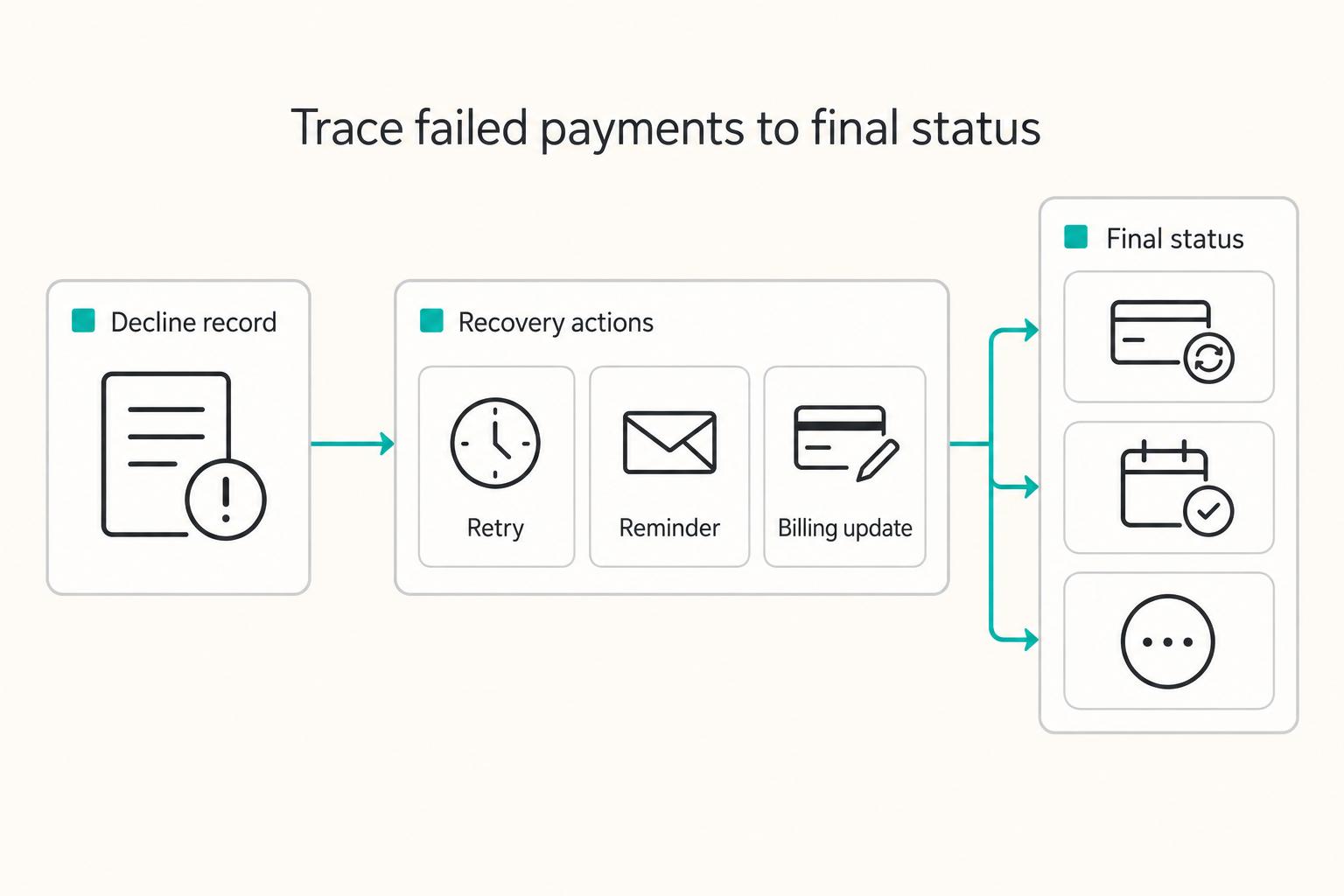
So the practical test is not "does this vendor promise more recovery?" It is "can we reconstruct one failed renewal from first decline to final status?" If you cannot pull an account-level trail that shows the failure event, retry attempts, reminder sends, billing update, and final subscription state, do not trust the headline recovery number yet. One failure mode is tuning messages or chasing AI claims before you have clean attribution and reconciliation.
The rest of this article follows that path in order: instrumentation first, then retry routing by failure type, then reminder cadence, then finance reconciliation. If you want a more tactical companion on failed-payment operations, start with A Guide to Dunning Management for Failed Payments. For related context, see Choosing Between Subscription and Transaction Fees for Your Revenue Model.
Start with a precise mental model of dunning#
Start by treating dunning as a focused failed-payment recovery workflow, not a broad growth strategy. In practice, it combines automatic retries, reminder messages, and a clear billing-update call to action to recover an at-risk renewal.
Make that sequence explicit and visible in operations:
- the decline is recorded
- a retry is scheduled
- a reminder is sent
- a billing-update prompt is delivered
- the payment method is updated (or not)
- the subscription status is updated
If your team cannot explain that path quickly and clearly for one account, the process is still too implicit to scale and audit reliably.
Keep scope and attribution tight. Revenue recovery includes other loss drivers (like turnover and billing inefficiency), so measure dunning impact specifically from failed payment to final outcome instead of blending it into broader platform lift. Also, platform-level billing-error rates are useful context, but they are not universal across all channels, geographies, or business models.
For a deeper mechanics view, see Smart Dunning Strategies: How to Sequence Retry Logic for Maximum Recovery. Related: 7 Dunning Strategies That Recover Failed Subscription Payments.
Quantify the billion-dollar claim without hand-waving#
Treat the billion-dollar narrative as a scenario, not a proven market fact.
Build a transparent range model from your own renewal cohort, and keep each assumption tied to one unit so subscriber rates and revenue exposure do not get blended.
| Model element | What to use | Guardrail |
|---|---|---|
| Subscriber base | Renewals due in the period | Do not use total signups or lifetime accounts |
| Baseline failed-payment/involuntary churn rate | Your observed rate for that cohort | Keep the cohort window explicit |
| Expected recovery from dunning actions | Your observed recovery rate by sequence | Label as scenario assumptions, not universal constants |
| Recovered renewals | renewals due × failed-payment/involuntary churn rate × recovery rate | Keep formula inputs visible for review |
| Revenue exposure cross-check | A separate revenue-based view | Do not merge revenue percentages directly into subscriber-rate math |
| What is still unknown | Market-wide benchmark confidence | This does not establish a validated "$1 billion" dunning figure |
Use external materials as context, not proof. The Zuora S-1/A is a formal filing artifact, while the Water Research Foundation figures are subscription-funded research context with a stated informational caveat, and not dunning recovery evidence.
We covered this in detail in Subscription Pause vs Cancel and the Middle Option That Protects Revenue.
Cover table-stakes mechanics before advanced optimization#
Do not optimize sequencing or copy until your core recovery mechanics work end to end. Advanced tuning starts only after retries, reminders, a clear billing-update CTA, and a self-serve payment update flow are fully operational.
| Element | Implementation requirement |
|---|---|
| Automatic payment retries | Define and activate a retry policy for failed renewals, with attempt timing documented and visible |
| Reminder emails | Trigger reminders from the failed-payment event, not from manual batches or support follow-up |
| Billing-update CTA | Include a direct payment-update action in every reminder |
| Self-serve update flow | Let customers update billing details without opening a ticket |
Separate retryable from non-retryable early#
At this stage, route failures into two tracks instead of one. You can add finer logic later in Smart Dunning Strategies: How to Sequence Retry Logic for Maximum Recovery.
- Retryable outcome: schedule retries and reminders, and keep billing-update access available throughout. Retry window: use the current approved policy, not an unverified default.
- Non-retryable outcome: skip repeated payment attempts and move directly to billing-update messaging, account review, or final stop based on your policy.
Treating all declines as temporary usually adds noise, delays customer action, and hides which accounts actually need billing updates.
Make every state visible#
If one account cannot be traced from first failure to final outcome, fix visibility before further optimization. For each failed-payment record, require:
- Status: current stage (for example failed, retry scheduled, awaiting customer update, recovered, closed)
- Owner: who is responsible now (billing ops, support, or automation)
- Next action: exact pending step and planned time
- Outcome: recovered, canceled, expired, or unresolved
For an external example of a documented notification flow, see FastSpring Classic. For related finance context, see ASC 606 Revenue Recognition Decisions for Subscription Pricing.
Set retry and escalation rules by failure type#
Retry when recovery looks plausible, and escalate when the customer must act. That one rule keeps dunning effective without turning it into noise.
Once you can see status, owner, next action, and outcome for each failed renewal, the core question is simple: what failure type is this, and who acts first? A single generic path for every failed payment is a known recovery mistake, because different failure types need different actions.
Route the first decision to the right owner#
Start with decline type, then layer in account value. Keep ownership explicit across billing automation, support, and revenue leadership.
| Failure type | First decision owner | Retry rule | Primary customer action | Escalation owner and trigger | Policy cap |
|---|---|---|---|---|---|
| Plausibly retryable decline on a standard account | Billing system | Run limited automatic retries | Wait, with payment-update option available in every reminder | Support if retries end without update or recovery signal | Retry cap pending policy confirmation |
| Customer-action-required decline | Billing system routes out of retry path; support owns next step | Stop repeated charge attempts | Update billing details | Support immediately; revenue owner only when churn risk or contract value warrants | Retry cap pending policy confirmation |
| Failed renewal on a high-value account | Revenue owner, using billing status | Use segmented retries only if recovery still looks plausible | High-touch outreach plus billing update | Revenue owner on first failed renewal or another pre-set trigger | Retry cap pending policy confirmation |
Make this table visible to everyone handling failed renewals. The point is consistent routing by failure type, not routing by whoever sees an alert first.
Separate payment attempts from customer messaging#
Do not force retries and reminders into one rigid sequence. Retry logic and messaging logic can run separately, so customer-action-required failures can get immediate billing-update outreach even when no further charge attempt is planned.
Deliverability is an operating dependency, not a marketing detail. If reminders miss inboxes, failed payments can progress to cancellations without customer response. As a checkpoint, verify SPF, DKIM, DMARC, and (where relevant) BIMI for failed-payment email, and account for Gmail/Yahoo bulk-sender requirements introduced in 2024.
If you want deeper implementation detail after this routing step, read Smart Dunning Strategies: How to Sequence Retry Logic for Maximum Recovery.
Define the high-value branch before you need it#
High-value accounts need a short, explicit escalation path:
- Trigger: first failed renewal on a defined high-value account, or any failure with commercially meaningful churn risk
- Owner: named revenue owner or account lead
- Channel: direct email first, then phone or another approved channel if there is no response
- Handoff outcome: recovered, billing update pending, approved grace period, or cancel decision confirmed
Keep one guardrail explicit: avoid retry storms. Excess attempts can raise cost and degrade signal quality, making it harder to see which accounts need a billing update or human outreach. Use retries to test recoverability, not to maximize attempt volume.
Also watch timing. Pre-failure outreach (such as card-expiry reminders) can outperform waiting until after failure. If avoidable update cases keep repeating, move outreach earlier instead of adding more post-failure attempts. For the broader operating model, see Building Subscription Revenue on a Marketplace Without Billing Gaps.
Design reminder cadence for recovery without fatigue#
After you set retry rules by failure type, treat reminder cadence as a controlled recovery lever, not a fixed blast. Keep the sequence bounded, give each touch one purpose, and review cadence as part of retention and churn management, not only payment operations.
Give each reminder one job#
A practical sequence is one where each message has a single outcome:
| Message | Job |
|---|---|
| Message 1 | Confirm the payment failure and identify the subscription |
| Message 2 | Clarify what happens if the issue stays unresolved |
| Message 3 | Prompt one clear billing-update action in your self-service flow |
| Message 4 | Confirm recovery after payment succeeds |
As an operating check, trace cohort, template, send time, billing-update destination, and downstream recovery outcome for each send.
Keep outreach as a separate decision dimension#
Do not treat reminders as a side effect of retries. Keep recovery actions and outreach decisions explicit, then tune cadence by account context and handoff needs.
Use a checkpoint model: validate payment rules early, then re-check reminder performance during retention/churn review so timing and messaging stay aligned with real outcomes.
Use trust and experience signals as a brake#
If repeated reminders add pressure without clear progress, slow down and retune. In digital channels, attention is abundant but trust is limited, so repetition without new value can increase fatigue risk.
Also verify deliverability requirements directly in provider documentation, including Gmail's bulk-sender expectations, before scaling reminder volume.
Related: Revenue Recovery Playbook for Platforms: From Failed Payment to Recovered Subscriber in 7 Steps. If you want a deeper dive, read Subscription Revenue Recovery Decisions That Protect Margin.
Make dunning auditable across product, finance, and ops#
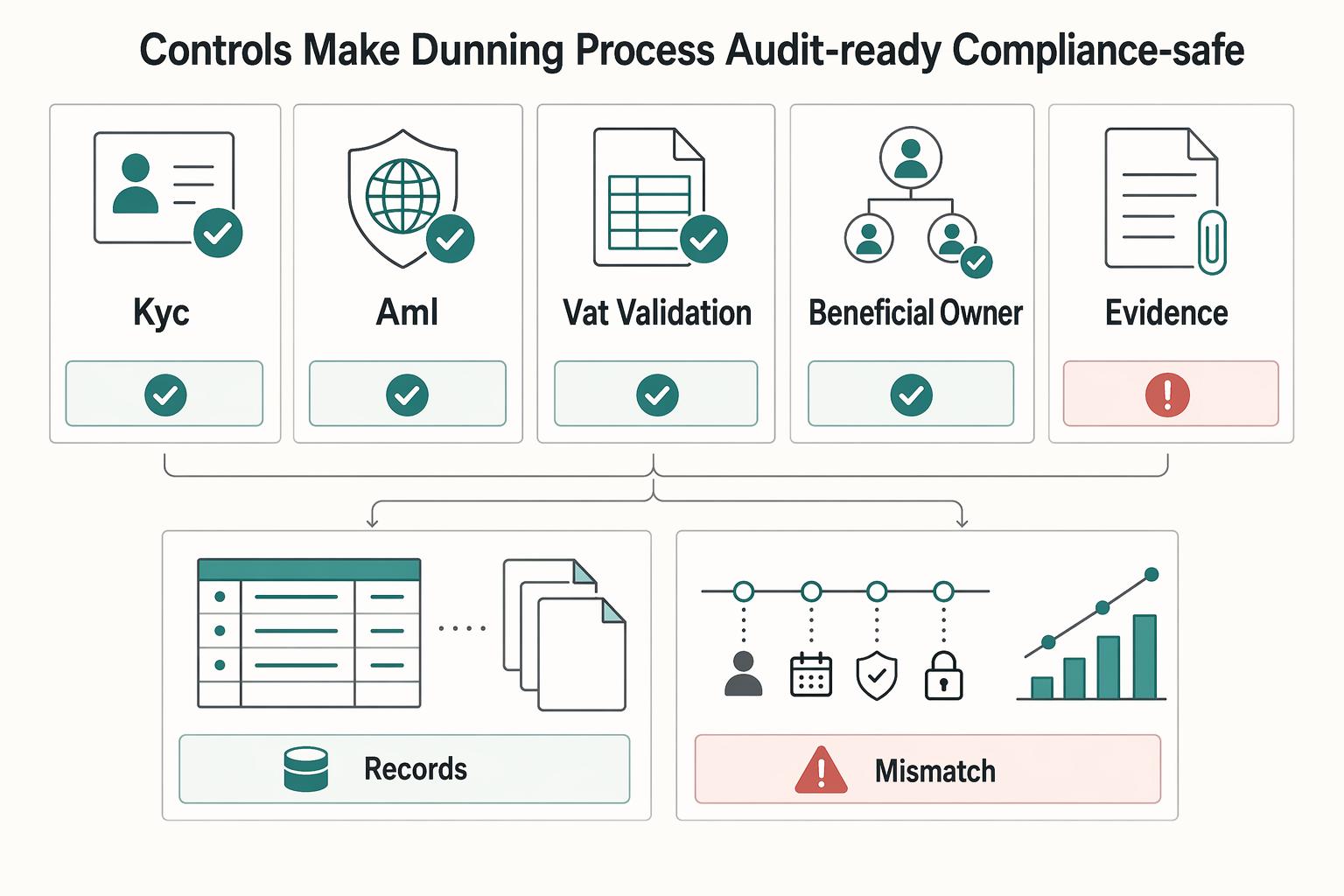
Auditability is the control that keeps dunning credible across teams. If you cannot reconstruct one failed renewal from first decline to final subscription state, pause optimization and build a minimum audit record first.
This is not just internal preference. Finance buyers are increasingly asking for transparency over outcome claims, and Slicker reports that 68% of finance decision-makers treat auditable AI models as a deal-breaker. The practical risk is simpler: failed payments plus disconnected systems and weak reporting create operational drag.
Minimum audit record#
Keep a small, defensible record that answers three questions: what happened, who owns it, and what the financial outcome was.
| Record area | What to capture |
|---|---|
| Event lineage | original failure event ID, customer/subscription/invoice identifiers, gateway response, timestamp, and source |
| Retry actions | every automatic and manual retry with timestamp, processor outcome, and attempt number |
| Reminder actions | each reminder send, template or campaign name, send time, and delivery outcome when available |
| Billing-update attempts | hosted page or portal attempt, method-update result, and timestamp |
| Final subscription state | final state (for example active, renewed, paused, canceled, or unpaid) with effective time |
| Churn classification and financial outcome | revenue recovered, churn delayed pending policy timing, or unresolved exception |
As a control check, sample recovered accounts and manually rebuild the chain from one joined trace. Preserve idempotency so webhook replays or job retries do not create duplicate reminders or duplicate recovery actions.
Assign owners before close#
Do not leave ownership implied. Define one owner per control area so evidence gaps and policy drift have a clear home.
| Owner | Owns | Verification check |
|---|---|---|
| Engineering logging owner | Event lineage, identifiers, timestamps, idempotency controls | Replayed events do not create duplicate retries or reminders |
| Finance reconciliation owner | Recovered-payment reconciliation and exception queue | Sampled recovered accounts tie to settled records |
| Ops policy owner | Contact limits, consent/communication controls, state labels, policy enforcement | Reminder and escalation actions match approved policy |
Reconcile outcomes in close workflow#
At close, classify every case into recovered revenue, delayed churn, or unresolved exceptions.
Recovered revenue should map to a settled payment and aligned billing records. Delayed churn stays separate until your policy timing checkpoint is confirmed. Unresolved exceptions are cases where logs suggest success, but finance cannot reconcile the cash outcome or final state.
If retry sequencing is still underperforming, tighten it next with Smart Dunning Strategies: How to Sequence Retry Logic for Maximum Recovery. For a broader operating framework, use A Guide to Dunning Management for Failed Payments.
Choose the right vendor posture for your stage#
Choose for control and evidence, not headline recovery claims. If a tool cannot show the path from first decline through retries, reminders, billing updates, and final outcome, finance will inherit manual cleanup later.
Use one comparison table with four decision lenses. The grounded sources support two subscription-dunning postures and one adjacent category that should stay separate.
| Decision lens | Recharge-style configurable dunning | Chargebee-style broader billing platform | Dispute or post-transaction tools |
|---|---|---|---|
| Attribution clarity | Documented checkpoints include Performance analytics and Email analytics; still confirm account-level export depth. | Bark's case study reports outcomes, including a 27.8% automated dunning success rate, but that is one merchant case, not a benchmark. Ask for raw event visibility. | Keep separate unless the tool explicitly includes retries and reminder workflows for failed renewals. |
| Policy control | Strong operator control over message tone and notification testing, including editable email copy and A/B testing. | Better fit when dunning is part of a broader subscription-and-billing operating model, not only reminder tuning. | Usually relevant later, after issues move into disputes or inquiries. |
| Implementation effort | Faster start when you need a defined failed-payment recovery flow with retries and notifications. Watch manual retry permissions, since manual retries can skip scheduled wait time. | Better fit when the current setup is engineering-heavy. In Bark's case, a self-built setup struggled to scale, and deployment time reportedly moved from 6 weeks to 1 week. | Lower relevance for launch-stage dunning; this does not replace retry/reminder mechanics. |
| Finance reconciliation readiness | Potentially workable, but not proven from excerpts alone. Require exports that tie failure events and outreach actions to final payment status. | Same rule: case-study outcomes are not close-ready evidence by themselves. Validate reconciliation with finance before rollout. | Often the weakest fit for renewal reconciliation because scope begins later in the payment lifecycle. |
Pick by stage and ownership model:
- Early launch: prioritize a managed setup with retries, reminders, email-copy control, and baseline analytics; one billing or ops owner can run it.
- Scaling operations: require notification testing, stronger exports, and explicit exception handling; ownership should be shared across product, finance, and ops.
- Mature optimization: add custom logic only when segment-level policy needs, market complexity, or engineering constraints justify it.
Build instead of buy only when vendor limits block a real operating need. In evaluation, test export depth, workflow flexibility, retry-policy configurability, and cross-team auditability. A practical check is one account-level export covering failure event, each retry, each reminder, any billing update, and final settled or unpaid state. If that output is not clean, review A Guide to Dunning Management for Failed Payments before committing.
Treat manual overrides as a control risk, not a convenience feature. If manual retries can bypass planned timing, require a log of who triggered the override, when, and why.
For a step-by-step recovery sequence, use Revenue Recovery Playbook for Platforms: From Failed Payment to Recovered Subscriber in 7 Steps.
Conclusion#
Treat dunning as an inspectable operating discipline, not a reminder blast. Your next move is simple: if you cannot reconstruct one failed renewal from first decline to final paid or canceled state, stop tuning copy and fix visibility first.
Start with a baseline you can see#
Set a baseline that product, billing, and support can all describe the same way: failed payment detected, customer notified, billing details updated when needed, retries only where your policy treats them as retryable, and subscription state changed at a defined stop point. If that baseline is still vague, start with A Guide to Dunning Management for Failed Payments, then document only the live settings your owner can confirm instead of repeating old defaults from memory.
The useful check is not a dashboard total. Pull one account-level trace or export and confirm it shows the failed charge event, each reminder sent, any payment method update, every retry attempt, and the final subscription status. If finance, product, and support each tell a different story for that same account, the problem is likely handoffs, not reminder wording.
Route failed payments by what the failure means#
Do not treat every decline like a soft nudge problem. Build your routing logic around whether another attempt is likely to work or whether the customer needs to update billing details first. Use Smart Dunning Strategies: How to Sequence Retry Logic for Maximum Recovery as the reference point for that choice.
One common failure mode is misclassifying involuntary billing errors as voluntary churn. RevenueCat's 2026 context is useful because it frames platform differences as billing reliability, not unsubscribe behavior, and reports 32.3% of Google Play cancellations and 15.2% of App Store cancellations as involuntary billing errors across 115,000+ apps and over $16 billion in tracked revenue. That is not a benchmark you should copy into every forecast, but it is a strong prompt to review Google Play first if Android revenue matters to you. Their guidance is specific on one practical point: much of the fix can happen in Play Console, and most of that review takes under an hour before the dunning sequence even has a chance to work.
Verify results before you scale policy changes#
Keep recovery claims conservative until you can verify them against your own cohorts. The real question is not whether the headline opportunity sounds large. It is whether your current policy reduces leakage caused by billing failures rather than hiding tracking gaps or market mismatches.
Before you roll a new sequence across countries, payment methods, or plan types, write down what is in scope and what is not. A short policy note is enough if it names the channel, payment methods, decline cohorts, confirmed retry settings or a clear pending-confirmation note, cancellation trigger, owner, and the evidence pack you will use to judge results. That evidence pack should include at least one cohort view of failed renewals plus a small sample of account-level traces, because another documented failure mode is treating leakage as only a finance problem when the root cause may sit in product and billing handoffs.
If you want a clean next step, do four things in order: confirm the baseline sequence, separate retryable failures from update-required failures, check one trace end to end, then expand only where the rules and evidence still hold. That is how you turn subscription dunning into a decision you can defend.
Frequently Asked Questions
What is dunning in a subscription business?
Dunning is the follow up after a payment fails. In practical terms, it is the reminder, retry, and billing update path between the first failed charge and either recovery or cancellation. If you cannot point to that exact sequence in your product and billing data, you do not yet have a usable dunning operation.
What is the minimum setup that actually works?
The minimum is straightforward: capture the failed payment event, send a clear reminder, give the customer a direct billing update path, and retry only where retrying still makes sense. You can run that manually at very small scale, but once volume rises, automation matters because one common end state is that customers ignore every attempt and the subscription gets canceled. If you need a quick baseline checklist, start with A Guide to Dunning Management for Failed Payments, then verify that each step is visible in an account level export.
How many reminders and retries should we send before canceling service?
There is no universal count you should copy across every business, market, or payment method. A better rule is to set a bounded sequence, then check whether later touches still produce billing updates or just create fatigue and noise. If you publish a benchmark here, use your own cohort data and keep unverified numbers out until they are checked.
Do automatic retries always improve recovery?
No. Stripe Smart Retries is described as using machine learning to choose retry timing, and the cited excerpt says it can make up to eight attempts within a customizable timeframe, but more attempts are not automatically better. If the failure reason indicates retries are unlikely to work, or the issue needs a new payment method, move faster to a billing update call to action. Then review your sequencing against Smart Dunning Strategies: How to Sequence Retry Logic for Maximum Recovery.
What proof should we require before trusting a vendor's recovery claim?
Ask for evidence you can reconcile, not a percentage on a slide. A practical proof pack is one account level trace that shows the failed payment event, every retry, every reminder, any billing detail update, and the final paid or canceled state. If the vendor cannot export that cleanly, finance will end up stitching evidence by hand and you will not know whether the claimed lift came from dunning or from something else.
Can dunning alone create a billion dollar outcome?
Treat that as a scenario to model, not a fact to repeat. Your upside depends on your own failed payment exposure, how many failures are recoverable, and how much of the problem is billing reliability rather than true customer intent to leave. If you need a headline number for planning, build conservative, base, and aggressive cases and label any external figure as an assumption until your cohort math is signed off.
How do we separate involuntary churn recovery from broader subscription growth effects?
Start with a clean cohort of subscriptions that hit a failed recurring payment event. Then measure only the actions and outcomes tied to that failure. One useful attribution boundary from the 2026 RevenueCat context is that platform differences were framed as billing reliability, not unsubscribe behavior, with 32.3% of Google Play cancellations and 15.2% of App Store cancellations described as involuntary billing errors across a dataset covering 115,000+ apps and over $16 billion in tracked revenue. Use that as a platform-specific example, not a default benchmark for every business. If you operate on Google Play, check the Play Console side first because most of that fix takes under an hour before the dunning sequence even begins.
Try a related tool
Researched and edited by the Gruv editorial team. Gruv builds cross-border billing, payouts, and finance-operations software for global businesses.
Sources
- cs.arizona.edu/~mercer/Projects/BoggleWordstrusted
- documents.dps.ny.gov/public/Common/ViewDoc.aspxtrusted
- downloads.regulations.gov/FWS-R6-ES-2014-0048-0196/content.pdftrusted
- homepages.math.uic.edu/~leon/mcs360-f07/projects/3-4/dictionary-lar...trusted
- justice.gov/atr/p2208-oracle-question-answer-document-or...trusted
- lacera.gov/sites/default/files/assets/documents/board/2...trusted
- openknowledge.worldbank.org/bitstreams/8a4eb7cf-3c5b-5b03-96ea-1b34603b6...trusted
- pmc.ncbi.nlm.nih.gov/articles/PMC8123335trusted
Educational content only. Not legal, tax, or financial advice.
Related Posts
A Guide to Dunning Management for Failed Payments
If you run recurring invoices, failed payments are not back-office noise. They create cashflow gaps, force extra follow-up work, and increase **Involuntary Churn** when good clients lose access after payment friction.
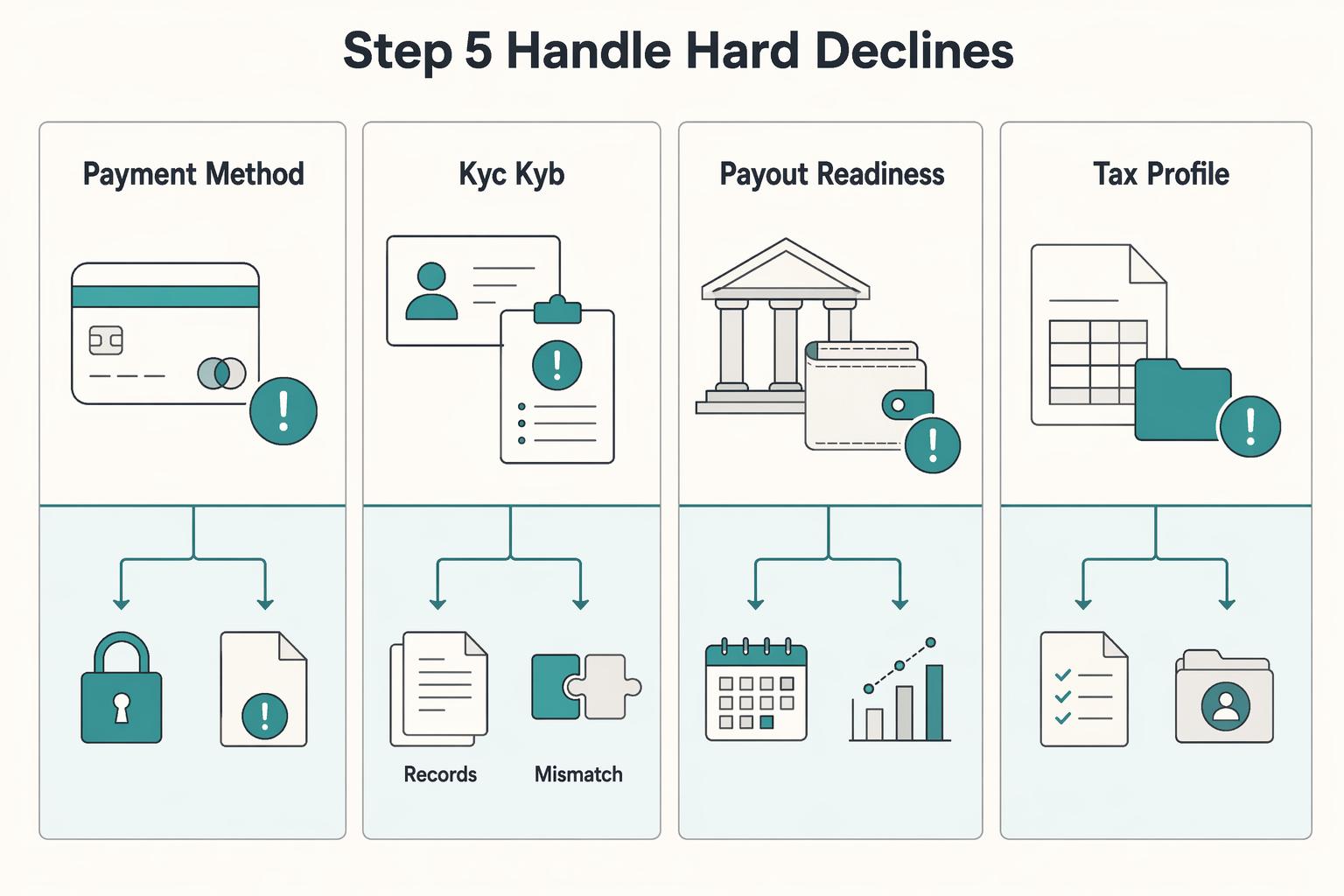
Revenue Recovery Playbook for Platforms: From Failed Payment to Recovered Subscriber in 7 Steps
Failed payment recovery is an involuntary churn problem, not just a card-retry setting. On a marketplace platform, one failed renewal can still turn into a lost subscriber when product, engineering, and operations are not running the same recovery process.
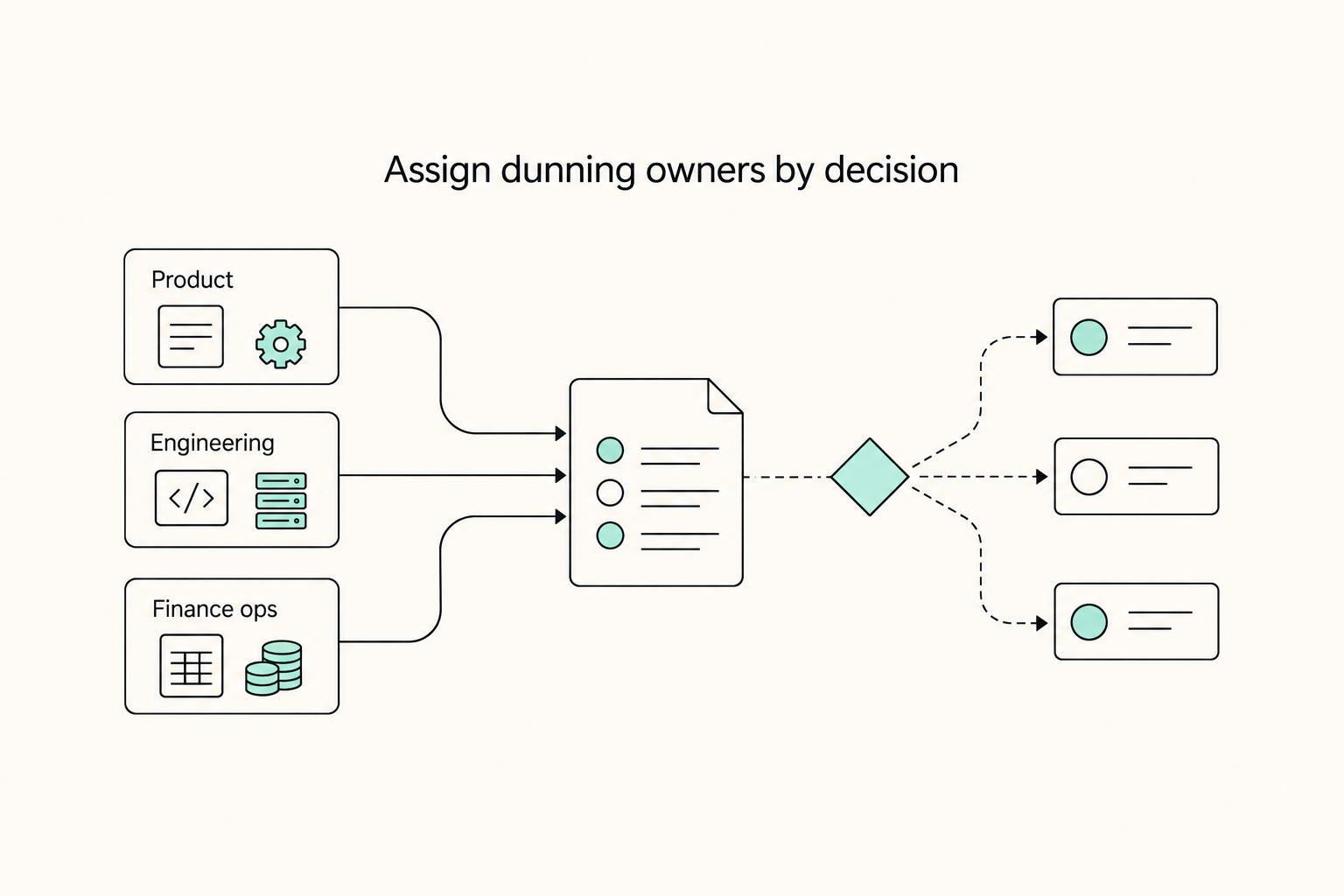
Smart Dunning Strategies to Sequence Retry Logic for Maximum Recovery
If you treat retry logic as a billing setting, you may get some upside and still create hidden operational gaps. A better starting point is shared ownership across teams. Product decides customer treatment. Engineering controls retry execution and event integrity. Finance ops owns reconciliation and audit-trail review.