
Quick Answer
Define collections as an accounts receivable control flow first, then automate messaging inside it. In an auto-reminders dunning contractor marketplace setup, only send on eligible invoice states, re-check status at send time, and pause outreach when payment evidence exists but posting is still unresolved. Require named approval before any Collection agency handoff, and close cases only after Reconciliation confirms the receivable is actually resolved.
Build a Reminder and Dunning Flow for Marketplace Operations#
If you are building an automated reminder flow for a contractor marketplace, make one decision first: treat collections as receivables operations, not as a messaging feature. Dunning belongs inside your accounts receivable process, so reminder logic has to follow the same financial truth your team uses to decide whether an invoice is unpaid or resolved.
The core anchors are your payment records, Reconciliation, and Settlement. Reconciliation matches payment records to what sits in your books, which keeps a "paid" status from drifting away from reality. Settlement is not a single moment, either. It is a multi-party movement of funds after payment initiation, which means your collections logic cannot assume authorization, receipt, and posting all happen at once. If you ignore that sequence, you can easily send an overdue notice on an invoice finance is already clearing.
The practical goal of this guide is to help finance, ops, and product owners build a collections flow with explicit control points. You should be able to answer a short list of operating questions without guessing. Which invoice states enter reminders? What pauses reminders? Who can approve escalation? What has to reconcile before an invoice is marked resolved? How should downstream financial actions react when payment status changes late? Those are operating decisions, not copy decisions.
Keep one checkpoint in mind from the start: before any reminder goes out, confirm that the current invoice state still matches the latest payment and posting state. If those records do not line up, do not let the reminder send and fix it later. That becomes a failure mode fast, especially in high-volume collections.
A buyer may have paid, but the receipt has not yet been matched. Or the invoice may look open in one view while the financial record is already moving through settlement. In those cases, the right move is to pause collection activity and investigate the mismatch first.
The other requirement is audit readiness. As invoice count and payout complexity grow, you need more than successful collections. You need an audit trail in the NIST SP 800-53 Rev. 5 sense: a chronological record that lets your team reconstruct what happened and when. For reminder operations, that means keeping enough evidence to trace invoice status changes, payment references, posting outcomes, settlement-related decisions, and operator interventions. If you cannot reconstruct the sequence, you do not really control dunning yet.
For a related operational lens, see How to Handle Termination of an International Contractor.
Define your operating scope before you automate collections#
Set scope first: automation should run only on clearly defined invoice states, owners, and boundary rules.
Step 1. Limit which invoice states can enter dunning. Use named states, not broad labels. Start with unpaid at Invoice due date and Overdue invoice, and include disputed invoices under review only if your policy allows reminder activity during dispute handling. Your reminder job should pull only from a documented eligibility list, with a reason for every excluded state.
Step 2. Separate ownership before launch. Assign one owner for Payment reminder content, one approver for Collection agency escalation, and one signoff owner for final Reconciliation. This separation of duties is an internal-control safeguard, so one person does not execute consecutive accounting tasks unchecked. Keep auditable records of owner assignments, approvals, and resolution decisions.
Step 3. Write down the marketplace boundary. In a Contractor marketplace, define what the platform enforces versus what buyer and contractor resolve directly. If the platform only sends reminders and records outcomes, say that explicitly. If it can pause payouts, suppress reminders during disputes, or trigger manual review, document the conditions for each action.
Step 4. Add policy caveats for MoR, tax, and regional compliance. If your platform is the Merchant of Record, that role is responsible for tax calculation, collection, and remittance, and can also affect KYC and AML ownership. Do not assume one escalation rule fits every market or program. If third-party collections are possible, require debt-type and jurisdiction review before escalation because rules such as Regulation F can apply in some contexts.
Related: 3-Way PO Matching for Marketplaces: How to Automate Invoice Verification at Scale.
Prepare the minimum data and controls required for launch#
Before launch, make sure every reminder is tied to a real open receivable and can be blocked by compliance or tax controls when required.
| Record | When it applies | Details |
|---|---|---|
| Form W-9 | When your launch controls require it | Used to provide a correct TIN to payers |
| Form W-8BEN | When your launch controls require it | Foreign payees may need to provide it to the payer or withholding agent |
| FBAR | When foreign-account scenarios meet ownership/signatory conditions and exceed the $10,000 aggregate threshold during the year | Uses FinCEN Form 114 and is due April 15 with an automatic extension to October 15 |
Step 1. Lock the data objects that decide whether an invoice is collectible. Your checklist should cover the invoice status model, Open items list, Payment allocation logic, and a canonical Ledger event map. Automated dunning relies on overdue-invoice tracking, so status changes, allocations, and ledger events need to agree on what is still open. If open-items balances and receivables from your books do not match, fix allocation and posting logic before launch.
Step 2. Add compliance gates before reminders escalate or payouts move. If your flow uses KYC, KYB, AML, or VAT validation, treat them as blocking controls, not passive metadata. KYC supports risk-based identity verification, and KYB covers identifying and verifying beneficial owners of legal-entity customers. Where EU VAT checks are part of your program, confirm whether VIES validation is enabled for that entity and flow rather than assuming it applies everywhere.
Step 3. Confirm tax artifacts for exception paths up front. Your launch controls should define when W-8BEN, W-9, and 1099-NEC records are required. Form W-9 is used to provide a correct TIN to payers, and foreign payees may need Form W-8BEN provided to the payer or withholding agent. If foreign-account scenarios meet ownership/signatory conditions and exceed the $10,000 aggregate threshold during the year, FBAR becomes a records dependency using FinCEN Form 114, due April 15 with an automatic extension to October 15.
Step 4. Minimize personal data in reminder operations and logs. Under GDPR, personal data should be adequate, relevant, and limited to what is necessary. In practice, keep reminder templates, dashboards, logs, and exports to only the fields needed to identify the invoice and route action. Masking identifiers in dashboards and exports is a practical control when full visibility is not required for collections work.
For a step-by-step walkthrough, see Subscription Billing Platforms for Plans, Add-Ons, Coupons, and Dunning.
Design a dunning sequence that aligns to risk and recoverability#
Design the sequence around the Invoice due date, not the last reminder sent. Due-date-relative timing keeps stages auditable and prevents drift as cases age.
Step 1. Set stages from pre-due through final escalation. Define explicit Dunning levels: one pre-due step, a first overdue notice, progressive follow-ups, and a final escalation window. Time each step by days relative to due date, not relative to the previous step. Some documented setups use examples like a first collection letter 1 day after due date and a final collection letter 14 days after due date, but those are examples, not a universal cadence.
| Stage | Trigger basis | Purpose | Operator note |
|---|---|---|---|
| Pre-dunning | Before due date | Nudge payment before lateness starts | Keep tone factual and include invoice reference only |
| First overdue notice | On or after due date | Confirm invoice is now overdue | Recheck open balance immediately before send |
| Progressive follow-up | Further days after due date | Increase urgency if still unpaid | Increase urgency only when no payment or resolution is recorded |
| Final escalation window | Later overdue stage | Decide manual collections vs. external escalation | Stop routine reminders once escalation begins |
If an account has multiple unpaid invoices, decide whether the leading (oldest open) invoice controls stage selection and apply that rule consistently.
Step 2. Branch by invoice profile and exception state. Make risk-based branching explicit in the workflow. Configure rules by invoice amount or aging balance so low-value, standardized invoices can stay automated while higher-risk cases move to earlier manual review. Use a defined threshold and exception flags consistently rather than relying on ad hoc operator judgment.
Step 3. Tie reminder delivery to posting behavior, not just send schedules. Set Payment reminder channel and retry logic by stage, and map each step to expected Payment allocation behavior. Before each send, re-read the current open balance. If payment is reported but posting is unresolved, pause escalation and investigate. If partial payment posts, switch messaging to remaining balance.
Step 4. Define hard criteria for Collection agency handoff. Set a named approval owner and require an evidence package before handoff: invoice, dated reminder history, current open balance, posting references, dispute status, and relevant customer communication. Once referred, suppress routine automated reminders so the customer does not receive overlapping messages from your platform and a third party.
Decide what to automate and what must stay manual#
Use a simple rule: automate deterministic reminder work, and route judgment-heavy exceptions to a person.
| Action | Handling | Note |
|---|---|---|
| Reminder creation | Automate | Rule-driven action |
| Issuing | Automate | Rule-driven action |
| Sending | Automate | Rule-driven action |
| Scheduling | Automate | Rule-driven action |
| Status transitions | Automate | Rule-driven action |
| Waivers | Manual queue | Keep with an owner and due date |
| Legal escalation | Manual queue | Keep with an owner and due date |
| Dispute counterarguments | Manual queue | Keep with an owner and due date |
Step 1. Keep clean overdue cases in automation, and pause exception cases early. If an Overdue invoice has no dispute or chargeback indicators in your records, keep automated dunning active. If a query, dispute, or chargeback signal appears, pause that customer, invoice, or invoice group instead of letting reminders continue on cadence alone. Resume automated evaluation only after the exception is resolved.
Before each send, confirm the item is still open in your Open items list and check for new exception signals. This keeps reminder automation aligned with current account state.
Step 2. Automate repeatable steps, and send judgment calls to a named owner. Automate rule-driven actions such as reminder creation, issuing, sending, scheduling, and status transitions. Keep waivers, legal escalation, and dispute counterarguments in a manual queue with an owner and due date.
A chargeback is a formal dispute, so responses may require evidence and written context. Record manual and automated dunning actions in system notes so decisions are traceable.
Step 3. Pause reminders when payment proof exists but posting is missing. Use an explicit if-then rule: if payment proof arrives but posting is missing, pause reminders and prioritize Reconciliation. Verify whether payment was received but not posted, misapplied, or still waiting allocation before restarting the sequence.
This prevents stronger notices from going out while accounting records are still catching up.
Step 4. Define reminder overrides as communication controls, then test boundary behavior. Let ops stop reminders quickly, but define that override so it controls reminder communication only. Keep Settlement and Payout execution permissions under their own controls unless a separate action is taken.
Test this in your workflow: pause one invoice and confirm reminders stop, the receivable stays open, and payout or settlement state does not change unless explicitly triggered.
If you want a deeper dive, read AP Automation vs. Manual AP Processing: A Cost-Benefit Analysis for Marketplace Operators.
Implement event flow and posting controls end to end#
Reminders should trust posted payment state, not payment intent. If the event path is loose or non-idempotent, retries can create false "paid" outcomes, duplicate Payment allocation, or trigger dunning after cash has already landed.
Step 1. Define one canonical event order from trigger to reconciliation. Use the same sequence for every clean case: reminder trigger event -> payment confirmation signal -> Webhooks ingestion -> idempotent posting -> Reconciliation checkpoint. This keeps your reminder engine from treating buyer action as final payment. In bank-transfer flows, status can remain Open until funds arrive in the virtual bank account, then the provider webhook confirms receipt.
Before each send, confirm the invoice is still open in your Open items list, no successful payment event has been ingested since queue time, and posting status is current.
Step 2. Acknowledge webhooks quickly, then process from durable storage. Return 2xx fast, store the payload and identifiers, and run posting asynchronously. This avoids turning transient endpoint failures into repeated side effects when providers retry non-2xx deliveries (for example, up to 25 retries over 3 days in one documented policy).
Your ingestion checkpoint is simple: you should be able to look up whether an exact event was already received and what processing state it is in.
Step 3. Apply idempotency at both event and posting layers. Assume duplicate webhook delivery and deduplicate by provider event identifier (for example, event_id). Then enforce posting idempotency so same-key retries return the original result instead of creating a second journal or closing the invoice twice.
Test this directly: replay the same webhook and verify Payment allocation, invoice status, and journal count are unchanged after the first successful post.
Step 4. Re-read payment state at send time for asynchronous rails. Do not send from stale state. Asynchronous flows can finalize across seconds, minutes, hours, or days, and estimated arrival timing can drift, so reminder evaluation must happen immediately before each send.
If payment is confirmed but posting is pending, suppress the reminder and route to Reconciliation. If payment is not confirmed, send as planned. If payment exists but allocation failed, keep the case visible in collections reporting and block the next customer-facing reminder until resolved.
For incidents, capture a compact evidence pack in the case record:
- provider event ID and internal receipt timestamp
- webhook payload reference
- linked journal entry or failed-post reference
- invoice ID and
Payment allocationresult - operator action, reason, and time
Need the full breakdown? Read A Guide to Dunning Management for Failed Payments.
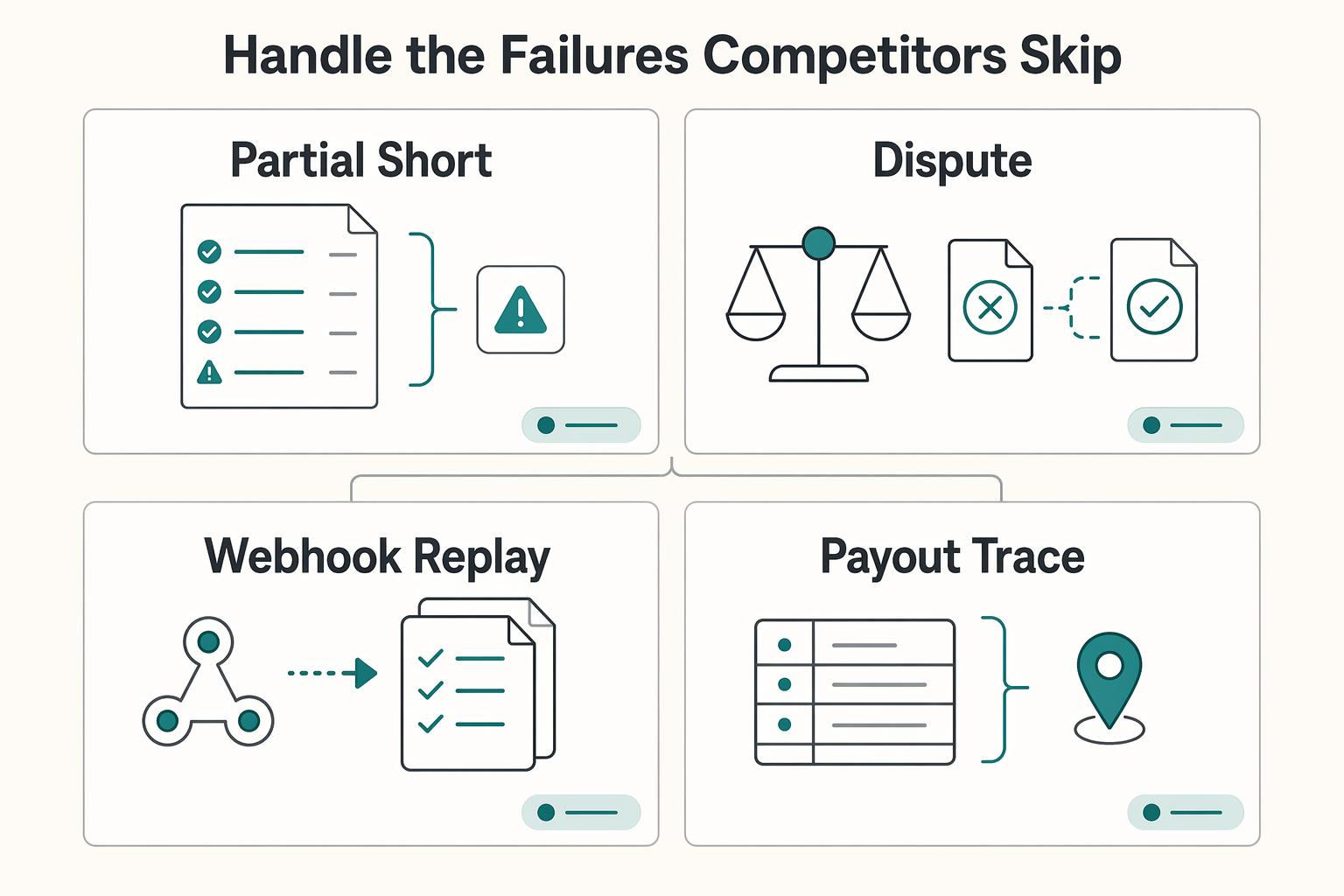
Handle the failures competitors skip#
Failures are inevitable; the control point is having explicit recovery paths before they hit operations. Without that, teams improvise around partial cash, delayed Webhooks, and failed Settlement, and reminder accuracy breaks first.
| Failure case | Required response | State effect |
|---|---|---|
| Partial, short, over, or misapplied receipt | Treat as an open exception until amount and application are confirmed | Keep unresolved items visible in the Open items list and avoid advancing the case as fully paid |
| Dispute | Pause dunning immediately with a Dunning block or Paused dunning state | Keep the receivable operationally visible |
| Delayed webhook delivery | Re-check current invoice state at send time and prevent processing one event multiple times | If a late payment event arrives after a reminder, tag it as a timing miss and block the next touch |
| Failed settlement after "paid" | Reverse receipt state, reopen the receivable, and pause downstream payout movement until the money position is confirmed | Hold affected Payout batches or apply reserve logic where provider capabilities allow |
Step 1. Route partial and misapplied receipts to investigation, not closure. Treat any partial, short, over, or misapplied receipt as an open exception until amount and application are confirmed. Partial and multi-item application are operationally supported, and short or overpayments can be routed to investigation instead of being treated as clean closure.
After posting, verify remaining open amount and confirm the receipt was applied to the intended debit item. Keep unresolved items visible in the Open items list, assign an owner in Reconciliation, and avoid advancing the case as fully paid until the mismatch is resolved.
Step 2. Add a dispute lane with a real dunning stop. A dispute should pause dunning immediately while keeping the receivable operationally visible. Use a Dunning block or Paused dunning state at the customer, invoice, or invoice-group level so reminders stop without hiding the item from collections work.
Keep disputed items on the Open items list with owner, status, and reason metadata. Require a structured pause reason and reason detail so recurring failure patterns are measurable instead of buried in free text.
Step 3. Guard against duplicate reminders from delayed webhook arrival. Delayed webhook delivery is normal, so reminder sends must re-check current invoice state at send time. Providers may retry undelivered events for up to three days, and processors should explicitly prevent processing one event multiple times.
If a reminder goes out and a late payment event arrives after, tag it as a timing miss and block the next touch. If the payment event is already stored but not posted, treat it as a posting exception, not a debtor issue, and capture webhook event ID, internal receipt timestamp, reminder job ID, invoice ID, and operator action.
Step 4. Define rollback rules for failed settlement after "paid." If Settlement fails after an invoice is marked paid, reverse receipt state, reopen the receivable, and pause downstream payout movement until the money position is confirmed. Where provider capabilities allow, hold affected Payout batches or apply reserve logic to prevent payouts based on failed settlement.
Communicate rollback status to the contractor clearly and quickly, including that payout is temporarily on hold pending reconciliation. If the failure creates or risks a negative balance, reserve behavior can apply in some provider setups and may be time-limited (for example, up to 180 days in one documented case), so encode provider-specific rules in your runbook and tag root cause before closure.
Track the KPIs that prove your system is getting cleaner#
You need KPI coverage across recovery, posting, and exceptions, not just reminder volume, to know whether the system is actually improving.
Step 1. Measure conversion across the payment chain. Track three stage rates separately: reminder sent to paid, paid to posted in Ledger, and posted to complete Reconciliation. Add average time to pay as a trend view, and use DSO or CEI as supporting collection-performance metrics over time, not as fixed targets. Validate that invoices marked paid can be tied to both posting and reconciliation status.
Step 2. Watch risk and friction alongside recovery. Use your A/R aging report to track movement across 1-30, 31-60, 61-90, and >90 day buckets. Pair that with manual intervention rate, escalation rate to Collection agency, and reopen rate after an item is marked resolved. If overdue balances improve while reopenings or escalations climb, treat that as process friction, not clean progress.
Step 3. Add operational health checks that catch drift early. Webhook timing and exception backlog should be monitored continuously because webhook-driven payment operations are asynchronous. Track webhook delay distribution (provider event time to internal receipt time), exception queue age, and unresolved Payment allocation items, including unapplied or on-account receipts. If oldest queue age keeps rising, data accuracy risk is increasing even when reminder sends continue.
Step 4. Run a monthly governance review and force rule decisions. Hold a monthly review across finance, ops, and product using KPI trends and system-note history for automated and manual dunning actions. End each rule review with an explicit keep/change/retire decision. If a rule increases reopens or escalations relative to recovered cash, revise it before scaling reminder volume.
Conclusion#
The main point is simple: reminder automation is strongest when it stays tied to accounting truth, Reconciliation checks, and named operator ownership. Launch dunning without those controls, and you may get more outbound messages without cleaner recovery.
Use this copy-and-paste checklist to get a first production version live without creating avoidable cleanup work:
- Confirm scope, owners, and escalation authority.
Decide exactly which invoice states enter Dunning: pre due, due, overdue, and dispute-suppressed cases. Name one owner for reminder content, one for queue review, and one approver for Collection agency handoff. Your verification point is simple: for any overdue case, an operator should be able to answer who can pause reminders, who can approve escalation, and who signs off final resolution.
- Validate prerequisite data, compliance gates, and tax artifacts.
Before the first Payment reminder goes out, make sure your Open items list, invoice status model, payment allocation logic, and canonical Ledger events are all live and internally consistent. Check compliance blockers that should force manual review, including AML identity verification controls where your program requires Customer Identification Program procedures, and confirm U.S. tax artifacts such as Form W-9 and Form 1099-NEC where they are actually in scope. A recurring risk is operationally valid outreach built on incomplete tax or identity records, which can complicate payout handling or audit review later.
- Launch a staged sequence with explicit if-then rules.
Start with a small sequence: one reminder before the invoice due date, one on the due date, and one after the invoice is overdue. Keep the decision rules blunt enough that ops can apply them consistently: if payment proof arrives but posting is missing, pause further reminders; if dispute indicators appear, suppress automation and route to manual review; if buyer history is clean and the invoice is routine, keep the sequence automated.
- Enforce idempotent webhook posting and reconciliation checkpoints.
Payment events are asynchronous, and webhook endpoints can receive the same event more than once. Log event IDs before processing side effects, then verify that retries do not duplicate Payment allocation, close an invoice twice, or create false paid states. The checkpoint that matters most is send time: before each reminder, re-check current payment status against the latest posted state rather than trusting the original queue snapshot.
- Review KPI trends on a regular cadence and change rules based on evidence.
Collections KPIs matter because they measure recovery on receivables, but no single fixed KPI set fits every marketplace. Review the measures that match your risk mix, such as reminder sent to paid, paid to posted in Ledger, posted to complete Reconciliation, overdue aging movement, manual intervention rate, escalation rate, and reopen rate. If send volume rises while reopen cases or unresolved posting exceptions also rise, tighten controls before you add more reminder stages.
That is the practical finish line for this kind of reminder automation: fewer false touches, cleaner posting, and clearer accountability when exceptions hit.
Related reading: How to Classify a Worker as an Employee vs. an Independent Contractor in the US.
Frequently Asked Questions
What is the minimum dunning sequence a contractor marketplace should implement first?
A practical starting sequence can include three touches: one before the invoice due date, one on the due date, and one after the invoice is overdue. Before each send, re-check current invoice status so you do not remind on an invoice that was already paid or is in dispute.
When should reminders start before the invoice due date versus only after an overdue invoice?
Use pre-due reminders when that fits your collections policy and the invoice context. If the case is sensitive, disputed, or the payment state is not clear, it is safer to delay or pause reminders until status is confirmed. If payment state is uncertain, reminder timing should not get ahead of accounting status.
What should be fully automated versus manually reviewed in marketplace dunning?
Automate consistent, repeatable actions such as scheduled reminder delivery. Keep manual review for cases that involve judgment or risk, including disputes, exceptions, and higher-stakes escalation. A review checkpoint before outbound notices helps prevent avoidable errors.
Which KPIs best show whether auto-reminders are improving collections quality, not just message volume?
Use KPIs that measure recovery outcomes, not only message activity. Common examples include how many reminded invoices get resolved, aging movement, manual intervention rate, escalation rate, and reopen rate. If sends increase but recovery quality worsens, the sequence is likely creating operational cleanup instead of better collections results.
When should a case escalate to a collection agency?
Do not use one universal day-count rule, because timing depends on invoice value, dispute status, buyer history, and your approval policy. Treat escalation as a staged step after earlier contact methods and after internal review confirms the case is appropriate for stronger action. Keep a clear handoff record with reminder history, invoice details, payment-status checks, and operator notes.
How do webhook delays or posting lags in the ledger affect reminder accuracy?
Webhook-driven payment updates are asynchronous, so reminder timing can drift from real payment state. Your send job should check the latest payment status at send time, not only when the reminder was first queued. You cannot remove lag entirely, but you can reduce stale or duplicate notices with send-time status checks.
How should compliance checks like KYC, KYB, AML, and GDPR constraints change dunning operations?
They should change both routing and data exposure. Under GDPR data minimisation (Article 5(1)(c)), reminder content and operational logs should include only the personal data necessary for collections, with masking where appropriate in dashboards and exports. For a deeper treatment, see GDPR for Marketplace Platforms: How to Handle Contractor and Seller Personal Data Compliantly. On the AML side, U.S. CIP rules at 31 CFR 1020.220(a)(2) require risk-based identity verification procedures, so unresolved identity-verification or AML flags should route cases to manual review before stronger outreach or payout-handling changes.
Try a related tool
Researched and edited by the Gruv editorial team. Gruv builds cross-border billing, payouts, and finance-operations software for global businesses.
Sources
- consumerfinance.gov/rules-policy/regulations/1006trusted
- csrc.nist.gov/glossary/term/audit_trailtrusted
- docs.stripe.com/webhookstrusted
- ec.europa.eu/taxation_customs/viestrusted
- ecfr.gov/current/title-31/subtitle-B/chapter-X/part-1...trusted
- ecfr.gov/current/title-31/subtitle-B/chapter-X/part-1...trusted
- ftc.gov/legal-library/browse/rules/fair-debt-collect...trusted
- irs.gov/forms-pubs/about-form-w-9trusted
Educational content only. Not legal, tax, or financial advice.
Related Posts

GDPR for Marketplace Platforms: How to Handle Contractor and Seller Personal Data Compliantly
Treat this as an operating decision, not a policy exercise. If you own compliance, legal, finance, or risk for a platform, your job is to decide who owns each GDPR duty. You also need to define what evidence must exist, what your team reviews on a recurring basis, and which issues need escalation before a launch or vendor change goes live.
AP Automation vs Manual AP Processing for Marketplace Operators
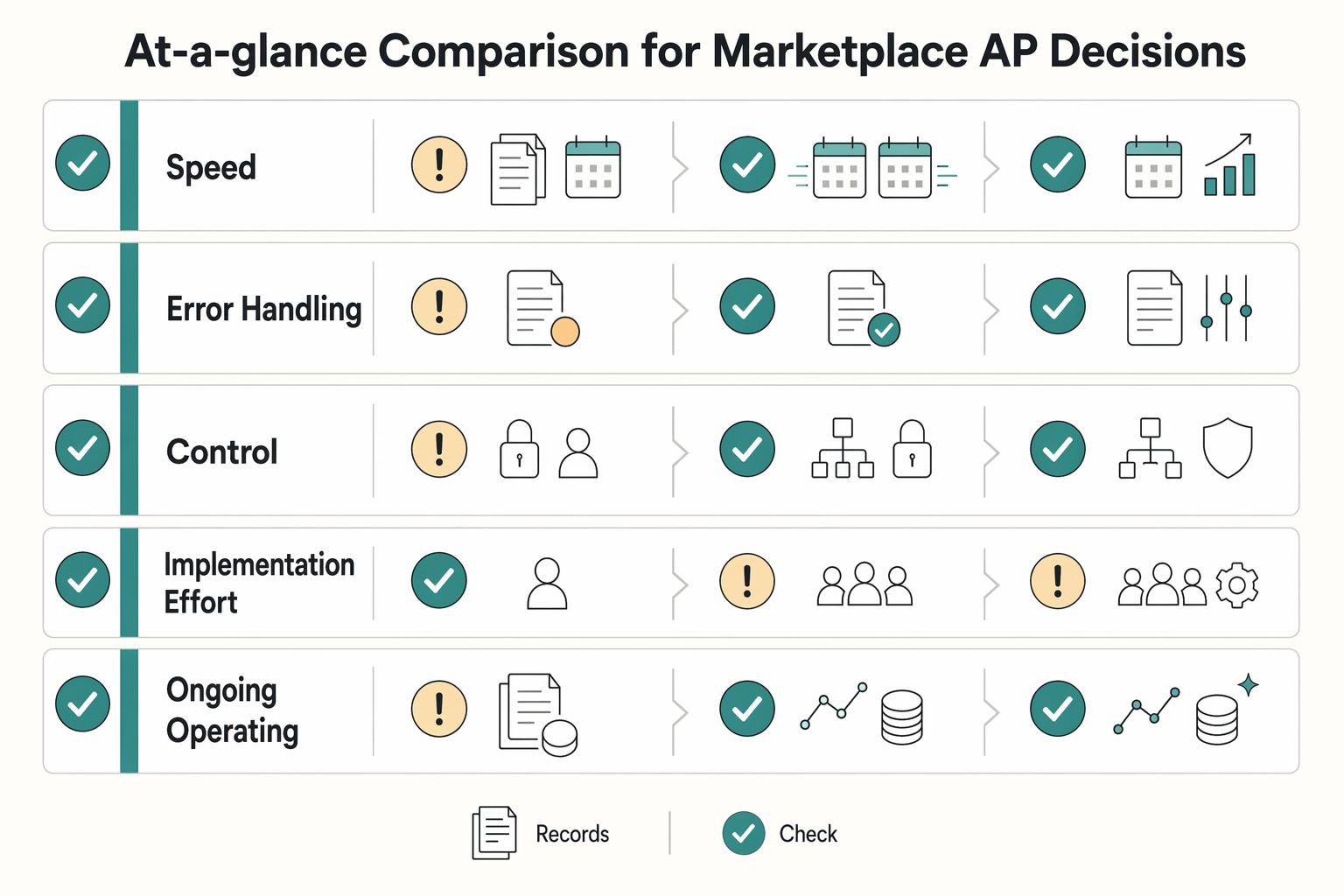
For marketplace operators, this is not a generic AP explainer. The real choice is whether you should stay with manual AP, move to rules-based automation, adopt AI-powered automation, or run a staged hybrid while volume, controls, and integrations catch up.
3-Way PO Matching for Marketplaces and Automated Invoice Verification
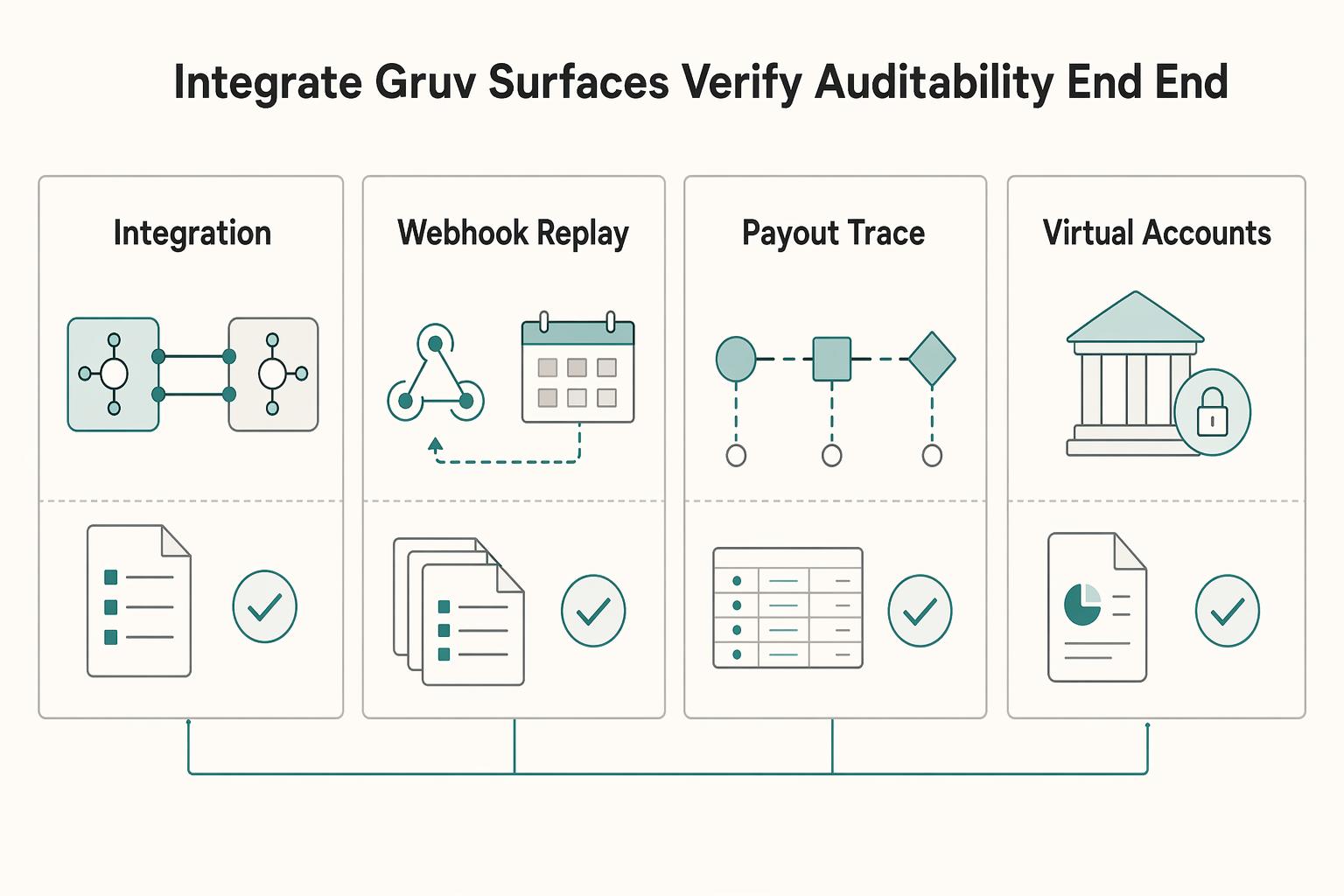
**Start here: treat three-way PO matching for marketplaces as a control decision, not a software toggle.** If you are still checking invoices only against a purchase order, you can miss cases where the invoice looks right on paper. The delivered item or service may still not match what was ordered.