
Quick Answer
Use three way po matching marketplaces when you can reliably connect each purchase order, invoice, and receiving record such as a GRN or item receipt at line level. If that third record is inconsistent, start with two-way controls and add targeted three-way gates for higher-risk categories. Before broad rollout, confirm mismatch ownership, hold-release evidence, and retry-safe processing so duplicate API calls or repeated webhooks do not trigger unintended payment actions.
How 3-Way PO Matching Works for Marketplace Invoices#
Start here: treat three-way PO matching for marketplaces as a control decision, not a software toggle. If you are still checking invoices only against a purchase order, you can miss cases where the invoice looks right on paper. The delivered item or service may still not match what was ordered.
When basic invoice checks stop being enough#
Basic invoice checks stop being enough when invoice-to-PO comparison no longer tells you whether the ordered value was actually delivered. Two-way matching compares an invoice only to its PO. Three-way matching adds a receiving document or other fulfillment proof before payment. That extra record matters because the PO shows intent and agreed cost, while the fulfillment record shows whether the ordered value was actually delivered.
The warning sign is not just volume. It is your AP team spending real time reviewing documents line by line, then chasing missing details before anything can be approved. Manual document sharing brings more errors and slower processing, so if your team is forwarding PDFs, screenshots, or spreadsheet exports to confirm fulfillment, you are already in a failure mode automation is meant to reduce.
Set the goal before you automate#
Before you automate, set the goal correctly. The point is not to approve everything faster at any cost. The point is to reduce payment risk by checking whether the PO, invoice, and fulfillment evidence agree, then routing exceptions for review while routine matches pass cleanly.
That tradeoff is real. Stronger matching can lower the chance of paying the wrong amount, but it can also increase exception handling when records are incomplete. Some matching tools are built to handle high line volumes quickly, so AP effort can shift away from routine approvals and toward investigating unmatched details.
Agree on valid evidence and exception ownership#
Before you build rules, agree across purchasing and AP on what counts as valid evidence. For goods, that usually means a receiving record tied back to the original PO. For services, you may need an equivalent proof of completion, but define that up front instead of letting operators guess case by case.
Your first checkpoint is simple: can you consistently identify the same transaction across the PO, invoice, and fulfillment record without manual interpretation? If not, do not start with heavy automation. Clean up document references first. Your second checkpoint is exception ownership. Someone needs to own missing fulfillment records, price mismatches, and duplicate invoice reviews, or the queue will turn into a month-end cleanup problem.
This guide stays on that operational path. It will show you when to use two-way versus three-way matching, what to configure at the line-item level, and how to keep payment controls auditable without turning every payout into a manual review. If you want a broader primer first, this companion piece is useful: Invoice Matching Explained: How Platforms Automate 2-Way and 3-Way Matching to Prevent Overpayment.
What three-way matching means in marketplace operations#
Treat three-way PO matching in marketplaces as a payment-control rule: pay only when the Purchase order (PO), Invoice, and fulfillment evidence, such as a Receipt, Goods received note (GRN), or Item receipt, align.
Define the three records and the payment outcome#
The control objective is consistency across all three records before approval. The PO shows what was ordered and the agreed price, the receiving-side document shows what was received and in what quantity, and the invoice requests payment. If quantity, description, or price does not match, hold payment and route the case for review.
This is the core control, not just AP workflow automation. Intake speed helps operations, but matching is what blocks payment for unordered, undelivered, duplicate, or misstated charges.
Expect line-level operational friction#
The practical challenge is usually operational, not conceptual. Records often come from different teams or systems, so line-level checks matter more than header-level checks. A useful checkpoint is whether you can reliably tie the same transaction line across the PO, invoice, and fulfillment record without manual guesswork.
If you cannot, treat that as a readiness gap. Unmatched queues often come from missing references, late fulfillment records, or unclear service descriptions rather than confirmed overbilling.
Set the fulfillment evidence scope#
Define acceptable fulfillment evidence before you automate. For goods-based flows, a GRN, receiving report, or item receipt is typically the third document. For contractor or service flows, use a policy-defined completion record and document it before invoices route.
At minimum, you need a PO, invoice, accepted fulfillment record, and clear ownership for Line-item discrepancy resolution. Without that scope, controls stay inconsistent even when the software works.
If you want a deeper dive, read Invoice Matching: How Platforms Automate 2-Way and 3-Way Invoice Verification.
Choose two-way or three-way based on risk and fulfillment signal quality#
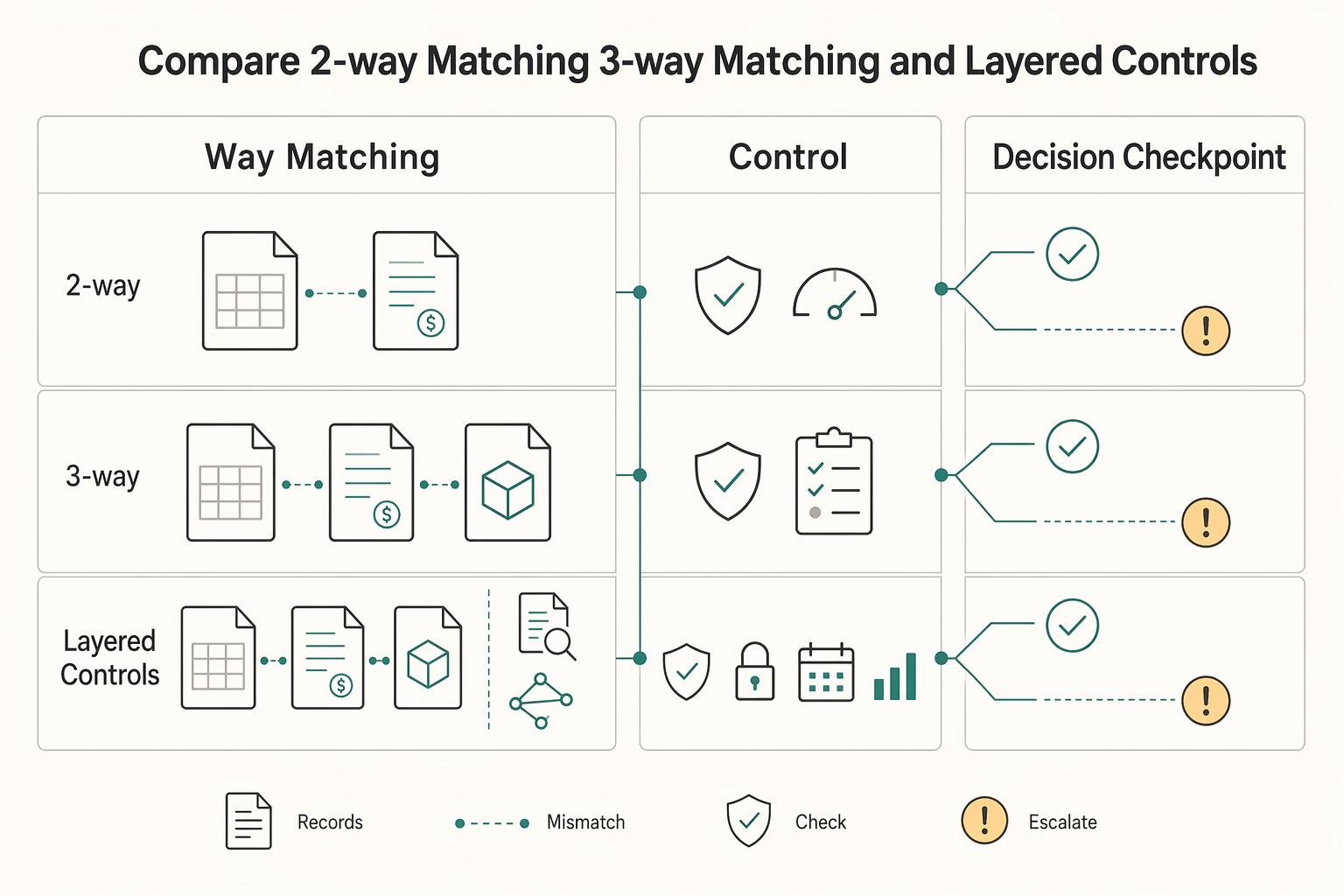
Use Two-way matching when fulfillment evidence is weak, and use three-way controls only where your receiving signal is reliable enough to enforce payment holds.
Two-way matching checks the Purchase order (PO) and Invoice. Three-way matching adds a receiving-side record such as a Goods received note (GRN) or Item receipt. If that third record is late, incomplete, or hard to connect to invoice and PO lines, strict matching usually creates review noise instead of better control.
Use a simple decision rule: if overpayment risk or policy exposure is high, accept slower approvals and apply stricter matching; if speed is critical and risk is low, start with two-way and add targeted three-way gates later.
| Model | Control strength | Operational overhead | False-positive risk | Approval latency |
|---|---|---|---|---|
| Two-way matching | Lower (ordered vs billed) | Low | Lower when fulfillment records are weak or inconsistent | Faster |
| Targeted three-way by category | Medium to high where applied | Medium | Moderate when receiving quality varies by category | Mixed |
| Broad three-way across PO-based spend | Highest when receiving records are reliable | High | Higher when receiving records are late or incomplete | Slower |
A mixed policy is often the practical path: baseline two-way, then require three-way for higher-risk categories where delivered quantity or receipt quality matters more.
For creator or contractor payouts with milestone attestations, treat the third document as usable only when completion evidence is specific and reviewable. For physical procurement with strong Item receipt or GRN records, three-way controls are usually easier to enforce consistently.
Stricter matching has a concrete cost: mismatches can place invoices on hold, and holds must be released before payment. That tradeoff is useful when it prevents payment on incomplete delivery, but costly when the mismatch is mostly documentation quality.
Related: The Best Way to Pay Filipino Virtual Assistants from the US.
Gather prerequisites and assign ownership before automation#
Do not enable automated matching until document standards, ownership, and data handoffs are explicit. Most failures are operational: missing PO references, receiving records that do not map to invoice lines, or no clear approver when a rule or exception needs a decision.
Define line-level document minimums#
Set minimums at line level, not just header level. Line-level matching is the common mode, and in three-way logic the invoice quantity is compared to matched product receipt quantity.
| Field | Required on | Use in matching |
|---|---|---|
| Stable line-item ID | PO, Invoice, and GRN or Item receipt | Supports line-level matching |
| Item or service reference | PO, Invoice, and GRN or Item receipt | Helps tie the same line across records |
| Quantity and unit price where relevant | PO, Invoice, and GRN or Item receipt | Supports quantity and price checks |
| Reference back to the originating PO line | PO, Invoice, and GRN or Item receipt | Lets an operator trace each invoice line to one PO line and one receiving-side line |
For each PO, Invoice, and GRN or Item receipt, require those four fields. If you track charges such as freight, include those fields in scope from the start so validation paths are not missed. Before go-live, test a real transaction and confirm an operator can trace each invoice line to one PO line and one receiving-side line without relying on email or free text.
Assign ownership before rule design#
Assign a RACI before implementing automation rules. Define who is Responsible, Accountable, Consulted, and Informed for:
- Rule changes
- Exception approvals
- Audit-response ownership
Keep one named final approver per mismatch type. Shared ownership without a final decision owner is where holds age and override history becomes hard to defend.
Map fields across APIs, webhooks, and finance tools#
Map the required matching fields end to end across your API, Webhooks, and ERP/AP tools. Confirm every required field arrives where matching actually runs, and do not assume each surface carries the same references.
Build retries in from day one:
- Use idempotent API writes to avoid duplicate objects or updates on retry
- Keep idempotency keys within the 255-character limit
- Make webhook consumers duplicate-safe, since undelivered events may retry for up to three days
Set a minimum launch evidence pack and do not waive it:
- Written approval policy
- Discrepancy routing by owner queue
- Reconciliation export format finance can use
- Ledger journal trace requirements showing who changed what, and when
Final readiness check: start from a ledger journal entry and trace back to the invoice, PO, fulfillment record, and human approval or override action. If that trace breaks on sample transactions, matching is not ready for live payout decisions. For a step-by-step walkthrough, see Chargeback Management for Marketplaces and MoR Dispute Recovery.
Configure line-item matching logic and tolerance rules#
Set matching at the line level first, and treat header totals as a secondary backstop. If an invoice line cannot be tied to one Purchase order (PO) line and one receiving-side line, send it to review before you rely on invoice-level totals.
Start with line identity, quantity, and price#
Build line-level checks first, then add header-level checks. Line-level matching is the base control in AP and can run in two-way or three-way mode, while header or invoice-total matching has less detail.
Apply three checks to every invoice line:
- Identity check
Require a deterministic PO line reference. In structured invoice standards like Peppol, InvoiceLine > OrderLineReference > LineID is the buyer-issued PO line identifier, with cardinality 1..1.
- Quantity check
Compare invoice quantity to the matched receiving document, item receipt, or GRN when you run three-way logic. Also block duplicate mappings, such as multiple invoice lines consuming the same receiving line.
- Price check
Compare invoice unit price to the PO line price or an approved change, then evaluate any discrepancy against your configured policy.
Run a quick transaction-level validation before go-live: confirm each invoice line resolves cleanly to the intended PO line and receiving-side line without free-text interpretation.
Set hard-fail and soft-review tolerances#
Define tolerance by mismatch type, and split outcomes into hard fail versus soft review. Matching discrepancies should be evaluated against configured tolerances, so operators are applying policy, not guesswork.
A practical policy split is:
- Hard fail for identity breaks and duplicate candidates
- Soft review for quantity or price variances when line references are valid
Do not copy a generic percentage. Some systems show examples such as 15%, but your threshold should come from your approval policy, commercial terms, and audit posture.
Publish duplicate and mismatch rules#
Document the rules in one operator-facing table. Duplicate checks should use more than invoice number alone; a multi-field check, such as supplier, invoice type, amount, currency, and date, is a stronger first pass.
| Mismatch type | Auto-action | Owner queue | Evidence required to clear |
|---|---|---|---|
| Missing or invalid PO line reference | Hard fail | AP or Marketplace Ops | Corrected invoice with valid PO line ID |
| Invoice line maps to the same PO or receiving line as another invoice line | Hard fail | AP | Supplier confirmation plus corrected invoice, or documented duplicate rejection |
| Quantity exceeds matched GRN or receiving record | Soft review or hard fail per policy | Ops | Corrected GRN or approved exception record |
| Unit price differs from PO line beyond tolerance | Soft review | AP | Approved PO change, contract approval, or documented price exception |
| Header total mismatch with lines otherwise valid | Soft review | AP | Recalculated invoice or supplier credit note |
When you launch version one, keep identity and duplicate controls explicit, and avoid creating review work for non-material formatting differences your standards already normalize. Loose identity rules with aggressive auto-approval usually create harder exceptions later across payment, fulfillment, and ledger reconciliation.
Related reading: How Marketplaces Add Recurring Revenue Without Billing Gaps.
Design exception handling and recovery paths before launch#
Define exception flow before go-live: every matching failure needs a named queue, an owner, a release condition, and an escalation path so Payout batches do not stall.
Separate queues by hold reason#
Route by hold reason, not by team. When matching criteria are not met, invoices can be placed on matching holds, so your queues should reflect the specific hold that must be cleared.
| Exception queue | Typical trigger | Default disposition | Evidence needed to clear |
|---|---|---|---|
| Missing evidence | No corresponding GRN or item receipt for a line | Hold until fulfillment proof arrives | Receiving document tied to the same PO line |
| Quantity mismatch | Invoiced quantity exceeds received quantity (for example, QTY REC Hold) | Review against tolerance policy | Corrected GRN or other receiving record |
| Price mismatch | Unit price exceeds PO line price beyond configured amount or percentage tolerance | Review and approval | Approved PO change or documented price exception |
Duplicate Invoice event | Same invoice appears to be submitted twice | Hard stop pending investigation | Supplier confirmation, rejection note, or corrected invoice record |
Keep missing evidence separate from quantity variance. No receipt at all is a different recovery path from a partial receipt.
Set escalation around payout timing#
Tie escalation to payout risk. Once an item is overdue in workflow, it becomes eligible for escalation, so map each queue to payout timing and escalate items that can miss the next batch.
Use an operational check before each payment run: review your matching hold detail report, or equivalent held-invoice report. If the same hold reason ages across cycles, ownership or evidence requirements are likely too loose.
Rerun matching after corrected receiving data#
Recovery should be explicit: correct the exception, rerun matching, then resubmit approval to release the hold. For late or partial receiving data, expect to run rematch more than once until full quantity is covered.
If invoices auto-submit to workflow hourly or daily, start escalation after the rematch window, not at raw ingest, so valid late receiving records can clear first.
Require a complete manual override note#
Use a manual override template and require it for every manual release. At minimum, capture:
- override reason code
- approver name and timestamp
- linked
Ledger journalentry or reference - supporting document attached to the invoice record
A manual release without a reason and ledger link may clear one payment, but it creates avoidable audit and reconciliation risk later.
Add compliance and payout controls for cross-border flows#
Cross-border payouts need a second control layer: invoice approval alone should not release funds. Treat approval to pay and eligibility to move money as separate decisions.
Gate payout release on compliance status#
Gate payout release on compliance status, not match status alone. A payout should require both: the invoice passed matching, and the payee passed relevant KYC, AML, and, where applicable, KYB checks. For U.S.-regulated legal-entity onboarding, beneficial-owner identification is required at account opening under 31 CFR 1010.230, so entity verification should not be deferred until after invoice approval.
Run a simple control test: mark an invoice approved, set the payee to pending KYB or AML review, and confirm it is excluded from the next payout batch. If it can still be paid through CSV upload, ad hoc wire, or manual release, the control is incomplete.
Capture tax artifacts by corridor and payee type#
Capture tax artifacts by corridor and payee type. In U.S. withholding/reporting contexts, a foreign payee may provide Form W-8BEN, while a U.S. person typically provides Form W-9 (Request for Taxpayer Identification Number and Certification). If payouts are reported as nonemployee compensation, keep the mapping to Form 1099-NEC.
| Artifact or check | Context | Article note |
|---|---|---|
| Form W-8BEN | Foreign payee in U.S. withholding/reporting contexts | A foreign payee may provide it |
| Form W-9 | U.S. person in U.S. withholding/reporting contexts | Request for Taxpayer Identification Number and Certification |
| Form 1099-NEC | When payouts are reported as nonemployee compensation | Keep the mapping to it |
| VAT validation | EU business flows where relevant | Store the result record with the payer/payee context |
| FBAR | When the flow actually triggers that review path | Filed as FinCEN Form 114; avoid treating it as a universal payout-release document |
| FEIE | When the flow actually triggers that review path | References tests such as 330 full days in 12 consecutive months; avoid treating it as a universal payout-release document |
For EU business flows, run VAT validation where relevant and store the result record with the payer/payee context. For FBAR and FEIE, avoid treating them as universal payout-release documents; capture them when your flow actually triggers that review path. FBAR is filed as FinCEN Form 114, and IRS guidance references a $10,000 aggregate foreign-account threshold during the calendar year; FEIE references tests such as 330 full days in 12 consecutive months.
Bind matching holds to every payment rail#
Bind matching holds to every payment rail. In marketplace three-way PO matching, a control is broken if AP blocks an invoice but another payout tool can still send funds. Make payout_eligible a derived status from the same hold logic used by matching, and require an override reason, approver, and linked evidence before any exception payment.
A common failure is bypassing a QTY REC Hold with a manual bank payment to save a batch. That clears today's queue and creates a harder reconciliation problem later.
Document ownership in MoR and mixed models#
Document ownership clearly in Merchant of Record (MoR) and mixed setups. The Merchant of Record (MoR) is the entity legally responsible for processing customer payments, and those models can place KYC, AML, and tax duties on that entity, but not every seller-payout control is automatically owned by MoR.
Use a per-flow ownership matrix that names who owns policy enforcement, evidence retention, and audit response. The risk signal is simple: one team assumes MoR owns the issue, another assumes the platform does, and no one can produce the tax form, VIES result, or beneficial-owner record on demand.
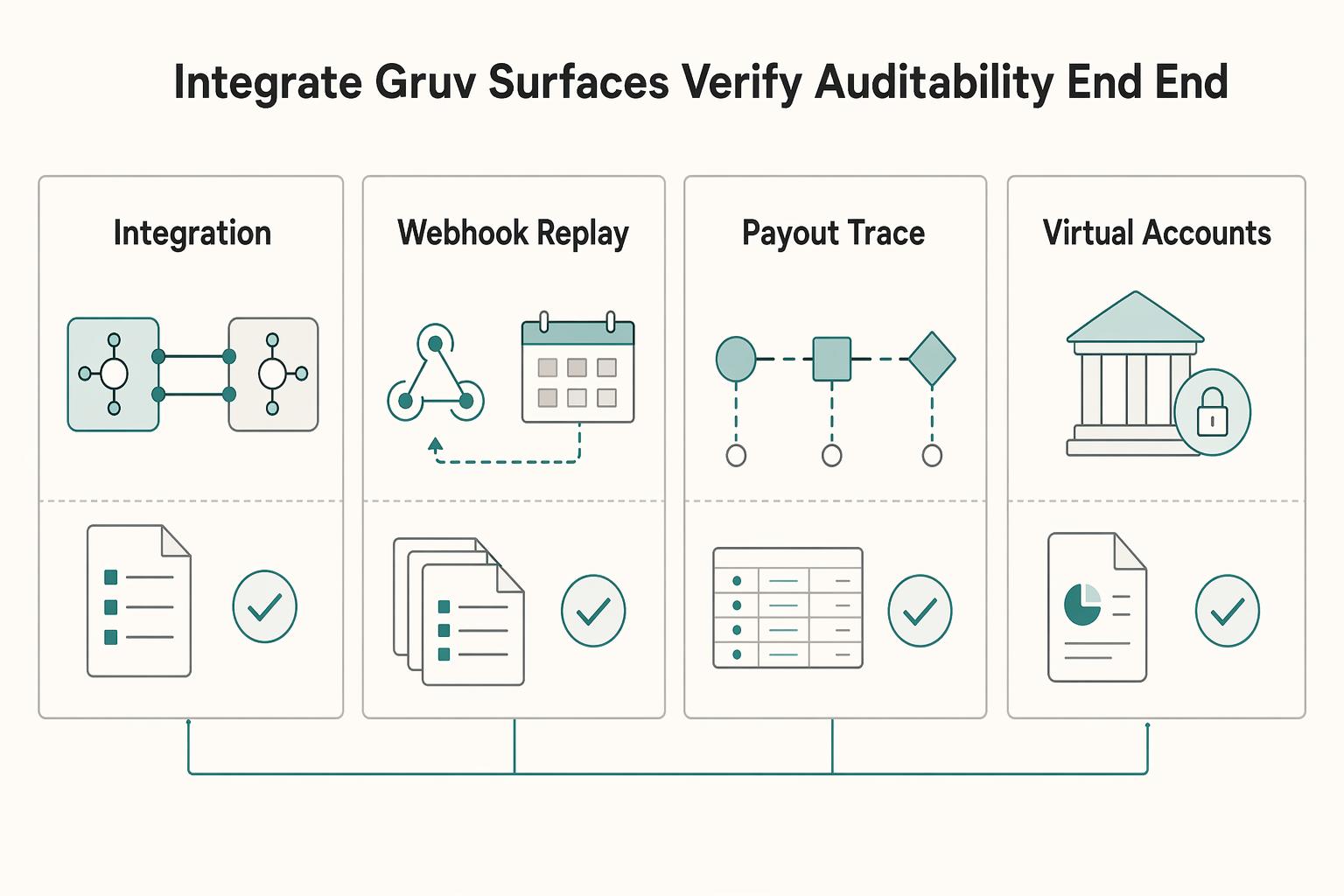
Integrate with Gruv surfaces and verify auditability end to end#
After matching and compliance gates, integration drift is the next failure point. Keep three outcomes non-negotiable: retries are safe, state changes are traceable, and Finance can show why money was or was not released without stitching screenshots.
| Control area | Required practice | Validation |
|---|---|---|
| Mutating API calls | Send an idempotency key and store it with the resulting internal record | Force a client retry after a simulated timeout and confirm the original result is returned |
| Webhooks | Treat delivery as at-least-once and deduplicate explicitly | Replay the same webhook payload twice and confirm the second pass is marked already processed |
| Gruv states and Ledger journal events | Use them as the trail you reconcile to | Keep a clear chain from API request to transaction state change to Ledger journal event to payout decision |
| Virtual Accounts (VBA) funding signals | Map funding-receipt signals into the payment-readiness view used by Finance and Ops | Before rollout, confirm payout release outcomes match policy and reconciliation closes from transaction state to journal to bank activity |
Make mutating API calls retry-safe#
Make every mutating API call retry-safe. For invoice creation, approvals, hold releases, and payout instructions, send an idempotency key and store that key with the resulting internal record. The key should make repeated identical calls resolve to the same outcome, so a timeout retry does not create a second approval or payout.
Test this by forcing a client retry after a simulated timeout and confirming you get the original result, not a duplicate side effect. A common failure is issuing a new key on each retry, which breaks deduplication.
Treat webhooks as at-least-once delivery#
Treat webhooks as at-least-once delivery and deduplicate explicitly. Log the provider event ID, event type, related invoice or payout reference, and processing result before irreversible actions run. Then enforce a duplicate check so the same event cannot reopen approval, clear a hold twice, or trigger a second payout release.
Validate it by replaying the same webhook payload twice and confirming the second pass is marked already processed.
Use Gruv states and ledger journals as the audit trail#
Use Gruv transaction states and Ledger journal events as the trail you reconcile to. Avoid treating mutable exports or dashboard snapshots as the source of truth. For each matched Invoice, keep a clear chain: API request, transaction state change, Ledger journal event, and payout decision.
Your evidence pack should let an operator answer quickly: what happened, when it happened, and what record triggered it. A red flag is any exception resolved in chat or notes that never lands in the journal-backed trail.
Connect virtual account funding signals, then gate rollout#
Connect Virtual Accounts (VBA) funding signals where supported, then gate rollout with launch checks. Virtual-account structures can improve visibility and reconciliation, so map funding-receipt signals into the payment-readiness view used by Finance and Ops. That keeps fully matched invoices from moving before funds are visible.
Before wider rollout, confirm on real volume:
- required fields are consistently populated
- exception aging trends down instead of accumulating
- payout release outcomes match policy
- reconciliation closes from transaction state to journal to bank activity
If any checkpoint fails in pilot, fix it before scaling.
Conclusion#
Use the same bar for launch that you would use for audit review: if you cannot prove why one invoice was released and another was held, you are not ready to widen payout automation. A practical start is this copy-and-paste checklist.
-
Enforce source document standards. Your
PO,Invoice, andGRNorItem receiptneed consistent references before matching logic matters. Check that key fields needed for matching are required in the source systems, not added later by hand. If fulfillment evidence is optional or inconsistent, three-document matching can generate avoidable exceptions. -
Choose the matching model by risk tier.
Two-way matchingcompares the PO and invoice within configured tolerances.Three-way PO matchingadds fulfillment-to-invoice verification, which is the stronger control when evidence quality is reliable enough to enforce. If that proof is weak, late, or inconsistent, start with two-way for that category and move up only when the signal is clean enough to avoid constant false positives. -
Ship rules and exception governance before volume. Define line-item checks first. Make the payment outcome explicit: if an invoice is out of tolerance, place a matching hold and keep it blocked until someone resolves and releases it. A useful checkpoint is to pull one held invoice for each major failure type, such as missing fulfillment proof and quantity mismatch, and confirm the reviewer can clear it using recorded evidence rather than Slack context or memory.
-
Verify retry safety and traceability before broad payout batches. For
APIwrites, use an idempotency key so a retry does not create a second approval action. ForWebhooks, assume the same event can arrive more than once and prove your consumer skips already processed event IDs. Then trace one transaction end to end through the audit trail: who entered or edited data, which state changed, and whichLedger journalor journal record ties the financial effect back to the invoice decision. -
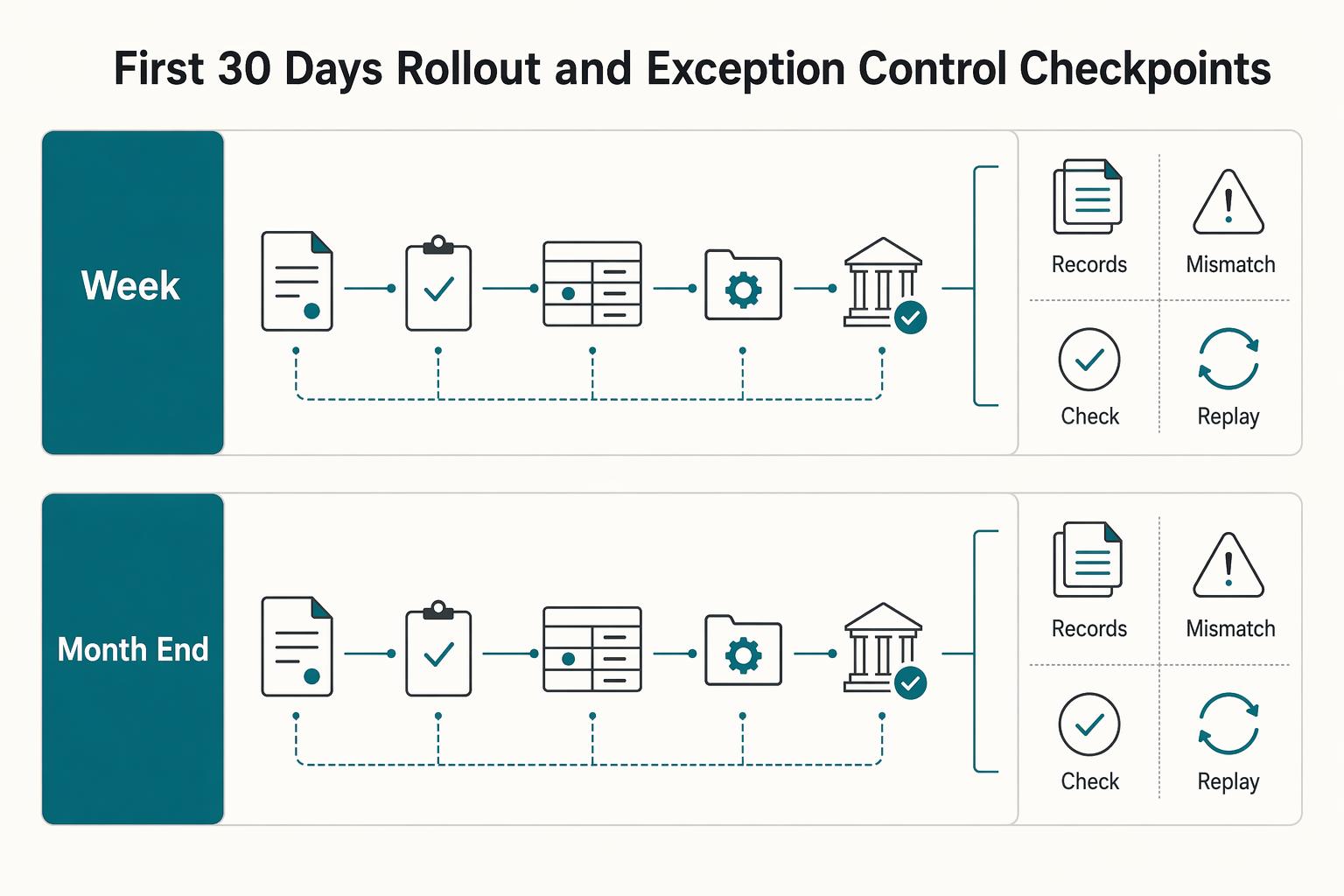
Roll out in phases and tighten only after the signals stabilize. Start with a narrower supplier group, spend type, or route where your fulfillment evidence is strongest. Watch the exception mix, rematch success on late receiving records, and reconciliation quality before tightening tolerances or expanding scope. If you use a tolerance percentage, document why it exists and revisit it with real exception data. Even a common illustrative figure like 15% is a policy choice, not a universal standard.
If you want a deeper side-by-side on when to use two-way or three-way controls, see Invoice Matching Explained: How Platforms Automate 2-Way and 3-Way Matching to Prevent Overpayment.
Frequently Asked Questions
What documents are matched in three-way PO matching for marketplaces?
Three-way matching checks three records before payment: the purchase order, the invoice, and proof that the order was actually fulfilled. In practice, that third document is a receiving record (for example, a product receipt). If one of those records is missing or cannot be linked to the same line items, you do not have a clean three-document match.
How is marketplace three-way matching different from standard AP matching?
The core control is the same: an AP check that cross-checks purchase details across three documents before an invoice is paid. Marketplace implementation details can vary by system design, so define exception and payout handling in your own policy.
When should we use two-way matching instead of three-way matching?
Use two-way matching when your process only supports reliable invoice-to-PO comparison. Two-way matching compares an invoice only to its PO, while three-way adds delivery verification. When delivery evidence is consistently available and you want that additional control, use three-way.
What happens operationally when line items do not match?
Those differences are matching discrepancies. The practical next step is to compare each variance against your configured tolerances, because tolerances determine whether matching holds are placed on invoices. If a variance exceeds tolerance, hold the invoice and route it to review. If it falls within tolerance, follow your policy for handling.
Can three-way matching reduce overpayment and fraud risk in practice?
Yes. It can help because it adds delivery verification beyond invoice-to-PO checks and is used to reduce invoice-fraud exposure. The key point is "can," not "automatically will."
How do APIs and webhooks change three-way matching reliability at scale?
They matter because retries and duplicate deliveries can happen. For API writes, use idempotency keys so retries do not perform the same operation twice. For webhooks, expect the same event more than once and skip already logged event IDs before you process irreversible actions.
What should we verify before turning on automated payout release?
There is no universal checklist that applies everywhere. Before enabling automated payout release, verify your process can consistently capture the PO/invoice/receipt records, evaluate discrepancies against configured tolerances, and prevent duplicate API or webhook processing through idempotency and event-ID deduplication.
Try a related tool
Researched and edited by the Gruv editorial team. Gruv builds cross-border billing, payouts, and finance-operations software for global businesses.
Sources
Includes 2 external sources outside the trusted-domain allowlist.
- docs.stripe.com/api/idempotent_requeststrusted
- docs.stripe.com/webhookstrusted
- ecfr.gov/current/title-31/subtitle-B/chapter-X/part-1...trusted
- europa.eu/youreurope/business/taxation/vat/check-vat-n...trusted
- irs.gov/businesses/small-businesses-self-employed/re...trusted
- irs.gov/forms-pubs/about-form-1099-nectrusted
- docs.oracle.com/cd/A60725_05/html/comnls/us/ap/point04.htmexternal
- docs.oracle.com/en/cloud/saas/financials/25b/fappp/how-can-i...external
Educational content only. Not legal, tax, or financial advice.
Related Posts
How Platform Teams Use 2-Way and 3-Way Invoice Matching to Stop Overpayment
Platform teams do not need another glossary entry on invoice matching. They need controls that stop real overpayment paths before money goes out the door. At its core, invoice matching compares an invoice with supporting records before payment. The practical question is what you add when a clean match still does not mean the invoice should be paid as submitted.
How Platforms Automate 2-Way and 3-Way Invoice Verification
The real question is not whether you know the textbook difference between 2-way and 3-way matching. It is whether your team can turn that difference into a real payment gate inside Accounts Payable. In an invoice verification platform, the distinction matters only when it changes what gets paid, what gets held, and what evidence must exist before settlement moves forward.

The Best Way to Pay Filipino Virtual Assistants from the US
There is no single best way to **pay Filipino virtual assistants**. The right choice keeps payments on time, secure, and easy to verify, not just cheap on paper.