
Quick Answer
Identify the contracting debtor, reconcile principal after payments/credits and state why it is overdue. Follow contract notice terms and applicable pre-action rules, give the required response time and itemize any justified charges. Preserve the letter, attachments and delivery evidence. After the date, assess replies and remaining procedural obligations before choosing a proportionate recovery route.
Stage 1: Establish the payment terms and evidence#
Many payment disputes are avoidable if you tighten the contract, onboarding path, and invoice controls before work starts. The aim is simple: no ambiguity about who pays, when they pay, how you invoice, and how you escalate if something slips.
Step 1: Lock payment terms before kickoff#
Before work starts, your contract should clearly cover the due date or payment terms, invoice currency, late-payment handling, governing law, dispute forum, and notice method. If any of those points are vague, delay is much easier to excuse.
| Term | What to specify | Grounded note |
|---|---|---|
| Due date or payment terms | Use an exact due date or clear net terms | UK guidance generally uses 30 days for public authorities and 60 for businesses; businesses can agree longer if fair. |
| No agreed date | Avoid leaving the contract silent | UK guidance measures lateness from 30 days after invoice receipt or delivery, whichever is later; use that as a reference point, not a universal default |
| Invoice currency | Set one invoice currency | Assign responsibility for FX and bank charges, and if budgeting and invoicing currencies differ, say which currency controls the amount owed |
| Late-payment handling | Keep late-fee language specific to the jurisdiction that applies | For applicable UK B2B debts, statutory interest is 8% plus Bank of England base rate; a contractual interest remedy may displace it. |
| Governing law and dispute forum | State both in the contract | Keep governing law and forum selection separate because they solve different problems |
| Notice method and suspension | Put notice mechanics and any suspension-of-work right in writing | Do not assume email alone is always enough for legal notice, and do not assume suspension rights are automatic everywhere |
Use an exact due date or clear net terms. If UK late-payment rules are the fallback that governs your deal, guidance says agreed dates should usually be within 30 days for public authorities or 60 days for business transactions. A longer period may still be valid if it is fair. If no date is agreed, UK guidance measures lateness from 30 days after invoice receipt or delivery, whichever is later. Use that as a reference point, not a universal default.
Set one invoice currency and assign responsibility for FX and bank charges. If budgeting and invoicing currencies differ, say which currency controls the amount owed.
For applicable UK commercial debts, statutory interest is 8% plus the Bank of England base rate. GOV.UK says you cannot claim statutory interest if the contract provides a different interest rate; public-authority contracts have separate constraints. Verify the applicable remedy and calculation before adding it to a demand.
Put notice mechanics and any suspension-of-work right in writing. Do not assume email alone is always enough for legal notice, and do not assume suspension rights are automatic everywhere.
Step 2: Verify the payment path, not just AP contact#
A correct AP email is not enough if the wrong entity signed the contract or procurement rules block payment. Before kickoff, confirm the exact contracting entity and how it pays suppliers. Collect the full legal name, registered address, billing address, and authorized signatory.
If you check a UK company in Companies House, treat it as a first screen only. Then cross-check it against the contract signature details and billing or remittance instructions.
Also ask four operational questions early:
- Is a PO required?
- Must invoices go through a specific portal or channel?
- Who approves invoices internally?
- Which supplier or tax setup documents are required?
This is where many avoidable delays start. Some large buyers explicitly return invoices unpaid when PO or submission rules are not followed.
For relevant EU VAT registrations, save the VIES result; UK GB VAT numbers use UK channels. US persons can provide Form W-9 through a secure channel where applicable, while foreign persons may need other tax documentation. Do not include a personal TIN in a widely copied demand letter.
| Contract/Process Control | What Problem It Prevents | What to Collect as Proof | When to Use It |
|---|---|---|---|
| Signed contract with due date, currency, governing law, forum, and notice clause | Scope for "we never agreed to that" delay arguments | Signed final contract and version trail | Every engagement |
| Legal entity and billing verification | Invoicing the wrong entity or address | Registry check, order form or signature match, billing confirmation | Every new client, especially multi-entity groups |
| PO and portal or channel confirmation | Invoice returned unpaid for process noncompliance | PO copy, portal or channel instructions, submission evidence | Any client with procurement controls |
| VAT or TIN onboarding checks | Tax setup rejection or invoice treatment errors | VIES result, VAT or TIN docs, W-9 or tax onboarding records | Cross-border and US payer setups |
Step 3: Send only a proper invoice#
Many late-payment disputes start as an invoice rejection. If the invoice is incomplete or routed incorrectly, payment may not be released.
| Item | Include | Note |
|---|---|---|
| Your legal details | On the invoice | Listed as a deal-specific field that usually matters |
| Client legal and billing details | On the invoice | Listed as a deal-specific field that usually matters |
| Invoice number and date | On the invoice | Listed as a deal-specific field that usually matters |
| Service period and clear line items | On the invoice | Listed as a deal-specific field that usually matters |
| Total, currency, and due date | On the invoice | Listed as a deal-specific field that usually matters |
| PO | On the invoice | If required |
| Tax or VAT identifiers | On the invoice | Include required VAT/tax invoice fields; keep sensitive personal TINs in restricted tax forms. |
| Reverse-charge notation | On the invoice | If reverse-charge treatment applies |
Before sending, make sure your invoice includes the deal-specific fields that matter. Those usually include your legal details, the client's legal and billing details, invoice number and date, service period, clear line items, total, currency, due date, PO if required, and the applicable tax or VAT identifiers. If reverse-charge treatment applies, include the required notation.
Run a short pre-send check each cycle:
- the legal entity matches the signed contract
- the billing address and submission channel match client instructions
- required PO, supplier, or approver references are present
- tax treatment is verified, not guessed
- submission proof is saved as a PDF, portal receipt, or sent record
Step 4: Preserve evidence while everything is clear#
Do not wait for a dispute before building your file. Keep one payment file per client with the signed contract, scope documents, onboarding and tax checks, PO records, invoice copy, submission proof, and approval or acceptance emails. If you need to escalate later, you can show that the invoice was valid, properly submitted, and due without rebuilding the record from memory.
You might also find this useful: How to Write a Final Demand Letter Before Legal Action.
Before you send the next proposal, lock in stronger payment terms and enforcement clauses with this freelance contract generator.
Stage 2: Draft and deliver a factual demand#
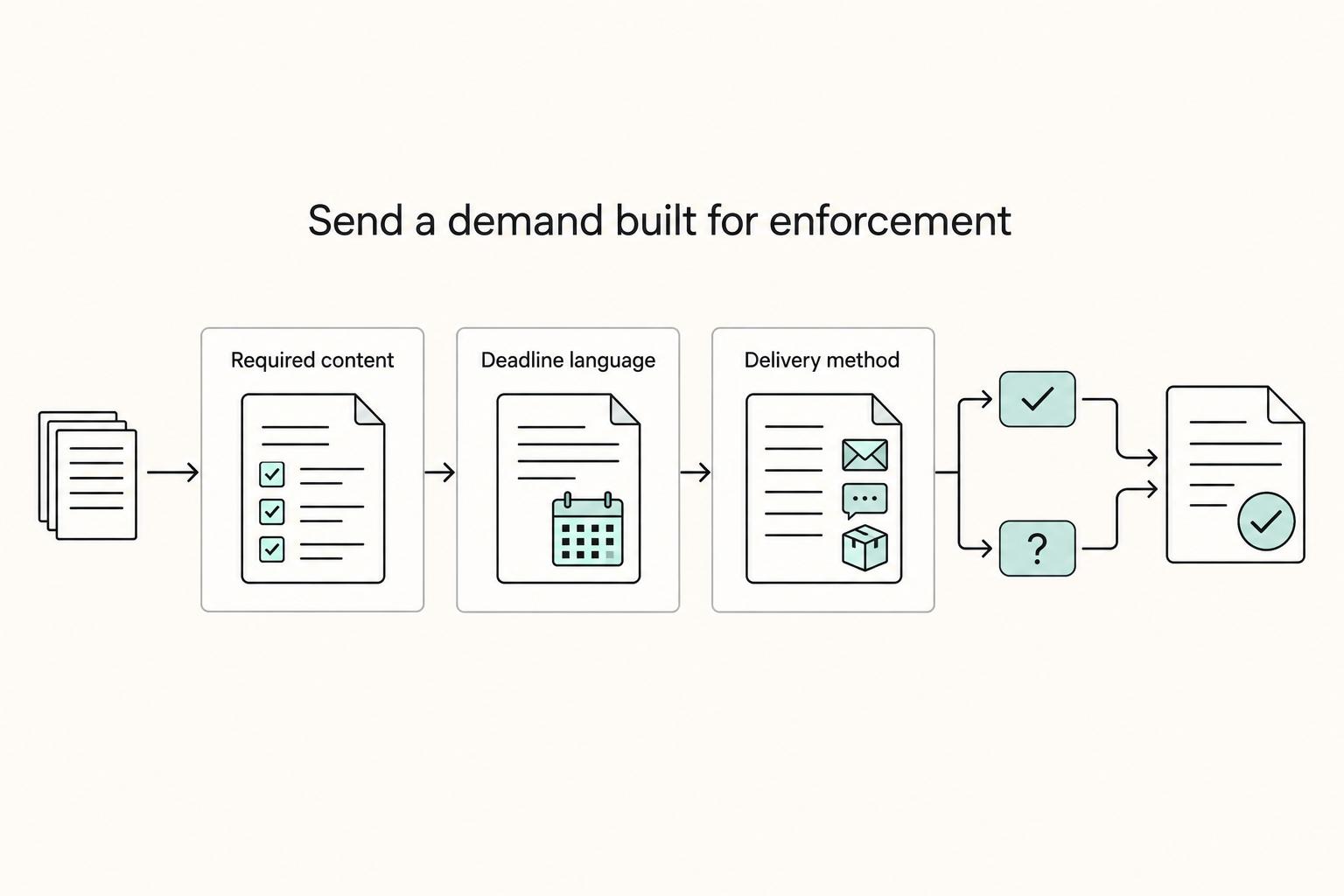
Once an invoice is overdue, use a factual demand to seek payment or a specific response. Reconcile payments, credits and genuine disputes first. The letter should state the supported balance, the response/payment date and the next step you can lawfully take.
The tone should shift here from conversational reminders to neutral, formal language. Keep it respectful and precise so the client can route it quickly.
Before you send anything#
Before you send the letter, check your file: contract terms, the invoice, and prior communications. Confirm that the invoice is still unpaid, the amount you are claiming is supported by your records, and your notice details match the agreement. Procedural mistakes and loose drafting weaken your position.
Demand letter framework you can fill in#
Use the table below as a fill-in structure, then tailor the wording to your contract and records.
| Field | What to include |
|---|---|
| Your legal name and address | Your legal entity and mailing address |
| Client legal name and notice details | Client entity and agreed notice details |
| Date | [YYYY-MM-DD] |
| Subject | Demand for payment — Invoice [number] |
| Invoice details | [invoice number(s), invoice date(s), service period, short service description] |
| Amount due | [principal amount claimed] |
| Overdue statement | [invoice is overdue as of date] |
| Payment deadline | [specific calendar date] |
| Payment/response instructions | [how to pay or respond] |
| Next step if unpaid | [collection referral / legal review / proceedings, as appropriate] |
| Contact for resolution | [name, email, phone] |
| Attachments | Invoice, relevant agreement/service evidence and calculation; required protocol forms where applicable. |
Follow both the contract’s notice terms and the applicable pre-action procedure; a short contract cure period does not override court rules. In England and Wales, the Debt Claims Protocol covers a business creditor claiming against an individual, including a sole trader, but generally excludes company-to-company debts. It calls for a Letter of Claim, statement/account details, Information Sheet, Reply Form and Financial Statement, normally sent by post, with at least 30 days for reply and further obligations when the debtor engages. Other claims use their applicable protocol or the general pre-action direction.
Sample wording with a reconciled balance#
Adapt this example and the response period to your actual procedure: “On [date], [client legal name] agreed to [services]. Invoice [number], dated [date], was due on [date]. The invoice total was [currency]5,000; we received [currency]1,000 on [date] and issued a [currency]250 credit on [date]. The outstanding principal is [currency]3,750. Copies of the invoice, agreement and acceptance record are attached. Please pay through [verified method] or send your specific response and supporting records to [contact] by [applicable date]. If unresolved after the required response period, I will consider [accurate next step].” Add interest or recovery charges only as a separate supported calculation. The example assumes no additional payments or credits.
Route it to reduce "we never received this"#
Use a simple sequence so the right people see the same notice, and keep a complete record of what you sent and what came back. A practical sequence can be:
- Deliver to the contract’s notice recipient and address using the required method.
- Copy the operational and AP contacts so they can route payment or identify a dispute.
- Use the appropriate legal/dispute contact if unresolved; retain each version and delivery record.
Choose delivery channels by evidence value#
No single delivery method is required everywhere. Use the channels that fit your contract and workflow, and keep one audit file with the final letter, attachments, delivery records, replies, and call notes. If your agreement specifies a notice method, use it instead of guessing.
What to avoid#
Avoid the mistakes that make the letter easy to ignore or dismiss. A measured, evidence-backed letter is often stronger than an aggressive one.
- emotional language, blame, or insults
- legal conclusions you cannot support from your documents
- threats you are not prepared or entitled to pursue
- sending before verifying contract terms and notice provisions
If you want a deeper dive, read The Silent Profit Killer: How to Stop Margin Erosion in Your Freelance Business.
Stage 3: Escalate in Order Once the Cure Date Passes#
After the stated date, check responses, payments and any mandatory waiting or disclosure period before escalation. Do not file automatically while an applicable protocol requires more time. Screen claim size, collectability, forum, relationship value and evidence strength, then choose the next step.
Step 1: Send the final notice#
A further notice can resolve a routing problem, but it is not universally required and must not consume a limitation period. If appropriate, confirm the prior demand, address any reply and state the next lawful step. Use this checklist:
- Confirm delivery proof from prior notices such as email records, portal logs, mailing records, and replies.
- Restate the cure opportunity with a specific calendar date.
- State the exact next trigger: agency handoff, counsel review, arbitration filing, or court filing.
- Keep one clean handoff file with the contract, invoice, service or acceptance evidence, notice records, and payment ledger.
If you need U.S. mailing proof, USPS Certified Mail gives a mailing receipt, and Return Receipt can add signature proof. Before sending, verify that the amount, addressee, and notice path still match your contract records.
Step 2: Screen the claim before spending more#
Do not spend more on escalation just because you are frustrated. A judgment does not guarantee payment, and recovery depends on what you can prove and what you can actually collect. Use this decision framework before you spend more:
| Filter | What to verify now | Escalation signal |
|---|---|---|
| Claim size | Whether the amount fits a verified local simplified-court cap and party type | If yes and domestic, simplified court may be efficient |
| Collectability | Whether the debtor entity is operating and reachable | If weak, legal spend risk rises |
| Jurisdiction friction | Where enforcement must occur and how hard cross-border enforcement will be | Higher friction favors paths with clearer enforcement mechanisms |
| Relationship value | Whether preserving a strategic account still matters | If high and the dispute looks procedural, try one short executive escalation |
| Evidence strength | Contract, invoice, delivery, acceptance, ledger, notices | Strong file supports formal action; weak file needs cleanup first |
California small-claims limits distinguish claimant type: individuals, including sole proprietors, can generally claim up to $12,500; corporations and other covered business entities generally have a $6,250 limit. Verify eligibility, venue, service and current court limits before filing. These examples do not establish an international forum.
A written arbitration clause is a decision point, not an automatic enforcement guarantee. Check validity, scope, forum and applicable exceptions. The New York Convention provides a framework for qualifying foreign/non-domestic awards, with treaty coverage, reservations and refusal grounds; it does not ensure recovery from an insolvent debtor.
Step 3: Hire a collections agency deliberately#
A collections agency can make sense when the debt appears real and collectible, but you want a recovery attempt before full legal proceedings. Treat it as controlled delegation, not a handoff you stop managing. Before you sign, check these points:
- cross-border operating capability where the debtor is located
- fee model in writing, including what happens if recovery fails
- reporting cadence and file visibility during the engagement
- licensing and compliance checks in relevant jurisdictions using official lookup tools
- written settlement authority limits, including discount and payment-plan approval rules
Define settlement authority clearly. Also, do not assume consumer-debt rules automatically govern commercial invoices. FDCPA scope is consumer debt, not corporate or business debt.
Step 4: Choose the dispute path you can enforce#
Once you move beyond notice, the real question is not which path looks toughest. It is which path you can actually enforce.
| Path | When it fits | Enforceability path | Cost exposure type | Timeline predictability | Confidentiality | Execution complexity |
|---|---|---|---|---|---|---|
| Small claims or local simplified court | Domestic debt within a verified local cap | Local judgment-enforcement tools | Filing, service, and potential counsel spend | Better for simpler local disputes, but still court-calendar dependent | Usually public; confirm local access rules | Lower |
| Court litigation | Larger domestic claims, or where your chosen court is practical | Depends on local law and recognition rules; exclusive court clauses may matter in some international civil or commercial cases | Filing, service, counsel, possible travel, motion practice | Less predictable | U.S. federal proceedings are generally public | Higher |
| Arbitration | Larger contract disputes where your agreement requires or permits it | Foreign and non-domestic awards are generally capable of recognition and enforcement under the New York Convention framework | Forum, arbitrator, administration, and counsel costs | Case-specific, but procedure is set by your clause and selected rules | Privacy/confidentiality depends on agreement, rules and law; enforcement proceedings can be public. | Potentially substantial fees and cross-border enforcement work; assess proportionality. |
If you are deciding between agency recovery and formal action, start with a practical default. A modest claim with decent collectability often supports an agency-first approach. A larger claim with strong evidence and an enforceable forum points toward formal proceedings. If you need the next step after that, see A Freelancer's Guide to Collecting on a Judgment.
Run the Same Fortify, Demand, Escalate Process Every Time#
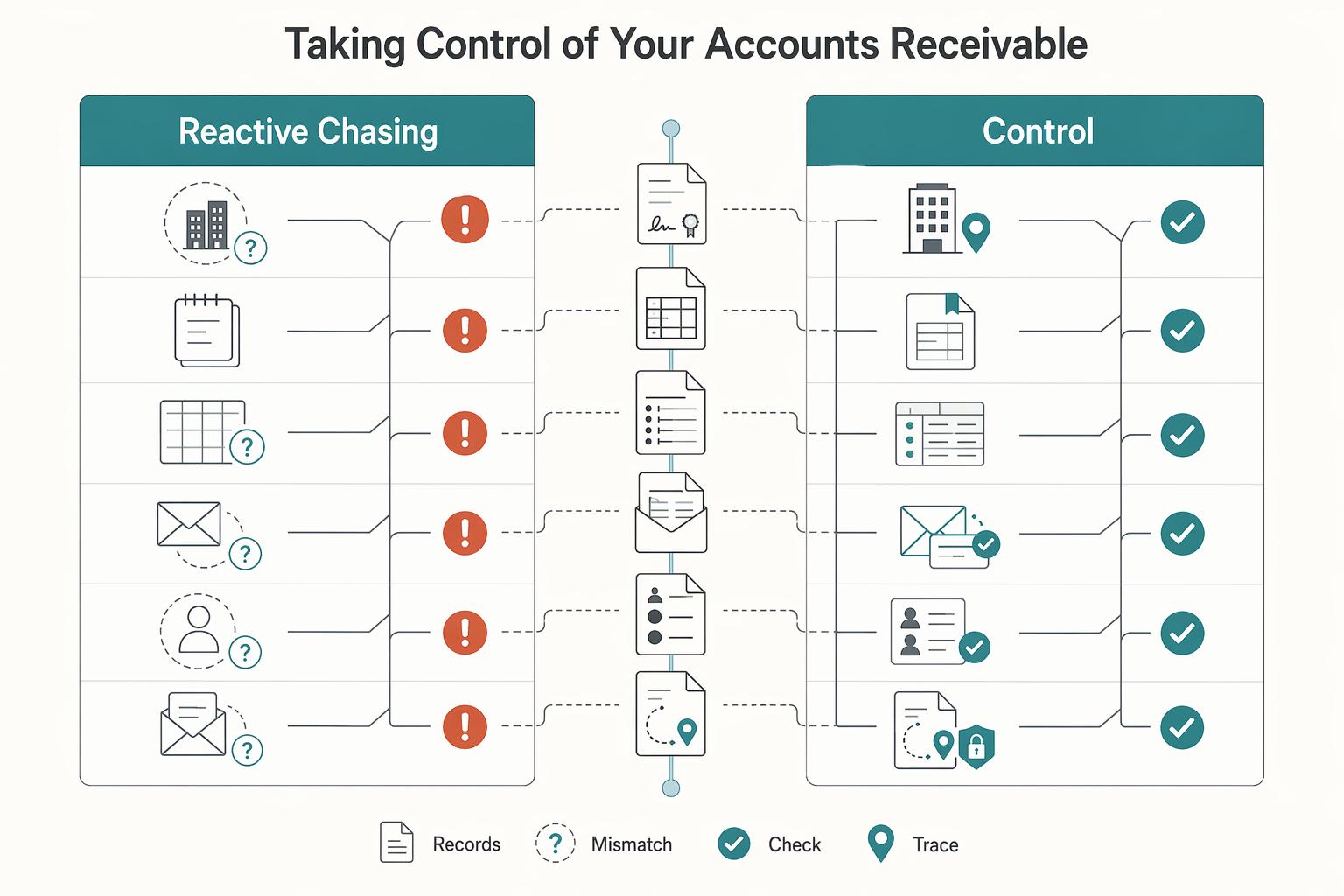
You get more control when you run the same Fortify -> Demand -> Escalate process every time. That keeps unpaid invoices where they belong: as a cash-flow issue, not a personal conflict. Before you chase payment, build one evidence file with the signed agreement, invoice, ledger or payment history, prior reminders, contact list, and delivery proof for every notice.
| Approach | How you behave | Main risk | Likely business impact |
|---|---|---|---|
| Reactive chasing | You send ad hoc follow-ups when pressure spikes | Gaps in facts, weak paper trail, inconsistent deadlines | More delay, more stress, weaker escalation position |
| Process-led receivables control | You follow one documented process every time | More upfront admin discipline | Faster routing, cleaner evidence, better escalation readiness |
- Fortify your starting position.
Before work starts, verify the client's legal entity, billing contact, and contract notice path. The standard is simple: if payment stalls, you already know who owes the money, where notices must go, and which documents prove the deal. Do not rely on trade names or informal contacts who cannot approve payment.
- Send a factual demand, not an emotional one.
A demand letter can be both a pre-court resolution step and an evidence tool. State how much is owed and why, and match it to your invoice and ledger. Send it through channels you can prove. If you use USPS Certified Mail, add Return Receipt for delivery proof, but do not treat certified mail as guaranteed receipt or guaranteed valid service in every case. Keep email headers, the mailing receipt, tracking, and replies in the same file.
- Escalate by deadline, not by mood.
Assign an escalation owner and track the limitation deadline separately from reminder dates. California requires asking for the money before small claims, which can be done in person, by letter or email; a demand letter is not the only permitted method. Individuals/sole proprietors and corporate claimants have different limits. Verify filing, service, evidence and hearing requirements with the chosen court rather than relying on one locality’s deadline.
What to do now: adopt this three-step process, use it consistently, and treat unpaid invoices as a managed business function.
If you want a cleaner cross-border collect-to-payout workflow with clear status tracking and records, explore Gruv for freelancers.
Frequently Asked Questions
How do you make a demand letter for unpaid invoice legally defensible internationally?
Match the correct debtor and supported balance, follow contract notice terms and applicable pre-action rules, give the required response opportunity and preserve the exact letter, attachments and delivery evidence. A demand is separate from service of court papers; no single international method guarantees validity.
What should you include when the client is in the EU?
Identify the contracting legal entity, invoice dates/numbers, service basis, principal balance, payments/credits and response/payment instructions. If the applicable member-state commercial late-payment rules support interest or recovery compensation, itemize the legal basis, rate, dates and calculation separately. EU guidance describes a minimum €40 recovery compensation entitlement for qualifying late commercial payments; consumer claims and national procedure differ. VAT registration and OSS filings do not replace the debt-demand requirements.
What are the alternatives to suing a foreign client?
Consider direct negotiation, a documented installment agreement, mediation or a licensed local collections agency. Arbitration requires an applicable agreement or later consent and can be costly. Compare expected recovery, debtor assets, fees and enforcement location before committing; keep limitation deadlines visible.
How do you write a letter that a large corporation will take seriously?
Make it factual, short, and easy to route internally. Before you send it, confirm the legal entity, amount, invoice number, and timeline against your records.
Can you charge late fees on an unpaid international invoice?
Claim only the applicable contractual or statutory remedy, without double counting. UK qualifying B2B statutory interest is 8% plus Bank of England base rate, subject to contractual-remedy rules; EU commercial rules provide country-specific interest and recovery compensation. Itemize principal, payments/credits, rate, day count and recoverable charges. A demand does not create a new fee entitlement. If the debtor disputes delivery, amount or authority, preserve their reply and address the evidence. Offer a practical resolution where appropriate; do not characterize a genuine dispute as fraud merely because payment is late.
Try a related tool
Researched and edited by the Gruv editorial team. Gruv builds cross-border billing, payouts, and finance-operations software for global businesses.
Sources
- consumerfinance.gov/ask-cfpb/what-laws-limit-what-debt-collector...trusted
- europa.eu/youreurope/business/finance-and-tax/making-r...trusted
- irs.gov/forms-pubs/about-form-w-9trusted
- justice.gov.uk/documents/debt-pap.pdftrusted
- justice.gov.uk/courts/procedure-rules/civil/rules/pd_pre-ac...trusted
- selfhelp.courts.ca.gov/pa/node/227trusted
- tulare.courts.ca.gov/system/files/forms-and-filings/small-claims-...trusted
- uncitral.un.org/en/texts/arbitration/conventions/foreign_arb...trusted
Educational content only. Not legal, tax, or financial advice.
Related Posts

Stop Freelance Profit Margin Erosion Before It Hits Cashflow
Revenue can hold steady while the business underneath it gets weaker. What comes in matters, but what you keep after the work is delivered is the clearer signal of health.
A Freelancer's Guide to Collecting on a Judgment
Winning the case is only part of the job. Getting paid is a separate enforcement process, and [the court does not collect for you](https://selfhelp.courts.ca.gov/civil-lawsuit/judgment/how-collect). At this point, you are the judgment creditor and the other side is the judgment debtor. Your next decisions are about cash flow, time, and risk.

The Freelance Payment Penalty: A Modeled Audit of Platform Fees, FX Spreads, and Payout Delays
The money rarely disappears through a single, easy-to-spot fee. The real loss is stacked. A marketplace takes its commission, a processor adds a charge for international cards, a bank or payment company converts the currency at a spread, a platform holds the funds before release, and a wire sheds a little to intermediaries on the way in. Each layer looks defensible on its own, but the worker feels the combined result as a smaller deposit and a later payday.