
Quick Answer
Early payment discounts can make some clients pay faster, but only if earlier cash collection is worth the discount cost. The article recommends measuring baseline DSO and payment timing by segment, fixing invoicing or approval friction first, and testing clear rules such as 2/10 Net 30 only where margin room, uptake, and controls support a positive ROI.
Why early payment discounts work#
An early payment discount should be treated as an economic decision, not an automatic concession. You give up invoice value to get cash sooner, so the core test is whether faster cash collection is worth the discount cost.
Step 1 Frame the offer as a cash trade, not a courtesy#
An early payment discount is a working-capital mechanism: the buyer pays earlier and receives a small invoice reduction. It can improve cash flow without adding debt, but it is not self-executing. In 2/10 Net 30, the buyer gets 2% off if they pay within 10 days; otherwise, the full amount is due in 30 days.
Adoption is optional, so results are never guaranteed. If uptake is low, you can add process overhead without materially changing collection timing.
Step 2 Anchor the decision to DSO and ROI#
Use Days Sales Outstanding (DSO) to track collection speed, and Return on Investment (ROI) to test whether program benefits outweigh program cost. Faster payment is useful only when the value of earlier cash collection exceeds the discount you gave up.
Before testing any offer, capture a baseline:
- Current DSO trend
- Actual payment timing by customer segment
Without that baseline, you cannot tell whether behavior changed or you simply discounted invoices for customers who already paid early.
Step 3 Decide upfront what this guide will help you implement#
This guide focuses on execution: confirm the use case, model expected ROI, define your Discount eligibility rule logic, and set controls that are clear enough to review later. The goal is a program that is measurable and reversible, not just launched.
The throughline is simple: these discounts change behavior only when economics, rule logic, and control structure align. If you cannot explain who gets the offer, how you will measure impact in DSO and ROI, and how exceptions are documented, the program is not ready.
Run a fast qualification test before you offer any discount#
After you set a baseline, default to no discount unless you see a collection-speed problem that a price incentive is likely to change.
Step 1 Screen the economics first#
Start with Days Sales Outstanding (DSO) and margin by segment. DSO measures the average days to collect after a credit sale, and lower DSO means faster collections. Typical early-payment discounts are around 1% to 2%, so they can reduce profitability if payment timing does not improve.
Check recent payment timing by segment, not just the portfolio average. If invoices are already paid early, a 2/10 Net 30 offer can end up discounting behavior you already had.
Step 2 Qualify by segment, not by company-wide average#
Run this as a segment decision, not a single policy for every buyer. Payment challenges vary across businesses and industries, so response to a discount is often uneven.
Evaluate each cohort on its own DSO pattern and margin room. If you average everything together, you can miss where discounting helps and where it only adds cost.
Step 3 Check for process friction before you pay for speed#
Treat late payment as a process question before a pricing question. In one UK study, 24% of surveyed businesses linked late payments to administrative errors, and that rose to 36% among large businesses. For a deeper diagnostic checklist, use invoice processing workflow controls.
Look for invoicing and processing errors in your own workflow, then fix those first. Structured eInvoicing is associated with fewer errors and smoother cash flow, which may improve timing without giving up invoice value.
Step 4 Set a stop condition before launch#
Define your stop condition before you start the test. For example, pause or end the program if DSO does not improve, if usage is concentrated among customers who already paid early, or if margin loss appears without better collection outcomes.
If you cannot agree on a stop rule upfront, wait to launch until the decision logic is clear enough to govern.
Prepare the data and owners before you touch pricing#
Do not change pricing until you can show what is happening now and who owns each decision. Without a baseline, named owners, and audit artifacts, discounting is hard to govern and easy to misprice.
Step 1 Build the minimum evidence pack#
Build four views for each target segment: Days Sales Outstanding (DSO) trend, gross margin, dispute rate, and current collection timing. DSO is the average days to convert credit sales into cash, and you can track it monthly, quarterly, or annually. Choose one cadence and keep it consistent so before/after comparisons hold. Pair this with a DPO baseline from accounts payable cycle optimization.
Go beyond a portfolio average. Pull payment timing by segment so you can separate early payers, near-term payers, and consistently late payers. Include dispute rate because it shows the share of actual payments that were disputed, and read it with lag in mind since cardholders can dispute payments up to 120 days later.
Verification: for each segment, you should be able to answer: how long cash takes today, how much margin room exists, and whether the issue is timing, disputes, or both.
Step 2 Assign owners before the first offer goes live#
Set explicit ownership and authority before launch. A practical split is: finance approves economics, product encodes the Discount eligibility rule, revenue controls customer messaging, and ops owns exception handling.
Define handoffs clearly. Finance approves allowed terms by segment. Product converts terms into deterministic logic and exclusions. Revenue only communicates enforceable terms. Ops runs a documented path for exceptions.
If you cannot name one accountable owner for each decision, pause before launch.
Step 3 Define the audit trail you will need later#
Decide your audit artifacts before launch and where they are stored. At minimum, retain invoice term history, approval records, Discount eligibility rule version history, and payout or reconciliation exports showing how discounted transactions settled.
If you operate as a Merchant of Record (MoR), this is higher-stakes because the MoR is legally responsible for payment processing and related transaction obligations. Tie exports to payout reconciliation so you can trace settlement batches and included transactions when invoice value, collected cash, and payout totals do not line up.
Verification: test one invoice end to end: original terms, approved rule version, payment date, discount outcome, and final reconciliation entry.
Step 4 Lock a review cadence with go, hold, and stop rules#
Set a recurring review cadence so the program is actively governed. Use monitoring that includes trend analysis, comparisons, and reconciliations, not only dashboard checks.
Review four questions each cycle: did DSO improve in the target segment, did gross margin stay within plan, is exception volume manageable, and are disputes or reconciliation gaps rising? Keep decisions explicit: go, hold, or stop.
If you want a deeper model for the next step, connect this governance to ROI analysis rather than treating it separately, including whether 2/10 Net 30 is worth testing at all. You can benchmark recovery economics with dunning analytics and recovery ROI.
Choose the right discount structure for each segment#
Choose one structure per segment first: fixed terms, dynamic discounts, or financing. Mixing all three at launch makes it hard to tell which lever changed behavior.
Step 1 Match the structure to the payment problem#
Use 2/10 Net 30 when you want a simple fixed offer and the segment can act inside a hard window: 2% discount if paid within 10 days, otherwise full payment at 30 days. The rigidity is intentional. If payment lands on day 12 or day 15, no discount applies.
Use Dynamic discounting when you need timing flexibility. Payment can occur between invoice approval and the due date, and discount levels vary by timing. Earlier payment means a larger discount.
Use Supply chain finance as a separate liquidity tool, not an expanded discount menu. Under Payables Finance, suppliers can access finance on buyer-approved payables while the buyer payable remains due at maturity. In reverse-factoring mechanics, a finance institution pays suppliers first and the buyer pays that institution later. If suppliers need accelerated liquidity, compare reverse factoring in platforms.
Step 2 Choose by customer type, invoice size, and margin room#
If the segment has standard invoices and predictable approvals, fixed terms are usually easier to explain and enforce. The tradeoff is bluntness: no incentive for someone paying after the fixed window, and the same concession even when a buyer would have paid early anyway.
If invoice size and approval timing vary, dynamic terms can better match concession to actual acceleration. The tradeoff is operating complexity: variable calculations, more policy edge cases, and more chances for product logic and legal terms to drift.
If liquidity is the main objective, financing may fit better than broad invoice-price concessions. It adds structure and governance complexity, and supplier-finance terminology often includes supply chain finance, payables finance, and reverse factoring. Related IAS 7 / IFRS 7 supplier-finance disclosure amendments are effective for annual periods beginning on or after 1 January 2024.
| Structure | Expected DSO impact | Margin sensitivity | Operational burden | Policy complexity |
|---|---|---|---|---|
| 2/10 Net 30 | Can move payment earlier when customers can meet the 10-day window | High when triggered, because the fixed 2% applies | Low to moderate | Low |
| Dynamic discounting | Can improve timing across payment dates between approval and due date | Variable, because discount changes with payment timing | Moderate to high | Moderate to high |
| Supply chain finance / Payables Finance | Can accelerate supplier liquidity while buyer payable remains due at maturity | Lower direct invoice-price sensitivity than broad discounting; economics shift into financing terms | High | High |
Step 3 Start with one structure per segment#
Do not launch both 2/10 Net 30 and Dynamic discounting in the same segment initially. You need a clean read on what changed.
- If invoice amounts are consistent, margin room is clear, and 10-day payment is realistic, start with fixed terms.
- If payment timing is less predictable and you need a sliding incentive from approval to due date, start with dynamic terms.
- If the priority is liquidity support without broad pricing changes, assess financing instead of adding another discount layer.
Verification: before launch, confirm one segment, one structure, one owner, and one success condition tied to DSO and margin.
Step 4 Encode exclusions before the first invoice goes out#
Define a Discount stacking rule before any offer is live. State clearly whether early-pay incentives can combine with promo credits, negotiated reductions, or other adjustments, then enforce that logic in product and contract language.
The common failure mode is accidental compounding across teams. Your audit trail should let finance reconstruct each outcome from invoice subtotal, adjustment lines, eligibility decision, and rule version. If that is not possible, pause rollout and tighten policy before scaling.
Build the ROI model that decides launch, pause, or stop#
Before launch, run one economic test per segment: does earlier cash collection and real behavior change outweigh discount cost and downside risk, or are you giving up margin for limited acceleration? Keep the model aligned with collection telemetry from a payment reconciliation dashboard.
Step 1 Model the three lines that matter#
Build one segment-level model with three separate lines: discount cost, cash acceleration value, and risk-adjusted behavior change. Keep them separate so you can see what failed if results disappoint.
For discount cost, model the exact structure mechanics. In 2/10 Net 30, that is 2% off if paid within 10 days, otherwise full payment in 30 days. For Dynamic discounting, use the expected mix of payment dates and discount levels, not one flat average unless this is an early rough-cut.
For cash acceleration value, convert earlier collection into a documented cash-value assumption. Define your Days Sales Outstanding (DSO) convention up front, because DSO can be modeled with either credit sales or revenue as the denominator. Pick one convention, label it, and use it consistently.
For risk-adjusted behavior change, discount headline upside for customers who do not change timing or would have paid early anyway.
Verification: per segment, show baseline DSO, projected DSO, discount dollars, and the behavior-change assumption linking them.
Step 2 Tie every scenario to ROI and DSO movement#
Use Return on Investment (ROI) and DSO together as the decision view, not payment speed alone.
Keep ROI auditable: benefit relative to cost. In practice, benefit includes modeled value from earlier collection plus any defendable behavior lift; cost includes discount expense plus identifiable operating drag. Do not force a universal cutoff; set a clear internal launch rule instead.
Keep DSO beside ROI in every case. DSO measures collection time after sale, and lower DSO is generally associated with stronger cash flow and collections. If ROI looks acceptable but DSO barely moves, you may be rewarding customers who already pay early. If DSO improves but ROI is negative, the concession is too expensive for the gain.
Use consistent periods: 90 days for quarterly views, 365 for annual views.
Step 3 Add a bounded sensitivity table#
Do not approve rollout from one adoption and one margin estimate. Use bounded sensitivity analysis with low/mid/high inputs.
| Scenario | Adoption assumption | Margin room | Likely decision read |
|---|---|---|---|
| Low | Low uptake of eligible invoices | Tight margin | Usually pause unless DSO gain is still meaningful |
| Mid | Moderate uptake | Moderate margin | Candidate for pilot or narrow launch |
| High | Strong uptake | Comfortable margin | Launch only if upside still holds after risk adjustments |
If upside only works in the most aggressive adoption case, run a constrained pilot instead of full rollout. Small-scale testing is the right move when feasibility is still uncertain.
Step 4 Add the downside line before approval#
Include one explicit downside row for disputes, reversals, and exceptions tied to your Late-payment reversal clause.
A disputed card payment can become a chargeback, meaning the payment is reversed and funds are withdrawn from your account. Chargeback handling is also time-consuming and resource-intensive. Model expected reversal and exception volume rather than treating it as legal fine print. Document dispute handling alongside chargeback resolution workflows.
Keep evidence traceable: invoice issue date, payment date, applied discount, and reversal decision should map back to the governing Discount eligibility rule. If that trace is missing, treat it as a stop signal.
Verification: before launch, confirm baseline and projected DSO, a documented ROI formula, low/mid/high sensitivity, and one downside row for disputes and late-payment reversals. If any are missing, stay in pilot.
Set policy rules and contract terms clients can follow#
Once the economics work, ambiguity becomes the bigger risk. If clients, finance, and billing logic interpret terms differently, you should expect payment delays, disputes, and avoidable exceptions.
Step 1 Write the early payment clause so timing is machine-readable#
Your Early payment clause should state eligibility, clock start, and settlement event in one place. Do not leave those rules to invoice footnotes or email language.
For fixed terms like 2/10 Net 30, state the outcome plainly: 2% within 10 days, otherwise the full amount due within 30 days. Then define timing: compute the discount window from the invoice date. If an invoice has no date, add a fallback that uses receipt of a proper invoice by the designated billing contact.
Define settlement with one explicit payment-date event your system honors. If this is vague, term interpretation and system outcomes can diverge.
Verification: test three sample invoices and confirm legal, ops, and product return the same eligibility result using the same start-date and payment-date event.
Step 2 Define the reversal rule before the first exception hits#
Your Late-payment reversal clause should explicitly cover missed windows, partial payments, and chargeback-adjusted settlements.
State that if payment is recorded after the eligibility window, the discount does not apply and the remaining amount stays due. For partial payments, do not assume universal treatment: some systems can calculate cash discounts on partial payments when configured, and without that setup an invoice can remain open with a balance. Your contract terms should match system behavior exactly.
Cover reversals directly. If a payment is later adjusted by chargeback and a separate debit adjustment occurs, state whether the discount is reversed, partially reversed, or unchanged. If you issue credit notes, define whether they are net of any cash discount already taken so settlement logic stays consistent.
Step 3 Add a discount stacking rule with hard precedence#
If you offer promos, credits, or negotiated rates, add a Discount stacking rule that clearly defines what combines and what does not. This is necessary because some billing setups allow multiple discounts on one invoice, while others block combinations across rule groups.
Set precedence explicitly, not just prohibition. For example: negotiated rate first, promotional credit second, early-pay discount last, with specific non-combinable cases listed. A generic "cannot be combined with other offers" line is usually not enough for real exceptions.
Step 4 Map each contract sentence to one executable rule#
Map each policy sentence one-to-one to your product's Discount eligibility rule. This prevents signed terms and invoicing logic from drifting apart.
| Policy term | System field or rule | Evidence to retain |
|---|---|---|
| Eligibility window | discount-days value (for example, 10) | rule version and approval |
| Clock start event | invoice date or proper-invoice receipt date | invoice timestamp |
| Settlement method | recorded payment-date event | payment timestamp and processor record |
| Stacking precedence | promo/credit combinability logic | applied-discount metadata |
If any clause cannot be tied to a field, rule, or event, fix it before launch. That is the practical check for whether your policy will drive faster payment behavior without avoidable disputes.
Encode discount logic in invoicing, payments, and ledger controls#
Once contract terms are clear, the risk shifts to execution consistency. Make discount outcomes server-calculated, traceable, and retry-safe so invoice amounts, payment states, and ledger entries stay aligned.
Step 1 Calculate the discount on the server at invoice posting or finalization#
Make the server, not the client or checkout UI, decide discount eligibility. Configure payment terms so discount dates and logic are set when the invoice is posted, then calculate the payable amount at payment time from the stored rule and recorded payment-date event. When you encode rules, map operational events using webhook implementation patterns.
That gives you a stable control point. Some systems calculate payment discounts and discount dates at posting, and in Stripe most invoice details are no longer editable after finalization. If early-pay logic depends on mutable fields after that, disputes and manual fixes become more likely.
Use a deterministic rule: for terms equivalent to 2/10 Net 30, a payment recorded on day 8 should return one amount due, and day 12 should return another, with no UI-side math.
Verification: replay payments before, on, and after the cutoff for three finalized invoices, and confirm collected amount, remaining balance, and ledger posting match.
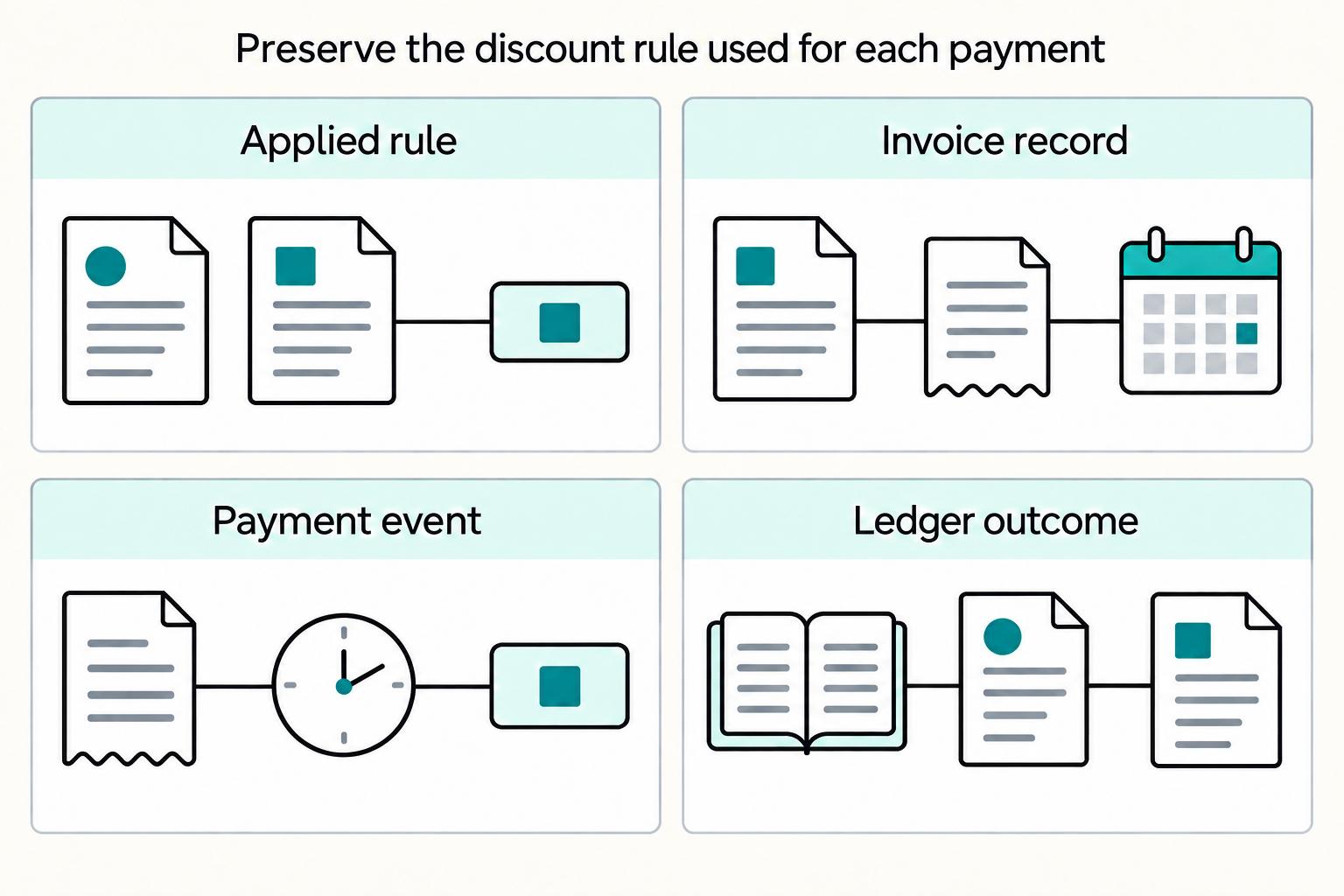
Step 2 Persist the applied rule and version in transaction metadata#
Store the applied Discount eligibility rule and its version on the payment or nearest transaction object you control. Metadata is built for internal reference data, with enough room for compact audit fields.
| Metadata field | Why keep it |
|---|---|
discount_rule_id | Identifies which rule decided eligibility |
discount_rule_version | Shows which logic was live at payment time |
invoice_id | Links payment to the invoice |
discount_outcome | Records eligible, ineligible, or reversed |
eligibility_cutoff_at | Preserves the exact deadline used |
Do not rely on today's rule table to explain yesterday's payment. If logic changes later, rollback analysis depends on the version captured with the transaction.
Step 3 Route payment events into ledger journals and reconciliation records#
Map each payment-state update to a consistent journal outcome. Payment methods define how payments post to the general ledger, and bank-subledger posting supports reconciliation, so this mapping should be explicit and reviewable. For month-end proof, align journals with subscription payment reconciliation practices.
For bank transfers, use Virtual Accounts where supported to improve automated matching. For checkout flows, keep invoice_id, payment object ID, and balance transaction ID linked so reconciliation can follow money movement cleanly.
A common failure mode is discount on the invoice but gross booked first with a later manual adjustment. That adds timing noise and month-end cleanup.
Step 4 Keep marketplace payouts traceable from invoice to payout batch#
In marketplaces, do not assume one payout equals one invoice. Ensure payout amounts are net of discount outcomes where appropriate, and preserve the chain from invoice to payment to payout batch.
Automatic payouts help because they keep transaction-to-payout association. Where available, use payout-linked balance transactions to show which transactions funded each payout batch.
Step 5 Add idempotent retry handling before go-live#
Make every external write that can change invoice, payment, or payout state retry-safe. Idempotent requests let repeated submissions return the original result instead of re-executing the operation, which prevents duplicate discount application during retries.
Use one idempotency key per business event, keep it within documented limits, and treat key retention as finite. Keep internal event IDs and downstream duplicate checks as well. Idempotency reduces duplicate writes; it does not guarantee exactly-once behavior across all services and integrations.
Add compliance and tax gates before scaling cross-border use#
Before you scale cross-border discounts, gate payout release on compliance and tax status, not just payment success. If KYC/KYB/AML or tax-document checks are incomplete, a faster-paid invoice should not create a faster withdrawal path. Before cross-border expansion, align controls with global tax withholding engine design.
Step 1 Gate payout release on KYC and AML status#
Treat payout release as a separate approval event. In U.S. covered financial-institution contexts, written procedures must identify and verify beneficial owners of legal entity customers, and those procedures must be part of the AML compliance program.
Use verified status from your provider or compliance team, not a generic "onboarded" flag. Test at least three cases before launch: approved entity, pending review, and changed ownership details.
Step 2 Match KYB checks to the market and program#
Do not apply one universal KYB checklist across all markets. FATF sets international standards, but countries implement them through local measures, and lower-risk scenarios may allow simplified measures.
At account opening, capture beneficial owners for each legal-entity account, the documents reviewed, and the rule set applied. Store the applied rule version on the account record so you can explain market-by-market differences in approval outcomes.
Step 3 Branch W-8, W-9, and 1099 logic before reporting season#
Split your tax-document flow early. Use Form W-9 to collect a correct TIN for payer/requester reporting, and collect Form W-8 BEN from foreign beneficial owners when requested by the withholding agent or payer.
For U.S. nonemployee compensation, Form 1099-NEC applies at $600 or more and is generally due by January 31. Payment card and third-party network transactions are reported on Form 1099-K instead of Form 1099-NEC. If a TIN is missing or mismatched in a 1099-NEC case, backup withholding can apply at 24%.
Step 4 Test EU VAT validation and post-supply discount handling#
For EU flows, validate VAT numbers through VIES and store the validation result, country, and timestamp with the invoice or counterparty record. VIES is a search engine into national VAT data, and updates may not appear immediately, so urgent exceptions may require local tax-authority follow-up.
Then test post-supply price reductions. Under the VAT Directive Article 90 principle, the taxable amount is reduced when price is reduced after supply, subject to Member State conditions. Keep the VIES check, invoice ID, discount outcome, and any correction record linked so discount presentation and VAT treatment stay consistent.
Pilot by segment and use explicit stop-go thresholds#
Once your tax, payout, and eligibility controls are in place, keep rollout narrow and decision-led. A pilot is a small-scale trial meant to tell you whether you should scale. During pilot review, track failed recovery behavior using revenue recovery playbooks.
Step 1 Choose one narrow cohort and one offer mechanic#
Start with a targeted cohort, not your full base. Segment using criteria you can enforce cleanly, such as payment terms, payment method, or payment currency.
Keep the offer design consistent inside the pilot so results are interpretable. If you need payment-timing sensitivity, use Dynamic discounting, where earlier settlement leads to a larger discount.
Step 2 Define the evaluation plan before execution#
Set your monitoring and evaluation approach early, in parallel with pilot design, and use findings during the pilot and after it finishes.
Compare collection speed and economics together using one consistent method throughout:
- DSO:
Accounts Receivables / Net Credit Sales x Number of Days - ROI:
Net Income / Cost of Investment
Step 3 Use explicit stop-go criteria for scale decisions#
Decide in advance what outcomes qualify as scale, adjust, or hold. Keep those criteria tied to the pilot's core question: whether faster cash conversion and realized return justify the discount and operating effort for this segment.
If results are mixed, adjust scope before expanding. For example, tighten targeting criteria or shift from a flat structure to Dynamic discounting so discount size better reflects payment acceleration.
Step 4 Promote only when results are repeatable#
Treat one strong review as a signal, not proof. Move to broader rollout only when repeat reviews show stable performance on your chosen DSO/ROI method and clean operational execution for the same cohort and offer logic.
Recover quickly from the failure modes most teams miss#
Even if your pilot clears DSO and ROI checks, pause expansion until these breakpoints are controlled in writing and in code. The fastest recovery is usually tightening timing rules, discount precedence, reconciliation evidence, and contract-to-rule alignment before exceptions spread.
Step 1 Tighten the expiry trigger#
Lock the timing logic first: your Early payment clause should state one clock start, one expiry point, and what timestamp counts as payment. This is the main control against static-term misuse (for example, 2/10, net 30) where a discount can be taken without true early payment.
Use one clock start consistently (for example, invoice date) and define the payment-time rule clearly, because eligibility disputes often come down to timestamping. Also state post-window behavior: when the discount is unearned, default to zero unless you explicitly allow an unearned discount or grace period.
Your checkpoint is practical: sample invoices near the cutoff and confirm finance, product, and support all reach the same earned/unearned result. If partial payments are allowed, verify whether your rule prorates or rejects the discount.
Step 2 Lock discount precedence before promotions collide#
Set a single Discount stacking rule before combining early-pay offers with promos or other credits. Billing systems can apply stacked discounts together, and some implementations apply each discount to the original charge amount.
Put the precedence in both contract text and application logic. If policy and code disagree, you will create avoidable credits or disputes.
Verify with a small matrix: promo only, early pay only, both present, and late payment with both attempted. Every path should resolve deterministically without manual support judgment.
Step 3 Trace invoice to payout with hard evidence#
Treat reconciliation as an evidence problem: preserve traceability from invoice to payment to payout. Missing or incorrect payment reference data can break customer- and invoice-level matching even when the discount rule is correct.
Carry invoice ID, applied rule version, net amount, and discount amount through your ledger records. If you use Virtual Accounts, map each one to the correct legal entity or vendor to keep a clear audit trail. Keep Payout batches (settlement batch) artifacts so you can audit the underlying transactions in each payout.
Checkpoint: pick one discounted invoice and trace it end to end from invoice, to payment event, to ledger entry, to virtual-account reference (if used), to payout batch. For manual payouts, reconciliation accountability remains with the operator.
Step 4 Map contract language to executable rules#
Reduce legal-policy drift by mapping each eligibility sentence in the contract to one executable Discount eligibility rule. Keep the mapping explicit and avoid hidden policy in support macros or ad hoc email text.
This matters because ambiguous contract terms are generally construed against the drafter (with jurisdiction-specific outcomes). After mapping, retest edge cases like late payment, partial payment, and attempted discount claims after the earned window closes.
If outcomes drift across legal, finance, and product, update contract text and rule logic together, then rerun the edge-case set before rollout resumes.
Use this copy-paste launch checklist#
Keep the program in pilot until every line below has an owner, evidence, and one verification point.
- Qualification complete: Baseline Days Sales Outstanding (DSO) is documented (average collection time on credit sales), segment margins are documented, and launch/pause/stop rules are written. Because there is no universal "good" Return on Investment (ROI) benchmark, your stop condition must be explicit.
- Pricing design complete: Each cohort has one pricing structure with clear boundaries. For fixed terms, 2/10 Net 30 is 2% off within 10 days, otherwise full payment in 30 days. For dynamic discounting, discount size changes with payment date, so eligibility logic and customer messaging must be tighter.
- Governance complete: The Early payment clause, Late-payment reversal clause, and Discount stacking rule are approved in both contract language and application logic. Legal, finance, and product should all get the same result for late payment, partial payment, and promo-plus-discount cases.
- Systems complete: Discount calculations run server-side, retries are protected with idempotency keys, and records can trace invoice, payment event, discount amount, and resulting balance movement. The applied rule and rule version are captured in metadata, and one discounted invoice can be traced end to end into the ROI dashboard.
- Compliance and tax complete (where supported): In regulated U.S. banking contexts, CIP identity checks are risk-based and legal-entity procedures address beneficial-owner verification; if you rely on the Feb 13, 2026 FinCEN relief, confirm your institution has adopted that optional approach. Tax handling is defined for Form W-9, Form W-8BEN, and Form 1099 workflows, including when 1099-K rules apply instead of 1099-NEC/1099-MISC. If EU flows are in scope, VAT-number checks via VIES and discount tax presentation are validated.
Conclusion#
The right move is to treat an early payment discount as a controlled pricing rule with measurable economics, or not offer it. It can pull payment forward, but only when terms are narrow, timing is explicit, and controls prevent unearned discounts.
Step 1 Qualify the use case before you spend margin#
Launch only if faster cash is worth the price concession. Use DSO as a core baseline and post-launch check, since it reflects how long collection takes after a sale. If DSO is already stable or margin cannot absorb the reduction, fix process and collections friction first.
A prompt-payment discount is an invoice reduction in exchange for earlier payment, not a general goodwill gesture. Before launch, define the target cohort, expected DSO movement, and a clear stop condition.
Step 2 Encode the rule exactly as clients and systems will apply it#
Precision in terms is non-negotiable. 2/10 net 30 means 2% off if paid within 10 days; otherwise full payment is due in 30 days. In federal prompt-payment language, the discount window is computed from the invoice date, and an offered discount is part of the award only within the stated period; that level of clarity is the standard to copy.
Contract terms, invoice wording, and payment logic should align on clock start, eligibility window, settlement handling, and exceptions. Because prompt-payment discounts are variable consideration in IFRS context, weak policy-to-system mapping creates revenue and settlement risk. Validate one invoice end to end using invoice date, payment timestamp, applied rule version, and final collected amount.
Step 3 Enforce hard guardrails and judge performance with evidence#
Without enforcement, discounts become leakage. Prevent discount-taking outside the window, define exception handling, and keep an audit trail of term history, approvals, and applied rules.
Misapplied prompt-payment discounts can create direct financial penalties in at least one federal rule set, which underscores the control risk. Judge performance on realized DSO movement, discount usage, disputes, and exceptions. If usage rises without faster collection, tighten the cohort or stop; if controls hold and economics remain positive, this becomes a margin-aware growth lever instead of a blanket giveback.
Frequently Asked Questions
Do early payment discounts actually make clients pay faster?
Sometimes. These discounts are designed to pull payment forward with a small percentage off for payment inside a short window, but uptake is optional. The real proof is lower DSO, not just higher discount usage.
How do we calculate whether an early payment discount is worth it?
Start with the discount cost per invoice, then compare it with the value of receiving cash earlier and any real change in payment behavior. Use DSO = Accounts Receivables / Net Credit Sales x Number of Days as a core check. If discount usage rises but DSO does not improve, the economics are weak.
What discount terms should we test first for enterprise vs SMB clients?
Do not assume enterprise and SMB clients need different starting terms. Choose based on buyer risk, payment behavior, and margin room. Test one simple structure first, such as 2/10 Net 30 or 1% within 10 days, so it is easy to explain, verify, and enforce.
When should we avoid early payment discounts entirely?
Avoid them when DSO is already stable and margins cannot absorb even a small discount. Also avoid them when late payment is mainly caused by invoice friction, approval delays, or billing disputes. Do not launch if you cannot enforce the payment window consistently.
Which teams must approve and operate the program day to day?
There is no single team model that fits every company. A practical split is finance approving the economics, product encoding the Discount eligibility rule, revenue controlling customer messaging, and ops handling exceptions. Day to day, the operating team should verify payment timing, applied discount, resulting balance movement, and the rule version used.
Is 2/10 Net 30 better than dynamic discounting for a platform business?
Not universally. 2/10 Net 30 gives a fixed 2% discount if payment is made within 10 days; otherwise the full amount is due in 30 days. Dynamic discounting changes the discount by payment date, so use fixed terms for simpler messaging and auditability and dynamic terms when you want day-based pricing flexibility.
Researched and edited by the Gruv editorial team. Gruv builds cross-border billing, payouts, and finance-operations software for global businesses.
Sources
- acquisition.gov/far/52.232-8trusted
- acquisition.gov/far/subpart-32.9trusted
- consumerfinance.gov/ask-cfpb/how-can-i-get-a-refund-on-a-product...trusted
- ecfr.gov/current/title-31/subtitle-B/chapter-X/part-1...trusted
- ecfr.gov/current/title-31/subtitle-B/chapter-X/part-1...trusted
- gao.gov/products/gao-25-107721trusted
- gao.gov/greenbooktrusted
- guides.gaoinnovations.gov/greenbook/2025/principle-16-perform-monitori...trusted
Educational content only. Not legal, tax, or financial advice.
Related Posts

The Freelance Payment Penalty: A Modeled Audit of Platform Fees, FX Spreads, and Payout Delays
The money rarely disappears through a single, easy-to-spot fee. The real loss is stacked. A marketplace takes its commission, a processor adds a charge for international cards, a bank or payment company converts the currency at a spread, a platform holds the funds before release, and a wire sheds a little to intermediaries on the way in. Each layer looks defensible on its own, but the worker feels the combined result as a smaller deposit and a later payday.

How to Respond to a Subpoena for Business Records
Move fast, but do not produce records on instinct. If you need to **respond to a subpoena for business records**, your immediate job is to control deadlines, preserve records, and make any later production defensible.
A US Expat's Guide to Investing in UCITS ETFs to Avoid PFIC Issues
The real problem is a two-system conflict. U.S. tax treatment can punish the wrong fund choice, while local product-access constraints can block the funds you want to buy in the first place. For **us expat ucits etfs**, the practical question is not "Which product is best?" It is "What can I access, report, and keep doing every year without guessing?" Use this four-part filter before any trade: