
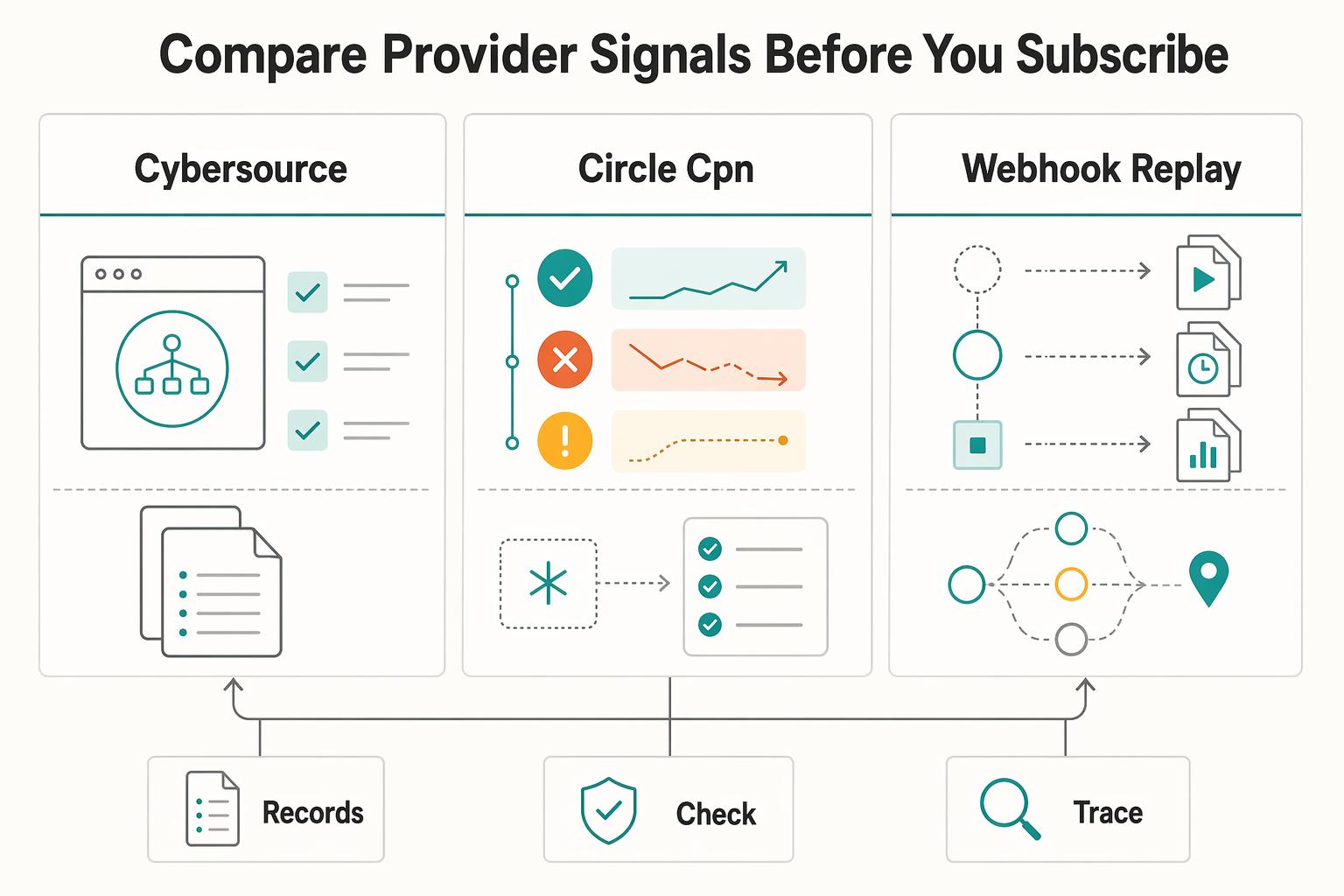
Quick Answer
A reliable payment webhook pipeline uses a secure HTTPS receiver, sender verification, durable event capture, and provider event IDs to identify repeated deliveries. Acknowledge after safe persistence, then apply each valid business transition once with an atomic or durably recoverable financial write. Keep capture separate from settlement and available cash, and reconcile retries or late updates.
Design a reliable payment webhook pipeline#
Payment webhooks are easy to stand up. Reliable payment operations are not. The difference comes down to a few architecture decisions you make early, before late or out-of-sequence events start showing up in production.
A webhook is an HTTP endpoint that receives event notifications from a payment provider. In practice, payment events are asynchronous, so webhook-driven integrations are near real-time, not perfectly immediate. Design for non-linear timing from the start, not a clean, in-order stream.
The main job here is payment status synchronization. Amazon Payment Services describes real-time webhook notifications that keep systems synchronized and notes that updates can still arrive even when customers do not complete the return flow. Square sends webhook notifications when a payment is created or updated, and Stripe positions webhooks as a way to process large volumes of business-critical events.
This architecture guide helps platform teams decide how provider notifications map to internal state, which updates are safe to apply, what should wait for reconciliation, and who owns late or out-of-sequence signals.
The scope is intentionally narrow: payment notifications, payment status synchronization, and production-grade reliability. We will focus on practical choices such as:
- how to structure webhook subscriptions and event scope
- how to verify and process notifications safely
- how to handle asynchronous timing and event sequencing
- how to map provider events into internal transaction and ledger behavior
What payment webhooks are and what they are not#
Start with a simple distinction: payment webhooks are provider-initiated callbacks to your Webhook URL, rather than a polling loop your app runs on a timer. In Cybersource, the Webhooks REST API is what you use to subscribe to the events you care about and designate the receiving URL.
Use webhooks for fast status synchronization, not as permanent truth at every moment. Cybersource docs define them as automated notifications for specific events, including events outside normal request/response flows or Reporting API coverage. A practical mental model is an API call in reverse: the provider calls your backend when an event occurs.
Amazon Payment Services makes the lifecycle split especially clear. Transaction Feedback gives you the immediate result after processing, while Notification Feedback covers post-payment updates such as capture, refund, and delayed status changes. If your state model only handles the first outcome, it can miss legitimate follow-on updates.
That leads to the core design implication: process webhook signals quickly, but keep reconciliation logic in place. Amazon Payment Services says webhooks provide real-time synchronization. It also says Check Status does not return all possible outcomes and can be insufficient on its own in incomplete-payment scenarios.
Operationally, get acknowledgment behavior right first. For Amazon Payment Services, successful webhook receipt is confirmed with HTTP 2xx (200, 201) or 302.
Need the full breakdown? Read How to Build a Payment Sandbox for Testing Before Going Live.
Pick your ownership model before coding endpoints#
Choose the ownership model before anyone writes handlers. For most teams, the real choice is between centralized ingress, domain-owned endpoints, or a hybrid.
| Pattern | Good fit | Ownership upside | Main risk |
|---|---|---|---|
| Centralized webhook ingress service | Payouts, invoicing, and ledger posting are owned by different teams | One owner for signature verification, deduplication, and routing | Becomes a bottleneck if it starts making business decisions |
| Domain-owned consumers with separate endpoints | One team owns the payment lifecycle end to end, or domains are truly independent | Faster local delivery and fewer handoffs | Security and idempotency controls drift across teams |
| Hybrid | Shared ingress for verification and routing, domain teams own downstream handling | Keeps edge controls centralized while domains stay autonomous | Contracts degrade if envelope and status rules are not fixed early |
If multiple teams consume the same payment events, centralized ingress is often the safer starting point, but it is not the only workable model. Stripe supports both patterns: a single endpoint for many events or separate endpoints, and it also supports routing to cloud eventing destinations. Either model works if responsibilities are explicit.
Draw the responsibility line sharply#
Whatever model you choose, assign named owners to the controls that cannot be ambiguous. At minimum, make these explicit:
- Signature verification using the raw request body
- Deduplication using processed event IDs
- Event-contract handling, including envelope fields used for routing
Do not leave this as vague shared responsibility. Deliveries can be duplicated, and idempotency needs an explicit owner.
Set the contract checkpoint before code review#
Before the first endpoint merges, agree on a short contract covering these basics:
- Event envelope
- Internal status vocabulary
- Error-handling ownership
For envelope discipline, require stable routing and identity fields such as id, source, specversion, and type in CloudEvents-style contracts. If you publish through Azure Event Grid Namespaces, keep the 1 MB event-size limit in scope when designing payloads. For a deeper architecture comparison, see ERP Integration Architecture for Payment Platforms: Webhooks APIs and Event-Driven Sync Patterns.
Choose a launch event scope you can operate confidently#
A narrow launch scope is easier to run well than a broad one you cannot explain. Subscribe first to signals that change a user-facing payment status or force a ledger decision, then add the rest later.
Start from business actions, not the full catalog#
For Cybersource, build scope from Supported Products and Event Types and your organization's enabled values. Subscription requests require a product plus a corresponding event type. They can include multiple products and event types, so define your day-one business actions first rather than starting from the full catalog. Before mapping anything, confirm what is actually enabled for your org in the product and event retrieval response fields productId and eventTypes.eventName.
A good launch rule is simple: if an incoming signal does not change a customer-visible status or a finance decision, leave it out of wave one.
Compare provider signals before you subscribe#
Circle CPN documents a clear event list for webhook notifications and uses notificationType as the event indicator in payloads. The documented lifecycle examples include cpn.payment.completed, cpn.payment.failed, and cpn.payment.delayed, which are strong first-wave candidates when they map directly to status handling and operational action. Circle also shows a wildcard [notificationTypes](https://developers.circle.com/cpn/guides/webhooks/setup-webhook-notifications) option ("*") in setup. Treat that as an available configuration, not a sensible launch default.
Mastercard Transaction Notifications Webhook is narrower in the material here. It describes real-time transaction notifications to your endpoint with an issuer decision (approval or decline) plus transaction details. For launch planning, that usually means getting the decision mapping right rather than selecting from a broad event catalog.
| Provider | Provider signal to scope first | Internal state/action to define first | Owner team |
|---|---|---|---|
| Cybersource | Enabled eventTypes.eventName values for selected product(s) | Only states that drive user status or ledger decisions | Named team before launch |
| Circle CPN | cpn.payment.completed, cpn.payment.failed, cpn.payment.delayed | Completed, failed, and delayed handling flows | Named team before launch |
| Mastercard Transaction Notifications Webhook | Issuer decision: approval, decline | Authorization or decline handling path | Named team before launch |
Write this mapping table before any subscription goes live. If a signal has no internal state or no clear owner, keep it out of phase one.
Lock security controls before first production event#
Do not let untrusted payloads reach business logic. Before your first live event, lock provider-specific transport, signature, and key controls.
Sequence controls by provider, starting with Cybersource#
For Cybersource, a practical setup path is to create REST API Keys, implement and test Digital Signature Key verification for incoming notifications, and add OAuth Credentials only if your webhook server uses the OAuth or OAuth with JWT policy. If you use only the default mutual trust policy, OAuth credentials are not required.
Signature verification is a core operational control because the docs tie it to integrity and replay-attack prevention. They also recommend keyInformation.expiryDuration of 365 days and replacing the signature key every year. For Payment and Unified Checkout events, Message-Level Encryption is required before go-live.
Treat message-level encryption as a documented requirement, not a general assumption#
For Payment and Unified Checkout, MLE is mandatory and documented with AES-GCM 256-bit symmetric encryption and RSA-OAEP 2048-bit asymmetric encryption. For Amazon Payment Services, Circle CPN, and Mastercard Transaction Notifications, the retrieved webhook docs here do not establish mandatory webhook message-level encryption.
Compare controls before wiring your receiver#
| Provider | Auth model for webhook setup or delivery | Signature method | Encryption support in retrieved docs | Operational note |
|---|---|---|---|---|
| Cybersource | REST API Keys for setup; OAuth credentials only if using OAuth or OAuth with JWT policy | Validate notifications with a Digital Signature Key | Required for Payment and Unified Checkout events (MLE: AES-GCM 256-bit + RSA-OAEP 2048-bit) | Track keyInformation.expiryDuration and annual key replacement. |
| Amazon Payment Services | Secure HTTPS webhook URL required; endpoint must acknowledge with 2xx (200, 201) or 302 | Retrieved webhook docs here do not name a webhook signature header or method; APS API docs state mandatory signature validation and recommend SHA phrase rotation every 90 days | No mandatory webhook MLE requirement established in retrieved docs | Ensure webhook acknowledgments match documented status codes. |
| Circle CPN | HTTPS endpoint required | Verify X-Circle-Signature with Circle public keys identified by X-Circle-Key-Id | No mandatory webhook MLE requirement established in retrieved docs | Keep key-id to public-key lookup reliable for verification. |
| Mastercard Transaction Notifications | Confirm HTTPS delivery and any mutual-TLS requirement in the active Mastercard program documentation | Retrieved webhook page does not document a webhook signature header; do not assume Mastercard API OAuth 1.0a request signing applies to outbound webhooks | No mandatory webhook MLE requirement established in retrieved docs | Validate the actual program's transport and sandbox behavior before launch. |
Define rotation and secret custody rules on day one#
Set rotation and storage rules for the Webhook URL service before production traffic starts. At minimum, track active key material, expiry and rotation timing, and provider-specific verification readiness so config drift is caught early. Common examples are expired signature keys, incorrect APS acknowledgment behavior, or transport controls that have not been confirmed for the active Mastercard program. For vendor evaluation, see Webhook Payment Automation for Platforms: Production-Safe Vendor Criteria.
Design idempotent ingestion and status mapping into the ledger#
Assume duplicate, retried, and out-of-order deliveries are normal. Ingress has to be idempotent before any downstream side effects touch balances, payouts, or customer-visible status.
Stop duplicates before they create side effects#
Providers such as Razorpay use at-least-once delivery semantics, so the same event can be sent more than once, especially after failed or slow acknowledgments. Retry behavior varies by provider, and event order should not be assumed.
Use the provider event ID to identify repeated deliveries at ingress. Stripe can also create separate Event objects for the same object and event type, so event-ID deduplication alone does not protect the business effect. For a specific flow, guard the valid transition with the provider object ID, event type, and current internal state; allow later legitimate transitions. If processing is complete, record the replay and return the provider's success response without repeating its effects.
At minimum, store an ingress record with enough detail to support replay, rejection, and investigation:
- provider name
- provider event ID
- received timestamp
- signature verification result
- raw payload reference
- linked internal transaction ID, if resolved
- processing status, for example:
received,processed,rejected_duplicate,rejected_invalid_transition
Map provider signals into your own state machine#
Keep provider event names at the edge and translate them explicitly into your internal states. A workable internal model can be accepted, pending, terminal, and reversed, with success or failure outcome detail attached where needed.
Define mappings per provider and per flow. An authorization may map to accepted or pending if capture is still required. A confirmed capture can complete the payment-processing stage, while settlement, payout, and cash availability remain separate states. Map failure or decline to the appropriate failed attempt without treating an earlier authorization as cash received.
| External signal | Internal state | Illustrative accounting action | Notes |
|---|---|---|---|
| Authorization or issuer approval | accepted or pending | Record authorization status; no settlement or available-cash entry | Approval alone does not establish captured funds |
| Confirmed capture | terminal for the capture stage | If the flow uses accrual postings, recognize the appropriate processor receivable or clearing balance; do not label it cash | Settlement and payout remain separately tracked |
| Processor settlement or bank payout confirmation | settled or paid_out in a separate funds state | Reconcile and clear the receivable against confirmed settlement; recognize bank cash only when the bank account is credited | Provider settlement, payout initiation, and available cash can occur at different times |
| Failure or issuer decline | terminal (failure) | Record the failed attempt; reverse a prior accrual only if one was actually posted | Must not be overwritten by older-stage events |
| Refund, reversal, or post-success correction, when provided | reversed | Reverse or adjust the affected receivable, clearing, or cash balance according to the actual funds movement | Reference the original entry and reconcile any later settlement correction |
Make the ledger the source of truth#
The table is an illustrative state-to-accounting map, not Gruv's production ledger contract. Define accounts and posting triggers for your own payment flow and chart of accounts. Keep authorization, capture, processor receivable or clearing, settlement, bank payout, and available cash distinct. Treat wallet and dashboard views as derived projections that may lag the validated ledger and reconciliation records.
Only post ledger entries from validated transitions, not directly from raw webhook event names. Build customer and ops views from posted ledger entries plus current transaction state.
Reject invalid regressions explicitly#
Out-of-order delivery means you need explicit reject paths, not just happy-path transitions. Processing in created-time order can help during replay or backfill, but you still need hard transition guards.
Set rejection rules like these:
- if a transaction is terminal success, reject later
acceptedorpendingupdates unless the event is an explicit refund or reversal - if a transaction is terminal failure, reject older-stage events that move it backward
- if a transaction is already reversed, block events that try to restore the original success automatically
- if you cannot confidently link the event to an internal transaction, quarantine it instead of guessing
For every rejected transition, log the prior state, incoming mapped state, provider event ID, and rejection reason so terminal outcomes cannot be silently overwritten. For a related cost lens, see How to Calculate the All-In Cost of an International Payment.
Handle retries, delays, and out-of-order delivery without manual firefighting#
A production webhook pipeline should make late success, duplicate resend, and multi-day provider retries routine rather than painful. The operating pattern is simple: acknowledge fast, persist safely, and let controlled asynchronous processing decide what happens next.
Square says your endpoint has 10 seconds to respond and may send duplicates when acknowledgments are late. Stripe can resend undelivered events for up to three days, and PayPal retries non-2xx deliveries up to 25 times over 3 days. At ingress, persist the raw event with the provider event ID, then return 2xx once it is safely recorded.
Make retries boring#
The main rule is consistency: first delivery, provider resend, manual replay, and dead-letter recovery should all hit the same deduplication controls.
Before queueing downstream work, check the provider event ID in your ingress store. If its business transition is complete, return success and stop. A received or processing record alone does not prove that a ledger write happened. Commit the processed decision and financial effect in one transaction where possible; otherwise use a durable recovery record that can reconcile and finish or safely retry the effect. Route stale in-progress records for controlled recovery instead of letting competing workers guess.
Late success is not the same as duplicate success#
These two cases look similar in logs but should be handled differently. A late success is a valid state advance. A duplicate success is a no-op replay.
If a transaction is still pending and a later event maps to terminal success, finalize it once and record that completion arrived after delay. If the transaction is already terminal success and the same event ID appears again, do not post another ledger entry or trigger customer actions. Record the duplicate replay and return 2xx.
Also, do not rely on arrival order alone. Stripe notes that EventBridge delivery order is not guaranteed, so transition guards have to decide validity.
Route exhausted failures where humans can work them#
When internal retries are exhausted, move messages to a dead-letter queue instead of retrying forever. Monitor DLQ backlog with ApproximateNumberOfMessagesVisible and alert when messages accumulate so operators can inspect and recover.
Define an ownership workflow before launch. Keep the incident packet compact and useful. Include the provider event ID, internal transaction ID if resolved, first-seen and latest-retry timestamps, current processing status, rejection reason, and raw payload reference. For deeper implementation detail, continue with Implementing Webhook Retry Logic for Payment Notifications.
Validate provider unknowns before go-live contracts are signed#
Do not sign contracts or expand scope on assumptions. Build a must-confirm matrix for each provider and treat unresolved webhook gaps as launch risk.
If replay behavior or signature verification cannot be confirmed, webhook events alone should not drive irreversible actions such as ledger finalization, payouts, or customer-visible completion.
What to confirm in each provider doc set#
- Retry policy: attempt count, interval, and whether it is configurable.
- Signature verification controls: required key material, how verification data is obtained, and whether replay protection is documented.
- Failure response expectations: which HTTP responses count as successful receipt and what happens when your endpoint is unhealthy.
- Notification history or retention visibility: whether past notification history or details can be retrieved for investigations.
Known vs unknown (from current retrieved docs)#
| Provider | Retry policy | Signature/key detail | Failure response expectation | History/retention visibility | Unknowns to close before contract |
|---|---|---|---|---|---|
| Cybersource Developer Center | Known: default 3 retry attempts after a failed delivery, first retry after 1 minute, then 1-minute intervals; subscriptions have a configurable default retry policy. | Partial: payment and Unified Checkout events require message-level encryption. Exact signature algorithm name is not confirmed. | Partial: deliveries are withheld when health check URL is unresponsive until it becomes responsive again. | Known for history: docs state you can retrieve webhook notification history or details. Exact retention duration is not confirmed. | Exact retention duration; exact signature algorithm name. |
| VISA Platform Connect / Visa Acceptance docs | Known: default retry policy can be configured during subscription create or update. | Known at control level: a digital signature key is required before subscribing; signature validation is tied to replay-attack prevention. Exact algorithm name is not confirmed. | Not confirmed. | Known for history: docs state you can retrieve webhook notification history or details. Exact retention duration is not confirmed. | Response-code expectations; exact retention duration; exact signature algorithm name. |
| Amazon Payment Services | Not confirmed. | Not confirmed for webhook signature verification mechanics here. API security guidance notes SHA-phrase rotation every 90 days, but that does not confirm webhook signature flow. | Known: endpoint must return 2xx (200, 201) or 302 to confirm receipt. | Not confirmed. | Retry schedule; replay semantics; webhook signature verification details; retention duration. |
| Circle CPN | Known: Testing: 6 retries; Production: 11 retries. | Known: notifications are digitally signed with an asymmetric key, and Circle provides an API to retrieve the public key and algorithm used for signature verification. | Not confirmed. | Not confirmed. | Response expectations; exact retention duration; full replay semantics. |
Use the matrix as a go-live gate#
Use this matrix as a contract gate, not a cleanup list for later. Where unknowns remain around replay semantics or signature verification, treat webhook events as advisory. Confirm business state through your internal ledger or available provider retrieval surfaces before taking irreversible actions.
For a step-by-step walkthrough, see Build a Contractor Payment Flow for Home Services Marketplaces. Before you lock contracts, align retry semantics, signature handling, and event-state mapping with the implementation patterns in the developer docs.
Execute implementation in four milestones teams can actually deliver#
A workable delivery sequence is secure endpoint and auth first, then state mapping with idempotency, then retry and operations proof, then broader event coverage. That order keeps risk down while still letting teams ship.
Milestone 1 builds a secure ingress#
Make ingress production-ready before you add business logic. Your subscriber endpoint should be publicly accessible over HTTPS, and for Circle CPN it must handle both HEAD and POST.
Follow each provider's setup order for security artifacts. Cybersource requires a Digital Signature Key to receive webhook notifications; its documentation describes notification validation separately as optional. Validate the sender as a recommended production control. Use OAuth Credentials when the chosen integration policy calls for them, and configure required message-level encryption for Payment and Unified Checkout events. Confirm the active Mastercard program's transport controls before treating an HTTPS endpoint as ready.
Treat sender verification as a launch requirement, not a cleanup task. PayPal is explicit that without message verification, you cannot validate the sender.
Milestone 2 keeps scope small and idempotent#
Keep the event set small and make idempotency part of the write path from day one. Amazon Payment Services separates immediate Transaction Feedback from later Notification Feedback such as capture, refund, and delayed status changes, which is a useful model for state mapping.
Branch logic using provider event discriminators, not inferred patterns. Circle CPN uses notificationType, and Stripe uses the event object type.
Persist the delivery record before acknowledgment, then commit the business transition and financial effect atomically or with durable recovery. Stripe documents that fulfillment can be called multiple times for the same Checkout Session, including concurrently, so a pre-write event log alone cannot prevent duplicate fulfillment.
Milestone 3 proves retries and operations work#
At this point, assume redelivery will happen and prove your system behaves correctly under failure. Amazon Payment Services requires 2xx (200, 201) or 302 to confirm receipt. Stripe retries live-mode delivery for up to 3 days and sandbox delivery three times over a few hours. PayPal retries non-2xx deliveries up to 25 times over the course of 3 days.
This milestone is complete when retries are tested, duplicate side effects do not occur, and delivery visibility is wired into operations. Stripe Workbench delivery states, Delivered, Pending, and Failed, are a good example of the telemetry you want in active monitoring. For deeper retry design, see Implementing Webhook Retry Logic for Payment Notifications.
Milestone 4 expands coverage only after telemetry is stable#
Only expand event scope after production telemetry is stable. Where providers allow scoped subscriptions, such as Stripe event destinations, start with selected event types instead of full firehose coverage.
Keep first-wave events limited to customer-visible state changes and reconciliation-critical updates. Add secondary lifecycle events only after delivery health, dedupe behavior, and state consistency are consistently clean.
Run payment sandbox tests that mirror production failure modes#
A sandbox is only valuable if it proves your listener stays correct under duplicates, retries, and verification failures, not just one clean delivery. In Payment Sandbox Testing, focus on the failure classes most likely to create incorrect state transitions, then capture evidence that idempotency and state mapping still hold.
| Provider path | What to validate | Sandbox caveat that changes the test |
|---|---|---|
| Stripe webhooks | Duplicate delivery handling, retry behavior, and signature verification with Stripe-Signature | Live-mode automatic retries can continue for up to three days; sandbox automatic retries occur three times over a few hours. Mutating raw payload bytes can fail signature verification |
| PayPal Webhooks REST API | Success path with HTTP 2xx, failure path when success is not returned, and resend visibility | PayPal retries failed deliveries up to 25 times over 3 days; simulator events to HTTPS port 443 cannot be verified through the verify-webhook-signature postback flow |
| Mastercard Transaction Notifications Webhook | Approved and declined paths, plus your internal mapping for both outcomes | Confirm whether this program sends sandbox webhooks directly or requires simulation and retrieval before using the result as delivery evidence |
Test the failure classes that actually break money movement#
For Stripe, run duplicate deliveries against the same business object and confirm that only one state transition is committed. Then test signature failure by altering raw body handling before verification. Stripe documents that payload mutation can cause verification failure.
For PayPal, validate both acknowledgment paths: HTTP 2xx should stop retries, and non-2xx should trigger retries. Use the simulator for listener behavior, but do not treat simulator events as proof of verify-webhook-signature postback verification.
For Mastercard Transaction Notifications, test both approval and decline mapping. Confirm the sandbox delivery path for your program; if it requires simulation and retrieval rather than direct webhook delivery, replay the retrieved notifications through your listener and record that distinction in the test evidence.
Verify downstream consistency, not just ingress success#
Pre-launch sign-off is stronger when it shows retries and delays do not create inconsistent payout, invoice, or ledger outcomes. A replayed success should not create duplicate financial records in your system. It should only extend processing history.
Use a practical three-part evidence pack for each scenario:
- provider delivery evidence, for example Stripe request logs or PayPal event status or resend history
- internal state snapshots before first receipt, after first receipt, and after replay or delay
- reconciliation output, where applicable, showing payout, invoice, and ledger views agree on the final result
If those artifacts are missing for duplicate, delayed, and failed-verification scenarios, the implementation is not yet well proven. If you want a deeper dive, read Payment Sandbox Testing: Test Cards, Webhooks, and Failure Modes Before Go-Live.
Operate with audit-ready controls after launch#
After go-live, treat webhook operations as an audit trail problem. Every delivery should be explainable, replay-safe, and traceable to an internal money movement record. If you cannot show which provider event was received, how it was retried, and what internal transaction record it mapped to, the integration is still fragile.
Start with regular checks for ingestion health, replay activity, and unresolved exceptions. In Stripe, Event deliveries shows each event as Delivered, Pending, or Failed, and each event includes Delivery attempts with prior HTTP status codes. Use that to confirm failed or pending deliveries are visible outside app logs and to spot repeated non-2xx responses before and after manual handling. Stripe also states that manually processed undelivered events can still be retried automatically, so incident closure should include duplicate-side-effect checks. Live mode retries can continue for up to 3 days; sandbox retries are shorter.
For traceability, keep a durable correlation record linking provider event IDs, provider object or payment IDs, internal transaction IDs, and your ledger journal reference. Stripe also supports querying missed events for reconciliation, and recovery queries are limited to events from the last 30 days. For Circle CPN, webhook notification objects follow the same schema as Get Payment, and a trace request ID supports log correlation with Circle Support.
Before rollout changes, run a provider coverage check against the items below:
| Provider or program | What can vary | What to confirm before rollout |
|---|---|---|
| Cybersource | Products and event subscriptions | Whether the product or event is enabled for your organization; confirm with your account manager if needed |
| Circle CPN | Program scope | Whether your integration is in the documented OFI-only webhook scope |
| Mastercard Transaction Notifications | Environment behavior and access tier | Whether your target environment uses direct webhook delivery or the Undelivered Notifications API path |
| Amazon Payment Services | Market and merchant eligibility | Whether legal, regulatory, or merchant-profile constraints apply |
Record these checks in the change record, then confirm edge-case coverage with provider docs and Gruv support before expanding event scope.
Conclusion#
Getting a webhook endpoint online is the easy part. The harder question is whether your architecture and rollout sequence keep asynchronous payment notifications trustworthy under real operating conditions.
Providers are clear about scope and responsibility: webhooks are asynchronous signals, and your team decides how to use them. Production safety depends on your controls, not just event delivery. You need authenticity checks, explicit event-to-state mapping, and reconciliation for cases where one callback or one status response is not enough.
Most launch risk sits in provider-specific details, not code syntax. Cybersource requires subscription by product plus corresponding event type, and available events can vary by organization enablement. Cybersource documentation also states that message-level encryption is required for payment events. Amazon Payment Services requires your endpoint to acknowledge with 2xx (200, 201) or 302.
If you are close to go-live, keep the next steps short and testable:
- Confirm provider unknowns in your actual program docs and account config. Verify event availability, signature method, encryption requirements, acknowledgment rules, and whether webhook data is sufficient for critical decisions or only a trigger for follow-up checks.
- Lock the security model before live traffic. Verify signatures, preserve the raw request body exactly as sent when required for signature verification, and apply your provider's required transport and security controls.
- Finalize event-to-state mapping in writing. Define which events move state forward and which late or duplicate arrivals must not overwrite terminal outcomes.
- Run failure-mode sandbox tests and keep evidence. Capture proof that repeated or delayed notifications are handled safely, invalid signatures are rejected, and required acknowledgments are returned.
The bar for payment-notification webhooks is not "we received an event." It is higher than that. You should be able to explain why you trusted it, how you handled it, and what state changed. Before expanding event scope in production, recheck provider docs and confirm the specifics for your exact account and enabled products.
If you need to confirm market/program coverage and rollout controls for your webhook architecture, contact Gruv.
Frequently Asked Questions
What is the minimum secure setup for payment webhooks before production traffic?
Start with a public HTTPS endpoint, provider-specific sender verification, and deduplication before accepting live events. Preserve the raw request body when verification depends on it, confirm acknowledgment behavior, and check program-specific transport controls. Stripe uses Stripe-Signature, Cybersource documents a Digital Signature Key, and Amazon Payment Services accepts 2xx or 302 acknowledgments.
Which payment events should we subscribe to first for an initial launch?
Start with events that change a customer-visible payment status or force a payout or ledger decision. If a signal has no internal state mapping or no clear owner, leave it out of phase one and expand only after first-wave flows are stable.
How do we decide between a centralized webhook service and domain-owned consumers?
Use centralized ingress when multiple teams depend on the same notifications or when one place should own signature verification, deduplication, and routing. Domain-owned consumers fit when one team owns the payment lifecycle end to end, but idempotency and status-mapping contracts still need explicit ownership. A hybrid model works when edge controls stay centralized and domains own downstream handling.
What should happen when duplicate or out-of-order webhook events arrive?
Assume duplicates, retries, and out-of-order delivery are normal. Use provider event IDs to identify repeated deliveries, then guard the business transition by the relevant payment object, event type, and current state. Commit the processed decision and financial effect atomically or make recovery durable. Return success for completed replays, reject late regressions, and quarantine events that cannot be linked confidently.
How do we verify whether message-level encryption is required or optional?
Check the provider's implementation and security documentation directly. Cybersource explicitly requires message-level encryption for Payment and Unified Checkout events, while the retrieved docs here do not establish a mandatory webhook MLE requirement for Amazon Payment Services, Circle CPN, or Mastercard Transaction Notifications.
What provider details are usually missing from quick-start docs and must be confirmed directly?
Confirm retry policy, signature verification mechanics, replay protection, failure-response expectations, environment differences, and notification history or retention visibility before go-live. If those items remain unclear, treat webhook events as advisory rather than the sole trigger for irreversible actions such as ledger finalization, payouts, or customer-visible completion.
How should we sequence implementation so we ship quickly without creating platform debt?
Ship in four milestones: secure ingress and auth first, state mapping with idempotency second, retry and operational proof third, and broader event coverage last. Keep the initial event scope small, prove duplicates and redelivery do not create side effects, and expand only after telemetry is stable.
Researched and edited by the Gruv editorial team. Gruv builds cross-border billing, payouts, and finance-operations software for global businesses.
Sources
Includes 5 external sources outside the trusted-domain allowlist.
- developer.paypal.com/api/rest/webhookstrusted
- docs.stripe.com/webhooks/process-undelivered-eventstrusted
- docs.stripe.com/webhookstrusted
- developer.cybersource.com/docs/cybs/en-us/webhooks/implementation/all/...external
- developer.cybersource.com/docs/cybs/en-us/webhooks/implementation/all/...external
- developer.mastercard.com/transaction-notifications/documentation/api-...external
- developers.circle.com/cpn/guides/webhooks/setup-webhook-notificationsexternal
- developers.circle.com/cpn/references/webhooks/webhook-eventsexternal
Educational content only. Not legal, tax, or financial advice.
Related Posts

The Freelance Payment Penalty: A Modeled Audit of Platform Fees, FX Spreads, and Payout Delays
The money rarely disappears through a single, easy-to-spot fee. The real loss is stacked. A marketplace takes its commission, a processor adds a charge for international cards, a bank or payment company converts the currency at a spread, a platform holds the funds before release, and a wire sheds a little to intermediaries on the way in. Each layer looks defensible on its own, but the worker feels the combined result as a smaller deposit and a later payday.

How to Respond to a Subpoena for Business Records
Move fast, but do not produce records on instinct. If you need to **respond to a subpoena for business records**, your immediate job is to control deadlines, preserve records, and make any later production defensible.

A US Expat's Guide to Investing in UCITS ETFs to Avoid PFIC Issues
The real problem is a two-system conflict. U.S. tax treatment can punish the wrong fund choice, while local product-access constraints can block the funds you want to buy in the first place. For **us expat ucits etfs**, the practical question is not "Which product is best?" It is "What can I access, report, and keep doing every year without guessing?" Use this four-part filter before any trade: