
Quick Answer
Use a finance-first measurement rule: book ROI only after recovered payments are posted to the general ledger and pass tie-out. Define one ROI equation, one attribution window, and one denominator per segment before launching changes. Build reads with control or holdout cohorts by decline reason code, payment method, and customer cohort, then separate provisional recovery from final recovery. If a payment cannot be traced from failure event to posting entry, keep it out of claimed results.
How Finance Teams Define ROI in Failed Payment Recovery#
If you want ROI numbers your finance team can defend, start with evidence before optimization. For failed payment recovery campaigns, treat measurement as an operations problem. Define metrics up front, tie outcomes to your general ledger, and do not treat provisional wins as final until tie-out confirms them.
Anchor ROI to accounting finality#
Anchor every campaign result to accounting finality. The general ledger is the record of transactions by account. Tie-out is a reconciliation control that compares systems and resolves discrepancies so financial information stays accurate, complete, and valid.
Use a hard rule in practice: a recovery can look promising before it is financially countable, but it is not a defended result until the posting lands in the books and your tie-out passes. Payment recovery workflows include asynchronous events. Retries can happen later, and customer communications may occur between the initial failure and the final successful payment.
For any reported recovered amount, you should be able to trace a complete chain: failure event, retry or outreach action, successful payment event, and final posting.
Define the core operating metrics#
Define the three operating metrics that carry the rest of the analysis:
- Recovery rate: the share of dunning-entered invoices that are successfully recovered.
- Time-to-recovery: elapsed time across the retry lifecycle.
- Cost-to-recover: recovery spend per successful recovery, used as an ROI efficiency signal.
Keep the counting rules explicit. Document what enters the denominator, what counts as a successful recovery, and when the clock starts and stops. Without those rules, teams can produce different answers from the same campaign by using different timestamps, cohorts, or success criteria.
Set scope before comparing results#
Set scope to match real platform operations. This guide assumes asynchronous payment events, automated retries, customer communications after an initial failure, and audit and control expectations around reported outcomes.
That scope matters because many failed payments are recoverable and automated retries are an available mechanism. Metrics become decision-ready only when the event chain is complete and the result window is finalized. Be careful with early reporting. Recovery metrics can be distorted before campaigns finish. Some tools reference default windows around 25-28 days. Define your own attribution window and apply it consistently before you compare campaigns or claim lift. If your team cannot say when a campaign is complete, pause ROI claims.
By the end of this guide, you will have a measurement approach operators can run and finance can defend. It should include posted evidence, tie-out checks, clear metric definitions, and decision rules for when the numbers are reliable enough to use.
What to prepare before you calculate ROI#
Before you calculate ROI, lock ownership and evidence. If finance, payments ops, and product are not aligned on definitions, access, and review cadence, your first readout turns into a debate instead of a decision.
Assign ownership before reporting starts#
Assign ownership for dunning analytics before anyone pulls numbers. For example, finance can own book tie-out and monthly matching against external statements, payments ops can own decline and retry data quality, and product can own campaign changes and timestamps.
Confirm report access matches responsibility. Some platforms require Analytics-role permission for campaign analytics, so verify access before the first reporting cycle. Use a simple readiness check: each team can state KPI definitions, reporting cadence, and escalation paths when counts do not match.
Collect source inputs you can explain later#
Collect inputs in source form so you can explain results later. Keep decline logs with processor decline or response codes, retry-attempt logs, campaign timestamps, and revenue outcomes that can be matched back to the books.
Do not collapse decline reasons too early. Those processor codes carry the cause detail, and broad relabeling too soon makes campaign comparisons harder to defend. If you use Stripe Billing, invoice.payment_failed is one concrete event stream for payment failures and retry updates.
Freeze the baseline and exclusions#
Freeze a baseline period before campaign changes, then document exclusions up front. At minimum, exclude test transactions and internal activity, and document any other non-comparable events you remove from eligibility.
This keeps later control group comparisons clean. Mid-period changes to timing, eligibility, or messaging without a dated note will contaminate the baseline.
Build a reproducible evidence folder#
Build a minimal evidence folder another operator can reproduce. Include a metric dictionary, SQL or query spec, dashboard screenshots, and a monthly tie-out artifact that shows what matched and which discrepancies were resolved.
If a dashboard figure cannot be recreated from the query, or a recovered amount cannot be traced to the books, pause ROI reporting until that gap is fixed.
Define the ROI formula and metric dictionary before touching campaigns#
Set the formula and names first, or your first review will be about definitions instead of decisions. For each failed payment recovery campaign, lock one ROI equation, one attribution window, and one denominator rule before retry cadence or messaging changes go live.
Set the canonical formula and attribution window#
Define ROI as a ratio, not a recovered-cash headline. Use one canonical equation across teams, such as ROI = net income / cost of investment, and keep the same equation month to month.
Then lock the attribution window. A conversion window is the period after an interaction in which recovery is counted. Outcomes outside the window are excluded from that campaign. If your retry design is close to Stripe's recommended default of 8 tries within 2 weeks, a 14-day window can be internally consistent. If you use a 30-day window, report it clearly and do not compare it directly with 14-day results unless you restate the numbers.
Your check is simple: sample recovered payments and confirm each one falls inside the window, ties to the same campaign logic, and traces to the posted record.
Publish the metric dictionary in operator terms#
Use short names, but define each metric fully in operator terms before launch.
| Metric | Working definition to lock before launch | Why it matters |
|---|---|---|
| Recovery rate | Share of failed payment volume or failed invoices recovered after first failure, using one fixed denominator | Prevents inflated recovery claims from shifting eligibility |
| Retry success rate | Your internal definition of recoveries from retry attempts in a defined segment and window | Comparable only when attempt and success rules stay fixed |
| Time-to-recovery | Elapsed time from first failed attempt to recovered payment, using one timestamp pair | Shows recovery delay, not just eventual recovery |
| Cost-to-recover | Total campaign and ops cost divided by recovered payments or recovered value, as documented | Exposes segments that recover cash at high effort |
| Involuntary churn avoided | Customers retained after failed-payment recovery, counted within a stated window and cohort rule | Connects recovery operations to retention without over-claiming causality |
| Customer lifetime value preserved | Expected future revenue retained from recovered customers, based on your CLV model | Directional unless paired with holdout or cohort comparison |
Be explicit about numerator and denominator language. For example, Recurly documents recovery rate as recovered invoices during dunning divided by invoices that entered dunning.
Add deduplication and denominator rules#
Write idempotency counting rules into the metric spec, not just the API layer. Safe retries should not let you count the same outcome twice.
Use a dedupe rule based on the business object and final recovery outcome, rather than raw event volume. One failed payment can generate many events, but it should contribute one counted recovery outcome. Also account for provider behavior. Stripe idempotency keys can be up to 255 characters and may be pruned after 24 hours, so analytics dedupe cannot rely only on provider-side key retention.
Finally, require every rate to declare its denominator by payment method and customer cohort. If payment methods or cohorts are blended without explicit definitions, treat the result as directional, not decision-grade.
Related: Revenue Recovery Playbook for Platforms: From Failed Payment to Recovered Subscriber in 7 Steps.
Instrument the event chain so every result is ledger-verifiable#
Only count recovered value as ROI when it is traceable from first failure to final posting in the books. Anything not tied out is provisional.
Anchor one payment object across the full sequence#
Use one internal payment object per order or customer session, then attach each failure, retry, touchpoint, recovery, and posting result to that same object. If retries create new payment records, duplicate recoveries become much harder to prevent.
| Stage | Minimum join keys | Verification point |
|---|---|---|
| Failure event | internal payment ID, provider reference | One first-failure record per payment object |
| Retry attempt | attempt ID, internal payment ID | Replayed attempts do not create new payments |
| Customer touchpoint | send ID, internal payment ID | Touchpoint links to the same payment under dunning |
| Recovery event | provider event ID or PSP reference, internal payment ID | Amount and currency match the payment being recovered |
| Ledger posting | ledger entry ID, internal payment ID, reconciliation batch ID if used | Final recovered value passes reconciliation tie-out |
Join provider events with idempotent keys#
Treat retries and redeliveries as normal. Idempotent processing means repeated requests with the same key resolve to the same result, and previously handled webhook events are acknowledged without reprocessing.
Store internal payment IDs with the provider identifiers used for dedupe. For Adyen, duplicates can share eventCode and pspReference, and later duplicates can carry updated details, so resolve to the latest event state. Use timestamps to enforce sequence instead of arrival order. If keys do not map cleanly, block ROI reporting for that segment until you fix the mapping.
Add verification checkpoints before rollup#
Before reporting, require three checks: completeness, chronology, and amount tie-out. Every counted recovery should have the expected upstream records, timestamps should follow business order, and recovered amounts should match what is posted and matched.
Keep a compact evidence pack for each reporting period with:
- internal payment ID
- provider event ID or PSP reference
- retry attempt IDs
- customer touchpoint ID and timestamp
- recovery amount and currency
- posting entry ID
- settlement or batch reference, if used
Separate operational recovery from accounting finality#
Show operational recovery early, but do not treat it as final ROI. Payment success can remain pending before funds are available, so provisional and final recovery should be separate statuses.
This matters when later dependencies reverse earlier assumptions. For example, uncaptured Stripe PaymentIntents are canceled after 7 days by default. Count "final" recovery only after posting and control checks pass. That separation keeps reporting decision-grade and protects trust in finance-facing numbers.
For a step-by-step walkthrough, see The $1 Billion Revenue Recovery Opportunity in Subscription Dunning.
Build a baseline with control and holdout groups#
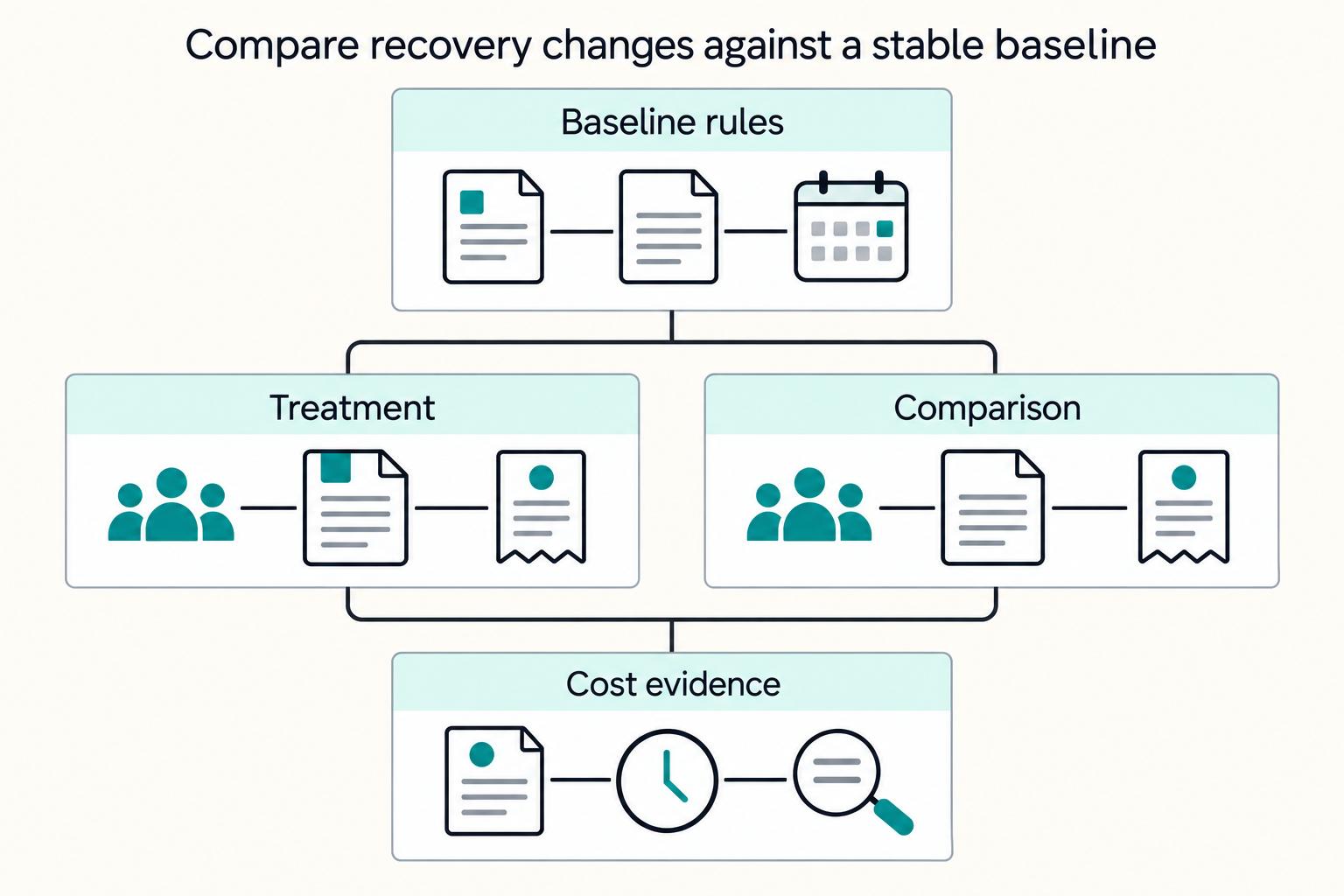
Once your event chain is book-verifiable, estimate impact with a stable pre-change baseline plus a concurrent comparison group. Use two groups: treatment, which gets the dunning change, and control or holdout, which does not. Without that side-by-side view, unrelated movement can look like lift.
Freeze a baseline before launch#
Set a pre-change period that reflects normal failed-payment behavior for the segment you are testing, then keep those baseline rules fixed through the readout.
A control group is the group not exposed to the intervention. A holdout group is a defined segment intentionally excluded for a set period so it can serve as a persistent baseline. Either can work if the setup is fixed before launch.
Lock eligibility for comparable populations#
Define treatment and comparison eligibility before launch using:
- Decline reason code
- Payment method
- Customer cohort
These fields help keep groups comparable. If segment mix shifts between groups, apparent lift can come from composition changes rather than campaign impact.
Read lift on outcome and efficiency together#
Compare treatment versus control on your primary recovery outcome and a paired efficiency metric, then net the result against incremental recovery cost. The real question is whether recovery improved in a way that still supports ROI after the added recovery cost.
Use matched cohorts when holdout is not feasible#
When randomized holdouts are not feasible, use matched comparison cohorts that are as similar as possible on pre-intervention characteristics. If you have pre and post data for both groups, a difference-in-differences style read can improve the estimate.
Document the limitation clearly. Quasi-experimental designs do not use random assignment and carry selection-bias risk, so findings should be treated as directional rather than fully causal.
Segment campaigns so you optimize the right failures#
Treat failed payments as different operational problems, not one queue. Start with Decline code/refusal reason x Payment method x Customer cohort so you can separate retry-friendly failures from cases that need customer action.
Build a weekly segmentation table#
Use one row per segment for the last full reporting period, then compare outcome deltas to your baseline or control readout. Keep v1 small:
| Column | Why it belongs in v1 | What to decide from it |
|---|---|---|
| Decline code / refusal reason | These signals indicate why authorization failed, though some are broad | Retry, outreach, or caution bucket |
| Payment method | Response behavior differs by payment method | Whether the same code behaves differently by method |
| Customer cohort | Retry policy can vary by segment | Whether handling should differ by cohort |
| Recovery rate | Core recovery outcome | Whether performance is improving |
| Retry recovery contribution | Shows how much retries are contributing | Whether retry-heavy logic is earning its place |
| Internal recovery cost (if tracked) | Economics guardrail | Whether recovery is getting less efficient |
Split soft and hard declines before changing cadence#
Split soft and hard declines before you change cadence. Soft declines are temporary and can be retried. Hard declines are not immediately resolvable, so repeated retries on the same method are often the wrong move.
For persistent hard-decline behavior, move earlier to payment-method update outreach. Keep a caution bucket for ambiguous declines, for example generic declines, and test those segments carefully instead of assuming they behave like clearly soft or clearly hard groups.
Add deeper cuts only when they change action#
Add extra columns only if they change what you do next. Code meaning can vary by card network, and response behavior differs by payment method, so deeper splits can help, but only when they change the retry, outreach, or stop decision.
If the extra split does not change action, leave it out of the weekly table. The goal is a report your team can review quickly and use for repeat decisions.
Tune cadence when conversion holds but economics worsen#
If conversion holds but your internal recovery cost is rising, tune cadence before you add volume. Typical levers are fewer attempts, longer intervals, or earlier outreach.
Use provider defaults as starting points, not guarantees of improvement. For example, Stripe Smart Retries recommends 8 tries within 2 weeks, and Braintree allows retry intervals from 1 to 10 days. Review segment performance with before-and-after cadence and recovery outcomes so changes are based on reported results, not estimated optimization alone.
Decide when to use smart retries and when to use customer outreach#
Choose the path from segment evidence, not vendor preference. Use retry-first only where Retry success rate is consistently strong and customer action is usually unnecessary. Move to outreach-first when the same code-method pattern keeps failing or when recovery timing misses your internal cash targets.
Start with retry-first only where it works#
Retry-first makes sense when failures are likely temporary and automated timing helps resolve them without customer action. Smart Retries are AI-timed, and retrying can recover revenue without manual intervention, but that only matters if your own segment data confirms it.
Check Decline reason code x Payment method x Customer cohort and confirm that recoveries in that segment mostly come from retries, not from payment-method updates or outreach. If customer action drives most recoveries, do not treat it as retry-first even if headline recovery looks acceptable.
Use defaults as a starting point, not proof. For example, 8 tries within 2 weeks can be a baseline. Then verify with outcomes. Retry-led recovery should hold or improve, and you should monitor Cost-to-recover and Time-to-recovery as guardrails.
Switch to outreach-first when customer action is required#
Switch to outreach-first when repeated retries fail on the same code-method pair or the decline context points to customer intervention. Some network decline scenarios require contacting the customer before retrying, and with a hard decline code, automatic retry may not run.
Payment method should drive this decision. By default, failed non-card methods and Direct Debit payments, except ACH Direct Debit, are not automatically retried, so retry-first can be weak by design in those segments.
If you see repeated attempts, little recovery lift, and slower cash collection, move earlier to payment-detail update prompts, account alerts, or support-triggered outreach.
Use a mixed strategy when cash recovers too slowly#
Use a mixed strategy when retries still recover value but not fast enough for your finance tolerance. Keep a limited retry window, then trigger outreach earlier instead of forcing a pure retry-only or outreach-only model.
Segment-level policy support makes this practical, including different retry policies by customer segment. Validate the change by outcome: track whether earlier outreach reduces Time-to-recovery without materially reducing total recovered value.
Treat vendor benchmarks as directional#
Treat vendor benchmarks as hypothesis inputs unless their definitions match your reporting scope. Before you use any external percentage, align cohort, payment-method mix, attribution window, and metric population.
| Source | Published claim | Why to treat it as directional |
|---|---|---|
| Slicker | Up to 70% vs 30% for smart retries vs traditional dunning emails | Self-reported comparison; definitions and cohort scope may not match yours |
| Baremetrics | 30%-70% recoverable with the right strategies | Broad marketing range, not a normalized benchmark |
| Finsi | 38% average recovery rate and 72hr average recovery time | Self-reported average across decline types, which may not reflect your mix |
| Beast Insights | 80-85% vs 20-30% for best-in-class dunning vs native retries | Presented as best-in-class and B2B-oriented, not universal |
| Chargeflow | Describes dunning as a preset recovery process | Useful description, not a validated performance benchmark |
Use the same caution with platform analytics. For example, Stripe recovery analytics are scoped to recurring subscription payments and exclude the first invoice after a trial, so direct comparisons require scope matching first.
If retry timing is part of your recovery model, this guide breaks down how teams sequence retries to improve recovery without adding avoidable payment friction: Smart Dunning Strategies to Sequence Retry Logic for Maximum Recovery.
Set explicit thresholds for scaling, pausing, or stopping#
Do not scale a retry or outreach policy on recovered cash alone. Define cohort-level green, yellow, and red thresholds up front, and let data-quality guardrails block expansion even when Recovery rate rises.
Define thresholds by customer cohort#
Set thresholds at the Customer cohort level using the same decline-code and payment-method segmentation from your decision model. Recovery analytics can be reviewed by decline code, and retry policies can differ by segment, so your thresholds should follow that structure.
For each cohort, set status bands for:
- Recovery rate (share of failed subscription payment volume later recovered)
- Cost-to-recover
- Involuntary churn or retention impact
Use green to scale, yellow to hold and monitor, and red to pause or roll back. Do not import universal cutoffs. Anchor each band to your own baseline or holdout, then record the rule so finance and ops evaluate the same thresholds.
If a cohort has a custom retry policy, log the exact settings. That can include 8 tries within 2 weeks or other allowed windows like 1 week, 2 weeks, 3 weeks, 1 month, or 2 months. That way, threshold changes can be tied to a clear policy version.
Pause scale-up when reconciliation quality degrades#
If recovered value rises while matching exceptions rise, pause expansion and fix event integrity first. This control confirms record accuracy and consistency, so threshold decisions are not reliable when records stop matching.
This is a governance choice, but a defensible one. When a guardrail is breached, halt rollout until it is back in range. A practical pattern is to review a defined window, for example the preceding four-week window, and confirm you can still connect recovery events, retry attempts, and final postings without manual reconstruction.
Cap retries when retention worsens#
If retries improve recovered cash but retention worsens in the same cohort, treat that as a yellow or red condition. Recovery programs should reduce involuntary churn, not just increase attempts.
Respond by capping retries, shortening retry duration, or moving that cohort to earlier customer outreach. Use retry controls you can configure directly, and remember two constraints: some declines should not be retried, and excessive retries can add network fee pressure. Validate ROI with matched scope by comparing retention and recovery for the same cohort and attribution rules.
Add a hard stop for stale retries#
Set a stop rule for retries beyond your configured retry duration. At minimum, exclude those late recoveries from campaign ROI so comparisons stay consistent.
Document the rule in plain language: what starts the window, what recovery date qualifies, and how late recoveries are handled. This keeps scaling decisions tied to evidence you can defend.
Related reading: How to Set Up Google Analytics 4 on Your Freelance Website.
Run a monthly governance review that finance and ops both trust#
After you set stop and scale thresholds, route segment changes through a monthly governance review and ship only when records reconcile and control checks pass. Recovery trends alone are not enough to approve a change.
Review only finalized segment results#
Review segment performance, exceptions, and proposed updates in one forum with the stakeholders who own the outcomes. Because reconciliation is meant to surface record gaps, treat unresolved differences between key records as blockers.
Approve changes only when each affected cohort has finalized results you can defend: prior-version recovery outcomes, reconciled amounts, and current exceptions. If your recovery window is 25 to 28 days, do not sign off on months that still include open campaigns.
Publish a short decision log#
Log every approval in a short decision note so later ROI checks are verifiable. Keep the format concise. Each note should state:
- what changed
- why it changed
- which KPI should move, for example Recovery rate, time to recovery, or involuntary churn
- who owns the follow-up review
Avoid vague entries like "retry logic updated." Name the segment, prior setting, expected KPI direction, and review date.
Preserve a versioned audit trail#
Keep a versioned history in Dunning management so you can compare campaign performance over time and avoid mixed comparisons when settings change while older invoices are still in dunning. Pair that history with your decision log to trace who approved each update.
Capture pre-change and post-change records, not just final outcomes: proposal, approval or rejection, exact rule edit, and first review period after launch. If performance drops below your predefined thresholds, execute the documented corrective action path immediately.
Common mistakes that create fake ROI and how to recover fast#
Fake ROI usually comes from four avoidable errors: counting too early, blending unlike segments, duplicating retries, and claiming lift without a control. Fix them by tightening evidence rules and restating past numbers when inputs were not comparable.
Require capture and settlement completion before booking recovered value#
A retry "success" is not the same as recovered cash. Authorization reserves funds, capture is a follow-on step, and settlement happens later, so only count recovered value after capture and settlement complete. If campaigns have not finalized or results have not stabilized, mark ROI as provisional instead of booked.
Re-cut reporting by Payment method#
Blended reporting across different Payment method mixes can hide real performance or create fake uplift. When payment-method composition changes, before-and-after results are not directly comparable unless you re-segment. Rebuild the baseline by Payment method, then restate prior periods using the same denominator logic.
Dedupe retries and rerun KPI history#
Missing Idempotency controls can overcount both activity and recovered value. Idempotency is designed so retries do not perform the same operation twice, so one logical attempt should remain one logical attempt. Dedupe affected records using idempotent keys, then rerun KPI history for impacted periods so historical trends match the corrected logic.
Add a Holdout group and relabel old periods honestly#
Without a Holdout group, reporting is directional, not causal. Holdout comparison supports lift measurement against a non-exposed group. Implement a Holdout group in the next cycle, lock eligibility rules, and label prior periods as directional rather than causal in governance notes and Dunning management history.
Copy and paste checklist for launching ROI measurement#
Before launch, use this checklist. If any item is still unclear, keep ROI reporting provisional.
- Metric dictionary approved. Finance, payments ops, and product agree on exact definitions for Recovery rate, Retry success rate, Time-to-recovery, Cost-to-recover, and churn avoided. Use one shared definition per metric. If teams can compute the same metric in different ways, stop and fix that first.
- Instrumentation validated from failure to recovery with Ledger tie-out. Trace a sample from initial failure through retries to final posting. Confirm the result survives your scheduled matching review, with transaction-level drill-down available for payout or settlement questions, and fix mapping gaps in event IDs or idempotency keys before launch.
- Baseline and Control/Holdout design locked before launch. Document the baseline period and the Control group or Holdout group, then freeze eligibility by Decline reason code. Treat processor response codes as useful failure context, but if eligibility rules change during the test, label lift as directional rather than causal.
- Segment thresholds and stop rules set. Define scale, pause, and stop rules per segment instead of blending all recoveries together. If you start from a retry policy like 8 tries within 2 weeks, document what would trigger earlier caps for specific segments.
- Governance cadence scheduled with owners and rollback path. Pre-build the evidence pack: metric dictionary, query or SQL spec, dashboard screenshots, matching sign-off, and a decision log with rollback criteria.
Before launch, map each checklist item to explicit event states, idempotent retries, and ledger posting checkpoints; the Gruv docs are a practical reference for aligning finance and engineering workflows.
Conclusion#
Treat dunning analytics as an operations measurement system, not a campaign story. If a recovery cannot be traced from the failure event through recovery actions to final posting in your general ledger, do not use it to claim ROI.
Anchor metrics to posted evidence#
Use one shared metric dictionary with recovery rate plus your internal timing and cost metrics, then review those metrics against matched outcomes. Stripe's framing is useful because it treats failed-payment recovery as a KPI function and defines recovery rate as the percentage of subscription payment volume recovered after failure.
Keep monthly results provisional when operational recovery events do not tie out to posted amounts, and fix the mapping before further optimization.
Segment before scale#
After measurement integrity is stable, segment by decline code, payment method, and customer cohort so actions match observed failure patterns. Stripe supports different retry policies by segment, which matters because blended recovery rates can mask segment-level differences. Scale only when you can explain why a segment gets a given treatment and finance can later verify the result from posted records.
Separate optimization from proof#
Optimize only after definitions, instrumentation, and matching controls are stable. Smart Retries and defaults such as 8 tries within 2 weeks can be starting points, but they are not universal targets and they are not proof of ROI. If you need causal lift, use a control or holdout design. Otherwise, treat results as directional operating signals rather than causal impact.
The operating standard is simple: shared definitions, traceable event chains, like-for-like segment comparisons, and matched posted value. If one piece is missing, fix that first. Optimization comes after measurement integrity, not instead of it.
If you want a second set of eyes on your control-group design, reconciliation gates, and payout failure operations, talk with Gruv.
Frequently Asked Questions
How do you measure dunning campaign ROI without overstating results?
Measure recovery from value that is actually posted and matched, instead of using retry attempts or email clicks as direct ROI proxies. Keep current and previous month results provisional while retry windows are still open, because recovery rates can move before retries finish. If you use Stripe revenue recovery analytics, keep its scope separate from broader reporting because it covers recurring subscription payments and excludes the first invoice after a trial.
Which KPI should be primary for failed payment recovery campaigns?
Use one shared metric dictionary first, then treat Recovery rate as the primary KPI within that normalized definition, because it is the percentage of failed subscription payment volume recovered after failure. Do not evaluate it in isolation: reconcile reported recovery against posted outcomes so finance and operations are measuring the same result.
Why are vendor recovery-rate claims hard to compare across platforms?
Vendor recovery rates are hard to compare because scope and cohort rules differ. Stripe recovery analytics are scoped to recurring subscription payments, Recurly frames benchmarks within its own platform context, and Baremetrics lifetime Recover metrics are anchored to your Recover activation date. Timing also shifts reported performance, since failed charges can recover in later months and current-month recovery can change while retries are still running.
What data must be instrumented before optimizing smart dunning?
Because subscription activity is asynchronous, instrument webhook-driven events for payment failures and subscription status changes before optimization. Capture decline codes and consistent event identifiers across each step, and use idempotency controls so retries do not create duplicate operations. Keep idempotency-key constraints in mind, up to 255 characters, with possible removal after at least 24 hours, and confirm your own retention and traceability still support audit and matching.
When should we switch from retries to customer outreach?
Switch when repeated retries are no longer likely to resolve the failure path. Stripe does not automatically retry when no payment method is available or when the issuer returns a hard decline code, and some soft declines require authentication or a customer-initiated retry. If you started with Stripe's recommended default of 8 tries within 2 weeks and the same decline pattern continues, move earlier to outreach.
How do we prove recovery gains are real and not reporting noise?
Use randomized control and treatment assignment with a control or holdout group if you want causal lift, not directional movement. Holdouts help estimate the overall effect on your customer base while other factors change. Then validate the observed lift against posted outcomes and matching checks so apparent gains that fail tie-out are treated as noise, not ROI.
Try a related tool
Where Gruv fits
See recurring billing operations
Launch recurring billing, manage plan changes, and configure failed-payment recovery as the billing model grows.
See reconciliation and mismatch review
Compare ledger entries, provider payment records, and statement rows to see what matches and what finance needs to review.
Researched and edited by the Gruv editorial team. Gruv builds cross-border billing, payouts, and finance-operations software for global businesses.
Sources
- acf.gov/sites/default/files/documents/opre/Quasi-Exp...trusted
- csrc.nist.gov/glossary/term/data_dictionarytrusted
- docs.stripe.com/billing/revenue-recovery/smart-retriestrusted
- docs.stripe.com/billing/revenue-recovery/recovery-analyticstrusted
- fdic.gov/risk-management-manual-examination-policies/...trusted
- federalreserve.gov/supervisionreg/srletters/sr1107a1.pdftrusted
- finance.cornell.edu/controller/internalcontrols/unitlevelactivit...trusted
- occ.gov/publications-and-resources/publications/comp...trusted
Educational content only. Not legal, tax, or financial advice.
Related Posts

The Freelance Payment Penalty: A Modeled Audit of Platform Fees, FX Spreads, and Payout Delays
The money rarely disappears through a single, easy-to-spot fee. The real loss is stacked. A marketplace takes its commission, a processor adds a charge for international cards, a bank or payment company converts the currency at a spread, a platform holds the funds before release, and a wire sheds a little to intermediaries on the way in. Each layer looks defensible on its own, but the worker feels the combined result as a smaller deposit and a later payday.

How to Respond to a Subpoena for Business Records
Move fast, but do not produce records on instinct. If you need to **respond to a subpoena for business records**, your immediate job is to control deadlines, preserve records, and make any later production defensible.
A US Expat's Guide to Investing in UCITS ETFs to Avoid PFIC Issues
The real problem is a two-system conflict. U.S. tax treatment can punish the wrong fund choice, while local product-access constraints can block the funds you want to buy in the first place. For **us expat ucits etfs**, the practical question is not "Which product is best?" It is "What can I access, report, and keep doing every year without guessing?" Use this four-part filter before any trade: