
Quick Answer
BAHTNET is Thailand's high-value THB real-time gross settlement system, so platform operators should assess it early only if their product needs final, irrevocable interbank settlement or high-value institutional movement. For most retail transfer flows, start with retail rails and assume partner-mediated access. During discovery, investigate the actual route, the settlement evidence you will receive, and who owns rejects, repairs, and reconciliation, then resolve material gaps before live launch.
What Bahtnet is and why it matters to platform operators#
Treat BAHTNET as an early architecture decision, not a late banking detail. For many Thailand launches, the practical question is whether your product actually needs BAHTNET-level settlement behavior or whether a bank or payments partner can absorb that complexity for you.
That distinction matters. The Bank of Thailand describes BAHTNET as infrastructure for high-value fund transfers among institutions and organizations with current accounts at the BOT, using Real-Time Gross Settlement that is final and irrevocable. If you treat all Thailand bank transfers as one bucket, you can end up with the wrong routing logic, support model, and partner controls.
Before you start#
Start with one blunt rule. If your use case is mainly retail transfer flows, begin with retail-rail assumptions and only escalate if a partner shows that your settlement path depends on BAHTNET. If your launch depends on high-value institutional movement or final, irrevocable RTGS settlement, assess BAHTNET early because it can affect partner choice, controls, and reconciliation evidence.
You do not need to decide direct access versus partner access yet. You do need to stop treating those paths as operationally equivalent.
Step 1 Frame the decision the right way#
Start with one question: should BAHTNET change your market-entry design, or can partner-mediated access cover your needs without hidden settlement risk? Use two early checks:
- Verification checkpoint: confirm whether your target flow needs final, irrevocable interbank settlement, and whether your partner can provide transfer-result evidence, not just dashboard status. BAHTNET includes a Status Tracking service that notifies transfer results into the creditor account, so ask for that level of proof.
- Failure mode: if you treat different rails as interchangeable too early, exception handling, traceability, escalation, and posting evidence often break once tested against your product assumptions.
Check the data shape early too. BAHTNET adopted ISO 20022 in 2022 to support richer structured data and better transaction tracking. If you launch through a bank or PSP, ask whether those fields are preserved end to end or flattened in transit.
Step 2 Know what you should leave this guide with#
By the end, you should have three concrete outputs:
- A decision path for whether BAHTNET should change your Thailand launch scope.
- A due-diligence checklist for banks and payment partners, including what to investigate during discovery and confirm before live launch.
- Implementation checkpoints for product, payments operations, and finance so transfer states tie back to settlement artifacts.
That keeps the focus on architecture, ownership, and proof, not just rail labels. For a step-by-step walkthrough, see Choosing Local Bank Transfer Networks by Country for Platform Payouts.
Step 1 Understand what BAHTNET does in your stack#
Treat BAHTNET as a high-value transfer dependency to verify early, not as a catch-all label for Thailand payment flows. The supported anchors here are narrower than many teams assume: BAHTNET is identified as the Bank of Thailand Automated High-value Transfer Network in THB, and RTGS means real-time gross settlement. Use partner diligence to confirm your access model, operating responsibilities, and the exact evidence you will receive.
| Topic | Requirement | Timing |
|---|---|---|
| BAHTNET ISO 20022 | BOT migrated BAHTNET payment messages to ISO 20022 | 15 August 2022 |
| Swift address data | Payments changes deferred; prepare structured or hybrid data and confirm applicable bank/rail rules | Revised address timing to be announced by December 2026 |
| MT101 interbank relay | Confirm FI-to-FI relay exposure and current pain.001 transition plan; do not apply a corporate-wide deadline | November 2026 payments changes deferred; obtain current partner schedule |
Model high-value bank-transfer paths separately from other payment paths, and do not assume their routing, exception handling, or proof artifacts are interchangeable. During discovery, investigate:
- which rail is used for each use case, including where routing changes between payment paths
- whether ISO 20022 fields are preserved end to end or translated into a thinner internal format
- what transfer-result evidence you receive for posted, stalled, and rejected payments
The BOT records BAHTNET’s ISO 20022 migration on 15 August 2022. Swift subsequently deferred its planned November 2026 payments changes, including structured-address enforcement, in an announcement updated 21 September 2026. Revised address timing is due by December. Continue preparing structured or hybrid addresses and verify each bank and rail’s current validation rules; the old date is not a universal cross-border cutoff.
Also check whether initiation uses MT101 interbank relay messages and how the partner plans to move to pain.001. The planned November 2026 payments changes have been deferred. FI-to-FI relay migration is distinct from corporate SCORE initiation, which has no universal pain.001 migration deadline. Get the current schedule and any conversion charges from the partner for your actual message flow.
For cross-border context, see our guide to Correspondent Banking Explained: Why Your International Wire is So Slow and Expensive.
Step 2 Compare BAHTNET against PromptPay and partner wires#
Pick your primary rail based on the settlement outcome your product needs. BAHTNET’s RTGS role is established; partner access, customer-credit timing and exception handling still require confirmation for your service.
| Rail | Operator | Access model to assume until verified | Settlement role you can state now | Failure handling posture |
|---|---|---|---|---|
| BAHTNET | Bank of Thailand | Direct or associate participation requires BOT approval; platforms can use contracted bank/PSP services | High-value THB real-time gross settlement in BOT accounts; downstream customer posting is a separate service step | Confirm participant and partner escalation paths, including rejected or stalled instructions |
| PromptPay | Thailand's fast payment system in the PayNow-PromptPay linkage context; linkage work involved MAS, BOT, and industry partners | Confirm via your contracted bank or payment partner | In the linkage context, a real-time cross-border transfer service for retail customers in Singapore and Thailand (launched April 2021) | Validate partner controls for AML, sanctions screening, data usage, and redundancy practices before go-live |
| Partner-mediated bank wires | Your contracted bank or payment provider | Through that partner relationship | Use when your provider routes through bank-transfer paths, including international legs where relevant | Confirm timing, bank charges and FX costs for the actual route; international legs and investigations can add delay and cost. |
BAHTNET uses ISO 20022, but a partner’s API and any retail-rail translation may expose different fields. Ask each partner to document those boundaries and the payment evidence you receive for posted, pending, rejected, and repaired states.
Use this as the decision checkpoint: for your launch use case, which rail is primary, and which is fallback if it stalls or is unavailable? Record unverified assumptions for partner discussion and prototyping; resolve material routing claims before live launch. For a related comparison, see ACH vs Wire Transfer for Contractor Payouts When Platform Teams Should Use Each.
Step 3 Decide whether BAHTNET should alter your Thailand launch plan#
Treat BAHTNET access as a contracting and verification question. You can investigate direct participation and prototype alternatives during discovery; do not promise or operate direct access until the relevant eligibility and operating responsibilities are confirmed.
Use a proof-based decision tree#
| Your situation | What to do now | What must be verified before live launch |
|---|---|---|
| BAHTNET appears only inside a bank or provider backend flow | Keep the launch partner-led | Who owns posting, rejects, repairs, and settlement evidence |
| Your product promise depends on this rail for settlement certainty | Investigate access and evidence gaps with prospective partners | Access model, responsible legal entity, and proof you receive for settlement outcomes |
| You think direct participation might be possible | Compare participant criteria and alternatives during discovery | Written eligibility and operational constraints from the relevant institution |
If you are a non-bank platform and do not have documented direct access, treat partner-mediated access as the launch assumption until direct eligibility is confirmed in writing. Put the settlement behavior you need into contracts instead of relying on sales-stage statements.
Check governance against standards you can inspect#
BAHTNET access criteria and operational duties are set out in BOT rules. Your own regulated obligations depend on your legal role and activity. Ask each partner to map those duties to your access model and contractual responsibilities.
Use BAHTNET’s 2024 self-assessment as the relevant benchmark: Principle 18 covers participation requirements, Principle 8 settlement finality, and Principles 17 and 22 operational risk and communication standards. Those rail-level rules inform diligence; they do not replace your partner’s service agreement.
Resolve material unknowns before live launch#
Track fees, SLAs, operating windows and cutoff behavior during discovery. Before live launch, obtain written confirmation of the access model, responsible entities, escalation paths, settlement evidence, exception states, and applicable fee, investigation and manual-repair charges.
Engineering can explore options with labelled assumptions while partners answer these questions. Ask which exceptions require manual intervention, who handles them and what records they produce; test those cases before relying on straight-through processing in production.
Step 4 Choose your access model and ownership boundaries#
If direct access is not documented, use a partner-led model as a planning assumption and investigate alternatives. Define contractual ownership before live operation, including compliance duties, exception handling and settlement evidence for both success and failure states.
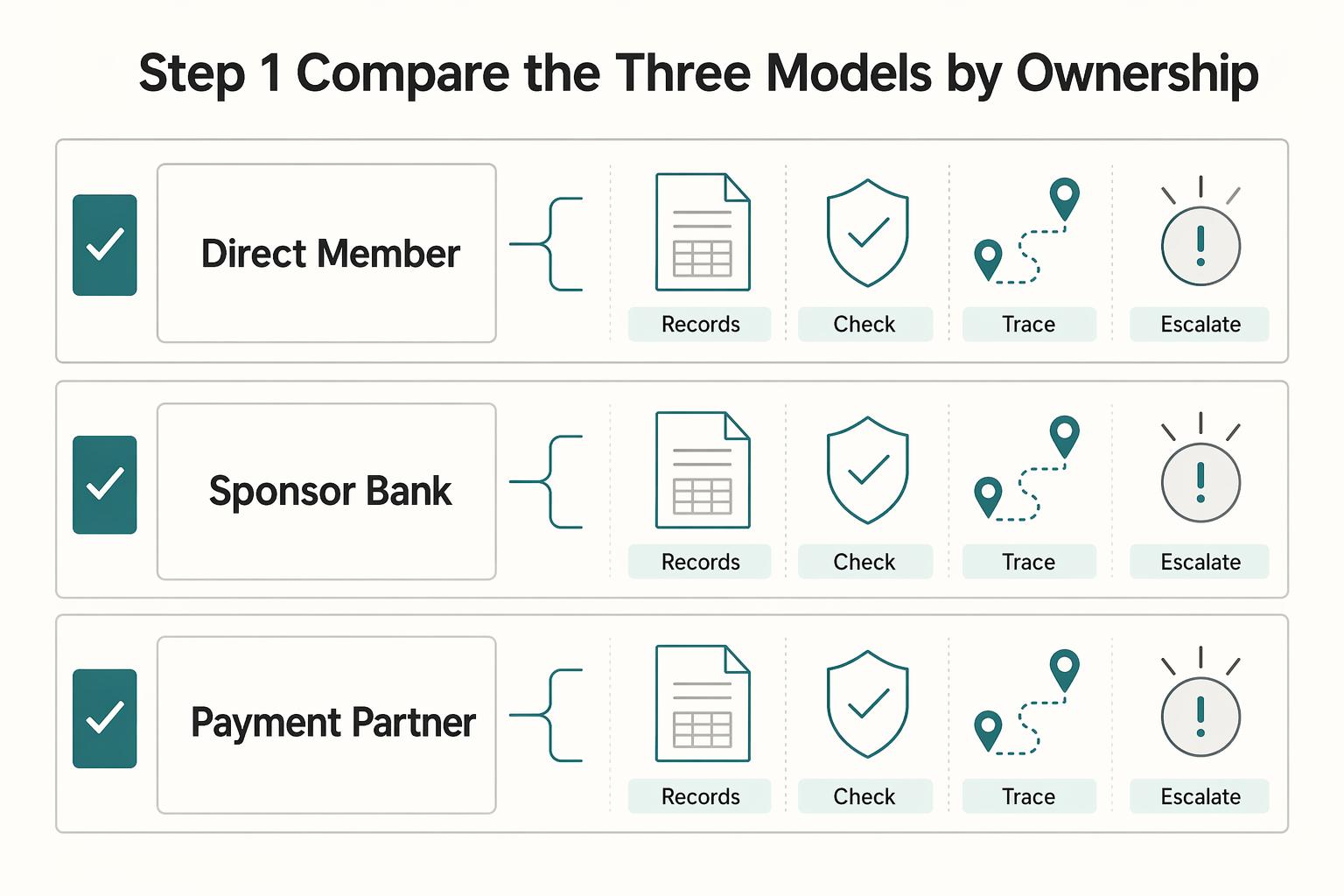
Step 1 Compare the three models by ownership, not labels#
Choose by accountability, not by naming. Use these models as operating shapes, then assign owners line by line. This is a planning map to refine during diligence, not a statement of Thai legal allocation.
| Operating model | Compliance ownership to confirm | Operations ownership to confirm | Incident response ownership to confirm | Scenario fit |
|---|---|---|---|---|
| Direct member path | Your entity obligations versus institution obligations, documented in writing | Who submits, monitors, repairs, reconciles, and retains records | Who handles rejects, delays, and participant-side failure procedures | Use only when direct access and roles are explicitly confirmed |
| Sponsor-bank path | Sponsor obligations versus your internal control boundaries | Which party owns rail-facing flow, initiation quality, and user-facing controls | Escalation path, contacts, and evidence outputs | Use when sponsor and platform boundaries are explicit in writing |
| Payment-partner path | Regulated-duty boundaries across partner and bank chain | Which party owns flow execution versus your ledger and customer-state updates | Cross-party coordination for investigations and repairs | Use when partner-chain handoffs and owners are explicit |
After model selection, you should be able to name one accountable owner for initiation approval, transfer submission, exception repair, and final evidence delivery.
Step 2 Keep market-map entities separate from integration scope#
Treat Thailand Securities Depository Co., Ltd. (TSD) as market-context evidence unless your flow directly touches that infrastructure. In its September 2022 PFMI disclosure for Thailand, TSD identifies SEC and BOT as authorities in that FMI context. It also includes access and governance areas such as Principle 18 (access and participation requirements), Principle 19 (tiered participation arrangement), and Principle 13 (participant-default rules and procedures). Use that as a diligence benchmark, not as proof of BAHTNET integration scope.
Compare published BAHTNET participant criteria during discovery, then confirm your entity’s eligibility and partner-specific fees and service windows. For other market entities, ask for the transaction-path handoff and operational owner before including them in the live flow.
Step 3 Put exception ownership into the contract before live launch#
PFMI principle headings help frame diligence, but they do not define your contract allocations for these workflows. Document explicit ownership for these three checkpoints:
- Failed-transfer investigation: case opener, rail-facing contact owner, and reference-trail delivery.
- Beneficiary correction: who can request or apply correction, required revalidation, and manual-handling ownership.
- Settlement confirmation evidence: artifact format for settled, rejected, and pending outcomes and delivery timing.
Test sample artifacts before live launch. If evidence is only dashboard status text rather than durable confirmation records, identify how reconciliation and support will obtain the missing records.
Step 4 Choose consciously between launch speed and control depth#
Partner-led models can reduce the setup you own, but increase dependency on third-party escalation and interpretation. Compare actual onboarding requirements and evidence delivery rather than assuming one model is always faster. Direct-member operation requires confirmed access and ownership boundaries.
Compare partner-led and direct options during discovery using available facts and labelled gaps. Before committing live scope, confirm access and contract escalation, correction and evidence duties. For a related recovery workflow, see Bank-Rejected Contractor Payout Recovery for Platform Teams.
Step 5 Prepare a working brief for partner outreach#
Start outreach with the transaction profile, available sample data and known requirements you have. Label missing information and open questions so partners can help resolve them. Confirm production requirements and evidence through diligence and testing before launch.
| Evidence item | What to include | Why it is needed |
|---|---|---|
| Payment-choice decision memo | Expected corridors, average and high-end ticket patterns, likely exception volumes, level of settlement certainty, and constraints around receipt evidence, digital records, and manual review | Another operator should be able to identify routine flows, higher-risk flows, and flows that need final settlement evidence |
| Message and trace artifact | Sender, beneficiary, intermediary, purpose, remittance, and reference fields; sample outbound message view; sample confirmation artifact; exact reconciliation fields for success, reject, and pending outcomes; use illustrative samples labelled as such where live artifacts are not yet available | Tests whether one initiated payment matches one partner reference, one bank-side reference, and one customer-visible record |
| Control pack | AML and KYC gating points, approval chains for high-value or unusual transfers, audit-trail retention expectations, who can override or repair a failed payment, and applicable internal policies, document standards, and recordkeeping rules | Identifies current controls and open regulatory questions for partner diligence |
| Partner questions and later written confirmation | Coverage for corridors and transfer types, cutoff or operating-window constraints, returns and exception process including investigation ownership, and evidence format for settled, rejected, and pending outcomes | Request these during outreach; confirm material conditions before live launch |
Step 1 Document the payment profile you actually need#
Start with a short payment-choice decision memo, not a generic market summary. Define expected corridors, average and high-end ticket patterns, likely exception volumes, and the level of settlement certainty your product needs.
Keep the profile operational. Add constraints beyond price: who needs receipt evidence, what digital records are accepted for your purpose and where manual review is likely. Mark unknowns for the partner rather than treating them as prerequisites for the first call.
Use a simple check: another operator should be able to read this profile and identify routine flows, higher-risk flows, and flows that need final settlement evidence.
Step 2 Specify your message and trace requirements#
Prepare a draft field list with the payment messages and intermediary-credit instructions you expect to use. Available examples and labelled gaps are enough for initial outreach. List sender, beneficiary, intermediary, purpose, remittance and reference fields, then ask the partner what survives each handoff.
A key technical risk is incomplete or inconsistent data mapping across standards and providers. Cross-border ISO 20022 work highlights this directly: inconsistent adoption can fragment processing and reduce interoperability. Require a sample outbound message view, a sample confirmation artifact, and the exact reconciliation fields returned for success, reject, and pending outcomes.
If you need a refresher on trace fields, What is a SWIFT MT103 and How to Use It to Trace a Wire Transfer is a useful primer. The practical test is simple: can you match one initiated payment to one partner reference, one bank-side reference, and one customer-visible record without a free-text investigation?
Step 3 Map your controls to your own risk policy#
Bring a control pack, not just an API questionnaire. Show any AML and KYC gating points already defined in your own policy, approval chains for high-value or unusual transfers, audit-trail retention expectations, and who can override or repair a failed payment.
Include regulatory-readiness evidence in the same pack. Policy evolution has included new laws and regulations, so your outreach materials should show which internal policies, document standards, and recordkeeping rules already apply to your product. Thin control documentation often turns diligence into long loops and vague answers that reappear during implementation.
Step 4 Set a go or no-go gate before live launch#
Use discovery and prototypes to resolve open questions. Before live launch, obtain written partner confirmation of four items:
- Coverage for corridors and transfer types in scope
- Cutoff or operating-window constraints relevant to your flow
- Returns and exception process, including investigation ownership
- Evidence format for settled, rejected, and pending outcomes
Treat delivery format as part of production readiness. If answers are screenshots, sales copy or dashboard text, continue discovery and testing to establish durable records and named responsibilities before live operation.
Related: A Guide to the 'For Further Credit' (FFC) Instruction in Wire Transfers. Before partner calls, turn this section into an internal readiness brief, then map required statuses and webhook evidence against Gruv docs.
Step 6 Design the end-to-end flow from initiation to final posting#
Design the flow around BAHTNET’s documented RTGS behavior and your partner’s service. Identify each entity’s legal role and the Thai rules applicable to the activities it actually performs.
- Map the full lifecycle in your own ledger terms: initiation, acceptance, in-flight states, and final posting.
- Define internal retry and idempotency controls per state so duplicate submissions and duplicate postings are prevented by design.
- Mark every transformation boundary in your stack and list the exact references that must survive each handoff.
- Reconcile external status updates against internal states using deterministic keys rather than free-text notes.
- Add a hard verification checkpoint as an internal control objective: every terminal outcome should be explainable from the original request to final posting records with a complete audit trail.
For direct or associate participation, BOT criteria require an eligible institution category, BOT-approved current or settlement account, and operational readiness including systems, BCP and training. A platform using a partner service is not automatically a participant. Before live operation, confirm the authorizations required for each entity’s actual activities; do not assume every integration requires the platform itself to be Thai-incorporated or hold the same licence as its bank.
Step 7 Build settlement and reconciliation controls before go-live#
Treat reconciliation as a go-live control with named owners, not a month-end finance cleanup. If pending, posted, returned, and unmatched transfers do not have ownership, internal SLA rules, and evidence requirements, your process is still in test mode.
| Queue | Primary owner | Internal SLA rule | Required evidence to close |
|---|---|---|---|
| Pending | Payments operations | Review every control cycle; escalate when aging breaches your internal threshold | Internal transfer ID, partner or bank acknowledgment, latest state timestamp, amount, beneficiary reference |
| Posted | Finance with payments operations support | Reconcile in your defined operating cycle; any ledger post without settlement evidence is an exception | Ledger posting ID, settlement confirmation or bank evidence, amount or account match, posting timestamp |
| Returned | Payments operations with customer support or compliance as needed | Triage in your defined operating cycle; no reissue until the cause is classified | Original instruction, return message or bank notice, beneficiary details used, decision record for refund or resend |
| Unmatched | Reconciliation lead | Investigate in your defined operating cycle; no carry-forward without assignee and escalation path | Internal and external references, transformed message output, partner status payloads, operator notes tied to evidence |
Use one verification standard across all queues: each item must be traceable from original request to final outcome with deterministic references, not free-text comments.
For Thailand, keep controls anchored to the operating context. The Bank of Thailand oversees payment systems, and BAHTNET is the only large-value payment system operated by the central bank. A practical checkpoint is whether your controls hold up against the same lenses reflected in BAHTNET's disclosure structure, especially Principle 17 (operational risk) and Principle 22 (communication procedures and standards).
If you use a formal security control framework as a design posture, apply it to reconciliation operations without making certification claims. Queue access, approval rights, logging, incident handling, and change approval for reconciliation logic should sit inside the same security and audit boundary as payment initiation.
Cross-system reconciliation becomes more important when external participants are involved, including NITMX-operated retail interbank transfers or securities-side entities such as TSD and TCH. Reconcile across internal records, external structured outputs, and bank-side settlement evidence where available. This is also where inconsistent ISO 20022 implementation can fragment processing and hinder interoperability.
Before launch, run a dry-day test with posted, returned, and intentionally broken cases. Include one case with a truncated reference during transformation and one where a partner status arrives before bank evidence. If the team cannot close each queue with complete evidence, fix the controls before production volume.
For payout control workflows, see Wire Fraud Prevention for Platforms: How to Spot Spoofed Bank Details Before You Pay.
Step 8 Address cross-border and FX risk paths up front#
Treat the cross-border FX path as a pre-launch control, not a post-launch optimization. If any Thailand payout can turn into a THB-USD transfer, document settlement-sequencing risk and where you remain exposed to one leg settling before the other.
BAHTNET has a documented USD-THB payment-versus-payment link with Hong Kong’s USD CHATS. That does not mean every partner FX flow uses it. Confirm your route, eligibility, settlement sequencing and leg-level records, including how exceptions are handled when the linked protection is unavailable.
Collect address components in a form that supports the partner’s applicable ISO 20022 rules, including town and country when required. Swift’s planned November 2026 address enforcement was deferred; bank and domestic-rail requirements may differ. Test mapping and validation for your actual flow rather than applying one deadline to all cross-border payments.
What to require before go-live#
If your product depends on cross-border payouts, require explicit partner commitments on:
| Checkpoint | What to get in writing | Article note |
|---|---|---|
| FX settlement sequencing | How FX settlement is handled when THB and USD legs do not complete together | Document settlement-sequencing risk before launch |
| Exception escalation | Who owns exception escalation and which communication path is used | Any linkage, sequencing, protection method, and evidence-flow assumptions stay partner-specific until confirmed in writing |
| Leg-level evidence | What settlement evidence you receive for each leg, including what proves a return, hold, or partial completion | Partner responses that do not name the evidence you will receive if one side stalls are launch blockers |
| MT101 transition | Whether the flow uses FI-to-FI relay or corporate initiation, its current migration schedule and any conversion charges | Planned November 2026 payments changes were deferred; confirm current message-specific requirements |
| Address data | Applicable bank/rail fields and current validation schedule; preserve structured data through handoffs | Swift deferred address enforcement and will update timing by December 2026; do not impose the old date universally |
| ISO 20022 code sets | A release-planning checkpoint for external code sets | External code sets are maintained quarterly, with updates at end February, May, August, and November |
Treat these as launch blockers:
- partner responses that stay at a marketing level and do not name the evidence you will receive if one side of a transfer stalls
- data mapping that fails the applicable bank or rail validation rules for the live route
Also include an ISO 20022 code-set checkpoint in release planning. External code sets are maintained quarterly, with updates at end February, May, August, and November. Stale values and address fields may quietly increase cross-border exceptions.
Step 9 Avoid common operator mistakes and recover quickly#
Common preventable failures usually come from treating different routes as the same and operating without usable evidence. To recover quickly when a transfer stalls, keep route decisions explicit, require real artifacts, and define incident ownership before you scale.
Split routing by outcome#
Do not run multiple transfer paths as one generic route. Start from the settlement outcome you need, then map to the specific path your partner has confirmed in writing.
Use one checkpoint per route: can you name the completion evidence, who sends it, and what your ledger does if that evidence does not arrive?
Require artifacts, not provider language#
Ask the partner for actual completion and exception records. A public description of the rail establishes its role, but does not show what your API, portal or support workflow will return.
Require an evidence pack before scale:
- one sample completion confirmation file
- one returned or rejected transfer example
- one held, repaired, or manually reviewed case showing the fields you actually receive
If exception artifacts are missing, plan for limited visibility in the first real incident.
Standardize trace data in support workflows#
Set a single trace-data standard for support from day one. Keep the exact instruction references and transmitted text across handoffs, and test recovery with a mock case using only stored records. If reference data is altered or truncated between systems, investigations can slow and resolution quality can drop.
Turn unknown governance into contract terms#
Treat governance unknowns as launch risks, not documentation gaps. Oversight context can confirm that supervision exists, but it does not define your incident path or SLA in practice. Before increasing volume, lock these into contract terms:
- exception owner
- response target
- escalation path
- evidence format for holds, returns, and partial completion
If any of these stay vague, keep volume at pilot level until they are explicit.
Decide your Thailand architecture with a copy and paste checklist#
Use the checklist to separate discovery from launch approval. Begin partner discussions with available facts and labelled gaps, then resolve critical access, control and evidence questions before going live. Published BOT rules establish the rail’s role; partner documentation establishes your actual service.
- We documented which BAHTNET assumptions are confirmed vs unconfirmed for our Thailand use case.
- We selected a primary access model and assigned ownership boundaries across product, operations, compliance, and finance.
- We validated partner capabilities for BAHTNET-adjacent flows, exception handling, and reconciliation evidence.
- We mapped message and trace requirements for our flow and tested the partner’s actual field preservation.
- We closed critical unknowns on governance, SLAs, and operating constraints before committing launch scope.
- We have a clear escalation path for failed, delayed, and unmatched transfers before going live.
Keep accountability, risk ownership and escalation explicit. Use BAHTNET’s current disclosure to frame rail-level diligence, then document the service responsibilities your platform and partners actually own.
For terminology background only, not as proof of Thailand-specific requirements, review What is a SWIFT MT103 and How to Use It to Trace a Wire Transfer and FFC vs FBO vs FAO Wire Transfer Instructions for Platform Teams. If BAHTNET-linked payouts are part of launch scope, validate coverage, compliance gating, and exception ownership for your exact flow with Gruv.
Frequently Asked Questions
Can a non-bank platform operator connect directly to BAHTNET?
Non-bank access is possible for categories specified by BOT, including supervised payment system and payment service providers, subject to approval and the applicable requirements. Being a platform alone does not establish eligibility. For your launch, compare the participant criteria with a contracted bank or PSP service and obtain confirmation before operating direct access.
Who can be a BAHTNET member in practice?
BOT’s published criteria cover financial institutions, specialized financial institutions, specified government or statutory entities, securities companies/clearing houses/depositories, and supervised payment system or service providers. All require BOT approval for the relevant current or settlement account and must meet operational requirements. Direct participants use their own connection; associate participants rely on a direct participant, with the same access criteria.
Is BAHTNET the same thing as PromptPay for platform payouts?
The guidance here does not provide PromptPay operating or settlement details. What it does confirm is that BAHTNET is a high-value RTGS rail with final and irrevocable settlement. Do not treat BAHTNET and PromptPay as interchangeable until your partner maps both rails explicitly.
When should BAHTNET influence marketplace payout architecture decisions?
BAHTNET should shape architecture when high-value THB interbank settlement or the USD-THB PvP path matters to your product. Confirm customer-credit timing and partner limits separately. For example, Wise’s THB guide lists recipient-bank-specific transfer limits and arrival estimates; those are Wise service conditions, not universal BAHTNET cutoffs.
What should we verify first with a Thailand banking or payments partner?
Verify the route and completion evidence before discussing scale. Confirm whether the flow uses BAHTNET, who holds the BOT account relationship, and what transfer-result notification you receive, including Status Tracking where applicable. Request rejected and delayed examples and the partner’s investigation process; do not assume a universal delay limit.
How do SWIFT MT103 and FFC instructions fit into Thailand payout operations?
Treat MT103 and FFC as traceability checks, not assumed BAHTNET requirements. Whether they are mandatory or standard inside BAHTNET is not established. Ask partners where those fields are mapped, whether free-text instructions are preserved, and which reference survives into final confirmation. For a refresher, see What is a SWIFT MT103 and How to Use It to Trace a Wire Transfer.
Researched and edited by the Gruv editorial team. Gruv builds cross-border billing, payouts, and finance-operations software for global businesses.
Sources
Includes 5 external sources outside the trusted-domain allowlist.
- bis.org/cpmi/pietf/iso20022.pdftrusted
- wise.com/help/articles/2932335/guide-to-thb-transferstrusted
- bot.or.th/content/dam/bot/documents/th/our-roles/payme...external
- bot.or.th/content/dam/bot/documents/th/our-roles/payme...external
- media.set.or.th/set/Documents/2022/Sep/PFMI_TSD_Discloure.pdfexternal
- swift.com/news-events/news/swift-accepts-community-req...external
- swift.com/standards/iso-20022/iso-20022-bytes/call-act...external
Educational content only. Not legal, tax, or financial advice.
Related Posts

The Freelance Payment Penalty: A Modeled Audit of Platform Fees, FX Spreads, and Payout Delays
The money rarely disappears through a single, easy-to-spot fee. The real loss is stacked. A marketplace takes its commission, a processor adds a charge for international cards, a bank or payment company converts the currency at a spread, a platform holds the funds before release, and a wire sheds a little to intermediaries on the way in. Each layer looks defensible on its own, but the worker feels the combined result as a smaller deposit and a later payday.

How to Respond to a Subpoena for Business Records
Move fast, but do not produce records on instinct. If you need to **respond to a subpoena for business records**, your immediate job is to control deadlines, preserve records, and make any later production defensible.
A US Expat's Guide to Investing in UCITS ETFs to Avoid PFIC Issues
The real problem is a two-system conflict. U.S. tax treatment can punish the wrong fund choice, while local product-access constraints can block the funds you want to buy in the first place. For **us expat ucits etfs**, the practical question is not "Which product is best?" It is "What can I access, report, and keep doing every year without guessing?" Use this four-part filter before any trade: