
Quick Answer
To catch spoofed bank details before payout, treat every bank-detail change as a pre-release risk event and require a go, hold, or block decision. Verify the account and the requester through independent checks, use out-of-band confirmation from your own records, and require MFA or equivalent controls plus dual approval for high-risk or override cases.
How Platforms Catch Spoofed Bank Details Before Payment#
Wire fraud prevention for platforms is a pre-payment control problem. Once a payout goes to spoofed bank details, you may be dealing with a loss event, especially on rails like Fedwire that are immediate, final, and irrevocable once processed.
That is what makes BEC dangerous. The request often looks ordinary. It may be a bank-detail change from a known contact or an update in a familiar email thread tied to real payment activity.
What you need before release#
Use this guide to make consistent go, hold, or block decisions before release. The goal is controlled payouts with clear ownership and evidence, not the largest possible review queue.
Before releasing a payout after a bank-detail change, confirm you can see:
- request source
- time of the change
- authentication result, or equivalent identity-check result
- exception approver, if applicable
If one is missing, treat that as an information gap, not a clean decision.
Anchor controls to payment finality#
Anchor controls to payment finality, not assumed recovery options. In the US context, Fedwire third-party transfers have a 6:45 p.m. ET business-day initiation deadline and are designed to be final once processed, so your strongest control point is before release.
Do not rely on recall assumptions after submission. Build review gates on the assumption that recovery may be limited, slow, or unavailable.
Use explicit release rules#
Use explicit release rules, not case-by-case judgment in chat. In spoofed bank-detail scenarios, teams often face conflicting signals, which leads to inconsistent decisions.
A beneficiary change, weak authentication, or pressure to "push this one through" should trigger a defined outcome. For urgent cases, use controlled speed: a time-boxed hold path with documented exception approval.
Keep records you can defend#
Treat controls as operational decisions backed by records you can defend later. Keep the request trail, authentication outcome, reviewer or approver identity, decision timestamp, and final disposition.
Tune the decision model over time. Tighter rules can catch more fraud, but they can also increase queue load and delay legitimate payouts. Calibrate for false positives, volume, and market timing.
Localize legal and compliance checks#
Standardize the operational decision logic, but apply the actual jurisdiction, rail and regulated-program requirements. A banking control reference can inform a platform policy without becoming a universal legal obligation for every platform.
Apply actual payment-authentication requirements for the selected service and jurisdiction. UK APP reimbursement protections began on 7 October 2024 for in-scope UK Faster Payments/CHAPS transfers by individuals, microenterprises and charities, subject to the applicable rules; they do not cover every platform wire worldwide.
With those ground rules in place, the next step is to define which bank-detail changes should be treated as payout-risk events.
Define spoofed bank detail risk in platform payouts#
Treat a vendor bank-detail change request as a payout-risk event, not routine maintenance, when timing or channel context is unusual. For consistent go/hold/block decisions, start from hold until the request is independently verified.
Flag the request context#
Escalate a change request that arrives at an unusual time or through a new channel. BEC patterns show that attackers can use real business context and subtle spoofing so requests look normal.
Before release, confirm all three:
- when the bank details changed
- which channel carried the request
- whether the change was confirmed outside that same channel
If evidence exists only in the original email thread, ticket, social message, or call, treat it as insufficient for release.
Separate the attack type#
Classify the pattern so your response matches the risk:
- BEC: targets legitimate transfer-of-funds workflows, including vendor or supplier account compromise and payment-instruction changes.
- Phishing: uses spoofing to lure disclosures. Treat related payment changes as potentially compromised and review authentication evidence.
- Social media impersonation: contact from social profiles is not identity proof on its own.
- Spoofed caller ID: displayed caller name or number is not identity proof.
If contact starts on phone or social channels, verify through a known-good path you already control.
Verify the account, then the owner#
Where the actual provider supports them, use account-status checks to assess receivability and name/ownership checks to compare the beneficiary with the intended payee. Record coverage, timestamp and confidence. A name match or open-account signal is not a guarantee of ownership, requester authority or fraud-free payment; unsupported checks need an approved alternative verification path.
This is the key separation between an error signal and a fraud signal. An account can be open and still be the wrong beneficiary.
Review both sender and receiver#
Apply Sender and receiver review to both sides of the payout instruction. Check who initiated the change, whether that sender matches established contact records, and whether beneficiary identity fields align with the payout record.
A clean beneficiary check is not enough if sender identity is weak. Retain originator and beneficiary identity fields tied to the decision.
Related: Invoice Fraud Prevention for Platforms: How to Detect and Stop Fake Invoices Before They're Paid.
What to prepare before you change controls#
Before you tighten payout rules, set governance and operations first so stricter checks run the same way every time instead of shifting by reviewer or queue.
Assign owners before you change policy#
Make ownership explicit before rollout. Name who owns payout execution, who owns threshold policy, and who owns escalation standards. This is a practical governance model rather than a universal legal requirement, but you still need named owners.
Use a simple checkpoint: one owner for payout execution, one for threshold policy, and one escalation contact for suspected BEC or override pressure. If one person can initiate, review, and approve a wire change, add Dual approval as a compensating control.
Inventory the controls that are actually live#
List where Wire transfer authentication, Multi-factor authentication (MFA) (or equivalent-strength controls), and Dual approval are enforced in production, and where they are not. For each control, record the trigger, where it fires, who can bypass it, and what evidence is retained.
Do not rely on policy text alone. Sample recent bank-detail changes and confirm the controls actually fired.
Define cut-off, queue, and review timing#
Document rail-specific or provider-specific payout cut-off times before adding new holds. If you use Fedwire, online message processing stops at published cut-off times and the service closes at 7:00 p.m. ET. Do not treat that as a universal schedule across banks or markets.
Also assign an exception-queue owner and define an internal review target for high-risk changes. Operationally, your process should handle near-cut-off change requests without ad hoc overrides.
Build a minimal review data map#
Give reviewers only what they need to decide go, hold, or block. Show the payout ID, payee ID, change timestamp, request channel, limited prior and new bank-account fields, authentication result, and whether out-of-band confirmation used an independently sourced phone number. Keep personal data limited to what is necessary for the review purpose.
If reviewers must open raw email threads or full bank details to decide, the review view is incomplete. If the review view hides channel, timing, or authentication outcome, key spoofing signals can be missed.
Map the payment-change attack paths you actually face#
Map payment-change risk by channel and actor first. A single generic bank-detail-change flow hides where Phishing, Spoofed caller ID, or override pressure can bypass controls.
Trace each request channel end to end#
Map each intake route you actually allow: email, portal, support ticket, and phone. For each route, record how the request is submitted, who reviews it, what authentication is checked, and what evidence is retained before release.
Flag where trust is assumed too early. Email and phone paths should explicitly capture spoofing and phishing patterns, including vishing and fake caller identity. Your checkpoint is simple: for each channel, identify what stops a request that only appears trusted.
Add actor paths that drive BEC-style fraud#
Overlay the actor paths that put pressure on reviewers, because they often explain why a normal-looking channel becomes risky:
- Compromised or impersonated contact: a request appears to come from a legitimate account or known person.
- Fake vendor contact: a Business Email Compromise (BEC) pattern where the request appears to come from a known source.
- Internal override pressure: someone is pushed to rush release or skip normal confirmation steps.
This matters because the same channel fails differently depending on the actor path. If you merge them, controls become too generic to stop real bypasses.
Separate first-time setup from updates#
Treat first-time payout setup and updates to existing details as separate events. Documented BEC patterns include vendor payment-update requests, so updates may warrant stricter handling in many workflows.
A practical rule is to require stronger proof when an existing beneficiary account is changed, such as out-of-band confirmation using contact details from your own records, plus dual approval before release.
Mark pre-release detection points that can stop loss#
Document where a suspicious change can still be stopped before batch release. Prioritize two decision gates: payee detail match checks and request-origin/context review.
Where available, name and account checks like UK Confirmation of Payee (CoP) or EU Verification of Payee (VOP) can provide match signals before transfer initiation. Treat those results as release inputs, not background notes. Then review request origin and context, including sender, channel, authentication outcome, and pattern fit. Route each change to go, hold, or block with recorded evidence.
Set go hold block decision rules before payout cut-off#
Set one pre-cut-off rule: every bank-detail change should end as go, hold, or block based on the same signals, not reviewer urgency.
Build one mandatory decision table#
Use request context, supported account-status/beneficiary checks, and independent requester verification/authentication together. Record unavailable or inconclusive checks explicitly rather than silently treating them as passed.
| Request and timing | Supported destination status and beneficiary checks | Verification/authentication result | Decision | Required operator action |
|---|---|---|---|---|
| Expected channel, no cut-off pressure, no other fraud flags | Current supported checks pass; unavailable checks resolved through approved alternative evidence | Passed per policy | go | Confirm independent requester verification and required approvals, then release and record evidence/time |
| Near cut-off, after inactivity, or via a new channel | Verified or consistent | Missing, weak, or incomplete | hold | Require out-of-band confirmation before release |
| Verification mismatch, failure, or unresolved status | Failed, mismatched, or unresolved | Any result | Hold or block under policy | Stop release, preserve evidence, route to investigation |
| Override requested after failed or missing verification checks | Not clearly resolved | Failed, bypassed, or not performed | hold or block (per policy) | Route to exception review with documented approval evidence |
Do not let one clean signal override a bad one.
Force a hold for low-confidence changes near cut-off#
Use an explicit if-then rule: if bank details change inside the cut-off window and verification confidence is low, set hold and require out-of-band verification.
For callback controls, confirm through a known contact record, not contact details inside the request. In U.S. wire contexts, callback procedures are also recognized under UCC Article 4A security procedures, so align your release rule with the procedure you can defend.
Require two-person approval for overrides#
Keep originator and approver responsibilities separate where possible. For exception releases that bypass standard checks, require dual approval as your control baseline.
If your tooling supports only one approver, use a compensating control outside the normal payment queue and document that review before clearing it.
Add jurisdiction notes where timing and finality matter#
Include rail-specific notes in the same table. For BAHTNET, operating hours are 8.30 to 17.30 hrs. on working days of financial institutions, customer transfers follow agreed user cut-off times, and RTGS settlement is final and irrevocable.
That means late bank-detail changes that still need verification should usually stay on hold rather than move through a rushed override.
Expire approvals so retries cannot reuse stale trust#
Treat approvals as single-use for a specific decision state, beneficiary record, and release attempt. Set explicit expiry triggers (for example: batch close, rail cut-off, beneficiary-bank-field edits, or a new payout attempt after hold).
A retry should not inherit an earlier approval when request data or review context has changed.
If you are implementing go/hold/block rules in production, use Gruv's docs to map policy gates, idempotent retries, and payout status handling into your workflow.
Build a layered control stack that works in production#
Do not ship with verification alone. For high-risk bank-detail changes, use one stack that answers three questions before release: does the beneficiary data align, is the requester authenticated at the right strength, and did an independent approver sign off?
FFIEC guidance for financial institutions supports risk-based layered security and warns against reliance on a single factor. For this operational policy, separate initiation and approval and require the configured independent reviews. A clean signal should not override unresolved evidence of a potentially fraudulent change.
Map each control layer to the question it answers#
Use these layers together so reviewers do not treat them as substitutes.
| Control layer | What it helps prove before payout | What it does not prove by itself | Operator checkpoint |
|---|---|---|---|
| Account ownership verification | Supported name/identifier matching provides evidence of beneficiary alignment | Guaranteed ownership, requester authority, or account receivability | Confirm the result is tied to the current payee name and account identifier pair, not an older record |
| Account status verification | The account appears open, valid, or otherwise receivable for transfer processing | That the named payee owns it, or that the request came from an authorized person | Check the result for the specific release attempt, especially after any last-minute edit |
| Multi-factor authentication (MFA) | The authentication event used two or more distinct factor types | That the bank details are correct, or that payout should be approved | Verify distinct factors and assurance of the selected flow, including fallback behavior |
| Step-up authentication | Stronger identity assurance when risk rises | It cannot cure a failed account verification result | Trigger step-up from risk rules in the decision table, not reviewer discretion |
| Dual approval | Two authorized approvers approved under the configured policy | It does not fix bad evidence and should not rubber-stamp a mismatch | Verify both approvals and any separate initiator/approver rule; do not count one person twice |
A passing layer does not cancel a failed one. Keep unresolved beneficiary or requester evidence in hold/block under policy. If a provider check is unavailable, require approved independent alternative evidence rather than silently passing or imposing an impossible check.
Fit tools to jobs, not marketing categories#
Assign tools by function, then combine them into one operating stack.
- Account-validation tools: assess the actual bank/country coverage, freshness, confidence and what each result establishes. Trustpair documents vendor account-validation services; validate the selected integration rather than treating marketing coverage as proof for every destination.
- Identity/authentication tools: assess requester authentication, recovery and fallback assurance independently of account validation.
- Workflow controls: require documented release authority, separation of duties, a controlled exception route and retained evidence. No single tool guarantees all layers.
If your stack answers only one question, the exposure remains.
Roll out the full stack to the riskiest cohorts first#
Roll out all layers first where bad releases are most likely and most costly, starting with beneficiary-detail changes and other high-risk update requests.
For the selected high-risk cohorts, deploy supported beneficiary/status checks or approved alternative evidence, requester step-up authentication, and policy-defined independent approvals together. Expand only after observing manageable review throughput and delay impact.
Shipping only verification can feel fastest. Verification can reduce misdirected-payment risk, but it does not replace identity assurance and independent approval for high-risk changes.
Review weekly signals before expanding scope#
Before expanding coverage, run a weekly checkpoint on three signals: fraud catch rate, review backlog, and payout-delay impact.
Sample held and blocked cases to confirm what actually triggered the decision: name and identifier mismatch, account-status issue, weak or missing step-up result, or approval bypass. Then review queue age and delay patterns. If backlog rises after adding a cohort, pause expansion and tighten triggers before removing layers.
Also review released exceptions for evidence quality: what passed, what failed or was bypassed, who approved, and when. Thin records can mean the stack looks layered on paper but is weak in audit or post-incident review.
Design the escalation matrix by role and incident severity#
Use the escalation matrix as the decision spine for held payouts. Each severity band should state who owns the case, who can release or block it, and when Legal is brought in. Clear ownership helps you avoid both weak-evidence releases and unnecessary payment freezes.
Set severity bands with named owners#
Keep the bands tied to release authority, not just notifications. Maintain segregation of duties by separating initiator, approver, and reconciler roles.
| Severity band | Typical trigger pattern | Primary owner | Release authority | Required action |
|---|---|---|---|---|
| S1 review | Change request with limited risk evidence so far | Finance/AP | Finance/AP approver separate from initiator | Hold, verify account details, complete out-of-band callback using a trusted number |
| S2 fraud-risk hold | Escalating risk signals in the same case, such as repeated failed authentication attempts, unresolved verification conflicts, or pressure to override controls on changed bank details | Risk with Finance/AP support | Risk plus independent approver | Keep hold, require stronger authentication and documented rationale |
| S3 legal-sensitive incident | Spoofing indicators combined with pressure to change account details quickly, including requests that appear to come from a known vendor identity | Compliance and Legal | Legal-informed exception decision or block | Stop any unsubmitted suspicious release and preserve evidence; if funds may have moved, contact the bank immediately while Legal/Compliance review proceeds |
For every band, a reviewer should see on one screen who owns the case now and who can authorize release.
Turn trigger signals into stateful escalation rules#
Escalate based on signal accumulation, not one noisy event. Track failed authentication attempts as case state, and combine that with verification outcomes and channel behavior.
Use rules like these in your matrix:
- Repeated failed authentication attempts on a payment-change case should raise severity, especially when urgency or channel switching is also present.
- Verification conflicts should block release until out-of-band confirmation is completed through a trusted contact path you sourced independently.
- Override requests on changed beneficiary details should generally move outside routine Finance/AP handling into risk review, with Compliance added when spoofing indicators are present.
A common failure mode is treating a callback to a phone number from the suspicious message as independent verification.
Add a time-boxed urgent path for business-critical payouts#
Urgent payments can move only through a documented exception path, not an ad hoc shortcut. Record the hold reason, callback result, authentication result, approver names, and timestamp in the payout record.
Define one fixed pre-cutoff route: Finance/AP raises, Risk reviews, and an independent approver signs the exception. If the evidence pack is incomplete by the time box, keep the hold or rebook to the next cycle.
Hand off to Legal when spoofing and account-change pressure converge#
Make this handoff explicit in policy. Set a clear legal-review trigger, such as when a request appears to come from a known vendor identity, asks for payment-account changes, and adds pressure for speed or secrecy.
At handoff, preserve the suspicious message, callback notes, authentication history, verification outputs, and approval trail. If funds may already have moved, direct immediate contact with your financial institution and request bank-to-bank contact. Where reporting duties may apply, have Compliance and counsel confirm obligations and timelines for your organization or regulated partners.
Build the evidence pack for audit and post-incident review#
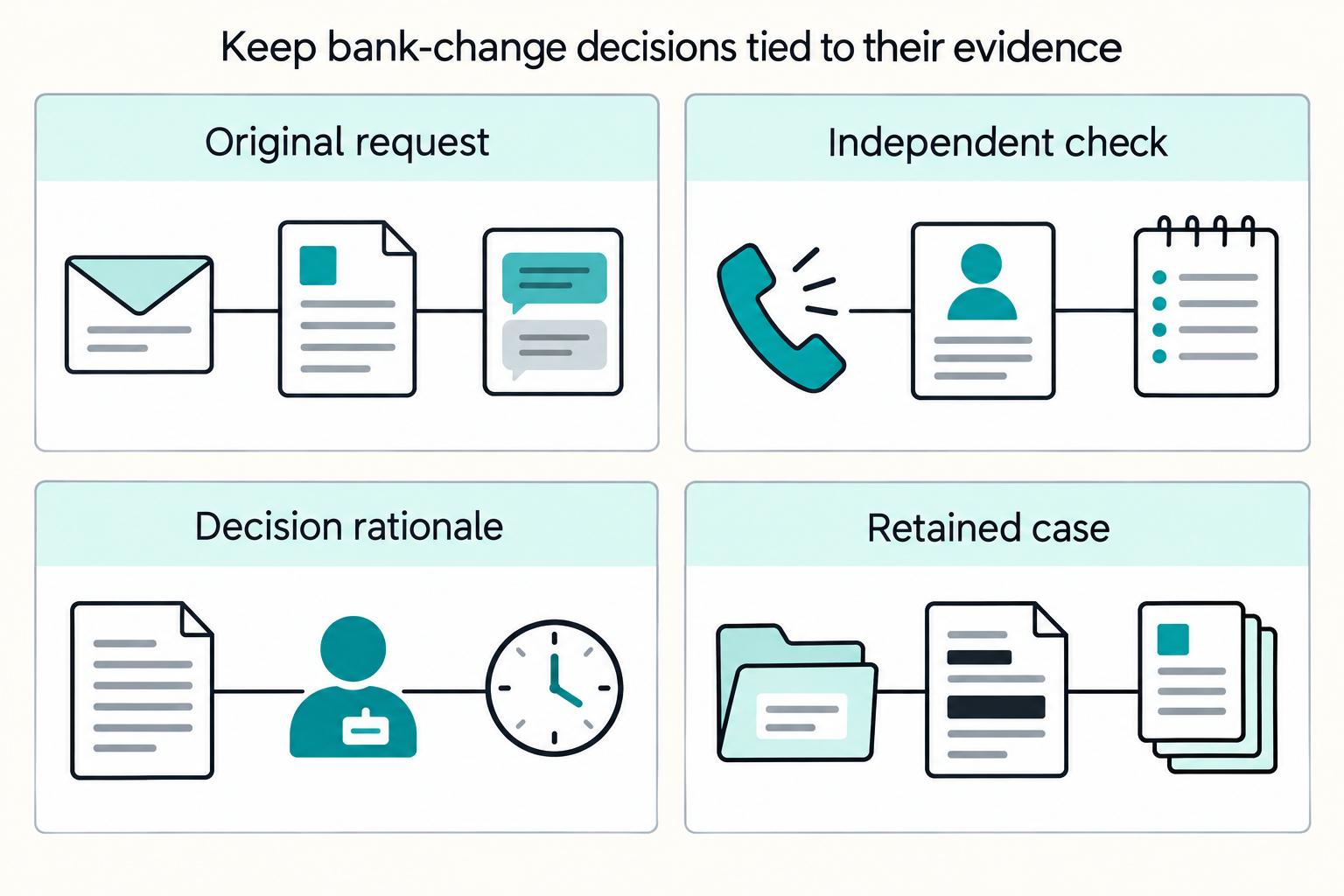
If you cannot reconstruct a held or exception-released payout months later, the control is not defensible. Treat the evidence pack as required output for every high-risk Vendor bank-detail change request.
Capture one minimum bundle for every decision#
Use one standard bundle so a reviewer can quickly see what was requested, what checks ran, who approved, when the decision happened, and the final outcome.
Store these artifacts against the payout ID and change-request record so the decision can be reconstructed later:
- request payload, including submitted bank-detail change, channel used, requester identity as presented, and original message or ticket
- authentication outcome, including whether step-up or other authentication passed, failed, or was abandoned
- verification output from out-of-band payment-change verification and any account checks used for the decision
- approver identity, with named initiator, reviewer, and any independent approver
- decision timestamp and final disposition such as
go,hold,block, or exception release
For spoofing and BEC cases, preserve raw message evidence. IC3 complaint guidance emphasizes transaction and account details, amounts, dates, recipient, loss totals, specific event details, and email headers when available.
Preserve verification proof with the request trail#
A bare "verified" flag is not enough for audit, reconciliation, or post-incident review. Keep verification proof beside the original Vendor bank-detail change request trail so you can show what was checked before funds moved.
Include the original request, out-of-band callback notes, known phone-number source, and verification outputs captured at decision time. Keep retries with timestamps instead of overwriting earlier results. The core control point is independence: do not rely on email alone.
Require a real rationale for any Dual approval override#
A Dual approval override should include a short written rationale, not just two approvals. Require clear reasoning on why release was allowed, what conflicting evidence was reviewed, and what compensating check closed the gap.
Keep the rationale concise and specific. This supports management-authorization evidence in internal accounting controls and makes later review defensible.
Store redacted artifacts in an audit-ready structure#
Store evidence in a fixed, redacted structure tied to payout IDs for reconciliation and regulator response. Use one case record with linked artifacts rather than scattered attachments.
Keep versioned suspicious messages, headers where available, callback notes, verification output, approvals and disposition in access-controlled evidence storage. Use redacted working copies while preserving any original evidence required for investigation or legal hold. Set retention and deletion from applicable law, contracts and purpose; bank recordkeeping duties do not automatically apply to every non-bank platform.
For a step-by-step walkthrough, see Transaction Monitoring for Platforms: How to Detect Fraud Without Blocking Legitimate Payments.
Integrate controls into Gruv payout and virtual account flows#
Put controls at the points where they can still stop a bad transfer. In many payout flows, that is typically before payout creation, before batch release, and before provider submission. After provider handoff, you are usually documenting release decisions, not changing them.
Place the same policy at three decision points#
Use one policy decision record across the full flow. If your flow has payout creation, batch release, and provider submission stages, run checks at each release point so risk signals are evaluated before release.
Use one shared case or decision ID and one current disposition, go, hold, or block, across payout, batch, and send layers. If each layer makes an independent decision, you can end up with conflicts like "approved in batch" but "failed verification at send time." That makes exception releases harder to defend.
Make retries idempotent before you automate them#
Keep a durable payout-instruction ID and validate provider replay support, scope and retention for the actual endpoint. PayPal-Request-Id is supported only by specified APIs and only for the stored-ID window; it is not a universal REST POST guarantee. Fence concurrent automated/manual execution and preserve attempt history beyond provider key expiry.
Test a forced timeout in a sandbox or controlled environment. Preserve the original instruction and key, query/reconcile the provider outcome, and replay only under validated same-operation conditions. A timeout is not proof of failure; do not issue a new payout or redirect the same obligation to another rail while its outcome remains unknown. Reapprove changed beneficiary details without discarding that unresolved instruction history.
Tie release gates to KYC and AML status where supported#
Apply actual KYC/CIP/CDD requirements for the regulated entity, capability and program. Route pending or stale evidence to the responsible owner under the applicable rules; a platform policy must not substitute for a legally required check or treat every update as identical.
Do not hardcode a universal auto-block rule. Program and jurisdiction expectations vary, so route unresolved cases into a controlled exception queue with named owners, blocking reason, review timestamp, and the exact artifact needed to clear the hold.
Document rail-specific timing before promising global SLAs#
Set SLAs from actual rail and participant constraints, not assumptions. BAHTNET is the Bank of Thailand RTGS rail, and settlement is final and irrevocable, so pre-submission controls are critical when your Thailand payout flow depends on participant-bank submission.
The Bank of Thailand publishes BAHTNET working-day hours of 8.30 to 17.30. Participant banks and providers can have earlier customer cutoffs, and holidays or service notices can change availability. Anchor deadlines to the selected provider and current operating calendar, not the system closing time. See How Bahtnet Works.
Related reading: Wire Transfer Fees for Platforms and How to Minimize Outbound Costs.
Common failure modes and how to recover without freezing payouts#
The usual breakdown is not missing controls. It is controls that are too broad, too easy to bypass, or too unclear to operate under pressure. Recover by tightening scope and ownership, not by turning protection off, because after wire release settlement is typically immediate, final, and irrevocable.
Narrow overbroad holds and keep strong authentication#
If holds are piling up, tune triggers to higher-risk scenarios instead of removing Multi-factor authentication (MFA) or other layered controls. Prioritize impersonation-prone change requests and other requests where authentication confidence is weak.
Check that held cases cluster around impersonation-prone requests, not routine maintenance. Use periodic risk assessments to retune rules and fix noisy intake paths before broad payout freezes.
Stop single-person exception releases#
Manual bypass risk rises when one person can release an exception alone. Use Dual control for exception releases and require a short rationale that records what failed, who reviewed it, and why release was allowed.
Check for cases where the same person appears in multiple approval roles or where notes are vague and unsupported. Dual control is only reliable when it reflects segregation of duties.
Require verification and identity controls together#
One clean signal is not enough under Business Email Compromise (BEC) patterns. Treat bank-detail changes as impersonation-prone and use layered controls before release.
If a request comes through email or a support ticket and the contact path is new or pressured, do not rely on the thread alone. Perform independent callback verification using contact details from your own records, not details provided in the suspicious message.
Make escalation ownership explicit and practiced#
Escalation confusion is a control failure during urgent payouts. Publish an Escalation matrix with named owners and clear handoff expectations.
Test this with a recent held case and ask who owns it now, who can approve release, and who must be escalated. If answers differ, the matrix is not operational yet.
Require a minimum evidence pack before closure#
As an internal control, avoid closing incidents before core artifacts are captured. At minimum, keep the change-request trail, authentication result, verification output, approver identity, decision timestamp, final disposition, and any exception rationale.
For bank-style funds-transfer recordkeeping, retain core payment-order artifacts, including execution date, payment instructions, and beneficiary bank identity.
Conclusion#
Do not let a bank-detail change move straight to payout based on the request message alone. The controls that hold up are consistent: verify the account, verify the requester, require dual control when risk rises, escalate by policy, and keep a defensible record.
Use this checklist before release:
Classify each vendor bank-detail change request before payout processing#
Mark higher risk when sender details or the request channel cannot be independently trusted. BEC messages can appear to come from known sources, including lookalike sender addresses. Record whether the case is routine, high-risk, or blocked before payout action.
Verify the destination account independently before release#
Run supported destination checks and independent beneficiary verification under the selected risk policy. Record unavailable, mismatched or stale results and require approved alternative evidence where needed. An open account or name match does not prove the requester is genuine or guarantee absence of fraud.
Verify actor identity through a separate path#
For risky changes, require multi-factor authentication (MFA) or controls of equivalent strength. Complete out-of-band confirmation using contact details from your own records, not details provided in the request.
Require dual approval for high-risk or override decisions#
Use dual approval when risk is high, authentication confidence is weak, or someone requests urgent release despite warnings. Ensure both approvers are identifiable and the override rationale is documented.
Follow a published escalation matrix with named owners and authority#
Define who owns escalation and who can hold, block, or approve by exception. Define escalation triggers in policy, including repeated authentication failures and manual override requests.
Archive an audit-ready evidence pack for every held, blocked, or exception-approved payout#
Retain the linked request, authentication, verification, approvals, timestamps and decision evidence under the applicable retention rules. As a banking reference, 31 CFR 1020.410 covers qualifying funds transfers of $3,000 or more, with specific duties and exceptions; non-bank platforms should not assume identical applicability. If a sent transfer looks fraudulent, contact the financial institution immediately and request receiving-bank coordination. Collect and supply the evidence in parallel; do not wait for a complete packet before urgent contact or required reporting.
Review the decision trail periodically against actual fraud signals, release authority and payout-delay impact.
Frequently Asked Questions
What is the minimum control stack to catch spoofed bank details before payout?
Use supported destination checks or approved independent alternative evidence, risk-appropriate MFA or equivalent assurance, and policy-defined independent approvals. Confirm risky change requests through a known-good path from your own records. A name match does not establish requester authority, and unavailable checks must not silently pass.
What should happen if bank details change right before payout cut-off?
Treat last-minute bank-detail changes as a hold condition unless your policy and evidence clearly support release. Urgency plus sender anomalies are common wire-fraud warning signs. Do not release from the message thread alone. Complete out-of-band verification, rerun authentication when needed, and send the case through fresh review and approval.
Is account verification enough without MFA or dual approval?
No. Account verification helps validate destination details, but it does not by itself prove requester legitimacy or ensure exception governance. If single-factor controls are not adequate for risk, use MFA, or equivalent strength, within layered controls and separate initiation from approval, with dual approval for higher-risk releases.
When should Finance escalate to Compliance or Legal instead of releasing with an exception?
There is no universal legal threshold for every platform, so your escalation matrix must define this. Escalate when spoofing indicators and pressure to release appear together, when independent verification cannot be completed, or when release would require bypassing normal approval controls. Involve Compliance, and involve Legal for serious or disputed cases.
What evidence should be retained after a blocked, held, or released payout?
Retain the full decision trail: request history, authentication results, verification output, approver identities, decision timestamp, disposition, and any exception rationale. For a bank-style benchmark, keep core payment-order artifacts such as originator and beneficiary identifiers, amount, execution date, and payment instructions. In U.S. bank recordkeeping context, 31 CFR 1020.410 covers certain funds transfers of $3,000 or more. 31 CFR 1010.410 permits retention as original, copy, or electronic record. Non-bank platforms should not assume automatic one-to-one applicability.
How can platforms reduce fraud risk without causing unacceptable payout delays?
Start by applying the strictest controls to the highest-risk patterns supported by your policy and evidence, especially urgent last-minute bank-detail changes with sender anomalies. Track suspicious changes caught and review backlog so controls stay proportional. If routine maintenance is getting trapped, refine trigger criteria instead of disabling MFA or approvals, because once a wire is released, settlement is typically immediate, final, and irrevocable.
What if a payout was already released and later looks fraudulent?
Treat it as an emergency and assume recovery is uncertain. Contact your bank and the receiving bank immediately to request a wire recall, and if the fraud was internet-initiated, consider filing with IC3. Keep payment instructions, beneficiary details, the decision trail, and approval records ready so escalation is fast and complete.
Researched and edited by the Gruv editorial team. Gruv builds cross-border billing, payouts, and finance-operations software for global businesses.
Sources
- apps.leg.wa.gov/rcw/default.aspxtrusted
- csrc.nist.gov/glossary/term/Multi_Factor_Authenticationtrusted
- developer.paypal.com/api/rest/reference/idempotencytrusted
- ecb.europa.eu/press/intro/news/html/ecb.mipnews250310.en.htmltrusted
- ecfr.gov/current/title-31/subtitle-B/chapter-X/part-1...trusted
- fbi.gov/how-we-can-help-you/common-frauds-and-scams/...trusted
- federalreserve.gov/paymentsystems/fedfunds_about.htmtrusted
- ffiec.gov/news/press-releases/2021/pr-08-11trusted
Educational content only. Not legal, tax, or financial advice.
Related Posts

The Freelance Payment Penalty: A Modeled Audit of Platform Fees, FX Spreads, and Payout Delays
The money rarely disappears through a single, easy-to-spot fee. The real loss is stacked. A marketplace takes its commission, a processor adds a charge for international cards, a bank or payment company converts the currency at a spread, a platform holds the funds before release, and a wire sheds a little to intermediaries on the way in. Each layer looks defensible on its own, but the worker feels the combined result as a smaller deposit and a later payday.

How to Respond to a Subpoena for Business Records
Move fast, but do not produce records on instinct. If you need to **respond to a subpoena for business records**, your immediate job is to control deadlines, preserve records, and make any later production defensible.
A US Expat's Guide to Investing in UCITS ETFs to Avoid PFIC Issues
The real problem is a two-system conflict. U.S. tax treatment can punish the wrong fund choice, while local product-access constraints can block the funds you want to buy in the first place. For **us expat ucits etfs**, the practical question is not "Which product is best?" It is "What can I access, report, and keep doing every year without guessing?" Use this four-part filter before any trade: