
Quick Answer
Pay the verified person or company operating the virtual creator under the agreement. Separate brand fees, affiliate commissions, platform earnings and rights licenses; verify platform eligibility, rights, tax classification and the actual payout corridor. Link accepted work to one payable obligation and reconcile payment attempts, fees and final receipt.
Pay the operator behind the virtual creator#
AI influencer payouts go to the person or business operating the virtual creator under the applicable agreement. The avatar name identifies the campaign or channel; it does not supply a legal payee, tax identity or bank beneficiary. Establish the operator, the rights being supplied and the source of the earnings before choosing a payment route.
A virtual creator can earn through a brand campaign, affiliate commissions, platform monetization or a rights license. Those arrangements have different payers and eligibility rules. This operating guide uses current first-party platform, payment-provider and US regulatory guidance checked on 3 October 2026. Worked amounts are hypothetical, not earnings benchmarks.
Map four identities before onboarding#
| Identity | Example | Record to retain |
|---|---|---|
| Public persona | A fictional avatar called Nova | Campaign/channel identifier and authorized operator |
| Contracting supplier | Nova Studio Ltd or an individual creator | Legal agreement and authority to provide the deliverables |
| Rights contributor | A designer, performer, voice artist or licensor | Relevant assignment, license or consent and its limits |
| Payment recipient | The approved supplier or documented authorized recipient | Verified beneficiary, tax classification and provider account |
One company may perform several roles, but record that conclusion rather than inferring it from a matching email address. An agency collecting money for a creator needs documented authority; beneficial-owner or tax documentation can require additional analysis. A designer who made the avatar does not automatically own the channel or have authority to receive every campaign payment.
For platform monetization, obey that platform’s actual account rules. AdSense account-type guidance says organization payments are payable to the company name and individual payments to the account holder’s payee name. After activation, the account type cannot simply be changed. Set the appropriate operator profile before expecting an avatar’s display name to work as the payee.
Separate earning models from payout timing#
| Earning arrangement | Who owes payment | What creates the amount due | Record needed |
|---|---|---|---|
| Sponsored deliverable | Brand or contracted agency | Acceptance of the agreed asset or milestone | Contract, approved version and acceptance record |
| Retainer | Contracted client | Defined service period and scope | Period, deliverables and scope adjustments |
| Affiliate commission | Affiliate program or merchant under its terms | Qualified attributed transactions after applicable adjustments | Attribution, refunds, eligibility and commission statement |
| Platform monetization | Platform under its program agreement | Eligible activity and finalized earnings | Program status and finalized earnings statement |
| Rights license | Licensee | Agreed permitted use and payment terms | Rights scope, territory, term and consideration |
NET-30 is a due-date term; an instant payout is a payment-speed offering. Neither defines the earning model. State which event starts the 30-day clock and distinguish scheduled release, provider submission and expected receipt. Faster payout does not turn a provisional affiliate commission into a finalized entitlement.
Check platform eligibility before forecasting revenue#
YouTube’s current disclosure guidance requires disclosure of meaningfully AI-generated or altered realistic content, including realistic scenes that did not occur and making real people appear to act or speak differently. It also addresses music that is the main focus. Its current upload instructions use the “AI use” field; follow the live guidance rather than an older interface label.
YouTube says disclosure itself does not limit monetization eligibility. Its separate channel monetization policies require original, authentic content and address generic, repetitive or mass-produced material. An AI label therefore is neither a blanket monetization ban nor approval of repetitive content. Review the finished channel and assets against both policies.
Do not assume that a sponsored video also earns a platform reward. TikTok’s Creator Rewards guidance excludes sponsored content from its described original-content eligibility. Program availability, account type and the applicable current country terms still need confirmation before including platform rewards in a campaign budget.
Record eligibility as a dated decision for a particular program and account. Separate estimated analytics revenue from finalized payable earnings. If platform eligibility changes, determine what happens to that revenue stream under the platform terms; do not silently cancel an independently owed brand fee without a contractual basis.
Clear rights and advertising claims before acceptance#
The US Copyright Office’s AI report announcement explains that copyrightability depends on sufficient human-authored expression; merely supplying prompts is not enough. Human selection, arrangement or modification can matter. Keep evidence of the rights actually controlled and avoid promising exclusive copyright in every element simply because an AI tool produced the image.
Copyright, permission to use a real person’s likeness or voice, music licensing and the tool’s commercial-use terms are separate questions. Ask the supplier to identify relevant inputs, contributors, consents and restrictions. Define permitted edits, distribution channels, territory, duration and any exclusivity in the agreement. Obtain a rights assessment for the actual use instead of treating the generator subscription as a universal clearance.
FTC guidance on AI avatars does not impose a blanket ban on virtual influencers. Fake or false underlying testimonials and deceptive uses can still violate the applicable rules; its guidance also addresses unauthorized celebrity avatars where viewers would think the celebrity actually endorsed the product.
A virtual character saying “I used this supplement and recovered” raises a different claim issue from an obviously fictional product demonstration. Document the factual basis for claims and avoid inventing personal experiences. FTC disclosure guidance requires appropriate disclosure of material brand connections. An AI-content label and a paid-sponsorship disclosure answer different questions.
Write a campaign contract that finance can apply#
| Term | Concrete decision |
|---|---|
| Supplier and authority | Name the legal operator and any agency collection authority |
| Deliverables | Identify asset versions, channels, dates and revision allowance |
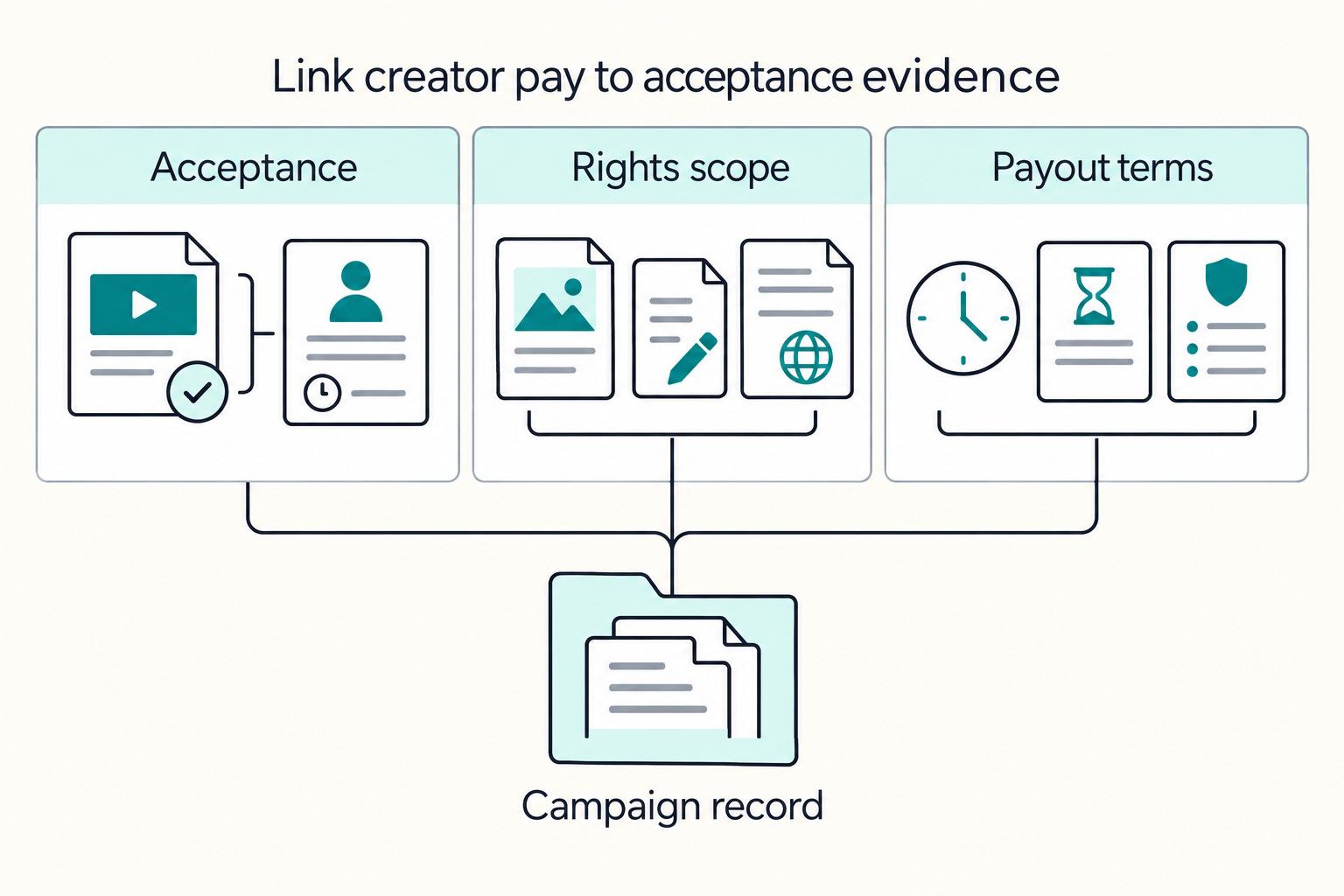
| Acceptance | Name the approver, decision deadline and evidence; define rejection and cure |
| Rights | Specify licensed uses, exclusions, start/end dates and contributor permissions |
| Compensation | Separate base fees, commissions, bonuses and any applicable taxes |
| Payment | State currency, clock-start event, due date and fee allocation |
| Holds and disputes | Specify lawful/contractual grounds, notice, responsible owner and review path |
For example, a campaign record can show asset V3 accepted by the named client approver on 6 October, a USD2,000 base fee and payment due 30 calendar days after that acceptance. That is a hypothetical contractual schedule, not a standard required by a platform. If required intake is incomplete, notify the supplier and resolve it under the agreement rather than letting an internal hold quietly rewrite the due date.
Do not use indefinite rights review as a substitute for an acceptance deadline. If a separate contributor raises a claim, preserve the approved asset, notice and disputed use. Decide whether the agreement permits holding the affected amount, whether undisputed amounts remain payable and how an agreed correction will be documented.
Classify the payment before choosing tax documents#
In a US reporting context, Form W-9 provides the relevant US payee TIN/certification. W-8BEN is a foreign individual beneficial-owner form; W-8BEN-E serves foreign entities in its applicable context. An intermediary, flow-through entity or effectively connected income can require a different form. Route documents from the actual tax classification, not the avatar’s apparent nationality.
IRS Publication 515 generally sources personal-service income where work is performed and copyright royalties where the property is used. A mixed campaign production and rights license should therefore have an actual classification/allocation assessment. A foreign bank account or foreign operator alone does not establish that every payment is outside US withholding or reporting.
Assign the decision to the party responsible for the applicable return and withholding. Document payer identity, payee status, payment type, source, treaty claims and any required reporting path before applying a rate. Do not route every creator payment to Form 1099-NEC or promise zero withholding from a W-8 alone. FBAR concerns qualifying foreign-account interests or authority; it is not a creator-onboarding form.
Build a corridor matrix around the actual provider product#
Stripe’s current Connect cross-border documentation supports transfers between platforms and connected accounts in the US, UK, EEA, Canada and Switzerland under the stated conditions. Self-serve cross-border payouts outside those regions are not supported by that offering. It distinguishes Connect from Global Payouts and specifies supported service agreements and funds flows. This is one provider’s product scope, not a universal country-access rule.
| Example route | Connect self-serve region screen | Decision still required |
|---|---|---|
| US platform to UK operator | Both are listed regions | Account approval, agreement, currency and supported funds flow |
| UK platform to Canadian operator | Both are listed regions | Beneficiary and provider requirements; fees and actual timing |
| US platform to French operator | US and EEA are listed | Legal supplier, verified account and supported configuration |
| US platform to Singapore operator | Recipient is outside the listed regions | Evaluate a separately supported product or route; do not assume Connect access |
| UK platform to Indian operator | Recipient is outside the listed regions | Confirm a separately approved corridor and local requirements |
For each proposed route, record sending entity, supplier country, beneficiary country, currency, provider product, account approval, tax treatment and evidence date. Receiving-country bank details do not override the supplier’s onboarding requirements. A currency supported for customer charges does not establish that the same currency can settle to that supplier.
Reconcile one hypothetical campaign from fee to receipt#
Assume an accepted USD2,000 base fee and a USD300 earned bonus, with no taxes or withholding in this example. The obligation is USD2,300. If the agreement makes the operator bear a USD20 payout fee, show USD2,280 paid to the operator plus USD20 deducted under that agreement, settling USD2,300. If the payer bears the fee instead, the operator receives USD2,300 and the payer’s cash outflow is USD2,320.
Keep the earning calculation separate from payout charges. An unearned bonus is not a payout deduction; a paid commission subsequently reversed by a qualified refund is a separately supported adjustment. For a foreign-currency receipt, retain the actual quoted rate, converted amount and fee breakdown. Do not compare providers on a headline transfer fee while ignoring FX and receiving-bank deductions.
| Record | Example purpose |
|---|---|
| Campaign and obligation ID | Links accepted asset and USD2,300 amount due |
| Supplier and beneficiary IDs | Shows who contracted and where payment is authorized |
| Adjustment record | Documents earned bonus, refund or other agreed change |
| Payout attempt and reference | Identifies the submitted provider transaction |
| Final outcome and reconciliation | Matches provider result, cash movement, deductions and remaining payable |
Handle holds, timeouts and returns without double payment#
Maintain one payable obligation with separate payment attempts. If a submission times out, retain it as unresolved, query the provider and reconcile status before trying another route. A new method or beneficiary does not make the original attempt disappear. A confirmed failed attempt can be retried under the provider’s supported process; a returned payment requires confirmation of returned funds and any retained fees.
A verification hold should have a reason, owner, supplier communication and review record. Separate content acceptance from provider eligibility so the team can explain whether the deliverable was rejected, the obligation is disputed or only the transfer is blocked. Once resolved, authorize the next attempt against the still-open amount and keep earlier references for reconciliation.
Pilot with metrics whose denominators are clear#
- Choose a limited set of legal suppliers, contracts and already verified corridors.
- Record payable obligations, submitted attempts, final paid outcomes and unresolved balances separately.
- Measure on-time receipt against the contractual due date, not only API submission time.
- Track hold reasons, resolution time, disputed amounts and unsupported adjustments.
- Reconcile every pilot obligation and payout reference before widening coverage.
If 20 obligations are due and 18 are confirmed received on time, the on-time obligation rate is 90%. Sending 22 attempts does not create 22 successful creator payments. Report the two remaining obligations and any unknown attempt outcomes explicitly. Scale from actual records rather than a promotional estimate of virtual-influencer earnings.
Frequently Asked Questions
Who receives an AI influencer payout?
The approved person or company operating or representing the virtual creator under the relevant agreement receives payment. Record the legal supplier, rights authority, tax classification and authorized beneficiary separately from the avatar’s public name.
Can AI-created videos earn YouTube revenue?
AI use alone is not a blanket exclusion. Required disclosure and monetization policies both apply: disclosure itself does not remove earning eligibility, while generic, repetitive or mass-produced content can fail the original/authentic content rules. Check the actual account and finished content.
Does an AI-content label replace sponsorship disclosure?
No. The AI label tells viewers about synthetic content; a sponsorship disclosure identifies a material brand relationship. Apply the relevant platform and advertising requirements to both issues.
Can a virtual creator receive cross-border payments everywhere?
Availability depends on the legal operator, platform program, provider product and corridor. Verify the exact sending and recipient countries, account eligibility and currency; broad customer-payment coverage is not evidence of universal creator payouts.
Should every virtual creator complete a W-9?
No. In the applicable US reporting context, route documents by the actual payee’s tax status and role. US persons, foreign beneficial owners and intermediaries can require different documentation, and the payment’s classification/source determines the reporting and withholding analysis.
Where Gruv fits
Researched and edited by the Gruv editorial team. Gruv builds cross-border billing, payouts, and finance-operations software for global businesses.
Sources
Includes 2 external sources outside the trusted-domain allowlist.
- copyright.gov/newsnet/2025/1060.htmltrusted
- docs.stripe.com/connect/cross-border-payoutstrusted
- ftc.gov/business-guidance/resources/consumer-reviews...trusted
- ftc.gov/business-guidance/resources/disclosures-101-...trusted
- irs.gov/forms-pubs/about-form-w-9trusted
- irs.gov/forms-pubs/about-form-w-8-bentrusted
- support.google.com/adsense/answer/10163external
- support.google.com/youtube/answer/14328491external
Educational content only. Not legal, tax, or financial advice.
Related Posts

The Freelance Payment Penalty: A Modeled Audit of Platform Fees, FX Spreads, and Payout Delays
The money rarely disappears through a single, easy-to-spot fee. The real loss is stacked. A marketplace takes its commission, a processor adds a charge for international cards, a bank or payment company converts the currency at a spread, a platform holds the funds before release, and a wire sheds a little to intermediaries on the way in. Each layer looks defensible on its own, but the worker feels the combined result as a smaller deposit and a later payday.

How to Respond to a Subpoena for Business Records
Move fast, but do not produce records on instinct. If you need to **respond to a subpoena for business records**, your immediate job is to control deadlines, preserve records, and make any later production defensible.

A US Expat's Guide to Investing in UCITS ETFs to Avoid PFIC Issues
The real problem is a two-system conflict. U.S. tax treatment can punish the wrong fund choice, while local product-access constraints can block the funds you want to buy in the first place. For **us expat ucits etfs**, the practical question is not "Which product is best?" It is "What can I access, report, and keep doing every year without guessing?" Use this four-part filter before any trade: