
Quick Answer
Use a hybrid policy: keep NET-30 as the default, then enable Instant Payout only for eligible creators after operational checks pass. NET-30 is an invoice due-date term, not a payout-rail guarantee, so define schedule, pending-balance timing, and retry behavior separately. Treat speed as conditional until account and country support are confirmed. If you promise fast payout, assign who pays the fee and require clear handling for failed, returned, or deferred payouts before broad rollout.
Why payout timing is now a product decision, not a back-office setting#
Payout timing now sits across product, finance, and operations. For an Influencer Marketing Platform, the choice is not just about when money goes out. It shapes creator trust and engagement on one side, and cash control, margin pressure, and reconciliation effort on the other.
Creators increasingly expect fast or near-instant access to earnings, while platform teams still need to keep payout costs low and close the books cleanly. Payment infrastructure is a critical technology decision. If you treat payout timing as a finance toggle set once in the back office, you miss the product consequences.
| Option | Plain meaning | Main upside | Main risk |
|---|---|---|---|
| NET-30 | Payment is due within 30 days of invoice receipt | Can improve cash control and give finance more control | Slower creator experience and more payment-status friction |
| Instant Payout | Release eligible funds immediately instead of waiting for the default schedule | Stronger speed promise for creators | Higher cost and tighter operational controls needed |
| Hybrid Payout Strategy | Keep a default schedule, but allow faster release for eligible cases | Balances creator experience with margin discipline | More policy logic to manage and explain |
A few definitions matter up front. NET-30 is an invoice term, with payment due within 30 days of receiving the invoice. Instant Payout is not just "paid faster." In provider documentation, it usually means an immediate release path outside the normal payout schedule. Stripe, for example, says Instant Payouts can be requested any day or time, including weekends and holidays, with arrival typically within 30 minutes. That is a useful reference point, not a universal market rule.
This guide stays narrow on purpose: platform-side Creator Payouts and Influencer Payments. The question here is how your platform decides when to release funds, not personal budgeting advice for freelancers or general AP policy for every supplier class.
Before you promise speed, verify the payout schedule and market support in the exact provider account and jurisdiction you plan to launch with. Provider docs are explicit that payout availability varies by industry and country of operation, and even threshold guidance can change over time. A common failure mode is product marketing promising "instant" while operations later discovers country limits or schedule constraints after creators already expect same-day cash.
The evidence base is thinner than it should be. Cross-provider settlement mechanics, fee detail, cutoff rules, and regional constraints are often provider-specific and need provider-level confirmation. This guide stays concrete where documentation is clear and explicit about what still needs provider-level confirmation before you ship. Related: Performance Marketing Payouts: How to Pay Affiliates Influencers and Publishers Compliantly. If you want a quick next step, try the free invoice generator.
NET-30 vs instant payout at a glance#
Use this as a starting posture, not a universal rule: when liquidity is tight, bias to NET-30 or a hybrid model; when creator competition is high, add targeted instant access only where eligibility, cost, and failure handling are already verified.
| Option | Cash-flow impact | Creator experience | Ops load | Failure exposure | Margin pressure | What is unknown until you verify provider + market |
|---|---|---|---|---|---|---|
| NET-30 | Strong working-capital protection because payment is due 30 calendar days after billing | Slowest access to funds | Lower fast-lane urgency, with ongoing billing/payout coordination | Lower exposure to fast-lane disbursement failures | Lowest direct pressure if you stay on standard schedules | Actual payout schedule, fund-availability lag, country support, and account-specific holds |
| Instant Payout | Funds leave sooner once eligible | Fastest access; cited provider guidance includes arrival within 30 minutes | Highest exception handling and reconciliation intensity | Higher exposure to blocked/deferred payouts that need explicit retry flows | Highest direct fee pressure; cited pricing includes 1% in most countries and a US change from 1% to 1.5% on June 1, 2024 | Cutoff behavior, settlement dependencies, exact eligibility, regional coverage, and whether instant is enabled in your account |
| Hybrid Payout Strategy | Balanced baseline control with selective acceleration | Strong if eligibility rules are clear | Moderate to high due to policy logic and communication | Moderate, with concentrated fast-lane exception handling | More controllable when paid speed is limited to a subset | Which creators, countries, and payout methods can use the fast lane without manual intervention |
| Default recommendation | Bias here when liquidity and close-control needs are the priority | Add targeted fast access when delayed earnings are hurting activation | Expand eligibility only after deferred/failed payout handling is reliable | Treat fast payout as conditional, not a blanket promise | Set cost ownership before launch | Confirm account-level settings before publishing pricing or SLA promises |
This comparison only works if you separate billing terms from payout execution. Pay by Invoice (net terms) defines when an invoice is due; NET-30 means payment is due 30 calendar days after billing. That billing term does not define payout cadence, payout rail, or fund-availability timing.
Do not mix billing terms with payout mechanics#
A payout schedule is how often funds are sent. Payout speed is how quickly funds become available to be paid out. Those are separate controls, and provider documentation explicitly notes schedule does not determine pending-balance availability timing.
| Concept | What it defines | What it does not define |
|---|---|---|
| Pay by Invoice / NET-30 | When an invoice is due; payment is due 30 calendar days after billing | Payout cadence, payout rail, or fund-availability timing |
| Payout schedule | How often funds are sent | Pending-balance availability timing |
| Payout speed | How quickly funds become available to be paid out | The invoice due date |
So "we pay creators NET-30" is incomplete on its own. You still need to define payout cadence, pending-balance timing, and whether instant payout exists outside the default schedule.
Verification points that save you pain later#
Before launch, verify the exact provider account and country path you will use:
| Verification point | What to verify | Grounded note |
|---|---|---|
| Standard payout schedule | What the standard payout schedule is for this account, and whether it is free or fee-based | Standard schedules can be free or fee-based |
| Pending balance timing | How long funds stay pending before they are available for payout | Standard flows can involve 2 or 3 business days |
| Instant payout availability | Whether instant payout is available for this entity, market, and payout method | Availability varies by industry and country of operation |
| Blocked payout handling | Whether a payout auto-retries or requires a new submission | Deferred payments are not automatically reprocessed |
That last point is operationally critical. In Tipalti terminology, a deferred payment means an issue was detected, and cited guidance says those payments are not automatically reprocessed. If your team assumes auto-retry, support and reconciliation load can rise quickly.
Use NET-30 when working-capital protection is the priority. Use instant payout when speed is a clear growth lever and fee/exception load is acceptable. Hybrid is often the most practical first production model because it protects baseline economics while allowing targeted speed where it matters.
For a step-by-step walkthrough, see How to Hedge FX Risk on a Global Payout Platform.
Where NET-30 protects margin and where it hurts growth#
Use NET-30 as your baseline when buyer invoices fund creator payouts; switch to selective faster access when creator acquisition becomes the constraint.
The margin logic is straightforward: net terms set the invoice payment window, and longer terms let buyers hold cash longer by extending payable cycles. If brands or agencies pay you on invoice terms, aligning creator payout timing to that cycle helps protect working capital and keeps finance operations more predictable.
There is also real upside in payment flexibility on the buyer side. Balance reports that adding pay-by-invoice with terms was associated with a 38% average lift in new buyer acquisition, and Forrester reports 81% buyer dissatisfaction and 86% stalled B2B purchases. Treat that as a strong expectation signal, not proof that every influencer platform should apply one payout timing to every creator.
| Where NET-30 helps | Where it hurts growth |
|---|---|
| Protects cash when brand or agency invoices settle on terms | Delayed creator earnings can weaken trust and acceptance for future work |
| Reduces margin pressure from advancing funds before cash lands | More payment-status questions and support load |
| Matches enterprise B2B invoice expectations | Higher friction for smaller creators with tighter cash needs |
Creator-side risk usually shows up as operational friction first. Payment delays often lead to repeated payment-status chasing, which increases support burden and strains creator relationships.
Decision rule: if creator acquisition or activation is slowing growth, do not force universal NET-30. Keep NET-30 as the default and apply a Hybrid Payout Strategy with tiered eligibility for faster payouts.
This pairs well with our guide on Affiliate Marketing Management for Platform Operators Running a Partner Network.
Where instant payout wins and the hidden costs teams underestimate#
Instant Payout works best as a gated product feature, not a universal default, unless your economics, exception handling, and reconciliation controls are already proven.
The speed advantage is real for eligible payouts: Stripe says funds typically settle within 30 minutes. That can be a meaningful experience difference versus NET-30, but faster disbursement also raises the bar for operational reliability.
What teams often underestimate is the servicing load behind an "instant" promise. Stripe's payout states include processing, posted, failed, returned, and canceled, so your team needs to manage more than successful posts.
The hidden costs usually show up in operations first#
Stripe states Instant Payouts carry per-transaction fees, with cited levels of 1% in some listed regions and 1.5% for the US, AU, NZ, and AE in the referenced excerpt. Beyond fees, operating costs often grow through:
- Exception handling: failed or returned payouts require review, communication, and resend decisions.
- Retry and resend overhead: Stripe notes payouts are typically returned within 2-3 business days, which can turn an instant lane into a multi-day case.
- Reconciliation overhead: fast payouts still need clean mapping to campaign approvals, payout records, and ledger entries.
- Higher support expectations: faster payout tiers usually require faster human resolution when something breaks.
A practical control check is whether you can track non-success states by cohort and day, not just total posted payouts.
Build vs buy is mostly a choice about who owns complexity#
| Option | Supported context | Likely strength | Verify before rollout |
|---|---|---|---|
| Stripe | Instant Payouts typically settle within 30 minutes for eligible payouts; per-transaction fees apply; statuses include processing/posted/failed/returned/canceled | Speed plus explicit payout-state visibility | Eligibility, exact regional pricing, and resend/reconciliation fit in your flow |
| Lumanu | Positions invoice consolidation for influencer marketing, replacing many creator invoices with one Lumanu invoice | Less invoice sprawl in creator payable operations | Payout timing, exception workflow depth, and ledger/support integration |
| Tipalti | Emphasizes status, invoice, due-date, and reconciliation tracking across entities/currencies; markets payouts to 190+ countries | Reconciliation visibility for multi-entity operations | Fit with creator UX, approval flow, and any instant-speed promise |
Use instant payout where your margin and controls can support it. Keep the rest on NET-30 or hybrid lanes until failed/returned rates, visibility, and servicing performance show the model is stable.
You might also find this useful: AI Influencer Payouts: How Platforms Pay Virtual Creators and Synthetic Brand Ambassadors.
How to design a hybrid policy that product, finance, and ops can all enforce#
Build a three-lane policy with clear gates: default to NET-30, use Milestone-Based Payment Terms when work is approved in stages, and offer Instant Payout only as an opt-in lane for eligible accounts. If ops cannot audit the rules as clear yes/no decisions, the hybrid policy is not enforceable.
| Lane | When it applies | Release trigger | Verify first | Speed-cost owner |
|---|---|---|---|---|
| NET-30 | Default lane for most creators and campaigns | Payment due 30 days from invoice date | Standard approval and invoice record | Platform cash-flow policy |
| Milestone-Based Payment Terms | Campaigns with defined stage gates | Release at completed milestone | Milestone completion evidence and approval | Defined in campaign terms |
| Instant Payout | Limited, opt-in fast-pay lane | Approved payment plus eligibility pass | Onboarding status, supported country/currency/account conditions, approved invoice or completion evidence, and no active risk hold | Must be explicitly assigned in policy |
Set eligibility in layers so decisions are explainable: creator tier, campaign type, and dispute profile. That structure lets you justify why one cohort can access faster payout while another remains on NET-30 or milestones.
Use dispute and risk signals as hard gates. Open disputes can put funds on hold, and payouts may be paused where the platform is exposed to negative balances, so high-dispute cohorts should stay on slower lanes until completion evidence and payout exception patterns stabilize.
Price the speed before launch#
Pick one pricing posture up front so margin ownership is explicit:
| Pricing posture | Fee owner | Description |
|---|---|---|
| Platform-funded speed | Platform | Absorbs the fee as a growth cost |
| Creator-paid speed | Creator | Opts in and pays for faster access |
| Sponsor-subsidized speed | Sponsor | Covers speed only when contract terms explicitly assign that cost |
For Stripe contexts, the stated Instant Payout fee for marketplaces/platforms is 1%, and Stripe payout docs also cite 1.5% in listed markets (US, AU, NZ, AE).
If you want a deeper dive, read How to Offer Instant Payouts as a Premium Feature: Pricing and UX Design for Platforms.
Implementation checkpoints from contract terms to payout events#
Lock contract terms and your event sequence before exposing fast pay. NET-30 vs. instant is rarely the implementation risk by itself; unclear approvals, duplicate requests, and opaque status handling are what break ops and finance later.
Start with the contract, not the API#
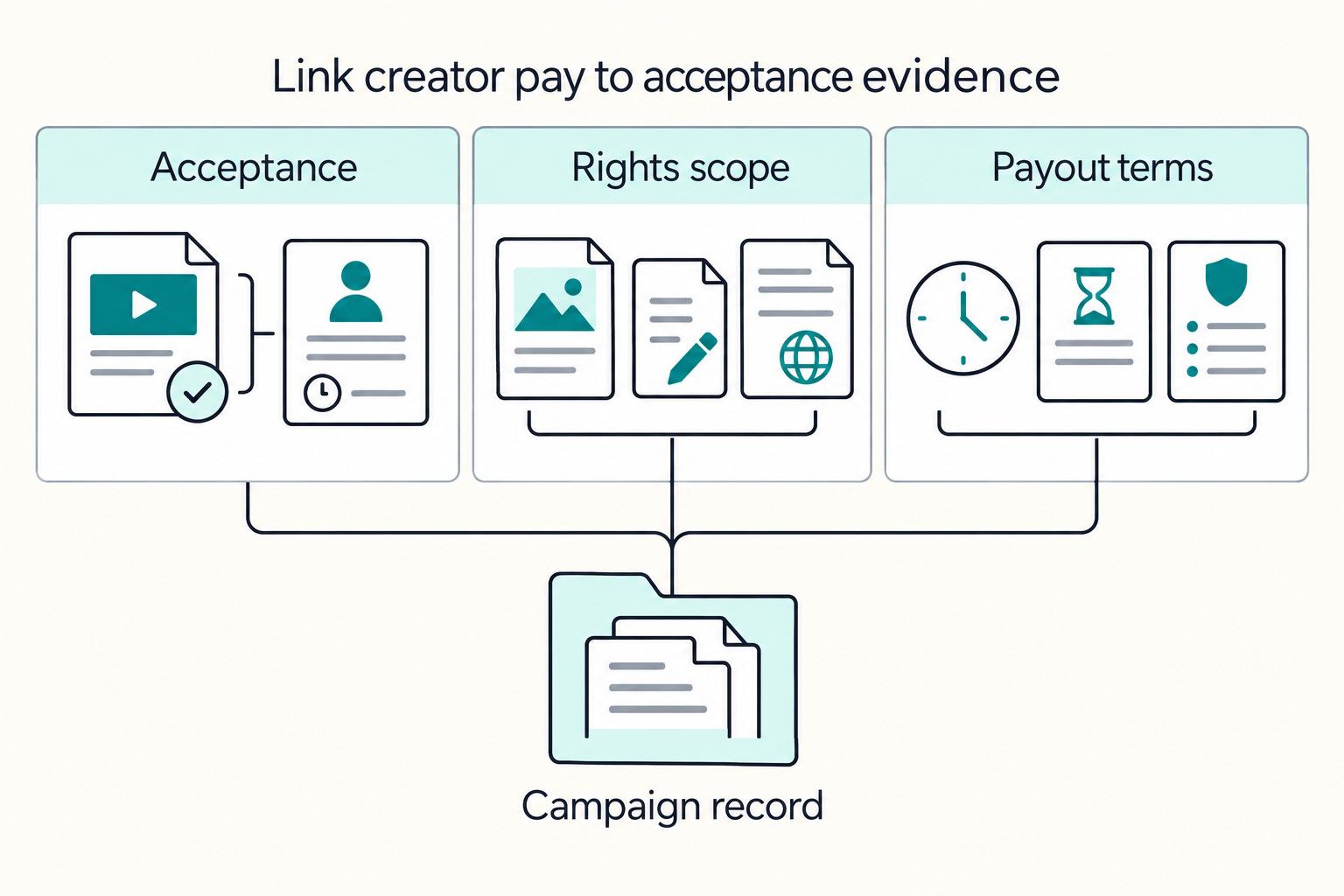
Your Creator Payouts automation should only enforce terms that are explicit in the contract or campaign order. Lock five primitives first: payment timing, approval authority, review window, dispute and reversal triggers, and required release evidence.
A milestone reference point: Upwork's fixed-price flow allows 14 days to review submitted work before auto-release. You do not need that exact number, but you do need a declared review window and auto-release rule for any Milestone-Based Payment Terms flow. For disputes, avoid claiming one universal deadline across all rails; set an internal response clock and define the evidence pack up front (approval log, invoice or milestone record, completion proof, payout reference, dispute correspondence), because disputed funds can be put on temporary hold.
| Checkpoint layer | What must be explicit | What ops should verify | Common failure mode |
|---|---|---|---|
| Contract terms | Timing, approval authority, dispute/reversal rules | Signed terms match configured payout lane | Product promises faster release than contract allows |
| Trigger event | Approved invoice, approved milestone, or other release event | Evidence exists before payout creation | Payout created from incomplete or disputed work |
| Event handling | Webhook processing and status transitions | Duplicate events are handled safely | Same payout updated twice or moved to wrong state |
| Finance close | Ledger posting and reconciliation export | Provider references match payout batch records | Cash movement cannot be tied back at month-end |
Freeze the order of operations#
Use one sequence every time: trigger event, policy gate, payout instruction, status webhook, ledger post, reconciliation export. Do not combine payout creation and ledger posting in an uncontrolled webhook step.
Webhooks are HTTP POST event delivery, and providers can deliver duplicates. Stripe notes endpoints may receive the same event more than once and can resend undelivered events for up to 3 days. Use idempotency keys on your Payment API calls so retries return the same result instead of creating divergent outcomes; Stripe states same-key requests return the same result (including 500 errors), and Adyen supports retry-safe idempotent requests. Then add replay-safe webhook consumers, fast acknowledgement, and async processing; Adyen notes responses beyond 10 seconds can cause failing status and retries.
Define clear intermediate and terminal payout states in your platform, and map each provider state into them explicitly. If support cannot distinguish pending provider confirmation, failed and retryable, paid, and reversed, the hybrid model is not launch-ready. Prioritize reliability over headline speed, because cleanup cost usually lands on finance and support. For the full breakdown, read Catching Payout Errors Early in High-Volume Platform Operations.
Compliance and audit details that break launches when left vague#
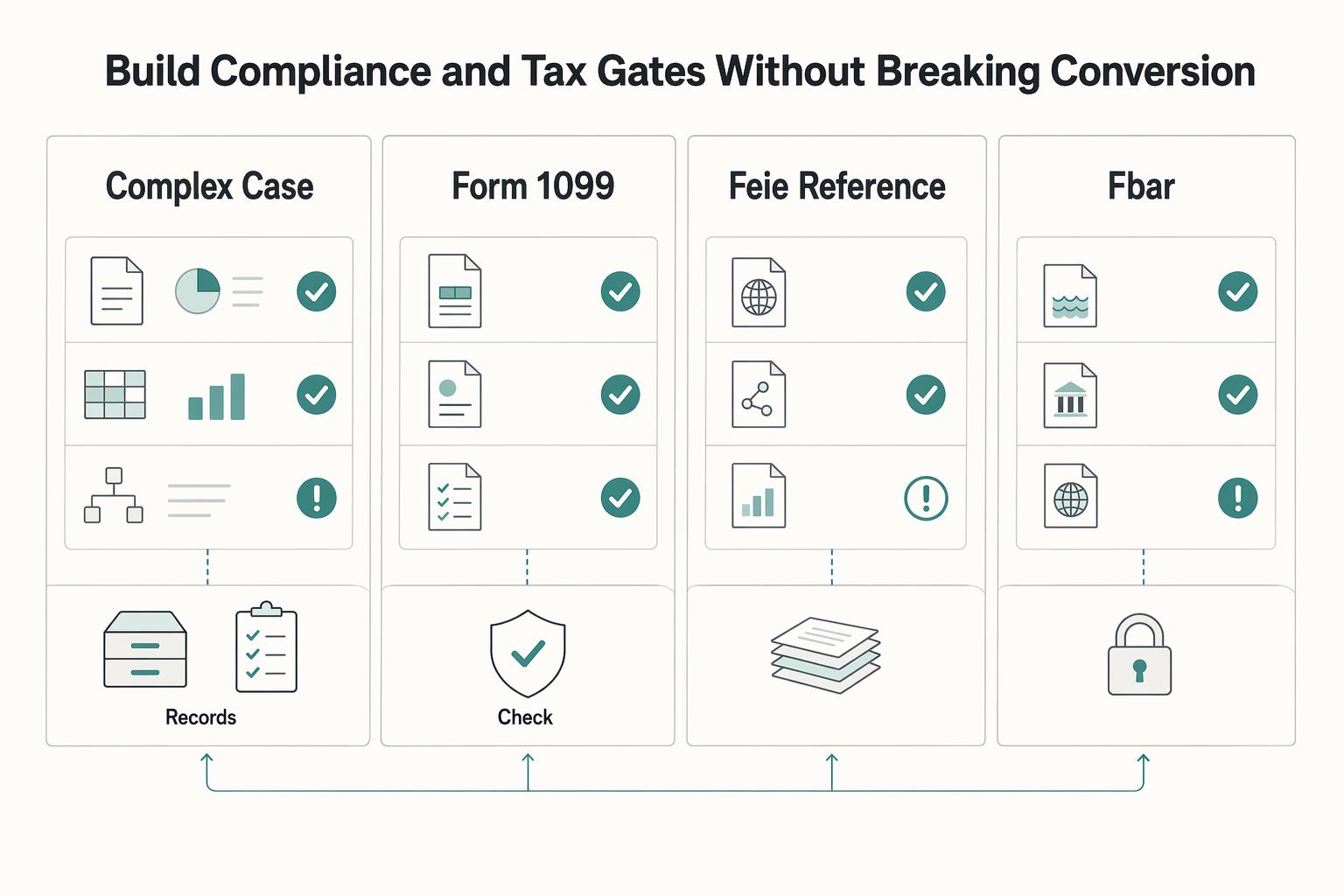
Define payout release blockers before launch, or both NET-30 and Instant Payout will fail when approvals are done but funds still cannot move.
Keep these gates in the same policy layer as payout timing. For connected accounts, KYC requirements must be fulfilled before accounts can accept payments and send payouts. Tax readiness is also a release gate: missing required tax status information can pause payouts, so collect the required tax profile, including Form W-9 where relevant, before release eligibility.
| Control area | What must be defined | Ops verification | Common break |
|---|---|---|---|
| Identity and KYC | Which account types need verification before payout | Account is verified before payout creation | Approved creator cannot be paid |
| AML and policy holds | What screenings or watchlist checks can place a hold | Hold reason is visible to ops and support | Funds are blocked with no explainable status |
| Tax readiness | Required tax forms and taxpayer data before release | Tax profile complete, including Form W-9 when applicable | Payout paused after approval |
| Audit traceability | Link from request to provider reference to ledger journals | Reconcile payouts to underlying transactions and ledger journals | Finance closes books by manual stitching |
For Influencer Payments, require an evidence pack that is complete and traceable: approval logs, exception reasons, payout status history, provider reference, and ledger journal linkage. If your payout stack cannot preserve that chain, month-end close and audits become manual cleanup.
Do not assume one global compliance policy will hold across every market. Verification requirements vary by location, business type, and requested capabilities, and some program or country setups can add extra payout fees. In a Hybrid Payout Strategy, publish those differences early so product promises stay aligned with what compliance and finance can actually release.
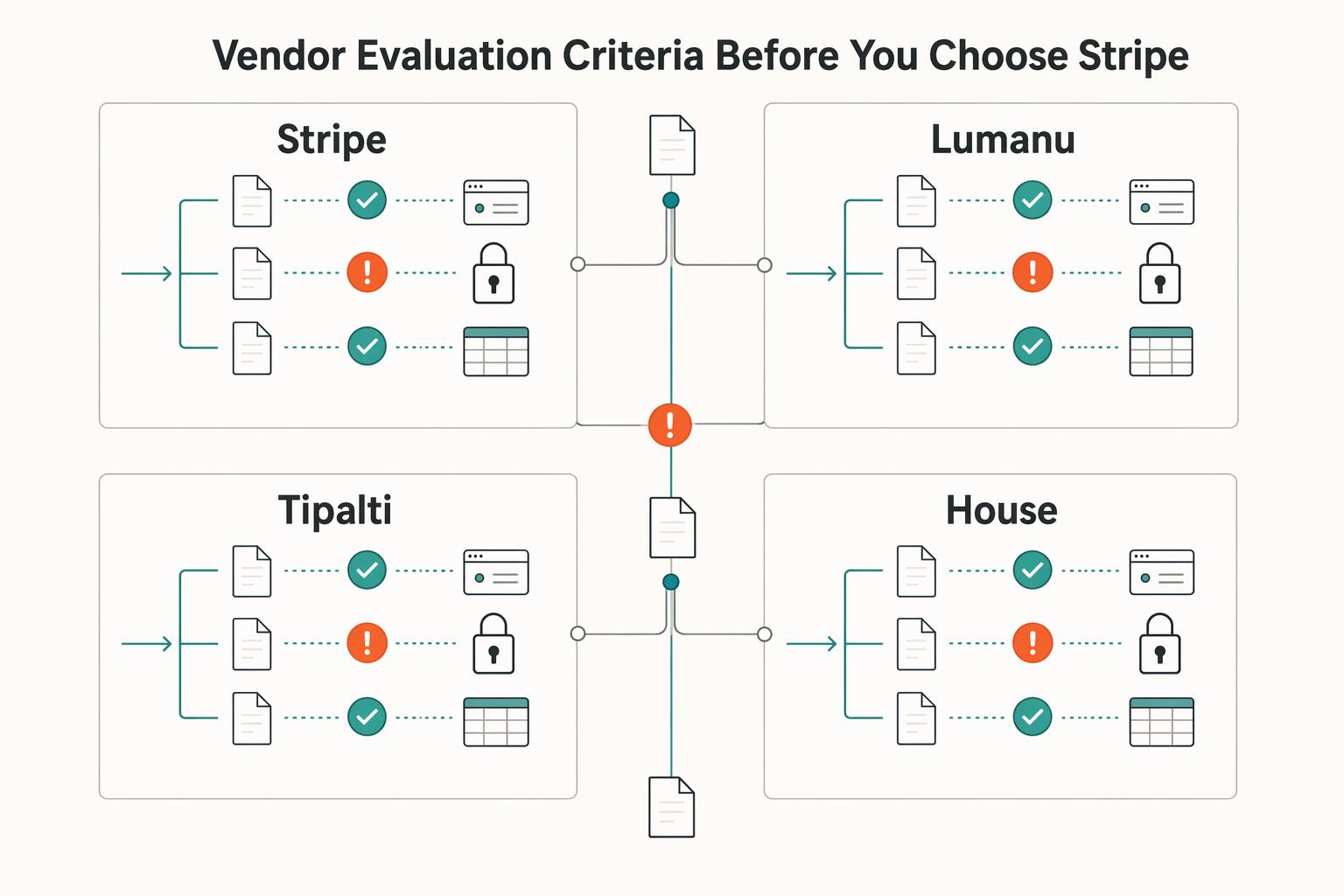
Vendor evaluation criteria before you choose Stripe, Lumanu, Tipalti, or in-house#
Choose based on operational fit: can your team track, explain, and recover payout exceptions across ops, engineering, and finance-close workflows? Brand recognition matters less than whether status signals, recovery events, and reconciliation outputs line up in practice.
| Option | Status transparency | Exception and recovery signals | Integration depth for platform UX | Reconciliation evidence |
|---|---|---|---|---|
| Stripe | Connect exposes payout lifecycle events including payout.created, payout.updated, payout.paid, and payout.failed | Webhooks are positioned for high-volume, business-critical event handling | Embedded onboarding keeps connected accounts inside your app and supports localized data validation across supported countries | Payout reconciliation report is built to match bank payouts to underlying transaction batches |
| Lumanu | API supports payout status and payout transaction-log retrieval | Webhooks are documented for payment status, funding alerts, and compliance updates | API is positioned for onboarding and payout triggers | Transaction-log retrieval can help, but verify export shape against your finance import needs |
| Tipalti | Progressive payment statuses are available for transparency and appear in Hub, APIs, IPNs, and FTP update reports | Optional detailedStatus adds stage-level visibility without replacing existing status fields | Test integration depth against your onboarding and approval flow, rather than assuming fit | Strong status visibility, but confirm export fields required by your ledger and close process |
| In-house | Whatever you build | Whatever you build | Full control if your onboarding, ledger, and event model already exist | Only as strong as your reporting and audit design |
Run an intentionally messy proof test before committing. In your payout automation flow, test a failed payout, a compliance hold, and a retry, then verify the same event appears consistently in webhook payloads, ops views, and finance exports. A common failure mode is a good happy path with mismatched status models across support, engineering, and finance.
If onboarding continuity is your top priority, Stripe's embedded onboarding is a concrete advantage. If stage-level payout visibility is your priority, Tipalti's cross-surface statuses and optional detailedStatus deserve extra weight. If you already have mature ledger and event architecture, in-house can work, but only if you can produce the same audit-ready evidence pack at close.
We covered this in detail in PIX vs. SEPA vs. ACH vs. SWIFT for Platform Payout Decisions by Market.
The decision to make this quarter#
Choose one primary posture now, then expand only after margin, failure handling, support load, and reconciliation are stable. If you have not yet proven fast-disbursement economics and ops capacity, use a Hybrid Payout Strategy with strict eligibility.
| Primary posture | Choose it now when | Verify before expanding | Main red flag |
|---|---|---|---|
| Default NET-30 | Working capital control and predictable release timing are the priority | Whether payment-timing tickets rise and whether approval rules prevent "when do I get paid?" escalations | Creator drop-off or campaign acceptance declines because timing feels unclear |
| Default instant | Faster creator activation is the priority and you can absorb or pass through fees | Margin impact first: cited US instant payout pricing changed from 1% to 1.5% per payout on June 1, 2024 | You promise speed before confirming eligibility, late-payout handling, and closeout workflows |
| Hybrid with strict eligibility | You need margin protection and a stronger creator payout experience | Whether standard and premium-speed payouts are clearly separated in status tracking and exports | Exception handling becomes ad hoc and support starts making one-off payout promises |
Keep the commercial term separate from the payout rail. NET-30 is a payment term, not proof of settlement speed by itself. After release approval, a standard payout schedule can still be free with a 2 business day baseline, while instant carries an explicit fee.
Before widening access, treat these as hard checkpoints:
- Margin impact: quantify the fee effect on contribution margin, including the documented US 1.5% instant payout fee.
- Failure rate: validate payout destination details, since bank-detail mismatches can trigger rejected payouts.
- Support burden: late or missing payouts can have several causes, so support needs clear status visibility.
- Reconciliation accuracy: finance should be able to verify request, payout status, and export outputs without manual stitching.
Roll out in phases, not all at once. Start with a limited cohort, use configured standard cadence options (daily, weekly, or monthly), and add a tightly controlled instant lane only after failure handling and closeout are stable.
Publish creator-facing terms at the same time: what approval event starts the clock, expected delivery timing, who pays any instant fee, what pauses payout, and what happens after a rejection caused by bank-detail issues.
Related reading: Platform Economics 101 for Commission Fees, Payout Costs, and Gross Margin.
Frequently Asked Questions
What does NET-30 mean for influencer creator payouts in platform operations?
NET-30 means payment is due 30 days after the invoice date. In platform terms, that is a billing term first, not proof that funds will move on a specific rail or on the exact same clock as your payout processor. If you use NET-30, put the due date, approval step, and what starts the clock in the creator agreement or campaign brief so support is not arguing over timing later.
Is Instant Payout always better for creator retention and activation?
No. Instant Payout can send funds to an eligible debit card or bank account within minutes, and one cited provider says funds typically settle within 30 minutes, but speed comes with a fee and eligibility requirements. Treat it as a paid product choice, not a universal default. Verify that the payout destinations and countries you support are actually eligible before you promise it.
Who should absorb instant payout cost: platform, creator, or brand sponsor?
Someone will pay for it because instant disbursement is not free. One cited provider documents a fee of 1% of the payout amount for most countries and 1.5% in the United States, Australia, and New Zealand. Assign margin ownership up front. Use creator-paid if speed is a premium feature, platform-paid if faster payout is part of your acquisition strategy, or sponsor-paid if rapid creator payment is part of the campaign economics.
Can one platform run NET-30 and instant payouts at the same time?
Yes, a hybrid policy is possible, but do not assume every provider, market, or account configuration supports it the same way. The grounded example is that payout schedules can be configured as daily, weekly, or monthly, and manual settings can be used for faster lanes in some setups. Your launch checkpoint is simple: confirm country-specific payout schedule options and instant eligibility before launch.
How do Milestone-Based Payment Terms change payout risk and dispute handling?
They reduce ambiguity if you define them tightly. Campaign briefs and production calendars can tie payment to milestones, which gives you a cleaner release trigger than vague “campaign completed” language. The failure mode is loose wording. Vague payment schedules and missing invoice details create disputes fast, so each milestone should name the approval owner, evidence required, and whether a dispute pauses the next payout.
What depends on provider or market coverage and must be confirmed before launch?
Country-specific payout schedules, instant payout availability, account eligibility, and fee treatment all need confirmation. Do not ship creator-facing copy until you have verified which countries support your chosen schedule, which payout destinations qualify for instant delivery, and how those fees are recorded in your own reconciliation process. If your article goal is a NET-30 versus instant payout decision, this is the last check that prevents a product promise your ops team cannot honor.
Try a related tool
Where Gruv fits
Gruv for creator platforms
Turn approved creator earnings into payable rows with source references, clear item status, and a finance-ready export.
See reconciliation and mismatch review
Compare ledger entries, provider payment records, and statement rows to see what matches and what finance needs to review.
Researched and edited by the Gruv editorial team. Gruv builds cross-border billing, payouts, and finance-operations software for global businesses.
Sources
Includes 3 external sources outside the trusted-domain allowlist.
- docs.stripe.com/payouts/instant-payoutstrusted
- docs.stripe.com/payoutstrusted
- irs.gov/forms-pubs/about-form-w-9trusted
- support.stripe.com/questions/june-2024-pricing-update-for-insta...trusted
- support.stripe.com/questions/what-are-instant-payouts-and-who-i...trusted
- bill.com/learning/net-30external
- bill.com/learning/net-termsexternal
- forrester.com/press-newsroom/forrester-the-state-of-busine...external
Educational content only. Not legal, tax, or financial advice.
Related Posts
How Platforms Can Offer Instant Payouts as a Premium Feature Without Margin Surprises
Treat instant payouts as a paid acceleration option, not a blanket promise that money always arrives immediately. Teams tend to get better results when they package it as a Premium feature with clear scope limits, then make those limits visible before pricing, copy, or rollout decisions harden.
Performance Marketing Payouts for Affiliates, Influencers, and Publishers Without Compliance Debt
The first decision is not where you can grow fastest. It is which vertical and country pair you can launch now without creating payout compliance debt. Get that wrong, and early volume can hide messy approvals, weak records, and payout disputes that slow you down later.
AI Influencer Payouts for Virtual Creators
Treat this category as a money movement decision before you treat it as a growth story. A lot of the public discussion around **ai influencer payouts virtual creators** mixes product marketing with monetization advice. That tells you the market is paying attention. It does not tell you whether a payout program will launch cleanly or scale without constant exceptions.