
Quick Answer
Influencer payment automation is the finance operations layer that handles creator onboarding, payee and tax data collection, approvals, payout execution, status tracking, exception handling, and finance-ready recordkeeping. It does not cover creator discovery. A complete setup gives teams audit-ready visibility and reconciliation support without relying on emails, CSV handoffs, or manual dashboard checks.
Influencer payment automation for brands and agencies in plain terms#
Influencer payment automation is the finance operations layer for creator payouts, not creator discovery. In practice, it covers payee onboarding, collecting payout and tax details, approval routing, fund disbursement, payment status visibility, and recordkeeping finance can use to close the books without spreadsheet handoffs. For teams standardizing creator disbursements across channels, How to Pay Creators Globally on YouTube, Twitch, and Substack is a useful companion model.
That distinction matters because many platforms combine two different jobs:
- selecting creators and improving campaign performance
- executing payouts with controls, visibility, and audit-ready records
Those jobs can live in one product, but strength in one does not prove capability in the other.
What is clearly in scope for payment automation:
- automated payout steps such as approvals, scheduling, payee-data collection, and payout execution
- finance visibility, including dedicated payment views and audit trails
- status visibility for internal teams and creators
- end-to-end onboarding, payments, and tax or compliance automation
What is adjacent, but not the same layer:
- creator casting, role definition, campaign optimization, and trend or performance insights
- Creator & Trends Studio or Creator Catalyst style selection flows tied to creator identification
Keep your evaluation strict. If a product helps you choose creators but cannot show payout approvals, payment status, and finance traceability, treat it as adjacent tooling, not payment infrastructure.
A practical checkpoint is to walk one payout from request to finance proof. You should be able to see the approval path, collected payee details, current payout status, and the record finance will rely on later. If that still depends on ad hoc messages or manual file handoffs, the process is not audit-ready. If that finance handoff is still fuzzy, Payment Reconciliation Dashboards for Subscription Platforms gives a practical review lens.
This article stays focused on finance execution: how to move from manual creator payouts to repeatable, auditable payment operations with clear status visibility.
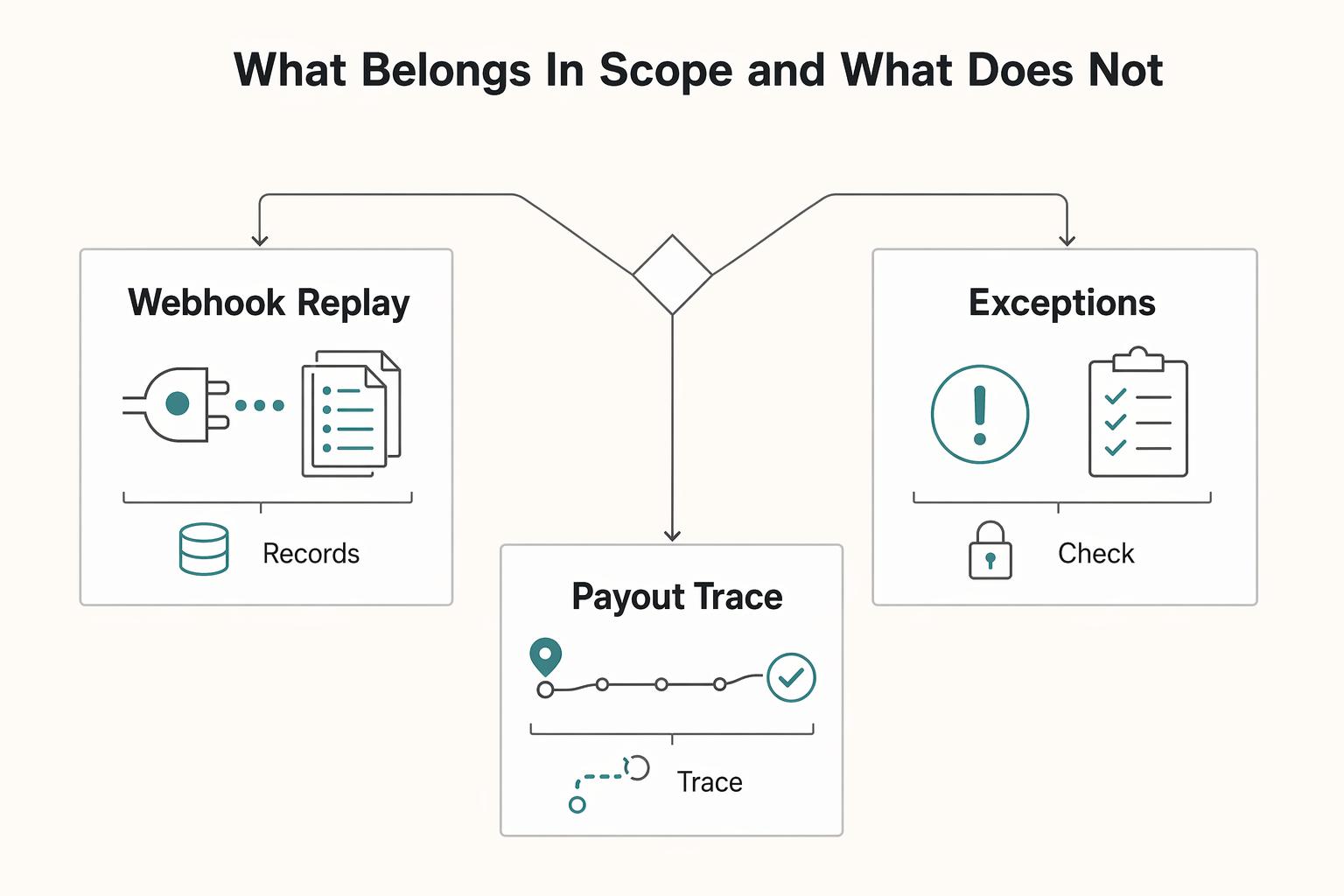
What belongs in scope and what does not#
If a product cannot carry a creator payout from onboarding through approval, send, status tracking, exception handling, and finance proof, it is adjacent tooling, not payment infrastructure.
The work in scope is the weekly operating load for ops and finance:
- payee onboarding
- approval routing between campaign and accounting owners
- payout execution
- status visibility across the payout lifecycle
- exception handling for payout failures, for example
payout.failed - reconciliation support and month-end close support for both NET-30 and Instant Payout models
Payment terms change what the system must handle. With NET-30, you need payable dates, approval timing, and a clear record of when the obligation is due within the 30-day window. With Instant Payout, you need near-real-time balance and status handling, plus a release path where supported. Embedded onboarding and webhook-driven payout events keep that flow current. For the timing tradeoffs behind that choice, compare Same-Day, Next-Day, and T+2 Payout Settlement Speed and Cost.
Use one end-to-end walk-through as your filter: onboarding, internal approval, payout execution, live status, and reconciliation evidence finance can use later. If the process still depends on email approvals, CSV handoffs, or someone manually checking a provider dashboard, it is not a complete payout layer. The matching side of that handoff is easier to design if you already understand straight-through processing for automated payment matching.
What does not belong in scope is creator discovery and casting logic. Creator & Trends Studio, or CATS, is framed around identifying creators, assigning roles, and shaping campaigns. Trend coverage can inform campaign strategy, but it does not prove payout traceability.
Why most vendor comparison advice is not enough for operators#
Most vendor comparisons help you orient to the market, but they are weak buying tools for payout operations. They show who is in the category, not whether the product can handle the full approval-to-payout-to-reconciliation sequence your teams have to run.
You can see that limit in the formats:
- CreatorIQ vs Meltwater is positioning content.
- Meltwater is framed as an "Influencer Payment Platforms Comparison Table."
- MediaNug's March 27, 2026 piece is a "14 best" roundup.
- Lumanu's Dec 17, 2025 guide is closer to buyer guidance and does mention potential error states, but it is still a guide, not an implementation plan.
For procurement, you need proof the system works under real operating conditions. Ask whether it shows:
- retry safety after connection errors, for example idempotent request behavior
- asynchronous lifecycle updates through webhook-driven status changes
- finance-close artifacts after funds move, such as payout reconciliation output and failed payout breakdowns
- granular payment-stage visibility, such as API and webhook status fields like
detailedStatus
Before you buy, run one sample payout and ask for the exact evidence pack your team would use at close. If the process still ends in dashboard screenshots, email threads, or manual CSV cleanup, keep looking. For the rail itself, Payout API Design Best Practices for Reliable Disbursement Platforms is a strong benchmark.
Choose build, buy, or hybrid based on failure cost not feature count#
Choose the model your team can still operate reliably when payouts fail and finance needs close-ready records, not the one with the longest feature list. If you cannot staff payout reliability work across onboarding, status handling, and reconciliation, default to buy or hybrid. If you need product-level control and embedded UX, an API-led path can fit, but only with disciplined operational controls.
| Path | Typical tools | Choose this when | Main upside | Main cost or risk |
|---|---|---|---|---|
| Full platform | CreatorIQ Pay, Tipalti | You want one vendor to own more onboarding, payout execution, and payee experience | Lower engineering lift. Tipalti says payees can self-onboard, track payouts, and submit tax info in a branded portal. CreatorIQ says payments and performance tracking can be managed in one place | Less product control and more dependence on the vendor data model and portal behavior |
| API-led stack | Stripe Connect plus internal orchestration | You need full UI control, embedded UX, and product-specific approval logic | Stripe says API onboarding gives "Full control over your own UI" | Stripe also labels API onboarding "Most effort, can delay going live." You own more failure handling and support burden |
| Hybrid | Vendor payout rails plus internal approvals, controls, and finance artifacts | You want faster launch than pure build but still keep internal controls | Keeps internal approval and reconciliation discipline while reducing payout plumbing work | Boundary confusion. Teams can overestimate what the vendor handles in exception paths |
| Red flag on lock-in risk | CreatorIQ Pay, Lumanu, Tipalti, Stripe | Review before procurement | N/A | Lock-in risk increases when onboarding, compliance or tax data, payout history, and payee communications sit with one provider. Lumanu's "single vendor of record" model increases that dependency. Tipalti's branded onboarding and tax workflows can raise switching friction. CreatorIQ's one-place payments-plus-performance model can do the same. Stripe lock-in is more likely in deep Connect integration, such as account models, onboarding flows, and webhooks, than in a vendor portal |
The checkpoints that matter more than the feature list#
Start with engineering capacity and finance ops maturity. Stripe's onboarding docs are explicit: API onboarding is the highest-effort route and can delay launch, while hosted or embedded options reduce development effort and time to launch.
Then check creator volume, country spread, and your tolerance for manual exception queues. If your tolerance for manual exceptions is low, buy or hybrid is usually safer.
For country coverage, validate program-specific availability in writing before you commit. Tipalti claims 196 countries and 120 local currencies. Lumanu claims 180+ countries. CreatorIQ currently publishes different figures in different places, including 80+ markets and 60+ currencies, and 190 countries and 120 currencies. Do not rely on one generic number. If cross-border creator programs are in scope, pressure-test those claims against Global Payment Processing Platforms: Complete Infrastructure Guide.
Use the failure path to choose the model#
Pressure-test each option on failed payouts, not happy-path demos. In a Stripe-led build, you need webhook-driven recovery for payout.failed, and Stripe notes that a failed payout can disable the external payout account until updated. The event side of that recovery path is easier to reason about if your team already uses webhook-driven payment automation for platforms.
If your team cannot reliably map failure events, control retries, and prevent duplicate sends, do not pick API-led just for flexibility. If you can run that reliably and need embedded control, API-led can be the right call.
What to verify before you commit#
Run one live pilot payout and ask for the exact evidence your finance team will use at close:
- Status visibility: payout state changes available outside dashboard screenshots through API or webhook visibility.
- Failure recovery: a clear failed-payout path, including correction and retry flow plus duplicate-payment safeguards.
- Finance artifacts: an exportable payout register, failed payout breakdown, and reconciliation-ready output with provider references.
Set payout policy before you select tooling#
Before you compare vendors, settle the rules the system has to enforce. If policy is unresolved, pause selection or you will optimize for demos and inherit gaps when approvals, holds, and close deadlines hit.
Decide the core rules first: who can create a payable, who can approve release, and whether those roles can overlap. Enforce that with role-based permissions, not shared logins or inbox approvals. Then lock the timing rules for when NET-30 applies and when Instant Payout is allowed, because payout schedules and eligibility vary by country and destination.
Your minimum controls should be non-negotiable across build, buy, and hybrid paths:
- Compliance gates before release: require KYC for payout recipients, plus KYB or beneficial-owner checks where your model and jurisdiction require them. Confirm whether your team or the provider owns collection and maintenance.
- AML and sanctions handling: define who can place a hold, who reviews suspicious activity, and who owns reporting of blocked or rejected transactions.
- Duplicate-send prevention: require idempotency keys on payout creation, and require retries to match the original request parameters.
- Audit evidence: retain an event trail with user, timestamp, payout ID, provider reference, and status changes. If a vendor says "audit log," confirm exportability and whether edits are detectable.
Before procurement, ask each vendor to walk through one held payout, one retry, and one approval change. The evidence pack should include reference numbers, payee or account identifiers, dates, and status history finance will need at close. A common failure mode is simple: creator-speed goals are clear, finance-control rules are not, and nobody has defined when an Instant Payout can bypass normal NET-30 review.
Build the end-to-end payout sequence your teams can run every day#
What matters most is a single operating sequence with explicit state transitions, owners, and evidence at each handoff. Without that, teams spend time debating status labels instead of resolving payouts. Treat this as your internal operating sequence, not a provider standard.
A practical daily flow is: onboarding -> compliance checks -> payable creation -> approval -> payout execution -> webhook-driven status update -> ledger posting -> reconciliation export.
Start with onboarding and compliance, not money movement#
No payee should be payout-eligible until required verification is complete. Connected accounts must satisfy KYC requirements before they can send payouts, and with API-based onboarding your platform owns verification collection and ongoing updates, at least once every six months. For the identity-control layer, Payee Verification at Scale for Mass Payouts is the right companion control.
Keep separate internal states for profile_created, verification_pending, verification_passed, and payout_destination_confirmed. If you collapse those into one active state, payables can be approved for recipients who still cannot receive funds.
Make payable creation and approvals retry-safe#
Create payables with an idempotency key and keep it visible in the shared record. Retries must reuse the original request parameters so a timeout does not turn into a duplicate send.
Before a payable becomes ready to execute, require a complete approval record: approver, approval timestamp, amount, currency, payee identifier, and the approved destination-details version.
Treat provider events as asynchronous, and define side branches#
After execution, update internal states from webhook events rather than manual dashboard checks. Webhook consumers must be duplicate-safe because undelivered events can be retried, and already processed events should still return success to stop further retries.
Define explicit non-happy-path branches with owners:
- Held payout: map approval or compliance waits to an internal hold queue, for example
PENDING_APPROVAL. - Failed payout: if a payout to an external bank account fails and the account becomes
errored, route it to destination repair before resubmission. - Returned payout: treat it as repair and reissue. Incorrect destination information is a common cause, and returns are typically seen in 2-3 business days, depending on country.
- Webhook delay or duplicate delivery: do not post to the ledger until event handling is confirmed against the payout record and provider reference.
Map provider states to internal states before launch#
Do not expose raw provider labels as your operating truth. Stripe statuses like processing, posted, failed, returned, and canceled need internal translation, and posted does not confirm recipient settlement. Tipalti also exposes statuses across Hub, APIs, IPNs, and FTP reports, including mappings from detailedStatus to original values.
Define internal states in plain terms: awaiting approval, submitted, in transit, posted, recipient confirmation pending, failed, returned, and canceled. Close the loop with a payout reconciliation export, because reconciliation remains your responsibility. On the close side, Account Reconciliation for Payment Platforms is the practical follow-on.
Validate global coverage with evidence not marketing language#
Treat any "global" claim as unproven until you have three things for each launch corridor: a country-by-program matrix, a pilot payout result, and written launch-market confirmation.
Public claims are useful for triage, not approval. Stripe supports cross-border payouts but limits self-serve coverage to listed regions, and settlement currency support is country-specific. Tipalti publishes a country-by-country method table for its USD-funded program and also notes that provider thresholds can change.
| Vendor / program | Public coverage signal | Public payout rail/method evidence | Currency signal | Onboarding/compliance evidence | What to mark now |
|---|---|---|---|---|---|
| CreatorIQ Pay | Claims 190 countries and 120 currencies | No public rail-by-country matrix found here | 120 currencies claimed | Public materials cite controls, compliance, and role-based permissions | Unknown by corridor. Require written market confirmation |
| Lumanu | Public pages state both 180+ countries and "over 100 countries" | Not publicly documented | One page states funding in 40+ currencies | Compliance positioning exists, but no market matrix found here | Inconsistent public signal. Do not approve from headline numbers |
| Tipalti | API marketing claims 200+ countries or territories, 120 currencies, 50+ methods | Public USD-funded country coverage table. Statuses exposed in Hub, APIs, IPNs, and FTP reports | 120 currencies claimed at platform level. Method coverage depends on program | Detailed operational docs, including deferred-payment handling | Strong public program evidence. Still revalidate thresholds and country rows |
| Influencer Hero | Not publicly documented | Help docs show payout flow redirecting to Stripe | Not publicly specified here | Workflow steps are documented, but market coverage is not | Unknown. Confirm corridor support in writing |
Build a matrix by country and program#
Use launch country plus program as the row key, not vendor homepage claims. For each row, record payout method, settlement currency, recipient type, onboarding requirements, compliance gates, unsupported corridors, and post-submission status surfaces.
Keep this caveat explicit in rollout docs: coverage varies by market/program.
Verify with pilots before rollout#
Run a low-risk pilot payout per launch corridor and confirm: If you also need a creator-specific batch model, Mass Payouts for Affiliate Networks, Publishers, Partners, and Creators at Scale is the closer comparison.
- The payee can complete onboarding and become payable under that market's rules.
- Status events arrive and map to your internal states, for Stripe:
payout.created,payout.updated,payout.paid,payout.failed. - At least one exception path is proven. In Tipalti, deferred payments are final and require a new payment order.
If you validate only the happy path, operations risk remains untested.
Require written launch-market confirmation#
Before go-live, require written confirmation for approved countries, payout methods, currencies, recipient types, compliance prerequisites, known thresholds, unsupported combinations, and the operational status surfaces you will monitor, such as webhooks, IPNs, and API fields.
If a vendor cannot provide this, treat that corridor as not launch-ready.
Design exception handling before scale exposes it#
Exception handling should be designed before volume grows, not after. The goal is simple: classify failures, assign queue ownership, and make retries replay-safe so exceptions stay normal operating work instead of turning into emergencies.
Classify exceptions by required next action#
Do not route everything as "payment failed." Each class should tell the team what to do next, what evidence to attach, and whether funds can move again.
| Exception class | What it means operationally | Primary owner | Required case evidence |
|---|---|---|---|
| Compliance hold | Payment is blocked pending compliance review | Compliance or finance risk | case ID, blocked reason, payee record, review notes |
| Failed rail transfer | Transfer did not complete on the payout rail | Payments ops | provider payout reference, reason code, timestamps, retry status |
| Beneficiary mismatch | Payee details do not pass rail or bank checks | Payee ops or support | submitted beneficiary data, correction request, approval trail |
| Unmatched return | Returned funds cannot be matched cleanly to the original payable | Reconciliation or finance ops | return reference, original payable ID, amount, currency, posting notes |
Triage by ownership and severity, then process from a managed queue. If intake volume can spike, put webhook and payout-status handling behind asynchronous processing so endpoints are not the bottleneck.
For SEPA corridors, keep exception classes explicit: rejects, returns, recalls, and requests for recall are SCT R-transaction exception types. Reason codes matter because they drive the originator's next action.
Put SLAs on queues, with named owners#
Set response and resolution targets per class, assign a queue owner, and review aging daily. Without queue-level targets, unresolved items pile up into close-week cleanup.
For U.S.-jurisdiction blocked-property cases, track reporting deadlines in the case record. Under 31 CFR § 501.603, the initial OFAC blocking report is due within 10 business days from the date property becomes blocked.
A weekly control is enough to catch drift: sample open exceptions and confirm that owner, severity, created time, latest provider reference, and next action are present.
Make retries replay-safe, not manual guesses#
Treat retries as idempotent replays of the original request, not new payout attempts. Stripe's idempotency model is designed for safe retries during connection failures and recovery.
Before any resend, require operators to confirm the original idempotency key, provider payout reference, and current payout status. On the event side, log processed webhook event IDs and ignore duplicates.
Keep a distinct waiting state for "not fully traceable yet" so teams do not resend too early. In Stripe, some trace details can stay pending for up to 10 days after arrival_date.
Reconciliation and audit evidence should be a product requirement#
If you cannot prove a payout from approved request to provider reference to ledger entry to month-end export, your payment automation is not complete.
Trace every payout through one chain of evidence#
Set a minimum bar: every payout batch must be traceable from the internal payable or batch request to the provider payout reference, to the accounting posting, to the file or report finance uses at close.
Stripe's reconciliation model is explicit. You need the payout ID, po_xxx, to retrieve the payout's underlying transactions, and every movement in or out of a Stripe account creates a BalanceTransaction. Stripe also recommends automatic payouts because they preserve transaction-to-payout association. If you use manual payouts, Stripe states that you must reconcile those payouts against transaction history yourself.
For Tipalti, treat status evidence as multi-channel, not UI-only. Tipalti documents statuses in the Hub, APIs, IPNs, and FTP update reports, and supports Payment Details reporting. For audit and close support, repeatable exports and API records are stronger evidence than screenshots.
Standardize the finance artifacts you keep#
Do not let each provider define your evidence structure. Keep one internal artifact set across CreatorIQ Pay, Stripe, and Tipalti integrations so the accounting handoff stays predictable.
Use a consistent pack, such as:
- payout register
- exception log
- settlement confirmation document in your internal evidence pack
- reconciliation summary
Use the same internal identifiers in every artifact: payable ID, batch ID, provider payout reference, payout status, amount, currency, posting date, and export date window. Do not assume vendors share one cross-platform schema.
Prove it on live runs before you scale creator volume#
Before you scale creator volume, sample completed live payouts and prove end-to-end traceability across four checkpoints: internal approval record, provider reference, accounting entry, and close-ready export.
Use one checklist for each sample:
- Internal payable or batch ID maps to the provider payout reference.
- Status evidence exists in report, API, or export output, not only UI.
- Ledger posting amount, currency, and date match payout evidence.
- Export package contains the same identifiers finance will use at close.
"Paid" alone is not sufficient. You need evidence of which payout, which transactions, and which reporting period. Stripe's bank reconciliation tooling is designed for close support, but availability is currently limited to direct US-based Stripe accounts using an automated payout schedule. If you are outside that setup, design your own close evidence pack.
One final control is worth asking about: whether the vendor provides a SOC 1 report. SOC 1 matters for controls tied to your financial reporting, but it does not replace your own reconciliation design.
Use a procurement scorecard that finance and engineering both sign#
Use one weighted scorecard, apply it to every vendor, and do not select anything until finance and engineering both sign the same outcome. This is a governance rule, not a legal requirement, and it prevents one-team wins that fail in production.
A weighted model works only if the criteria are tailored to your acquisition and actually separate vendors on the issues that matter.
Frequently Asked Questions
What should influencer payment automation cover before rollout?
It should cover creator onboarding, payee and tax data collection, approvals, payout execution, live status visibility, exception handling, and finance-ready reconciliation evidence.
When is creator discovery separate from payout automation?
Creator discovery is separate when the product helps you find or rank creators but cannot show payout approvals, payment status, or the evidence finance needs to close the books.
What should a payout pilot prove before scaling creator volume?
A pilot should prove end-to-end traceability from internal approval to provider reference to accounting entry to close-ready export, including one held payout and one retry case.
How should teams handle failed creator payouts?
Treat failed payouts as queue-based exceptions with named owners, duplicate-safe retries, and status updates driven by provider events rather than manual dashboard checks.
What tax data should be collected before the first creator payout?
Collect the tax and payee information your jurisdiction and payout model require before payment starts so year-end reporting and onboarding do not become manual cleanup work later.
When is a hybrid payout stack better than one provider?
A hybrid stack is better when one provider cannot cover the recipient mix, payout methods, controls, or reconciliation evidence your program needs without heavy manual workarounds.
Where Gruv fits
Gruv for creator platforms
Turn approved creator earnings into payable rows with source references, clear item status, and a finance-ready export.
See reconciliation and mismatch review
Compare ledger entries, provider payment records, and statement rows to see what matches and what finance needs to review.
Researched and edited by the Gruv editorial team. Gruv builds cross-border billing, payouts, and finance-operations software for global businesses.
Sources
- acquisition.gov/far/15.304trusted
- advocacy.sba.gov/2026/02/18/fincen-issues-exceptive-relief-to...trusted
- bsaaml.ffiec.gov/manual/OfficeOfForeignAssetsControl/01trusted
- csrc.nist.gov/CSRC/media/Projects/Supply-Chain-Risk-Manage...trusted
- docs.stripe.com/api/idempotent_requeststrusted
- docs.stripe.com/webhookstrusted
- ecfr.gov/current/title-31/subtitle-B/chapter-X/part-1...trusted
- ecfr.gov/current/title-31/subtitle-B/chapter-V/part-5...trusted
Educational content only. Not legal, tax, or financial advice.
Related Posts

The Freelance Payment Penalty: A Modeled Audit of Platform Fees, FX Spreads, and Payout Delays
The money rarely disappears through a single, easy-to-spot fee. The real loss is stacked. A marketplace takes its commission, a processor adds a charge for international cards, a bank or payment company converts the currency at a spread, a platform holds the funds before release, and a wire sheds a little to intermediaries on the way in. Each layer looks defensible on its own, but the worker feels the combined result as a smaller deposit and a later payday.

How to Respond to a Subpoena for Business Records
Move fast, but do not produce records on instinct. If you need to **respond to a subpoena for business records**, your immediate job is to control deadlines, preserve records, and make any later production defensible.
A US Expat's Guide to Investing in UCITS ETFs to Avoid PFIC Issues
The real problem is a two-system conflict. U.S. tax treatment can punish the wrong fund choice, while local product-access constraints can block the funds you want to buy in the first place. For **us expat ucits etfs**, the practical question is not "Which product is best?" It is "What can I access, report, and keep doing every year without guessing?" Use this four-part filter before any trade: