

Quick Answer
Start by treating straight-through processing as an operating model instead of a single feature. Use a six-stage control chain across authorization, processing, matching, exception routing, posting, and reporting, then prove each transaction is traceable from provider reference to ledger outcome. Keep ambiguous or high-impact cases in human review, and align ACH exception timers to settlement windows so routine batch latency is not flagged as a processing failure.
Why Reconciliation Is the Real Test of Straight-Through Processing#
Straight-through processing is strongest when you design it as an end-to-end operating model, not just a matching feature. The practical boundary is simple: STP covers the full transaction path, and automated payment matching is one critical part of that path.
STP means completing transactions with minimal human handling from initiation through completion, including reconciliation-related work. For platform teams, success is not just "payment sent." It is an outcome that is authorized, recorded, matched, posted, and explainable in the ledger. Manual intervention should appear only where policy requires it.
In practice, STP is usually partial, not absolute. Treat it as an STP rate: what share of your flow is reliably automated today. That gives you room for staged rollout, exception routing, and control where data quality or payment-rail behavior is noisy.
Breakdowns often show up in cash application and reconciliation, especially when payment details are inaccurate or incomplete, or when payments are split across channels. That is why stronger automation still needs exception handling. Some items should flow straight through, and some should be flagged for review.
Set the automation boundary early.
- Fully automate deterministic, reversible steps, such as stable matching rules on clean references and status posting when provider and internal records agree
- Keep human review for ambiguous matches, duplicate signals, material reconciliation impact, and timing-sensitive disagreements
Before go-live, test traceability on real transactions from authorization to processor reference, to settlement or bank line, to final ledger result. Also account for ACH timing. Processing runs 23 1/4 hours each business day with four daily settlements. That can create temporary status mismatches that look like failures if your exception logic is too aggressive.
What STP means for platform payouts in practice#
For platform payouts, STP means the transaction flow runs end to end with minimal human intervention, not just that one step is automated. The standard is a result finance can trust across initiation and validation, posting, payment matching or cash application where relevant, and reconciliation.
A useful test is whether AP and AR can review the same transaction and, with a clear reconciliation design, reach one defensible status and ledger outcome. If the payout looks complete in one system but still needs manual cleanup in receivables or the general ledger, you have partial automation, not true end-to-end processing.
Automated payment matching is a core component, but it is not the whole operating model. It can auto-apply incoming payments to open invoices and clear them. STP still depends on correct posting and reconciliation around the general-ledger boundary, including checks before and after posting.
Use this checkpoint on real transactions.
- Confirm the transaction passed initiation and validation checks
- Confirm the payment match or clearing event
- Confirm the posted ledger result
- Confirm reconciliation around posting is complete
The common risk is a false finish: matched but not posted correctly, posted but not reconciled, or AP and AR resolving the same item with different status logic. Treat that as a design gap, not as full STP. Related: AP Automation vs Manual AP Processing for Marketplace Operators.
STP and automated payment matching are not the same job#
STP and automated payment matching solve different problems. Matching is one control step. STP is end-to-end automation from initiation through completion with minimal manual intervention, and in practice teams often track it as an STP rate rather than an all-or-nothing state.
You can have strong matching and still miss STP if downstream steps break or still require manual handling. That is the practical distinction: a successful match is progress, not proof that the full transaction path is automated.
| Dimension | STP | Automated payment matching |
|---|---|---|
| Scope | End-to-end transaction flow | One stage that links payments, invoices, and supporting records |
| Process span | Multiple downstream steps in the lifecycle | Matching logic and exception handling within the matching stage |
| Input data | Lifecycle events and completion evidence across steps | Invoice references, remittance details, PO data, receipt evidence, and payment details |
| Common failure mode | One stage succeeds but the transaction still fails later in the flow | Unmatched or misapplied items from missing or inaccurate payment details |
| Success metric | Higher STP rate across the lifecycle | Higher correct-match and cash-application outcomes with fewer unresolved exceptions |
What matching actually covers#
Matching also has subtypes, and they behave differently in operations.
| Matching type | Data checked | Key note |
|---|---|---|
| Invoice matching | Invoice and supporting evidence | Associates an invoice with supporting evidence |
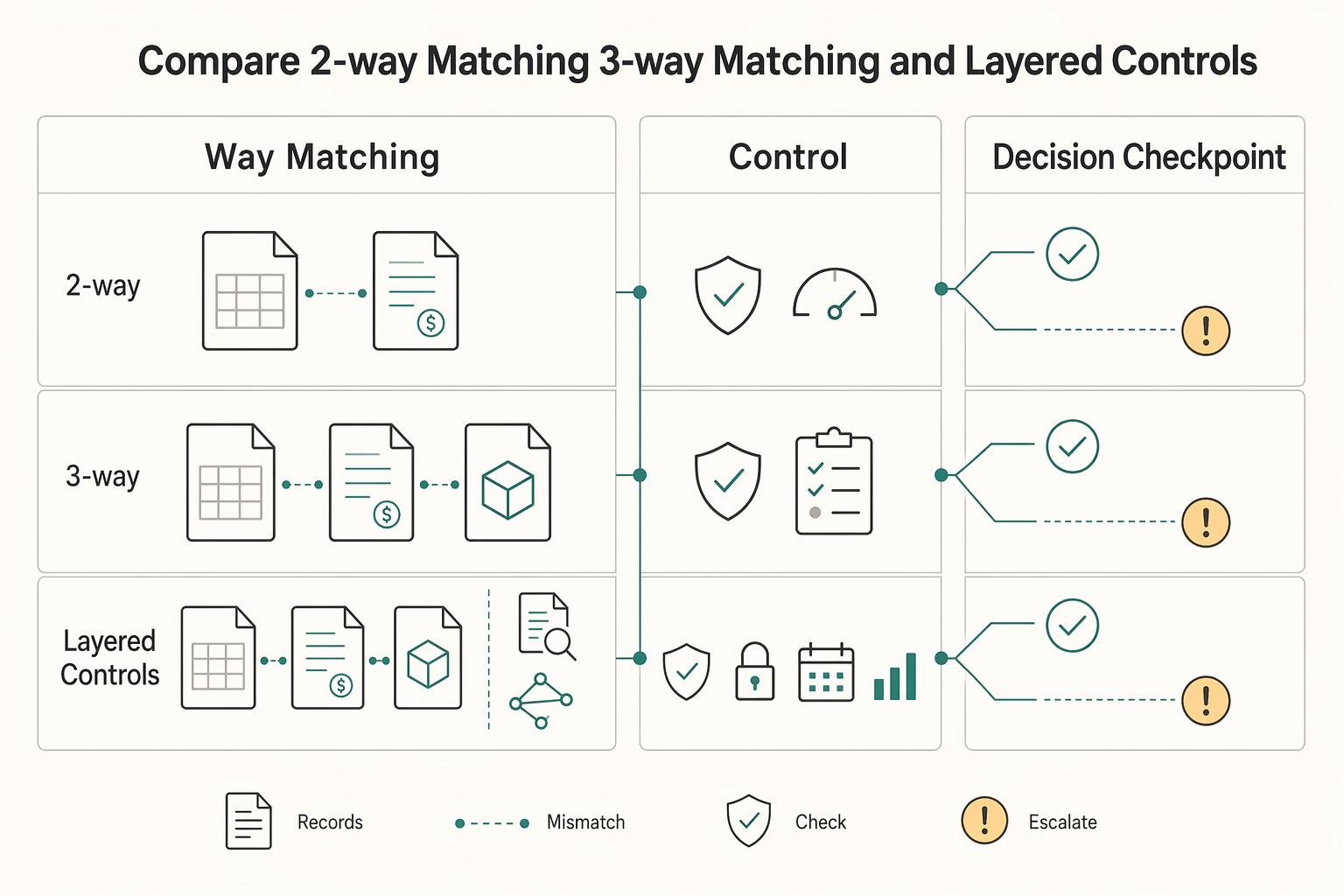
| 2-way matching | Purchase order and invoice details within tolerance rules | May be the highest-fidelity control you can automate when only PO and invoice data are reliably available |
| 3-way matching | PO, invoice, and receipt evidence | Adds an extra control check because it requires receipt data |
If your process depends on fulfillment proof, 3-way matching adds an extra control check because it requires receipt data. If only PO and invoice data are reliably available, 2-way matching may be the highest-fidelity control you can automate at that stage.
Which problem to solve first#
Start with the exception source, not a generic automation goal. If unresolved remittances, missing references, or inaccurate payment details create most of the manual work, matching controls and remittance quality are often the first lever. If the bigger problem is cross-step handoffs across the full transaction lifecycle, broader STP design may be the better starting point.
Use a simple verification check on "automated" items. Confirm the evidence fits the chosen method. That may be PO plus invoice for 2-way, PO plus invoice plus receipt for 3-way, or usable remittance and reference data for receivables. A technically successful match can still fail later if a required record is missing, late, or inaccurate.
The six-stage flow that makes STP reliable#
Reliable STP comes from stage-by-stage control, not just a successful match. Use this six-stage operating model as one practical template to keep traceability from authorization through reconciliation, while remembering that STP sequences can vary by implementation.
| Stage | What must happen | Practical handoff (example; org-specific) | Verification checkpoint |
|---|---|---|---|
| Payment authorization | Confirm the payment is allowed under your policy, amount, counterparty, and method rules. | Product defines approval rules and statuses; engineering enforces them in the payment path; finance ops validates control and accounting fit. | Store a unique transaction ID, approval outcome, timestamp, and actor or rule source for every authorized payment. |
| Processing | Move the payment through network processing, for example authorization, clearing, and settlement. | Engineering owns provider integrations and state transitions; product owns user-visible statuses; finance ops defines when status is financially practical. | Map provider reference IDs to your internal transaction ID, and make duplicate webhook delivery idempotent so state is not applied twice. |
| Matching | Link payment and remittance data to the correct invoice or obligation. This is where cash application begins in AR. | Finance ops owns match rules and tolerances; engineering provides remittance fields and matching outputs; product defines what users can view or correct. | Keep match evidence: amount, payer or payee identifier, invoice reference, remittance detail, and rule or confidence used. |
| Exception workflows | Route unmatched, partial, or conflicting items to investigation instead of forcing automation through. | Finance ops owns investigation and resolution; engineering routes full case context; product shows exception status clearly. | Record reason code, owner, opened timestamp, and linked transaction evidence for every exception. |
| Posting | Apply verified matches to customer accounts after required review; record received cash independently even when invoice allocation is unresolved. | Finance ops sets posting and review requirements; engineering writes journal and ledger events; product exposes final status. | Confirm allocation and ledger destination; record unmatched received cash in the approved suspense or unapplied-cash account rather than omit the receipt. |
| Reporting | Reconcile applied and posted outcomes against bank records and operational status data. | Finance ops owns reconciliation evidence; engineering provides exports and bank mappings; product consumes the same source of truth for status. | Reconcile bank, receivables, and payables regularly, and resolve any bank-versus-ledger status mismatch. |
Matching decides how received money should be allocated; review pauses allocation where evidence is weak. Record the cash receipt when the bank or provider evidence supports it, using an approved suspense or unapplied-cash account if needed. Resolving the match later applies or reclassifies that receipt with a linked journal, without counting cash twice.
Timing controls matter just as much as matching logic. If your exception clock starts before the rail has had time to settle, you create avoidable manual work. For ACH, settlement timing can include current-day windows such as 1:00 p.m. ET and 5:00 p.m. ET, plus future-business-day timing such as 8:30 a.m. ET. Exception triggers should align to expected settlement behavior.
Treat a payment as straight through only when you can prove one auditable chain of IDs, timestamps, and evidence across all six stages. If a handoff cannot be reconstructed, that path is still an exception path, not reliable STP.
The minimum data contract required before you automate matching#
Before automated allocation, define the source system, owner, validation rule and fallback for each matching field. Missing invoice evidence should block guessed allocation, while independently evidenced cash receipts remain recorded under the approved accounting policy.
Start with fields that survive handoffs#
The minimum contract is not a universal banking standard. It is the smallest field set your team needs to prove why cash was matched, posted, or held.
In practice, these five groups are a useful baseline before go-live.
- Payer and payee identifiers
- Invoice reference or other remittance information
- Amount and currency
- Transaction and settlement timestamps
- Status events delivered through webhooks or equivalent provider updates
Remittance detail is a practical dependency, not a nice-to-have. Invoice numbers, applied discounts, and similar references make reconciliation faster. When remittance is incomplete, research effort rises and cash application slows. You do not need perfect remittance on every payment, but you do need a clear fallback when it is missing. Do not guess the invoice allocation; record independently evidenced cash under the approved suspense policy.
A useful readiness check is simple: sample recent payments and confirm you can reconstruct one chain from invoice record to provider transaction to posted ledger entry from stored fields alone. If that chain breaks, fix the contract before you scale volume.
Duplicate protection is part of the contract#
Duplicate prevention belongs in the contract because retries can change financial outcomes. Keep request deduplication and event deduplication as separate controls.
First, use idempotency keys on retryable create and update requests. Stripe supports idempotency keys on POST requests and describes them as unique retry keys that let the server recognize repeated attempts for the same operation. Use a UUID or a stable business key only when it is truly unique for that operation.
Store provider references and incoming event identities, with receipt distinct from completed processing. Commit local journal effects and completion together; interrupted external actions need durable recovery state and supported idempotency. Deduplicate both redelivery and distinct events describing the same business effect. Retain request IDs and keys when supplied so operations can distinguish retries from new actions.
A common failure pattern is payment creation being idempotent while duplicate webhook deliveries still trigger duplicate posting. You need both controls.
ACH timing can look like a matching failure when it is not#
For ACH, timing can create false exceptions if your rules fire too early. ACH is batch-based, and settlement timing should determine when matching and exception clocks start.
| Timing point | Detail | Operational note |
|---|---|---|
| Processing day | ACH processes payments 23-1/4 hours each banking day | Settlement timing should determine when matching and exception clocks start |
| Daily settlements | ACH settles payments four times each banking day | Set exception timing to the rail's expected settlement behavior |
| Standard settlement calendar | Standard settlement does not occur on weekends or federal holidays | Do not use authorization or file submission time alone |
| Later Same Day ACH window | 4:45 p.m. ET deadline with settlement at 6:00 p.m. ET | Include available settlement timestamp in the contract |
Nacha states ACH processes payments 23-1/4 hours each banking day and settles payments four times each banking day. Standard settlement does not occur on weekends or federal holidays. For later Same Day ACH, the Federal Reserve describes a 4:45 p.m. ET deadline with settlement at 6:00 p.m. ET. Same Day ACH also has a stated cap of up to $1 million.
Set exception timing to the rail's expected settlement behavior, not just authorization or file submission time. If you label ACH transactions unmatched before the relevant window has passed, you can create avoidable manual work. Include ACH processing date, available settlement timestamp, and provider status events in the contract so teams can separate true matching failures from normal rail timing.
Readiness table#
| Required field | Source system | Owner | Validation rule | Fallback behavior when missing |
|---|---|---|---|---|
| Payer and payee identifier | Invoice or customer/vendor master, plus payment provider record | Finance ops for naming rules; engineering for mapping | Must map to one internal account or counterparty record with no ambiguity | Hold automatic customer allocation until identity is confirmed; record evidenced received cash under approved suspense policy |
| Invoice reference or remittance detail | Invoice or ERP record, customer submission, provider remittance fields | Finance ops | Must match an open invoice or approved obligation, or pass a documented alternate match rule | Hold automatic invoice allocation for research; record received cash without a guessed match |
| Amount and currency | Invoice record and provider transaction | Finance ops | Currency must match the obligation, and amount must match or fall within approved tolerance; any FX conversion needs a separate documented rate and amounts | Create an exception for partial, over, or conflicting payment rather than auto-applying |
| Provider reference ID and internal transaction ID | Payment provider and internal payments service | Engineering | Preserve a canonical internal payment identity and linked provider, attempt, batch and journal references; one-to-many relationships may occur | Hold automatic allocation and investigate missing links; preserve evidenced cash receipts |
| Webhook event ID, request ID, and idempotency key | Provider event payload | Engineering | Receipt and processing-completion states are distinct; completed business effects have a durable duplicate guard | Accept the event for review only after dedupe check; never post twice from repeated delivery |
| Transaction and settlement timestamps | Provider events, ACH file/header metadata, bank or provider status feed | Engineering with finance ops sign-off | Timestamps must be recorded in a consistent timezone and retained with status changes | Missing essential timestamps need investigation; expected settlement latency alone should not trigger a failed-payment alert |
Do not treat match rate alone as readiness. Readiness means you can prevent duplicate posting, explain every posted item, and avoid false ACH exceptions caused by settlement timing.
Choosing rule-based matching, AI, or a hybrid model#
For reliable posting, many teams start with deterministic rules as a baseline, then add ML where ambiguity remains. In practice, hybrid models are common: rules handle clear matches, and uncertain cases stay with finance for review.
Once your data contract is stable, decide which outcomes are safe to auto-apply and which should stay in suggestion mode.
Rules first when inputs are predictable#
Rule-based automation, whether BPA or RPA, works best when inputs, outputs, and triggers are clearly defined. In matching systems, rule conditions can enforce exact or tolerance-based matches, so finance can explain why a transaction was applied.
This approach is especially defensible when your source data has enough reference attributes to avoid ambiguity. Deterministic engines can also model different match shapes directly, including one-to-one, one-to-many, many-to-one, many-to-many, and zero-amount logic. For many-to-many types, Oracle requires a Match Exactly condition.
Where AI helps and where it should stop#
AI and ML can help when references are incomplete or inconsistent and your team has manual history to learn from. SAP's framing is practical: rules match most items, unmatched items stay manual, and ML complements standard rules by learning from past manual actions.
Use ML as a suggestion and prioritization layer rather than blanket auto-posting. A confidence score is model-specific, not a universal probability of correctness. Calibrate thresholds on reviewed outcomes, materiality and ambiguity, with human approval where required.
Hybrid selection table#
| Model choice | Best use case | Main risk | Review requirement |
|---|---|---|---|
| Rules only | Stable formats and reference-rich data | More unmatched items when references are missing or ambiguous | Manual review of unmatched items and rule exceptions |
| ML suggestions only | Inconsistent references where teams want suggestion support | Over-trusting suggestions without enough controls | Reviewer must confirm or discard each suggestion |
| Hybrid (rules + ML) | Rules baseline exists and ambiguity is concentrated in exceptions | Control gaps when rule and model outcomes conflict | Rules auto-apply only in defined cases; low-confidence items go to review |
Set escalation policy before go-live#
Define the low-confidence path before launch. Your policy should assign reviewer ownership, define when manual review is mandatory, and require confirm-or-discard decisions for suggested matches.
A practical control is to retain enough evidence to reconstruct each decision, including the confidence score, candidate matches, reviewer action, and final posted outcome. If a decision cannot be explained from stored evidence, tighten controls before you expand automation.
Design exception routing before you scale throughput#
Define exception routing before volume rises. A conservative policy is to let automation clear only cases you can unwind cleanly, and send decisions that could materially change cash application or reconciliation to human review.
Start with a practical taxonomy#
You do not need a perfect master list, but you do need a stable working list early. Start with a small set that matches your real exception patterns, such as remittance mismatches, incorrect recipient items, misrouted payments, timing issues, and return events.
Use labels that separate remittance issues from rail or settlement issues so each queue has a clear next action, evidence trail, and owner. Keep categories tight enough that a reviewer can act without reconstructing the full payment history every time.
Assign owners and timing by exception type#
Route each exception type to one primary resolver and one fallback, based on who can make the correct posting or routing decision fastest. The org chart matters less than decision clarity and handoff speed.
Assign response targets using the actual rail event and participant obligation. ACH operator transmission windows, bank return deadlines and responses to requests for return are different clocks; do not apply one to every exception. Confirm bank and provider deadlines, including earlier internal cutoffs, with the responsible operations owner. See ACH Payment Processing for Platforms for the rail workflow.
Auto-resolve only what stays reversible#
In practice, exception handling is where payment processing diverges from normal STP flow. SAP Exception Control is built for those situations, and configured threshold breaches can push payment orders into exception handling when incorrect recipient items exceed permitted limits.
Automate corrections within approved accounting tolerances and route material ledger-impact decisions to review. Preserve the original receipt and posted journals; resolve a wrong allocation with linked correcting entries rather than remove already-posted evidence. Configured vendor exception behavior does not replace that accounting policy.
Preserve evidence for audit and re-review#
Your exception process should preserve enough evidence to explain every decision after retries, reversals, and month-end close. Keep the original payment event, remittance text, candidate invoice matches, provider reference ID, timestamps, ownership history, reviewer action, and final posting or reversal result.
Also keep retry-safety records on your side. Stripe idempotency keys can be up to 255 characters and may be removed after they are at least 24 hours old, so provider-side request history alone is not a durable audit trail.
Integration checkpoints for engineering and finance ops#
Once exception ownership is set, treat the integration boundary as a shared control point. Engineering and finance ops should be able to point to the same payment state, ledger outcome, and evidence trail.
Make webhook handling replay-safe#
Webhook updates are asynchronous, so your source of truth cannot be only a product screen or front-end callback. Define the webhook contract early: accepted event types, required fields, duplicate detection rules, and late-event behavior.
Authenticate and durably receive inbound events, then process them with duplicate-safe local journal effects and a completion marker committed together. A crash after receipt must leave recoverable work rather than a false completed event. Use supported provider idempotency on outbound writes and retain internal operation history beyond provider key retention.
On Stripe, idempotency keys can be up to 255 characters and may be pruned after they are at least 24 hours old, so keep your own durable processing and posting record. Also verify signatures against the exact raw payload, because request-body mutation can fail verification and block otherwise valid updates.
Normalize instant and batch rails into one reconciliation model#
If you support both real-time rails and batch rails, map them into one internal reconciliation model. ACH is batch-oriented, while FedNow runs near real-time with 24x7x365 processing, so timing differs even when ledger intent does not.
Your internal record should consistently track processing state, settlement timing, payout or batch linkage, and exception outcome across rails. Avoid collapsing different states into one label if finance still needs payout, batch-close, or bank-movement linkage for reconciliation.
Test failure cases before launch#
Before launch, test the failure modes that break reconciliation in production.
| Failure case | What to confirm | Evidence sample |
|---|---|---|
| Duplicate event delivery | One financial effect and completed posting decision; retain delivery-attempt evidence separately | Provider event ID, receive timestamp, internal payment ID, final product status, export row, and exception-routing result |
| Out-of-order delivery | Ignore stale observations; preserve legitimate later returns and reversals as linked financial events | Provider event ID, receive timestamp, internal payment ID, final product status, export row, and exception-routing result |
| Missing payload data | Hold invoice allocation for review; independently evidenced cash receipts remain recorded under approved suspense policy | Provider event ID, receive timestamp, internal payment ID, final product status, export row, and exception-routing result |
For sign-off, capture one evidence sample per case with provider event ID, receive timestamp, internal payment ID, final product status, export row, and exception-routing result.
Reconcile exports to what users see#
Treat finance exports as reconciliation artifacts, not a mirror of UI status text. Use provider reporting that preserves transaction-to-payout linkage, and include order-management linkage where finance workflows require it.
Go live only when each item can be traced end to end from provider report to internal order or invoice to product-visible status. That is the control that prevents split-brain operations between support, finance, and accounting teams.
Use this section as a pre-launch review: map webhook retries, idempotency handling, and status surfaces against the implementation patterns in the Gruv docs.
Controls that keep automation fast without weakening risk posture#
Fast automation is defensible when every auto-authorization or auto-posting decision ties back to a policy gate you can reconstruct later. If a decision cannot be explained for audit, AP, AR, or support, route it to exception handling instead of straight-through flow.
For STP, keep the decision and its evidence on the same transaction trail. An operator should be able to trace one item from provider event ID to internal payment ID to finance export row. Then they should be able to see whether it was auto-approved, held, or sent to review. Use a simple checkpoint: test one auto-approved payment and one routed exception, and confirm both can be independently reconstructed without chat threads or side spreadsheets.
Map verification requirements to the country, legal entity and enabled financial product. Provider onboarding is an input to that decision rather than automatic proof that every obligation is satisfied. Where PSD2 and Strong Customer Authentication apply, assign the relevant regulated responsibilities explicitly.
Distinguish operator submission cutoffs from settlement times. FedACH has scheduled Same Day ACH settlement windows, while RTP processes qualifying payments continuously with final, irrevocable interbank settlement. A recipient’s voluntary return or fraud-recovery process is a separate action, so keep recovery and posting controls specific to the rail.
Keep logs thin but usable. Data minimisation means storing only what is necessary, and logging practice warns against collecting too much or too little. Keep the identifiers and timestamps needed for cash application and reconciliation, but avoid spreading raw personal data across routine logs, tickets, and exception queues. Store evidence once, then reference it everywhere else.
KPI scoreboard and launch checklist for the first 90 days#
In the first 90 days, judge the launch by operational trend quality, not raw volume. STP progress is most visible when manual effort and matching friction decline as volume scales.
| Measure | What it tells you | First checkpoint |
|---|---|---|
| Manual-touch rate | Share of eligible transactions requiring a manual touch; define its denominator consistently with STP rate | Sample auto-posted items and verify no hidden spreadsheet or support intervention was needed |
| Exception routing volume and age | Whether rules are too strict, too loose, or under-modeled | Split true unmatched items from timing-related holds, especially by rail |
| Match accuracy and duplicate-post rate | Whether automated matching is reliable | Map provider event IDs and idempotency keys to one internal payment ID so retries do not create second postings |
| Cash application lag and reconciliation close time | Whether AR and AP can close cleanly | Confirm finance exports, ledger outcomes, and product statuses agree on the same transaction set |
Do not rely on aggregate movement alone. A falling manual-touch rate can hide rising duplicate posts or slower reconciliation. Webhook-based systems can deliver the same event more than once, and some providers do not guarantee delivery order, so duplicate-post rate should be tracked separately. Exception aging should also reflect retry behavior during outages: Stripe can resend undelivered events for up to three days, and event-list backfill is limited to the last 30 days.
Use a named-owner launch checklist, even if sign-off is informal.
- Finance ops: confirm AP and AR can reconstruct one auto-posted payment and one exception from provider event to ledger export without side notes
- Engineering: test duplicate events, out-of-order events, endpoint failure, and replay handling before cutover
- Product: verify status surfaces clearly reflect asynchronous outcomes, including bank confirmations and dispute-related changes, so operations is not working from stale states
Use external benchmarks only where their industry, business model and transaction scope fit yours. Establish an internal baseline in the first week, including hidden manual work, and compare accuracy and exception trends as well as speed.
Conclusion#
STP is strongest when matching, exception ownership, and retry-safe integration are designed as one operating model. If those controls are weak, automation can shift work into cash application and reconciliation instead of removing it.
Start with a clear data contract before you expand automation. Use consistent internal and provider references, complete payment data, and usable webhook event payloads. Better data quality is the first prerequisite for stronger STP. Missing matching data belongs in an exception queue rather than a guessed invoice allocation. Independently evidenced receipts still belong in the ledger under the approved suspense policy.
Keep request identity, webhook authenticity and crash recovery together. Acknowledging durable receipt should not mark financial processing complete. Commit completed local effects atomically, recover interrupted work and prevent duplicate journals across repeat deliveries. Retain internal operation history beyond the provider’s supported retry and key-retention windows.
Scale only after verification passes. Trace sample auto-posted items from raw event to match decision to ledger output without relying on spreadsheet repair in the middle. Confirm cash application lands on the correct invoice where relevant. Roll out in phases and judge progress by reconciliation outcomes like duplicate-post rate, exception aging, cash application lag, and close effort, not raw transaction volume. For ACH flows, account for rail timing. The network processes payments 23 1/4 hours each business day and settles four times a day, so some lags can reflect timing effects rather than true breaks.
When you move from design to rollout, align your exception ownership model with compliance-gated disbursement flows and batch tracking in Gruv Payouts, where enabled.
Frequently Asked Questions
What is straight-through processing in payments, in plain terms?
Straight-through processing means a transaction moves through its lifecycle with minimal manual intervention. It is not all or nothing, so teams usually manage to an STP rate rather than assuming every case can be automated. Some exceptions still need human review.
How is STP different from automated payment matching?
STP is the end-to-end operating outcome, while automated payment matching is one control inside that flow. Matching links receipts to the correct open transaction and then either applies them automatically or routes them for review. If matching quality is weak, STP performance can plateau even when payment execution is automated.
What data is required for reliable automated payment matching?
Keep a durable internal payment identity, linked provider and attempt references, counterparty, amount and currency, remittance evidence, timestamps and match decision. A payment can have multiple events or attempts, so preserve those relationships. Use supported provider keys and internal duplicate controls for retries.
What should be auto-approved versus routed to human review?
Auto-approve matches that are exact or clearly within your defined tolerances. Route ambiguous or high-impact cases to human review, including mismatch scenarios that cannot pass matching checks. In AP workflows, failed tolerance checks should place the invoice on hold, and payment should wait until that hold is explicitly released.
Which KPIs prove STP is actually improving operations?
Track STP rate, manual-touch rate, exception volume and aging, match accuracy, duplicate-post rate, cash application lag, and reconciliation close time. For receivables-heavy teams, DSO can add context on how quickly credit sales convert to cash, but it should not replace transaction-level accuracy checks. A reliable test is tracing sample auto-posted items from provider event to ledger output.
Can STP work across ACH payment processing and other payout rails?
Yes, but only if your matching logic reflects rail-specific timing instead of assuming instant settlement everywhere. ACH is batch-based with scheduled settlement, and Same Day ACH settles three times daily with payments up to $1 million. Multi-rail designs should use one reconciliation framework with rail-aware status handling, including regional payment-method differences where relevant.
When should a team add AI or machine learning to matching logic?
Add ML after deterministic rules handle clear cases and the remaining workload is repetitive, messy, or exception-heavy. A hybrid model works best when rules handle obvious matches and ML ranks or recommends harder cases. Keep humans responsible for complicated exceptions that require manual clearing.
What is the easiest way to avoid false confidence after launch?
Higher volume does not prove healthy automation. Provider delivery and backfill windows vary; keep your own durable event, match and posting evidence. If an auto-applied item cannot be traced from source event to match decision and ledger result, the path is not reliably straight through.
Try a related tool
Where Gruv fits
See reconciliation and mismatch review
Compare ledger entries, provider payment records, and statement rows to see what matches and what finance needs to review.
Plan and approve payout batches
See how payee status, approval rules, route review, and exception handling sit in one payout workflow.
Researched and edited by the Gruv editorial team. Gruv builds cross-border billing, payouts, and finance-operations software for global businesses.
Sources
- csrc.nist.gov/glossary/term/artificial_intelligencetrusted
- docs.stripe.com/api/idempotent_requeststrusted
- docs.stripe.com/webhookstrusted
- eba.europa.eu/publications-and-media/press-releases/eba-cl...trusted
- ecb.europa.eu/services/glossary/html/act7s.en.htmltrusted
- federalreserve.gov/paymentsystems/fednow_about.htmtrusted
- federalreserve.gov/paymentsystems/fedach_about.htmtrusted
- legislation.gov.uk/eur/2016/679/article/5trusted
Educational content only. Not legal, tax, or financial advice.
Related Posts
How Platform Teams Use 2-Way and 3-Way Invoice Matching to Stop Overpayment
Platform teams do not need another glossary entry on invoice matching. They need controls that stop real overpayment paths before money goes out the door. At its core, invoice matching compares an invoice with supporting records before payment. The practical question is what you add when a clean match still does not mean the invoice should be paid as submitted.
ACH Payment Processing Platforms for U.S. Collections and Payouts
Start with the outcome, not the feature label. You may need a setup that collects money in and sends money out over the U.S. banking network, not just a generic bank-transfer option. In practice, that often means ACH debits for collections and ACH credits for payouts, with controls your product, engineering, and finance teams can run in production.

The Freelance Payment Penalty: A Modeled Audit of Platform Fees, FX Spreads, and Payout Delays
The money rarely disappears through a single, easy-to-spot fee. The real loss is stacked. A marketplace takes its commission, a processor adds a charge for international cards, a bank or payment company converts the currency at a spread, a platform holds the funds before release, and a wire sheds a little to intermediaries on the way in. Each layer looks defensible on its own, but the worker feels the combined result as a smaller deposit and a later payday.