
Quick Answer
Start with a corridor-level control plan, not a model-first rollout. Agentic commerce risk scoring works when you define who owns losses, enforce policy gates like KYC/KYB/AML and PCI obligations, and keep evidence that reconstructs each disputed payment from agent request to provider outcome. Use deterministic rules early, add hybrid signals when false declines or new abuse patterns appear, and delay markets where ownership or documentation is still ambiguous.
Agentic commerce is moving quickly, and the controls around it are still evolving#
Agentic commerce is moving quickly, and the controls around it are still evolving. If you treat fraud, compliance, and accountability as one generic risk bucket, you can make the wrong launch call even when demand looks strong. A corridor can look attractive commercially and still be weak operationally because provider coverage, control expectations, or accountability are not ready.
The shift is not theoretical. Visa describes agentic commerce as a major change where AI agents can buy and sell on our behalf, and its own analysis warns that fraud tends to follow innovation quickly. In Visa's 2025 Trusted Agent Protocol announcement, AI-driven traffic to U.S. retail sites was said to have surged more than 4,700% in a year. Growth like that is a reason to move carefully, not a reason to skip control design.
This article treats agentic commerce risk scoring as an operating decision, not just a model output. You need a way to choose where to launch first, which controls must be live before real volume, and when existing deterministic authorization rules may stop being enough. Early on, the harder question is usually not "Can the agent complete checkout?" It is "Can you explain what it did, why it was allowed, and who owns the outcome if it goes wrong?" That explainability and accountability standard is already familiar in regulated settings. AWS points to the kind of multi-jurisdiction context operators face: SR 11-7 in the US, SS1/23 in the UK, and ECB guidance in the EU.
Market readiness is also uneven. Provider footprint and program support vary by country and corridor. Stripe presents country-by-country availability, with more countries still to come. PayPal says it is available in 200+ countries or regions and supports 25 currencies, which is broad coverage but still not universal sameness. If you are planning expansion, verify the exact corridor, product, and evidence path you will rely on before assuming a launch will transfer cleanly from one market to the next.
Trusted-agent guardrails are emerging for a reason. Visa positions Trusted Agent Protocol as a way to distinguish legitimate agents with commerce intent from malicious automation and rogue bots. That helps, but it does not remove your need to define approval rules, retain records, and assign a failure owner. Before launch, use this checkpoint: can your team reconstruct one disputed transaction end to end, including what the agent requested, what policy checks ran, which provider executed the payment, and who must respond if there is a dispute or compliance review?
The sections that follow stay close to those decisions. We will separate ownership by participant, show when rules should carry more weight than models, and lay out a market and control sequence you can actually use when coverage, regulation, and evidence requirements vary. For a broader operating framework, read Financial Metrics That Matter for Your Business.
Agentic commerce risk scoring in plain terms#
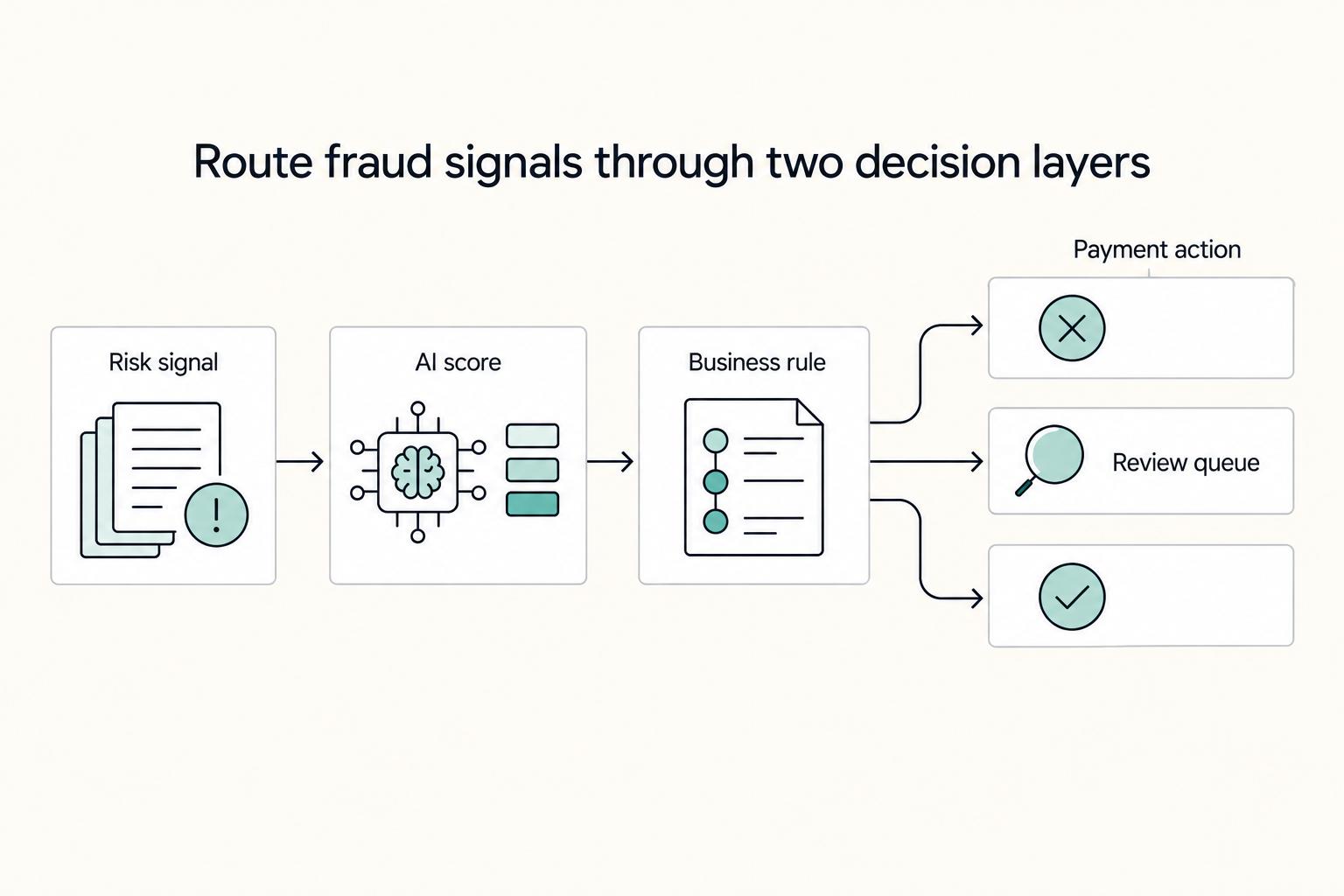
Agentic commerce risk scoring is the decision layer that turns an agent-initiated payment attempt into an operational action: allow, block, send to review, or require step-up authentication such as 3DS. If you cannot clearly define those outcomes, you are not yet running risk scoring in a usable way.
That boundary matters most in early launches using Agentic Commerce Protocol and Instant Checkout. ACP is an open standard for AI commerce, and Instant Checkout is built with Stripe. In this phase, behavior data is often limited, so explicit authorization rules typically need to carry more weight while model signals mature.
It is also broader than model output. It includes policy gates and escalation paths, including identity-program requirements such as CIP where applicable, AML controls, and PCI DSS obligations for entities that store, process, or transmit cardholder data. If a transaction passes a model check but fails a policy gate, it should not proceed.
Trusted Agent Protocol and tokenization can reduce identity and credential risk, but they do not remove merchant liability or disputes. Chargebacks can still happen and funds can still be reversed, so your decision trail must remain explainable from request through outcome. For a different risk lens, see A Comparison of Dubai Free Zones for E-commerce Businesses.
Who owns risk when bots control wallets#
The bot usually does not own the loss. When abuse gets through, loss and recovery work typically sit with the Merchant of Record (MoR), the platform, or both.
In Stripe Connect, disputes and chargebacks are filed against connected accounts when those accounts are the MoR. Stripe also states the platform is in the end liable for chargebacks and related costs for destination charges and separate charges and transfers, and can still be responsible when a connected account balance goes negative.
Processors and agent network partners are part of the flow, but that does not automatically move merchant-side dispute liability to them. OpenAI's service terms state the customer is solely responsible for GPT content, actions, and configurations, so do not assume an agent provider will absorb chargeback losses or evidence gaps.
Where the burden lands when abuse succeeds#
Merchant-side loss often comes first: Visa notes a dispute can cost both the transaction amount and the merchandise. Then the operational work starts: merchants may need to provide transaction records through the acquirer, and representment outcomes depend on supporting documentation, including Mastercard flows. In PayPal-enabled flows, Seller Protection eligibility is determined by PayPal based on submitted information, and Item Not Received protection requires proof of delivery.
| Flow | Decision rights | Required controls | Evidence retained | Failure owner |
|---|---|---|---|---|
| Visa-enabled flow | Merchant or MoR responds via acquirer within network dispute process | Clear MoR assignment and dispute-response process | Transaction record and decision trail | Usually merchant/MoR; platform exposure can still apply in some Connect structures |
| Mastercard-enabled flow | Merchant or MoR may reject chargeback with documentation | Defined representment ownership and process | Supporting documentation for representment | Usually merchant/MoR first; platform exposure depends on setup |
| PayPal-enabled flow | PayPal determines Seller Protection eligibility from submitted information | Seller Protection checks and proof-of-delivery collection where required | Proof of delivery and case submission records | Seller/MoR if protection is unavailable or denied |
If contract-stage ownership is unclear, delay launch in that corridor until liability, dispute handling, and evidence duties are explicit. For a step-by-step walkthrough, see A German Freelancer's Guide to Permanent Establishment Risk in the US.
When to use rules first and when to scale models#
Use a staged approach: rules-heavy at launch, hybrid in growth, and model-led at scale with guardrails and manual review. The switch is not a universal volume threshold; it is whether your current controls still balance fraud prevention and legitimate approvals.
If you carry the loss, launch with controls you can explain and audit. In Radar, deterministic rules let you explicitly allow, block, review, or request 3DS, which is useful when behavior data is still thin and abuse patterns are still forming. Keep in mind a practical constraint: Radar's rules guidance says only merchants with more than $100,000 processed can write allow rules.
| Decision layer | Deterministic rules | Fraud models / hybrid scoring |
|---|---|---|
| Setup dependency | Direct rule configuration tied to known patterns | Depends on model output quality plus trusted outcomes and ongoing tuning |
| Explainability | High: explicit conditions and actions are readable | Lower unless you retain score context, inputs, and final action |
| False-positive risk | Can rise when broad blocks stack | Can reduce friction when combined with supporting issuer signals |
| Monitoring burden | Rule performance and exception tracking | Fraud loss, false declines, drift, and risk-label distribution monitoring |
Move from rules-only to hybrid when static logic starts hurting good transactions or missing newer abuse variants. Stripe documents a hybrid path where model output is combined with issuer CVC and postal code responses in real time, helping preserve blocks for higher-risk traffic while authorizing lower-risk traffic.
Keep one practical point in your operating model: human reviewers who understand ambiguity and nuance will outperform models when determining intent.
| Trigger condition | Action |
|---|---|
| Clear repeat abuse pattern | Tighten deterministic rules (block, review, 3DS) |
| False declines and rescue exceptions are rising | Introduce hybrid scoring with issuer verification signals |
| New abuse variants outpace static logic | Retrain and recalibrate model-led scoring |
| Many ambiguous cases or weak automation context | Add or expand manual review queue |
Model-led scale works best with guardrails: hard rules for known bad patterns, hybrid logic for the middle, and human review where intent is unclear. Related reading: Foreign Exchange Risk for Freelancers Getting Paid Internationally.
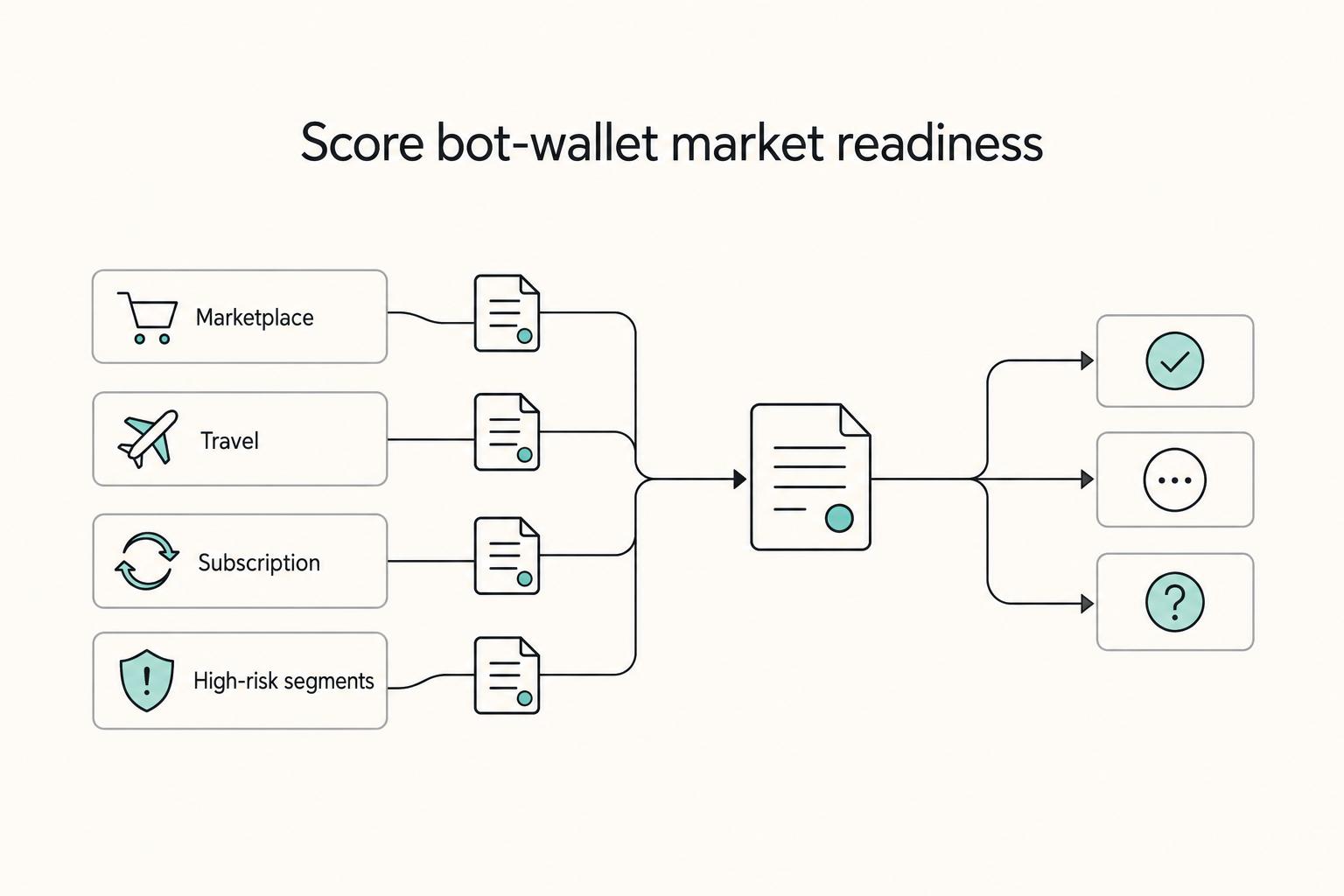
Choose launch markets with a risk readiness scorecard#
Choose markets only where controls are clear enough to defend decisions later. Treat launch selection as a risk-readiness decision first: if KYC, KYB, AML, PCI scope, dispute handling, or ownership is unclear for a country, partner, or vertical, it is a no-go.
Score the corridor before you score the traffic#
Use a corridor scorecard, not a global checklist. FATF's risk-based approach and country-specific KYC requirements mean onboarding, monitoring, and evidence duties can differ across markets, even when demand looks similar.
| Readiness area | What to confirm |
|---|---|
| KYC and KYB clarity | Identify the required onboarding data and business documents for that country, and who owns collection. |
| AML readiness | Define where screening sits in the flow, what escalates, and which team handles hits. |
| PCI compliance scope | Confirm your current controls match how payment data will be handled in that corridor. |
| PSP and acquirer coverage | Verify country support directly. Coverage is country-dependent, and local acquirer reliability can matter as much as headline availability. |
| Local dispute pressure | Include Visa's monthly VAMP monitoring in readiness checks. Threshold updates took effect on 1 June 2025, and one listed excessive-merchant condition includes a monthly fraud-plus-dispute count of at least 1,500. |
| Evidence defensibility | Confirm your logs, ledger events, and partner references can support chargeback responses in that corridor. |
A corridor can be commercially attractive and still be unlaunchable if you cannot prove why a payment happened, what the agent requested, and which controls fired.
Vertical fit changes the answer#
Vertical fit should change your launch bias. Trust and downside are not uniform: acceptance is generally stronger for low-risk, repeatable tasks than for high-stakes decisions.
| Vertical | Conversion posture | Main exposure | Launch bias |
|---|---|---|---|
| Marketplace | Agent convenience can help, but trust varies by merchant and item | More parties, returns, and evidence dependencies | Launch only if seller, payment, and fulfillment events are tightly linked |
| Travel | Lower trust for expensive, hard-to-reverse decisions | High-stakes exceptions, itinerary disputes, costly recovery | Start narrow with strong review paths |
| Subscription | Better fit for repeatable, lower-risk purchasing | Retry abuse, account misuse, cancellation disputes | Often a stronger early candidate if identity and evidence are clean |
| High-risk segments | More friction is usually required from day one | Higher abuse pressure and stricter compliance scrutiny | Often defer until controls and ownership are proven |
When choosing between corridors, prefer the one where customer intent is easier to verify and defend.
Make the market brief a required launch artifact#
Require a one-page market brief per corridor before approving production volume. As Laura Matukaityte put it: "There is no cookie-cutter approach to compliance judgment, just as there is no one standard approach to the rules".
| Brief item | What it covers |
|---|---|
| Control requirements | Country-specific KYC/KYB, AML flow, PCI scope, and confirmed PSP/acquirer support. |
| Expected failure modes | Onboarding stalls, unsupported partner features, dispute spikes, missing evidence, unclear refund handling. |
| Escalation owner | Named owners for compliance, payments operations, and final go-live approval. |
| Timeline assumptions | Onboarding lead time, review capacity, partner dependencies, and mitigation time if dispute pressure rises. |
Use a blunt gate: do not launch where compliance gates are unclear or evidence cannot support chargeback defense. If you need a deeper proof checklist, see Chargebacks in Agentic Commerce: Evidence Liability and Recovery Workflows for Platforms. For broader third-party payment oversight, see Vendor Risk Assessment for Platforms: How to Score and Monitor Third-Party Payment Risk.
Minimum control stack before first production volume#
Before first production volume, your minimum standard is simple: you must be able to prove every payment decision, retry outcome, and payout action end to end. If you cannot, do not launch.
Set the non-negotiables first#
Treat these as hard gates, not launch nice-to-haves:
| Control | Requirement | Specific detail |
|---|---|---|
| Tokenization before order completion | Create a delegated payment token before order completion. | This reduces credential exposure, but it does not by itself remove PCI DSS scope if your stack stores, processes, or transmits cardholder data. |
| KYC/KYB/AML onboarding gates | Run KYC, KYB, and AML checks in onboarding before payment activity goes live. | If ownership for collection, verification, or escalation is unclear, launch should stop. |
| Idempotent request handling | Retries must be safe and produce one side effect only once. | Duplicate requests should return the same result, and parameter mismatches should fail with HTTP 409. |
| Audit-ready event trails | Keep request/response logs and emitted order events tied to payment orchestration. | A passing order completion test should return HTTP 201 Created, and the transaction should still be reconstructable from logs. |
Get the decision order right#
Provider implementations vary, but the control flow should usually follow this order:
- Identity and onboarding status check
- Transaction intent validation
- Velocity checks for abnormal bursts or retry patterns
- Approval or challenge decision
- Payout release gating for cases under review
If you can approve checkout but cannot pause payout during review, you still have a control gap.
Make dispute evidence a required output#
For every disputed transaction, build the evidence pack from system records, not memory. At minimum, keep:
- agent identity signal captured at approval time
- provider references (for example, confirmation identifiers)
- ledger and order event timestamps
- decision log showing which checks fired and what action was taken
Do not assume one evidence bundle fits every dispute type. Some cases require transaction logs, refund logs, timestamps, and confirmation records. If a payment cannot produce a complete evidence pack quickly, it should not have reached production.
Use a pass/fail launch checklist and block go-live if any item is missing:
- delegated payment token creation works before order completion
- KYC, KYB, and AML onboarding gates are live with named owners
- duplicate requests return consistent outcomes and mismatches surface as
HTTP 409 - request/response logs and emitted order events are queryable
- payout release can be paused for review cases
- disputed transactions can generate the required evidence pack on demand
We covered this in detail in Assessing Services PE Clause Risk Under Tax Treaties for Cross-Border Consultants.
Failure modes you should plan for before they happen#
Once your minimum control stack is live, assume incidents will still happen. Your objective is to contain abuse fast, track checkout friction separately, and avoid chargeback losses caused by missed evidence deadlines or unclear ownership.
Bot-driven credential abuse is the first failure mode to plan for. OWASP defines credential stuffing as automated testing of stolen username and password pairs against login forms, so this risk should be explicit in your runbook. If an abuse pattern is novel, tighten deterministic authorization rules first so the authorization outcome stays clear: approve, decline, or refer.
Policy drift is quieter but just as operationally dangerous. Visa notes that fraud tactics in agentic commerce are evolving, so rules that worked recently can become permissive without obvious alerts. Check live approvals against recent incidents, not only launch assumptions. If the same pattern appears across merchants or corridors, prioritize fraud model features because the signal is no longer isolated.
Assign the owner before the incident#
| Failure mode | Primary owner | Verification checkpoint |
|---|---|---|
| Credential stuffing or account-takeover burst | Security engineering | Login and checkout telemetry shows spike source, blocked attempts, and whether challenged sessions reached authorization |
| Policy drift in rules | Risk operations | Weekly review confirms current rules still match observed abuse patterns and recent declines/refers are explainable |
| False positives at checkout | Payments risk owner | Blocked non-fraudulent payments are tracked as a distinct metric, including the estimated non-fraud percentage in tools like Radar |
| Delayed detection after authorization | Fraud operations | Early fraud warnings are reviewed in queue with action before they age into disputes |
| Evidence gaps during chargebacks | Dispute operations | A disputed payment can produce a complete evidence pack and meet submission deadlines without manual reconstruction |
False positives need a dedicated owner because lower fraud rates can hide conversion damage. Radar surfaces the estimated percentage of non-fraudulent payments that were blocked. If that rises after a rule change, narrow or roll back the change before stacking more logic.
Recover in a fixed sequence#
Use a staged sequence: contain, classify, preserve evidence, notify stakeholders, tune controls, then reopen volume in stages. Sequence matters. If you tune controls before preserving logs, provider references, ledger timestamps, and decision history, later dispute defense gets weaker.
Delayed detection is especially costly: 80% of early fraud warnings convert into a fraud dispute if no action is taken. Treat each EFW as an operational deadline, not an informational alert.
Reopen in slices. Start with lower-risk merchants or corridors, keep stricter deterministic authorization rules in place, and verify evidence packs can still be generated on demand. Missing evidence submission deadlines can cause an automatic chargeback loss, so recovery is only complete when dispute operations can prove the paper trail holds. This pairs well with our guide on Common Reporting Standard (CRS) for Digital Nomads: Self-Certification and Data Mismatch Risk. If you want a next operational step, browse Gruv tools.
How to wire scoring into product and ops without adding chaos#
Put scoring at the exact points where money movement or liability changes. In practice, use decision gates at checkout authorization, wallet funding (if you support stored value), payout release for connected-account exposure, and only high-risk retries in payment orchestration.
This keeps control where agentic checkout actually runs: applications can initiate and complete purchases, but the seller still owns payment processing. That is why authorization needs an explicit risk decision even when an issuer would approve, and why payout release is a practical gate when dispute risk rises.
Use your ledger as the source of truth, then reconcile it with traceable provider events so operators can verify three things for any payment: what the agent requested, what your policy decided, and what the rail executed. Stripe balance transactions are useful here because they include a source ID tied to the related object, and webhook event destinations provide the asynchronous confirmations you will not get inline.
For retries and recovery, enforce two non-negotiables:
- Idempotent retries: one idempotency key per business operation, persisted with the ledger entry. Keys can be up to 255 characters, and providers can prune them after at least 24 hours.
- Masked card display: ops tools should mask PAN by default, consistent with PCI DSS 3.4.1 display requirements.
For deeper auth-stage tuning, see A Guide to Stripe Radar for Fraud Protection.
Related: How At-Risk Rules Limit S-Corp Loss Deductions.
Conclusion#
The practical strategy here is sequencing, not hype. Start where ownership is explicit, controls are live, and evidence is recoverable on demand. Expand only after a corridor proves it can survive real disputes, real abuse, and real operational recovery.
The hard part is not the model. It is the accountability gap created when delegated AI decisioning sits across merchants, processors, agent providers, and network rules. Current regulatory frameworks are still catching up, and end-to-end autonomous purchasing is still early stage, so aggressive rollout assumptions are usually the expensive mistake. If you cannot say where accountability begins and ends before launch, you do not have a launch case yet.
Treat agentic commerce risk scoring as an operating discipline, not a score output. The control point that matters most is the corridor-level decision: country, payment rail, partner set, and vertical together. A market that looks commercially attractive can still be a no-go if your team cannot prove required compliance controls, evidence retention, and escalation ownership for that exact setup. Trust is the prerequisite here. As Visa put it plainly, without trust, commerce does not happen.
Your next move should be concrete: build a market-by-market scorecard and make it binding. At minimum, each corridor should pass three checks before first production volume:
- Accountability check: contracts and internal ownership clearly assign who approves, who handles disputes, who reimburses losses, and who preserves evidence.
- Evidence check: ops can pull a chronological transaction file without engineering help, including receipts, communications, policy decisions, and system logs tied to the payment event.
- Compliance check: local requirements and partner obligations are documented well enough that reviewers are not guessing during incidents.
If one of those checks fails, block launch and keep it in pilot. That is not caution for its own sake. Delayed operational response can weaken merchant leverage in agent-mediated channels, and evidence gaps are often harder to fix after the first dispute wave arrives. A common failure mode is moving forward because the checkout works while accountability, retention, or escalation is still fuzzy.
One last judgment call: do not force a single global participation model too early. The grounded view is that the winning approach is likely blended rather than fully open or fully closed. Keep control over critical processes and customer data, prove readiness corridor by corridor, and let expansion follow evidence instead of optimism.
Frequently Asked Questions
What is agentic commerce risk scoring and what is out of scope?
Agentic commerce risk scoring is the approval decision around an AI-initiated payment action: approve, decline, or refer, based on the signals you have in real time. In practice, teams often add policy gates around that decision, not just a model score. Out of scope is any claim that one protocol, token, or partner setup removes merchant liability or chargeback exposure.
Should we start with deterministic authorization rules or fraud models?
Start with deterministic authorization rules unless you already have enough clean, labeled behavior data from this exact channel. In early agentic flows, data is sparse and behavior shifts quickly, so deterministic rules are often more effective than immature models. A good checkpoint is whether reviewers can explain why a transaction was approved or declined without guessing.
Who owns fraud and dispute risk in agentic transactions across platform, merchant, and network partners?
You should assume ownership is fragmented and often unclear until contracts and network rules make it explicit. When a card-not-present payment is deemed truly fraudulent, merchant-side liability can still apply, and in ACP-style flows merchants may still reimburse banks for chargebacks. If a corridor leaves liability or evidence duties ambiguous, delay launch rather than hoping the processor or model provider absorbs the loss.
What minimum controls must be live before we allow bots to trigger wallet or checkout actions?
At minimum, you need a real authorization-stage decision, a traceable event trail, and evidence retention that can reconstruct what the agent requested, what your policy decided, and what the payment rail executed. You also need a way to preserve communications, receipts, policies, and system logs by transaction. A red flag is any launch where ops cannot pull a single transaction file without engineering help.
How should we phase rollout by country and vertical when compliance and partner coverage vary?
Do it corridor by corridor, not with one global launch policy. Start where partner responsibilities, dispute handling, and evidence collection are clear, then expand only after those checks hold under live volume. If local partner coverage is thin or the compliance path is not documented, keep that market in pilot or skip it.
What evidence should we store to defend chargebacks tied to AI-agent purchases?
Store it as a chronological file and group it by type: receipts, communications, policies, and system logs. For physical goods, collect valid proof of shipment or delivery because seller-protection paths can depend on it. If you want a shot at Visa CE3.0 compelling evidence, keep linkage to at least two previous undisputed transactions on the same payment method, within 120 to 364 days of the disputed transaction.
What key parts of this space are still unknown and require conservative assumptions?
The biggest unknown is where accountability begins and ends once delegated agents, merchants, processors, and network rules all touch the same transaction. Another is how quickly abuse patterns will mutate before you have enough data for model-led controls. The conservative stance is to plan for losses and operational recovery to fall on the merchant unless your contracts, evidence standards, and partner obligations clearly assign otherwise.
Try a related tool
Researched and edited by the Gruv editorial team. Gruv builds cross-border billing, payouts, and finance-operations software for global businesses.
Sources
Includes 2 external sources outside the trusted-domain allowlist.
- csrc.nist.gov/pubs/sp/800/61/r3/finaltrusted
- docs.stripe.com/radar/rulestrusted
- docs.stripe.com/radartrusted
- ecfr.gov/current/title-31/subtitle-B/chapter-X/part-1...trusted
- paypal.com/us/webapps/mpp/country-worldwidetrusted
- stripe.com/globaltrusted
- aws.amazon.com/blogs/security/preparing-for-agentic-ai-a-fi...external
- corporate.visa.com/en/sites/visa-perspectives/security-trust/th...external
Educational content only. Not legal, tax, or financial advice.
Related Posts
Vendor Risk Assessment for Platforms: How to Score and Monitor Third-Party Payment Risk
Use this guide to build a practical, defensible approach to scoring and monitoring payment-adjacent vendor risk, with clear escalation points and named ownership. It is for compliance, legal, finance, and risk teams that need decisions and evidence that will hold up under scrutiny.
A Guide to Stripe Radar for Fraud Protection
**Treat Stripe Radar for fraud as a cashflow protection system, not a vanity fraud score.** Stripe Radar gives you real-time screening with AI and no extra development setup, but outcomes still depend on your rules and operations. Your job is simple: decide when to `Block`, `Review`, or `Allow`, then tie those decisions to fulfillment timing and client communication so fraud protection supports more predictable revenue.

Chargebacks in Agentic Commerce: Evidence Liability and Recovery Workflows for Platforms
For platform founders, the hard call is no longer just how to stop fraud. You also have to handle disputes where the payment was authorized, but the buyer later says the result was not what they meant to approve. That gap between "authorized" and "wanted" is where much of the new risk sits. It gets wider when an AI agent can browse, compare options, fill carts, and complete purchases on a customer's behalf.