
Quick Answer
Yes - s-corp at-risk rules cap the loss you can deduct to what you are personally exposed to lose under IRC Section 465. A reported loss on Schedule K-1 is only the starting point, and a bank-loan guarantee by itself usually does not raise your deductible ceiling. If your loss is higher than your at-risk amount, the excess is carried forward to a later year. Review your Form 6198 position before filing.
The at-risk rules in IRC Section 465 govern whether you can actually deduct your S corporation's losses. They test whether you have real skin in the game, preventing deductions for losses that exist only on paper. For a founder who values control, this is about avoiding year-end surprises and keeping a firm grip on funding and tax strategy. It is not abstract. It affects what loss you can claim and when.
Break it down this way:
- The core principle: You can deduct pass-through losses only up to the amount you personally stand to lose if the business fails. That amount is your at-risk basis. It is the ceiling on your loss deduction for the year. Losses above that ceiling are not gone forever. They are suspended and carried forward until you have enough at-risk basis to use them.
- The critical distinction, at-risk versus stock basis: This is where many smart founders get tripped up. Stock basis and at-risk basis often move together, but they are not interchangeable. At-risk basis is narrower because it excludes investment or debt for which you are not personally and economically liable. That distinction sits at the center of sound loss planning.
- The personal guarantee trap: This is the most common and costly mistake. Personally guaranteeing a loan that your S corporation takes from a third-party lender, such as a bank, does not increase your at-risk basis. The IRS and courts have consistently treated a guarantee as something less than a direct economic outlay. You are a backstop, not the primary person at risk. To increase at-risk basis, the loan generally must run directly from your personal funds to the corporation.
- The order of operations: At-risk limitations are only one hurdle, and sequence matters. The IRS applies the limits in this order:
- Stock and debt basis limitations: First, confirm you have enough overall basis. 2. At-risk limitations: Next, confirm you are economically at risk for the loss. 3. Passive activity loss limitations: Then test whether passive-loss rules apply. 4. Excess business loss limitation: A final overall cap may still apply.
Once you internalize those distinctions, the rest of the analysis becomes more practical. You stop reacting to a K-1 and start managing the inputs that determine whether the loss is actually deductible.
Step 1: Conduct Your Annual At-Risk Audit (Assess Your Position)#
Start here and leave with one number: your current at-risk amount under Section 465. That number is your present cap on deductible pass-through loss, even if your K-1 shows more loss and even if you already cleared stock and debt basis.
A practical screen is straightforward: ask whether a given item would leave you materially poorer if the activity failed. If yes, it may support at-risk treatment. If it is only a contingent promise, it usually does not.
For borrowing, classification drives the result. Recourse debt, where you are personally liable, can count. Nonrecourse debt is generally excluded for at-risk purposes, with a stated exception for qualified nonrecourse financing in certain real-property holding activity. A direct shareholder loan, where your funds go straight to the S corporation, is different from a third-party corporate loan that you merely guarantee.
Decision table for each funding source#
Run every funding item through this table.
| Funding source | Counts toward at-risk now? | Why it usually does or does not count | Action |
|---|---|---|---|
| Cash you contributed personally | Yes | Section 465 includes money you contributed | Include |
| Property you contributed personally | Yes | Section 465 includes adjusted basis of contributed property | Include |
| Loan you made directly to the S corp from your funds | Can count | Section 465 has a shareholder-loan carveout in the related-party borrowing rule; treatment still depends on facts | Include and verify |
| Third-party loan to the S corp that you personally guaranteed | Usually no | A guarantee alone is generally not the same as advancing your own money | Exclude unless you actually paid |
| Debt where you are personally liable for repayment | Often yes | Recourse borrowing may count because you bear repayment risk | Verify |
| Nonrecourse loan used in the activity | Generally no | Nonrecourse borrowing is generally excluded | Exclude unless exception applies |
| Amounts protected by a guarantee, stop-loss agreement, or similar protection | No | Protected amounts are treated as not at risk | Exclude |
| Borrowing from a person with an interest in the activity | Generally no | Usually excluded, with a shareholder-loan carveout in corporate context | Verify and likely escalate |
| Loan supported by your non-activity property as collateral | May count in part | May be allowed up to net fair market value of pledged property | Verify carefully |
Compact annual audit walkthrough#
Once you classify the funding sources, the audit is mostly mechanical. Use this sequence:
| Step | What to do | Key detail |
|---|---|---|
| Collect records | Pull available support | Contribution records, loan documents, bank transfers, year-end balance sheet, K-1, and records showing who borrowed from whom |
| Classify each item | Mark each line include, exclude, or verify | [cash contribution], [adjusted basis property], [direct shareholder loan], [guaranteed third-party debt], [pledged nonbusiness property] |
| Total eligible amounts | Add only included items | Hold verify items out until you have support |
| Flag suspended-loss risk | Compare your at-risk total to current-year pass-through loss, after prior basis limits | Any excess is suspended and carried forward, not lost; if you had not-at-risk amounts in a loss activity, Form 6198 is generally required |
Final checks before you trust the number#
One failure mode is treating guaranteed third-party debt as if it were a direct shareholder loan. If the corporation borrowed and you only guaranteed the debt, do not include it as at-risk just because you signed the guarantee. Use this checklist before you rely on the number:
- Confirm each item is classified by substance, not just bookkeeping label.
- Separate direct shareholder loans from corporate debt you guaranteed.
- Check whether any amount was protected against loss by reimbursement, stop-loss, or similar protection.
- Verify whether any lender had an interest in the activity.
- If nonrecourse debt appears, test whether a narrow exception applies before deciding.
Escalate to a tax pro when the facts are mixed or unclear. That is especially true for refinancings, restructurings, related-party loans, nonbusiness collateral, or any large-loss year where one classification change would materially change the deduction.
For a step-by-step walkthrough, see A Deep Dive into the UAE's Corporate Tax for Freelancers and LLCs.
Step 2: Forecast Your Year-End Position (Identify the Gap)#
Now use the Step 1 number to answer the planning question that actually matters. Will your projected year-end loss fit inside your at-risk amount, or will part of it be nondeductible under Section 465? Use these terms consistently before you calculate:
- Projected net loss: your planning estimate of the current-year activity result aligned to Form 6198 Part I, current-year profit or loss combining lines 1 through 4.
- Current at-risk basis: the current-year amount at risk used in Form 6198 Part II or III, starting with your verified Step 1 amount.
- Deductibility gap: projected loss above your at-risk amount, because loss is allowed only to the extent you are at risk.
- Suspended loss carryforward: loss disallowed under the at-risk rules that carries to the first succeeding tax year for the same activity.
1) Build a defensible year-end loss forecast#
Forecast to the close of the taxable year. A K-1 loss by itself does not confirm deductibility, and at-risk is only one of four shareholder loss limitations. Use a fill-in template based on your own books and workpapers:
| Forecast input | What to enter |
|---|---|
| Year-to-date activity result | Pending verified current-year result from your books |
| Expected income through year-end | Pending projected income through year-end |
| Expected deductions through year-end | Pending projected deductions through year-end |
| Prior-year loss previously limited by at-risk rules (same activity, if applicable) | Pending verified same-activity carryforward, if applicable |
| Projected net loss | Calculate combined result from your workpapers |
Keep the support together: current P&L, ledger detail for unusual items, and a short assumptions note. If key items are unresolved, mark the forecast as provisional.
2) Test projected loss against your current at-risk basis#
This comparison tells you whether you have a problem to solve now or simply a number to monitor. Compare projected net loss to current at-risk basis.
- If projected loss is less than or equal to at-risk amount, no at-risk gap appears at this point.
- If projected loss is greater than at-risk amount, the excess is your deductibility gap and is the amount likely to be suspended as a carryforward.
If key assumptions are still unresolved, treat this comparison as provisional and update it before filing.
If the comparison shows a gap, move to Step 3 and review basis-increase options. If no gap appears, document your assumptions and recheck before filing Form 6198. Then remember that passive-loss limits may still apply after that.
Related: What Is a Reasonable Salary for an S-Corp Under IRS Rules?.
Step 3: Execute Your Strategic Action Plan (Close the Gap)#
If Step 2 shows a deductibility gap, act before year-end. Section 465 limits the current-year loss to your at-risk amount at the close of the taxable year, so timing is part of the result.
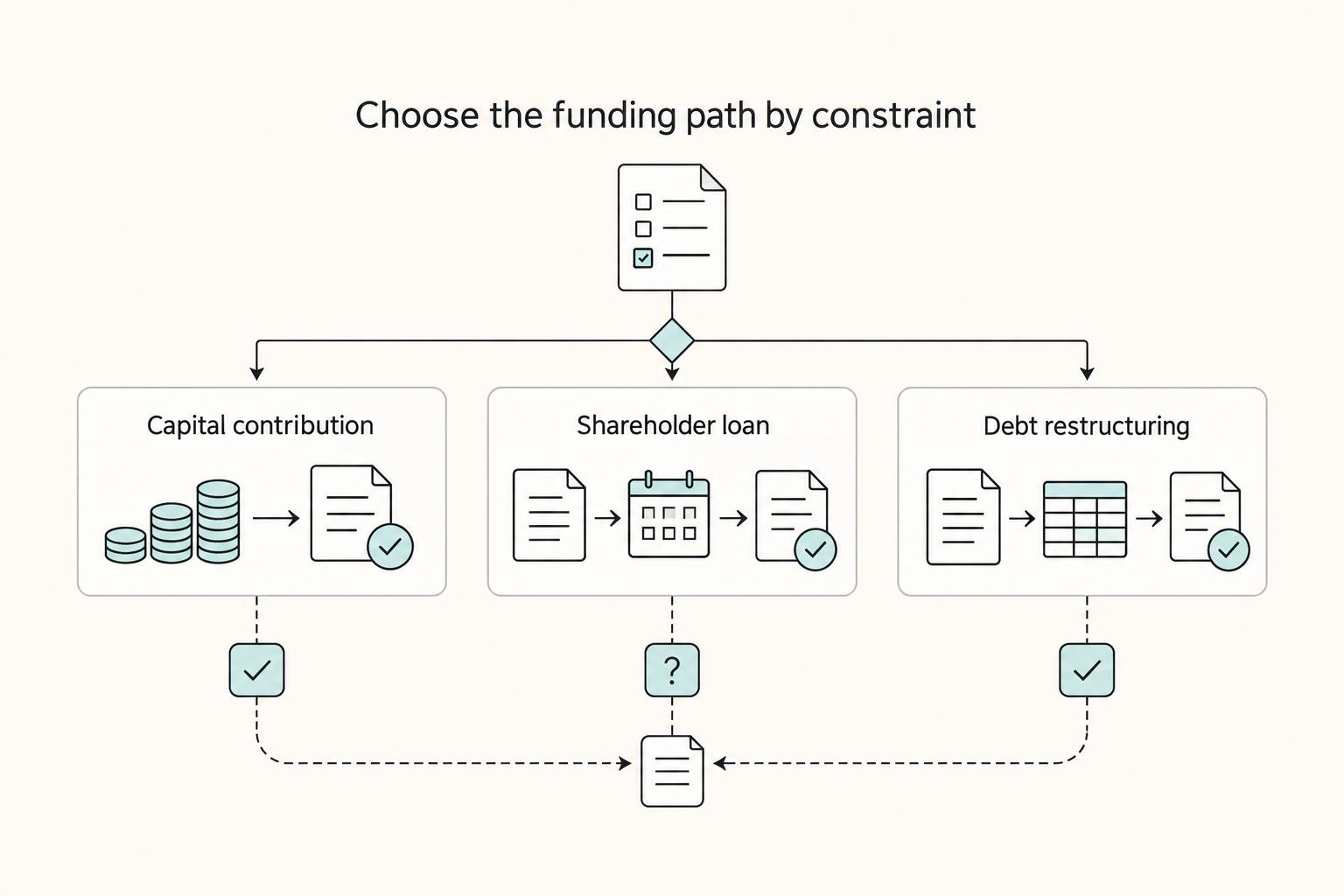
Use this decision rule. Choose a capital contribution when you want the cleanest execution and do not expect repayment. Choose a direct shareholder loan when repayment is real and documentable. Consider recourse-focused debt restructuring when new cash is not available and you are prepared to accept genuine personal liability.
Sequence still matters here. Loss limits are applied in this order: basis on Form 7203, then at-risk on Form 6198, then passive-loss and excess-business-loss limits. Before funding the required basis increase amount from Step 2, confirm that your chosen path also supports the earlier basis layer. If needed, revisit How to Handle Shareholder Distributions in an S-Corp.
Choose the path that matches your constraint#
| Path | Choose it when | Basis / at-risk impact | Documentation burden | Cash-flow impact | Personal-liability exposure | Audit defensibility |
|---|---|---|---|---|---|---|
| Capital contribution | You have liquidity and do not need repayment rights | Contributed money or property is included in at-risk amount | Low to moderate | Personal cash moves into the business | Generally limited to contributed amount for this step | Typically straightforward if records are clean |
| Direct shareholder loan | You want repayment rights and can lend directly from personal funds | Supports debt basis only if the debt is bona fide and runs directly from the S corporation to you; at-risk treatment depends on real economic exposure | Moderate to high | Personal cash moves out, and you hold a receivable | Economic exposure depends on terms and collectability | Strong when terms and conduct match real debt |
| Recourse debt restructuring | No fresh cash is available, lender will amend, and you accept higher risk | Helps only to the extent you are personally liable and not otherwise protected against loss | High | May avoid new cash at closing | Highest, because personal assets may be exposed | Highly facts-and-circumstances dependent |
If related-party financing, lender amendment complexity, or uncertain debt characterization is present, consult qualified tax counsel or a CPA before execution.
Definitions that change the result#
A few familiar terms carry real consequences in this analysis.
A bona fide shareholder loan is true debtor-creditor debt, evaluated under all facts and circumstances, that runs directly from the S corporation to you. A guarantee alone does not create debt basis.
Arm's-length terms means controlled-party loan terms should line up with what unrelated parties would accept in similar circumstances, including support for interest and repayment structure.
A recourse conversion means you are actually personally liable for repayment. If you are still protected against loss in substance, the restructuring may not improve your at-risk position.
Build the evidence pack before money moves#
Build the file before money moves, because documentation is not cleanup work after the fact. It is part of the transaction.
| Path | Documents to keep |
|---|---|
| Capital contribution | Transfer evidence from your personal account to the corporation; corporate approval records, if used in your governance process; ledger entry to equity that matches the transfer trail |
| Direct shareholder loan | Signed loan agreement; transfer evidence; repayment terms, including schedule or maturity; interest support; approval records |
| Recourse restructuring | Executed lender amendment; documentation showing you are personally liable; documentation showing no side protection against loss |
For a capital contribution, keep:
- Transfer evidence from your personal account to the corporation
- Corporate approval records, if used in your governance process
- Ledger entry to equity that matches the transfer trail
For a direct shareholder loan, keep:
- Signed loan agreement
- Transfer evidence
- Repayment terms, including schedule or maturity
- Interest support
- Approval records
For recourse restructuring, keep:
- Executed lender amendment
- Documentation showing you are personally liable
- Documentation showing no side protection against loss
Execution guardrail: if documents are incomplete by year-end, do not assume the change will be respected for current-year loss allowance.
If you want a deeper dive, read Sole Proprietorship vs. LLC: The Definitive Guide for Global Freelancers.
Before you finalize your year-end move, document your assumptions in one place so your contribution-versus-loan decision is defensible: Open Gruv tools.
Sustained Vigilance: A Monitoring System to Avoid the Recapture Rule#
The yearly fix is not enough if later transactions change the picture. The practical goal is to catch changes before they turn into a filing surprise.
Treat proposed transactions and classification updates as pre-check events, not after-the-fact explanations. That mindset matters because routine operational changes can affect your at-risk position in ways that matter for Form 6198.
Use these terms consistently:
- At-risk review flag: an internal warning that your year-end projection may require additional Form 6198 analysis.
- Pro-forma at-risk balance: your estimated amount at risk after a proposed transaction, before you execute it.
- Trigger transaction: any proposed transaction or classification change that could materially change that estimate.
Use Form 6198 as your field map#
Form 6198 should anchor your records throughout the year, not only at filing time. It is used to figure three outputs: current-year profit or loss from the activity, amount at risk, and deductible loss.
Focus on these checkpoints:
- Tie opening records to Part II, Line 6: adjusted basis on the first day of the tax year.
- Track Part I items, including prior-year nondeductible amounts.
- Review classifications that may fall under Amounts Not at Risk.
Pre-transaction workflow#
Before any trigger transaction, run a short pre-check instead of relying on memory or a year-end reconstruction:
- Update your current at-risk position from your rollforward.
- Model the proposed transaction into a pro-forma at-risk balance.
- Flag items that may belong in Amounts Not at Risk.
- Record a dated go or no-go decision with inputs, approver, and supporting documents.
Monitoring cadence and event triggers#
Use a light cadence and run it consistently:
| Timing | What to do |
|---|---|
| Quarterly | Refresh your rollforward and align it to the current Form 6198 structure |
| One month before year-end | Recheck projected activity results and prior-year nondeductible amounts |
| Before any material transaction or classification change | Rerun the pro-forma test and save the draft analysis |
If classification, carryforward treatment, or Amounts Not at Risk handling is unclear, pause and consult a tax pro before you book the transaction.
You might also find this useful: A Deep Dive into the German Trade Tax ('Gewerbesteuer') for Freelancers.
From Compliance Burden to Strategic Control#
The practical shift is to treat this as an operating routine, not a year-end scramble. If basis tracking, debt treatment, planned distributions, or payroll treatment are unclear, pause before you file or move cash and have a CPA or tax advisor review the facts.
After Form 2553, S corporation compliance is ongoing. For ongoing compliance, that means keeping a living paper trail that shows, line by line, how money moved into the business, out of it, and between you and the corporation. The work stays the same from year to year: verify the position, forecast the pressure points, and act only on changes you can support.
Audit#
Start with what you can verify now. Reconcile monthly, tie contributions, loans, repayments, and distributions to bank activity, and keep basis tracking current. Also confirm shareholder-employees are paid W-2 wages through a bona-fide payroll system, and schedule payroll tax deposit deadlines well ahead of time. The signal to take seriously is anything you cannot trace back to source documents or upcoming deadlines.
Forecast#
Project planned moves before they happen: owner draws, debt payments, payroll deposits, and any year-end funding. If the plan creates a documentation gap or a treatment question you cannot defend, escalate before execution, especially when debt structure or distributions drive the result.
Act#
Execute only what you can document cleanly. If you move cash or change debt terms, keep the legal form, money movement, and bookkeeping treatment aligned, and save the support while the transaction is fresh. If payroll deposits slip, treat that as immediate remediation: failure-to-deposit penalties can start at 2% and escalate to 15% after an IRS demand notice.
Use the same control loop each cycle: review the inputs, identify the gap, execute the adjustment, and document the outcome. That is how you keep S-corp compliance controlled, supportable, and far less likely to create surprises later.
We covered this in detail in A Deep Dive into the US-Mexico Tax Treaty for Remote Workers.
If your basis, distributions, and debt structure still do not reconcile cleanly, get a coverage and workflow walkthrough for your setup: Talk to Gruv.
Frequently Asked Questions
My K-1 shows a loss. Can I deduct it?
Not automatically. A K-1 loss is only the starting point because S corporation losses are tested in order through stock and debt basis, at-risk, passive activity, and excess business loss limits. If you have not updated Form 7203, and Form 6198 when applicable, treat the loss as provisional.
What is the difference between stock basis, debt basis, and the at-risk limit?
They are related, but they do different jobs. Basis tests whether you can absorb a loss. At-risk tests whether you are actually exposed to economic loss under IRC §465. | Measure | What you track | What to exclude or question | Which limit controls deductibility | | --- | --- | --- | --- | | Stock basis | Your stock basis under S corporation rules, commonly tracked on Form 7203 | Do not assume stock basis and at-risk are identical | Loss is limited by stock basis before later limitations are applied | | Debt basis | Bona fide indebtedness running directly from the corporation to you | A guarantee alone does not create debt basis | Loss is limited unless direct shareholder debt basis exists, commonly tracked on Form 7203 | | At-risk amount | Money and adjusted basis of property contributed, plus qualifying borrowed amounts where you are personally liable or pledged other, non-activity property | Amounts protected against loss (including many guarantee or nonrecourse arrangements) and certain related or interested-person borrowing | Loss is limited at the at-risk amount, computed on Form 6198 |
How do I estimate my deduction ceiling without building a full model?
Use the basic Form 6198 logic:
[cash contributed] + [adjusted basis of property contributed] + [borrowed amounts that qualify as at risk] - [amounts not at risk] = [at-risk amount] Then apply the ceiling:
min([allowed loss after basis limits], [at-risk amount]) Count direct shareholder debt only when it is bona fide debt running directly to you. Do not count a guarantee by itself.
Does a personal guarantee on the company’s bank loan count?
Usually no, not by itself. For S corporation debt basis, a guarantee alone does not create basis, and §465 can exclude amounts protected against loss through guarantees and similar arrangements. If you later make an actual payment on guaranteed bona fide debt, basis may increase to the extent of that payment.
Can changing the debt structure increase my at-risk amount?
Sometimes, but only when the revised structure actually fits the at-risk rules. Borrowed amounts can count when you are personally liable or when you pledge other property as security, but certain related-party or interested-person borrowing can still be excluded. Escalate before booking changes if the restructure is the main deduction strategy.
What triggers recapture, and what should I check before filing or moving cash?
Recapture risk starts when your amount at risk is reduced below zero at year-end, often after distributions or other transactions. Before you file, verify your year-end rollforward against Form 6198 and confirm distributions and other transactions were reflected correctly. Before major cash moves, rerun a pro-forma at-risk check and pause if the move could push you below zero.
What happens to losses I cannot deduct this year?
Disallowed at-risk losses carry to the first succeeding taxable year for that same activity. They are not permanently lost. Before filing next year, retest those carried losses through all applicable limits in order. Do not assume a carryforward becomes deductible automatically.
When should I stop self-diagnosing and call a tax professional?
Stop when the issue is classification, not arithmetic. Escalate for related-party borrowing, guarantees that may have converted into actual payments, debt restructures, qualified nonrecourse financing questions, or any mismatch between your Form 7203 and Form 6198 positions.
Try a related tool
Researched and edited by the Gruv editorial team. Gruv builds cross-border billing, payouts, and finance-operations software for global businesses.
Sources
- congress.gov/108/chrg/CHRG-108hhrg90972/CHRG-108hhrg90972...trusted
- cppa.ca.gov/regulations/pdf/ccpa_updates_all_written_com...trusted
- ecfr.gov/current/title-26/chapter-I/subchapter-A/part...trusted
- irs.gov/instructions/i6198trusted
- irs.gov/businesses/small-businesses-self-employed/s-...trusted
- law.cornell.edu/uscode/text/26/465trusted
- law.cornell.edu/cfr/text/26/1.1366-2trusted
- sec.gov/files/rules/final/2024/33-11275.pdftrusted
Educational content only. Not legal, tax, or financial advice.
Related Posts

Sole Proprietorship vs LLC for Global Freelancers in 2026
For most freelancers in 2026, the practical default is still simple: use the simplest structure you can run cleanly, then formalize when risk actually rises. If your work is still in validation mode and the downside is contained, a sole proprietorship is often the practical starting point. When contract exposure, delivery stakes, or dispute risk starts climbing, forming an LLC deserves earlier attention.
How to Handle Shareholder Distributions in an S-Corp
Start with one rule: classify each owner transfer clearly, then keep enough records to test distribution taxability against **[stock basis](https://www.irs.gov/businesses/small-businesses-self-employed/s-corporation-stock-and-debt-basis)** later. In an S corporation, income, loss, deductions, and credits flow through to shareholders and are taxed on shareholders' personal returns. Whether a non-dividend distribution is taxable depends on stock basis, not debt basis. `Schedule K-1` reports the non-dividend distribution amount, but it does not tell you the taxable amount.

The Freelance Payment Penalty: A Modeled Audit of Platform Fees, FX Spreads, and Payout Delays
The money rarely disappears through a single, easy-to-spot fee. The real loss is stacked. A marketplace takes its commission, a processor adds a charge for international cards, a bank or payment company converts the currency at a spread, a platform holds the funds before release, and a wire sheds a little to intermediaries on the way in. Each layer looks defensible on its own, but the worker feels the combined result as a smaller deposit and a later payday.