
Quick Answer
Sourcing means finding, evaluating and selecting contractors or vendors for a defined need. Start with a common brief, build candidates through performance records/referrals/directories, compare equivalent scope, validate work evidence and record the award. Onboarding then creates the verified contract, supplier and payment records. Software should support the bottleneck; tax forms, approval and payment states need separate decisions and evidence.
How sourcing works for platforms#
Sourcing is the process of finding, evaluating and selecting the contractors or vendors needed to deliver a defined outcome. Onboarding follows selection: it records the agreement, verifies applicable information and creates the approved supplier/payment record. Good sourcing answers who can do the work and on what terms; onboarding answers how that relationship becomes operational.
- Sourcing picks the supplier
In plain terms, sourcing is the process of identifying, evaluating, and selecting suppliers or vendors. Strategic sourcing goes further than price comparison. It includes assessing fit, negotiating, and managing suppliers over time. That matters because a strong vendor choice can still fail operationally if nobody has tested how the record moves from selection into approvals, contracts, and activation readiness.
- Onboarding determines whether that supplier can actually go live
Onboarding collects and verifies the information needed for the relationship, routes approvals and keeps the contract and supplier record current. A selected contractor may still need an agreement, a documented payee identity and payment details. Keep 'selected', 'authorized to start', 'invoice approved' and 'payment sent' as distinct states.
Use a simple checkpoint. Ask to see how the tool handles a missing document, a rejected approval, and a supplier record update after submission. If the demo only shows the happy path, expect manual email and spreadsheet follow-up to return quickly.
- Many search results help you discover names, not implementation details
Product lists can help discover software names. They do not demonstrate how you will find qualified providers or verify the handoff from a selection decision into a usable supplier record. Use the sourcing procedure below before deciding which part needs software.
In practice, judge options by the day-2 details. What gets verified, which exceptions stall, and what status is visible across teams matter more than a ranking page.
Use that lens as you work through the list. The goal is not to admire the biggest category list. It is to move from shortlist to reliable supplier activation with fewer manual chases, fewer status gaps, and records you can trust when something breaks.
For a step-by-step walkthrough, see What Procurement Means for Platform Operators Managing Strategic Sourcing and Vendors.
Find and compare contractors before choosing software#
- Define the work. Write deliverables, acceptance criteria, needed expertise, location/time constraints, budget range and who decides acceptance. Distinguish a specific project from a continuing role that needs worker-classification review.
- Build a candidate pool. Use existing supplier performance, trusted referrals, professional directories, relevant marketplaces and direct outreach. Ask for evidence of comparable work and availability; a badge or referral is a lead, not verification.
- Request comparable responses. Give each candidate the same brief and ask for scope, exclusions, timeline, rate or fixed-price assumptions, capacity and references. Avoid scoring a cheap narrow proposal against a more complete one without normalizing scope.
- Validate fit. Review relevant samples and verify references with permission. If a work trial is necessary, use a scoped paid exercise with agreed rights, acceptance and payment terms. Do not request production work disguised as a free test.
- Select and record the decision. Apply essential skill, capacity and legal gates before weighted scoring. Keep the reason, approved scope/rate, contract and alternate supplier; pass those facts into onboarding rather than starting a new unlinked record.
For an illustrative translation job, both candidates must deliver 10,000 words with two named languages, glossary use, human review and a defined correction window. Candidate A quotes $1,200 and includes review; candidate B quotes $950 but adds $350 for review, making $1,300 for comparable scope. If evidence of quality and capacity is otherwise equal, A costs $100 less. This is an invented comparison, not a market rate or a claim that price should outweigh quality.
| Criterion | Weight | Evidence |
|---|---|---|
| Relevant quality | 40% | Comparable samples, review results and references |
| Capacity and delivery | 25% | Availability, proposed milestones and dependencies |
| Comparable total cost | 20% | Same scope, review and change assumptions |
| Communication and handoff | 15% | Response quality, version control and escalation |
Score 0–5 only after the essential gates pass. Illustrative scores of 4, 5, 3 and 4 yield 4×0.40 + 5×0.25 + 3×0.20 + 4×0.15 = 4.05 out of 5. Those inputs demonstrate the calculation, not vendor ratings. Record uncertainty and verify it before award rather than making the score look precise without evidence.
Who this list is for and how to choose#
This list is for teams that will own implementation after vendor selection, not teams doing name-only research. If you are choosing between Strategic Sourcing Application Suites and Supplier Onboarding Software, decide first where your process actually breaks: supplier selection or supplier activation.
- Use this section if you run real intake at scale
Use the model comparison when product, finance, operations and engineering need to carry supplier records across selection, approvals and payments. Do not choose a workflow from a count of products in a review category; your own bottleneck and evidence requirements matter.
- Skip this section if you only want rankings
Use discovery lists as a starting point, then ask the actual provider for the module, implementation scope and export evidence you need. A sourcing suite, supplier portal and payment service can overlap without performing the same job.
- Choose with operational criteria, not brand gravity
Evaluate control and auditability requirements first, including role-based permissions, encryption, privacy, and audit trails. Then test onboarding depth, integration fit, day-to-day visibility, and exportable audit evidence. In demos, pressure-test exception handling and record-change tracking, not just the happy path. We recommend taking the same exception scenario through every finalist.
- If activation is your bottleneck, weight onboarding depth higher
This is a situational bias, not a universal rule. When compliance and first-payout readiness are the delays, optimization features upstream in sourcing will not remove downstream activation friction on their own.
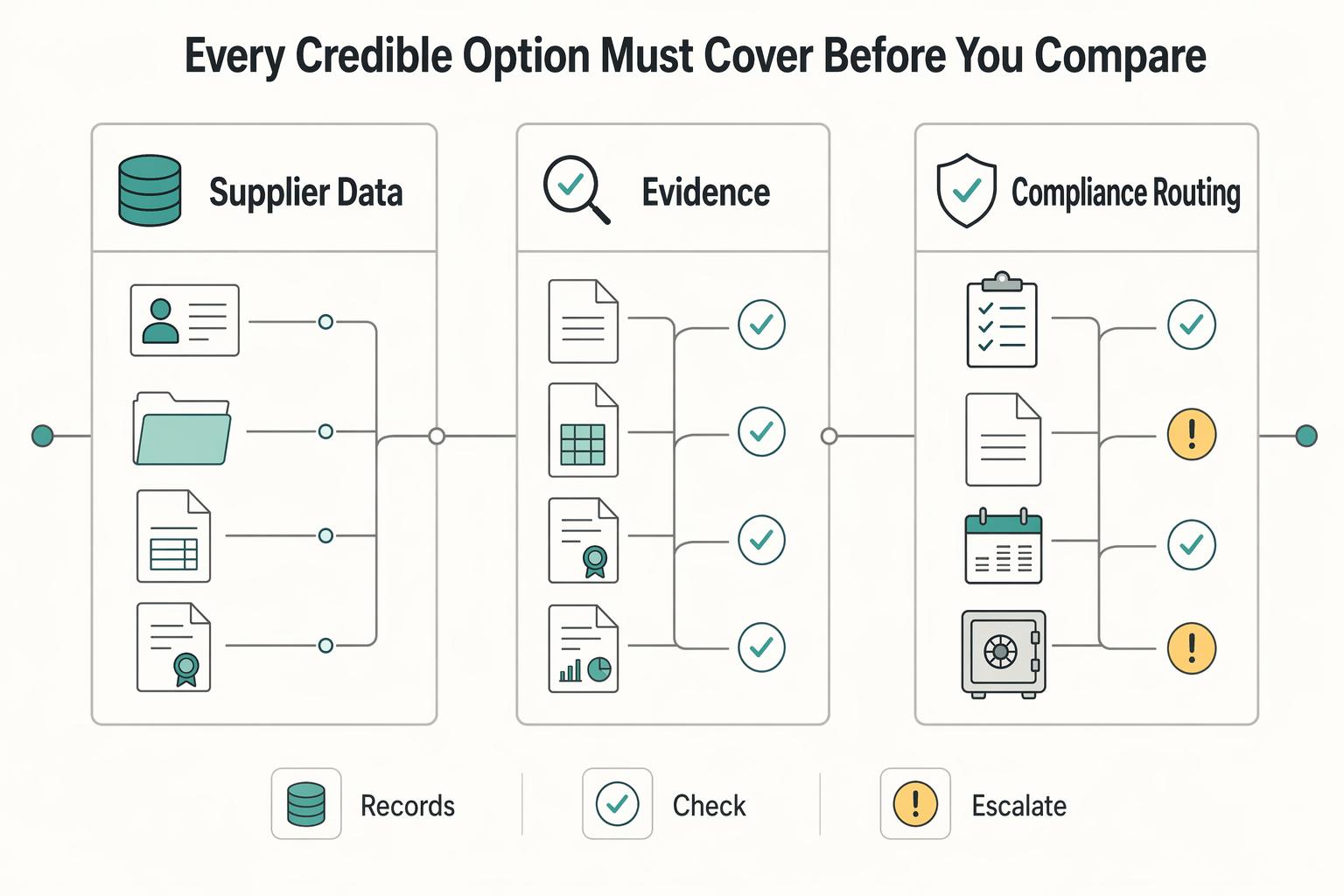
What every credible option must cover before you compare winners#
Set a minimum bar for the function being purchased. An onboarding product should support reliable supplier records, applicable documents, routing and audit history. A discovery or bid-comparison tool need not do every downstream task, provided the handoff into the authoritative supplier record is explicit and tested.
| Capability | Baseline | Live proof |
|---|---|---|
| Supplier data capture | Supplier details, tax documents, and certifications in one maintainable record | Show that updates stay visible and controlled after go-live |
| Document collection | Required, missing, and verified documents before a supplier moves forward | Show a missing tax form or expired insurance certificate being blocked, routed, and resolved |
| Compliance and routing | Cross-functional routing across procurement, legal, and finance with contract/document flow | Show who approved what and how status changes are recorded |
| Centralized records | A centralized supplier repository with non-happy-path visibility | Show exception handling, multi-team approval routing, and supplier record updates after corrections |
- Supplier data capture that stays usable
The tool should collect and store supplier details, tax documents, and certifications in one maintainable record. The real test is whether updates stay visible and controlled after go-live, not whether the intake form looks clean.
- Document collection with completion control
Credible options should show which documents are required, missing, and verified before a supplier moves forward. In demos, ask for a missing tax form or expired insurance certificate so you can see how incomplete submissions are blocked, routed, and resolved.
- Compliance checks, approval routing, and contract/document flow
Cross-functional routing across procurement, legal, and finance is baseline. Positioning around compliance automation, documentation flow, and multi-team visibility is directionally useful, but you still need proof of who approved what and how status changes are recorded.
- Centralized records plus non-happy-path proof
A shared supplier record should keep changes, verification decisions and related contracts visible to authorized teams. Vendor speed claims are not results for your operation; time the same intake and exception scenarios in your own controlled evaluation.
Require every finalist to show three things live: exception handling, multi-team approval routing, and supplier record updates after corrections.
Ask each provider which functions are native, which require another module and which rely on a manual or external process. Price integration, migration and ongoing review work alongside the licence.
If your team is weighing in-house sourcing against outside support, What Is Procurement as a Service? How Platforms Can Outsource Vendor Sourcing and Contracting breaks down when that model fits.
Best sourcing and onboarding models for platform teams#
Once a tool clears the minimum bar, choose the model that removes the constraint closest to first payout. If your bottleneck is upstream supplier selection and standardization, start with sourcing depth. If your bottleneck is document collection, approvals, and payment readiness, start with onboarding depth. We recommend writing that bottleneck down before the demo round ends.
| Model | Best fit | Key proof | Notes |
|---|---|---|---|
| Strategic-first stack | Upstream procurement rigor; supplier selection and standardization | Supplier discovery, evaluation, and comparison, plus the handoff into onboarding records | Strong sourcing analysis can still leave weak evidence of who completed onboarding requirements later |
| Onboarding-first stack | Document collection, approvals, and payment readiness | A missing required document, a blocked step, and the exact state change that advances the supplier | If sourcing maturity becomes the next gap, add a sourcing layer after onboarding flow is stable |
| Hybrid sourcing plus onboarding | Multiple teams share ownership of one supplier lifecycle | One supplier record moving from evaluation to approval to payment-ready status with consistent data and history | The practical risk is record drift between sourcing and onboarding states |
| Lightweight mid-market lane | Operational control without a full procurement transformation | Who verifies required documents, where approvals are recorded, and how supplier updates are logged | If controls stay informal, side processes can become the real system of record |
| Specialist onboarding lane | Stronger onboarding control quickly | Required documents, compliance checks, approval history, and the event that makes a supplier eligible to transact | Treat speed claims as positioning until validated in your workflow |
- Strategic-first stack
Start here when your main goal is upstream procurement rigor. Strategic sourcing application suites are positioned as integrated solutions for upstream planning, assessment, and performance work, and strategic sourcing is commonly framed around cost-saving opportunities and supplier-base optimization.
In this lane, require proof of supplier discovery, evaluation, and comparison, then verify the handoff into onboarding records. A common failure is strong sourcing analysis with weak evidence of who completed onboarding requirements later.
- Onboarding-first stack
Start here when intake execution is the problem. Supplier Onboarding Software is positioned to simplify and automate integrating new suppliers, which fits teams dealing with incomplete submissions, stalled approvals, and fragmented intake.
In demos, ask to see a missing required document, a blocked step, and the exact state change that advances the supplier. If sourcing maturity becomes the next gap, add a sourcing layer after onboarding flow is stable.
- Hybrid sourcing plus onboarding
For a connected model, SAP Business Network Discovery documents needs postings, supplier profiles and bid comparison. Coupa's supplier portal guidance describes business-profile, legal-entity and payment-method setup, with interactions depending on the customer's configuration. These are different product functions, not a claim that either alone guarantees a complete selection-to-payment flow.
Your key check is continuity: one supplier record moving from evaluation to approval to payment-ready status with consistent data and history. The practical risk is record drift between sourcing and onboarding states. We recommend treating any break in that chain as a product-risk signal, not just an onboarding inconvenience.
- Lightweight mid-market lane
For a smaller procurement workflow, Precoro documents separate Create/Approve permissions, supplier invitations and linked contracts. Medius describes supplier self-service, review/approval and REST API integration. Confirm the purchased modules, approval configuration and authoritative data ownership rather than assuming every feature is included.
This works if manual controls are explicit: who verifies required documents, where approvals are recorded, and how supplier updates are logged. If those controls stay informal, side processes can become the real system of record.
- Specialist onboarding lane
Gatekeeper advertises screening, adaptive routing and a self-service portal. Graphite Connect focuses on supplier onboarding and maintained information. Compare them on your required documents, change approvals and audit output; no vendor's faster-onboarding claim establishes your outcome.
Treat speed claims as positioning until you validate them in your workflow. Your proof should be concrete: required documents, compliance checks, approval history, and the event that makes a supplier eligible to transact. If upstream sourcing needs grow later, plan for adjacent tooling.
Decide when you need sourcing software, onboarding software, or both#
Use the bottleneck closest to first payout to decide the starting point: if vendor quality and negotiation outcomes are weak, start with sourcing; if approved vendors still stall before payment, start with onboarding.
- Start with Strategic Sourcing Platforms when commercial quality is the miss
Choose this path when your team struggles to compare suppliers, control rates, or use negotiation leverage. Strategic sourcing software is built for sourcing productivity and savings outcomes, including stronger negotiation position. The key proof in demos is side-by-side supplier evaluation plus a clean handoff into the supplier record finance will use later. A procurement-heavy enterprise often fits this path. If your teams are stuck upstream in supplier selection debates, onboarding software will not fix that root issue.
- Start with Supplier Onboarding Software when activation delay is the miss
Choose this path when tax, payment setup, approvals, or incomplete submissions are slowing activation. Supplier onboarding software is built to ensure required documentation, compliance requirements, and contractual records are complete before full onboarding. In practice, test one realistic flow: missing banking details, a blocked compliance document, reviewer approval, then a clear status change to payment-ready. If a vendor cannot show that sequence, you are likely getting better intake screens, not better execution.
- Use both when you have two bottlenecks, and sequence them on evidence
If procurement needs better supplier selection while finance and ops need faster activation, you may need both layers. Use a 90-day checkpoint, about three months, to review supplier setup cycle time in calendar days, plus whether exception queues and cross-team handoffs are improving. Add sourcing optimization after intake controls are stable. If tax, banking, compliance, and approval records are still fragmented, adding more sourcing depth usually increases record drift instead of improving operations.
Related reading: What Is a Supplier Portal? How to Give Contractors Self-Service Access to Payment Status and Documents.
Compliance and tax gates that should influence your vendor shortlist#
Shortlist vendors based on whether they can handle the tax and compliance branches you may actually encounter, not just whether they offer generic onboarding forms. These gates are context-dependent, but in cross-border programs they can materially affect withholding, review effort, and payout operations.
| Branch | Facts to establish | Workflow evidence |
|---|---|---|
| Payee and payment tax treatment | US/foreign person, individual/entity, service location and income type | Applicable form, reviewer and reason for the decision |
| Treaty or withholding review | Whether this payment requires withholding and a treaty claim is supported | Verified claim, submission/wait requirements where relevant, gross/withheld/net amounts |
| Bank detail change | Whether the request and account belong to the approved payee | Independent verification through a known channel, version and approval |
| Contractor status | Actual work/control and applicable employment rules | Classification review separate from tax-form collection |
| Account reporting | Whether the platform itself has a foreign-account/asset duty | Separate treasury/tax tracker; supplier's foreign bank does not automatically create the platform's account |
- Form 8233 and withholding branch logic
For US tax documentation, start with payee status and income type. W-9 is generally for a US person; W-8BEN documents a foreign individual and W-8BEN-E a foreign entity where applicable. For services, the IRS generally sources income where work is performed, not simply where the payer or bank is located. Do not impose 30% withholding on every foreign contractor.
Form 8233 can support a nonresident individual's treaty claim for qualifying personal-service compensation. Where applicable, the withholding agent reviews it, sends an accepted form to the IRS within five days and waits at least ten days after proper mailing to see whether the IRS objects. A missing claim does not mean no pay is owed: determine lawful withholding and remit the applicable net payment on the required schedule.
- Tax documents and change history
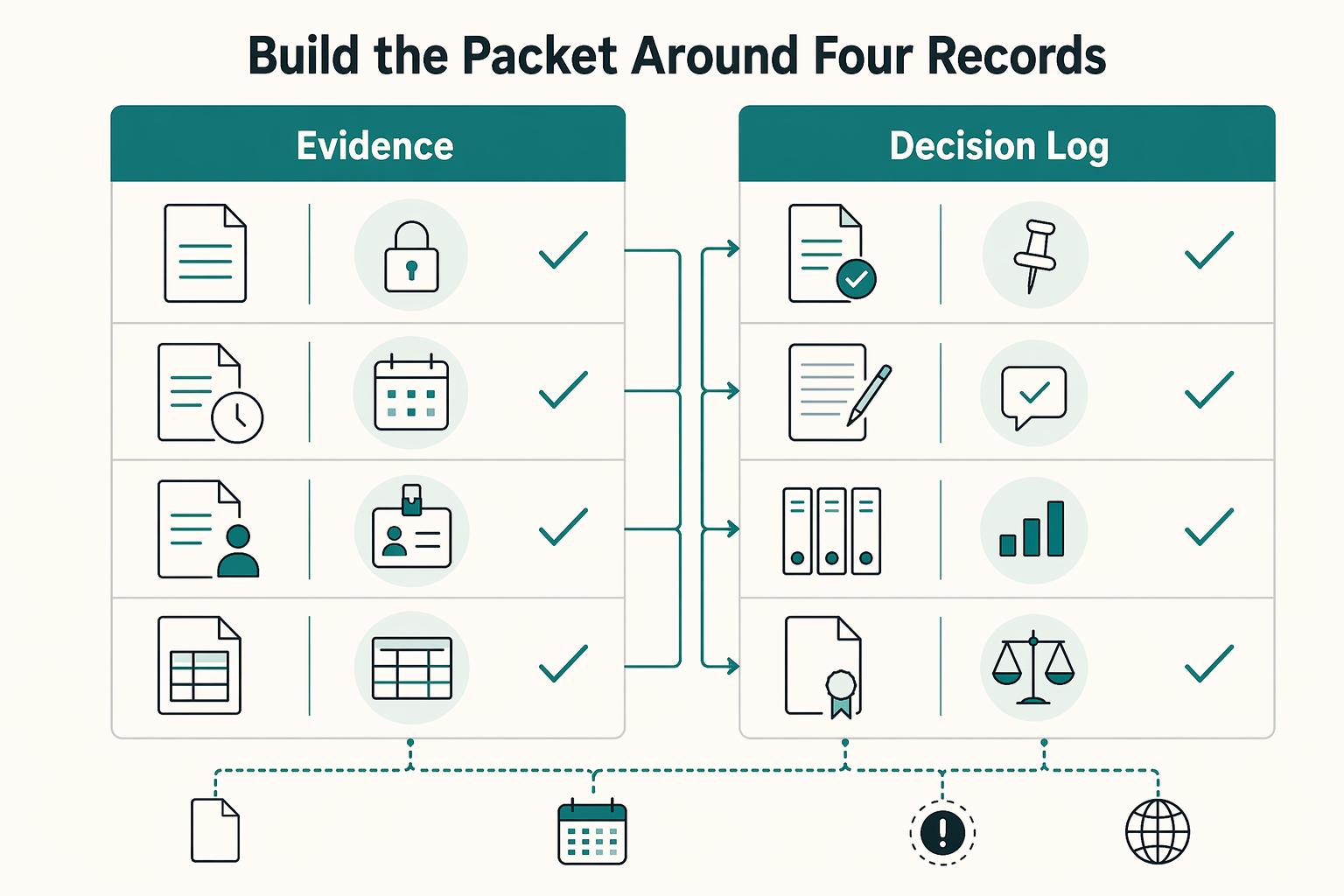
Retain the applicable form, version, tax status, service/income facts and reviewer decision with controlled access. Route changed information back to the relevant owner; document collection alone does not prove treaty eligibility, worker classification or permission to delay payment.
Separate tax review from bank validation and contractual payment terms. Show the gross amount, lawful withholding, net payable, due date and release decision. If approval is unresolved, escalate before the due date rather than using an internal onboarding flag as a blanket reason to withhold earned amounts.
- Foreign-bank details and treasury reporting
A contractor's foreign bank account is not automatically the platform's reportable foreign financial account. FBAR and Form 8938 depend on their own filer, interest/authority, asset and threshold rules. Keep any platform treasury reporting review separate from supplier selection; do not require every vendor to pass a $10,000 FBAR gate.
For a regional program, test the actual payee country, account fields, currency, supported route and evidence of receipt. Record who resolves missing information and who contacts the contractor. A successful local payment test does not prove every country or account type works.
For a more detailed vendor-vetting process, see How to Find Vendors for Your Platform and Vet Third-Party Providers at Scale.
Implementation sequence from shortlist to first reliable payout#
After tax and compliance fit, execution discipline becomes the differentiator. Do not move from shortlist to full rollout on demo confidence alone. A safer path is one end-to-end proof-of-flow first, then a phased rollout.
- Lock the requirements that control payout readiness
Define and freeze the minimum objects and states before integration starts: contractor or vendor record, document statuses, approval events, payout trigger, and reconciliation output. If these stay ambiguous, product can mark onboarding complete while finance still cannot release payment. Use a written field/status map approved by product, engineering, and finance.
- Shortlist for proof, not feature count
Keep only vendors that can demonstrate your required objects in sequence, not just broad onboarding claims. Ask for one controlled scenario from intake to payout-ready state, including what finance sees versus product or ops. If those views do not stay aligned, expect downstream support and reconciliation issues.
- Run a proof-of-flow with real end-to-end objects
Start with realistic synthetic records in a test environment: supplier, document changes, approval events, payment instruction and reconciliation output. Then use a limited authorized live cohort if necessary to establish actual receipt. Do not expose real tax or bank information merely to make a sales demo convincing.
- Design integration for safe retries and status truth
Use a persistent business-operation ID and one controlled submission path. Stripe's idempotency guidance allows key pruning after at least 24 hours, so provider keys alone are not a permanent duplicate-payment ledger. Handle duplicate or out-of-order events, retain provider references and reconcile status. If a payout result is unknown, query or reconcile it before creating another payment or changing rails.
- Pilot in a controlled ring before broad rollout
Use a limited cohort first, then expand gradually. During the pilot, watch exception queues and verify status changes remain visible across systems. If approval-path visibility is incomplete, or finance cannot distinguish "awaiting review" from "payout-ready," fix that before widening rollout.
- Assign clear owners for changes and exceptions
Name one owner in product for status design, one in engineering for integration and retry behavior, and one in finance for payout-release and reconciliation criteria. Shared accountability without a decision owner slows triage when records disagree across systems. Clear ownership keeps exception handling fast and auditable.
Red flags that signal the wrong choice before contract signature#
The wrong pre-signature choice is usually visible early: the vendor cannot prove exception handling, audit traceability, or tax workflow behavior beyond a polished demo. Treat those gaps as product risk, not sales polish issues.
- Happy-path demo only
A clean intake walkthrough is not enough. Ask for the exact report or view that shows approvals still in process, plus completed approvals and denials. If they can only show ideal screens, they have not proven the exception path your team will run in production.
- Integration claims with no event-to-audit evidence
Treat broad integration claims as incomplete until the team can map onboarding events to specific audit artifacts. For SAP Ariba, ask where significant event actions are logged and how approval history is surfaced. If they cannot name those artifacts clearly, finance often ends up piecing together screenshots, emails, and tickets instead of using a traceable record.
- Vague tax and withholding coverage
Ask how the tool routes the tax branch applicable to your payee and payment, rather than asking whether it 'supports FATCA' in general. Require the actual collected document, reviewer decision, submission evidence if required, withholding/net-payment output and due-date escalation. Technical status does not settle the legal duty to pay.
- "Best tool" language with no use-case fit
Ranking pages can help you discover options, but they are still summary inputs. Gartner category pages are review and rating oriented, and HighRadius presents a snapshot list. If the pitch leans on rankings but cannot explain fit for your approval depth, document model, and payout controls, move on.
Choose the bottleneck and test the handoff#
The right answer is not a generic vendor ranking. It is a sequence you can operate: pick the model that matches your bottleneck, prove it in realistic conditions, then expand only when the record, approval, and payment checkpoints hold.
- Choose for the actual constraint
If your pain is upstream supplier selection, e-sourcing applications are built to organize and evaluate RFIs and RFPs. If your pain starts after selection, with compliance documents, approvals, and first-payment readiness, Supplier Onboarding Software should come first. The winning choice is the one that removes the current blocker, not the one that looks strongest in a 2026 review page or "top tools" roundup.
- Validate with a real pilot before broader rollout
A procurement pilot program is a controlled test, not a demo replay. Use real records and a smaller user base first, even something as limited as 2 to 3 users, and confirm the software works in real-world scenarios before you expand. Your checkpoint is operational proof, not feature coverage. Verify document status, approval steps, payment status, and finance-side records across the same workflow. If statuses drift between operational and finance views, or approvals stall while payment steps continue, stop there and fix the handoff before rollout.
- Scale only when one record can support day-2 operations and audit review
The platform that lasts is the one that can serve as the single source of truth for supplier contracts, compliance documents, and payments. Centralized vendor information is not just cleaner admin. It lets finance, ops, product, and engineering look at the same record and answer the same questions about what was submitted, what was approved, and when. What matters is audit-ready transparency. If your sourcing decision lives in one tool but compliance documents, approval history, and payment readiness live elsewhere with no clean linkage, you have built rework into the process.
Selection and onboarding need a deliberate handoff: preserve the approved supplier identity, scope, rates and contract terms when the operational record is created. Separate tools can work when those links and owners remain reliable.
If you want a simple final rule, use this one: do not sign on the basis of rankings alone, and do not scale on the basis of a happy-path demo. Move forward when your finance, ops, product, and engineering owners can all trace one vendor record from intake through approval to first reliable payment with the evidence preserved.
Frequently Asked Questions
What is the difference between sourcing and supplier onboarding for platform teams?
Sourcing is about finding and evaluating suppliers. A sourcing platform helps with supplier discovery, sourcing events, and supplier evaluation in one place. Supplier onboarding starts later. It is the structured process of collecting, verifying, and approving a vendor's information before you authorize work or payment.
Are Strategic Sourcing Platforms the same thing as Supplier Onboarding Software?
No. Strategic Sourcing Platforms are built for selection and evaluation, while Supplier Onboarding Software is built for approval and activation. If your current pain is slow contractor setup, missing tax forms, or payout delays, start with onboarding depth first, not sourcing features.
What features are non-negotiable when onboarding contractors and vendors at scale?
At minimum, your onboarding flow should capture legal details, tax details, and payment details through a standardized form, then run compliance checks before approval. You also want a clear record of what was submitted, what was verified, and who approved it. If a tool cannot show document status per record, it becomes much harder to resolve missing items before first payout.
Should we pick one platform first or implement sourcing and onboarding together?
For many platform teams, sequencing is easier than trying to launch both at once. If activation is your bottleneck, pick onboarding first and prove that approvals, documents, and payout readiness move cleanly end to end. Implement both together only when you already have cross-functional ownership across product, engineering, and finance and can test the full handoff without gaps.
How do we evaluate "best" tools when Top 10 lists use unclear scoring methods?
Treat rankings as discovery inputs. Ask every finalist to show the exact supplier record, document version, approval event, change history and export required for your use case. A comparative vendor ranking or review score does not prove that those records will stay aligned in your configuration.
What compliance and tax checks should be included before first payout?
Establish the payee, income type, service location and applicable tax documentation, verify bank details, and record contract/invoice approval and due date. Route treaty or withholding questions to the responsible reviewer. Supplier bank location alone does not establish FBAR, Form 8938 or 30% withholding. An incomplete exemption claim may require lawful withholding rather than indefinite nonpayment.
How can we reduce rollout risk when integrating onboarding into payment operations?
Use synthetic records for the first integration proof, then a limited authorized live cohort to verify receipt and reconciliation. Keep onboarding, invoice approval and payment states distinct. For an unknown payment outcome, check the provider and reconcile before resubmission; a retry must not create a second obligation.
Try a related tool
Researched and edited by the Gruv editorial team. Gruv builds cross-border billing, payouts, and finance-operations software for global businesses.
Sources
Includes 5 external sources outside the trusted-domain allowlist.
- docs.stripe.com/api/idempotent_requeststrusted
- irs.gov/forms-pubs/about-form-w-9trusted
- irs.gov/instructions/iw8bentrusted
- docs.coupa.com/en/supplier-documentation/coupa-for-supplier...external
- gatekeeperhq.com/vendor-onboarding-softwareexternal
- graphiteconnect.com/product/supplier-onboardingexternal
- help.precoro.com/how-to-manage-suppliers-in-precoroexternal
- medius.com/solutions/supplier-onboardingexternal
Educational content only. Not legal, tax, or financial advice.
Related Posts

How to pay a contractor team in Latin America
For a LATAM contractor team, choose the payment setup by the currency and account each person can actually use. A company sending USD to Mexico, Colombia and Argentina may need three different receiving paths. The best default is a supported bank payout with a clear quote and traceable receipt; add a contractor-management platform when its contract and invoice workflow saves enough administration to justify the full cost.
IRS Form 8233: When Foreign Contractors Claim Treaty Exemptions and What Platforms Must Verify
Form 8233 is used by nonresident alien individuals to claim exemption from withholding on compensation for personal services, but for platform operators the key exposure is often operational: scope decisions, review quality, recordkeeping, and escalation. When you pay nonresident individuals for U.S.-source personal services income, the real risk is often not whether a form exists, but whether your team can show why a claim was accepted.

Choosing Dynamic Discounting for Contractor Early Payment on Platforms
Dynamic discounting is a buyer-led arrangement on outstanding invoices. Payment happens before the due date, and earlier payment usually means a larger discount. The core question is who funds that acceleration. In the standard model, the buyer uses its own cash, so your early-pay offer sits inside working-capital policy, not just product configuration.