
Quick Answer
For a payment platform operator, ERP is the business control layer for finance and operating processes, not the system that routes or executes payments. Use ERP for approvals, finance workflows, and reporting, keep live payment execution in the payment stack, and define ownership for status fields, webhooks, reconciliation, and payout sequencing before integration starts.
Why ERP Matters for Payment Platform Operators#
If you run a payment platform, ERP can become as much a boundary problem as a definition problem. Vendor explainers from SAP, IBM, Sage, Corpay, and Ramp give you baseline context. In practice, you still need to decide where ERP ends, where payment systems begin, and how records move between them.
At a basic level, Enterprise Resource Planning (ERP) is software that streamlines core business processes across functions. A useful guardrail is scope: financials and ERP are not the same thing. If ERP is treated as the container for every payment event and control decision, ownership can become blurry before integration work starts.
The confusion usually starts with terms that sound similar but matter differently in operations. An API is the rules and protocol layer that lets systems communicate. A webhook is an HTTPS endpoint that receives real-time event pushes. Payment reconciliation is the process of matching transaction records for accuracy and consistency. A payout schedule is the cadence for disbursing funds to a bank account.
Stripe's ERP integration guide, last updated June 7, 2024, includes vendor-selection guidance and describes ERP architecture as centered on a single main database. That centralized model does not remove the need to define how real-time payment status changes are handled across systems.
Before you build, document four items in one place so ownership is visible before integration work starts:
- API contract
- Webhook intake behavior
- Reconciliation owner
- Payout sequencing assumptions
This guide focuses on those implementation choices: API contracts, webhook boundaries, matching ownership, and payout sequencing. The goal is to help you set clear system boundaries before money movement and accounting have to agree under production conditions. For a broader planning view, we covered related groundwork in A Guide to Resource Planning for Small IT Agencies.
What ERP means for a payment platform operator#
For a payment platform operator, ERP is the business control layer for finance and operating processes, not the runtime layer that selects processors or executes payment transactions.
That boundary matters in day-to-day operations. ERP streamlines business workflows across functions. The orchestration layer centralizes gateways, processors, acquirers, and routing rules, including multi-processor paths. If a capability depends on processor selection, routing, or live execution state, it usually belongs in the payments stack, not in ERP.
Cloud ERP is often where spend controls, finance workflows, and enterprise reporting sit, especially when you want shared controls across finance and procurement instead of rebuilding them in product code.
Keep any "single source of truth" claim narrow. ERP can be the source of truth for finance visibility and controls without becoming your default payment event status system. The general ledger remains the core accounting record for financial reporting, and payment systems still need explicit integration with ERP and accounting tools.
Before implementation, assign ownership of core fields across your payment platform, ERP, and ledger, for example status, amount, currency, counterparty, and provider reference. Label each record as an approval, execution fact, or accounting output. We recommend one simple starting rule: ERP governs and reports, the payment layer executes, and explicit field mappings connect the two.
If you want a deeper dive, read What Is AP Automation? A Platform Operator's Guide to Eliminating Manual Payables.
Separate ERP from payment orchestration and the general ledger#
Separate three responsibilities: ERP for business process control, payment orchestration for routing and execution, and the general ledger for accounting records that support financial statements. These are logical roles, not a requirement for three products: the general ledger can be a module within ERP. A separate operational payment ledger may also track balances and movements before controlled posting to the GL.
| Layer | Primary role | Best-fit examples | Usually a poor fit |
|---|---|---|---|
| ERP | Cross-functional business controls and process management | approvals, finance process controls, reporting inputs | processor routing rules, provider failover execution |
| Payment orchestration | Transaction routing and execution across processors | route by country/currency/amount; consider another processor after a confirmed failure | core accounting record ownership |
| General ledger | Core accounting record for financial statement support | journal postings, balances, statement-ready aggregates | real-time processor routing, provider failover logic |
Use a routing-first decision rule. If a capability needs to react to live payment outcomes, route by conditions, or retry across processors, it is usually better anchored in the payment layer. If it is mainly policy, approvals, or finance-oriented process control, ERP is usually the better anchor.
Set event ownership before integration starts. Define which system emits each canonical status, which system consumes provider webhooks, and how record matching compares records across systems without conflicting ownership.
Before you build, require one verification checkpoint in your API contract: each status field has one source of truth, one update path, and named consumers. Writing this down in an OpenAPI-style spec, whether JSON or YAML, can remove guesswork and expose ownership conflicts before code is merged. For a step-by-step walkthrough, see What Is a Payment Facilitator (PayFac)? And Should Your Platform Become One.
Decide what ERP should own and what your platform should own#
Define process ownership right after status ownership. A common default is to keep customer-facing payment UX and provider routing in platform services, while finance approvals, accounting controls, and enterprise reporting often sit in cloud ERP. Use that split as a starting point, then test it against your architecture.
Avoid split authority. If ERP and the payment stack can both change the same business outcome, you have two control planes. ERP is designed to simplify organizational functions, and cloud ERP finance is positioned as a financial source of truth. That usually makes it better suited to controlled finance workflows than live payment execution.
| Process area | Likely primary owner | Why this usually fits | Handoff you should define |
|---|---|---|---|
| Invoicing | Cloud ERP | Invoice policy, approvals, terms, reporting, and accounting controls usually sit with finance operations | Invoice IDs, customer/account mapping, status field map, posting rules |
| Collections | Shared, but one side must own state transitions | Payment attempts may run in platform services while receivables policy and reporting often sit in ERP | Canonical collection status, retry event mapping, dispute or exception codes |
| Dunning | Often Cloud ERP for policy, platform for execution hooks | Dunning is communication to collect overdue receivables, so policy and escalation often align with finance controls | Dunning stage definitions, contact outcome fields, suppression rules |
| AP automation | Cloud ERP | Approval levels, routing, and payables workflow are common ERP capabilities | Vendor or master data mapping, approval status map, payment file or instruction export rules |
| Payout infrastructure | Platform services | Payout movement depends on payout schedules plus provider event handling and retry safety | Payout ID mapping, settlement status map, bank reference fields, matching packet |
Use the table as a design test. Each row needs one owner for business decisions, one owner for execution events, and a named handoff.
Keep execution where event reliability is handled#
Keep live payment execution close to webhook and retry controls. Webhooks can deliver duplicate events, and failed deliveries can be retried, so customer-facing payment state, provider routing, and payout execution logic often fit best in systems built for idempotent retry behavior.
Payout infrastructure is the clearest case. Execution state often comes from provider events, while ERP can receive controlled outputs for finance reporting and approvals.
Put finance controls where finance teams operate#
AP automation, approval routing, and enterprise reporting usually belong in ERP. ERP workflow tooling is built for configurable approval levels and routing, which is often not worth rebuilding in payment services.
Invoicing and dunning are boundary workflows. ERP can own policy state where it defines terms, overdue logic, and reporting. Platform services can own end-user payment UX and provider calls.
Define handoffs before implementation#
Before you merge code, define at least three handoff artifacts:
| Artifact | What to define |
|---|---|
| Field mapping spec | Shared IDs, references, status values, timestamps, and amount and currency fields, with a source of truth and update direction for each field |
| Idempotency behavior | How retries and webhook replays do not create duplicate business effects across the ERP boundary |
| Matching packet | The minimum record set needed to compare transactions across systems |
Include failure modes in the matrix up front as well: duplicate webhook events, delayed settlement updates, and month-end GL versus ERP mismatches. If a process crosses systems repeatedly and still lacks a single owner for business state, redesign the boundary before implementation. Related: What Is Vendor Management? A Platform Operator's Guide to Supplier Lifecycle Control.
Choose an integration pattern that survives growth#
Pick integration boundaries based on failure tolerance and change frequency, not on what is easiest in the first release.
| Pattern | Best fit | Main risk to plan for |
|---|---|---|
| Direct API coupling (synchronous request/response) | Immediate confirmation is required before the next step | Tighter runtime dependency between the orchestration layer and ERP paths |
| Webhook or event-driven integration (asynchronous) | Payment and ERP flows need looser coupling and independent scaling | Duplicate or delayed delivery must be handled safely; retry windows depend on the provider (Stripe live-mode retries can last up to three days) |
| Hybrid (API + events) | Some ERP write-backs need immediate acknowledgment while other updates can be async | Boundary complexity unless ownership and replay rules are explicit |
As systems grow, event-driven boundaries between the orchestration layer and ERP can reduce brittle dependencies because producers and consumers can evolve independently. Treat webhooks as asynchronous event inputs, and design replay handling explicitly.
At every boundary, define idempotent request handling and replay rules. Enforce a durable operation identity and uniqueness around the local accounting effect; a processed-event flag must not be committed separately from the effect it protects. For remote writes, use the endpoint's supported idempotency behavior and retain its result. If a timeout leaves execution unknown, resolve the original attempt from provider records before rerouting or issuing a new operation. Define compensating actions for partial failures rather than assuming an external payment can be rolled back.
Run replay and partial-outage tests in a production-like environment, and repeat them as the integration changes. For a related look at retention and operations, see Subscriber Churn 101: What Every Platform Operator Needs to Know.
Design reconciliation and audit evidence before go-live#
This work should be designed before launch, not cleaned up after. If you cannot trace each payment or payout from the orchestration layer to the general ledger and cloud ERP with stable keys, the integration is likely not go-live ready.
This is not just an accounting cleanup step. Close readiness, investigations, and accounting accuracy depend on being able to show that the received event, provider-side money movement, and accounting entry map to the same underlying transaction. In practice, this follows the same completeness discipline as bank reconciliation: matching internal records to external records.
Define the matching keys up front#
Make matching deterministic first. Choose identifiers that survive retries, partial outages, and timing differences, then carry them consistently across the orchestration layer, the ledger, and ERP records.
For Stripe-led flows, this usually means preserving the Stripe event ID, the provider reference for the charge or payout, and the payout ID when payout-level traceability is required. Stripe states you need the payout ID (po_xxx) to retrieve payout transaction details. Stripe also recommends automatic payouts to keep transaction-to-payout association intact for reconciliation. If you use manual payouts, Stripe puts reconciliation ownership on you, so assign that ownership explicitly before go-live.
Before you launch, test both normal and broken flows and confirm the same key set finds the same transaction in all systems. Keep matching date windows explicit alongside amount, currency, and reference rules. Test late settlement and an imported bank transaction that falls in a different accounting period, rather than assuming one date window fits every ERP configuration.
Define a minimum evidence pack#
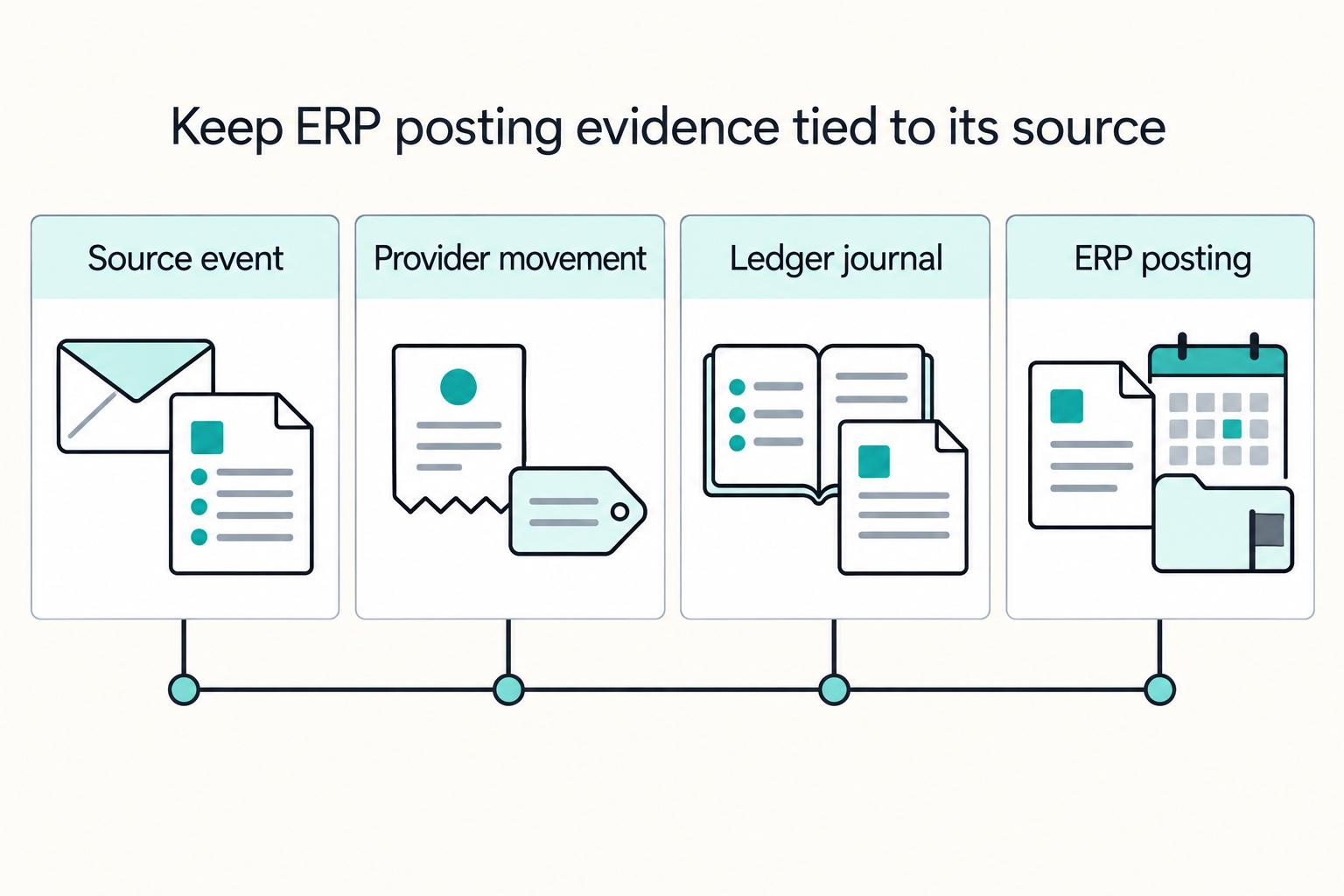
Define a minimum evidence pack so reviewers can trace what happened without rebuilding the story from logs. Audit evidence quality depends on relevance and reliability, so each posted movement should keep trace links together.
At minimum, keep these references together in the same evidence trail:
- Source event ID, such as a Stripe event ID
- Provider movement reference, including payout ID where applicable
- Internal platform transaction or payment ID
- General ledger journal link or journal identifier
- Cloud ERP posting or document reference
- Exception queue or dead-letter queue reference for unresolved items
Dead-letter references matter because they preserve a concrete trail for messages that were not delivered or not processed.
Write operator handling for the breaks you know will happen#
Define operator procedures for missing webhooks, stale statuses, and close-timing drift before go-live. Those breaks are easier to contain when the response path is already documented.
| Break | Handling | Key note |
|---|---|---|
| Missing webhooks | Use duplicate-safe processing plus replay handling | Stripe may resend undelivered events for up to three days, and it advises returning success for already processed events to stop retries |
| Stale statuses | Compare provider status timestamps with ledger and ERP posting timestamps | If provider state is final but no journal or posting link exists, route the item to an exception queue |
| Timing drift at close | Make period-date precedence explicit | Example precedence: event date versus settlement date versus imported bank date versus ERP posting date |
For missing webhooks, make sure your consumer tracks event ID processing state. Stripe may resend undelivered events for up to three days, and it advises returning success for already processed events to stop retries. Without event ID processing state, replay can create duplicate accounting side effects.
For stale statuses, compare provider status timestamps with ledger and ERP posting timestamps. If provider state is final but no journal or posting link exists, route the item to an exception queue instead of leaving close to manual inbox triage.
For timing drift at close, make period-date precedence explicit, for example event date versus settlement date versus imported bank date versus ERP posting date. If that precedence is unclear, teams can generate false breaks that look like missing money.
Set compliance and control boundaries by program and market#
Lock compliance ownership early. One global control design is not enough for cross-border payment programs. Jurisdictions supervise payment activity differently, and international AML/CFT standards are meant to be adapted to each country context.
Treat this as a boundary decision during implementation. Your payment team remains responsible for compliance in the payment data path. In many operating models, ERP receives approved outcomes and control status for reporting and downstream controls, while market-specific verification logic stays in payment operations.
Keep the sensitive checks near payment operations#
Where programs use this split, keep high-sensitivity verification and payout gating in the payment service with live operational context, then send only required outputs to ERP. In practice, that means ERP gets decision outputs such as status, reason, approver reference, and posting impact, rather than the full verification workflow.
This can keep market-by-market changes manageable and limit unnecessary spread of sensitive verification data. Verification requirements can differ by country, so embedding one fixed model in ERP can create avoidable rework.
Treat policy as configuration, not ERP customization#
If controls differ by market or program, consider keeping policy in API-exposed services rather than ERP scripts and custom fields. That can make policy updates operationally safer and avoid turning each control change into an ERP release.
Document three items explicitly so ERP consumers know what they can rely on:
- Decision owner by service
- Which decision fields ERP can treat as authoritative
- The audit trail linking policy decisions to payouts, journals, and incident records
Without that, teams can see an approved status in ERP but still be unable to trace the underlying check.
Know what SOC 2 proves and what it does not#
Use SOC 2 as evidence about controls at a service organization across trust-service areas. Do not treat it as a substitute for local legal analysis or proof that one control set works in every market. If this is a recurring enterprise ask, see SOC 2 for Payment Platforms: What Your Enterprise Clients Will Ask For.
Also set program-specific approval boundaries up front. Some platform programs require compliance review or pre-approval before materials are released, which reinforces that control mechanics vary by program and provider.
Get sign-off before production, not after launch#
Before rollout, get cross-functional sign-off on control ownership, retention ownership, and incident traceability, with participants based on the program and market. Define which records and logs must exist to investigate payout decisions later.
If you cannot show which policy decision fired, who approved exceptions, and where related logs are retained, the boundary is not production-ready even if the ERP integration appears complete.
Sequence implementation so you do not create platform debt#
Once control boundaries are set, sequence is your main debt-control lever. First lock the minimum operating model across the ledger, ERP, and orchestration layer, then integrate high-risk money paths, then add recovery and payables automation.
A phased approach is standard in ERP implementation. It matters even more for payment platforms, where asynchronous events and accounting effects can create expensive rework if contracts are loose.
| Phase | What to lock down | Gate before moving on | Failure pattern if skipped |
|---|---|---|---|
| 1 | Ownership map for the ledger, ERP, and the orchestration layer | One authoritative owner for each key status and posting outcome | Status and posting conflicts across systems |
| 2 | High-risk money paths with idempotent API behavior, webhook intake, and matching checks | Safe retries, duplicate-event handling, repeatable transaction-to-accounting matching | Duplicate posting, stale statuses, close-cycle breaks |
| 3 | Dunning and AP automation on top of stable posting and exception handling | Core posting and exception handling stay stable through close | Automation runs on unstable balances and states |
Phase 1 before money-path integration#
Your first deliverable is the baseline model, not code: which layer executes, which layer owns controls, and which layer is accounting truth. A common pattern is ERP for core business process, an orchestration layer for provider coordination and execution, and a ledger for internally consistent postings.
Before building integrations, verify each key status has one canonical owner and one consumer path. Also map third-party integrations and data handoffs now so later changes do not turn into ERP customization by default.
Phase 2 on high-risk event paths#
Start with paths that carry direct accounting impact and depend on asynchronous updates. Webhooks are asynchronous and can deliver duplicate events. You need idempotent API retries plus duplicate-event handling to prevent one business event from producing two accounting effects.
Run replay and retry checks before go-live. Retry the same request with the same idempotency key, replay a duplicate webhook event, and confirm matching still produces one matched transaction-to-accounting result. Keep operational evidence per posted event: API request identifier, webhook event reference, and matching record.
Phase 3 after core close behavior is stable#
Add dunning and AP automation only after posting and exception handling are stable. Dunning has ordered subprocesses, so unstable upstream receivable states can cascade into downstream reminder and balance issues. If you need a deeper breakdown, see What Is Dunning? A Platform Operator's Guide to Recovering Failed Recurring Payments.
For ERP customization, use a stability gate before adding new custom objects: wait until matching on existing mappings has proven stable across multiple close cycles. Treat that as a practical decision rule, not a universal law.
Red flags that usually signal expensive rework#
If ERP starts acting like your real-time transaction engine, you are probably blurring boundaries that are cheaper to keep separate. ERP is built to manage and simplify business processes and workflows, while the orchestration layer is built for rule-based routing, processor selection, and retry behavior.
ERP is doing execution work it does not need to own#
Red flag: ERP is being asked to pick processors, run failover, or absorb provider-specific status churn. The orchestration layer is designed for routing rules, for example by country, currency, or amount, and for retry across processors. ERP integration flows can be bulk import and export with callback and error-notification behavior.
Before you build, use one ownership test: for each money movement and status change, name one owner. Keep approvals, accounting output, and enterprise reporting in ERP. Keep near-real-time provider routing and failure handling outside ERP, then feed results back in.
Webhook replay behavior is undefined#
Red flag: replay behavior is not defined before launch. Webhooks can be delivered more than once, so duplicate handling cannot be deferred.
You need both controls at the boundary.
- API retries use an idempotency key so the same request does not create duplicate side effects.
- Webhook consumers track processing state and commit the deduplication record with the local effect it protects; remote writes also need endpoint-specific recovery.
Before go-live, replay the same API request with the same idempotency key and replay the same webhook event, then confirm a single downstream accounting outcome. Keep per-event evidence such as request ID, webhook event ID, and matching or payout reference.
genAI is leading the demo#
Red flag: generative AI capabilities dominate the evaluation before core integration proof is clear. ERP vendors, including SAP, do position genAI as product innovation, but that should not come ahead of API coverage, matching outputs, callback and error handling, and payout reconciliation behavior.
If those integration basics are not clear, treat the AI story as secondary until they are. Caution around newer agentic ERP claims points the same way: supervised autonomy and ROI clarity still matter, but integration boundaries come first.
Run this vendor checklist before signing#
Use this checklist to force proof on integration, close, and ownership details before contract signature.
Confirm integration fit, not just feature fit#
Start from your actual cloud ERP operating model. If you need side-by-side extensions, require a clear design showing custom logic outside core ERP and integration back through supported APIs and events. For example, SAP S/4HANA Cloud Public Edition supports extensions connected through SAP-released APIs or events, and NetSuite exposes REST web services as a documented integration channel.
Treat webhook claims carefully. Documented outbound server events or released events do not prove the ERP will handle every webhook pattern from your payment stack. Your checkpoint is a working demo with your payload shape, idempotency behavior, and one replayed event.
Ask for close evidence, not dashboard screenshots#
Require proof that matching supports your general ledger close, including exception handling. Oracle close procedures explicitly include reconciling receivables balances to the general ledger, and Oracle account reconciliation tooling is positioned around automated transaction matching. Ask for evidence with sample outputs, not verbal assurances.
Request a close packet that shows how a transaction moves from event to close and includes:
- source event ID and provider reference
- journal or posting reference into the GL
- exception queue or unmatched-item view
- operator steps to clear a break without spreadsheets
If they cannot produce that packet, plan for manual side files during close.
Test adjacent depth and capture limits in the contract#
Do not assume AP automation and dunning are equivalent across vendors. Dynamics 365 Finance documents vendor invoice automation and collection-letter workflows, and NetSuite offers automated dunning through its Dunning Letters SuiteApp. Confirm which module, app, or configuration delivers each required behavior.
| Product or area | Documented point | Check to capture |
|---|---|---|
| Dynamics 365 Finance | Vendor invoice automation and collection-letter workflows | Confirm which module, app, or configuration delivers each required behavior |
| NetSuite | Automated dunning through its Dunning Letters SuiteApp | Confirm which module, app, or configuration delivers each required behavior |
| Microsoft finance and operations apps | Service protection API limits | Put API usage limits in the SOW or order form |
| NetSuite | Request limits plus script governance ceilings where execution can terminate | Put constraints in the SOW or order form |
| NetSuite SuiteScript | Map/reduce key strings under 3,000 characters and value strings under 10 MB | Call out known constraints if custom processing depends on large payloads |
Put constraints in the SOW or order form: API usage limits, customization boundaries, and failure ownership between ERP and the orchestration layer. Microsoft documents service protection API limits in finance and operations apps, and NetSuite documents request limits plus script governance ceilings where execution can terminate. If custom processing depends on large payloads, call out known constraints such as NetSuite SuiteScript map/reduce limits of 3,000 characters and 10 MB.
Before you sign, map each vendor claim to concrete API and webhook behavior plus replay handling in your environment, then review the Gruv docs.
Conclusion#
The core decision is not picking the best ERP. It is defining clear ownership boundaries between ERP, the orchestration layer, and the general ledger before implementation starts.
Those three layers serve different roles. ERP is for streamlining core business processes with centralized visibility. The orchestration layer is for connecting providers and routing payments. The GL is where accounting entries are recorded for financial statements. Blur those boundaries and you can create integration and matching risk.
For operators, keep the split practical:
- keep payment routing, webhook intake, and provider-specific execution in payment services
- keep core business process controls and centralized visibility in ERP
- keep accounting entries and financial-statement inputs in the GL
Record matching ties those layers together. Its job is to compare records, identify discrepancies, and drive resolution.
Design for non-happy-path behavior from day one. Webhook payloads can arrive out of order, with partial data, or more than once, so retry-safe writes and replay handling need to be explicit. If you use Stripe-style idempotent requests, keep the operational constraints in the spec: idempotency keys can be up to 255 characters, and keys may be removed after at least 24 hours.
Before you build, run a cross-functional working session with engineering, finance ops, and compliance, and leave with written decisions on:
- owner per status that changes money movement or accounting outcome
- matching packet format, including the identifiers and ownership needed for exception handling
- retry and replay rules at each write boundary
- sequencing plan for high-risk flows first
Do not treat that session as final architecture sign-off. Use it to force early role clarity so ownership gaps and sequencing risks are visible before field mapping and API wiring begin.
If you want a practical architecture review of ERP boundaries, payout sequencing, and reconciliation controls, talk to Gruv.
Frequently Asked Questions
What is ERP for a payment platform operator versus a traditional back-office team?
For a payment platform operator, ERP is the business control layer, not the payment engine. It typically covers reporting, accounts payable, expenses, accounts receivable, cash management, and revenue recognition. A traditional back-office team may use ERP mainly for finance operations, while a platform team also needs clean ERP outputs from payment events without turning ERP into a real-time transaction processor.
How is ERP different from payment orchestration and a general ledger?
ERP, payment orchestration, and the general ledger serve different roles, even when the GL is part of ERP. Orchestration coordinates providers, routing, and execution; the GL holds accounting entries for reporting; ERP supports broader business processes and finance controls. Consider another processor only after a confirmed failure, and resolve an unknown outcome before a new attempt.
When should we keep logic in platform services instead of moving it into ERP?
Keep logic in platform services when it is real-time, provider-specific, or driven by external events. That includes webhook intake, signature verification, idempotent retry handling, and processor routing. Move logic into ERP when the goal is finance controls, accounting output, or enterprise reporting.
What should be decided before ERP integration work starts?
Decide system ownership before mapping APIs. Define which component is the source of truth for each critical payment status, which component consumes webhooks, and which component produces journal-impacting outputs for finance. Document field mappings, retry behavior, and failure paths before code is merged.
How do we reduce integration risk across APIs, webhooks, and reconciliation?
Start with retry-safe controls. Verify webhook signatures, require idempotency keys on write requests, and test replay behavior before go-live. Handlers should ignore already processed events and return success when appropriate, and reconciliation should connect payment-side events to accounting records so exceptions are traceable.
Does genAI in ERP products change core architecture decisions?
No. AI and machine learning features can add value, but they do not replace architecture boundaries. API coverage, webhook handling, and audit evidence still determine whether the design is operationally sound.
What is the minimum go-live checklist for payouts, controls, and audit readiness?
At minimum, define ownership for payout status, document the path from payment event to ERP and GL output, and maintain a matching view for exceptions. Validate webhook signature handling, duplicate-event replay handling, and a partial-outage case where events arrive late but accounting remains clean. Keep an evidence pack for each break that shows the event-to-posting trail and the operator action used to resolve it.
Researched and edited by the Gruv editorial team. Gruv builds cross-border billing, payouts, and finance-operations software for global businesses.
Sources
- bis.org/fsi/fsisummaries/exsum_23901.htmtrusted
- csrc.nist.gov/pubs/sp/800/92/r1/ipdtrusted
- docs.stripe.com/api/idempotent_requeststrusted
- docs.stripe.com/webhookstrusted
- law.cornell.edu/wex/general_ledgertrusted
- ojp.gov/sites/g/files/xyckuh241/files/media/document...trusted
- stripe.com/resources/more/payment-reconciliation-101trusted
- stripe.com/in/resources/more/what-is-payment-orchestrat...trusted
Educational content only. Not legal, tax, or financial advice.
Related Posts

The Freelance Payment Penalty: A Modeled Audit of Platform Fees, FX Spreads, and Payout Delays
The money rarely disappears through a single, easy-to-spot fee. The real loss is stacked. A marketplace takes its commission, a processor adds a charge for international cards, a bank or payment company converts the currency at a spread, a platform holds the funds before release, and a wire sheds a little to intermediaries on the way in. Each layer looks defensible on its own, but the worker feels the combined result as a smaller deposit and a later payday.

How to Respond to a Subpoena for Business Records
Move fast, but do not produce records on instinct. If you need to **respond to a subpoena for business records**, your immediate job is to control deadlines, preserve records, and make any later production defensible.

A US Expat's Guide to Investing in UCITS ETFs to Avoid PFIC Issues
The real problem is a two-system conflict. U.S. tax treatment can punish the wrong fund choice, while local product-access constraints can block the funds you want to buy in the first place. For **us expat ucits etfs**, the practical question is not "Which product is best?" It is "What can I access, report, and keep doing every year without guessing?" Use this four-part filter before any trade: