
Quick Answer
A Payment Facilitator lets your platform onboard sellers under its own program instead of requiring each one to open a separate merchant account, and you should adopt the model only if payment control is core to your product. That control comes with ongoing responsibility for approvals, monitoring, reconciliation, disputes, and partner dependencies after launch.
What a Payment Facilitator Does#
The question is not just what a Payment Facilitator is. It is whether the PayFac model is worth the operational lift, compliance burden, and partner dependency for your platform, market, and product.
This is an operating-model decision, not just a product UX decision. Mastercard defines a payment facilitator as a service provider registered by an acquirer to facilitate transactions for submerchants. Once you take more control of the payments experience, you also take on more responsibility.
Who this guide is for#
This guide is for the teams that will live with the decision day to day: founders, product leaders, finance and operations owners, and engineering leaders running embedded and platform payments.
Product teams often focus on onboarding and seller experience. Finance and ops teams often focus on risk ownership, approvals evidence, and reconciliation when money movement goes wrong. Engineering teams feel the implementation cost: more payment-state handling, more data responsibility, and more failure paths.
What this guide helps you decide#
The goal here is decision quality, not glossary coverage: is the PayFac model right for your business?
Use this as an operating-company decision. Revenue upside or a cleaner UX can support the case, but neither is enough on its own. You also need to confirm that your team can absorb the ongoing obligations that come with a larger payment-services role.
Before you go deeper, pressure-test three points with prospective partners and internally:
- Which legal entity will sit in the program
- Which jurisdictions are in scope first
- Which responsibilities stay with the acquirer or bank partner versus your platform
The caveat that changes the answer#
There is no universal checklist that applies the same way everywhere. Requirements for licenses and approvals vary by jurisdiction, acquirer or bank partner, and program structure.
Adyen notes that PayFac offerings often fall into regulated payment services, and that licenses and approvals can be required. Discover also states that licensing rules and responsibility can vary by country and model structure. Visa's model makes the participant structure explicit: acquirer, PayFac, and sponsored merchant.
Treat this as a multi-party, regulated operating choice from day one. A practical risk is treating "becoming PayFac" like packaging, then discovering late that the hard part is approvals, partner constraints, and ongoing operations.
What a PayFac is in platform terms#
In platform terms, a Payment Facilitator means your platform aggregates merchant payment activity under its own program instead of requiring each seller to set up a separate merchant account with a traditional acquirer. Mastercard defines a PayFac as a service provider registered by an acquirer to facilitate transactions for submerchants, and Visa refers to those sellers as sponsored merchants.
For your users, the change is practical. Sellers can accept credit cards, debit cards, and other digital payments through your platform onboarding experience instead of opening their own merchant account first. In some PayFac structures, the platform can sign the merchant acceptance contract on an acquirer's behalf for sponsored merchants.
That product shift is not the same as the business shift. On the product side, you control more of onboarding and payment acceptance in your UX. On the business side, you move into payment-services activity with broader compliance and risk responsibilities that can include KYC identity checks and PCI compliance.
Use a simple checkpoint before calling it a real program: confirm who is registered, who signs the merchant acceptance contract, and who owns KYC, PCI scope, and risk monitoring for submerchants. If those answers are fuzzy, you are still evaluating packaging, not an operating model. Do not assume onboarding under your umbrella removes all submerchant obligations.
How PayFac differs from Payment Aggregator and Merchant of Record#
The core decision is simple: choose PayFac when you want more control over onboarding and settlement design, and choose MoR when you want the provider to carry more legal and compliance responsibility. A payment aggregator often sits between those models in practice. The labels are not universal across schemes and providers, so verify the contract structure before you commit.
Checkout UX can look similar across all three models while liability, compliance, and settlement responsibilities differ materially underneath. In Visa's model, a Payment Facilitator can sign a merchant acceptance contract on an acquirer's behalf and can receive and distribute settlement proceeds, which is a different operating posture from a basic referral setup.
Where the line usually sits#
A PayFac is a merchant-enablement model under your program. Mastercard describes a PayFac as a service provider registered by an acquirer for submerchants, and Visa frames the PF as a third-party agent in an acquirer-led setup. In practice, you get more say over onboarding, merchant relationship design, and funds flow, with a heavier compliance burden.
A payment aggregator also lets businesses accept payments without each business setting up its own merchant account. The aggregator typically keeps more of the merchant-account structure under its umbrella, with funds first landing with the aggregator before payout.
A Merchant of Record is the legally responsible entity for the sale transaction. That role includes financial, legal, and compliance responsibility and typically covers refunds, chargebacks, and tax calculation, collection, and remittance. In a reseller model, the MoR is also the name on the customer's card statement and the recourse party in disputes.
Side by side decision criteria#
| Decision point | Payment Facilitator | Payment Aggregator | Merchant of Record |
|---|---|---|---|
| Who owns the merchant relationship | More direct platform ownership; in Visa's model, the PF can sign the merchant acceptance contract on an acquirer's behalf | Aggregator usually owns more of acceptance setup under its umbrella account | MoR owns the seller-of-record role for the transaction |
| Who carries merchant risk | Program-specific chain; Visa says the acquirer is responsible for acts of PFs and sponsored merchants | Depends on provider terms; do not assume the platform owns this risk | MoR carries financial, legal, and compliance responsibility for the transaction |
| Who handles disputes and customer recourse | Contract-specific; verify dispute operations and escalation ownership | Provider-term specific; verify dispute ownership and escalation | MoR handles refunds and chargebacks and is the visible recourse party on statements |
| Who carries tax and transaction compliance duties | Platform burden increases, but exact duties depend on structure and market | Provider- and market-specific; verify tax and compliance split | MoR is responsible for tax calculation, collection, and remittance |
| Where settlement lands first | Visa says PF can receive and distribute settlement proceeds from the acquirer | Funds initially go to the aggregator before payout | MoR processes funds as the legally responsible seller |
| How much control your platform gains | High for onboarding and funds-flow design | Moderate, depending on provider model | Lower operational control, with more legal and compliance burden shifted to the MoR |
The check that prevents a bad choice#
Do not rely on labels alone. Use three artifacts to cut through naming confusion:
- Merchant contract: who signs the merchant acceptance contract, and on whose behalf
- Settlement path: whether funds land first with your platform program, an aggregator, or the MoR
- Customer-facing liability clues: whose name appears on the card statement, and who contractually handles refunds, chargebacks, and tax
If one team says "we are the merchant" while another says "the provider is merchant of record," pause and reconcile it. Definitions can conflict by source: Adyen's PayFac context says the platform's user is the Merchant of Record, while an FIS payments dictionary describes a PayFac as becoming Merchant of Record for smaller merchants. The label alone is not enough for architecture or contract decisions.
Practical rule for platform teams#
If your roadmap depends on deep control over onboarding, merchant relationship design, and settlement design, evaluate a Registered Payment Facilitator path. If your priority is speed to market with less legal, tax, and dispute burden on your team, evaluate Merchant of Record first.
A common failure mode is choosing PayFac for better UX, then underestimating the compliance and operational load. The opposite mistake is choosing MoR for speed, then finding the operational control trade-offs too constrained for your model.
If you are near the boundary between models, validate edge cases before locking architecture or contracts. Use the adjacent explainer: What Is a Payment Aggregator? And How Is It Different from a PayFac or MoR?.
If you're evaluating funds flow and payout timing, read Understanding Payment Platform Float Between Collection and Payout.
Why platforms choose the PayFac model#
Platforms choose PayFac for control over the payment experience, not just for promised fee revenue. If embedded payments and fewer handoffs are core to your product, PayFac can fit. If they are not, the ongoing operating load can outweigh the upside.
Taking more ownership of onboarding, settlement, and merchant experience can give you tighter product control, but it also shifts more day-to-day responsibility onto your team.
The real product upside#
A common upside in vendor positioning is a more unified product path. Adyen frames PayFac as the platform taking on payment integration so users do not need their own setup, and BILL describes a sub-merchant structure under a PayFac master merchant account. In practice, that supports a platform-controlled flow for signup, acceptance, and payment enablement instead of separate provider steps.
This case is strongest for embedded-payments use cases, where extra handoffs can hurt momentum. Carat's Fiserv-backed positioning emphasizes embedding payments into workflows. That does not guarantee conversion gains, but it can let you design onboarding and payments as one surface instead of a chain of redirects, forms, and support queues.
What each team is actually buying#
The tradeoff is cross-functional, not just commercial. A PayFac decision changes what each function actually has to own.
- Product: More control over onboarding, payment activation, and the path from signup to first transaction. Worldpay markets this as smooth, integrated payments.
- Finance: Better visibility only if you build reporting and reconciliation capability. Worldpay explicitly calls that investment out.
- Ops: Potentially fewer external handoffs for users, but more internal exception handling if onboarding, payout, or dispute events fail.
- Engineering: A single platform surface can reduce stitched-together merchant setups. Carat/Fiserv markets one platform for boarding, credit, risk, and money movement.
Before you commit, run a practical check: review a sample reconciliation flow from transaction to settlement to sub-merchant payout, then walk through one failed onboarding case, one delayed payout case, and one chargeback case. If those still depend on email and spreadsheet chasing, the operating model is not ready.
What vendor claims must become internal proof#
| Vendor | Marketed upside | What you need to prove internally |
|---|---|---|
| Adyen | Users do not need their own payment integration | You can own onboarding and exception UX end to end, and the investment is justified |
| Worldpay | New fee revenue, better UX, data visibility | Unit economics still work after compliance, chargebacks, and reporting costs, and you can own risk obligations |
| Airwallex | Faster payouts, more flexibility, more control over customer experience | Payout support, escalation handling, and settlement controls can absorb payout issues without degrading CX |
| Carat / Fiserv | One platform for boarding, credit, risk, and money movement | Clear cross-functional ownership exists across product, ops, finance, and risk |
| BILL | Master merchant account with sub-merchants under it | Sub-merchant onboarding, monitoring, data, and reporting workflows are ready for that structure |
The realism checkpoint#
Revenue upside alone is not a sufficient reason to proceed. Carat highlights a lucrative recurring revenue model and claims 20 to 40 basis points more per transaction for registered PayFacs, while Adyen cautions that revenue upside often does not match effort and cost. Both can be true, depending on your volume mix, support load, and compliance posture.
Treat approval as an operating-model decision, not a monetization feature request. Require segment-level unit economics, reconciliation proof, chargeback ownership, risk and compliance responsibilities, and named escalation coverage.
If you're comparing operating models, read MoR vs. PayFac vs. Marketplace Model for Platform Teams.
When becoming a Registered Payment Facilitator is the right move#
Becoming a Registered Payment Facilitator is the right move only when payment control is core to your product economics and your teams can run the ongoing operating model after launch.
Go/no-go rules#
Use these as hard filters, not soft preferences:
- If your monetization and roadmap depend on controlling onboarding, acceptance, transaction routing, and payout experience, evaluate the registered path.
- If those outcomes can be outsourced without hurting core product goals, defer.
- If product, finance, ops, risk, and legal can sustain recurring compliance and exception handling, a PayFac license path can be rational.
- If that operating coverage is not in place, do not force registration.
Worldpay is explicit that the platform is responsible for compliance and risk management, and can be financially liable for sub-merchant activity and chargebacks. Adyen is explicit that licenses and approvals can be required, and also argues some platforms can keep commercial control without taking the full licensed burden. Treat that as a tradeoff to evaluate, not a contradiction.
The decision lever to verify early#
The early test is straightforward: can you carry the data and accountability that come with the role?
A payment facilitator is a service provider registered by an acquirer to facilitate transactions on behalf of sub-merchants. In practice, that means operating inside an accountability chain with your acquirer, meeting card-network data obligations, and maintaining sub-merchant transaction integrity in day-to-day operations. Card schemes require specific transaction data, and in the facilitated flow those data points must map to the sub-merchant as Merchant of Record.
Before you approve launch, run one real transaction end to end and confirm required payload fields and sub-merchant records reconcile. If you cannot prove that, defer.
How the call changes by platform type#
The exact mix varies by business model, so use this as a validation frame rather than a fixed rule.
| Platform type | When registration is more rational | What usually makes it harder |
|---|---|---|
| Contractor platform | Payment control is core to your product model | Sustaining recurring compliance, risk management, and exception handling |
| Creator platform | Payment control is core to your product model | Sustaining recurring compliance, risk management, and exception handling |
| Marketplace | Payment control is core to your product model | Sustaining recurring compliance, risk management, and exception handling |
Partnership does not remove the accountability chain. Visa states acquirers remain responsible for both payment facilitators and sponsored merchants, and certification materials show a formal gate in some programs before a Payment Facilitator agreement.
Before program launch, use an internal written decision memo with named owners across product, finance, ops, risk, and legal. It should name why control is necessary, which alternative model was rejected, who owns disputes and compliance evidence, how sub-merchant transaction data will be captured, and what conditions delay launch. If you cannot align on named owners, defer.
For a step-by-step walkthrough, see How to Handle Payment Disputes as a Platform Operator.
When not to become a PayFac yet#
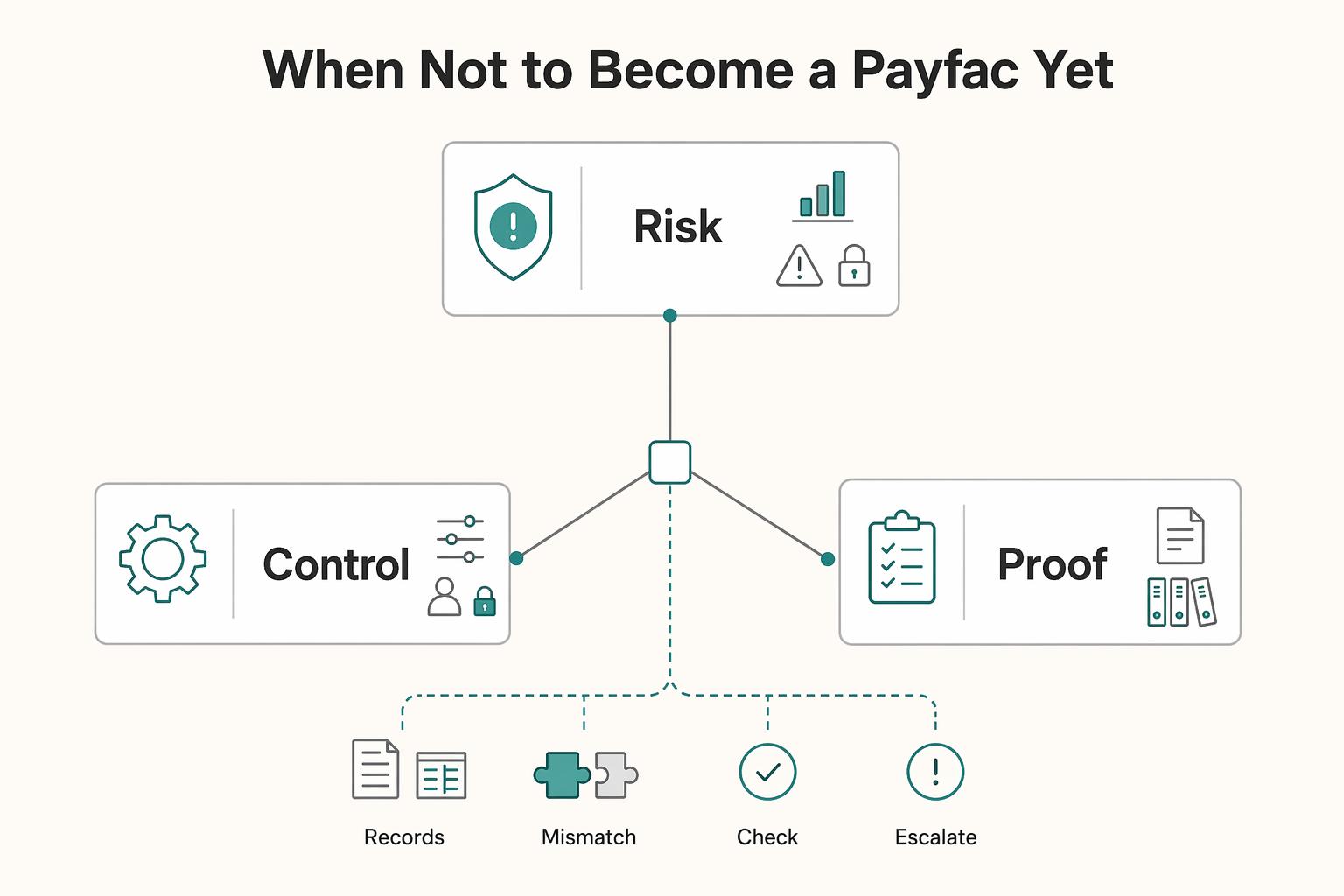
Do not become a PayFac yet if ownership is unclear for compliance, risk monitoring, dispute handling, or operational support. That is not a feature gap. It is an operating-model gap.
The disqualifiers are straightforward:
- no clear owner for compliance and risk management
- no ongoing monitoring coverage for suspicious transaction patterns
- no defined dispute-resolution or escalation path
- no durable owner for day-to-day payment operations
- no plan for required licenses and approvals over time
Use a simple gate before approval: one written evidence pack with named owners across product, ops, finance, and legal. If any owner is missing, defer.
When speed to market matters more than full control, choose a lighter route. A Payment Aggregator can reduce setup burden by letting businesses accept payments without setting up their own merchant account. A Merchant of Record can also be a better fit when you want another entity to carry transaction-level legal, financial, and compliance responsibility. If you want a side-by-side refresher, see What Is a Payment Aggregator? And How Is It Different from a PayFac or MoR?.
Treat this as an operating-model decision, not a checkout feature decision. In the PayFac model, registration and participant responsibilities sit inside acquirer and card-network frameworks, and offering these services can require licenses and approvals.
What approvals and compliance work you should plan for#
Plan for two approval tracks from day one: regulatory coverage for the services you perform, and sponsor or card-network approvals for the program structure you use. If you cannot name the in-scope legal entity, markets, payment methods, acquiring sponsor, and owner of ongoing evidence, you are not launch-ready.
The minimum compliance map#
A PayFac model often puts you into regulated payment services, so a processor contract alone may not be enough on its own. Build one map that ties together the activity, the legal entity performing it, the approvals or registrations that may apply, and the ongoing controls required after go-live.
Do not miss the sponsor layer. Visa's model centers on the acquirer, the payment facilitator, and the sponsored merchant, and Mastercard requires an acquirer to register a service provider as a payment facilitator. Treat that as a dependency, not a substitute for your own regulatory obligations.
What varies by jurisdiction and program#
There is no universal PayFac license. Requirements vary by market, entity structure, service scope, and payment method.
These regulatory regimes show why:
- UK pathways for payment and e-money services sit under the Payment Services Regulations 2017 and Electronic Money Regulations 2011.
- BaFin's PSD2 framing in Germany covers both authorization or registration and ongoing supervision.
- In US MSB treatment, you should expect an AML compliance program and registration renewal each two-calendar-year period by filing Form 107.
The practical move is a jurisdiction matrix before launch. For each market and payment method, record the in-scope entity, whether you rely on sponsor coverage or your own authorization or registration path, and the recurring obligations after approval.
The artifacts you should have by phase#
Use this as a minimum evidence pack, then adapt labels to your program.
| Phase | Required artifacts | Verify before moving on |
|---|---|---|
| Pre-launch documents | Jurisdiction/activity matrix; legal-entity responsibility memo; sponsor/acquirer dependency map; card-network registration plan; PCI scope decision memo | Confirm in writing which entity is the PayFac, which markets/payment methods are in scope, and sponsor alignment to that structure |
| Onboarding controls | Merchant onboarding policy; required data fields; review rules tied to sponsor and regulatory requirements; escalation path for higher-risk applicants | Validate onboarding collects what sponsor, network, and compliance owners need before processing starts |
| Monitoring evidence | AML program materials where applicable; transaction-monitoring evidence; ongoing supervision logs; payment-data handling control reviews | Confirm monitoring is continuous and owned, not just documented once |
| Renewal and attestation records | Current regulator filings/correspondence; network-registration maintenance records; Attestation of Compliance (AOC); ROC Template v4.0.1 evidence path where required | Verify owners, due dates, and the exact form required for your role, including PCI DSS AOC - Merchants v4.0.1 or PCI DSS AOC - Service Providers v4.0.1 |
Two points are easy to underestimate. PCI DSS v4.0 is continuous work, not a one-time project, and AOC is a formal declaration tied to assessment results. And as payments compliance leader Chris Bucolo puts it, early scope decisions can "have a dramatic impact on the costs for that company to comply with the security standard's requirements."
Before launch, ask for evidence, not assurance. You should be able to immediately produce sponsor confirmation, the current jurisdiction matrix, named monitoring owners, and the active PCI attestation path. Coverage will still differ by market and program, so treat approvals as market-by-market and entity-by-entity decisions, not a template you copy everywhere.
What changes across product, finance, ops, and engineering#
Passing approvals gets you to launch; clear operating ownership keeps you stable after launch. In a PayFac model for embedded payments and platform payments, each payment state change, settlement movement, and exception needs one accountable owner.
Who owns what in practice#
Many failures surface between teams, not inside one team. A practical split is: product owns merchant and payer experience, finance owns settlement and reconciliation truth, ops owns exceptions and escalations, and engineering owns reliable event handling and data integrity.
| Function | Primary ownership | What good looks like |
|---|---|---|
| Product | UX, onboarding flow, required data capture, user-facing status language | Onboarding collects only fields downstream controls use, and user-facing statuses match backend states |
| Finance | Settlement controls, reconciliation, ledger mapping, payout review | Every payout ties back to transaction history and ledger entries, not only provider dashboard totals |
| Ops | Exceptions, support handling, escalation, queue management | Teams can see failed onboarding, delayed webhooks, payout mismatches, and open provider cases in one place |
| Engineering | Reliability, retries, event processing, auditability | Retries do not create duplicate side effects, and every status change is traceable from API event to ledger posting |
Use one practical boundary: product explains flow, finance proves money movement, ops drives case resolution, and engineering makes sure the system behaves predictably under retries and delays.
Controls you should not negotiate away#
These controls are baseline because providers confirm key events asynchronously and may redeliver webhooks over multiple days.
- Idempotent retries: retries for create or update requests must not create duplicate charges, payouts, or ledger entries.
- Webhook deduplication and reconciliation: log processed event IDs, skip duplicates, and reconcile so missed events do not leave internal state behind provider state.
- Traceable ledger postings: every posting should reference the payment, payout, refund, fee, or dispute event that created it.
- Auditable status transitions: keep a timestamped trail of what moved a payment between states.
Pre-launch checkpoint: trace sample transactions from provider event to internal payment record to ledger posting to payout, then back again. If your provider gives transaction-level settlement artifacts such as a Settlement details report, finance should use them in reconciliation.
Failure modes to design before launch#
Design for delayed and repeated events, not just happy-path API responses. Stripe can resend undelivered webhook events for up to three days; Adyen retries three times immediately, then can continue from a queue for up to 30 days. Ops needs queue visibility and escalation paths, not just engineering alerts.
Mismatched settlement records are the finance-side equivalent: payouts land, but refunds, fee adjustments, or disputes are missing from internal rollups. If finance cannot explain deltas from transaction history and settlement reporting, support operations become harder to manage.
Dispute ownership is also configuration-dependent. In some setups, the platform is responsible for disputes, and unresolved connected-account negative balances can transfer from reserve after 180 days. As one marketplace operator put it, "We knew we wouldn't be able to handle funds ourselves." Treat that as an operating-model decision, not a UI decision.
Related: How Modern CFOs Make Payment Platform Expansion a Strategic Driver.
The technical and data checkpoints before launch#
Launch only when you can prove three things: duplicate-safe event handling, payout-to-ledger tie-out, and least-privilege access to sensitive data.
Start with the records that must reconcile#
Start with reconciliation outcomes, then build outward. Plan onboarding, event modeling, ledger mapping, and reconciliation outputs together before scale testing.
Onboarding choices shape which merchant and beneficiary fields you capture. The event model determines how asynchronous payment and payout changes land in your system. Ledger mapping turns those state changes into money-movement records. Reconciliation outputs show whether those records match provider settlement artifacts and bank payouts.
Payment flows are asynchronous, so treat provider events as state-change inputs, not only synchronous API responses.
Put verification checkpoints in writing#
Before launch, require explicit owners and pass-or-fail checks for:
- Event deduplication: store processed event IDs and make handlers safe for redelivery. Undelivered events can be retried for up to three days, so already-processed events should still return success to stop retries.
- Settlement-to-ledger tie-out: prove each payout traces to transactions and related adjustments. One practical check is listing payout-linked balance transactions with the
payoutparameter and matching them to internal ledger entries, or equivalent payout reconciliation reporting. - Status drift alerting: define how you will detect and triage internal payment or payout status drift from provider state after delivery failures or partial processing.
Also apply idempotency to outbound create or update calls, not just inbound webhooks. Idempotency keys can be up to 255 characters and may be pruned after at least 24 hours; unstable retry keys can increase duplicate-request risk.
Keep less data, show less data, restrict more access#
Use data minimization for onboarding and payment data. Avoid storing payment card data unless necessary, do not store sensitive authentication data, and mask or truncate displayed card data. Keep payloads to what support, reconciliation, and audit actually require.
Apply least privilege and business need-to-know across onboarding documents, card-related data, and payment operations views. Broad shared console access may speed launch, but it can increase exposure and complicate audits.
Scope can expand fast when you take on PayFac responsibilities#
Your business model choice changes implementation scope, and terminology varies by source. A Payment Aggregator uses a shared merchant account umbrella model. A PayFac is registered through an acquirer to facilitate transactions for submerchants, and network materials describe the PayFac role as potentially owning the merchant relationship directly and receiving or distributing settlement proceeds.
That is why complexity can rise when you take on PayFac responsibilities: more onboarding and merchant-status handling, more settlement responsibility, and a higher evidence burden for finance reconciliation. If you are still deciding, validate that choice before you expand build scope in parallel with this comparison.
If moving toward PayFac infrastructure means building your own system of record, How to Build a Deterministic Ledger for a Payment Platform covers the ledger design behind accurate balances and reconciliation.
A practical first 90 days decision and readiness checklist#
In the first 90 days, make one decision early and make everything else prove it: should you run as a Payment Facilitator or use a potentially lower-lift model such as Merchant of Record?
Weeks 1 to 2#
Lock the target model first: PayFac or MoR. This is an operating and liability decision, not a branding choice. A PayFac is registered by an acquirer to facilitate transactions for submerchants, while the MoR is the entity legally authorized and responsible for processing customer payments.
Set explicit go or no-go criteria before solutioning:
- If you need direct control over submerchant onboarding and settlement operations, continue evaluating PayFac.
- If you cannot yet sustain compliance, reconciliation, and support ownership, treat MoR as a serious path.
Write owners next to each criterion. If ownership is still unclear after two weeks, pause the PayFac path and reassess with PayFac vs aggregator vs MoR.
Weeks 3 to 6#
Now build the evidence pack for approvals and operational readiness. Keep it specific to your program and jurisdictions, because requirements are context-dependent and must be evaluated against applicable laws and regulations.
Include:
- Jurisdiction and entity map
- Sponsor or acquirer dependency list
- Submerchant onboarding control summary
- Support SOPs for onboarding failures, payment failures, refunds, disputes, and payout exceptions
- Escalation ownership by function, with a named first responder and decision-maker
- Reconciliation evidence showing bank payouts tied to settled transaction batches
One hard checkpoint: for Mastercard rails, PayFac status requires acquirer registration. If that registration path is not clearly represented in your plan, you are not launch-ready.
Weeks 7 to 10#
This is where technical readiness either holds up or breaks down. Validate controls under failure, not just happy-path flows. Test onboarding, authorization, and settlement behavior when events are late, duplicated, or partially processed.
At minimum:
- Simulate failures with test payment scenarios
- Prove webhook deduplication by logging processed event IDs and skipping already-logged events
- Prove outbound retry safety with idempotency keys
- Reconcile settlement outputs to bank payouts using payout reconciliation artifacts
- Confirm exception ownership for operations and finance
Do not rely on API success alone. If retries are unstable or dedupe is weak, duplicate operations and records can be created.
Weeks 11 to 12#
Run an executive checkpoint with three valid outcomes: launch, delay for gap closure, or select a lower-burden model.
Require evidence, not summaries:
- Approvals path by jurisdiction
- Settlement-to-bank tie-out
- Support SOPs and escalation ownership
- Duplicate-safe event processing and retry protection, including idempotency key handling aligned with documented key-retention behavior (for example, keys may be pruned after at least 24 hours)
If any one area is weak, delay is usually cheaper than launching into preventable exceptions.
If your checklist points to a lower-burden path over taking on direct transaction liability and compliance operations, review the practical MoR path in Gruv's Merchant of Record guide.
Make the PayFac decision with evidence not ambition#
Become a PayFac only when the control benefits clearly outweigh the ongoing compliance load, registration dependencies, and operating cost after go-live. If the case is mostly "more control would be nice," the evidence is usually not strong enough.
A PayFac model can improve onboarding ownership and payment operations control. It also brings regulated-service exposure, partner due diligence, and ongoing compliance and exception handling after integration.
Build the decision on an evidence pack#
Run one cross-functional checklist, document gaps, and force the model choice from that evidence. Product, finance, ops, engineering, and legal should sign the same memo. If any team cannot name owners, controls, and escalation paths, you do not have a launch decision yet.
Your evidence pack should cover four areas:
- Control case: which exact capability requires the registered route, for example onboarding ownership, settlement design, or monetization structure
- Compliance case: which licenses, approvals, sponsor or acquirer dependencies, and card-network registrations apply in each target market and program
- Operating case: who owns disputes, refunds, merchant support, reconciliation, and ongoing approval upkeep
- Implementation case: what sequence and timeline are realistic for the selected model
Use registration feasibility as a hard checkpoint. Mastercard states that an acquirer must register a service provider as a payment facilitator, and Visa guidance similarly points to acquirer registration after due diligence. If you cannot show a credible acquirer and program-registration path, do not treat a registered model as your default plan.
Pick the model that matches the evidence#
| Model | Choose it when | Verify before committing |
|---|---|---|
| Registered Payment Facilitator | Payment control is central to product and margin strategy, and you can carry the ongoing operating burden. | Settlement-to-bank tie-out, named owners for failures, and a documented plan for ongoing approvals and monitoring. |
| Merchant of Record | You prioritize faster execution and may prefer lower direct compliance ownership over full control. | Liability assignment is explicit: the MoR has legal responsibility for the transaction, including disputes and refunds. |
| Payment Aggregator or partner-led facilitation | You want some PayFac-like benefits without taking the full registered burden directly. | Jurisdiction-specific obligations are confirmed and not generalized across markets. |
Two checks are non-optional. First, do not assume MoR positioning is identical across all PayFac setups; sources describe different role assignments, so confirm exact liability and merchant-role mapping with partners. Second, confirm market and payment-method coverage early, because provider support can vary by market, program, and payment method.
Use timeline as a sanity check, not a promise: one provider comparison shows materially different windows by model, from 0-1 month to 2-4 months and 9-12 months. If your plan does not match that burden profile, revisit the model choice.
If you are narrowing options with Gruv, talk to sales first to confirm coverage by market and program. Then validate implementation sequencing in the technical docs before build-out.
Related reading: The Gig Economy in 2026: Payment Volume Trends Contractor Growth and Platform Consolidation.
After you lock your model decision, use Gruv docs to map implementation order for onboarding, event handling, and reconciliation controls.
Frequently Asked Questions
What is a PayFac in one sentence for platform leaders?
A Payment Facilitator lets your platform aggregate payment processing for users or submerchants under your program instead of requiring each one to set up separately. That can shift more onboarding and payment operations into your platform and bring you closer to regulated payment services.
How is a Payment Facilitator different from a Payment Aggregator and a Merchant of Record?
A payment aggregator lets businesses accept payments under a shared merchant account structure. A PayFac is often treated as a type of aggregator with broader service scope and more platform control over onboarding and settlement design. A Merchant of Record is different because it is the legal entity responsible for processing customer payments and for the financial, legal, and compliance aspects of the transaction. Because the labels are not universal, verify the merchant contract, settlement path, and liability before you commit.
Should my platform become a Registered Payment Facilitator now or later?
Decide based on readiness, not urgency. If ownership is still unclear for compliance, risk, support, reconciliation, or sponsor-acquirer dependencies, defer. If control over onboarding, acceptance, transaction routing, and payout experience is core and your operating coverage is in place, the registered path can be rational.
What regulatory licenses and regulatory approvals are typically involved?
There is no universal checklist. Requirements vary by jurisdiction, entity structure, payment method, acquirer, and card-network program. What is consistent is that PayFac offerings often involve regulated payment services, and an acquirer must register a service provider as a payment facilitator. You also need to plan for sponsor or card-network approvals and ongoing evidence after go-live.
Can we get PayFac-like benefits without taking full regulated payment services burden?
Sometimes. Some providers position partner models and PayFac-as-a-Service as ways to pursue similar goals without full self-registration. Do not assume those options have the same economics, control, or liability profile as a fully registered model.
What is the biggest operational surprise after launching a PayFac model?
The biggest surprise is often the ongoing compliance and risk management work after go-live, not the API integration. Teams also need clear ownership for exceptions, reconciliation, disputes, and escalation once the model is live.
Try a related tool
Researched and edited by the Gruv editorial team. Gruv builds cross-border billing, payouts, and finance-operations software for global businesses.
Sources
Includes 1 external source outside the trusted-domain allowlist.
- csrc.nist.gov/glossary/term/least_privilegetrusted
- docs.stripe.com/api/idempotent_requeststrusted
- docs.stripe.com/webhookstrusted
- irs.gov/businesses/small-businesses-self-employed/mo...trusted
- middlebury.edu/sites/default/files/2025-01/PCI-DSS-v4_0_1.pdftrusted
- stripe.com/resources/more/merchant-of-recordtrusted
- stripe.com/resources/more/payment-facilitator-vs-paymen...trusted
- adyen.com/en_GB/knowledge-hub/payfacexternal
Educational content only. Not legal, tax, or financial advice.
Related Posts

The Freelance Payment Penalty: A Modeled Audit of Platform Fees, FX Spreads, and Payout Delays
The money rarely disappears through a single, easy-to-spot fee. The real loss is stacked. A marketplace takes its commission, a processor adds a charge for international cards, a bank or payment company converts the currency at a spread, a platform holds the funds before release, and a wire sheds a little to intermediaries on the way in. Each layer looks defensible on its own, but the worker feels the combined result as a smaller deposit and a later payday.

How to Respond to a Subpoena for Business Records
Move fast, but do not produce records on instinct. If you need to **respond to a subpoena for business records**, your immediate job is to control deadlines, preserve records, and make any later production defensible.

A US Expat's Guide to Investing in UCITS ETFs to Avoid PFIC Issues
The real problem is a two-system conflict. U.S. tax treatment can punish the wrong fund choice, while local product-access constraints can block the funds you want to buy in the first place. For **us expat ucits etfs**, the practical question is not "Which product is best?" It is "What can I access, report, and keep doing every year without guessing?" Use this four-part filter before any trade: