
Quick Answer
W-8ECI documents a qualifying ECI claim; W-8BEN documents foreign individual beneficial-owner status. For nonresident individuals claiming a withholding exemption on personal services performed in the United States, review Form 8233 or W-4 instead. A U.S. customer alone does not decide the form.
Treat W-8ECI vs W-8BEN as a classification decision first#
Choose tax documents by payee status, income type, and service facts before scheduling a foreign contractor payout. A signed form does not resolve a mismatch between the payment and the tax treatment.
The high-stakes question is narrower than "do we have a form on file?" It is whether the payee and the payment belong on the right W-8 path in the first place. When your team gets that call wrong, the problem rarely stays neat. It can turn into withholding surprises, payout delays, disputes with the payee, and an audit trail showing the form was collected without a clear reason for choosing that path.
Foreign individuals generally give Form W-8BEN to the requesting payer or withholding agent, rather than filing it with the IRS. That certificate documents foreign beneficial-owner status; it does not establish that every payment qualifies for the same withholding treatment.
You should not force every foreign payee into the same intake lane. The IRS requester instructions are organized across Form W-8BEN, Form W-8BEN-E, Form W-8ECI, Form W-8EXP, and Form W-8IMY. In practice, your first checkpoint is not "do we have a W-8 on file?" It is "do we have the right W-8 path for this payee type and income pattern?" A foreign entity may belong on Form W-8BEN-E, not the individual form. That distinction should be caught before payout approval.
A useful intake control is simple: verify that the payee profile, entity status, contract narrative, and payout description all point in the same direction before the payer confirms withholding treatment. If those facts are mixed, incomplete, or inconsistent, do not let an auto-classifier guess its way into a tax form decision. Pause, document the uncertainty, and escalate before release. Slowing one payout is usually cheaper than unwinding a bad form choice across the whole payee relationship.
This comparison helps payout teams route intake for review. It does not determine whether a contractor has a U.S. trade or business or whether particular income is effectively connected.
W-8ECI vs W-8BEN at a glance#
Form W-8ECI documents a qualifying effectively connected income claim. Form W-8BEN documents a foreign individual’s beneficial-owner status for other covered income. There is an important contractor exception: the IRS directs nonresident individuals claiming a withholding exemption for personal services performed in the United States to Form 8233 or Form W-4, as appropriate, rather than W-8ECI.
| Decision point | Form W-8ECI | Form W-8BEN |
|---|---|---|
| Income type | Qualifying ECI claim, subject to the form’s exceptions, including individual U.S. personal services | Foreign individual beneficial owner status for U.S. withholding and reporting (not the ECI claim form) |
| Who signs | Qualifying foreign beneficial owner or covered entity; not limited to individuals | The foreign individual beneficial owner (foreign person using the individual form) |
| Who receives it | The withholding agent or payer, not the Internal Revenue Service | The withholding agent or payer when requested, not the Internal Revenue Service |
| Withholding posture | Treat as an ECI claim path, not a generic foreign-status certificate | Treat as the individual foreign beneficial owner path for withholding and reporting analysis |
| Operational next step | Verify income type and exceptions before collecting W-8ECI | Verify individual beneficial-owner status and whether a different income-specific form applies |
| Escalation trigger | Mixed U.S.-activity facts, inconsistent contract/invoice language, unclear beneficial owner, or profile mismatch with an ECI claim | Any U.S. trade-or-business indicator, signs the payee is an entity, or facts suggesting an intermediary/special-status path |
| Known unknowns | Validate edge-case interpretation against official IRS form instructions and specialist advice | Validate edge-case interpretation against official IRS form instructions and specialist advice |
Operational callout: these forms are generally provided to the withholding agent or payer during intake, not filed directly with the Internal Revenue Service.
Do not force every foreign payee into these two forms. IRS requester instructions also cover Form W-8BEN-E, Form W-8EXP, and Form W-8IMY, so if the payee is not an individual beneficial owner or the relationship looks like an intermediary or other special-status case, stop and re-route before payout approval.
For a step-by-step walkthrough, see W-8ECI for Platforms Handling Foreign Contractors With Effectively Connected US Income.
The decision rule that actually controls form choice#
Classify the payment before selecting the certificate. First identify whether the payee is an individual, entity, or intermediary, then establish the income type and activity facts. For an individual’s U.S. personal services, use the separate 8233/W-4 review path described above; do not route automatically to W-8ECI.
A U.S. client or U.S. bank account alone does not establish where services were performed or settle the income classification. Record the actual service locations and dates rather than inferring them from the customer address.
Before approval, check for one consistent story across contract scope, activity facts, invoice narrative, and payout description. If the record is mixed or incomplete, treat that as a control failure: do not auto-issue Form W-8ECI, and pause payout for tax or legal review rather than guessing.
A W-8ECI claim also does not remove every withholding regime. Partnership income, partnership-interest transfers, and U.S. real-property transactions have separate rules. Keep those cases outside the routine contractor-service workflow and assign specialist review.
Record the income-specific reason for the form choice. If one payee receives different income types, do not apply a certificate for one payment category automatically to the entire relationship.
The intake evidence your team needs before classifying#
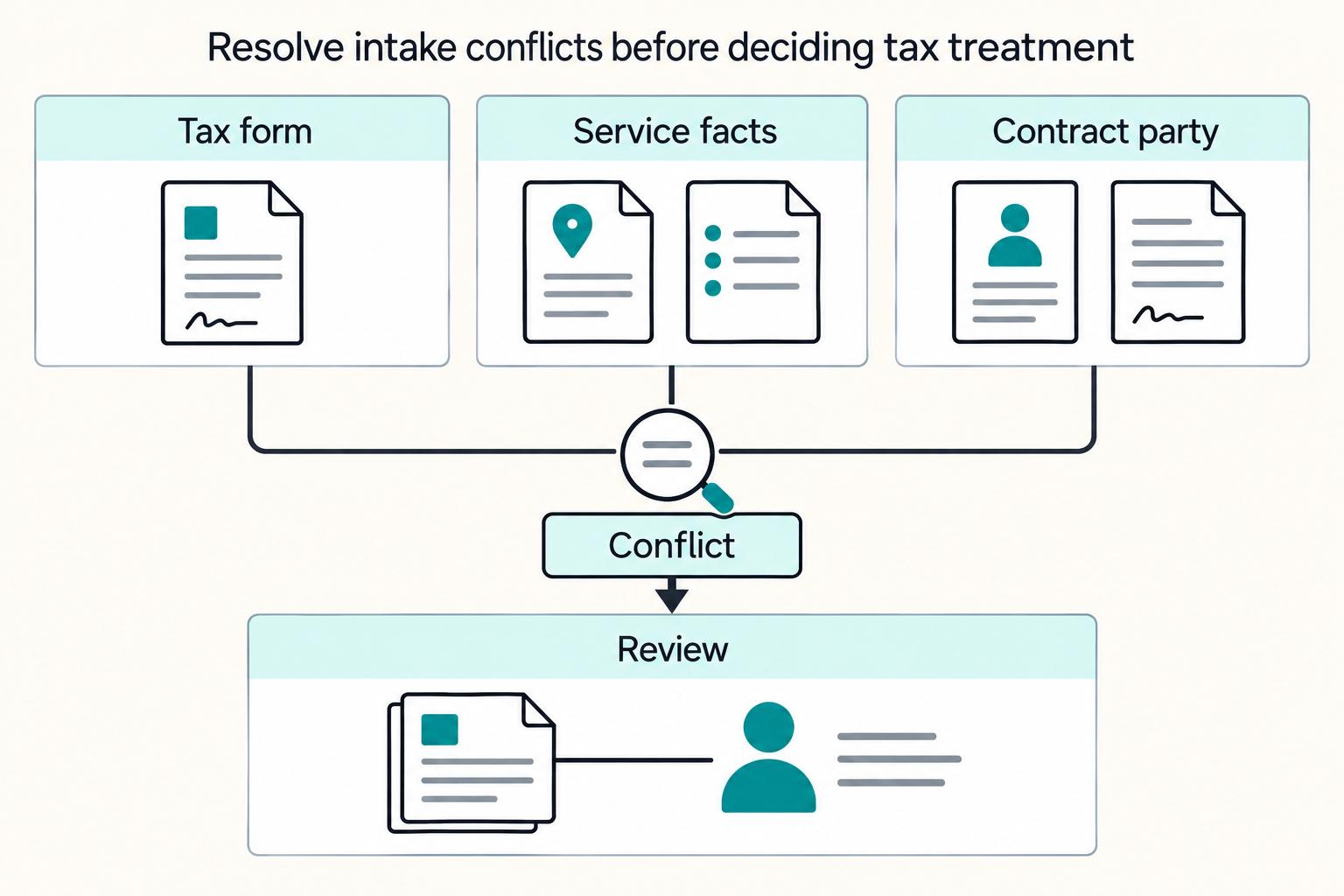
Classification is only as reliable as the intake file, so do not confirm withholding treatment until the form, onboarding data, invoice, and payout instruction tell one coherent story.
Treat the checklist below as an internal control standard. IRS Publication 515 explains withholding-agent responsibilities; the relevant form instructions determine which certificate fits the payment.
| Evidence item | Control owner | Classification use |
|---|---|---|
| Signed tax form | Compliance ops | Documents the approved payment-specific route, including 8233/W-4 where applicable. |
| Service location facts | Compliance ops, escalate to legal if mixed | Records where and when services occurred; triggers individual U.S. personal-services review when applicable. |
| Contract scope and named party | Legal | Confirms who is providing services and in what capacity; resolves party mismatches before form selection. |
| Payee status (individual vs foreign entity) | Compliance ops, legal for exceptions | Separates individual, entity, intermediary, and applicable income-specific routes. |
| Beneficial-owner alignment in file | Compliance ops + finance pre-payout check | Verifies payee identity, contract party, and payout beneficiary align before withholding treatment is finalized. |
Before payout release, run one verification checkpoint across the onboarding profile, invoice narrative, and payout instruction. If they conflict, pause classification and escalate rather than treating the form as a cure for missing or inconsistent facts.
For defensibility, keep a compact decision trail in the payout record: classification outcome, decision timestamp, reviewer, short rationale, and links to the artifacts used for the call.
For the W-8BEN-E foreign TIN branch, read What UK Companies Should Enter in Foreign TIN on Form W-8BEN-E.
How to run the process from onboarding to payout without rework#
Classify the form path before the first payable event. If you wait until payout scheduling or month-end cleanup, you usually get backfills, reversals, and a weaker audit trail.
IRS withholding-agent FAQs can support this workflow design, but only as awareness guidance. They describe suggested practices for identifying payments subject to reporting and withholding, and they are not legal authority.
| Stage | What to do | Primary control | If it fails |
|---|---|---|---|
| Onboarding | Collect tax profile and core payee facts | Tax-document collection in onboarding | Keep payout inactive until required intake or a lawful withholding-agent exception is approved |
| Policy check | Run checks on profile, contract, invoice story, and payout instruction | Pre-payable policy gate | Route mismatches to review |
| Form-path classification | Approve the payment-specific document path, including exceptions | Required classification field before payment processing | Block payment until classification is approved |
| Withholding setup | Apply reporting/withholding treatment that matches the approved path | Pre-disbursement validation | Stop release if treatment is missing or inconsistent |
| Payout release | Reconfirm invoice and payout details still match the approved file | Final disbursement gate | Send unresolved ECI facts to an exception queue |
Put controls where data first enters, not in late reconciliation. Use month-end for exception detection, not first-time classification decisions.
Escalation triggers your team should not ignore#
Escalate conflicting income facts, unsupported treaty claims, or unclear payee capacity. References to other reporting regimes should prompt a specific applicability question, rather than an automatic payout hold merely because a term appears in a file.
Compare the signed Form W-8, contract party, invoice narrative, and onboarding service-location facts side by side. If those records conflict, do not release payment until the conflict is resolved and documented.
| Escalation trigger | Why it should not stay in routine ops review | What evidence to require before release |
|---|---|---|
| Mixed ECI and non-ECI indicators in one payee relationship | Competing facts can lead to different withholding and reporting outcomes | Signed form, contract scope, service-location detail, invoice support, and reviewer rationale tied to the payout record |
| Treaty claim raised (for example, Korea-U.S. tax treaty) but facts are thin or contradictory | Treaty language alone does not resolve missing residency, beneficial owner, or activity facts | Written claim summary, residency support, beneficial owner alignment, and legal or tax review note |
| A specific unresolved reporting obligation | Its applicability and owner need a separate determination | Identify the affected obligation and whether it changes this payment’s treatment; do not infer a hold from terminology alone |
Separate payment-document requirements from a payee’s own asset-reporting obligations. Assign an owner to a concrete reporting question without collecting unrelated account data or treating that question as proof that a different W-8 is required.
For entity-form intake controls, use How Platforms Should Collect and Validate Form W-8BEN-E for Foreign Entities.
Hidden failure modes and avoidable costs in W-8 handling#
Misrouting Form W-8ECI and Form W-8BEN usually shows up as an operations problem first: timeliness pressure, repeat reviews, and preventable remediation when the file is not supportable at payout.
| Failure mode | What shows up in operations | Avoidable cost | Better control |
|---|---|---|---|
| Form path is chosen before core facts are verified | Late payout holds and rework near disbursement | Manual review loops and payout delay | Verify signed form, contract party, invoice narrative, and activity facts before release |
| File is incomplete at payout time | Payment requires documentation or an approved withholding/presumption treatment | Contractor friction, correction requests, and extra withholding-agent coordination | Require approved payment treatment, supported by a signed certificate or documented withholding-agent exception where applicable |
| Team assumes income is not U.S. source income without evidence | File appears clean until conflicting facts surface | Retroactive cleanup and weak audit trail | Require a short note stating which source and activity facts support the decision |
| Intake collects extra data "just in case" | Slower onboarding and more exceptions | Higher handling burden with no clearer form decision | Collect only what supports the W-8 determination and auditability |
An incomplete file can delay a payment or cause incorrect withholding. Approve the applicable treatment before release, using a documented exception process where the withholding agent can lawfully apply presumption or withholding rules.
Auto-block contradictory evidence and refer it for review. For missing documentation, allow release only after the withholding agent approves the required certificate or a lawful exception with the applicable withholding or presumption treatment. Record the reviewer, date, rationale, and supporting artifacts.
Red flags worth treating as stop signs#
- Missing evidence that the named payee is the beneficial owner
- Stale form records that no longer match the contract party or current activity facts
- Unsupported assumptions about U.S. source income
- Contradictions between invoice narrative and the selected form path
- Last-minute form swaps without documented rationale
Keep the process narrow on data collection, strict on evidence quality, and explicit about escalation ownership. That is the lowest-cost way to avoid turning W-8 intake into a later timeliness and remediation issue.
For freelancer W-8BEN completion details, read How to Fill Out Form W-8BEN for a Foreign Freelancer.
Scenario recommendations for platform operators#
Use separate lanes for foreign individual status, entity status, intermediaries, and income-specific exceptions. A contractor’s U.S. activity is a reason to review the personal-services branch, not a reason to default to W-8ECI.
| Platform scenario | Default document path | What to verify before approval | When to escalate |
|---|---|---|---|
| High-volume creator payouts, mostly individual beneficial owners, low U.S.-activity signal | Form W-8BEN | Signed form, payee is the beneficial owner, onboarding facts and payout narrative do not point to U.S.-connected business activity | Contract, profile, or invoice suggests services performed in the United States or other meaningful U.S.-business indicators |
| Individual contractors performing services in the United States | 8233/W-4 specialist review, as appropriate | Service locations, dates, status, income type, and any claimed exemption | Do not substitute W-8ECI for the individual personal-services exception |
| Complex entity payees | W-8BEN-E, W-8IMY, or an applicable ECI/special-status route | Whether the payee is the beneficial owner entity or an intermediary / flow-through entity / certain U.S. branch | Ops is about to use an individual form by habit, or entity structure is unclear |
| Treaty or interest-income pattern appears, including portfolio interest references | Hold reduced-withholding assumption pending documentation | Claimed basis for the treatment, named form on file, and rationale tied to the payment type | Documentation is incomplete, contradictory, or the reviewer cannot explain why the reduced treatment applies |
For individual creator payouts, W-8BEN may document foreign beneficial-owner status. Still classify the payment: royalties, services, and other income do not become interchangeable merely because the same creator receives them.
For individual contractors performing services in the United States, ask the withholding agent or tax reviewer to determine the appropriate 8233/W-4 treatment. For other supported ECI claims, review W-8ECI under its own instructions. Recheck the decision when engagement facts change.
Foreign entity beneficial owners may use W-8BEN-E, while intermediaries and certain flow-through arrangements may require W-8IMY. An entity with a qualifying ECI claim can instead fall within W-8ECI; entity status alone does not settle the choice.
Missing documentation does not impose 30% withholding on every foreign payout. The withholding agent must determine the payment’s source, income type, applicable withholding regime, and any valid exemption or treaty claim before approving treatment.
For contractor payout controls around W-8BEN, use W-8BEN Controls for Platform Payouts to Foreign Contractors.
Conclusion#
A useful decision process records the payee’s capacity, income type, service facts, selected document, and approved withholding treatment. Keep the individual U.S. personal-services exception visible so the comparison does not become a two-form shortcut.
The obligation continues after document collection: the withholding agent must apply the relevant withholding and reporting treatment. A reviewer should be able to see the required certificate or approved lawful exception, payment-specific rationale, and supporting artifacts in one place.
Keep straightforward foreign-status cases moving through the approved workflow. Refer income-specific exceptions and contradictory facts before release; do not treat W-8ECI versus W-8BEN as the complete menu of contractor documents.
A practical next step is to put three things into your onboarding flow first:
- The comparison table so reviewers choose the form path, or escalation, before the first payable event.
- The intake checklist so the same minimum evidence is captured every time and attached to the payout record.
- The escalation triggers so mixed facts or entity-form mismatches are routed early instead of debated at release time.
One more operator detail is worth locking down: form maintenance. Do not assume an old PDF sitting in onboarding is still acceptable. Assign an owner to review the live form version and checklist fields against current IRS instructions, then log that review date. That one check helps prevent a very ordinary but expensive problem: a complete-looking file built on outdated documentation.
If you want a durable outcome from this comparison, start small and auditable. Build the table, checklist, and escalation rules into onboarding, watch the exception trends for a cycle, and refine from actual failure patterns instead of adding blanket friction to every foreign payout.
Frequently Asked Questions
What is the one-sentence difference between Form W-8ECI and Form W-8BEN?
W-8ECI documents a qualifying effectively connected income claim; W-8BEN documents a foreign individual’s beneficial-owner status for other covered income. Nonresident individuals claiming an exemption for personal services performed in the United States instead need review of Form 8233 or W-4, as appropriate.
Do foreign payees send W-8 forms to the Internal Revenue Service or to the payer / withholding agent?
In normal intake, W-8 forms are generally provided to the payer or withholding agent, not sent directly to the Internal Revenue Service.
What happens operationally if no valid W-8 form is on file at payout time?
Do not approve an undocumented exemption. Follow the withholding agent’s exception process to obtain the required evidence or approve lawful withholding or presumption treatment. A missing W-8 does not automatically mean every payment is subject to 30% withholding.
When should a platform escalate instead of auto-classifying as non-ECI?
Escalate when the contract scope, service-location facts, invoice narrative, beneficial-owner record, or payee type do not line up cleanly, or when any U.S. trade-or-business indicator makes the non-ECI path hard to defend.
How should teams handle cases where treaty language is raised but facts are incomplete?
Treat incomplete treaty claims as unresolved. Do not assume reduced treatment until residency, beneficial-owner status, and activity facts are documented and reviewed.
When do adjacent obligations like FATCA, FBAR, FinCEN, or Form 8938 become relevant to escalation?
Escalate a specific unresolved obligation when it affects the payer’s treatment or requires another owner’s determination. FATCA status can matter to relevant entity documentation; a payee’s FBAR or Form 8938 question is separate from selecting the contractor’s payment certificate. Mere mention of a reporting term does not establish applicability.
Try a related tool
Researched and edited by the Gruv editorial team. Gruv builds cross-border billing, payouts, and finance-operations software for global businesses.
Sources
- irs.gov/instructions/iw8ecitrusted
- irs.gov/instructions/iw8bentrusted
Educational content only. Not legal, tax, or financial advice.
Related Posts

The Freelance Payment Penalty: A Modeled Audit of Platform Fees, FX Spreads, and Payout Delays
The money rarely disappears through a single, easy-to-spot fee. The real loss is stacked. A marketplace takes its commission, a processor adds a charge for international cards, a bank or payment company converts the currency at a spread, a platform holds the funds before release, and a wire sheds a little to intermediaries on the way in. Each layer looks defensible on its own, but the worker feels the combined result as a smaller deposit and a later payday.

How to Respond to a Subpoena for Business Records
Move fast, but do not produce records on instinct. If you need to **respond to a subpoena for business records**, your immediate job is to control deadlines, preserve records, and make any later production defensible.

A US Expat's Guide to Investing in UCITS ETFs to Avoid PFIC Issues
The real problem is a two-system conflict. U.S. tax treatment can punish the wrong fund choice, while local product-access constraints can block the funds you want to buy in the first place. For **us expat ucits etfs**, the practical question is not "Which product is best?" It is "What can I access, report, and keep doing every year without guessing?" Use this four-part filter before any trade: