
Quick Answer
Generally, invoice from your actual French micro-enterprise. For general-rule services to a US taxable business outside France, French VAT generally does not apply; check special cases and the applicable legal mention. Include mandatory invoice fields, declare gross collected turnover excluding VAT without fee deductions, and prepare the relevant electronic/reporting flow.
Invoice a US business from your French micro-enterprise#
A French micro-entrepreneur can generally bill a US business for permitted services using the French business identity. Confirm the customer, the service and VAT treatment, then issue the invoice at the applicable trigger. A US billing preference does not by itself require a US LLC.
Micro-entrepreneur accounting is simplified but still requires a chronological livre des recettes. Link collected receipts to customer identity, payment method and supporting invoice. Track unpaid invoices separately rather than treating invoicing as cash collected.
What risk first means here#
A risk-first setup is simple: every invoice should survive three checks before you send it:
| Check | Verify | Notes |
|---|---|---|
| Compliance check | Invoice includes the core formalities you use for your status; wording matches how you are billing | Check before you send |
| Identity check | Client's legal name, country, and who will actually pay you | A brand/entity mismatch can create reconciliation problems and slow approval |
| Evidence check | Service period, deliverable reference, and agreed payment terms | Attach or retain the proof that explains the bill |
If a payment later arrives short, late, or from the wrong remitter, those three checks give you something solid to work from.
Build one pre-send checklist, then stop improvising#
You do not need a fancy tool stack. You need one repeatable checklist for every international invoice. The useful version is short enough to use every time and strict enough to catch preventable mistakes when you are under deadline pressure. A practical pre-send checklist looks like this:
- Confirm the client legal entity and billing contact.
- Match the invoice to a dated service period or deliverable.
- Check your invoice wording and numbering before export.
- Save the final PDF where you can find it later.
- Record the expected amount and payer name so you can match the payment when it lands.
Resolve missing legal or tax details promptly before issuing, while preserving applicable invoicing deadlines. A missing internal evidence attachment is not a reason to indefinitely postpone an invoice for work already billed under valid terms.
Keep a monthly evidence routine#
Match invoices, agreements and receipts regularly, and update collected revenue in the correct period. The monthly reconciliation does not replace monthly or quarterly Urssaf deadlines or the annual tax return.
As of October 5, 2026, covered France-established VAT-taxable businesses, including micro-enterprises under franchise en base, already need to receive electronic invoices from September 1, 2026. Micro-enterprises’ covered issuance and e-reporting duties begin September 1, 2027. Domestic e-invoicing and transaction reporting for a US customer are separate paths.
We covered this in detail in A Canadian Corporation's Guide to Invoicing a US Client.
Understand the Terms Before You Change Anything#
Start from the French rules, not the client template. The Micro-entrepreneur (Auto-entrepreneur) setup is simplified, but it is still tied to specific tax and social obligations in France.
Issue invoices for professional service sales using French formalities. Include your own legal identity rather than replacing it with the customer’s preferred vendor label.
A micro-entrepreneur operates as an entrepreneur individuel. Put your first and last name with “Entrepreneur individuel” or “EI”, address and SIREN on the invoice, along with applicable registration/insurance mentions. Confirm the service or advance date and statutory invoice timing; EI is a required identity mention, not just context.
Use TVA as a checkpoint, not an assumption. Do not assume "US client = no French VAT issue," and do not reuse tva non applicable wording unless you have confirmed it fits the case.
If the customer requests a US vendor or W-9, explain your actual French legal and tax status and ask which onboarding requirement is unresolved. Do not create a US entity or submit a false status declaration just to satisfy a template. See France’s micro-entrepreneur regime for the separate regime decision.
Build a Compliant Invoice Core Before You Optimize Payments#
Before you optimize payment rails, lock a repeatable invoice workflow: validate client details, draft, verify VAT wording, then send. Keep that order even when payment feels urgent.
Use one pre-send checklist every time#
Use one checklist for each international invoice so your process stays consistent under pressure:
- Confirm the client's legal name and billing country.
- Draft from your own invoice template.
- Verify mandatory invoice mentions and the
"TVA non applicable"mention only when relevant. - Confirm invoice numbering is consistent (no duplicate or skipped number).
- Retain supporting agreement/work evidence and include required invoice particulars; attach only necessary client-facing material.
| Invoice item | Practical entry |
|---|---|
| Seller and customer | Seller first/last name + EI, address, SIREN and applicable registrations; actual US customer entity/address |
| Dates and numbering | Issue date, unique continuous chronological number, service or advance date, and prior PO number where applicable |
| Service and amounts | Precise description, quantities/rates, agreed currency, discounts, HT/TTC totals and VAT rate or applicable legal basis |
| Payment terms | Due date, early-payment discount or néant, applicable late-payment rate and €40 professional recovery mention where required; assess cross-border enforceability separately |
Urgency should change speed, not controls.
For covered domestic electronic invoices, use a plateforme agréée (PA) and supported structured format. An ordinary emailed PDF is not compliant e-invoicing for that flow. A US-business sale generally belongs to international transaction e-reporting instead; the client does not become a domestic PA recipient merely because you are French.
Quote and invoice are not the same document#
Treat the quote (devis) as the commercial offer, and the invoice as the payment request tied to an agreed billing trigger in your written agreement. Before you convert a quote into an invoice, make sure the billed scope, service period, and trigger are clearly aligned with what was accepted.
Clarify scope and the billing basis promptly. Keep authorized acceptance evidence; absence of a signed devis does not itself prove no agreement exists or permit ignoring an invoice deadline.
Add evidence before sending, not after a dispute#
Retain the accepted offer/contract, service or advance date, milestone reference and payment terms beside the invoice. Attach only material the client needs, using a secure route for sensitive documents; internal retention is not the same as a mandatory invoice attachment.
This keeps payable reviews faster and reduces avoidable back-and-forth later.
Decide VAT Handling With Clear If-Then Rules#
Treat VAT handling as a recurring decision, not a one-time setup. If the service changes, the billed client entity changes, or the billing route changes, re-check French VAT treatment before you send the next invoice.
Invoices are normally issued when the service is performed, with specific rules for advances, recurring services and permitted deferral. Do not treat the EU reverse-charge “15th of next month” exception as a general deadline for every US service invoice. Check the applicable timing in Service Public.
Keep the VAT field controlled#
Separate two no-French-VAT reasons. A general-rule B2B service supplied to a US taxable business is outside French VAT territorial scope; franchise en base is a separate supplier exemption. Choose the appropriate legal basis and keep the facts supporting it.
Before you send, verify these four points against one VAT decision note in your client record:
- billed client legal entity
- client country
- service description on the invoice
- date VAT treatment was last checked
If any of these changed, treat the prior VAT decision as outdated and re-validate before issuing the invoice.
Separate known cases from unknown ones#
For ordinary general-rule B2B services to a US business acting as a taxable person, DGFiP says to invoice without French VAT and use “TVA non applicable – art. 259-1 du CGI”. Verify that the establishment receiving the service is actually outside France. A US address alone does not resolve a France-based establishment or special-rule service.
For franchise en base, official guidance gives “TVA non applicable, art. 293 B du CGI”, a different basis from territoriality. Current DGFiP guidance also discusses recodified CIBS references; use the provision in force for the invoice date and check updates with your SIE. Micro status alone does not establish franchise eligibility. Check professional/customer status and exceptions for property, admission, transport and other special services; do not apply the B2B rule automatically to a consumer.
Use one escalation trigger#
Re-check VAT when service type, receiving establishment, customer status or contracting entity changes. A payment processor change alone does not necessarily alter the underlying service’s place of taxation. Resolve genuine uncertainty with your SIE or adviser without losing statutory deadlines.
Record the verified treatment and issue on time. If an error is found after issue, use a traceable correction or credit note rather than silently rewriting an issued invoice.
Choose the Right Billing Entity Without Creating Tax Friction#
Invoice from the actual French business that contracted and performed the service. A US LLC or PLLC is a separate structure decision with legal, tax and reporting consequences, not an ordinary prerequisite for receiving payment from a US client.
The tradeoff is straightforward: an extra entity can satisfy some client workflows, but it usually adds more moving parts across classification, tax and social rules, payment method setup, and risk management. Keep that full complexity in view before you restructure.
Test the blocker before changing entities#
If the request is "we prefer US vendors," confirm what is actually required:
- exact legal name they need on the contract and invoice
- whether the issue is vendor onboarding, payment rails, or contractor classification
- whether they are asking for a document in their file versus a different billing entity
- whether your current French billing setup already meets their process
Keep US-side forms separate from French invoice duties#
A foreign individual beneficial owner may supply W-8BEN to the payer to document foreign status where appropriate; W-8BEN-E is for applicable entities, and W-9 is for a US person. Services performed entirely in France are generally foreign-source for US tax, regardless of the payer’s location. US workdays, effectively connected income or treaty claims require a separate analysis and possibly a different form.
Give the applicable form to the requester through a secure channel, not routinely to the IRS or in a public invoice folder. A 1099-NEC reference is a payer-reporting question, not proof that you must form a US company. None of these forms replaces French invoice or receipts records.
This pairs well with our guide on How to Invoice a UK Client to Avoid VAT Complications Post-Brexit.
Pick Payment Rails Based on Risk Not Convenience#
Pick the rail that fails in the least damaging way for your cashflow. If holds, disputes, or reconciliation gaps are already a problem, prioritize clear status tracking and evidence quality over setup speed.
Your invoice duties do not change by rail. You still need a complete file for each invoice and payment outcome, whether payment comes through PayPal, an invoice link, or bank transfer.
Compare rails by operational risk#
| Rail | Fee drag | Dispute exposure | Payout visibility | Admin overhead |
|---|---|---|---|---|
| PayPal | French-account method pricing plus applicable international and FX charges; confirm the current quote rather than using US merchant rates | PayPal merchant docs include invoicing, dispute, and chargeback fee categories | Platform transaction records can help, but you still need your own evidence file | Moderate, with ongoing fee checks and dispute handling |
| Invoice-link collection (for example Stripe Invoicing) | Confirm pricing and enabled methods in your own account before offering it | Determined by the underlying card/wallet/bank method and provider, not merely the link | Often clearer when paid status is tied directly to the invoice record | Often lower than manual collection when status and exports are clean |
| Bank transfer | Confirm costs and setup details with your bank and the client's sending setup | Main operational risks are sender mismatch, partial payment, and missing remittance detail | Can be harder when statement lines do not map cleanly to invoice references | Higher when remittance quality is inconsistent |
Use the French-account PayPal fee schedule, your enabled method and actual currency conversion quote. The buyer being in the US does not make US merchant pricing applicable to your French account. Compare total fees and net proceeds for the specific flow.
Invoice-link flows are most useful when you need tighter payment-status tracking and faster reconciliation. If you use Gruv invoice collection and status tooling where enabled, you can centralize invoice state and audit-ready records; coverage varies by program.
Set failure ownership before first payment#
| Scenario | Check | Follow-up |
|---|---|---|
| Payment held | Check account status first and capture the provider message | Ask the client not to resend while the first transaction is unresolved; if payer confirmation is required, the client owns that step |
| Wrong remitter | Ask for payment from the contracting entity when possible | If another entity pays, require same-day remittance advice with payer name, invoice reference, amount, and send date |
| Partial payment | Compare invoice balance with gross payment applied; record fees and holds separately from client debt | Confirm the remaining balance in writing |
| Dispute or chargeback risk (wallet/card-style rails) | Keep an evidence pack ready | Include contract or accepted devis, invoice PDF, service period, deliverable reference, acceptance trail, and invoice terms |
Compare the enabled account’s full cost, supported currency, customer payment experience, refund/dispute process and statement quality. An invoice link is a collection interface, not a separate rail: its card, wallet or bank method determines much of the risk.
Need the full breakdown? Read The Best Way to Invoice a Canadian Client from a US LLC to Minimize Fees.
Lock In Contract Terms That Prevent Late or Bad Payments#
Late or bad payments are usually a terms problem before they are a payment-rail problem. Your invoice record helps, but it will not fix unclear scope, weak acceptance steps, or payment timing the client never clearly accepted.
Use your freelance contract to make the key points unambiguous:
- payment window
- scope boundaries and out-of-scope handling
- included revision rounds
- late-payment policy, stated explicitly and mirrored on the invoice
Use the devis as your first payment control#
Treat the Quote (devis) as a pre-invoice approval checkpoint. Before delivery starts, get written acceptance and make sure the devis and contract match on scope, price, delivery format, and billing rhythm.
Before issuing the first invoice, run a quick consistency check across the accepted devis, contract, and invoice draft:
- client legal name
- project description
- currency
- payment timing
Set terms by cash buffer, not optimism#
If proposed net terms exceed what your cash buffer can absorb, change the structure instead of hoping collections stay on track:
- require milestone billing for longer terms
- request partial upfront payment for front-loaded or custom work
- Specify the actual advance, earned-time or milestone trigger, preserving statutory invoice/payment requirements.
Pause when paperwork is inconsistent#
Before a new engagement or additional work, resolve these gaps. For obligations already owed, clarify the agreement and follow lawful agreed notice/cure requirements before any suspension:
- missing signer or no clear approver
- unclear acceptance criteria
- conflicting billing instructions across the contract, purchase order, or email
Keep the contract or authorized acceptance/devis, scope, billing trigger, contacts and verified receiving instructions together. A missing formal signature is not an automatic right to suspend owed work or delay a statutory invoice.
Run a Monthly Evidence and Reconciliation Routine#
Run this once a month so each client month closes with one clear record: what you invoiced, what you received, what fees were deducted, and why any gap exists.
| Step | Item | What to record |
|---|---|---|
| 1 | Issued invoice | What you invoiced |
| 2 | Received payment | What you received |
| 3 | Fee deduction | What fees were deducted |
| 4 | Net settled amount | The net settled amount |
| 5 | Exception notes | Why any gap exists; if the net is short, record the reason while the trail is still clear |
Worked example in euros to avoid an invented FX rate: invoice €2,000 for a general-rule service to the verified US business; it pays €1,200 gross, and the processor deducts €30. Record €1,200 collected, €30 fee, €1,170 net proceeds and €800 still receivable. For micro-social turnover, report collected amounts excluding VAT without deducting provider commissions or expenses; an unpaid invoice is not yet collected turnover. For USD invoices, retain the original currency, conversion date/rate and EUR reporting basis, and confirm the applicable method with your SIE/Urssaf.
Keep an invoice retention folder by client and month, with consistent files each time:
- invoice PDF
- Contract, authorized acceptance or accepted devis
- proof of payment
- snapshot of the VAT wording used on that invoice (including "TVA non applicable" when relevant)
The micro-entrepreneur declaration guidance requires monthly or chosen quarterly declarations, including a nil declaration where appropriate, plus the annual personal return. Keep the receipts book and supporting records for the applicable ten-year period from year-end, with secure access and traceable corrections. Separate collection dates from later transfers between your own provider and bank accounts.
Before you mark the month complete, confirm the key fields match across files: invoice number, client legal name, amount, currency, and payment date.
Explain each difference: unpaid customer balance, provider fee, FX movement, held funds or refund. A fee or hold is not automatically client underpayment.
Keep payer form status and secure evidence links separate from client-facing invoices. Record service location and any US workdays so a form request is assessed on facts rather than customer nationality.
Related reading: A US consultant's guide to invoicing a Swiss 'GmbH'.
Use One Repeatable Checklist for Every New US Client#
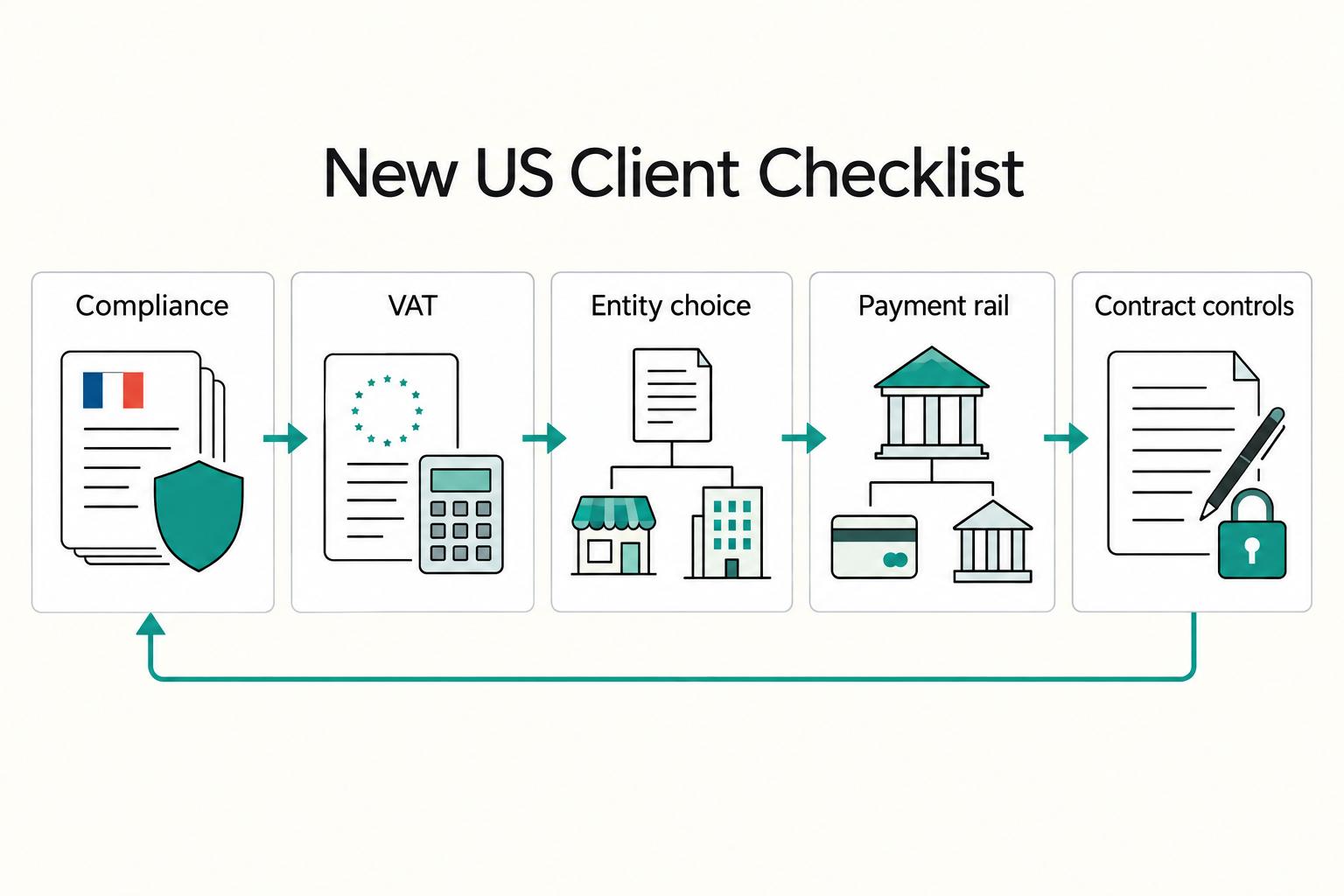
Use the same checklist for every new US client so each invoice cycle is lower risk than the last. Keep this sequence as your operating default: compliance first, VAT second, entity choice third, payment rail fourth, with contract controls throughout.
Follow the same pre-send sequence every time#
- Compliance first
Confirm the client record and your seller details before drafting the invoice.
- VAT second
Validate the VAT treatment for this specific invoice, then apply wording only after that check.
- Entity choice third
If a client asks for a different contracting entity, pause and confirm before you change your setup.
- Payment rail fourth
Decide the payment rail before sending so invoice terms and reconciliation expectations match the way funds will move.
- Contract controls always
Keep payment terms explicit in writing. A practical structure is to separate charges and payment, late payments, and VAT as distinct points.
Resolve missing facts before a new commitment and issue invoices by the applicable deadline. An internal checklist cannot unilaterally rewrite agreed terms or hold all billing indefinitely.
Reuse one monthly reconciliation routine#
Run the same monthly review for every client: match what you invoiced, what arrived, and any differences, then keep the related records together so the flow is traceable.
Maintain receipt capability now for covered domestic electronic invoices, and prepare the micro-enterprise’s covered issuance and e-reporting flow for September 1, 2027. Choose a PA and confirm software integration, international reporting fields and any exemptions. Retained PDFs remain useful evidence but are not themselves compliant structured domestic e-invoices.
For a step-by-step walkthrough, see How to Invoice a US Client from Mexico as a Temporary Resident.
Frequently Asked Questions
Can a French micro-entrepreneur invoice a US client legally?
Generally yes, for an activity you may lawfully carry on from your French micro-enterprise. Invoice using your actual French identity, apply the service/customer VAT rules, and declare collected revenue. A US LLC is not an automatic requirement.
What must appear on a micro-entrepreneur invoice sent to a US company?
Include invoice date and unique chronological number; seller name with EI, address and SIREN; client identity and billing details; service/advance date; detailed quantities, description and prices; currency, totals and applicable VAT basis; due date, early-payment terms and required late-payment mentions. Add a prior purchase-order number and other mentions where applicable.
Do I charge French VAT (TVA) when my client is in the United States?
For a general-rule B2B service received by a US taxable business outside France, generally no French VAT applies. Confirm the actual receiving establishment and service type. Property, admission, transport, consumer and other special cases can follow different rules; franchise status is a separate question.
When should I use the "TVA non applicable" mention?
Use the legal basis for the actual transaction. DGFiP gives art. 259-1 CGI for general-rule B2B services to a non-EU taxable customer, while art. 293 B CGI refers to franchise en base. Check the provision effective on the invoice date, including recodification updates, rather than treating either mention as universal.
Is PayPal acceptable for cross-border freelance invoices, and what are the risks?
An enabled French PayPal business account may support the collection flow. Check its French-market method, international and FX fees, hold and dispute terms; US-account prices are not your fee schedule. Reconcile gross customer receipts and fees separately, and do not request another payment while the first is unresolved.
Should I invoice as an auto-entrepreneur or through a US LLC/PLLC?
Use the actual French contracting business unless a separately assessed structure is warranted. Test whether the customer’s issue is a vendor form, payment route or real entity requirement before changing. A US entity introduces distinct legal and tax duties and does not erase French obligations.
Do W-8BEN or 1099-NEC forms change my French invoicing obligations?
US payer forms document applicable status/reporting questions; they do not replace French invoice formalities or revenue records. Use the correct form for your status and where services were performed, and do not submit W-9 simply because a US customer’s system requests it.
Try a related tool
Researched and edited by the Gruv editorial team. Gruv builds cross-border billing, payouts, and finance-operations software for global businesses.
Sources
Includes 4 external sources outside the trusted-domain allowlist.
- irs.gov/instructions/iw8bentrusted
- irs.gov/individuals/international-taxpayers/source-o...trusted
- paypal.com/fr/business/paypal-business-feestrusted
- entreprendre.service-public.gouv.fr/vosdroits/F31808external
- entreprendre.service-public.gouv.fr/vosdroits/F23208external
- impots.gouv.fr/professionnel/prestations-entre-assujettisexternal
- impots.gouv.fr/professionnel/prestations-aux-non-assujettisexternal
Educational content only. Not legal, tax, or financial advice.
Related Posts

Stop Freelance Profit Margin Erosion Before It Hits Cashflow
Revenue can hold steady while the business underneath it gets weaker. What comes in matters, but what you keep after the work is delivered is the clearer signal of health.

How Freelancers Can Decide on France’s Micro-Entrepreneur Regime
Low-stress compliance starts with one question: does the Micro-entrepreneur regime match your real setup right now? It is often presented as a simplified option for lower-revenue activity, so use it as a fit test, not a shortcut.

The Freelance Payment Penalty: A Modeled Audit of Platform Fees, FX Spreads, and Payout Delays
The money rarely disappears through a single, easy-to-spot fee. The real loss is stacked. A marketplace takes its commission, a processor adds a charge for international cards, a bank or payment company converts the currency at a spread, a platform holds the funds before release, and a wire sheds a little to intermediaries on the way in. Each layer looks defensible on its own, but the worker feels the combined result as a smaller deposit and a later payday.