

Quick Answer
A temporary-resident card alone does not settle work permission or Mexican tax obligations. Confirm your immigration conditions and tax registration, then issue CFDI when your Mexican invoicing obligations require it. A non-US individual may provide W-8BEN when requested; a US citizen or other US person uses W-9. Agree on currency and fees before billing, and retain XML, PDF, payment and conversion records.
What has to be true before you send the first invoice#
If you want to invoice a US client from Mexico without payment friction, focus on three outcomes: the client's AP team accepts the invoice, your SAT record stays compliant, and your net receipt is predictable.
Confirm that you can work and invoice from Mexico#
A temporary-resident card addresses immigration stay. It does not by itself establish permission for every paid activity, Mexican tax residence or the correct tax regime. Check the activity against your card conditions and the INM work-permission process, including independent work. Where a foreign-client remote-work arrangement is unclear, resolve the specific arrangement with INM before relying on the client’s location.
Mexican tax residence uses tax-law facts, including a home and, where homes exist in more than one country, the centre of vital interests. SAT explains residence separately from immigration status. Establish your registration, activity and tax regime; this guide’s CFDI workflow applies when you have a Mexican invoicing obligation.
Four terms drive most of the process:
- SAT: Mexico's tax administration authority.
- RFC: Your Mexican tax ID.
- CFDI: The official digital tax invoice Mexico requires taxpayers to issue, not just a self-made PDF.
- W-8BEN: The IRS form a foreign individual gives a US payer or withholding agent to document foreign status when requested.
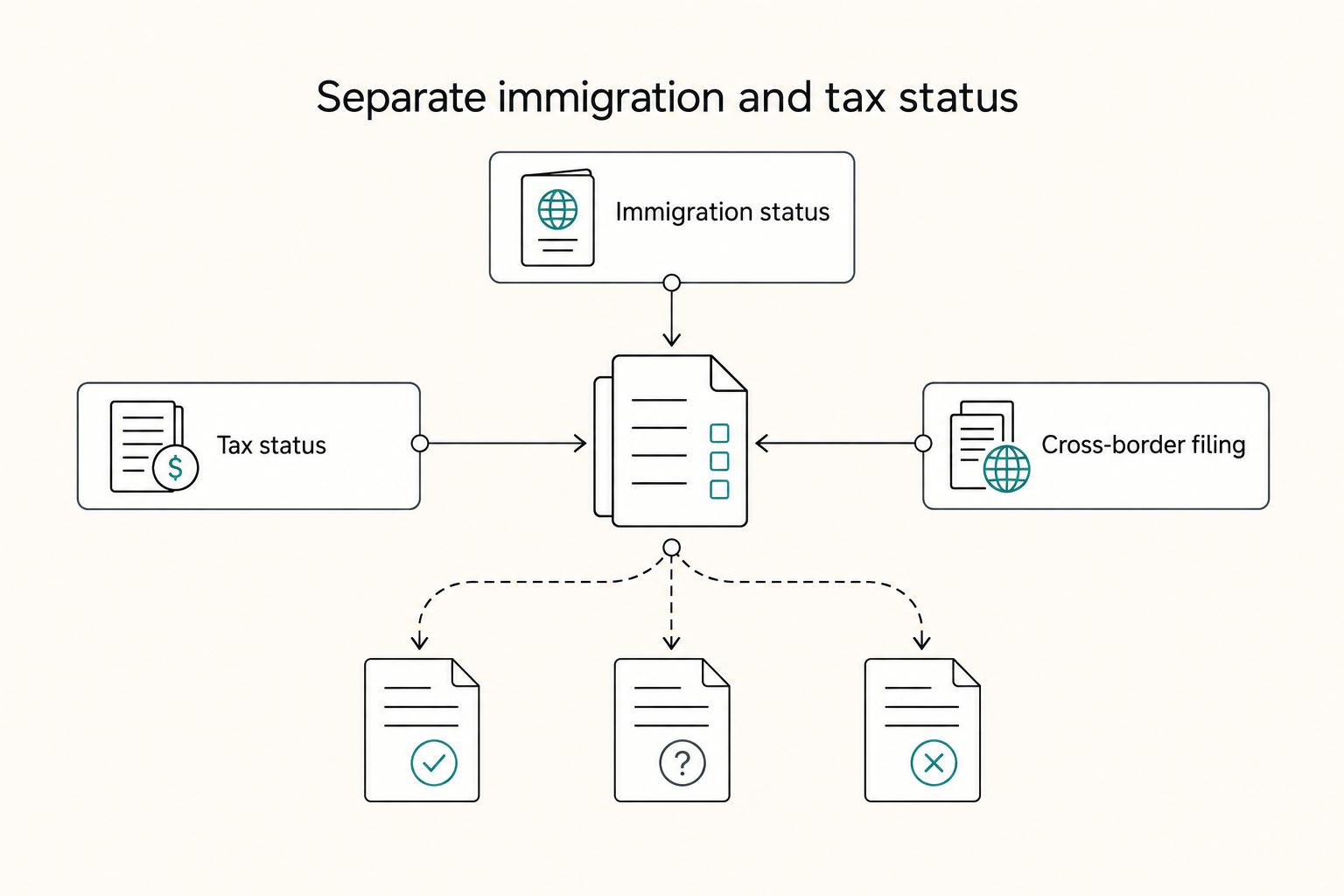
Keep those roles separate. The CFDI supports your Mexican tax record. The W-8BEN supports the US payer's foreign-status documentation process. A W-9 is for a US person, so sending one by mistake can create avoidable confusion.
The real test is operational. You are on track when the invoice is issued in SAT-compliant format, the client has the tax form they actually need, and the key fields are validated before you send anything. SAT guidance also names the generic RFC XEXX010101000 for certain foreign-resident counterparties not registered in RFC, but do not assume it applies in every case. After issuing a CFDI, verify it was certified through SAT's CFDI verification workflow. If you cannot verify certification, treat the invoice as incomplete.
This playbook walks through three linked decisions: how you handle client onboarding, how you choose currency and payment rails, and how you control compliance risk once the money starts moving. Before your first invoice, have these ready:
- your RFC and invoicing setup for issuing CFDI
- the client's legal billing details
- the appropriate US tax-status form if requested: W-9 for a US person, W-8BEN for a qualifying non-US individual
- your chosen payment method and account details
- a process to verify CFDI certification and store the certified record
If you want a deeper dive, read The Silent Profit Killer: How to Stop Margin Erosion in Your Freelance Business.
Prepare the client’s AP onboarding#
The first win is simple: remove guesswork for AP before the first invoice lands. Set the path early and you cut avoidable back-and-forth, reduce holds, and make first approval easier.
Set up the first invoice before it is due#
Confirm the legal billing entity, AP contact and accepted payment method before issuing. Ask whether the client has a Mexican RFC; for a foreign resident without RFC registration, SAT provides the generic XEXX010101000. Choose the US tax-status form based on your US-person status, not your location in Mexico.
| Item | What it means in practice |
|---|---|
| SAT | SAT (Servicio de Administración Tributaria) is Mexico's tax authority, so your invoicing process has to meet SAT requirements. |
| CFDI | CFDI is Mexico's electronic fiscal document for commercial/payment operations. |
| XML | XML is the SAT technical standard file for CFDI and the core electronic invoice record. |
| PDF representation | The PDF is a representation of the CFDI for review and records, and it should include the required legend that it is a printed representation of a CFDI. |
| W-8BEN | As a foreign individual, give Form W-8BEN to the US payer or withholding agent. Do not send it to the IRS. |
| W-9 | Form W-9 is for providing a US TIN to a requester filing IRS information returns. It is not a substitute for W-8BEN. |
- Confirm billing identity and the AP path.
Ask for the legal entity name, billing address, AP email, and any vendor portal or intake steps. Then send those details back for written confirmation so the invoice is addressed to the exact paying entity AP expects.
- Send a short onboarding note with clear document logic.
Your onboarding note should identify the contracting entity, the invoice documents AP will receive, the due date, payment details and the requested tax-status paperwork. A US citizen working from Mexico still uses W-9; a qualifying non-US individual provides W-8BEN to the payer when requested.
- Issue the first invoice in XML and PDF representation.
Generate the CFDI and send both the XML and the PDF representation. SAT technical guidance treats XML as the standard, and SAT updated CFDI to version 4.0 from 1 de enero de 2022. After issuance, verify SAT certification. If you cannot verify certification, treat the invoice as incomplete.
- Close the loop and keep records together.
Ask AP to confirm receipt and flag anything missing from their queue. Keep a client file with the certified XML, the PDF representation, the appropriate tax-status form you provided if requested, the confirmed billing details, and your SAT certification check.
Use this onboarding checklist for every new US client#
Use the same sequence every time so the first invoice does not turn into a custom troubleshooting exercise.
- Send your invoicing note before the first invoice is due.
- Confirm the legal billing entity, AP contact, and vendor onboarding route.
- Confirm whether the payer has a Mexican RFC and how the RFC field will be handled in the CFDI.
- Provide the form appropriate to your status when requested; residence in Mexico does not make a US citizen eligible for W-8BEN.
- Confirm payment terms, payment method, and fee allocation.
- Issue the CFDI, send the XML and PDF representation, and verify SAT certification.
- Store files and AP confirmations so follow-ups are based on documents, not memory.
Make AP approval easy while keeping your SAT record complete. For a broader classification check, see Are You an Employee or a Contractor? A Self-Assessment Checklist.
Choose currency around your actual expenses#
Invoice currency fixes one amount while leaving another exposed. If your costs are in MXN, a fixed USD invoice leaves you exposed to changes in the USD/MXN rate until conversion. A fixed MXN invoice protects the peso face amount before fees; a US client funding it in USD bears the conversion cost.
Choose the invoice currency first#
Choose the invoice currency based on who should carry FX risk between the agreement date and the payment date. In cross-border transactions, currency is negotiable, so decide it up front and document it.
Choose USD when client budgeting and holding dollar funds matter, while planning how and when to fund peso expenses. Choose MXN when receiving a known peso amount matters more. A shorter payment term reduces the exposure period but does not eliminate currency risk.
| Decision | Fixed USD invoice | Fixed MXN invoice |
|---|---|---|
| What is fixed | Dollar receivable | Peso receivable |
| Supplier with MXN costs | Peso value changes until conversion | Peso face amount stays fixed before fees |
| Client with USD budget | Dollar face amount stays fixed before fees | Dollar funding cost changes with the exchange rate |
| Receiving account | Holding USD delays conversion and keeps exposure open | Receiving MXN avoids a separate USD-to-MXN conversion by the supplier |
For CFDI, make sure the currency fields are right. c_Moneda must reflect MXN or the applicable catalog code, and TipoCambio is required when the currency is not MXN. Before you send the XML and PDF, confirm those fields are complete.
Compare payment rails by net receipt#
Choose the payment rail that gives you the best net receipt without creating avoidable operational risk. Headline fees rarely tell the full story. The real cost can include visible fees, FX spread, recipient-side deductions, speed differences, and dispute behavior.
Check the proposed route against IVA evidence requirements as well as fees. Article 58 describes foreign-origin funds and payment to the provider’s account. A processor or pooled intermediary payout may obscure the original payer and account trail; retain the upstream statement and downstream allocation, and resolve whether the route satisfies the applicable export conditions before selecting 0%. A local payout in Mexico is not, by itself, evidence of foreign-origin payment.
| Rail | Costs | Timing | Risk / fee note |
|---|---|---|---|
| Fedwire or bank wire | Confirm the current fee range before agreeing. Intermediary deductions and FX spread can affect net receipt. | Fedwire timing concerns its US bank leg; onward Mexican receipt depends on correspondent processing, FX, local cutoffs and the receiving bank. | Dispute or reversal risk is generally lower after final settlement; define sender, intermediary, and recipient fees in the contract. |
| ACH or Same Day ACH | Confirm the current fee range before agreeing. FX spread can apply if auto-conversion happens at receipt or payout. | Domestic ACH timing does not establish Mexican receipt; verify the receiving account and onward cross-border route. | Returns and exceptions still happen; state whether payment must arrive net of fees. |
| Card-based processor or checkout link | Visible fee plus processor FX spread and payout conversion effects. | Quick capture is possible, but payout timing depends on the platform. | Higher dispute or reversal risk, including chargeback-driven reversals and dispute-fee exposure; only use when pricing and evidence practices cover the risk. |
For each proposed rail, run this net-receipt test:
For example, a USD 1,000 invoice converts to MXN 18,000 at 18 pesos per dollar, but MXN 17,000 at 17. If peso expenses are MXN 15,000, the remaining amount before fees and tax falls from 3,000 to 2,000. An MXN 18,000 invoice keeps the peso face amount fixed; a dollar-funded client needs USD 1,000 at 18 or about USD 1,058.82 at 17. These are illustrative rates, not current quotes.
Auto-conversion can add a spread and remove your choice of timing. Holding USD preserves that choice, but it does not remove the risk that those dollars buy fewer pesos when you need them.
Use a multi-currency account with a process#
A multi-currency account helps only if you use it with discipline. Treat receiving, holding, converting, and documenting as four separate actions.
Receive in the agreed currency when possible. Set conversion timing around actual peso spending needs rather than a prediction that rates will improve. Record the rate, spread and separate transfer fees.
If U.S. tax reporting applies, federal income-tax determinations are made in your functional currency. Foreign-currency items are translated using prevailing rates at receipt, payment, or accrual, and posted rates are generally accepted when used consistently. Keep payment proof, conversion records, and your consistent posted-rate source in the file.
Set currency and fee terms in the contract#
Lock profitability terms before work starts. Currency and fee allocation are too important to leave for post-delivery email threads. Use this contract checklist:
| Term | What to specify |
|---|---|
| Invoice currency | State USD or MXN explicitly. If non-MXN CFDI is used, include TipoCambio handling in your invoice process. |
| Fee responsibility | Specify sender, intermediary, recipient, and conversion-spread allocation. |
| Accepted rails | List approved methods, such as wire, ACH, or a named processor. |
| Fallback method | Agree on an alternative method for a confirmed failed or unsent transfer; reconcile an unknown original outcome before requesting a replacement. |
If the client requires USD, budget for the peso value to move and consider shorter terms or a documented price-adjustment clause for future work. For card payments, retain delivery and acceptance evidence and plan for disputes.
Issue and retain the Mexican tax record#
Once currency and payment terms are set, run compliance in a fixed order. Here, SAT is Mexico's tax authority, RFC is your taxpayer ID, CFDI is the official digital tax invoice, IVA is value-added tax, and ISR is income tax. Working in sequence can reduce filing errors, improve documentation quality, and lower avoidable penalty risk.
Check invoicing readiness before you promise a date#
Before you promise an invoice date, confirm that your registration setup is actually ready. You need an RFC to be identified before SAT, and SAT requires taxpayers to issue electronic invoices. SAT also lists two prerequisites to generate them: e.firma and Certificado de sello digital.
Treat this as a go or no-go check. If your RFC is active but your e.firma or seal certificate is missing, expired, or inaccessible, treat that as not ready to invoice. Before invoicing, confirm you can issue a CFDI and download both required artifacts: the XML file and the PDF representation.
For US accounts payable requests, keep the forms straight. W-8BEN is for a foreign individual to establish foreign status, and Form W-9 is for a US person, including a resident alien.
Issue a CFDI and verify certification#
Issue the invoice as a CFDI, not a standalone PDF. The PDF helps the client, but use the XML as the primary fiscal record. For a foreign resident client not registered in RFC, SAT guidance lists the generic foreign RFC: XEXX010101000.
Before stamping, confirm the client's legal name and address exactly as they should appear, and make sure the service description matches your signed agreement. That helps prevent avoidable reissues and keeps your audit file consistent.
After issuance, verify the CFDI on SAT's verification page to confirm it was certified by SAT. Save the XML, the PDF, and the verification result together.
Set IVA treatment from evidence, not assumptions#
The general IVA rate is 16%. Article 29 includes specified export-service categories and a separate path for independent personal services used entirely abroad by a foreign resident without an establishment in Mexico. Identify the path applicable to your actual service, not just the client’s US address.
| Point | Article says | Watch-out |
|---|---|---|
| Applicable service path | Listed Article29 category or qualifying independent personal services | Do not assume every freelancer must fall into a listed category; determine the actual statutory path. |
| Baseline | The general IVA rate in law is 16%. | Export-service treatment is a conditional path, not a default. |
| Contracting party and payer | Apply export-service treatment only when you can document all required conditions for the contracting party and the payer. | The payer and contracting entity differ. |
| Foreign-resident status | The regulation ties foreign-use treatment to services contracted and paid by a foreign resident without establishment in Mexico. | The client has an establishment in Mexico. |
| Place of use | The regulation also ties foreign-use treatment to services used abroad. | A US parent signs but a Mexico team receives the benefit, or service use is split between Mexico and abroad. |
For an independent personal service, document complete use abroad by the qualifying foreign client. Regulation Article 61 links this path to Article 58’s payment conditions: the foreign resident contracts and pays, funds originate from accounts at financial institutions abroad, and payment reaches the service provider’s qualifying account by the permitted means. For the listed Article 29 categories, confirm the category-specific conditions too.
Escalate when the facts are mixed. For example, a US parent signs but a Mexico team receives the benefit, the payer and contracting entity differ, the client has an establishment in Mexico, or service use is split between Mexico and abroad. Also remember that even when special IVA treatment applies, income can still be subject to ISR.
Reserve for taxes when payment clears#
Reserve for taxes as soon as payment clears. SAT's declarations flow includes both ISR and IVA, so compliance does not end when you get paid. Move a defined share of each payment into a tax reserve right away, based on your regime and advisor guidance.
Allocate receipts to the invoices they settle. A payment can settle part of one invoice or several invoices, so preserve the allocation and remaining balances. Where your CFDI payment method requires a payment complement, issue it under the applicable SAT rules instead of assuming the original income invoice completes the payment record.
Required records#
Keep one evidence pack per invoice:
- client legal name, billing address, and identity details used on the invoice
- evidence of where the service is used and by which entity
- signed agreement or statement of work
- CFDI XML, PDF, and SAT certification verification result
- payment proof, including bank or processor confirmation and any FX conversion record
The Mexico tax-residency guide explains the residence question separately. Prepare whichever US tax-status form applies before AP onboarding, and keep it with the client’s request.
Close the invoice and payment record#
Match the payment, then file it#
When funds arrive, match the payment to the exact invoice, currency, and expected amount. Save the payment confirmation with the invoice and any FX record you use internally so timing, amount, or fee questions are easy to resolve.
Keep one evidence pack per invoice#
Keep the invoice, tax-status documentation, payment allocation and evidence supporting IVA treatment together. Mexican tax records generally have a five-year retention rule, with longer retention for specified records or circumstances; use the period applicable to your records rather than deleting every file on its fifth anniversary.
Check your next invoice cycle against this list:
- Documents ready: appropriate tax-status form if requested and payer entity confirmed
- Invoice validated: CFDI issued, RFC checked, IVA treatment tied to facts
- Payment terms confirmed: currency, due date, fees, remittance path
- File trail complete: invoice, payment allocation, FX record and applicable retention period
Frequently Asked Questions
What is a CFDI, and do you need one for a U.S. client?
CFDI is Mexico’s electronic tax invoice. Use it when your Mexican taxpayer registration and transaction create a CFDI obligation; a temporary-resident card alone does not decide that. For an applicable foreign-resident client without RFC registration, use SAT’s generic foreign RFC and the current CFDI field rules.
What should you send if the client only understands PDFs?
Send both files, not just the PDF. The PDF helps the client's AP team review the invoice, and the XML is the machine-readable file used in SAT verification. After issuing, verify certification status in SAT's CFDI verifier and save that result with the invoice file.
What is a PAC, and how do you screen invoicing software fast?
A PAC is a SAT-authorized certification provider. If your software uses an external PAC, check that certifier on SAT’s authorized list. SAT also offers its own issuance tools. Confirm CFDI 4.0 support, XML download and the fields required for your transaction. Investigate certificate errors with the actual SAT or PAC response rather than treating a fixed wait as a universal remedy.
Do you give the client a W-8BEN or a W-9?
A US citizen, resident alien or other US person generally uses W-9, even while living in Mexico. A qualifying non-US individual uses W-8BEN when the payer requests foreign-status documentation, giving it to the payer rather than the IRS. An entity or effectively connected income can require a different W-8 form. Immigration residence in Mexico is not the US-person test.
What IVA rate should you put on the invoice?
Determine IVA from the applicable service-export path. Independent personal services have a distinct Article 29 path requiring complete foreign use by the qualifying foreign client and the relevant payment conditions; listed service categories have their own conditions. A US address and USD invoice alone establish neither.
Try a related tool
Researched and edited by the Gruv editorial team. Gruv builds cross-border billing, payouts, and finance-operations software for global businesses.
Sources
- beta.trade.gov/articletrusted
- federalreserve.gov/paymentsystems/fedfunds_about.htmtrusted
- fiscaldata.treasury.gov/datasets/treasury-reporting-rates-exchangetrusted
- irs.gov/individuals/international-taxpayers/forms-fo...trusted
- irs.gov/pub/irs-pdf/fw8ben.pdftrusted
- portalhcd.diputados.gob.mx/LeyesBiblio/PortalWeb/Leyes/Vigentes/PDF/77_...trusted
- remittanceprices.worldbank.org/methodologytrusted
- remittanceprices.worldbank.orgtrusted
Educational content only. Not legal, tax, or financial advice.
Related Posts

Stop Freelance Profit Margin Erosion Before It Hits Cashflow
Revenue can hold steady while the business underneath it gets weaker. What comes in matters, but what you keep after the work is delivered is the clearer signal of health.
Are You an Employee or a Contractor? A Self-Assessment Checklist
Forget the label. Classification turns on the relationship you actually run, not the title you typed into the contract. It is also much easier to fix before you sign.
Tax Residency in Mexico for Nomads Beyond the Temporary Resident Visa
Start with one conservative call: are you likely becoming a Mexican tax resident this year, and what evidence supports that call today? That decision shapes the rest of your year. If you skip it, every later task turns reactive, from local tax planning to U.S. filing choices.