
Quick Answer
A subscription platform evaluation checklist should be created before demos and used as a go or no-go tool at contract stage. Define scope, assign one owner per risk lane, freeze the written criteria, and require concrete evidence such as scenario responses, integration notes, sample finance outputs, security and due-diligence materials, and stated operating constraints. If integration proof, finance evidence, or due-diligence answers are still unclear, stop and resolve the gap before signing.
What to Verify Before You Sign#
Treat the contract stage as a real go or no-go decision, not the point where demo momentum rolls into a signature. A shared subscription platform evaluation checklist gives product, engineering, finance, and operations one basis for judgment, so the call comes from the same facts, not four partial views.
This is a practical way to evaluate software. The label matters less than the discipline: writing down what you need to verify, running every vendor through the same criteria, and surfacing unresolved gaps before legal and procurement momentum takes over.
Why this needs more than one team#
A solid review is cross-functional, but each function should stay focused on its own risk area:
- Product: customer-facing billing behavior and plan logic.
- Engineering: integration, monitoring, and failure handling.
- Finance: reconciliation and audit-ready outputs.
- Operations: exception handling, refunds, and day-to-day change workflows.
Siloed reviews create false positives. A practical control is one named reviewer per function plus one written decision page that records pass, fail, or open risk before signature.
That matters because each team can be impressed by a different part of the process and still miss the thing that later causes pain. Product can like the visible experience. Engineering can like the API on first review. Finance can assume reports will be adequate. Operations can assume day-to-day changes will be easy.
If those assumptions never make it into one shared record, the organization can end up signing while each function still carries a different unspoken concern. A single pass, fail, or open-risk view forces those concerns into the same room.
Standardize the questions before the answers drift#
Set the written question set early, then hold every vendor to it. CISA's Vendor SCRM template supports software and service supplier assessments. NIST's July 2026 due-diligence guide is scoped to ICT suppliers and covers considerations such as provenance, resilience, and foundational cyber practices. Use these references to define the control questions before comparing vendor answers.
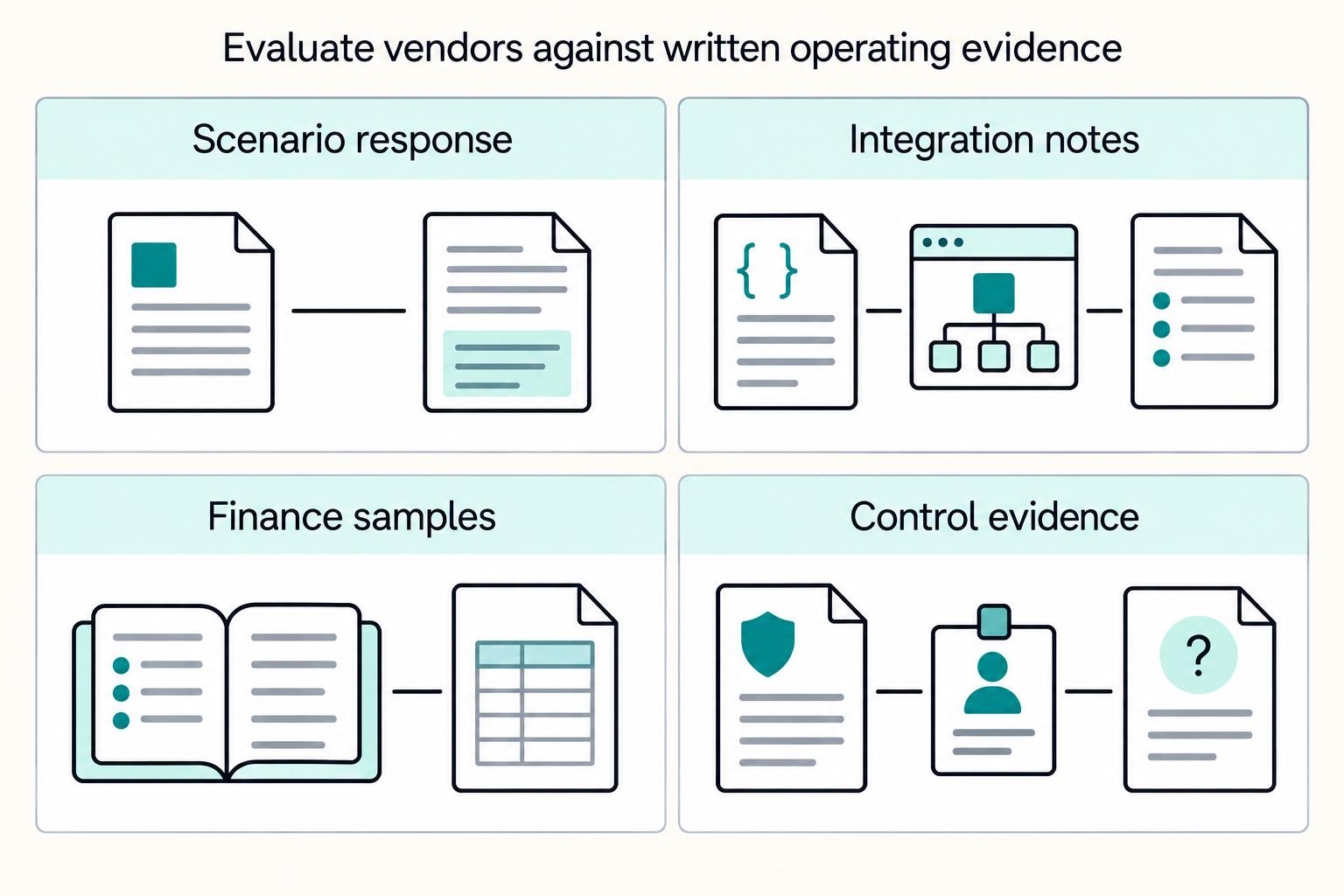
The evidence pack matters as much as the questions. Do not rely on verbal assurances. Ask for concrete artifacts like scenario responses, integration notes, sample finance outputs, security and due-diligence materials, and stated operating constraints.
A fixed question set does two things at once. First, it makes comparison possible. Second, it makes drift visible. If one vendor gives a polished story while another gives written artifacts, that difference should be visible in the record. If one vendor can show finance outputs and another can only describe them, that difference should be visible too.
This is not about punishing a weaker presentation style. It is about keeping the buying team from mistaking a smooth call for verified capability.
What this article is trying to help you decide#
The goal is a contract-stage checklist that leads to a decision you can defend. You are not trying to build the longest scorecard. You are trying to surface tradeoffs, red flags, and verification points that should change whether signing now is sensible.
Pre-signature risk checks have practical consequences. FINRA's 2025 third-party risk report describes increased vendor cyberattacks and outages over recent years, and highlights initial and ongoing due diligence among its examination observations. Its regulatory obligations apply to member firms; other software buyers can use the same questions to examine reliability, controls, ownership boundaries, and data access before signing.
Use the rest of this guide as a decision tool, not a feature tour. If a vendor passes visible product requirements but fails on integration proof, finance evidence, or due-diligence responses, stop there and resolve the gap before you sign.
If subscription pause is part of your buying scope, use the scenarios in How Platform Builders Implement Subscription Pause for Retention to test billing dates, resumption, and customer-facing behavior.
Set Decision Scope and Ownership Before You Compare Vendors#
Set scope and ownership before demos so the decision stays comparable instead of becoming vendor-led. Define what you need to solve now and as you scale, assign accountable owners across the core risk areas, and lock the criteria before the first call.
Define the problem and the boundary#
Write the scope in business terms for your SaaS or e-commerce model, then write down what is out of scope for this buying cycle. Use a practical planning window, such as the next 12 to 18 months if that matches your roadmap, but do not let edge-case demos expand requirements one vendor at a time.
This boundary is one of the simplest controls in the whole process. If it is missing, vendors can reshape the problem in whatever way makes their platform look strongest. That leads to a comparison where each vendor is effectively being scored against a different need.
A useful scope statement keeps the team anchored on the actual decision. What problem must be solved now? What scale needs to be handled? Which questions belong in a later buying cycle rather than this one?
A clear boundary also reduces internal confusion. Product may be thinking about customer-facing billing behavior and plan logic. Engineering may be thinking about integration and failure handling. Finance may be focused on reconciliation and audit-ready outputs. Operations may care most about exception handling, refunds, and day-to-day change workflows. Those are all valid concerns, but they need to tie back to one agreed buying scope.
Assign owners across the decision#
Use one owner for each decision lane: product fit, integration risk, finance controls, and vendor due diligence. That exact split is your operating choice, but the process should stay cross-functional. Planning should include everyone responsible for significant parts of the purchase, and user-side representation should be part of the selection process. Hold one final decision meeting with all owners present and record each lane as pass, fail, or open risk.
The important discipline is not the exact org chart. It is that no risk area is ownerless. A team that says "we all own it" often means nobody is accountable for driving the verification work to a conclusion. If product owns product fit, that person should be able to state clearly whether customer-facing billing behavior and plan logic meet the buying scope. If engineering owns integration risk, that person should be able to state whether the integration, monitoring, and failure handling evidence is sufficient. The same standard applies to finance controls and due diligence.
The written decision page matters because it turns discussion into a record. "We should be okay" is not a decision. "Pass," "fail," or "open risk" is. If something is open, the organization can decide consciously whether it is acceptable to proceed, whether it must be resolved before signature, or whether the vendor should be removed from consideration.
Freeze criteria before comparison#
Build the evaluation checklist before demos and keep it short enough to use consistently. Include:
- scope statement for this buying cycle
- evaluation factors and significant subfactors
- required evidence for each criterion
- named owner per decision lane
- final go or no-go checkpoint
This is the control point that prevents scoring drift. If you use an acceptability gate, set the minimum acceptability criteria up front and screen vendors against that baseline before broader comparison.
That "short enough to use consistently" point matters. A long scorecard can create the appearance of rigor while making the process harder to apply evenly. If the buying team cannot actually use it from first meeting to final review, it will become selective, and selective use is how drift begins. Keep only the factors that would change the contract decision.
A practical way to use the checklist is to separate it into two layers. The first is the acceptability gate. Can this vendor meet the minimum for this buying cycle? The second is the comparison layer. Among acceptable options, where are the tradeoffs? That keeps the team from spending too much time ranking vendors that do not even clear the basic threshold for scope, evidence, or operating fit.
You might also find this useful: How to Build a Subscription Billing Engine for Your B2B Platform: Architecture and Trade-Offs.
Make the Build vs Buy Call Before Deep Procurement#
Make the build versus buy call before pricing, legal review, and solution design go deep. If your team cannot sustain billing logic, retry behavior, and ongoing compliance-related changes after launch, buy subscription billing software or use a blend model. Build only when billing behavior is part of your moat and you are ready to own long-term maintenance, not just the first release.
This is not a simple binary choice. In practice, you are trading off delivery speed, control depth, and engineering burden. A lot of teams delay this question because they think vendor review will answer it for them. Usually the opposite happens.
Once demos, pricing, and legal review are moving, the organization starts acting as if buying is already the path. That can leave a weak custom-build option half-alive in the background, with no real owner and no clear maintenance plan. Or it can leave a team drifting into a buy decision without being honest about whether the integration and operating model are acceptable. Make the call early enough that it still changes behavior.
Put a hard gate in front of procurement#
Use a short build versus buy gate in the checklist, and require a clear yes or no before demos expand the scope:
| Question or condition | Signal | Implication |
|---|---|---|
| Can engineering maintain billing and still ship core product work? | No | Treat custom build as a risk. |
| Is launch timing fixed while compliance scope is still moving? | Yes | Buying now usually lowers schedule risk compared with building billing and compliance change handling at the same time. |
| Is billing logic truly differentiating? | Central to how you win | Build or blend can be justified. |
| Is billing logic truly differentiating? | Not central | Avoid creating a long-term maintenance obligation for standard billing mechanics. |
| Post-launch changes, retries, incident response, and version upkeep | No owner named | You do not have a build plan yet. |
Use this failure test: if no owner is named for post-launch changes, retries, incident response, and version upkeep, you do not have a build plan yet.
These questions work because they force the team to think beyond the first release. A build decision is not a statement of technical ability alone. It is a statement that someone will keep owning billing behavior, retry handling, incidents, and ongoing changes after launch. If that owner does not exist, or if that work will repeatedly lose priority to core product work, the build path is weaker than it looks in a planning meeting.
The same applies to a blend model. A blend can make sense when control depth matters in some areas and speed matters in others, but it still needs named ownership for the parts your team will operate directly. "Blend" is not a safe middle by default. It is only as strong as the ownership plan behind it.
Compare the parts that create operational drag#
Before feature demos start steering the decision, focus on the parts that usually create downstream drag: API quality, event delivery behavior, and idempotency.
| Area | Verify before commit | Why it matters |
|---|---|---|
| API | Exact endpoints, sample request and response bodies, and error-handling docs for core billing actions. | Strong API coverage reduces custom glue code. Thin APIs push complexity back into your app. |
| Webhook | Written retry behavior, delivery expectations, and example payloads. Stripe documents asynchronous handling, automatic redelivery for up to 3 days in live mode, and a 30-day List Events window. PayPal documents non-2xx retries up to 25 times over 3 days. Separately check your receiver's event deduplication and handling of out-of-order deliveries. | Weak event handling increases delivery noise and reconciliation burden. |
| Idempotency | Duplicate-safe request behavior, key limits, and key-retention windows. Stripe supports idempotent requests with keys up to 255 characters and notes keys can be removed after at least 24 hours. Adyen allows keys up to 64 characters and states a minimum 7-day validity period. | Supported API retries can recover the original result within the provider's key and retention conditions. Webhook deduplication needs a separate receiver-side control. |
These are not side questions. They are often the difference between a platform that looks manageable in a demo and one that creates daily operational drag after launch. API coverage affects how much custom glue code your team must maintain. Event delivery behavior affects how much noise lands in engineering and operations when calls fail or arrive late. Idempotency affects whether retries are safe or whether a transient issue can turn into duplicate side effects.
Test supported API retries with the same operation key inside the provider's retention window, and check how you recover an unknown result after that window. Separately test webhook signature validation, duplicate-event handling, non-2xx responses, timeouts, and delayed or out-of-order delivery.
Operator checks are useful because they put the platform in the frame of real operation rather than feature description. A platform can look complete in a feature grid and still leave the team with unclear retry safety, unclear callback handling, or unclear failure behavior. If those questions are not answerable before signature, they are not minor open items. They are part of the real cost and risk of the decision.
Buy for speed, but preserve your exit#
If launch timing is fixed and compliance scope is still moving, buying can lower schedule risk. But speed only helps if the contract-stage review still protects your future options. That means you should verify what is truly provided, what remains your team's responsibility, and what constraints are built into the operating model.
Preserving your exit starts with clarity. Do not sign on the basis of broad statements when the practical limits are still unclear. Ask for the written operating constraints. Ask for the integration notes. Ask for the sample outputs. Ask for the exact failure-handling behavior that engineering and operations will inherit. Buying for speed should not mean accepting ambiguity in the areas that determine whether the platform remains workable after go-live.
The right test is simple. If the platform helps you move faster now, can you still describe the path forward if scale, scope, or ownership needs change later? If the answer depends on verbal assurances or unresolved details, keep that as an open risk until it is addressed.
If you want a deeper dive, read Subscription Billing Software for SaaS Platforms: The Complete Evaluation Guide.
Score Capability Fit Against Real Revenue Scenarios and Verify Integration and Data Model Risk Early#
Visible product fit is only one part of contract readiness. Score capability fit against the revenue scenarios your business actually depends on. Then verify that the integration and data model can support those scenarios without pushing hidden complexity back into your app, your finance process, or your operations team.
This is where many evaluations drift toward surface-level comparison. A vendor can appear strong because the demo maps neatly to a broad product story. But the buying decision should rest on whether the platform can support real billing behavior, real plan logic, real refunds and exception handling, and the real finance outputs your team needs to operate. The score should come from those scenarios, not from presentation quality.
Start from the scenarios that affect revenue, not from the feature grid#
The right scenarios are the ones that matter to your SaaS or e-commerce model in this buying cycle. Use the scope statement you already set, then ask each vendor to respond to the same practical situations in writing. That keeps the comparison tied to your business rather than to a generic product tour.
The key here is consistency. Every vendor should be asked the same scenarios, the same supporting questions, and the same evidence requirements. If one vendor gets a broader chance to reshape the scenario while another is held to your written checklist, the scores stop being comparable.
A good score for capability fit should reflect more than whether a feature exists. It should reflect whether the behavior is clear, whether ownership boundaries are clear, whether the workflow is workable for operations, and whether finance can rely on the outputs. If a capability looks good in isolation but creates open questions in another lane, that should lower confidence in the overall fit.
Do not separate product fit from integration reality#
Customer-facing billing behavior and plan logic need to be checked together with the integration path. If a platform can model the needed behavior only by pushing unusual logic into your application, you do not have clean product fit. You have a tradeoff that engineering will carry.
That is why the integration review should happen early, not after commercial enthusiasm builds. Verify the exact endpoints, sample request and response bodies, and the error-handling docs for core billing actions. Ask for written notes on delivery expectations and example payloads for the event model. Check duplicate-safe request behavior, key limits, and key-retention windows. Those details shape how much hidden work sits behind the visible capability.
An early integration review also reveals whether the platform's data model aligns with the way your team will need to operate. If core states, outputs, or event behavior are difficult to reason about from the vendor's materials, that is not just an engineering inconvenience. It affects monitoring, reconciliation, and exception handling too.
Look for risk where responsibility becomes unclear#
Integration and data model risk often show up as boundary problems. Who detects failures? Who retries? What happens on non-2xx responses, timeouts, and delayed delivery? What part of the workflow is handled by the platform, and what part is left to your systems and your operators?
When those boundaries are unclear, teams often fill the gap with assumptions. Product assumes engineering can absorb it. Engineering assumes finance can work around it. Finance assumes the platform will produce the outputs needed for reconciliation. Operations assumes day-to-day change workflows will be manageable. The checklist should stop that by requiring the answers in writing before contract signature.
A useful practical standard is this: if the buying team cannot explain the end-to-end path for the scenario, the vendor has not yet proven fit. The goal is not perfection. The goal is to make the hidden work and hidden risk visible before they become your problem.
For the full breakdown, read How to Integrate Your Subscription Billing Platform with Your CRM and Support Tools. You can also turn your integration checklist into implementation-ready requirements with Gruv's API and webhook references in the developer docs.
Check Compliance Controls and Operational Guardrails, Then Test Finance Operations and Reconciliation Before Signing#
A contract-stage review is incomplete if it stops at visible product behavior and technical feasibility. You also need enough evidence that compliance controls, operational guardrails, and finance workflows are workable before signing. If those checks are postponed until after the contract, you are no longer deciding with the full risk picture in view.
The same standard applies here: do not rely on verbal assurances. Ask for concrete artifacts. For these lanes, that means security and due-diligence materials, stated operating constraints, scenario responses, and sample finance outputs.
Check controls in the form you will actually use them#
The point of a compliance and control review is not to collect a stack of labels. It is to understand whether the controls and guardrails are sufficient for the way your team will operate the platform. Ask for the security and due-diligence materials that support the review, and tie them back to your actual ownership model.
This is especially important when responsibilities are shared. A vendor may provide certain controls, but your team may still own monitoring, handling, or follow-up in practice. That is why the review should sit with named owners rather than float as a general legal or procurement task. Engineering needs enough clarity on monitoring and failure handling. Operations needs enough clarity on exceptions, refunds, and day-to-day changes. Finance needs enough clarity on outputs and reconciliation. Product needs enough clarity on customer-facing behavior and plan logic. A control review that does not connect to those lanes can look complete while still leaving practical gaps.
The FINRA report reinforces the value of reviewing vendors through the whole relationship, including data protection in contracts and the return or destruction of data at termination. For your evaluation, ask which controls the vendor supplies and which your team must operate. An unresolved ownership boundary belongs in the signature decision.
Treat operating constraints as part of the control picture#
Stated operating constraints belong in the evidence pack because they define the practical limits within which your team will work. A platform can be secure on paper and still be difficult to operate if key limits, handling expectations, or boundary conditions are unclear.
Ask for the constraints in writing. Then check whether your operators can live with them. Day-to-day change workflows, exception handling, refunds, retry behavior, and delayed event handling all need enough clarity that the team understands what normal operation will look like. A control framework that cannot be translated into day-to-day work is not enough to support a contract decision.
This is one place where cross-functional review is especially useful. Product may not notice an operational constraint that matters to operations. Engineering may not notice a finance implication. Finance may not see a support burden that sits with product or operations. The combined review helps surface those mismatches before they turn into post-signature friction.
Test finance operations before you call the deal done#
Finance should not be asked to approve on confidence alone. Reconciliation and audit-ready outputs are part of the decision, and they need written evidence before signing. Ask for sample finance outputs and review them as part of the checklist, not as a courtesy step after the technical team has already decided.
The test is practical. Can finance explain how reconciliation will work from the materials provided, and are the outputs in a form the team can rely on? If the answer is still "we think so," the review is not finished. A polished platform story does not replace evidence that finance can operate the result.
This is also where integration and event behavior matter again. Weak event handling increases delivery noise and reconciliation burden. So a finance review should not happen in isolation from the engineering evidence on callbacks, retries, timeouts, and delayed delivery. These are connected operational realities, not separate boxes on a scorecard.
Make open risks visible before signature#
If the control review or finance review leaves unanswered questions, keep them visible as open risks. Do not let them disappear into "we will sort that out in implementation." The purpose of the contract-stage checklist is to decide whether signing now is sensible. If a gap would change that decision, it belongs on the written decision page.
That page should show whether compliance controls are supported by evidence, whether operating guardrails are clear enough for real use, and whether finance has what it needs for reconciliation and audit-ready outputs. If not, the organization should decide consciously whether to stop, resolve the issue, or proceed with eyes open.
Redline the Contract Clauses That Drive Real Platform Risk#
Legal review should not operate as a separate track from the operational review. The contract needs to reflect the real platform behavior, ownership boundaries, data access expectations, and operating constraints that the buying team is relying on. If those practical points stay outside the contract discussion, the organization can end up signing a document that does not protect the assumptions behind the decision.
This does not mean legal has to rewrite every business process into the agreement. It means the buying team should identify the clauses and descriptions that carry the actual risk and make sure they line up with the evidence gathered during evaluation.
Bring the open risks into the redline process#
The written decision page should feed the contract review. If engineering still has an open question on integration behavior, finance still has an open question on outputs, or due diligence still has an unresolved boundary issue, those are not separate from the contract. They are exactly the kinds of risks that should shape what gets redlined, clarified, or held as a condition before signature.
This is one reason the process should record pass, fail, or open risk by lane. Without that record, legal review can become detached from the practical reasons the team is hesitating. The contract then moves forward based on general comfort rather than on the specific concerns surfaced during evaluation.
Focus on the terms that define real responsibility#
The pre-signature warnings point to a few practical themes that should stay central in redlines: reliability, controls, ownership boundaries, data access, and operating constraints. Those are the areas where a polished demo can leave the most room for misunderstanding if the written agreement and related materials do not match what the team believes it is buying.
If a vendor says something important about delivery behavior, support expectations, access, or handling, ask where that lives in the written package. If it only exists as a statement in a call, treat it as unverified for contract purposes. The goal is not to make the agreement abstractly perfect. The goal is to make sure the real assumptions behind the go or no-go decision are reflected clearly enough that the organization is not signing into ambiguity.
Do not let speed erase clarity#
Commercial momentum can create pressure to treat redlines as a cleanup step. That is exactly backward when the buying decision still depends on unresolved practical details. If launch timing is fixed, the pressure will be even stronger. But urgency does not make unclear responsibilities safer. It only makes them easier to miss.
A useful discipline here is simple: any issue important enough to appear as an open risk on the decision page should be reviewed directly during the contract stage. If it changes whether signing now is sensible, it is not housekeeping. It is part of the decision.
Build a Vendor Due Diligence Evidence Pack#
The evidence pack is not a side file for procurement. It is the proof set that supports the contract decision. The earlier sections of this guide all point back to the same rule: do not rely on verbal assurances. Ask for concrete artifacts, keep the question set fixed, and organize the answers so each owner can evaluate the same written record.
A strong evidence pack makes comparison fair, makes open gaps obvious, and gives the organization something durable to rely on when final approval time arrives.
What to collect#
Request the same core artifacts from every vendor:
| Artifact | Supports |
|---|---|
| Scenario responses | Product fit |
| Integration notes | Engineering review |
| Sample finance outputs | Finance review |
| Security and due-diligence materials | Control and supplier review |
| Stated operating constraints | Operations and cross-functional planning |
Use NIST's supply-chain risk guidance to examine the security evidence in the context of your supplier relationship.
Keep the pack structured by criterion and owner rather than by vendor marketing category. That makes it easier to see whether every decision lane has enough evidence to issue a pass, fail, or open-risk call.
How to use the evidence pack during evaluation#
Use the pack actively, not as an archive. For each criterion on the checklist, ask two questions: what evidence did we require, and did we receive it in a form that supports a decision? If the vendor provided only part of the evidence, mark the gap clearly. If the material answers one team's concerns but creates another team's open risk, note that too.
This approach keeps the process grounded. It prevents a common failure mode where teams remember the overall feel of the vendor conversation more strongly than the written evidence. It also helps stop the tendency to forgive missing documentation late in the process just because the commercial path is already moving.
Distinguish evidence from explanation#
Vendors will often explain how something works. Explanation can be helpful, but it is not the same as evidence. A scenario response in writing is different from a spoken walkthrough. Integration notes are different from a promise that the API is flexible. Sample finance outputs are different from a statement that finance reporting is covered. Security and due-diligence materials are different from a general assurance that controls are strong.
That distinction matters because explanations are hard to compare and easy to misremember. Evidence can be reviewed by the named owners, tied back to the criteria, and revisited during the final decision meeting.
Use the pack to support ongoing discipline#
The same documentation discipline that helps at signature time also improves the quality of the final go or no-go call. If a vendor cannot or will not provide enough concrete material before signature, that fact itself is useful information. It tells you something about what the implementation and operating relationship may feel like once the contract is signed.
The evidence pack therefore serves two purposes at once. It verifies capabilities and controls, and it shows how the vendor handles scrutiny when the buying team asks for specifics.
Plan the First 90 Days So Contract Value Shows Up Fast#
A contract decision is stronger when the team can see the path from signature to usable value. Do not plan the first 90 days in exhaustive implementation detail at this stage. But the core responsibilities and evidence-backed assumptions should be clear enough that the contract can produce results rather than stall in handoff confusion.
A lot of contract value is lost in the gap between what each team thought was being purchased and what each team is then asked to do after signature. Planning early helps close that gap.
Turn the decision lanes into an implementation handoff#
The owners who issue pass, fail, or open-risk calls should also define the immediate post-signature handoff for their lane. Product should know what customer-facing billing behavior and plan logic need to be validated first. Engineering should know the integration, monitoring, and failure-handling path it is actually building against. Finance should know which outputs it expects to review first for reconciliation and audit-ready use. Operations should know how exception handling, refunds, and day-to-day change workflows will be managed.
This is not new scope. It is the practical continuation of the contract-stage review. If the team cannot explain those first responsibilities at signature time, there is a good chance important assumptions are still sitting untested inside the deal.
Keep the early plan tied to the evidence pack#
The first 90 days should be built from the evidence you already required. Scenario responses should feed early validation. Integration notes should feed engineering setup and testing. Sample finance outputs should shape finance review. Security and due-diligence materials should inform operating controls. Stated operating constraints should shape how operations plans for normal use.
That connection matters because it keeps the organization from discovering after signature that its early implementation plan was based on a different understanding than the buying review. The evidence pack should not disappear when the contract is signed. It should become the reference point for whether the delivered experience matches what was reviewed.
Resolve open risks or assign clear follow-up#
If there are still open risks at signature, they should not be allowed to drift into general implementation noise. Assign the owner, the issue, and the follow-up path clearly. The same discipline used before signing should continue after signing: one record, named ownership, and no silent assumptions.
The point of planning the first 90 days is not just speed. It is to make sure contract value shows up in the form the organization actually needs: workable billing behavior, a manageable integration, usable finance outputs, and operations that can live with the platform's constraints.
For a step-by-step walkthrough, see How to Migrate Your Subscription Billing to a New Platform Without Losing Revenue.
Sanity Checks Before Final Approval#
Before final approval, step back from the vendor narrative and run a short sanity check against the actual evidence. This is where the organization asks whether the record supports a defendable decision, not whether the process simply feels far enough along to finish.
A good final review is often less about discovering something new and more about making sure obvious concerns are not being talked past.
Ask the simple questions that catch drift#
Use a short set of final checks:
- Are we still solving the scoped problem for this buying cycle?
- Does each decision lane have a named owner and a pass, fail, or open-risk call?
- Did we hold every vendor to the same written question set?
- Do we have concrete artifacts rather than verbal assurances?
- Are integration proof, finance evidence, and due-diligence responses sufficient to support signing now?
- If something remains open, is it visible and consciously accepted?
These questions work because they cut through momentum. A late-stage buying process can feel complete even when it is missing a few critical decisions. The sanity check forces the team to verify that the core controls from the start of the process were actually maintained.
Watch for false confidence signals#
Several signals can create false confidence late in the process: a polished demo, strong feature fit, fast procurement progress, or general internal enthusiasm. None of those things answer the core contract question on their own. The real test is still whether the unresolved gaps have been surfaced and handled.
The earlier warning applies here: if a vendor passes visible product requirements but fails on integration proof, finance evidence, or due-diligence responses, stop there and resolve the gap before you sign.
Make the final decision page usable#
The final decision page should be short enough that an approver can understand it quickly, but specific enough that it reflects the real work done. It should show the scope, the owners, the key criteria, the required evidence, and the final pass, fail, or open-risk outcome by lane. It should also highlight anything that would change whether signing now is sensible.
That page is what turns the checklist from a process artifact into a decision tool. It lets the final approver see whether the organization is signing on evidence and clear ownership or on momentum and incomplete assumptions. Related reading: Future Subscription Commerce Predictions for Platform Operators Through 2027.
Conclusion#
A useful subscription platform evaluation checklist is not a feature inventory. It is a contract-stage decision tool. Its job is to keep product, engineering, finance, and operations working from the same facts, with the same written questions, and with enough evidence to make a defendable go or no-go call.
Set the scope before demos. Assign owners by risk lane. Freeze the criteria before comparison. Make the build versus buy call before deep procurement. Test product fit against real business scenarios, then verify integration and operating reality early. Review controls, finance outputs, and due diligence with the same discipline. Bring open risks into the contract redline process. Build an evidence pack that relies on artifacts rather than assurances. Plan the first 90 days so the post-signature path is clear. Then run a final sanity check before approval.
If the vendor can support the scope, provide the evidence, and leave each owner able to mark pass rather than open risk, the decision is stronger. If not, do not let commercial momentum make the call for you. Stop, resolve the gap, and sign only when the record supports it.
Before legal signoff, test the checklist against your next renewal and implementation plan. Ask each vendor to separate recurring fees in the currencies you use, show what is billed per month versus annually, and note which migration or add-on charges could change the contract economics after launch.
If your team wants to confirm market coverage, compliance gates, and rollout fit before signing, talk to Gruv.
Frequently Asked Questions
When should we create the checklist?
Before demos. Set the criteria, evidence requirements, and ownership model early so vendor conversations do not reshape the comparison.
Who should own the evaluation?
Use one owner for each decision lane: product fit, integration risk, finance controls, and vendor due diligence. The process should still be cross-functional, but each lane needs a named reviewer who can record pass, fail, or open risk.
Is this only for regulated firms?
No. The FINRA observation is a useful reminder, but the lesson applies more broadly. A polished demo is not enough if reliability, controls, ownership boundaries, or data access are still unclear at signature time.
What evidence matters most?
Concrete artifacts matter most. Ask for scenario responses, integration notes, sample finance outputs, security and due-diligence materials, and stated operating constraints. The right evidence is whatever lets the named owner in each lane make a defendable pass, fail, or open-risk call.
What are the most important technical checks before signing?
Verify endpoints, request and response examples, and error handling for core billing actions. For supported API retries, check same-key replay, key limits, retention, and recovery after an unknown result. Separately verify webhook signature checks, event deduplication, retry schedules, delayed delivery, and out-of-order events.
How should finance be involved?
Finance should review reconciliation and audit-ready outputs before signature, not after. Ask for sample finance outputs as part of the evidence pack and confirm finance can explain how reconciliation will work from the written materials.
What if a vendor looks strong in product demos but has gaps elsewhere?
Stop and resolve the gap before signing. Visible product fit is not enough if integration proof, finance evidence, or due-diligence responses remain unclear. The checklist exists to surface those tradeoffs before legal and procurement momentum takes over.
How many sections should the final decision really cover?
Cover the real decision lanes, but keep the checklist short enough to use consistently. The final decision page should show the scope, the criteria, the required evidence, the named owners, and the pass, fail, or open-risk outcome.
Try a related tool
Researched and edited by the Gruv editorial team. Gruv builds cross-border billing, payouts, and finance-operations software for global businesses.
Sources
- acquisition.gov/far/7.102trusted
- acquisition.gov/afars/1.4-source-selection-team-roles-respon...trusted
- cisa.gov/resources-tools/resources/vendor-supply-chai...trusted
- csrc.nist.gov/pubs/sp/1326/finaltrusted
- csrc.nist.gov/glossary/term/service_level_agreementtrusted
- developer.paypal.com/api/rest/webhookstrusted
- docs.stripe.com/webhookstrusted
- docs.stripe.com/api/events/listtrusted
Educational content only. Not legal, tax, or financial advice.
Related Posts

The Freelance Payment Penalty: A Modeled Audit of Platform Fees, FX Spreads, and Payout Delays
The money rarely disappears through a single, easy-to-spot fee. The real loss is stacked. A marketplace takes its commission, a processor adds a charge for international cards, a bank or payment company converts the currency at a spread, a platform holds the funds before release, and a wire sheds a little to intermediaries on the way in. Each layer looks defensible on its own, but the worker feels the combined result as a smaller deposit and a later payday.

How to Respond to a Subpoena for Business Records
Move fast, but do not produce records on instinct. If you need to **respond to a subpoena for business records**, your immediate job is to control deadlines, preserve records, and make any later production defensible.

A US Expat's Guide to Investing in UCITS ETFs to Avoid PFIC Issues
The real problem is a two-system conflict. U.S. tax treatment can punish the wrong fund choice, while local product-access constraints can block the funds you want to buy in the first place. For **us expat ucits etfs**, the practical question is not "Which product is best?" It is "What can I access, report, and keep doing every year without guessing?" Use this four-part filter before any trade: