
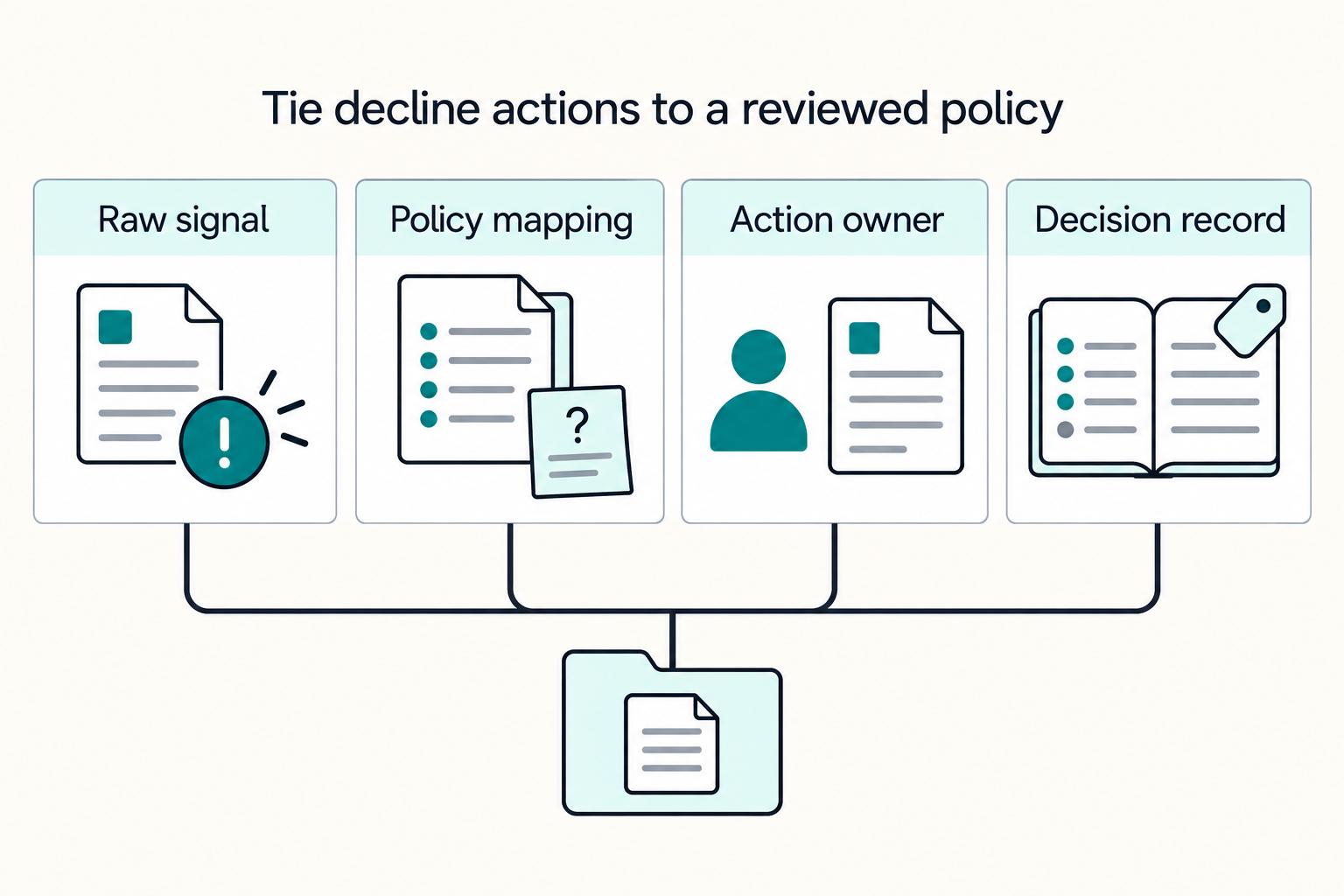
Classify first, then execute a coded path based on the response fields you actually receive. A soft vs hard payment decline platform response should route hard declines like `DECLINED` and `STOLEN_LOST_CARD` to payment-method change, while temporary paths such as some NSF recurring cases can use capped retries with terminal states. Keep idempotency keys and webhook dedupe in place, and mark recovery complete only after your own posting records confirm success.
Every decline should trigger a deterministic next action: retry, stop, or escalate. When teams rely on ad hoc judgment, they can launch uncontrolled retries, raise processing costs, and still fail to improve approval outcomes.
The key split is what happened in the transaction, not the label. Based on the definitions used here, a soft decline can happen even after issuer approval when processing or business-rule checks fail before settlement, such as AVS or CVN checks. A hard decline is an issuer refusal to authorize funds transfer. Treat it as non-retryable until the customer provides a different payment method.
Because provider labeling is not standardized, do not classify from labels alone. Classify from the response fields you actually receive: reason code, Reply Flag (rflag), and REST status and reason. If those fields conflict, treat the case conservatively.
| Pattern | Example response | Operational implication |
|---|---|---|
| Soft-decline style | `200 \ | DAVSNO \ |
| Hard-decline style | `203 \ | DCARDREFUSED \ |
For platform teams, this article focuses on what you can design and enforce. That includes card collection and recurring billing response logic, including checkout-time verification failures, post-authorization processing failures, issuer refusals, and context-dependent recurring cases like non-sufficient funds.
The main mistake to avoid is uncontrolled retrying. Without a structured policy, teams can raise processing costs and still fail to improve approval outcomes. A close second is weak evidence capture. For each declined payment, keep the payment record identifier and core response fields, including reason code, rflag, and status/reason, so cases can be reviewed and exported for analysis.
By the end, you should be able to define a code-level matrix for decline handling, roll it out without breaking customer messaging, and set concrete checks to confirm the automation is behaving safely.
For related context, see Understanding Payment Platform Float Between Collection and Payout.
Use this as a conservative internal default: if the decline signals you receive conflict, pause automatic retries until your matrix resolves the conflict. That can reduce repeated retries and help route clearly non-retryable hard-decline cases toward a payment-method update path. Use the specific decline code or message, the raw response detail you actually receive, and your internal mapping.
Keep two decisions separate: "retry this transaction now" and "recover revenue later." Some sources describe hard declines as non-retryable, while other recovery framing includes later dunning paths. Your matrix should keep those paths distinct. For related setup work, see Microsoft Dynamics 365 for Payment Platforms: Finance Module Setup and Payout Integration Guide.
Get ownership clear before you write retry rules. If issuer decisions, processor mappings, and gateway or transport failures all land in one bucket, you can apply the wrong fix and misclassify retry behavior.
Classify origin first, then decide action. Issuing bank decisions are different from processor-specific decline-code mappings. Both are different from technical failures such as timeouts or network errors that can look like declines.
| Origin of outcome | What it means in practice | First owner to act | First next step |
|---|---|---|---|
| Issuing Bank | The issuer approved or declined the attempt | Your designated payments owner | Parse the decline reason code and determine corrective action |
| Payment Processor | The response depends on provider-specific code mapping | Your designated payments owner | Validate processor code meaning before any retry decision |
| Payment Gateway | Operational failure path, such as timeout or connectivity, rather than a clear issuer refusal | Your designated technical owner | Confirm technical failure vs true decline before retry classification |
Keep this function split as an internal operating model, not a universal rule, and document who owns customer messaging, rule execution, and exception handling.
Use one checkpoint before any retry: review the decline reason code together with the available provider response details. If data is missing or signals conflict, follow your internal policy instead of blind retry.
Do not collapse issuer, processor, and gateway outcomes into one decline metric. That hides root cause. For hard-decline handling, a card-invalid control can be useful: Zenoti, for example, marks hard-declined cards invalid, blocks gateway submission, and skips retry logic for those cards. For related setup work, see How to Build a Payment Sandbox for Testing Before Going Live.
Your matrix should be an internal execution policy, not a universal truth table. For each decline-signal combination in your stack, assign one consistent action path: retry, stop, or escalate, with a named owner.
Because the material here does not support fixed payment-code meanings or universal mappings, treat each decline label as a policy row your team must define and review explicitly, not a row you can classify by label alone.
| Matrix row label | What your policy must define | If mapping confidence is low |
|---|---|---|
Provider decline code (raw) | Internal action (retry/stop/escalate) and owner | Escalate for manual review |
Internal normalized decline label | Internal action and owner | Escalate for manual review |
Unknown or ambiguous decline label | Escalation owner and decision checkpoint | Treat as unresolved until clarified |
For auditability, keep a consistent internal evidence record per row so support, ops, and engineering can reconcile the same event trail.
Treat upstream specs as change-prone when they are marked unstable. One grounded example is the Matrix client-server spec. It states unstable specs may change without notice and exposes version discovery at GET /_matrix/client/versions. Use the same discipline in policy governance by tracking mapping version, last verification time, and policy owner before you automate at scale.
If you need a deeper catalog of code fields to normalize, Payment Decline Reason Codes: A Complete Reference for Platform Engineers is the right companion piece.
For a step-by-step walkthrough, see White-Label Checkout: How to Give Your Platform a Branded Payment Experience. When your matrix is defined, map each decline outcome to idempotent API and webhook handling patterns in the Gruv docs.
Retry only temporary declines, and stop immediately on hard declines and lost or stolen account states.
| Scenario | Retry posture | What to verify before acting | Stop condition / next action |
|---|---|---|---|
| Hard decline or lost/stolen account state | Do not retry | Confirm decline class and latest provider result at authorization attempt time | Stop immediately and prompt payment method change |
Non-Sufficient Funds (NSF) on one-time payment | Controlled retry can be appropriate in some contexts | Check the latest Payment Processor feedback, prior attempt count, timestamp, and whether the issue still appears temporary | Stop at your defined terminal state, then request another payment method |
Non-Sufficient Funds (NSF) in Recurring Billing | Controlled retry is often useful when the customer still intends to pay | Verify invoice or subscription is still collectible and the result has not shifted to a non-retryable path | Stop at your terminal billing state, then trigger payment update flow |
| Prior auth hold exists but settlement should not proceed | Do not keep retrying capture or sale | Confirm current authorization status and the provider's recommended cleanup path | Route to authorization cleanup, not repeated payment attempts |
For both one-time and Recurring Billing flows, define bounded retry policy up front: max attempts, spacing windows, and terminal states. Do not run open-ended retries or ad hoc manual resubmits outside that same policy.
Be strict on hard declines. They are permanent failures, and repeating them wastes processing effort and can harm processor reputation. The next step is customer intervention, not automation.
Treat Non-Sufficient Funds (NSF) as temporary, not as guaranteed recovery. Allow retries only while processor feedback still supports a temporary path. If status turns ambiguous or conflicts with a non-retryable path, stop and move the customer to payment update.
When settlement should not continue on an existing auth hold, pause further payment attempts and follow your processor's authorization-handling process. This helps reduce authorization-related chargeback risk from careless reruns.
Ambiguous decline labels need a defined fallback path. If you leave the decision to checkout at runtime, it can improvise or freeze.
| Situation | Fallback handling |
|---|---|
| System does not mark the event as final | Treat the event as provisional |
Same label appears in one-time and Recurring Billing flows | Do not assume the outcomes mean the same thing without a validated internal mapping |
| Status and label conflict | Pause normal automation and follow the fallback path approved before launch |
| Ownership and decision precedence are undefined | Set them in the Go/No-Go process before incidents happen |
| Ambiguity events occur | Log them explicitly and watch them in real-time monitoring |
Treat the event as provisional unless your system marks it as final. Do not assume similarly labeled outcomes mean the same thing across one-time and Recurring Billing flows without a validated internal mapping. If status and label conflict, pause normal automation and follow the fallback path your team approved before launch. The material here does not establish decline-specific code mappings, weighting rules, or retry limits.
Set this up before incidents, not during them. Define ownership and decision precedence in your Go/No-Go process so product, ops, and engineering handle ambiguity the same way when glitches happen.
Log ambiguity events explicitly and watch them in real-time monitoring so you can tune your approach with evidence over time. Keep one source of truth for those rules, such as Payment Decline Reason Codes. For adjacent operational risk, see How to Handle Payment Disputes as a Platform Operator.
Make one rule non-negotiable: each retry should map back to the same original intent in your system, and that mapping should be explainable later. The safest guidance here is process discipline, not a universal payment-event sequence.
| Control | Grounded requirement |
|---|---|
| Original intent mapping | Each retry should map back to the same original intent in your system, and that mapping should be explainable later |
| Order of operations | Define one internal order of operations and keep it consistent across first attempts and retries |
| Repeat deliveries | Do not let each service interpret repeat deliveries differently |
| Stable identifiers | Use stable identifiers to make repeated events easier to trace without ambiguity |
| One dedupe rule | Keep one dedupe rule so repeated events are easier to trace without ambiguity |
| Immutable audit records | Keep immutable audit records so repeated events are easier to trace without ambiguity |
If your stack uses inbound events, dedupe identifiers, and a system-of-record state, define one internal order of operations and keep it consistent across first attempts and retries. Do not let each service interpret repeat deliveries differently.
Broker choice is secondary to state discipline. Message queues are a common async pattern, and some teams avoid a separate broker to reduce operational overhead. That tradeoff is explicit in the source evidence.
| Decision area | Separate broker (Amazon SQS, RabbitMQ, ZeroMQ) | Consolidated path (for example, Redis plus caching) |
|---|---|---|
| Async communication | Built for queue-based async communication between nodes | Can support async flows without a dedicated broker layer |
| Operational overhead | Adds a separate component to run and monitor | Often selected to avoid separate broker cost |
| What still matters | You still need clear ownership of retries and final internal state | You still need clear ownership of retries and final internal state |
For this goal, transport is not the main decision. Stable identifiers, one dedupe rule, and immutable audit records make repeated events easier to trace without ambiguity.
Customer messaging should follow the actual decline outcome, not a generic "payment failed" template. Keep one shared matrix for product copy, email logic, and support macros so customers and agents get the same instruction.
A practical default looks like this:
STOLEN_LOST_CARD, move the case to risk or manual review instead of repeated retry prompts.| Decline class | Customer message | Routing policy |
|---|---|---|
| AVS mismatch | Ask the customer to verify billing address details before retry | Use your normal recovery path, for example, in-product prompts or failed-payment email, and escalate only if unresolved under your own support rules |
| CVN/CVV mismatch | Ask the customer to re-enter the security code carefully before retry | Same correction-first flow as AVS, with support confirming the coded mismatch outcome before advising |
| Issuer hard decline / payment method unusable | Explain the payment cannot be retried on this method and request a different method | Send the customer to payment-method update, not repeat-charge loops |
STOLEN_LOST_CARD or fraud-linked outcome | Show a clear stop message and avoid "try again" prompts on the same card | Route to manual support or risk-reviewed handling |
Stripe's decline guidance for CVC and AVS checks is to have the customer verify details before another charge, while Visa Acceptance guidance says hard declines are non-retryable and require another payment method. Keeping those branches separate preserves recovery on soft issues and avoids bad retries on hard outcomes.
If decline signals point to review, block, or stolen-lost-card handling, move to your risk workflow rather than repeating correction prompts. Stripe Radar supports rule outcomes like allow, block, review, or require additional authentication, which fits this branch.
Do not treat every AVS, CVN, or CVV mismatch as fraud. AVS failures can also come from normal entry mistakes or outdated address records.
Support macros should use the same coded inputs as engineering logic, for example decline code, risk flag, provider reference, attempt context, and current posting state. This is an internal operating control, and it can help prevent policy drift between product and ops.
Because processor configuration can change status and response behavior, avoid freehand interpretation of decline text. Anchor macros to coded outcomes and keep one canonical mapping reference, such as Payment Decline Reason Codes: A Complete Reference for Platform Engineers.
Need the full breakdown? Read How Platform Operators Should Plan PCI DSS Level and Cost.
Put a compliance gate ahead of repeat retries. If a KYC, AML, or KYB review is open, treat the payment as a review case first, not a retry case.
| Situation | Check before another attempt | Action | Evidence to retain |
|---|---|---|---|
| Open KYC or KYB review on the customer or business | Is identity, business verification, or beneficial ownership review still unresolved? | Pause automated retries and route to manual review or support | Decision reason, operator action, attempt trace |
| Cross-border or multi-program flow | Which program, jurisdiction, and provider role applies on this route? | Apply corridor-specific policy, not a default domestic retry rule | Program or corridor, review status, attempt trace |
| Repeated declines with rising risk signals | Are attempts stacking across cards, entities, or regions? | Stop automated retries and escalate to manual review | Attempt history, decision reason, operator action, attempt trace |
Cross-border flows often warrant the strictest gate. BIS documented regulatory requirements for non-bank payment providers across 75 jurisdictions, and current enterprise guidance continues to describe fragmented AML, KYC, reporting, and related obligations that increase cross-border cost and uncertainty. In practice, obligations can differ by provider role and route, so one decline policy should not be assumed to fit every corridor.
Before you run a sensitive retry, ask one escalation question: is this still a payment recovery issue, or is it now a compliance review issue? Repeated declines do not automatically require AML review in every jurisdiction, but they may still trigger provider risk controls and manual handling, especially in cross-border paths where obligations vary across jurisdictions.
For sensitive escalations, keep a minimum evidence pack: decision reason, exact operator action, and an attempt trace with posting state. Add the applicable program or jurisdiction and current review status so the case is defensible for reporting, testing, and third-party governance checks.
Once your compliance gate is in place, these five KPIs tell you whether the policy is recovering revenue or just creating retry noise. Define each KPI from the same evidence set each time: Payment Decline Reason Codes for classification, attempt history for exposure, Webhooks for timing, and posting outcomes for financial resolution. Treat these as operational definitions for your policy, not universal formulas.
Start from unique declines, not total attempts. Exclude failed retries from the baseline population, and keep a fixed daily reporting window so comparisons stay stable. If you are aligning to Stripe Acceptance analytics, use 12:00 PM UTC to 11:59 PM UTC.
| KPI | What to measure | Boundary that keeps it credible | What to do if it worsens |
|---|---|---|---|
| Soft-decline recovery rate | Unique declines your matrix marks as retryable soft cases | Count the first decline once from decline_code or an equivalent provider reason field. Count recovery only after a later successful payment event is reconciled in your posting records. | If recovery stalls after adding retries, retune retry spacing, customer prompts, or specific matrix rows before scaling. |
| Hard-decline retry leakage | Unique hard declines or terminal non-retryable states | Measure executed follow-on attempts after a hard decline, not just scheduled retries. Use attempt history plus provider events. | If leakage rises after a rules change, pause rollout and fix terminal-state stop rules first. |
| False-decline rate | Declines later shown to be genuine customer payment attempts | Use a documented internal proxy, for example a later successful payment for the same invoice, cycle, or customer. Slice by reason-code families. | If this rises, pause risk or retry expansion and retune affected rows first. |
| Time-to-recovery | Recoverable declines that eventually convert | Measure from first decline timestamp to reconciled success in your posting records, not to a scheduled retry or customer update. | If it increases while recovery stays flat, inspect webhook delivery, retry timing, and message sequencing. |
| Revenue-at-risk | Amount tied to recoverable declines still unresolved | Track exposure until success or terminal stop state in your posting records. Segment by code family and flow owner where useful. | If open exposure climbs, prioritize the highest-value decline clusters before adding new policy rules. |
Two boundary checks prevent false confidence. First, attempt history can increment even when retries are not executed, so hard-decline leakage should be based on executed attempts or provider retry events, not scheduled attempts alone. Second, webhook delivery can be delayed, and undelivered events can be redelivered for up to three days, so mark delayed events separately and confirm recovery only after the related posting update lands.
Use one tradeoff checkpoint as you tune: more aggressive retries may improve short-term soft recovery, but they can also increase operational and reputational risk. Benchmarks like 8 tries within 2 weeks and 15 reattempts in 30 days are context markers, not universal targets.
Scale only when the guardrails hold:
If you want a deeper dive, read Payment Decline Rate Benchmarks: How Your Platform Compares to Industry Standards.
Use the first 90 days to make decline handling reliable before you expand retry volume. Treat this sequence as an operating template, not a universal standard: classify in REST API services first, make event handling trustworthy second, then tune ambiguous cases and hard-stop rules with product, ops, finance, and risk aligned.
| Phase | Primary work | Key grounded details |
|---|---|---|
| Days 1 to 30 | Baseline and matrix v1 | Measure unique declines and exclude failed retries; map failures into issuer declines, blocked payments, and invalid API calls; implement matrix v1 in REST API services; standardize Idempotency Keys across retry entry points |
| Days 31 to 60 | Webhook trust and deduplication | Keep Recurring Billing recovery webhook-driven; verify the Stripe-Signature header against the unmodified raw request body; deduplicate before customer messaging or financial updates; treat recovery as complete only after success is confirmed in your own records |
| Days 61 to 90 | Tune ambiguous and hard-stop rules | Tune ambiguous codes only after classification, idempotency, and webhook handling are stable; tighten hard-decline stop rules; use provider defaults like Smart Retries' 8 tries within 2 weeks as a reference, not a universal target |
Start with a clean baseline of what is failing now. Measure unique declines and exclude failed retries, then map failures into the three high-level buckets Stripe documents: issuer declines, blocked payments, and invalid API calls.
Implement matrix v1 in the REST API services that own charge attempts. Define deterministic outcomes for known hard stops and known retryable cases using the fields you already track: status (AUTHORIZED_PENDING_REVIEW or DECLINED), reason code, source, attempt count, timestamp, and current posting state.
Standardize Idempotency Keys across every retry entry point. The same operation should reuse the same key whether the retry comes from checkout, billing automation, or support operations. Stripe supports keys up to 255 characters. Reused keys return the same outcome, including prior 500 results, and keys can be pruned after 24 hours, so stale-key reuse can become a new request.
Make asynchronous events trustworthy before you optimize policy. If you run Recurring Billing, keep recovery logic webhook-driven, verify signatures with the Stripe-Signature header, and verify against the unmodified raw request body.
Add deduplication before customer messaging or financial updates. Stripe can resend undelivered events for up to 3 days, and PayPal can redeliver up to 25 times over 3 days after non-2xx responses, so handlers must recognize already-processed events.
For operational consistency, treat a decline as recovered only after the corresponding success is confirmed in your own records, not only when a webhook event arrives.
Launch message templates and support training in the same window. Support macros should match the same code-to-action outcomes used by your API so teams do not send retry guidance for terminal outcomes.
Tune ambiguous codes only after classification, idempotency, and webhook handling are stable. Insufficient-funds handling is context-dependent: Checkout.com lists 20051 as Insufficient Funds, Visa Acceptance maps reason code 204 to insufficient funds with alternate-payment guidance, and also notes recurring billing can involve temporary NSF conditions.
Tighten hard-decline stop rules at the same time. For invoice recovery, Stripe states that hard declines cannot be retried without a new payment method. If you use Smart Retries, use the documented 8 tries within 2 weeks as a provider default reference, not a universal platform target.
| Operating profile | Move earlier in the sequence | Why | Red flag |
|---|---|---|---|
High Recurring Billing volume | Ambiguous-code handling | NSF-like outcomes can be temporary and recovery is event-driven | Treating insufficient-funds outcomes as always retryable or always terminal |
| Mixed profile | Keep the default sequence | Classification and event integrity must be stable before policy tuning | Tuning retry rules before idempotency and webhook controls are reliable |
Close the quarter with an internal KPI review across finance and risk. If hard-decline retry leakage rises, freeze expansion and fix stop rules before further tuning.
We covered this in detail in How to Build a Deterministic Ledger for a Payment Platform.
The operating principle is simple: classify first, then run a coded action path for retry, stop, or escalate. When teams skip classification and jump straight to retries, a single decline can turn into an ops, reconciliation, and trust problem.
Different failure types need different handling, so treat classification as a policy gate, not an implementation detail. Use status-first branching where your provider supports it, then use reason code, source, and flow context to choose the action path.
Operational discipline matters more than clever retry logic. Keep one matrix across checkout, recurring billing, support, and finance so the same decline outcome gets the same treatment everywhere. If a reason code is unmapped, route it to manual review instead of improvising automation.
Verify recovery in your own system records, not from webhook receipt alone. Webhook deliveries can be delayed or resent for up to three days, so deduplication controls should run before customer messages, invoice updates, or payout side effects.
Implement matrix v1 now and track KPIs from day one. Review results on a regular cadence with product, ops, finance, and risk owners, then tighten stop rules or recovery paths based on leakage and recovery performance. If you want to pressure-test your decline policy against your actual markets and risk gates, talk with Gruv.
For platform operations, the difference is the next action: Visa Acceptance describes a soft decline as authorized by the issuer but blocked by processing or business rules, while a hard decline means the issuer refused authorization. That is why 200 (AVS_FAILED) and 230 (CV_FAILED) can appear as AUTHORIZED_PENDING_REVIEW, while 203 (PROCESSOR_DECLINED) and 205 (STOLEN_LOST_CARD) appear as DECLINED. If status and reason code conflict, pause automation and review your mapping before retrying.
Default policy should be no. Visa Acceptance states hard declines cannot be retried and require a different payment method. Braintree also notes card-network programs now penalize excessive retries, so repeated hard-decline attempts create avoidable downside.
Handle recurring soft declines as controlled recovery, not open-ended retries. Visa Acceptance notes temporary conditions such as NSF may be retried once the condition is resolved. Use webhooks for event-driven recovery, and mark recovery complete only after your system processes and records a successful payment, not just after an event is received.
Yes, context matters. Visa Acceptance lists 204 INSUFFICIENT_FUND as a hard-decline example with DECLINED, and the same guidance also describes NSF as a temporary recurring-billing soft-decline condition. In practice, branch by flow and status: treat one-time DECLINED 204 outcomes as stop-and-replace, and allow tightly bounded recovery only in a temporary recurring-billing path.
STOLEN_LOST_CARD is a clear manual-review case. Visa Acceptance maps reason code 205 to a customer-support review path instead of retry automation. Route other low-confidence cases to review too, especially when provider code, status, and source do not align; include provider reference, attempt count, timestamp, and current posting state.
They reduce duplicate side-effect risk during retries and event redelivery. Stripe states the same Idempotency Key returns the first result, including prior 500 errors, so retries do not create a second payment action. Stripe also warns webhook endpoints can receive duplicate events, and Adyen says to return 2xx, store, then process, so deduplication should happen before customer messages or ledger updates.
Start with provider-grounded signals: payment success rate, network authorization rate, and decline rate over time with retry noise filtered out. Add internal control metrics that reflect policy quality, such as hard-decline retry leakage and soft-decline recovery rate. If decline rate or leakage worsens, pause policy expansion and fix classification and controls before tuning further.
Yuki writes about banking setups, FX strategy, and payment rails for global freelancers—reducing fees while keeping compliance and cashflow predictable.
Educational content only. Not legal, tax, or financial advice.

The hard part is not calculating a commission. It is proving you can pay the right person, in the right state, over the right rail, and explain every exception at month-end. If you cannot do that cleanly, your launch is not ready, even if the demo makes it look simple.

Step 1: **Treat cross-border e-invoicing as a data operations problem, not a PDF problem.**

Cross-border platform payments still need control-focused training because the operating environment is messy. The Financial Stability Board continues to point to the same core cross-border problems: cost, speed, access, and transparency. Enhancing cross-border payments became a G20 priority in 2020. G20 leaders endorsed targets in 2021 across wholesale, retail, and remittances, but BIS has said the end-2027 timeline is unlikely to be met. Build your team's training for that reality, not for a near-term steady state.


