
Quick Answer
A white-label checkout platform lets a SaaS platform or marketplace offer a branded payment experience on top of third-party payment infrastructure, usually faster than building the full stack in-house. It is often the better fit when launch speed and brand continuity matter most, but you should verify the real checkout path, redirects, support ownership, pricing, reconciliation, and migration terms before committing.
How to choose a white-label checkout platform on ownership evidence, not feature demos#
A white-label checkout platform can help you launch a branded payment experience faster without building the full payment stack yourself. For SaaS and marketplace teams, that tradeoff is often practical because payments are usually more complex than a basic direct-to-consumer flow.
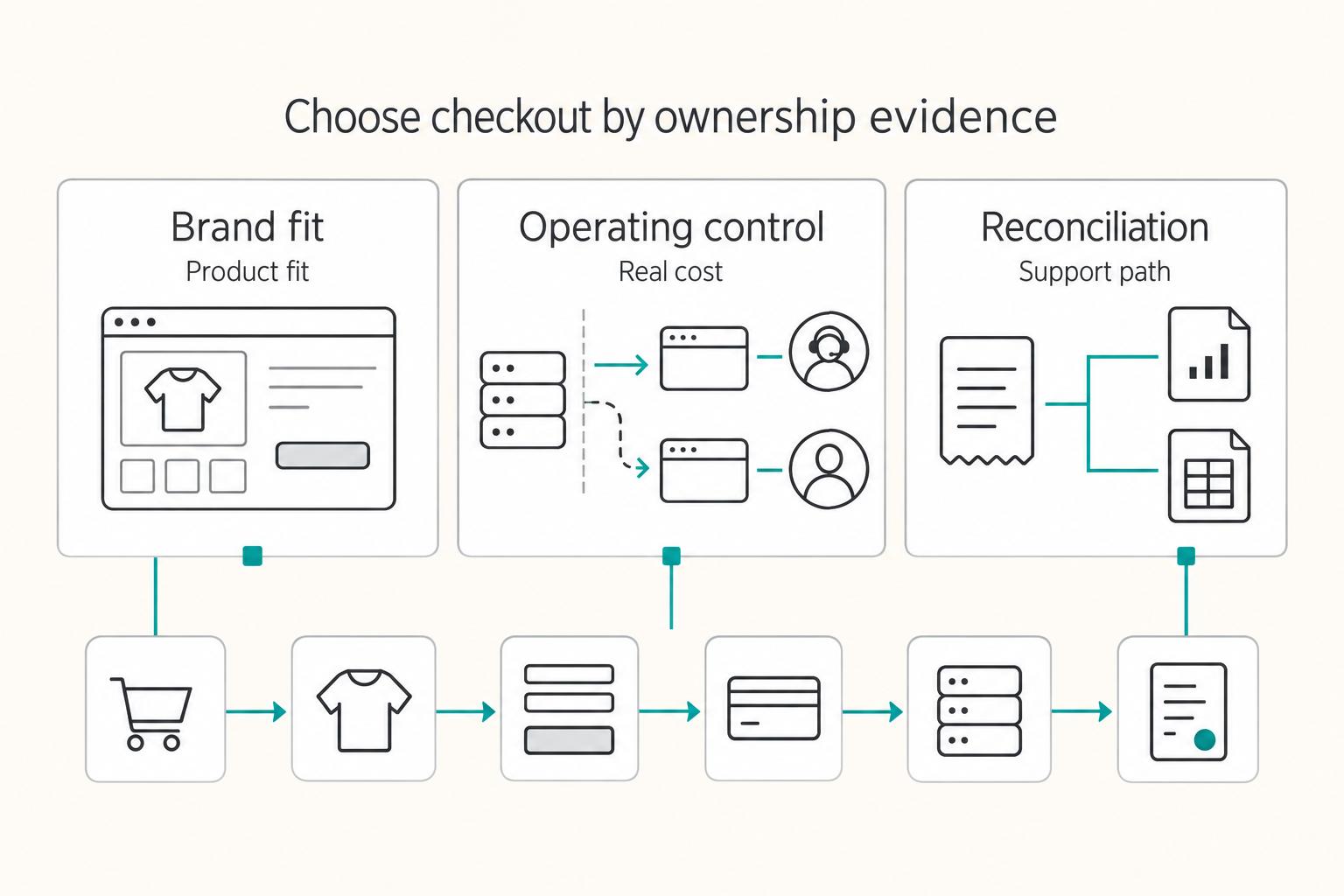
The tension is simple. Product wants checkout to feel native to your brand. Engineering and operations need something your team can run, support, and reconcile. White-label options can help, but "white label" does not always mean deep technical control. In many cases, customization is strongest at the brand layer while the core technical components stay fixed. Use a simple decision test early:
- Fit to your business needs and objectives
- Real costs and benefits
- The actual provider product you would implement
As you evaluate, confirm the real checkout path, not just the visual skin. Note what stays on your platform, where redirects appear, and what your team must support under your own SLAs and KPIs. Redirect-heavy paths can add friction and increase churn risk.
What a white-label checkout platform actually includes#
A white label checkout platform usually gives you branded checkout UX on top of third-party payment infrastructure, not a fully in-house gateway you control end to end.
Draw the product boundary#
Start by separating what you can change from what you are still renting. In many setups, you can control branding, some checkout surfaces, and parts of the merchant or seller experience, while the deeper technical layer stays with a third party. That can include provider-hosted checkout, payment, or order-tracking pages when redirects are involved.
Do not rely on a themed demo. Verify the real payment path in sandbox or through a live reference flow:
- Which pages stay on your domain
- Which pages are provider-hosted
- Where users are redirected
If that answer stays vague, assume branding control is stronger than infrastructure control.
Map actors and ownership early#
Map the provider network and your team in plain English. You do not need a deep rails model at this stage. You do need clarity on who owns checkout UX, who operates processing, and who handles front-line support when payments fail.
A common mistake is assuming "white label" means you own failure handling. In practice, your team may own the customer conversation and the SLA/KPI commitment, while resolution can still depend on the provider and its partners.
Test marketing claims against implementation evidence#
This is where positioning often gets slippery. Some claims imply broad control across branding and checkout pages. Other market views are narrower and frame customization as mostly brand-layer, with technical components staying largely out of the box. Do not infer capability depth from category language alone.
Ask each vendor for the same evidence pack:
- Hosted vs redirected flow diagrams
- Support ownership model
- Migration assumptions
The early unknowns can get expensive later. Focus on migration effort, support quality, and who actually owns incident resolution when checkout looks like yours but the infrastructure does not.
Decide between build and white-label for your stage#
If your real constraint is launch speed and branded checkout continuity, start with white-label. Build first only when your differentiation depends on control a vendor cannot give you.
Match the path to the bottleneck#
Use a simple build-vs-white-label decision tree and name what is actually blocking launch.
Choose white-label when you need a branded experience quickly and can accept vendor dependence. White-label is often framed as the faster route, with one comparison showing 2-6 weeks versus 8-18+ months for a custom build. Treat those numbers as directional, not guaranteed.
Choose build when you need control beyond branded surfaces and are ready to own code, servers, security, and ongoing maintenance. As a checkpoint, write a one-line decision note with your target launch window, available engineering capacity, and one non-negotiable capability.
Compare tradeoffs side by side#
| Criteria | White-label path | Build path |
|---|---|---|
| Launch speed | Often positioned as 2-6 weeks | Often positioned as 8-18+ months |
| Engineering lift | Lower initial build effort | High initial build plus ongoing ownership |
| Vendor dependence | Higher, including roadmap dependence | Lower vendor dependence, higher internal dependence |
| Extensibility | Strong for brand-layer customization, weaker for deep custom behavior | Highest control over custom behavior |
| Cost visibility | Can look simpler up front, but check fees or revenue-share effects | Larger up-front spend, with costs carried internally |
| Failure risk | Faster start, but blocked changes can wait on vendor | Higher risk of delays, bugs, and cost overruns |
Two cautions matter here. Timeline and cost ranges are context-specific, and sources conflict (8-18+ months vs 5-9 months; one source cites $100k-$500k for custom development). Do not anchor on a single estimate.
Stress-test for your operating model#
Write down your operating model before you commit. Then use that map to test whether you mainly need brand-layer speed or deeper product control.
Avoid forcing a model-specific rule. This comparison supports tradeoff analysis, not a universal "one model should always do X."
Require evidence before committing#
Before you move from theory to vendor selection, ask for proof that matches how you actually operate.
For white-label, request a sandbox flow showing the real customer path, branding limits, change turnaround, and full pricing structure, including any revenue-share terms. If 24/7 support is mentioned, confirm whether it is contractual.
For build, require a written ownership plan for code, servers, security, maintenance, and post-launch defects. If ownership is not explicit, the plan is not ready.
Related: How to Build a White-Label Payout Solution: Key Features and Customization Requirements.
Lock commercial and relationship ownership before vendor demos#
Start with ownership, not checkout UI. Before you spend time reviewing themes or hosted pages, confirm who owns day-to-day payment support and key operational decisions.
Ask ownership questions before feature questions#
White-label vendors are often positioned with a split: the provider runs uptime, security, and feature delivery; you control branding, pricing, and customer relationships. Treat that as a starting assumption, not proof that payment operations are clearly owned.
| Area | What to clarify |
|---|---|
| Merchant account operations | Who manages the process in your model, and whose process governs changes |
| Charge dispute posture | Who prepares evidence, who works with the processor or provider, and who communicates status to the customer or seller |
| Front-line support | Whether your team or the vendor responds first when a payment is pending, failed, duplicated, or challenged |
Ask these questions in the first call, and record a named owner for each. End the call with a one-page responsibility note with named parties, not labels like "shared," "joint," or "case by case."
Define merchant and seller relationships on paper#
Do not rely on vendor terminology alone. It's confirmed here that there is a broad split between operations ownership and brand or customer ownership, but a standard legal definition of Merchant relationship versus Seller relationship is not established.
Set working definitions for your model, then test them against real flows. If you do not map those responsibilities before contracting, legal review, support routing, and dispute handling can drift.
Route three incidents end to end with your team and the vendor:
- Failed checkout
- Dispute notice
- Seller complaint about a held payment
If routing differs across teams, the ownership design is not done.
Set contract red lines before technical discovery#
Treat governance as its own workstream. Before deep product walkthroughs, set non-negotiables for review:
- Service-level agreement (SLA), including the uptime commitment the vendor will actually back
- Escalation path and who notifies whom during outages or payment incidents
- Data export and exit handling expectations
If a vendor claims "SLA-backed uptime" or strong support, ask for the contract language and written support model, including channel, coverage, escalation ownership, and brand layer.
Use a stop rule in the first 60 minute demo#
A 60 minute demo can assess fit only if ownership and contract structure come first. If those boundaries are still vague on the first call, pause technical discovery and resolve structure before continuing.
This reduces failure-mode risk in white-label programs by avoiding late misalignment on disputes, support expectations, or exit handling.
Gather prerequisites and evidence before technical evaluation#
Treat pre-work as mandatory. Build your own evidence pack before any vendor deep dive so you can test claims against your funnel, your payment infrastructure, and your support model.
Build an internal evidence pack from the current flow#
Start from your live checkout flow, not vendor promises. Map the full journey end to end, including page transitions, redirects, failure states, manual interventions, and finance handoffs. This matters because some third-party setups route users to external checkout, payment, or order-tracking pages, and those off-platform steps can add friction and churn risk.
Capture these in one working document:
- A page-by-page map of current checkout UX, including where users leave your app
- Main failure points, for example failed payments, duplicate attempts, unclear pending states, or error messages that trigger support
- Reconciliation pain where finance manually matches provider references to internal records
- Security and compliance constraints on what payment or customer data can be shown, stored, or passed across tools
Someone outside the project should be able to identify exactly where user confidence, support confidence, and finance confidence break down.
Collect your integration inputs before asking for theirs#
"API-based" is only a starting point. Define your own integration input sheet first: current APIs, required status updates, failure handling in your stack, and how payment status changes feed internal records.
Engineering and finance should align on this together. For the payment states you track, define what internal state changes and what record is written. If you cannot describe your internal posting requirements and transaction identifiers, you are not ready to evaluate technical fit.
Your team should be able to explain, in plain language, which status updates create or update internal records and how duplicate updates are handled.
Define success metrics by function#
Set function-level metrics before demos so each team evaluates the same outcome. For example, product can own conversion targets, operations can own exception rate and close time, and finance can own reconciliation cycle time plus acceptable manual matching.
Tie each metric to your evidence-pack baseline. If redirects are a known drop-off point, measure whether a proposed flow reduces that friction. If support ownership is unclear, measure whether the model reduces ticket bouncing rather than simply moving it.
Each metric should have a baseline, target, and named owner.
Write a red-flag list and require proof#
Treat broad vendor claims as claims, not proof. Use a red-flag list to force unresolved risks into the open before deeper technical review.
| Area | Red flag |
|---|---|
| Pricing or fee logic | Unclear in writing |
| Migration assumptions | Depend on undefined work from your team |
| Support ownership | Missing for support tickets, escalations, and customer communication |
| Branding or checkout-control claims | Not demonstrated in sandbox |
| Security or compliance statements | Do not clearly separate provider coverage from your obligations |
If a vendor says checkout stays under your control, ask for a sandbox walkthrough of the exact pages, redirects, and error states your users will see. If they cannot show it, or cannot define support ownership for failed payments, pause the evaluation and keep the issue open.
Score providers with a weighted selection scorecard#
Use a weighted scorecard to make the decision evidence-based, not demo-driven. If providers are not scored in the same structure, rate-only arguments can hide integration and operational risk.
Set weights before vendor debate#
Set the scoring model before opinions harden. Define your scored categories in writing before you score any provider. A practical set is Checkout UX control, integration complexity, risk/compliance and ops burden, commercial terms, and support model. Use one scale across all categories, for example 1-5 or 1-10, then apply weights that total 100.
Use published weighting models only as a reference point, not a template. One 2025 methodology used 30% checkout speed and performance, 25% conversion impact, 15% platform flexibility, 10% integration complexity, 10% processing cost and fee structure, and 5% security and compliance standards.
If your core goal is branded control, weight Checkout UX control highest. If your main pain is finance exceptions or contract risk, shift more weight to commercial terms and risk/compliance and ops burden.
Before anyone scores Stripe, Airwallex, DECTA, SDK.finance, or Fiska, make sure product, engineering, finance, and ops agree on weights and scale.
Define what earns each score#
A score only helps if it has a hard definition. For Checkout UX control, define what top marks require: embedded vs hosted flow, redirect behavior, third-party branding visibility, failed-payment UX, and control over copy, layout, and status messaging.
Do not score from sales language alone. White-label claims can sound strong on calls and still be shallow in the actual customer flow. If the actual customer flow is not demonstrated, treat the claim as unproven.
Apply the same standard to integration and commercial scoring. For integration complexity, score what is verifiable: API docs, onboarding flows, and whether pre-built connectors reduce deployment effort. For commercial terms, score pricing certainty, not just headline rates, because public pricing can still be quote-based, for example, 2.1% + 30¢.
The main failure mode here is simple: teams score what they were told, not what they verified.
Force an apples-to-apples sheet#
Use one standardized table with identical fields for every provider.
| Provider | Checkout UX control | Integration complexity | Risk, compliance, and ops burden | Commercial terms | Support model | Unknowns still open | Evidence attached |
|---|---|---|---|---|---|---|---|
| Stripe | Score + note | Score + note | Score + note | Score + note | Score + note | Timeline reliability, migration support, escalation quality | Docs, sandbox, contract, references |
| Airwallex | Score + note | Score + note | Score + note | Score + note | Score + note | Timeline reliability, migration support, escalation quality | Docs, sandbox, contract, references |
| DECTA | Score + note | Score + note | Score + note | Score + note | Score + note | Timeline reliability, migration support, escalation quality | Docs, sandbox, contract, references |
| SDK.finance | Score + note | Score + note | Score + note | Score + note | Score + note | Timeline reliability, migration support, escalation quality | Docs, sandbox, contract, references |
| Fiska | Score + note | Score + note | Score + note | Score + note | Score + note | Timeline reliability, migration support, escalation quality | Docs, sandbox, contract, references |
Keep Unknowns still open visible in every review. If timeline reliability, migration support, or escalation quality is not proven, that risk should sit next to the score.
Every score should include a short note plus an artifact. If no artifact exists, mark the score provisional or leave it blank.
Require evidence and set a decision rule#
Require evidence for each score from at least one of these sources: docs, sandbox behavior, sample contract language, or operational references. Also separate "stated in docs" from "observed in sandbox."
For commercial terms and support commitments, capture contract evidence at clause level so sales claims and legal terms do not get conflated.
End with a written go or no-go threshold and one tie-break rule. A practical rule is this: no provider advances unless it clears the weighted minimum and has no critical unknown in categories tied to your current pain. For ties, pick the provider with fewer critical unknowns. If it is still tied, use scripted sandbox performance on redirects, failed-payment handling, and support handoff clarity.
For a step-by-step walkthrough, see How to Structure a White Label Partnership With Another Agency.
Before you lock vendor scores, sanity-check your webhook, idempotency, and reconciliation assumptions against the Gruv docs.
Design a branded checkout UX that still clears risk checks#
Treat this as a control-boundary exercise. Brand what users see, but keep provider-managed risk and compliance controls intact. In this setup, your team usually controls the visible experience, while the payment gateway and underlying infrastructure still handle core security and payment operations.
Map the control boundary#
Separate brand-controlled elements from provider-managed elements before you design flows.
| Area | Usually brand-controlled | Usually provider-managed | What to verify |
|---|---|---|---|
| Visual identity | Logo, colours, custom domain/URL | Hosted-page styling limits, if any | Brand is consistent on entry, return, and error states |
| Checkout presentation | Layout, copy, status messaging, retry prompts | Sensitive data-capture elements may be constrained | Which screens and fields are editable in sandbox |
| Risk and payment handling | User-facing explanations and next steps | Secure capture or encryption, routing, processor or acquirer handoff, core compliance controls | Which steps are provider-managed vs display-only choices |
Practical rule: do not try to remove controls tied to payment-data protection or provider-managed boundaries. Put your UX effort into clarity, status communication, and on-brand guidance.
Set a friction budget#
Set friction limits around provider-managed checks first, then simplify everything around them. Verify the real flow in sandbox, including redirect cases and consent or permission changes, because degraded states can remove or affect features.
The safest simplifications sit in the presentation layer: clearer copy, less duplicate messaging, obvious return paths, and explicit "what happens next" guidance.
Protect conversion around redirects and retries#
Redirects are often where branded checkout starts to feel less controlled, so handle them deliberately. If redirects are required, announce them before handoff, preserve order context, and return users to the same state. Avoid dumping users onto a generic page where payment status is unclear.
Make status messages explicit: failed, processing, or completed. That distinction matters because checkout presentation and actual funds movement are separate responsibilities.
Run a pass/fail verification checkpoint#
Before launch, capture sandbox evidence for first attempt, redirect out and back, failed payment, and retry flows, plus the transaction references finance needs for reconciliation.
Use pass/fail criteria:
- Brand consistency: logo, colours, and domain appear on entry, return, and failure states
- Drop-off visibility: you can locate abandonment before redirect, during redirect, after return, or on retry
- Error clarity: each failed or pending state tells users what happened and what to do next
- Redirect resilience: cart or order context survives the round trip without reset or blank states
- Performance claim check: if a provider cites figures like under
300msAPI response times or99.9%uptime, compare those claims against observed sandbox behavior before using them in launch assumptions
If any checkpoint fails, fix the UX before launch. A branded surface that breaks at the risk boundary is still a checkout failure.
Related reading: Choosing Creator Platform Monetization Models for Real-World Operations.
Connect checkout to your ledger reconciliation and payout stack#
Checkout is only complete when payment events reconcile cleanly to invoice status, ledger entries, and payout decisions. Treat the Payment Service Provider (PSP) as an event source that feeds your accounting and payout logic, not as the system that defines it.
Define your internal payment state order#
Separate payment lifecycle states from accounting and payout states. Define distinct internal states, for example, payment attempt or authorization, capture or paid, invoice update, ledger posting, and payout eligibility (plus wallet projection, if you use one).
Do not collapse these into a single "success" state. A payment can be captured and still require separate rules before funds become payout-eligible. The practical checkpoint is simple: can payment completion mark the invoice as paid, update the ledger, and trigger the next invoice step where needed?
In sandbox, trace one successful payment from checkout to invoice state, ledger entry, and payout flag with linked IDs and timestamps.
Make webhook handling idempotent before trusting it#
If your event handling is weak, reconciliation problems will show up late and expensively. Some providers offer a unified API and webhooks across checkout, payouts, ledger, and reporting. That can reduce integration friction, but only if webhook processing is idempotent.
Store raw webhook payloads, use a stable processing key, and ensure accounting effects post once even if the same event is delivered again. Also define behavior for out-of-order events so you do not create incomplete records or duplicate ledger effects.
Replay the same webhook in sandbox and confirm invoice state, ledger posting, and payout eligibility change once. If idempotency behavior, webhook behavior, sandbox keys, and versioned docs are unclear, pause the integration.
Define reconciliation artifacts finance actually needs#
Finance reconciles from references and settlement outputs, not from checkout screens. Missing or bad references create manual matching work, and in some cases that can cost an hour per issue.
| Artifact | Why it matters | What to verify before launch |
|---|---|---|
| Provider payment reference | Traces payments in PSP and settlement views | Stored on records, exportable, retained across retries |
| Internal order, invoice, or transaction ID | Connects payment events to your books and customer records | Stable across redirects, failures, and retries |
| Settlement mapping field | Links payment records to settlement or payout outputs | Settlement output can be matched back to internal records |
| Exception status and owner | Creates a practical queue for unresolved mismatches | Each exception has reason, owner, and last update |
| Currency and FX quote timestamp, if used | Helps explain differences between quoted, captured, and payout amounts | Visible on records and in finance exports |
This is where checkout needs to connect cleanly to the rest of your payment infrastructure. Checkout emits payment facts and references. Ledger and payout systems apply accounting and release rules.
Triage failure modes before they hit payouts#
Define operator actions for common mismatch cases before launch:
- Delayed webhooks: keep payments in a processing state and hold payout decisions until required events are confirmed
- Mismatched statuses: if provider and invoice states conflict, create an exception and resolve it before downstream balance changes
- Broken or missing references: queue for manual matching with enough customer and payment context to resolve quickly
This discipline matters even more when transaction sizes vary widely, for example, from £50 to £500,000. Before go-live, run a dry reconciliation close across successful, failed, retried, and pending payments, and confirm each outcome can be traced from the PSP event to final ledger state.
Set security compliance and SLA escalation rules#
Before launch, put security and compliance rules and incident escalation in writing so ownership, response expectations, and enforcement are clear when something breaks.
Write policy gates before launch#
Document security and compliance gates as operational rules, not broad policy language. Define which events trigger review, who can approve or block a case, and what evidence is required before normal service resumes.
Apply the same discipline to data-handling and access boundaries. Define what checkout can collect, who can access sensitive data, and where only restricted or masked values are allowed across support tools, finance exports, admin views, and exception queues.
Run a test case from checkout to support ticket to finance export and confirm data access and masking match your written rules.
Assign severity owners and measurable SLA targets#
An SLA only helps when it sets measurable outcomes, named owners, and escalation paths. For each severity level, define who is responsible, what must be delivered, how success is measured, and what enforcement applies if targets are missed.
At minimum, set:
- Internal owner, provider owner, and approver for incident and customer communication decisions
- Response, update, and resolution targets written into contract terms
- Agreed measurement method for outages or degraded performance
- Enforcement terms such as service credits, remediation plans, penalties, or termination rights
If a vendor cites 99.9% or more uptime, treat that as a baseline claim, not enough on its own. Agree the measurement method up front so availability reporting cannot hide failures.
Route escalations by incident type#
Do not route every issue through one generic queue. Security incidents, availability incidents, and customer-impact incidents need distinct owners and response paths.
- Security incident: define who can tighten controls and own customer-impact decisions
- Availability incident: define who can declare severity, who drives provider escalation, and when escalation is mandatory if unresolved
- Provider incident: require escalation beyond front-line support when unresolved, with a clear owner, next checkpoint, and current route
Prevent one failure mode in particular: unresolved incidents with no internal owner for customer communication decisions.
Require evidence for vendor claims#
Request security and compliance answers in writing during evaluation and again before production sign-off. Require controls documentation, audit artifacts, escalation contacts, incident-response materials, and breach communication procedures.
Your evidence pack should include signed SLA terms, documented escalation paths, control evidence, and the breach-notification process your legal and ops teams will follow. Final checkpoint: run a tabletop incident and confirm owners, escalation route, required evidence, and contract targets are clear without improvisation.
Roll out in 90 days with hard checkpoints#
Use a 90-day plan as a governance cadence with hard gates, not as a promise that every team can ship in exactly 90 days.
Lock phase scope and decision rights#
Run four phases: discovery and scoring, sandbox integration, pilot cohort launch, and production expansion. Assign named decision rights for product, engineering, finance or ops, and support before discovery closes.
| Migration model | Vendor role | Your team role |
|---|---|---|
| White-glove migration | The partner executes and is accountable for outcomes | Provides access and decisions |
| Assisted migration | The vendor guides | Does most of the work |
| Tool-based migration | Software helps transfer data | Owns configuration, testing, and launch |
Confirm the migration model early so staffing matches reality. In white-glove migration, your team provides access and decisions while the partner executes and is accountable for outcomes. In assisted migration, the vendor guides while your team does most of the work. In tool-based migration, software helps transfer data, but your team still owns configuration, testing, and launch.
End this phase with a written go or no-go memo.
Gate sandbox integration with written evidence#
Do not move out of sandbox on momentum alone. Move only when integration evidence is documented and risks are reviewed in writing. A clean demo is not enough for production readiness.
If launch depends on connected systems, treat those dependencies as explicit launch scope so gaps are visible before pilot. Fragmented legacy connections can make operations rigid and error-prone.
Close the phase with another written go or no-go memo.
Run a narrow pilot and close reconciliation before expansion#
Launch a limited pilot cohort so issues are isolated and reversible. Before expansion, run a reconciliation check so finance or ops can trace critical flows end to end, with variances resolved or assigned to owners.
End the phase with a short memo that states tested scope, open defects, reconciliation status, support signal, and a clear recommendation: pause, continue, or expand.
Define rollback rules before production expansion#
Set rollback criteria before broadening traffic, such as error signals, reconciliation breaks, or unresolved critical defects. Pair each trigger with a predefined action, owner, and checkpoint.
Consider running an incident drill before expansion and attach the results to the memo. This keeps risk decisions explicit. A failed rollout can mean lost revenue, damaged SEO, and unhappy customers, so each phase needs a written decision, not a status assumption.
Common failure modes and how to recover fast#
Many post-launch failures in this setup can be recovered faster when you work from transaction evidence, not assumptions. If issues appear, pause expansion and stabilize the flow before adding complexity.
Fix UX and integration breaks before wider rollout#
When checkout breaks, check integration compatibility first. Compatibility gaps can cause delays, broken payment flows, and higher abandonment risk.
Recover by re-running thorough UX and integration testing before broader deployment. Treat every broken handoff in the payment flow as a launch blocker until it is verified in testing.
Restore root-cause visibility first#
Resolution slows down when teams cannot see why payments failed. Merchants often struggle to pinpoint root causes, so support and engineering can end up guessing.
Recover by standardizing your triage view: transaction ID, provider reference, timestamps, and decline or error codes in one place. Use that shared evidence set before deciding on fixes.
Separate hard declines from soft declines#
Do not handle every decline the same way. Hard declines are usually dead ends for the same card, while soft declines can sometimes succeed after a retry or adjustment.
Recover by stopping repeated retries on the same card for hard declines and guiding the user to a different payment method. For soft declines, run controlled retries or adjustments and monitor outcomes.
Tighten incident handling and test escalation paths#
Recovery slows when escalation details are incomplete. When that happens, troubleshooting drags out.
Recover by requiring a complete escalation packet for every incident: affected transactions, timestamps, decline or error codes, and current impact. Then test the escalation path in a drill so it works under live pressure.
When your team is ready to move from scorecard to pilot, confirm coverage and ownership boundaries for your program with Gruv.
Final recommendation and copy-paste launch checklist#
Treat this as an ownership and operations decision first, then a UI and vendor decision. A white label checkout platform can speed implementation, but it does not remove compliance and ongoing operational responsibilities.
Document the decision before deeper vendor work#
Write a short build-vs-white-label decision memo with the rationale, launch constraint, accepted control limits, owners, and target go-live date. Confirm merchant relationship, seller relationship, and merchant account ownership in writing before design polish or pilot planning.
Complete the scorecard with evidence#
Run the decision tree, then complete a weighted scorecard using evidence tied to each score, for example: sandbox behavior, API or webhook docs, contract terms, pricing schedules, and escalation contacts. Validate market and program coverage in writing for your launch scope. If a provider cites broad localization claims, such as onboarding across 118 countries and 45 languages, treat that as provider-specific until your exact coverage is confirmed. Flag non-obvious fees early if the commercial model is not clear on one page.
Pass reconciliation and incident checkpoints before launch#
Launch only after reconciliation and incident checkpoints pass in sandbox and in pilot. Your team should be able to verify that transaction records stay consistent across systems and that incident workflows are handled safely.
Pilot first, then expand with explicit go/no-go criteria#
Move to limited production traffic only after the memo, scorecard, and operations gates are complete. Keep rollback triggers visible and documented, and require formal go or no-go signoff from product, engineering, finance or ops, and legal.
White-Label Checkout Launch Checklist
- Build vs white-label decision documented with clear rationale
- Merchant relationship, seller relationship, and merchant account ownership confirmed
- Weighted selection scorecard completed with evidence links
- SLA, escalation, and incident ownership approved by ops + legal
- Checkout UX and risk controls tested in sandbox and pilot
- Ledger posting, webhook idempotency, and reconciliation dry run passed
- Rollback triggers and go/no-go signoff documented
Frequently Asked Questions
What is a white-label checkout platform, and how is it different from a standard payment gateway?
A white-label checkout platform gives you a branded checkout experience on top of third-party payment technology. Unlike a standard payment gateway, the provider usually operates the underlying infrastructure while you control customer-facing surfaces like checkout and payment pages.
Who should choose white-label checkout instead of building payment infrastructure in-house?
Choose white-label when you want a branded experience without building and operating the full payments infrastructure yourself. It is often a practical fit when launch speed matters and your team does not want to own the full stack, but the choice should match your payment needs and operating model.
What should we evaluate first when comparing providers for a SaaS platform or marketplace?
Start with capability fit, not design polish. Confirm the payment methods your users need, then verify how much of the checkout and payment experience you can actually customize and support in your model.
What are the main risks of vendor lock-in, and how can we reduce migration pain later?
The main lock-in risk is dependence on a provider that owns and operates the underlying infrastructure. Reduce migration pain by defining portability, data export, support expectations, and migration assumptions in writing before you sign.
How do marketplace seller flows change the checkout decision compared with a simple SaaS billing flow?
Marketplace seller flows make the decision broader than simple SaaS billing because buyer and seller transaction flows can both matter. Do not assume seller-side requirements are covered by default, and require the vendor to define exactly what is supported and what stays out of scope.
Which unknowns should we force vendors to answer before signing?
Force vendors to answer payment-method coverage, branding boundaries, infrastructure ownership, and support ownership in concrete terms. Also require written clarity on pricing, compliance coverage, seller-flow scope, and migration or escalation expectations before signing.
Researched and edited by the Gruv editorial team. Gruv builds cross-border billing, payouts, and finance-operations software for global businesses.
Sources
Includes 3 external sources outside the trusted-domain allowlist.
- michigan.gov/-/media/Project/Websites/dtmb/Procurement/Co...trusted
- stripe.com/resources/more/white-label-payment-gatewaystrusted
- stripe.com/blog/platforms-can-now-white-label-payment-w...trusted
- tiffin.edu/wp-content/uploads/AI-Tools-with-Description...trusted
- wise.com/gb/blog/white-label-payment-gatewaytrusted
- adyen.com/knowledge-hub/white-label-payment-processingexternal
- airwallex.com/uk/blog/white-label-payment-gatewayexternal
- commercev3.com/resources/blog/white-label-ecommerce-platfor...external
Educational content only. Not legal, tax, or financial advice.
Related Posts

The Freelance Payment Penalty: A Modeled Audit of Platform Fees, FX Spreads, and Payout Delays
The money rarely disappears through a single, easy-to-spot fee. The real loss is stacked. A marketplace takes its commission, a processor adds a charge for international cards, a bank or payment company converts the currency at a spread, a platform holds the funds before release, and a wire sheds a little to intermediaries on the way in. Each layer looks defensible on its own, but the worker feels the combined result as a smaller deposit and a later payday.

How to Respond to a Subpoena for Business Records
Move fast, but do not produce records on instinct. If you need to **respond to a subpoena for business records**, your immediate job is to control deadlines, preserve records, and make any later production defensible.

A US Expat's Guide to Investing in UCITS ETFs to Avoid PFIC Issues
The real problem is a two-system conflict. U.S. tax treatment can punish the wrong fund choice, while local product-access constraints can block the funds you want to buy in the first place. For **us expat ucits etfs**, the practical question is not "Which product is best?" It is "What can I access, report, and keep doing every year without guessing?" Use this four-part filter before any trade: