
Quick Answer
Use a no-clarity, no-deal rule: confirm operating ownership before you negotiate rates. Build the partnership on a written Master Services Agreement (MSA), Statement of Work (SOW), and Service Level Agreement (SLA), then verify four points before kickoff: who speaks to the client, who approves rework, who signs off on QA, and what happens when timelines slip. Pause if IP ownership or confidentiality language is still unresolved.
Start here with a risk-first goal#
Treat this as a delivery risk decision first and a growth move second. A white label partnership with agency is more likely to hold up when the promise you make to the client matches the operating reality behind the scenes: who delivers, who supports, and who controls quality.
Step 1 Set the goal around trust, margin, and quality#
Do not start with "can they do the work?" Start with "can we protect the client relationship while keeping the work profitable and consistent?" These deals usually break when customer-facing promises are not tied to delivery ownership and quality control. If your agency sells fast turnaround, senior review, or direct responsiveness, each promise needs a real owner on the provider side before you talk about growth.
A practical checkpoint is to write down the 3 to 5 promises your agency already makes to clients. Match each one to a named delivery owner, a review point, and a fallback if that owner is unavailable. If you cannot map a promise to an owner, that promise is a risk. If you cannot map it to a review point, quality can drift as volume rises.
Step 2 Define success before you get into contract redlines#
Success here is not just finding a willing provider. Success is a signed White Label Agreement, clean operating rules, and fewer early surprises. In practice, that means both sides have written expectations for approvals, acceptance, escalation, and exits before any client work starts.
Your first verification test is simple: can both parties answer the same four questions the same way? Who talks to the end client, who approves rework, who signs off on quality, and what happens when delivery slips? If those answers live only in a sales call recap, email thread, or chat history, you do not have a reliable starting point. A good agreement turns that ambiguity into written workflows.
Step 3 Use a no-clarity, no-deal rule#
This guide focuses on Agency Partnership structure, not lead generation tactics or generic marketing advice. The decision lens is simple: if control, accountability, and legal clarity are weak, the deal is not ready. You can fix pricing later. It is much harder to repair client trust after a miss that nobody clearly owns.
The common failure mode is predictable. Your brand carries the client expectation, but the partner resists naming who handles support, who owns quality checks, or who steps in during an escalation. That is where margin often erodes first, because your team ends up absorbing rework, client communication, and damage control.
Start with one hard rule: if a partner will not put core responsibilities into the agreement, pause the deal. The rest of this article builds from that standard: score fit, choose the right structure, and document how the work actually gets delivered before you chase scale.
For a step-by-step walkthrough, see Agency Career Pathing With Clear Promotion and Lateral Move Rules.
Score partner fit before you discuss pricing#
Do not negotiate detailed rates until partner fit is clear. In a white-label model, you keep the client relationship and brand while the partner delivers behind the scenes, so a low hourly rate is not enough on its own.
Step 1: Score fit before final pricing. Use a one-page scorecard with three gates: commercial fit, legal fit, and delivery fit. This helps you avoid reactive decisions that later show up as quality inconsistency, margin erosion, or operational chaos.
| Gate | What to check | What to look for | Fail signal |
|---|---|---|---|
| Commercial fit | Service match, margin protection, communication model | Clear scope assumptions and revision handling | Attractive rate but vague scope or fragile margin logic |
| Legal fit | Contract clarity, ownership clarity, confidentiality handling | Clear language on responsibilities and outputs | Key ownership or confidentiality points stay unclear |
| Delivery fit | Quality controls, approvals, support, escalation, behind-the-scenes execution | Named owners, clear escalation path, proof of execution quality | No clear escalation owner or weak delivery process |
A useful control is to have two team members score the same partner. If their scores are far apart, tighten your criteria before moving forward.
Step 2: Ask for operating proof early. Before you give a verbal yes, ask for practical examples of how they run work, including sample scope and service terms and named escalation contacts where available. The goal is to confirm your team could run delivery without inventing missing rules.
Step 3: Keep hard-stop clarity rules. If IP ownership is unclear, pause. If confidentiality handling is unclear for an invisible delivery model, pause. That is an operating-risk decision, not legal perfectionism.
Step 4: Run basic legitimacy checks before price pressure. Verify the partner's entity details in the jurisdictions that matter to your engagement. A Certificate of Good Standing can be part of that check when relevant. If useful, see What is a 'Certificate of Good Standing' and When Do You Need One?.
Only after these checks should pricing become the focus. When you compare options, do not compare partner rates to salary alone: in-house cost also includes benefits (often around 1.3-1.4x salary), recruitment (often 20-30% and sometimes long hiring cycles), management overhead, and bench time. Partner ranges like $75-150/hour are typical examples, not universal rules.
Related: How to Price a White-Label Service for another Agency.
Pick the right structure for the work you actually sell#
Choose the structure based on control, client visibility, and delivery ownership, not labels. If you need strict brand control with repeatable fulfillment, use a white-label setup documented in a formal Retainer Agreement. If the work is narrow or temporary, subcontracting under a tight Statement of Work (SOW) is usually the cleaner starting point.
| Structure | Control over delivery | Client visibility | Operational burden on you | Best fit |
|---|---|---|---|---|
| White Label Partnership | High: you set standards, QA, and brand presentation | Low: provider stays behind your brand | Higher: recurring coordination, QA, and escalation management | Ongoing services you sell repeatedly |
| Subcontracting | Medium: you control scope, with less control over full process | Medium to low: depends on whether specialist involvement is disclosed | Moderate: mostly tied to a project or specialist task | Narrow, specialized, or temporary scope |
| Referral model | Low: you hand off delivery | High: client works directly with the provider | Low: minimal delivery oversight after handoff | You do not want delivery responsibility |
Use agreements that match the work pattern. For recurring delivery, anchor the relationship in a Retainer Agreement and attach a clear SOW/SLA as needed. For project work, keep subcontracting boundaries explicit in the SOW: deliverables, acceptance criteria, revision limits, turnaround expectations, and rework approvals.
Check classification risk before day-to-day management drifts into staff-like control. Worker-status analysis is fact-based and can turn on control or the right to control, along with factors like engagement length and payment method. If the relationship starts to look exclusive or heavily supervised, pause and get local advice before the structure hardens.
If you want a deeper dive, read What to Do If You've Been Misclassified as an Independent Contractor.
Prepare the deal package before contract redlines#
Do the alignment work before redlines. Your contract should reflect an agreed operating plan, not create one from scratch.
Step 1 Assemble one pre-signing packet#
Create one shared packet that captures how the partnership will run in practice: service catalog, acceptance criteria, reporting format, and draft Pricing Model assumptions.
Use it to confirm both sides are pricing and delivering the same thing. If this is a replacement or renewal deal, fold in lessons learned from the prior contract instead of rebuilding from memory.
Step 2 Lock role boundaries in writing#
Set role ownership early and in writing for end-client communication, rework approval, and QA signoff.
If ownership is unclear at this stage, redlines will stay vague and operational risk will show up later under your brand. A quick readiness check is simple: both sides should be able to confirm the same responsibility list without relying on informal "we'll decide later" language.
Step 3 Start with a draft MSA and first SOW, then require proof#
Bring a draft Master Services Agreement (MSA) and an initial Statement of Work (SOW) into the first serious negotiation round. Treat templates as starting points to customize, not fixed language to accept as-is.
Before redlines go deep, add an evidence checkpoint: request references or anonymized delivery samples that match the actual services you plan to sell together.
This pairs well with our guide on The Agency Scaling Blueprint: From Solo Freelancer to Hiring Your First 5 Global Contractors.
Write the agreement clauses that prevent expensive surprises#
Prevent surprises by making the contract operational. It should translate commercial promises into clear rules for approvals, acceptance, escalation, and exit. If those mechanics stay vague, brand control and support ownership can drift into IP and liability disputes.
Step 1 Draft the seven clauses as operating decisions, not boilerplate#
Prioritize these seven clauses in your white label agreement, and make each one answer a real delivery question:
| Clause | What to define |
|---|---|
| Confidentiality Clause | What information is confidential, who can access it, and for what purpose |
| Non-Solicitation Clause | Who cannot approach whose clients, staff, or contractors, including any written carveouts |
| Non-Compete Clause | How restrictions are framed, with the understanding that interpretation and enforcement can vary by jurisdiction and facts |
| Intellectual Property (IP) Ownership | Who owns newly created deliverables versus pre-existing materials, templates, and methods |
| License Terms | What use rights apply if background IP stays with the provider, including post-payment and post-termination use |
| Service Level Agreement (SLA) | What performance standards are measured and how misses are escalated |
| Termination Clause | How breach-based and ordinary exits work, including what survives termination |
Also define order of precedence so conflicting terms across MSA, SOW, SLA, or proposals have one controlling source.
Step 2 Convert each clause into rules your team can execute#
A clause is only useful if delivery and account leads can apply it without interpretation fights.
For each clause, define these four operating rules in the MSA, SOW, or SLA:
| Rule | What to define |
|---|---|
| Response time | Trigger event, channel, and timing expectation |
| Revision limit | What counts as an included revision vs. scope change |
| Acceptance standard | Observable completion criteria tied to the SOW/reporting/QA |
| Escalation owner | Named role or contact responsible for escalation |
If someone outside the sales process cannot answer who approves rework, how acceptance works, and who owns escalation, the clause is still too abstract.
Step 3 Lock exit mechanics and Transition Assistance now#
Add Transition Assistance in the initial agreement, not after problems start. Use an if/then structure: if SLA breaches repeat, trigger the cure process in your agreement; if cure fails, trigger termination and transition steps.
Spell out what must be returned, transferred, or deleted at exit; who owns the handoff; and how in-flight approved or paid work is handled. If you want post-termination handover support, write that obligation into the contract up front.
Because these clauses can be interpreted differently by jurisdiction and specific facts, treat this framework as contract design guidance, not legal advice.
You might also find this useful: How to Structure a White Label Service Agreement.
Set delivery governance your client can trust#
Client trust rises or falls on the reports and updates your agency delivers, so governance should make ownership, cadence, and communication boundaries explicit before launch.
Step 1 Name cadence and owners in writing#
Set the operating rhythm in your working documents so it does not depend on habit. Define who owns production, who performs QA, and who sends client-facing updates.
Use a recurring schedule your team can execute consistently, such as weekly and monthly cycles, with quarterly reviews when needed. In white-label delivery, each report is a brand touchpoint for your agency, so missed handoffs look like your service issue to the client.
Verification check: a teammate outside sales should be able to answer, from the documents alone, who drafts, who approves, and who sends.
Step 2 Set communication boundaries before issues happen#
Document who communicates externally and who stays behind the scenes when something slips. In a white-label model, your agency is the visible accountable party, and the provider is the invisible delivery layer.
Keep this simple and operational: define primary and backup owners for issue handling, what internal record should be captured, and who delivers the client update. That prevents mixed messages and protects trust when delivery pressure rises.
Step 3 Add checkpoints before client release#
Run recurring deliverables through clear checkpoints: internal QA, agency approval for release, and a short retrospective after delivery. This keeps quality and messaging aligned with your brand before anything reaches the client.
A common miss is treating QA as provider-only while the agency skips final signoff. In practice, clients evaluate your agency based on what they receive, not the backend setup.
Keep the provider invisible, but keep governance visible inside your team. That is what turns a promising partnership into consistent client trust.
We covered this in detail in How a Canadian Creative Agency can legally work with US-based freelance talent.
Protect margins with billing and payment rules#
Protect margin by making billing terms traceable to signed documents, not informal status updates.
| Control | What to document | Check |
|---|---|---|
| One commercial record of truth | Service expectations and pricing record in writing, with the agreement pointing back to that record and the request scope and accepted proposal carried as exhibits | Delivery and billing run against what those exhibits say |
| Billing alignment | Proposal pricing and delivery assumptions matched to the invoicing logic | You spend less time arguing interpretation |
| Ownership terms | If output is treated as works for hire and the vendor does not retain ownership in completed work, keep that language explicit | Reduces ambiguity when approving deliverables and closing invoices |
| Mock invoice check | Run a mock invoice using only the contract set and exhibits | If finance and delivery cannot explain the charge path from those documents alone, tighten the language before go-live |
Step 1 Keep one commercial record of truth. Put the service expectations and pricing record in writing and make sure your agreement points back to that record. A strong pattern is to carry the request scope and the accepted proposal as exhibits, then run delivery and billing against what those exhibits say.
Step 2 Align billing with documented representations and pricing. If your proposal sets the pricing and delivery assumptions, your invoicing logic should follow the same assumptions. This is the practical guardrail against early margin disputes: when work, price, and invoice rules come from the same written baseline, you spend less time arguing interpretation.
Step 3 Define ownership terms clearly to prevent downstream payment friction. If your agreement treats output as works for hire and states the vendor does not retain ownership in completed work, keep that language explicit. Clear ownership terms reduce ambiguity when approving deliverables and closing invoices.
Verification point: run a mock invoice using only the contract set and exhibits. If finance and delivery cannot explain the charge path from those documents alone, tighten the language before go-live.
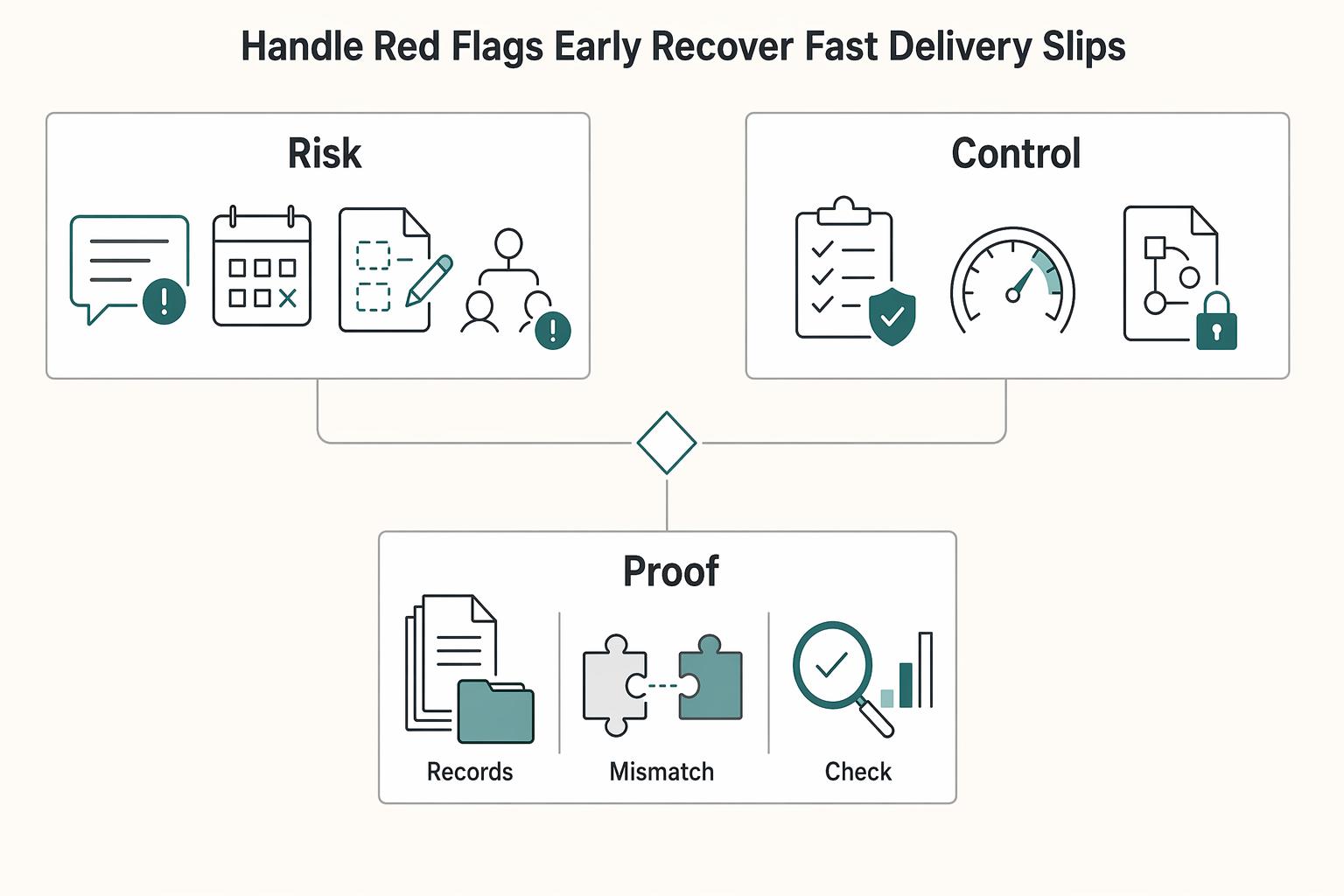
Handle red flags early and recover fast when delivery slips#
Treat repeated delivery friction as a structure problem first, not a one-time miss. The clearest warning pattern is vague Statement of Work (SOW) language, missed timelines, rework framed as "revisions," and weak ownership when you push for clause-level accountability.
Step 1 Spot structural risk early. Compare live work to the controls you already have: definition of done in the SOW, SLA commitments, and change-control records. If you cannot trace a miss to a clear requirement, owner, and approval path, the operating model is the issue.
Step 2 Contain client impact before assigning blame. Run your Incident Response Playbook first: pause risky new promises, decide what can still ship safely, assign one internal owner, and prepare the client update.
Step 3 Enforce remedies after documenting the incident. Use the incident review output to map what happened to the MSA, SOW, SLA, or white label agreement, then apply the remedies those documents already provide. If any legal language was pulled from online research, verify it against an official legal edition before relying on it.
Step 4 Exit cleanly if recovery is not credible. Execute the Termination Clause, request Transition Assistance, and secure deliverables, source files, status notes, and access credentials before access changes. Communicate corrective actions to the client early, not after they ask.
Copy-paste checklist before you sign#
Use this as a go/no-go screen: if an item is not backed by a document, named owner, or written rule, pause signing.
| Checklist item | What it includes | Check |
|---|---|---|
| Confirm fit with a written scorecard and evidence pack | Commercial, legal, and delivery fit before final pricing, plus anonymized samples in your delivery format, draft MSA/SOW/SLA materials, and named escalation contacts | Map at least one real sample to the exact service you plan to resell |
| Finalize the MSA, first SOW, and any SLA as one operating package | Approvals, acceptance, escalation, and exit made explicit so a new teammate can identify scope, acceptance standards, revision boundaries, delivery timing, and QA sign-off without a meeting | Done is clear from the documents alone |
| Lock legal protections before kickoff access | Confidentiality, non-solicit/non-compete where appropriate, IP ownership, license terms, termination, and transition support | Red flag: unclear IP ownership or vague license language |
| Validate economics in writing, not in draft spreadsheets | Pricing model, margin floor, billing cadence, and pass-through cost rules, and confirmation that any liability cap tied to fees from the prior 12 months still fits the service risk | Finance can state invoice timing, payment triggers, and reimbursable costs in one pass |
| Test operations before launch | Weekly cadence, QA checkpoints, incident handling, and client communication boundaries, including who joins client calls, who owns deadline misses, and how defects are logged and approved for rework | Keep these rules in contract-linked documentation, not scattered chat threads |
| Define a 30/60/90-day review plan and exit triggers | Pre-scheduled reviews, early-warning criteria, and cure and termination mechanics in writing, including 30/60 days for material breach where the agreement uses them | Exit criteria, transition obligations, and handback checklists are explicit before launch |
- Confirm fit with a written scorecard and evidence pack.
Validate commercial, legal, and delivery fit before final pricing. Your pack should include anonymized samples in your delivery format, draft MSA/SOW/SLA materials, and named escalation contacts. Verification: you can map at least one real sample to the exact service you plan to resell. Red flag: capability is described on calls but not supported in writing.
- Finalize the MSA, first SOW, and any SLA as one operating package.
Treat these as workflow documents, not admin paperwork: approvals, acceptance, escalation, and exit should be explicit. Make the SOW clear enough that a new teammate can identify scope, acceptance standards, revision boundaries, delivery timing, and QA sign-off without a meeting. Verification: "done" is clear from the documents alone.
- Lock legal protections before kickoff access.
Confirm confidentiality, non-solicit/non-compete where appropriate, IP ownership, license terms, termination, and transition support. Confidentiality language should cover non-public business, technical, and financial information disclosed under the agreement. If you start from a state-specific template, verify governing law and fit for your relationship; interpretation and enforcement can vary by state law and facts. Red flag: unclear IP ownership or vague license language.
- Validate economics in writing, not in draft spreadsheets.
Document pricing model, margin floor, billing cadence, and pass-through cost rules. If liability is capped by fees from the prior [12] months, confirm that allocation still fits the service risk. Verification: finance can state invoice timing, payment triggers, and reimbursable costs in one pass.
- Test operations before launch.
Set weekly cadence, QA checkpoints, incident handling, and client communication boundaries now. Decide who joins client calls, who owns deadline misses, and how defects are logged and approved for rework. Keep these rules in contract-linked documentation, not scattered chat threads.
- Define a 30/60/90-day review plan and exit triggers.
The first 2 to 4 weeks often set the tone, so pre-schedule reviews and document early-warning criteria. Define cure and termination mechanics in writing, including notice structures such as [30/60] days for material breach where your agreement uses them. Verification: exit criteria, transition obligations, and handback checklists (files, credentials, in-flight work) are explicit before launch.
Related reading: Manage Agency Project Profitability With Cashflow Checkpoints.
Frequently Asked Questions
What is a white-label partnership with another agency in practical terms?
In practice, a white-label partnership with agency means your client sees your brand while another provider delivers some or all of the work behind the scenes. In many models, you own the client relationship, positioning, and approvals, while the provider handles production. The arrangement works best when the partner can stay invisible and still match your standards. A useful checkpoint is whether they can work in your templates, documentation style, and delivery format, and whether a dedicated project manager is named before kickoff.
Is white labeling the same as subcontracting?
Not always. White labeling can use a subcontracting relationship underneath, but the operating expectation is often different: the provider is usually structured to stay in the background so your agency remains client-facing. If the work is narrow, temporary, or highly specialized, plain subcontracting under a tight SOW may be enough. If you need repeatable fulfillment, consistent branding, and clear communication boundaries, a white-label model may be the better fit.
What must be included in a white label agreement before signing?
There is no universal clause list, but you should not sign without clear language on scope, ownership, confidentiality, delivery standards, payment terms, and exit rights. In practical terms, that means a written agreement that defines responsibilities and service expectations before work starts. Your verification point is whether the documents answer basic operating questions without a meeting: who talks to the client, what "done" means, how many revisions are included, when work is accepted, and what happens if delivery slips. If any of that lives only in Slack or email, expect conflict later.
How do I protect client ownership and prevent partner poaching?
Start with role boundaries, not trust. Make it explicit that your agency owns the client relationship, decide whether the provider can ever contact the client directly, and put confidentiality obligations in writing through an NDA or stronger contract language. If poaching risk matters, ask for client ownership and non-solicitation language in the agreement rather than relying on verbal assurances. The failure mode here is letting the partner join calls "just to help" before those boundaries are documented.
What are the biggest risks in an agency white-label deal and how do I reduce them?
Common risks include vague scope, hidden quality problems, margin leakage, and blurred accountability. These can show up as rework disguised as revisions, missed handoffs, or tooling costs that were never priced. Reduce them with operator detail: a named project manager, written acceptance criteria, your own QA gate before anything reaches the client, and documented pass-through rules for third-party costs. If a provider cannot show sample deliverables in your preferred format, treat that as a red flag.
When should I choose a retainer agreement instead of project-based pricing?
Choose a Retainer Agreement when the work is recurring and the client expects ongoing output, support, or optimization. That structure can fit monthly SEO, maintenance, or repeat production better than one-off pricing, especially since some providers describe slower result windows such as 3 to 6 months for SEO. Use project pricing when scope is fixed and the endpoint is clear, such as a website build that may take 3 to 6 weeks. In either model, confirm whether billing is post-paid after completion or milestone delivery, and tie payment to acceptance events in the SOW rather than informal check-ins.
Try a related tool
Researched and edited by the Gruv editorial team. Gruv builds cross-border billing, payouts, and finance-operations software for global businesses.
Sources
- arcourts.gov/sites/default/files/Arkansas-CSIMasterServic...trusted
- cjil.uchicago.edu/print-archive/territorial-independence-intel...trusted
- contracts.hhs.texas.gov/sites/default/files/documents/2024-Aug/HHS00...trusted
- das.nebraska.gov/materiel/purchasing/6264/CentruryLink%206264...trusted
- doit.maryland.gov/contracts/DoIT-Contracts/Data-Telecommunicat...trusted
- downloads.regulations.gov/NLRB-2022-0001-0024/content.pdftrusted
- fac.gov/assets/compliance/2024-Compliance-Supplement...trusted
- federalregister.gov/documents/2023/10/05/2023-21078/guidance-for...trusted
Educational content only. Not legal, tax, or financial advice.
Related Posts

What to Do If You've Been Misclassified as an Independent Contractor
Treat this as a protection problem first, not a label debate. If your work was treated as an independent contractor arrangement even though the relationship functioned differently, your first goal is to protect pay, rights, and records while you choose the least risky escalation path. You can do that without making accusations on day one, which often keeps communication open while you document what happened.
When You Need a Certificate of Good Standing and How to Avoid Delays
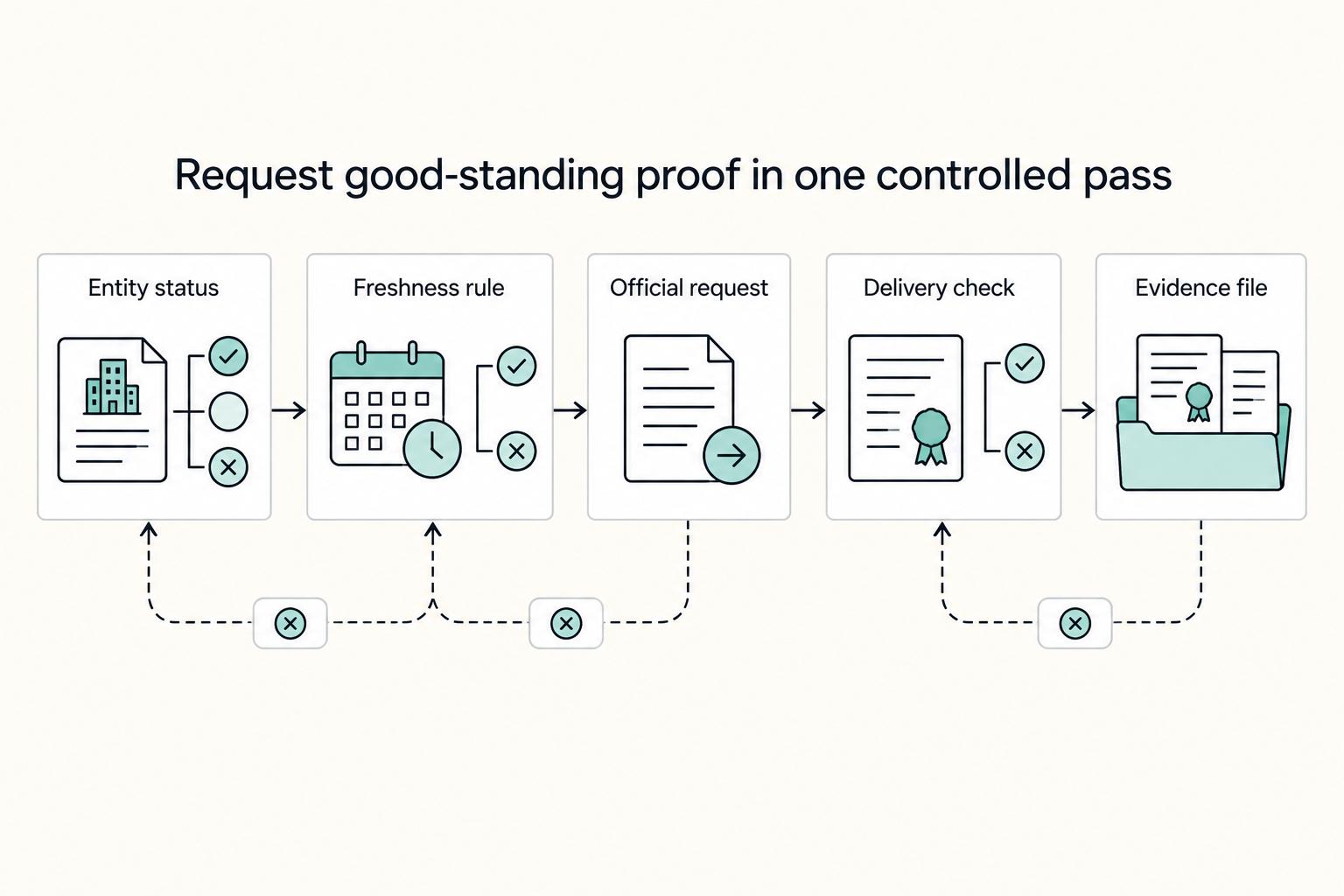
Start with two moves, in this order: confirm your entity status, then request the exact document title your reviewer will accept. That sequence removes the most common avoidable delay and keeps you from paying for the wrong output when the clock is already running.

The Freelance Payment Penalty: A Modeled Audit of Platform Fees, FX Spreads, and Payout Delays
The money rarely disappears through a single, easy-to-spot fee. The real loss is stacked. A marketplace takes its commission, a processor adds a charge for international cards, a bank or payment company converts the currency at a spread, a platform holds the funds before release, and a wire sheds a little to intermediaries on the way in. Each layer looks defensible on its own, but the worker feels the combined result as a smaller deposit and a later payday.