
Quick Answer
Build the stack by defining controls, owners, evidence outputs, and escalation rules before choosing tools. Then map payment flows and jurisdiction overlays, build a control matrix by function, and start with the smallest setup that can handle identity verification, AML screening or monitoring, case management, and regulatory reporting. Choose vendors by evidence quality, not demos, and integrate around one canonical decision record.
How to Scope a RegTech Stack for a Payment Platform#
This guide is about operating decisions, not definitions. RegTech is technology used to meet regulatory requirements more effectively. For payout platforms, the real work is deciding which controls to run, who owns them, what evidence to keep, and when an alert should be escalated.
The focus here is payment platforms managing contractor, seller, or creator payouts across markets. In that setting, gaps in identity controls, transaction monitoring, or reporting raise operational and compliance risk, and older workflows often break down as obligations expand.
Start by mapping requirements to core coverage areas, then evaluate tools and vendors against that map. Treat regulatory reporting, risk management, identity management and control, compliance, and transaction monitoring as your baseline checkpoint before vendor selection.
By the end, you should be able to define a minimum control set, assign ownership across compliance, legal, finance, risk, and engineering, and specify the evidence each control must produce. You will also have a practical sequence for control matrix design, vendor scoring, escalation rules, reporting pack design, and a staged rollout plan.
Related reading: Build a Global Contractor Payment Compliance Calendar for Monthly, Quarterly, and Annual Obligations.
What to prepare before you choose any RegTech tools#
Before you compare vendors, define the controls, evidence, and handoffs your platform must support. If you skip this step, you risk evaluating demos instead of decision-grade coverage.
Map your money movement end to end#
Start with one payout journey, from onboarding through funding, conversion, payout, reversals, and investigations. Mark where Identity Verification happens and where Transaction Monitoring continues after onboarding, because monitoring is ongoing work, not a one-time check.
Use a simple checkpoint. Every state change should map to a business event, a decision point, and a responsible team. Reversals and manual investigations often become blind spots, and those gaps may surface later during review.
Compile obligations by market and program#
Build one obligations list by market and program, and tie each item to the payment-flow step it affects. Keep GDPR, CCPA, and Anti-Money Laundering (AML/CTF) requirements visible in the same working document, even when controls differ by jurisdiction.
Do not assume one global setup covers every market. For each obligation, confirm the trigger, the affected data set, and the named reviewer.
Assign owners before handoffs get messy#
Name owners across compliance, legal, finance, risk, and engineering before work starts moving between teams. Clarify who opens a case, who approves reporting actions, and who resolves integration or data-feed issues.
Use ownership as a hard test. If a control ends with "shared ownership," it often becomes unowned in practice. The same risk can appear when an integration has an owner but the evidence trail does not.
Define your non-negotiables in writing#
Write your minimum evidence requirements before vendor calls. At a minimum, require detailed transaction and customer records that can support regulatory review and audits.
For implementation details such as API and webhook behavior, document your own expectations and test scenarios before evaluation. During evaluation, ask vendors to show replay and failed-event recovery outputs, not just polished claims.
If you want a deeper dive, read What Is RegTech? How Compliance Technology Helps Payment Platforms Automate Regulatory Reporting.
Set your compliance scope by payment flow and jurisdiction#
Scope should follow money movement first, then jurisdiction and program overlays. That separation keeps global controls distinct from local requirements and helps you avoid false confidence from vendor labels.
Split the scope by payment flow before you split by country#
Start with separate scope lines for incoming funds, held balances, outbound payouts, returns, and suspicious activity paths under Financial Crime/Fraud Prevention. Control needs can differ across entry, hold, payout, and reversal states, even for the same user.
Include the non-happy paths, not just the clean journey. For each flow, document a start event, a control decision, and a final disposition in plain language. Your scope should match real money movement, not just onboarding steps.
Mark global baseline controls separately from local overlays#
For each flow, identify baseline controls and then add jurisdiction or program overlays. A workable baseline can include Identity Verification, Transaction Monitoring where applicable, escalation case notes, and evidence retention for audit and Regulatory Reporting. Overlays should capture what changes locally, such as data-handling requirements where required.
Keep the baseline narrow and durable. An overlay should say exactly what changes, for whom, and at which trigger point. As a verification point, pick one outbound payout flow and confirm you can point to the baseline controls and the overlay that applies in one market but not another.
Apply a "coverage varies by market and program" rule#
Assume coverage varies until you prove otherwise. If payouts route through different partners, do not assume one control setup satisfies every partner, market, or program.
Make that visible in your scope sheet with fields for jurisdiction, entity or program, routing partner, and evidence source. Where one payout can route through multiple partners, confirm each route returns the records needed for monitoring, case review, and reporting. Run your IT stack analysis before you start integration so technical blockers surface early.
Failure mode: a control looks global on paper, but one route cannot provide the event data or decision evidence needed to operate it. Automation helps only when integrations return the right records and your team can use the outputs.
Write explicit out-of-scope notes to prevent silent overbuild#
For each flow and jurisdiction pair, add a short out-of-scope note. State what is not required in the current footprint, which partner routes are excluded, and which future markets are intentionally deferred.
Keep those notes visible during vendor review. Market commentary can be superficial or self-serving, so your scope document should stay the filter for vendor claims. When a control is questioned, you should be able to classify it clearly as in scope now, deferred, or excluded with a stated reason.
Related: 8 Resilient Compliance Controls for Payment Platforms in 2026.
Build your control matrix by compliance function#
Once scope is set, turn it into a control matrix before you add more tools. This is where compliance intent becomes operating behavior, and where fragmented setups start to show their cost.
Many teams inherit KYC, AML, fraud, reporting, and ops tools that were added under pressure instead of by design. The result is familiar: repeated customer-data entry, different risk states across tools, and handoffs that depend on email or chat. Your matrix is the correction. It defines what each function decides, who owns it, what evidence exists, and what happens next.
Create one row per compliance function#
Do not start with vendors. Start with the functions you actually have to run every day, and give each one its own row. For this scope, start with Know Your Customer (KYC), Transaction Monitoring, Case Management, Regulatory Reporting, and Audit Trail, then add Data Governance and Rule Change Management if those are distinct workflows in your operation. A compact matrix is enough to surface the first set of gaps.
| Function | Typical trigger | Block vs allow-with-monitoring question | Minimum evidence output |
|---|---|---|---|
| KYC | User onboarding, profile change, payout enablement | Do you block access or payouts until identity is verified, or allow limited activity while review is pending? | Provider reference ID, verification result, decision log |
| Transaction Monitoring | Funding event, payout request, reversal, unusual pattern | Do you stop the transaction now, or allow it while opening review? | Alert ID, rule hit detail, linked transaction record |
| Regulatory Reporting | Reportable event, closed investigation, filing cycle | Do you hold submission pending review, or queue with exception tracking? | Export-ready report file, source event links, reviewer sign-off |
| Case Management | Escalated alert, manual review, suspicious activity path | Do you freeze action until case closure, or permit monitored continuation? | Case notes, disposition, assigned owner |
| Audit Trail | Any material decision or status change | Do you block when logs are missing, or continue with incident escalation? | Event log, actor, timestamp, decision history |
| Data Governance | Data intake, retention, correction, export request | Do you reject incomplete records, or accept with remediation tracking? | Retention record, access log, data lineage note |
| Rule Change Management | Rule tuning, threshold update, model or configuration change | Do you pause deployment pending approval, or release under enhanced review? | Change record, approver, test evidence, version history |
The rows do not need equal weight. They need enough clarity that you can reconstruct what happened to a high-risk customer from onboarding through monitoring and review if a regulator asks.
Add the operating columns that force ownership#
A matrix becomes useful only when it forces accountability. For each row, add trigger, system of record, owner, SLA, escalation threshold, evidence artifact, and reviewer. Compliance software can improve operations, but it does not remove legal or regulatory accountability.
The system-of-record column is often where drift shows up first. If KYC shows one status, monitoring another, and payout ops a third, you likely have a control-traceability problem. For each function, define where the official decision lives and where the proof is stored.
Assign ownership by function, not by tool. A vendor can generate alerts, but ownership of alerts, cases, reports, and archives stays with your team. Treat the matrix as an ownership document first and a tooling map second.
As a verification point, pick one suspicious payout case and fill every column without guessing. If you cannot name the owner, reviewer, or evidence artifact quickly, the row is not ready.
Write block and allow-with-monitoring logic in plain English#
Every row needs explicit logic for block, allow-with-monitoring, and manual escalation. This is where failures often begin when teams skip the hard part.
Keep the language operational. KYC should state whether onboarding proceeds, whether payouts are held, which event opens a case, and who can clear it. Transaction Monitoring should state whether flagged payouts are stopped immediately or allowed while a case is opened. Rule Change Management should state whether unreviewed updates can go live or must wait for approval and test evidence.
A red flag is relying on labels like "pass," "review," or "complete" as the only output. Those labels are often too thin to defend later, especially when different tools use different thresholds. If a decision affects onboarding, payout release, or reporting, the matrix should map status to action and override authority.
Require evidence-level outputs, not dashboard comfort#
Dashboards help, but they are not enough on their own. Require evidence-level outputs for every function: provider reference IDs, decision logs, case notes, source event links, and export-ready artifacts.
For KYC, keep more than "verified." Store the provider reference ID, the decision, and the trace to the user and payout gate. For Transaction Monitoring and Case Management, keep the alert ID, triggering rule or scenario, analyst notes, disposition, and timestamps. For Regulatory Reporting, keep the export file and the records that fed it, not just a "submitted" status.
Failure mode: a control looks active in a dashboard, but the team cannot reconstruct the lifecycle end to end because evidence is scattered across tools and informal handoffs. That traceability gap is what gets exposed when someone asks for a full end-to-end view.
Each row should clearly state trigger, owner, block vs allow-with-monitoring decision, and evidence output. That matrix becomes your filter for vendor evaluation in the next section.
When owners, SLAs, and evidence fields are set, use Gruv docs to map payout gating, webhook events, and audit-trail surfaces into your control matrix.
Decide your minimum viable stack before multi-vendor expansion#
Use the control matrix to keep the stack minimal at first. In this blueprint, a minimum viable stack means the smallest setup that can run daily decisions and produce defensible evidence across four functions: Identity Verification, AML screening or monitoring, Case Management, and Regulatory Reporting.
Start with the smallest set that closes the core control loop#
Start with the smallest combination that can identify a user, monitor or screen risk, resolve investigations, and produce reporting outputs tied to source events. If one platform can cover those four functions at acceptable depth, it can be simpler to operate than stitching several tools together from day one.
Treat vendor coverage claims as a hypothesis to test, not a conclusion. Ask shortlisted providers to walk one high-risk flow end to end: identity verification, AML review, case record, and reporting artifact.
Check handling capacity before you add more tools#
If your team is already missing its own alert or review targets, another tool can add pressure before it reduces risk. More tools can mean more alerts, more statuses, and more handoffs. If review capacity is already tight, queues can age and decisions can drift.
Tighten ownership and escalation paths before adding another detection layer, and address analyst capacity where bottlenecks are already visible.
Prefer fewer systems until a real gap is proven#
Fewer systems are usually easier to reconcile and supervise, with fewer conflicting risk states to manage. Early on, that clarity can matter more than feature breadth.
The tradeoff is depth. A single platform may be enough at your current scale but weaker on some control depth or reporting detail. That can still be workable if the weakness is visible, documented, and manageable through tuning or process.
Run a structured validation checkpoint with shortlisted vendors before you expand. Use interviews or surveys to test edge cases, evidence exports, and escalation behavior.
Use hard expansion triggers, not vendor pressure#
Move to a multi-vendor stack only when a persistent gap remains after tuning, ownership fixes, and capacity changes. Use hard triggers like these:
| Expansion trigger | Gap to document |
|---|---|
| Documented control gaps | Controls you cannot reliably handle in the current setup |
| Evidence-quality gaps | Logs, case records, or report outputs are too weak to defend decisions |
| Timeliness gaps | Escalation and reporting remain too slow after process and queue cleanup |
If your current evidence chain across the four core functions does not reconcile cleanly, adding vendors usually multiplies the problem. At this stage, control quality matters more than tool breadth.
Compare vendors by function using evidence not demos#
Once you know your minimum stack, compare vendors against the matrix, not against presentation quality. Use demos as supporting material only, and record what is proven versus what is still a claim. Coverage in this market can sound broad, but decision quality depends on concrete artifacts and operational proof.
Score against functions, then label confidence#
Score each vendor across your required rows, for example Identity Verification, AML screening or monitoring, Case Management, Regulatory Reporting, and Audit Trail. For each score, label whether it is based on observed evidence, reference feedback, or an unverified claim.
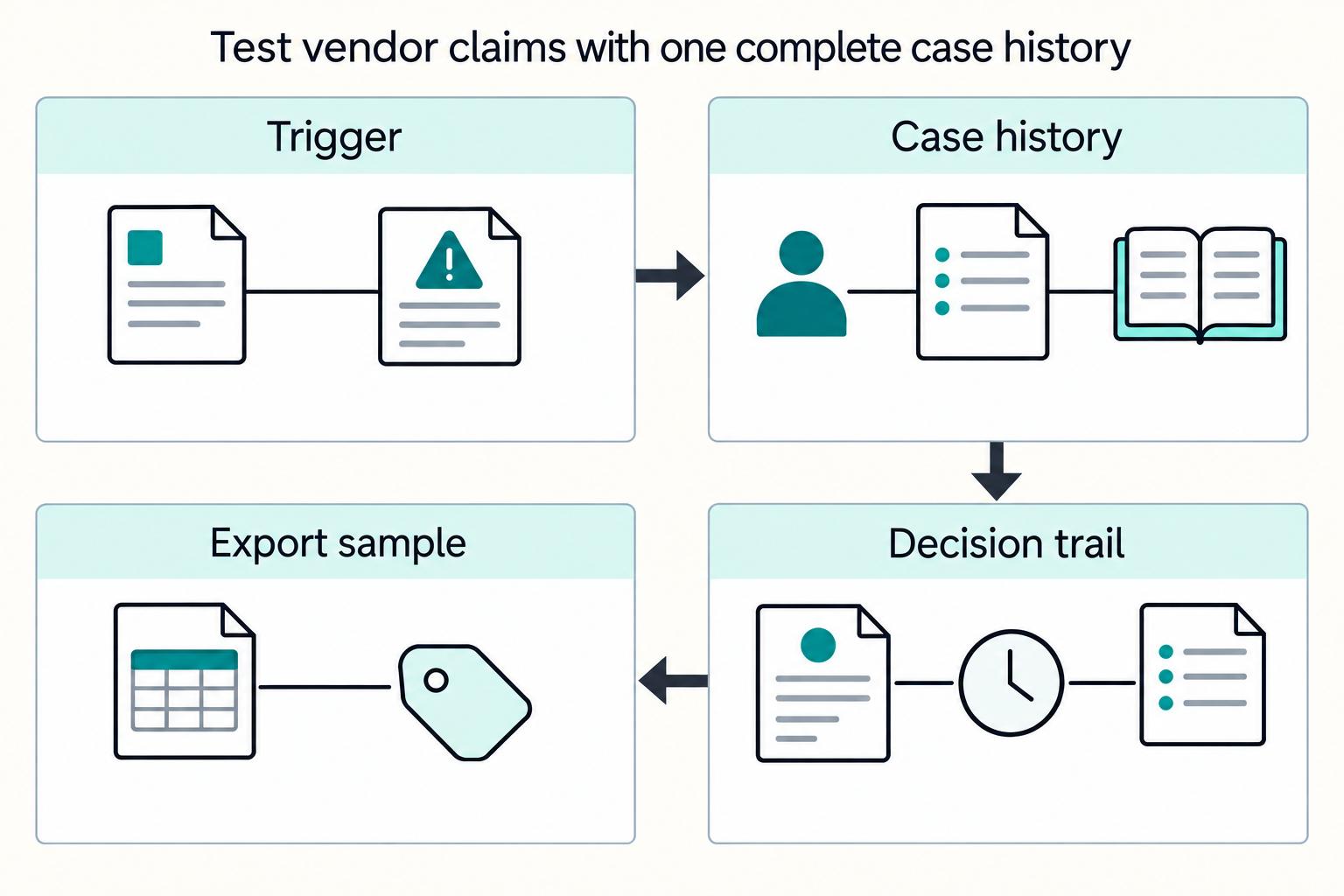
Ask each provider to run one realistic end-to-end case: trigger, analyst workflow, case record, decision history, and reporting export. By the end, you should have an evidence pack, not screenshots alone. That pack can include sample alerts, case notes, decision logs, and export samples that let a reviewer reconstruct what happened.
Compare operational proof points, not UI polish#
Feature grids can converge quickly, so prioritize what changes daily operations: alert explainability, Audit Trail granularity, case lifecycle support, and Regulatory Reporting export quality.
| Area to score | Evidence to request | Tradeoff to make visible |
|---|---|---|
| Detection and alerting | Alert examples with reason context, linked source events, and disposition paths | Higher sensitivity can surface more risk and more false positives |
| Case handling | Full case history with notes, status changes, approvals, and closure rationale | More automation can speed handling but reduce analyst intervention |
| Audit Trail | Records showing who changed what, when, and why, tied to source events | Deeper history improves defensibility but adds review and storage load |
| Regulatory Reporting output | Export samples with source IDs, case references, and final dispositions | Faster launch can create later manual reporting work if exports are weak |
| Integration fit | Webhook payload examples, retry behavior, API docs, and failure handling | Quick integration can reduce long-term flexibility if data models misalign |
The Audit Trail row can be decisive. Prioritize actor, timestamp, source-event linkage, decision outcome, and rationale that survive export. If retrieval is shallow or inconsistent, investigations and reporting get harder. If useful, go deeper on what an Audit Trail should contain.
Validate integration on failure paths too#
Integration quality is part of control quality, so test webhook behavior, retry safety, API ergonomics, and fit with your payout architecture under both normal and failure conditions. Then verify the system preserves one coherent decision record.
This is where real-time visibility becomes operational instead of marketing. More data helps only if your reviewers can supervise it reliably.
Make tradeoffs explicit before selection#
Do not hide tradeoffs inside one total score. Write them plainly: detection depth versus false-positive load, automation depth versus analyst control, and launch speed versus long-term reporting flexibility.
For shortlisted vendors, run in-depth interviews or surveys in addition to demos, and document edge-case handling, known limits, and unproven areas. If candidates are close, choose the cleaner evidence chain over the better demo. Defensible decisions, exportable records, and stable integration tend to matter most in day-to-day operations.
Design alert escalation rules for KYC AML and monitoring breaks#
After vendor evidence is in place, define exactly what happens when an alert fires. Every KYC, AML, and Transaction Monitoring alert should map to one owner, one queue, one response target, and one documented end state.
Assign escalation tiers by alert type and business impact#
Set escalation tiers separately for KYC failures, AML screening hits, and transaction-monitoring anomalies, then assign a decision owner in Case Management for each tier. Keep the tiers simple if you want, but make ownership and routing explicit.
Do not force one generic rule across all three alert families. If alerts are still handled through email, local files, or shared drives, treat that as a control gap. Low-automation environments can make timing and accountability harder to prove.
As a verification point, run one test alert per family and confirm queue, owner, priority, and source event are attached correctly.
Write explicit if then rules that connect to payout action#
Operations should not have to improvise while an alert is live. For each trigger, define the interim payout state, the owner, and the evidence required for the next action.
Example policy logic can be simple. For an uncertain name match under your policy, you might hold payout and open manual review. For an internally defined high-confidence sanctions condition, you might prevent release and escalate to the named approver. The exact cutoffs are program- and jurisdiction-specific, so keep your internal thresholds explicit and documented.
This works best when integration infrastructure is in place and alert payloads are reliable. Without linkage to the related payout or customer record, consistent decisions can break down.
Require closure criteria that cannot be bypassed#
Do not allow closure without evidence and rationale that can survive export and Audit Trail review. A note that only says "reviewed" is not enough.
Require these items before closure:
- source alert and provider reference ID
- linked customer or payout record
- analyst decision and written rationale
- evidence reviewed, such as identity documents, screening details, or transaction context
- approver, timestamp, and final payout status
As a control check, sample closed cases and confirm a reviewer can reconstruct the full decision without using email or shared drives.
Trigger after action review when noise repeats#
Repeated alert patterns should trigger formal Rule Change Management review, not faster dismissal. Use clear triggers such as recurring alert reasons, repeated analyst overrides, or rising clusters of false-positive closures.
In each review, answer three questions. Is the rule too broad? Is required context missing when the alert is created? Is escalation routing sending low-value work to senior reviewers? If the cause is unclear, run structured follow-up interviews or surveys with shortlisted providers to validate tuning assumptions and data-mapping behavior.
A strong escalation design does more than route risk. It exposes where controls are noisy, brittle, or too manual to scale.
Define the reporting pack your legal finance and risk teams need every month#
Monthly review works best when legal, finance, and risk are looking at the same evidence. Build one pack from Regulatory Reporting and Audit Trail records, and make sure it can be rebuilt from exportable records.
Build the pack around evidence, not summaries#
Use three sections each month: compliance outputs, finance reconciliation, and risk exceptions. That structure keeps each team on the same record set instead of separate summaries. Keep decision points tied to independent facts and analysis, not vendor marketing summaries.
| Pack section | Primary owner | Minimum contents | Common failure mode |
|---|---|---|---|
| Compliance outputs | Compliance | counts of reviews, holds, blocks, escalations, closed cases, linked case references | dashboard totals with no case-level traceability |
| Finance reconciliation | Finance | payout totals, held amounts, released amounts, reversals or mismatches, links to payout status | finance ledger agrees in total, but cannot explain exceptions tied to compliance decisions |
| Risk exceptions | Risk or Compliance | repeated alert types, overrides, unresolved exceptions, material decision changes | exception list exists, but no evidence of why an override was allowed |
The work often spans regulatory reporting, risk management, identity management and control, compliance, and transaction monitoring, so the pack should stay cross-functional instead of becoming a finance-only document.
Define the lineage fields that let reviewers reconstruct a decision#
Set one standard lineage field set and require it in every included record. A practical example can include source event, decision event, case reference, payout status, and final disposition, adjusted to your own obligations and controls.
Check one record end to end without email or shared drives. A reviewer should be able to confirm what triggered review, who made the decision, which case it used, whether payout was held or released, and how it ended.
Add tax-adjacent artifacts where your payout model needs them#
Include a small tax-adjacent section for 1099-NEC and 1099-MISC only when your operating model actually handles those support paths. Do not treat this as universal across all programs or jurisdictions.
Track handling evidence, not theory: case reference, payment type in question, support path taken, and final resolution state. For a deeper split between the two forms, see Music Royalty Tax Compliance: How Platforms Handle 1099-MISC vs. 1099-NEC for Artist Payments.
Set a sign-off sequence and archive it under Data Governance#
Set and document a sign-off sequence so monthly review stays consistent, for example: compliance review, finance validation, legal exception review, then archive under your Data Governance policy.
Define each sign-off clearly. Compliance confirms decision evidence, finance confirms monetary reconciliation to payout status, and legal reviews exceptions or edge cases. Archive the final pack, underlying exports, and approval record together so later review can be checked against the Audit Trail without missing versions.
For a step-by-step walkthrough, see Third-Party Risk Management for Payment Platforms: How to Vet and Monitor Your Payment Vendors.
Integrate the stack with payment architecture without creating duplicate risk states#
Your monthly pack is only as good as the architecture behind it. If Case Management, payout status, and ledger evidence disagree, treat that as a potential control failure, not three equally valid views.
Anchor every control decision to one canonical record#
Use one canonical compliance disposition per payment or payee review, and make downstream systems reference that record instead of keeping independent decision states. The case record, payout status, and ledger evidence should point to the same internal identifier and final disposition.
Use one shared decision vocabulary and one lineage chain from source event to decision event to payout outcome. Without common semantics, retries and asynchronous updates can create drift even when nobody intended to change the outcome.
Check this with one reviewed payout reconstructed end to end from integrated Audit Trail records, not spreadsheets or manual logs.
Make duplicate events replay to the existing decision path#
Design duplicate handling so replays resolve to the existing record instead of creating a second decision state. Retries are normal; duplicate risk rises when replay activity creates parallel case or payout states.
Test replay behavior directly in non-production. Confirm replay activity is recorded against the original reference in the integrated audit trail.
Tie KYC and AML outcomes to the release path you actually use#
If your operating model requires failed KYC or unresolved AML review to block release, enforce that in the payout path itself, not only in analyst-facing tools.
Define and document which states block release, allow release, or require a recorded override, and scope that logic by program or region where needed. Regional compliance logic is often more reliable than one global rule set.
Reconcile payment events and compliance decisions before reporting#
Run reconciliation checkpoints before reporting so drift surfaces early. Focus on exception types that break evidence reconstruction across decision states, payout outcomes, and ledger evidence.
Keep the exception output exportable and archiveable so repair decisions remain attributable and reviewable later.
Define outage behavior before dependency stress defines it for you#
Consolidated platforms are often presented as lower cost with a more integrated view of obligations, but dependency concentration still needs explicit handling. Do not assume consolidation is always safer or always riskier. Document the expected behavior either way.
For each dependency supporting Transaction Monitoring, Case Management, or Regulatory Reporting, document whether processing is queued, deferred, or blocked during degradation, and what evidence is preserved for replay and reporting. Where continuity is limited, state that constraint explicitly so no one is relying on a silent assumption.
You might also find this useful: OFAC Compliance for Payment Platforms: How to Screen Every Payout Against the Sanctions List.
Prevent false positives and case backlog from overwhelming ops#
Alert quality and queue health are controls in their own right. If false positives and redundant alerts swamp operations, the rest of the setup becomes harder to trust.
Measure alert quality at the level you can actually change#
Tune rules from segmented evidence, not one blended alert count. Track outcomes by rule or scenario, market, and payment flow in Financial Crime/Fraud Prevention and Case Management.
Keep watchlist categories separate in reporting, including sanctions, PEP, embargo or blacklist, adverse media, and other high-risk counterparty lists. These lists can drive different alert patterns across flows, and jurisdictional differences can add complexity.
At a minimum, each alert record can include rule name, watchlist type, market, flow, opened date, analyst disposition, closure reason, and payout outcome. The checkpoint is practical: from recent exports, you should be able to identify which rules create the most cases, which markets generate the most false positives, and which flows take longest to resolve.
Put queue discipline into Case Management before the queue chooses for you#
Backlog gets managed either by design or by drift. Define queue controls early: priority classes, aging buckets, and clear escalation paths when SLA conditions are breached.
Set thresholds by risk and payout impact, not analyst preference. Prioritize by both severity and potential customer harm, and make escalation evidence explicit in each case record with owner, timestamp, and reason. Silent aging is the failure mode to prevent.
Run regular rule reviews and retire noise on purpose#
Regular Rule Change Management reviews are where you remove low-value work without weakening high-value detections. Start with rules that have high volume, repeated low-value closures, or heavy concentration in one market or flow.
For each rule change, keep a short evidence pack with recent alert trends, case outcomes, affected markets or flows, expected impact, approver, and release date. Treat onboarding changes carefully. Lower-friction onboarding can also remove verification steps that deter fraud, so fewer onboarding alerts are not automatically a win.
Trigger a stop rule when backlog breaches the agreed threshold#
When backlog crosses your agreed threshold, pause non-critical rule expansion and recover throughput first. If growth is outpacing handling capacity, adding detections to an unstable queue can make stale cases worse.
Recovery should focus on clearing backlog, tightening the noisiest rules, and verifying that escalations are actually happening. Also confirm reopened alerts link back to the same case history and Audit Trail so decisions stay reconstructable.
Common implementation mistakes and recovery actions#
Many implementation failures are not about missing features. They come from controls that are not tied to a concrete compliance outcome. Recovery usually starts by tightening four areas: function mapping, scope, evidence ownership, and escalation criteria.
Map every product claim to a named compliance function#
Do not accept broad "AI compliance" claims on their own. Map each tool to one clear outcome in KYC, AML, regulatory reporting, or record keeping, and define the artifact it must produce.
| Compliance function | Sample output to confirm |
|---|---|
| KYC | identity verification result |
| AML | monitoring alert with case notes |
| regulatory reporting | export-ready report |
| record keeping | retained case record |
Use a simple checkpoint. For each promised capability, confirm a sample output exists, such as an identity verification result, a monitoring alert with case notes, an export-ready report, or a retained case record. If a vendor can show detection but not usable evidence, the control is incomplete. Outsourcing does not remove your regulatory responsibility, so retain operational oversight.
Document jurisdiction coverage as scoped, not universal#
Treat coverage as market-specific and flow-specific, not global by default. Document where your setup supports obligations such as AML/CTF and data privacy requirements like GDPR or CCPA, and explicitly note what remains excluded or manual.
A common failure mode is treating one global settings page as global compliance. Your recovery record should list market, payment flow, applicable obligation, tool, known constraints, and owner. If a provider covers only part of a market or cannot support the required data handling, state that before go-live.
Assign evidence owners before go-live#
If evidence ownership is unclear, implementation is not complete. Assign named owners for record-keeping artifacts and reporting exports before launch, including customer records, transaction records, and case files.
Validate ownership with a dry run from a realistic test case. Teams have spent months building before discovering their monitoring setup could not generate the reports they needed. If no one owns export format, storage location, and review, you still have a control gap.
Publish block hold escalate rules and test them#
Unclear escalation criteria can create inconsistent decisions. Publish clear block, hold, and escalate rules for KYC failures, AML hits, and monitoring exceptions, then test them with real incident scenarios.
Use a repeatability check. Run the same scenario twice with the same roles and confirm the same action and case record. If outcomes vary mainly by analyst preference, tighten the rule language before volume grows.
Execute a 90-day rollout by compliance function#
Treat this as an internal execution plan, not a regulatory standard.
| Phase | Main activities | Additional focus |
|---|---|---|
| Days 1 to 30 | Finalize scope, owners, and the control matrix for Identity Management and Control, Compliance, Transaction Monitoring, Risk Management, and Regulatory Reporting | Define evidence outputs per function and add verification checkpoints so controls are testable at scale |
| Days 31 to 60 | Complete vendor selection, integration tests, escalation drills, and first-pass Regulatory Reporting outputs | Include random sample-based checks to confirm APIs and workflows produce the expected compliance artifacts |
| Days 61 to 90 | Harden operations with backlog controls and evidence audits, plus any jurisdiction-specific adjustments needed for in-scope requirements | Prioritize real-time visibility into how incidents are detected, assessed, and contained |
Exit criteria: live controls with auditable evidence trails, reporting outputs in production, and documented escalation performance.
Conclusion#
Use a function-first build order: define controls, owners, evidence outputs, and escalation rules before you shop for tools. A credible setup is not the one with the most features. It is the one your team can run consistently without disrupting operations.
That credibility depends on whether core compliance controls are tied to real decision gates and auditable artifacts. If alerts or control failures cannot be traced from source event to final disposition, you may have automation without strong control evidence. The real test is whether you can show the decision, owner, action, and retained evidence.
Keep the tradeoffs explicit. Consolidation can improve data visibility and reduce moving parts, but it can also increase platform concentration risk. A modular stack can reduce that dependency and fit mixed-jurisdiction needs better, but it increases integration and evidence-management burden. There is no universal winner. Choose based on control gaps, jurisdiction mix, and your team's ability to operate the tools day to day.
Copy and paste checklist
- Confirm scope by payment flow and jurisdiction.
Map controls by flow first, then mark what is baseline versus jurisdiction-specific.
- Approve a control matrix with owners, reviewers, and evidence fields.
For each control, record the trigger, system of record, escalation path, and required artifact, then trace a sample case end to end.
- Select vendors using function-level scoring and integration proof.
Prioritize explainability, evidence export quality, case-handling depth, and fit with your current IT stack.
- Publish escalation rules for block, hold, and investigate decisions.
Document who can block or release, what enters review, and what evidence is required to close a case.
- Launch a regular reporting pack and evidence archive process.
Ensure compliance, finance, legal, and risk can review one consistent lineage from source event to reporting output.
- Run a post-rollout review and close documented control gaps.
Treat this as an internal checkpoint to verify alert handling, evidence completeness, and unresolved jurisdiction or flow gaps.
Short version: function first, evidence first, operator readiness first. Tools should follow that order.
Before rollout, run a market-by-market gap check and talk to Gruv to confirm market/program coverage, compliance gating, and reporting handoffs for your payment flows.
Frequently Asked Questions
What functions should a RegTech stack for payment platforms include first?
There is no universal order, so start with controls that protect live operations and produce defensible evidence. the minimum viable stack covers Identity Verification, AML screening or monitoring, Case Management, and Regulatory Reporting. Your baseline should also support data governance, rule change management, and integrated audit trails.
How do we map KYC, AML, reporting, and audit controls to named owners and evidence?
Use a control matrix with one row per function and columns for trigger, system of record, owner, reviewer, SLA, escalation threshold, and evidence artifact. Then test a sample case end to end so you can name the owner, reviewer, and evidence quickly. Keep the evidence in integrated audit trails rather than spreadsheets or manual logs.
When should we use one vendor versus multiple vendors?
Use one vendor if it can cover your core controls at acceptable depth and your team can operate it reliably. Move to multiple vendors only after tuning, ownership fixes, and capacity changes fail to close a persistent gap. The guide uses documented control gaps, evidence quality gaps, and timeliness gaps as hard expansion triggers.
How is real-time Transaction Monitoring different from Regulatory Reporting in daily operations?
Transaction Monitoring is an operational control that continues after onboarding and supports timely intervention when risk signals appear. Regulatory Reporting is an evidentiary and periodic function built around export-ready records tied to source events. Clean reports do not replace live monitoring or prove timely control action on their own.
What escalation points should exist for payout holds and high-risk alerts?
Set separate escalation tiers for KYC failures, AML screening hits, and transaction monitoring anomalies, and assign one owner and one queue for each tier. Write clear if then rules that state the interim payout status, the evidence required, and who can approve the next action. Exact thresholds and response targets should be documented in your internal policy.
What documents must stay audit-ready at all times?
Keep decision records retrievable across monitoring alerts, case files, reporting outputs, and rule updates. The key requirement is traceability from source event to final disposition through integrated audit trails. Evidence should include items like provider reference IDs, decision logs, case notes, source event links, and export-ready artifacts.
What remains unknown when vendor-led content lacks neutral benchmarks?
Vendor-led content does not let you confirm objective detection quality, true false positive burden, or operational usability. Claims about AI and automation are not enough unless the resulting decisions are traceable and auditable in practice. Treat those conclusions as directional until you review real sample alerts, reports, and evidence exports.
Researched and edited by the Gruv editorial team. Gruv builds cross-border billing, payouts, and finance-operations software for global businesses.
Sources
Includes 6 external sources outside the trusted-domain allowlist.
- cppa.ca.gov/regulations/pdf/preliminary_drop_public_comm...trusted
- hks.harvard.edu/sites/default/files/centers/mrcbg/files/AWP_...trusted
- acams.org/en/events/the-assembly/the-assembly-hollywoodexternal
- deloitte.com/lu/en/Industries/technology/analysis/regtech...external
- fintech.global/regtech100/wp-content/uploads/2023/12/RegTec...external
- fintech.global/regtech100/wp-content/uploads/2023/12/RegTec...external
- fintechoutlook.com/the-unified-compliance-stack-how-all-in-one-...external
- hyperproof.io/resource/fintech-compliance-and-how-to-maint...external
Educational content only. Not legal, tax, or financial advice.
Related Posts

The Freelance Payment Penalty: A Modeled Audit of Platform Fees, FX Spreads, and Payout Delays
The money rarely disappears through a single, easy-to-spot fee. The real loss is stacked. A marketplace takes its commission, a processor adds a charge for international cards, a bank or payment company converts the currency at a spread, a platform holds the funds before release, and a wire sheds a little to intermediaries on the way in. Each layer looks defensible on its own, but the worker feels the combined result as a smaller deposit and a later payday.
How to Respond to a Subpoena for Business Records
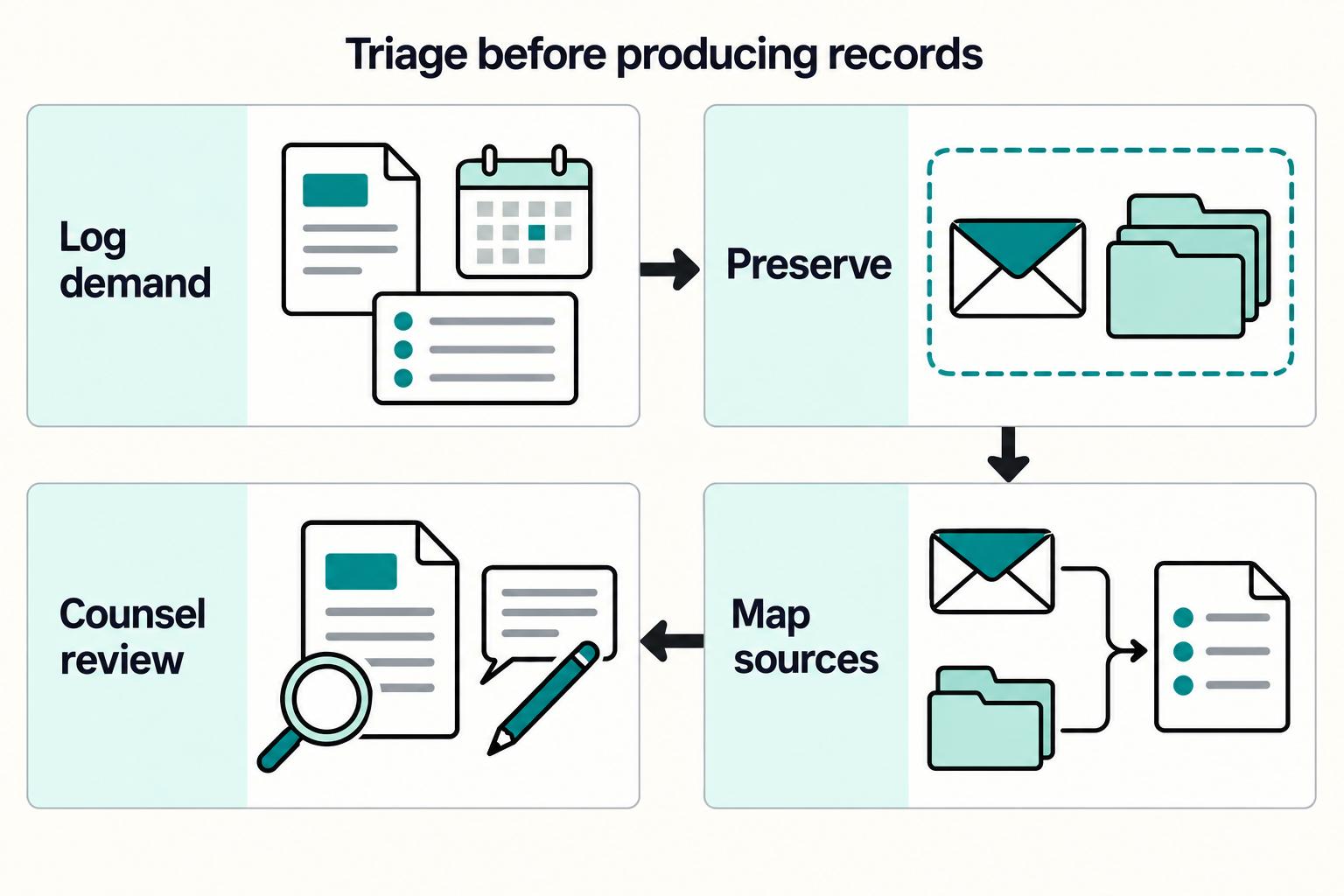
Move fast, but do not produce records on instinct. If you need to **respond to a subpoena for business records**, your immediate job is to control deadlines, preserve records, and make any later production defensible.
A US Expat's Guide to Investing in UCITS ETFs to Avoid PFIC Issues
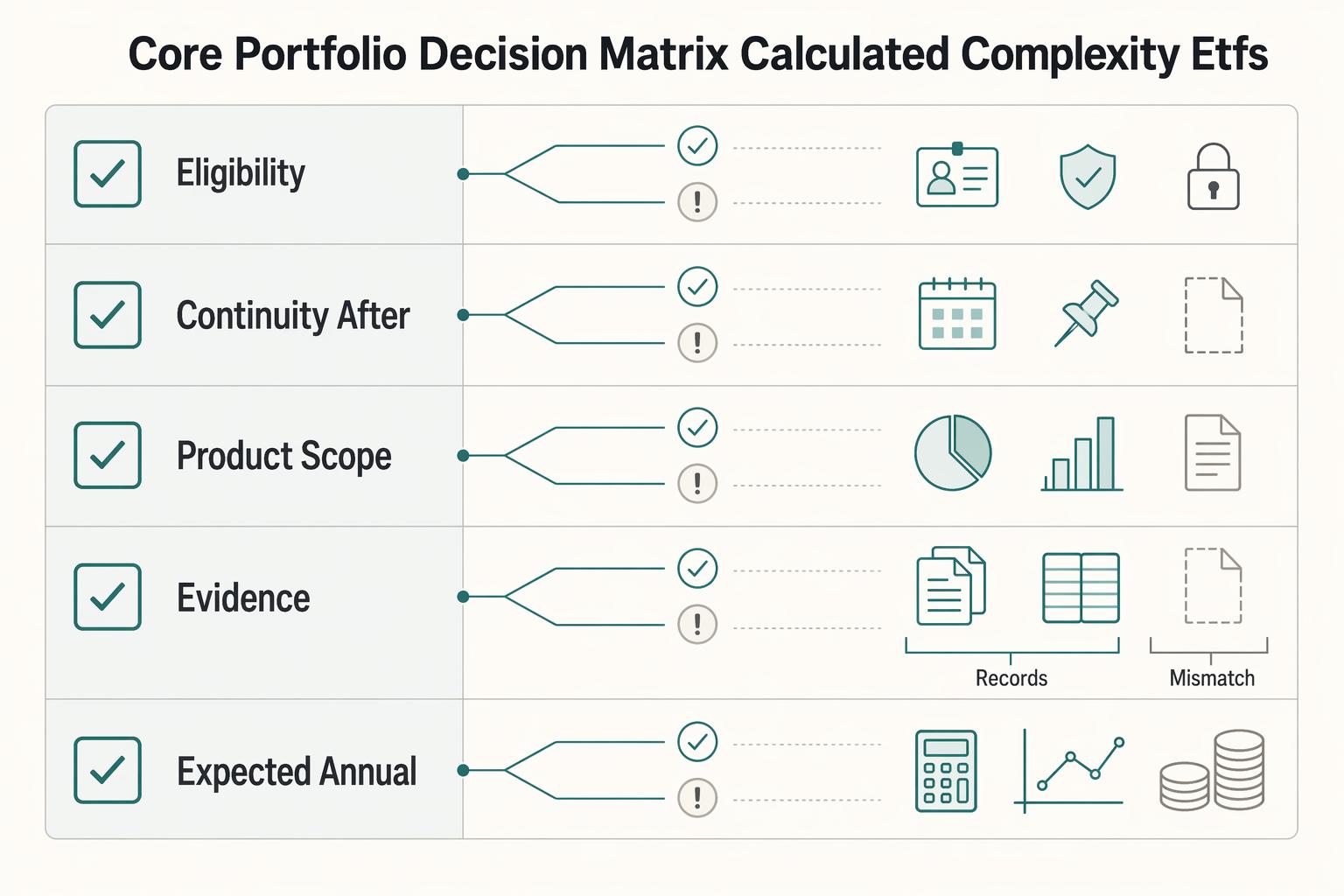
The real problem is a two-system conflict. U.S. tax treatment can punish the wrong fund choice, while local product-access constraints can block the funds you want to buy in the first place. For **us expat ucits etfs**, the practical question is not "Which product is best?" It is "What can I access, report, and keep doing every year without guessing?" Use this four-part filter before any trade: