
Quick Answer
Separate payment-failure loss from deliberate cancellations, assign one collection owner per invoice and define provider/method-specific eligibility before retries. Resolve pending or unknown prior outcomes before another financial attempt. Match messages to update needs, then measure mature recovered-value cohorts and collection costs.
Why payment-failure churn is a monetization problem, not just a billing bug#
Treat payment-failure churn as a monetization issue first. Many failed payments are recoverable, so what looks like churn is often revenue collection leakage rather than clear product rejection.
Step 1 Separate recoverable revenue from true retention loss#
Involuntary churn happens when customers stop paying unintentionally, usually because of payment friction rather than a decision to leave. That is different from voluntary churn, and the split matters because both affect recurring revenue for different reasons.
When failed renewals and deliberate cancellations sit in the same retention bucket, teams misread the problem. Some losses do point to product or pricing issues, but payment-failure churn is often addressed through recovery actions like retries and dunning.
Use a simple operating test. If you cannot report voluntary churn separately from failed-payment churn, you cannot tell whether you have a demand problem or a collection problem.
Step 2 Put ownership and economics around recovery#
Once you frame failed payments as a monetization issue, the next question is simple: how much recurring revenue is recoverable, and who owns that recovery process?
Manage recovery with clear ownership, explicit decision rules and measurable outcomes. Judge recovered invoice value against recovery costs and customer friction, rather than maximizing retry count.
Automated retries can reduce involuntary churn, but one blanket retry policy is not a strategy. Recovery should be managed with segment-level rules and clear tradeoffs.
Step 3 Bound the scope to subscription billing controls#
This playbook is limited to subscription billing workflows where recurring charges fail and can still be recovered. That includes invoice failures after the first attempt and the related controls around dunning, retry policy, customer messaging, and payment settings.
Retry design is one concrete lever. Smart Retries uses AI to choose reattempt timing and reduce involuntary churn. One documented default is 8 tries within 2 weeks, with configurable windows from 1 week to 2 months. Treat defaults as a starting point, not as a rule you copy unchanged.
The key decision is segmentation. Both dunning strategy and retry policy can be set by customer group instead of forcing every account through one collection path. That is how payment-failure churn becomes an actively managed monetization system instead of a passive billing outcome.
Track involuntary and voluntary churn separately so recovery gains are visible. See Involuntary vs. Voluntary Churn on Platforms: How to Measure and Attack Both Separately.
What to prepare before you change anything#
Before you change retry timing or Dunning management, get to a baseline you trust. This is churn-reduction work. If the starting point is fuzzy, you will not know what actually improved.
| Prep area | What to gather | Examples |
|---|---|---|
| Baseline evidence | Failed payments, recovery outcomes, and current dunning rules | Pull a consistent recent window |
| Raw event evidence | invoice.payment_failed webhook events, payment-method-update events, and final outcome events | Trace failures and retry attempts |
| Flow and owners | The full Payment failure recovery flow and who can change each step | Initial decline through retries, payment-method update, cancellation, and reactivation |
| Live settings and decline data | Payment gateway settings and logs, active Smart Retries window, and decline-cause data | 8 tries within 2 weeks, or 1 week, 2 weeks, 3 weeks, 1 month, or 2 months |
| Success definition and update path | Success criteria and the payment-method-update path end to end | Confirm customers can update the right subscription and pay outstanding invoices cleanly |
Step 1 Build the minimum evidence pack#
Pull a consistent recent window of Failed payments, recovery outcomes, and current dunning rules. Your baseline should show both the payment failure rate and how effective current recovery is before you change policy.
For Stripe, trace invoice.payment_failed events to the invoice, payment attempt and verified final outcome. With automations, next_payment_attempt appears in invoice.updated rather than invoice.payment_failed. Scheduled attempt_count can increase after a hard decline without creating an executed Charge; separate scheduled and executed attempts.
Step 2 Confirm the map and the owners#
Map the full Payment failure recovery flow from initial decline through retries, payment-method update, cancellation, and any reactivation. Then document who can change each step.
If ownership is split across finance, product, and payments operations, assign a clear decision owner before you tune policy so tradeoffs can be resolved quickly.
Step 3 Gather live vendor settings and decline-cause data#
Export current Payment gateway settings and logs from live configuration. If you use Stripe Smart Retries, record the active window, including whether you are using the recommended default 8 tries within 2 weeks or another configured window such as 1 week, 2 weeks, 3 weeks, 1 month, or 2 months.
Map actual provider decline codes and available advice to the appropriate action. Stripe distinguishes authentication, incorrect details, duplicate transactions and issuer-related declines; not every customer-action state is solved by another unattended charge.
Step 4 Define success before you tune#
Define success criteria up front for recovery effectiveness and involuntary churn reduction. Keep those definitions fixed while you test so the results stay comparable.
Also verify the payment-method-update path end to end. If customers cannot update the right subscription and pay outstanding invoices cleanly, retry tuning will not remove the real bottleneck.
A deterministic ledger makes it easier to measure recovered revenue, retries, and write-offs cleanly. See How to Build a Deterministic Ledger for a Payment Platform.
Set ownership and decision rights before touching retry logic#
Set decision rights first. Retry settings, dunning messages, and stop rules are safer to change when ownership is clear and one approver is designated.
Step 1 Name one accountable owner and one approver#
Assign one accountable owner for Payment failure recovery performance and one approver for customer-facing Dunning management changes. The owner prepares the evidence, proposes changes, and reports outcomes. The approver has final go or no-go authority.
If you cannot clearly identify who approves changes in Stripe under Billing > Revenue recovery > Retries, decision rights are not clear yet.
Step 2 Separate decision areas and document who controls each#
Treat retries, messaging, and stop rules as separate decision areas, even if one group reviews them together.
| Decision area | Accountable owner | Approver | Evidence before change |
|---|---|---|---|
| Retry timing and attempt limits | Payments or billing owner | Revenue or product approver | Current settings, decline-cause mix, baseline recovery outcomes |
| Failed-payment emails and reminder copy | Lifecycle marketing or product owner | Customer-impact approver | Current templates and timing, support feedback patterns |
| Stop rules for payment-method update or cancellation | Product or revenue owner | Functional approver | Current cancellation path, update-flow outcomes |
Keep this as a living record with the exact setting location, edit access, and required approval. If your stack includes custom recovery automations or orchestration retries, document those change paths too so edits stay controlled.
Step 3 Run one recurring cross-functional review with one shared record#
Run one recurring review across product, finance, and ops, and keep one shared Revenue recovery playbook record so retries and messaging are evaluated together. Track proposed changes, current Failed payments and recovery outcomes, messaging updates, and explicit approve, reject, or defer decisions.
That matters because recovery outcomes are shaped by both retries and failed-payment emails, not by retry logic alone.
Avoid overlapping major retry edits when tie-break authority is unclear. If ownership is split and tie-break authority is unclear, sequence major Smart Retries and dunning-flow changes instead of launching them together. Finalize who owns retries, who owns recovery emails, and who approves stop rules, then tune from a clear baseline.
Related: Revenue Recovery Playbook for Platforms: From Failed Payment to Recovered Subscriber in 7 Steps.
Step 1 map your churn leakage and baseline economics#
Once ownership is clear, map the leakage before you try to fix it. Separate voluntary churn from involuntary churn first, or your recovery decisions may target the wrong problem.
Use consistent definitions: voluntary loss follows a customer cancellation decision, while payment-failure loss follows collection failures. Preserve the initiating reason and final state so an administrative cancellation after dunning does not erase the cause.
Step 1 separate involuntary churn from voluntary churn#
Track the path from first failed renewal through recovery, cancellation or lapse, and any later reactivation. Preserve the initiating reason separately from the final subscription state.
Inspect your own payment-failure episodes instead of treating an unattributed founder anecdote as a benchmark.
Verification check: for any period, each churned subscription should land in one primary bucket only. If finance, product, and billing report different churn totals, reconcile that before changing retries.
Step 2 build a stage baseline for failed-payment leakage#
After the churn split is clean, map the failed-payment path end to end and refresh it on a regular cadence. Stripe recommends tracking payment failure rates, recovery rates, and recent failed payments for top customers. Chargebee's lifecycle framing of first failure, retries, dunning, and post-dunning supports a stage-based baseline.
| Stage | What to measure | Verification check |
|---|---|---|
| Initial decline | Failed invoices or renewal attempts, plus attached MRR or invoice value | Match gateway or billing failure logs for the same period |
| Retry attempts | Retry attempts per failed-invoice episode | Use one episode ID per invoice so retries are not counted as new failures |
| Successful recovery | Failed invoices later paid inside your recovery window | Tie recovered revenue to the original failed invoice |
| Cancellation or lapse | Subscriptions ending after a failed-payment sequence | Separate user-initiated cancellation from non-payment termination where possible |
| Reactivation | Accounts returning after payment-failure cancellation or lapse | Track separately so immediate recovery is not overstated |
Keep the focus on two anchors: revenue at risk at first decline and revenue recovered during the sequence. If you only track retry success counts, leakage can stay hidden.
Avoid mixing invoice-level and subscription-level metrics in one line item. Use one unit per metric and label it clearly. If you need both, split them into separate sections.
Step 3 cut cohorts by plan type and tenure#
Use consistent cohorts, such as plan type and tenure, rather than a blended average. Keep the same eligible failure definition and observation window across comparisons.
Those cuts change the economics of recovery effort. A low-price self-serve tier and a higher-value annual plan should not be managed the same way. A first-renewal failure and a long-tenure customer with a temporary card issue are different signals.
Use the cohort table to decide tradeoffs. If higher-value cohorts recover well after outreach, extra manual attention may pay back. If short-tenure, low-value cohorts show many failures with weak recovery, test whether additional retry density adds return or just noise.
Bring payments, analytics and product together when data is split across tools so gateway attempts, subscription states and cancellation reasons can be reconciled.
Step 4 use outside numbers as context, not targets#
Set targets from your own mature failure cohorts and recovery costs. Vendor marketing percentages use different populations and definitions and do not establish a transferable forecast.
Checkpoint before moving on. You should be able to explain, on one page, how much revenue enters the failed-payment path, how much is recovered, where drop-off occurs, and which plan and tenure cohorts drive the loss. If you cannot, keep working the baseline before tuning recovery policy.
For a step-by-step walkthrough, see How to Reduce Subscriber Churn on Your Platform Without Sacrificing Margin.
Step 2 segment failures and accounts before choosing actions#
Do not use one global retry cadence. Start with failure cause, then layer in customer value tier so the action fits both the decline pattern and the account economics.
At-risk customer segmentation is a practical starting point. Group accounts by payment behavior and reasons for missed payments. A temporary issuer issue, a hard decline, and a high-value account should not be handled the same way.
Read decline signals from the gateway#
Start with the payment gateway decline response. Gateway responses carry the decline reason, and the hard-versus-soft split should drive handling. Soft declines can be retry candidates. Hard declines should follow a different path.
If the issuer returns a hard decline code, Stripe Smart Retries does not automatically reattempt payment. If available, include issuer or network guidance such as Merchant Advice Code in your classification logic, since it is meant to help determine whether to retry.
Before you tune timing, run a simple quality check:
- What share of failures has a usable gateway decline category?
- What share still sits in an internal
unknownbucket?
If classification is still noisy, fix the mapping before you go deeper on retry optimization.
Define action tiers by segment#
Start with simple action tiers, then refine them as your data improves.
| Segment | Usual action | Why it fits |
|---|---|---|
| Soft decline, standard-value account | Eligible known soft decline: provider-supported later retries within the chosen window | Temporary issues may clear, and later spacing avoids dense fixed retries |
| Hard decline or issuer guidance not to retry | Pause new collection; follow required customer authentication, issuer contact or method update | Reattempts may conflict with issuer/network intent |
| Recoverable signal on a high-value account | Delayed retry path plus manual outreach when economics justify it | Segment-specific policies let you match effort to revenue at risk |
| Pending or unknown financial outcome | Resolve the prior attempt; block additional collection | Timeouts do not prove failure and a second route can duplicate a payment |
For eligible known failures, use the billing provider’s supported timing policy or a bounded custom schedule. Exponential backoff for transient API errors is different from spacing declined financial transactions; do not layer a competing collection scheduler over Smart Retries.
Treat Smart Retries as a layer, not the strategy. Smart Retries uses dynamic, time-dependent signals, and Stripe's recommended default is 8 tries within 2 weeks. Use that as a timing layer inside your segmentation model, not as a substitute for segmentation.
Before moving on, define for each segment the trigger, maximum attempt window, exit condition, and exception owner. Then monitor early for two avoidable errors: repeated retries on hard declines, and manual outreach on low-value accounts without clear recovery upside.
Step 3 design retry cadence and stop rules that protect trust and margin#
Use segment-specific retry timing with clear stop rules. Blanket daily retries can ignore decline type, add compliance cost, and keep contacting customers after the practical recovery window.
Set timing by segment, not by habit#
After segmentation, define each segment's retry window and attempt spacing. Stripe supports both Smart Retries and custom retry schedules for failed subscription and invoice payments, and Stripe says Smart Retries are more effective than fixed schedules. For many soft-decline segments, Smart Retries are a strong default timing layer.
A practical starting point is 8 tries within 2 weeks. Treat that as a baseline, not a universal rule. Stripe also allows 1 week, 2 weeks, 3 weeks, 1 month, or 2 months, so you can shorten or extend windows based on segment economics.
If using a custom schedule, stay within the provider’s supported retry count and method/network restrictions. Resolve pending or unknown prior outcomes before any new collection attempt; a timeout is not proof of a declined payment.
| Segment | Retry approach | Stop rule | Next action |
|---|---|---|---|
| Soft decline with valid payment method | Smart Retries or custom spaced retries within a defined window (for example, 1-2 weeks) | End of segment window or max attempts | Send update reminder, then final recovery notice |
| Hard decline | No auto retries | Immediate stop | Follow the required authentication, issuer-contact or payment-method update path |
| No payment method on file | No auto retries | Immediate stop | Send update link and rescue message |
| High-value eligible account | Explicit bounded policy window plus approved manual outreach | Actual maximum window/attempts and eligibility constraints | Assisted recovery, then configured terminal action if still unpaid |
| Pending or unknown result | No new financial attempt until resolved | Hold while reconciling provider outcome | Reconcile the existing attempt; prevent duplicate collection |
Verify retry eligibility for the actual provider, payment method and network advice. Stripe’s documented exclusions include missing methods, listed hard declines, India-issued cards and disconnected Connect accounts. Local direct-debit retry rules are separate and need explicit enablement; card defaults are not universal.
Write stop rules before launch#
Before you launch, do not rely on attempt count alone. For each segment, define:
- When retries pause.
- When payment-method update becomes mandatory.
- When the account exits collection retries and moves to post-collection messaging.
End-of-window actions follow actual configured subscription settings and customer terms. Hard declines or missing methods need an update-focused path; any extra grace period is an explicit policy choice, not a universal entitlement or automatic provider setting.
Align dunning with real retry windows#
Your dunning setup should match your actual retry logic. Recurly supports different dunning cycles and schedules, and Stripe supports automated emails for failed payments, expiring cards, and payment-method updates.
Use a simple sequence:
- Immediate failure notice with a payment-method update link.
- Reminders during the retry window when customer action can still help recovery.
- Final notice at the end of the window, or at grace-period start if you use one.
If Smart Retries controls exact timing, do not promise a fixed next retry date in customer messages.
Reduce attempt density when trust signals worsen#
If recovery flattens while complaints or collection costs rise, reduce avoidable attempts and inspect segment rules. Apply actual current provider/network restrictions; do not treat an old domestic retry-fee example as a universal fee or permission to retry.
Verify each policy change against revenue and unit economics#
Judge changes by recovered value net of collection costs, with stable cohorts and guardrails. Record segment, window, executed-attempt limits, stop conditions and messages. Use a controlled comparison when attributing improvement to the policy; a raw before/after rise does not alone prove lift.
If your retry policy is changing every week, lock the decision rules in one operating spec your teams can execute consistently. Use the Gruv docs as your implementation reference.
Step 4 orchestrate dunning journeys and payment method updates#
Once retry windows are set, the next job is making the customer path clear. Keep each retry state to one clear message and one clear next action.
Connect each retry state to one customer ask#
Make the message explicit: the subscription payment failed, the appropriate customer action and what happens next. When enabled for card-payment failures, Stripe sends failed-payment emails that support method updates; authentication can require a separate confirmation flow.
Keep the copy narrow and practical. If Smart Retries controls exact timing, do not promise a fixed retry timestamp. State that the invoice is unpaid and ask for a payment-method update now so retries can continue inside your collection window.
Recurly documents up to 50 dunning campaigns for eligible merchants; confirm actual account entitlement because the current page’s plan labels differ between sections. Segment only when it changes a defensible action or message.
Shorten the path from email click to saved payment method#
Reduce the steps between the failed-payment email and a completed payment-method update. Stripe supports sending customers to either a Stripe-hosted Customer Portal or your own subscription management page. Use the route with the least friction.
For a non-retryable decline, explain the appropriate next action without exposing sensitive fraud reasons. An authentication-required payment may need customer confirmation rather than simply saving a different method.
Test the full update path, including the provider’s payment-method precedence. In Stripe, updating a customer default does not replace an existing subscription default; update the field used by the failed subscription and verify the intended invoice outcome.
Branch recovery effort by account value and signal quality#
Do not force every failed payment into the same recovery path. Stripe supports segment-specific retry policies, and Stripe automations can notify your team when high-value invoices are overdue.
| Account segment | Recovery path |
|---|---|
| High-value overdue accounts | Assisted recovery with an internal alert plus human follow-up |
| Standard recoverable segments | Smart Retries plus update reminders |
| Hard declines | Appropriate customer action, such as authentication or payment-method update, before eligible collection |
| Pending/unknown prior attempt | Reconcile existing outcome before retry or alternate route |
This helps focus manual effort on accounts that warrant assisted recovery.
Treat vendor results as product-specific claims requiring a defined population and period. Use your own recovered invoice value and cost evidence for operating decisions.
Document segment copy, destination, collection owner, retry mapping and mature outcome windows. Separate observations from causal claims about policy changes.
Step 5 harden your payment stack before scaling retries#
Fix routing fragility before you increase retry volume. Retries can recover many failed payments, but they cannot repair a weak gateway, processor, or acquirer path.
The point is simple. If a customer updates their card but the next attempt still runs through the same weak route, the customer action changed but acceptance may not. Start with routing and response quality, then tune Smart Retries.
Audit the payment path before you tune retry volume#
Determine whether failures are customer-level, route-specific or outcomes still unknown. A backup route is usable only after the prior attempt’s financial result is resolved and the new attempt is eligible under actual method/network rules.
Confirm that you can see, for each failed recurring charge:
- gateway or processor used
- issuer or network response code
- retry-eligibility signals, including Mastercard Merchant Advice Code when present
- whether the attempt used a backup route or only the primary route
- final outcome after retry or payment-method update
If your data only says "failed" and "retried," you cannot tell whether retries are recovering payments or just repeating the same broken path.
Respect current provider and network advice for the actual transaction. Preserve the action and executed-attempt history; an instruction not to retry must not be bypassed by moving the charge to a backup route.
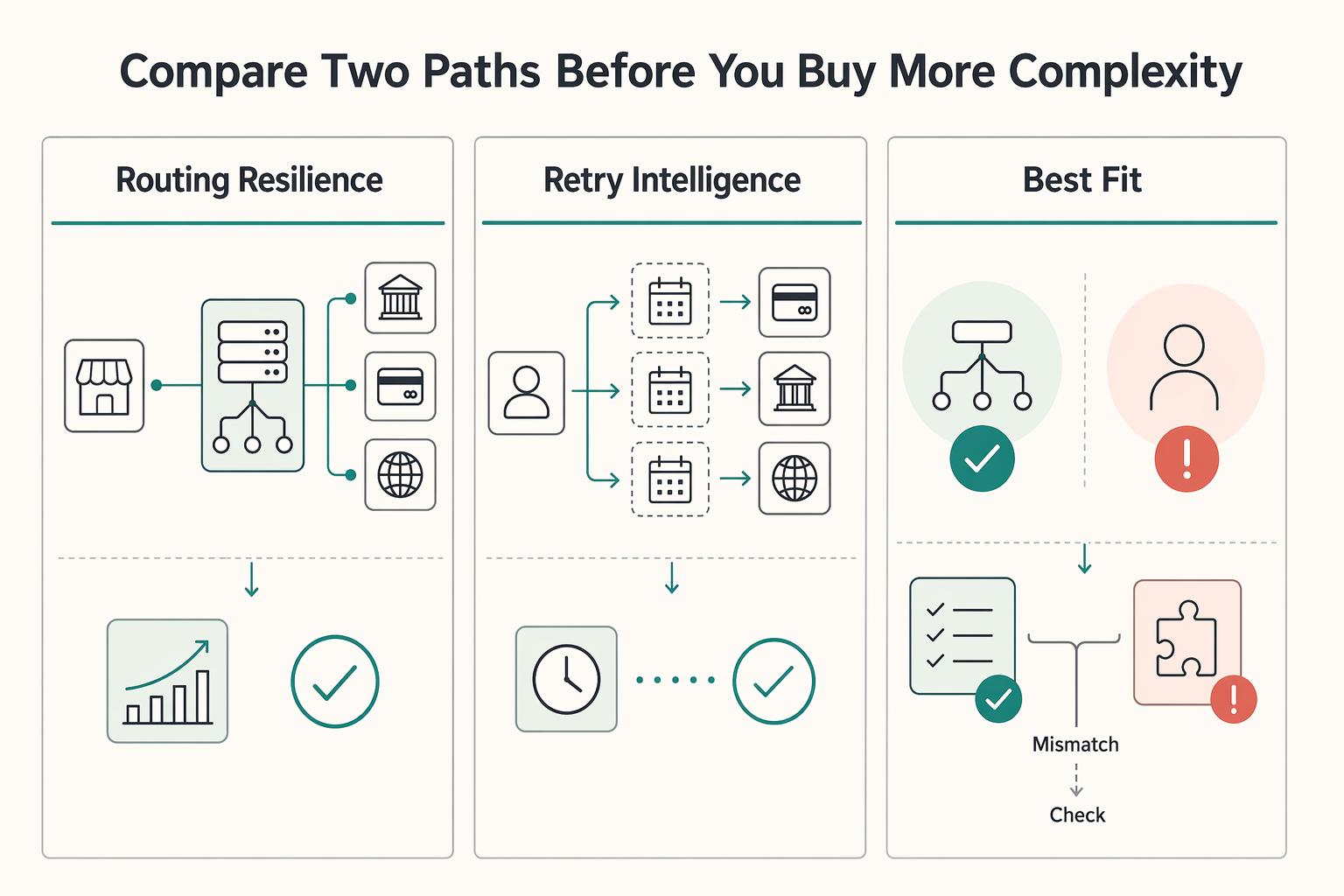
Compare the two paths before you buy more complexity#
| Decision area | Keep current gateway-only flow | Add orchestration or failover features |
|---|---|---|
| Routing resilience | Actual gateway topology and supported backup paths | Supported route selection with resolved prior outcomes and duplicate-prevention controls |
| Retry intelligence inputs | Limited to what the current gateway and billing stack expose | Can combine gateway, processor, acquirer, segment, payment method, fraud-risk, and currency rules |
| Best fit | Stable acceptance, low route concentration, clean decline data | Gateway-specific failure concentration or clear need to route by segment, currency, or risk |
Payment orchestration is not automatically the right move. It centralizes gateways, processors, acquirers, and related providers so routing can follow predefined rules plus real-time data. That helps when failures are routing-driven. It helps less when the core issue is customer-level decline behavior rather than route fragility.
Add machine learning only after the basics are clean#
Use Machine learning for retry timing only after your labels and routing data are trustworthy. If your team cannot clearly explain why recent failed payments were retried, stopped, or rerouted, keep improving data quality first.
Run controlled pre-live testing before rollout. Stripe test environments let you simulate transactions to catch integration defects before live payments. Pair that with regular failure testing and a small resiliency scorecard: failures by route, reroute success, retry success by decline class, and cases blocked by network rules.
If failures are concentrated in one gateway path, investigate that route and evaluate supported recovery options. Preserve invoice-level collection ownership and pending-outcome blocks before allowing failover; routing a second charge does not resolve the first one.
If failures are not gateway-specific and decline data is clean, then increase Smart Retry complexity second. This order keeps you from treating infrastructure fragility as a churn-optimization problem.
If you need a more advanced recovery layer, see How to Use Machine Learning to Reduce Payment Failures on Your Subscription Platform.
Step 6 run the weekly operating cadence and verification loop#
Review operations weekly if useful, but evaluate recovery only after the predefined observation window has matured. A one-week review is insufficient to close a two-month collection cohort. Set the experiment horizon and maximum runtime before launch.
Review one shared dashboard#
Run one shared dashboard across finance, product, and payments ops so decisions are based on the same definitions. Track the core signals: Failed payments, recovery rate, retained MRR or a GRR view, and the churn split between Involuntary churn and Voluntary churn.
That split should stay explicit. Involuntary churn is not the same as voluntary cancellation behavior, and combining them can hide whether payment recovery is working or simply masking a separate retention issue.
| Metric | What to verify | Why it matters |
|---|---|---|
| Failed payments | Whether volume is rising, flat, or concentrated in recent high-priority accounts | Shows whether the issue is broad or isolated |
| Recovery rate | Recovered failed-episode value divided by eligible failed value, same mature cohort/window; label count metrics separately | Shows whether retry or dunning changes are working |
| Retained MRR or GRR view | Whether recovered invoices meaningfully improve retained revenue from existing subscribers | Avoids celebrating saves that do not move revenue |
| Churn split | Involuntary churn versus Voluntary churn | Keeps payment-failure work separate from true cancellation behavior |
Before you call a win, verify movement in recovery rate against recent failed-payment records and confirm the saves came from actual recovered invoices.
Score experiments with pass/fail outcomes#
Treat each test as a decision, not as a dashboard trend. Define a hypothesis, a primary outcome, and guardrail metrics, then close it explicitly as validated, invalidated, or inconclusive.
Compare variables that are actually testable in this work, such as Smart Retries versus fixed retry timing, or one dunning window versus a longer one. Longer dunning windows can improve recovery in some contexts, but that is a test variable, not a rule to copy.
For Recurly, campaign edits or reassignment affect new invoices entering dunning; in-flight invoices retain their original configuration. Other providers have their own propagation rules, so record the version each invoice actually used.
Keep an exceptions log and a short decision record. Maintain an exceptions log for cases where Dunning management or retry behavior creates unintended outcomes, including unintended cancellations. Use account-level activity exports where available to verify which campaign and communications a customer actually received.
Close each review cycle with a short decision record. Record what changed, what happened to the four metrics, whether the hypothesis was validated, invalidated, or inconclusive, key exceptions, and one decision for the next cycle. That keeps your Revenue recovery playbook evidence-based instead of memory-based.
Related reading: What Is Negative Churn? How Platform Operators Achieve Revenue Expansion Without New Customers.
Common mistakes that sink recovery programs and how to recover fast#
The usual failure modes are copied defaults, metric confusion, and unsegmented retries. Treat retry and dunning settings as local policy decisions that you validate, not as vendor truth.
Step 1 test vendor defaults before you trust them#
Defaults vary by product and payment method. Stripe recommends 8 tries within 2 weeks for its applicable Smart Retries flow; use that as a scoped starting point, with actual eligibility and cost constraints.
Run a controlled comparison with stable eligibility, mature windows and customer-friction guardrails. Score recovered invoice value and costs alongside retained recurring revenue and the churn split.
Step 2 optimize for economics, not retry hit rate#
More successful retries do not automatically mean a healthier recovery program. The goal is lower involuntary churn and better overall economics, not just a higher count of eventual authorizations.
Respect current provider and network restrictions for each decline category. Do not infer permission from a historical Visa retry-count limit. Track executed attempts separately from scheduled retries, and avoid parallel manual, billing and orchestration collection on the same invoice.
Step 3 enforce segment rules and stop conditions#
Broad retry logic across all accounts can underperform. Major platforms support different retry policies and collection strategies by customer segment and gateway response code, and Stripe documents segment-specific retry policies through automations.
Use that capability to define segment-specific paths and clear stop conditions, then verify execution weekly. The minimum evidence pack is segment definitions, decline-code mapping, stop rules, and account-level activity exports showing which retry and dunning path each customer actually received.
Segment recovery by payment behavior, customer value, and risk, not just by plan tier. See How to Use Subscriber Segmentation to Reduce Churn on Your Platform.
Takeaway and copy/paste 30-day checklist#
Keep the first 30 days tight: separate the problem, assign clear ownership, run segment-based recovery rules, and judge changes against recovery outcomes and unit economics, not retry volume.
| Week | Focus | Actions |
|---|---|---|
| Week 1 | Baseline and ownership | Baseline Involuntary churn, Voluntary churn, and Failed payments in one shared view, and assign one owner for Payment failure recovery |
| Week 2 | Segmentation and retry rules | Publish eligible provider/method-specific retries and stop rules; prevent overlapping collectors and resolve unknown outcomes before new attempts |
| Week 3 | Dunning and experiment setup | Align Dunning management with payment-method update flows so failed-payment messages clearly direct customers to fix details and re-enter recovery; launch one controlled experiment |
| Week 4 | Review and next tests | Review mature failure cohorts, recovered value, churn split and collection costs; distinguish observations from controlled-test lift |
Keep the operating principle simple: fewer assumptions, tighter decision rights, and evidence-backed iteration beat generic retry volume. When you want to validate this kind of 30-day recovery plan against your own money-flow and controls, talk to Gruv.
Frequently Asked Questions
What is the difference between involuntary churn and voluntary churn in a subscription business?
Involuntary churn is customer loss caused by payment failure or banking issues, not an active cancellation decision. Voluntary churn is when the customer chooses to cancel. You should separate them in reporting because tactics for cancellation behavior usually do not fix payment-method or decline-path failures.
What are the minimum components of a reliable payment-failure recovery system?
Coordinate one collection owner, eligible retry logic, customer notices, a tested method-update or authentication path and verified final outcomes. Enable supported card updates where appropriate. Preserve pending-outcome blocks and method-specific restrictions across every automated or manual collector.
How should retry cadence work in practice when failure causes differ?
Map the actual decline or pending state before choosing timing. Eligible temporary declines may permit later attempts; listed hard declines need the appropriate customer action or method update. Unknown prior outcomes must be resolved before another financial attempt. Defaults remain provider- and method-specific.
When should we stop retrying and ask for a payment method update?
Stop additional collection when the provider or network says the attempt is non-retryable, or when the prior result remains pending or unknown. Route customers to the appropriate update or authentication path; changing a method does not bypass other restrictions.
What results should operators realistically expect from dunning and retry optimization?
Expect improvement in recovered revenue, not total elimination of involuntary churn. Many failed payments are recoverable, but some causes remain outside your control. Judge results against your baseline using recovered invoices and movement in involuntary versus voluntary churn.
What should founders and revenue leaders do first in the first 30 days?
Map ownership and failure states first, then validate eligible retries, messages and the exact payment-method update field. Use one collection owner per invoice, preserve pending-outcome blocks and trace each episode to its verified result.
Try a related tool
Researched and edited by the Gruv editorial team. Gruv builds cross-border billing, payouts, and finance-operations software for global businesses.
Sources
Includes 1 external source outside the trusted-domain allowlist.
Educational content only. Not legal, tax, or financial advice.
Related Posts

The Freelance Payment Penalty: A Modeled Audit of Platform Fees, FX Spreads, and Payout Delays
The money rarely disappears through a single, easy-to-spot fee. The real loss is stacked. A marketplace takes its commission, a processor adds a charge for international cards, a bank or payment company converts the currency at a spread, a platform holds the funds before release, and a wire sheds a little to intermediaries on the way in. Each layer looks defensible on its own, but the worker feels the combined result as a smaller deposit and a later payday.
How to Respond to a Subpoena for Business Records
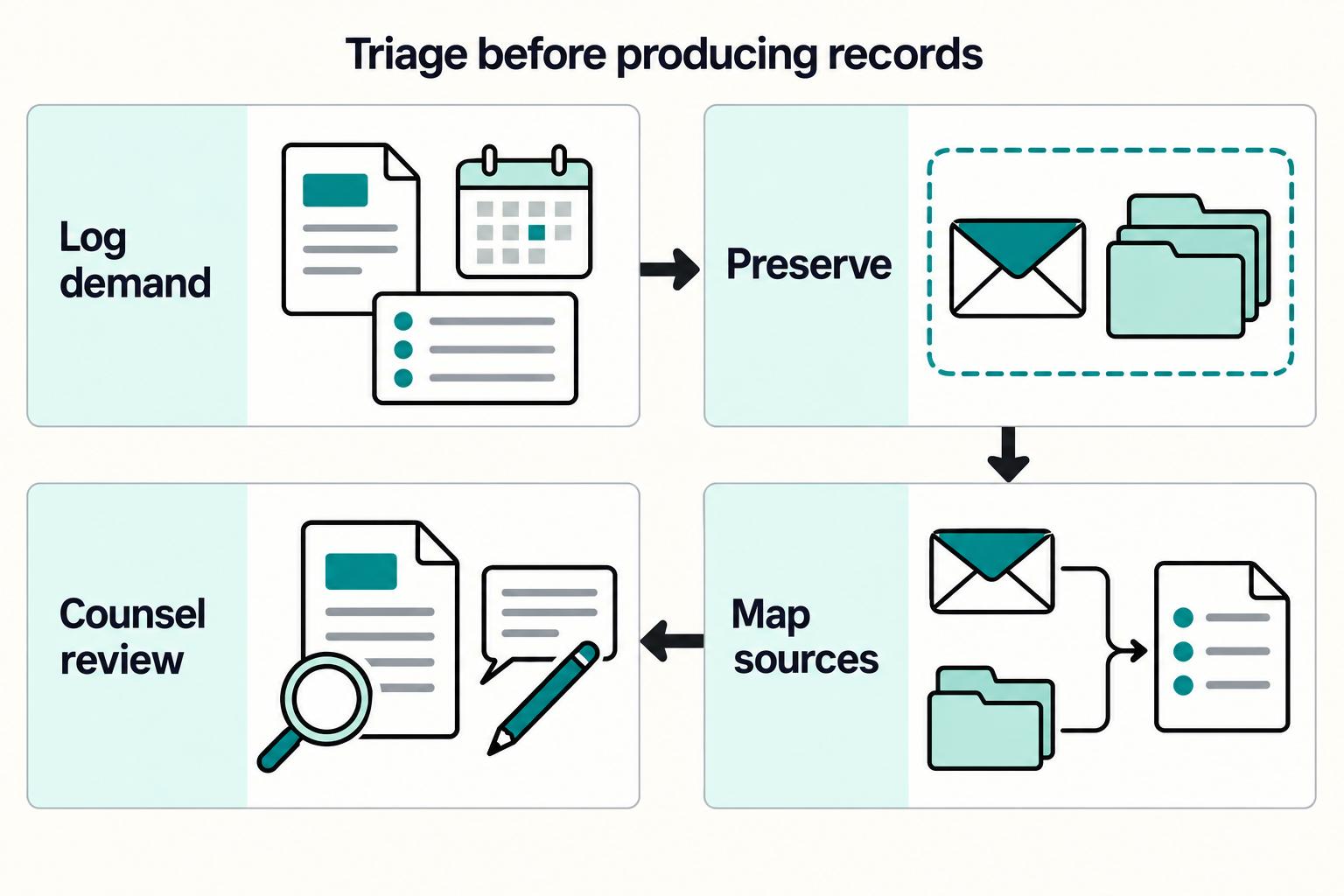
Move fast, but do not produce records on instinct. If you need to **respond to a subpoena for business records**, your immediate job is to control deadlines, preserve records, and make any later production defensible.
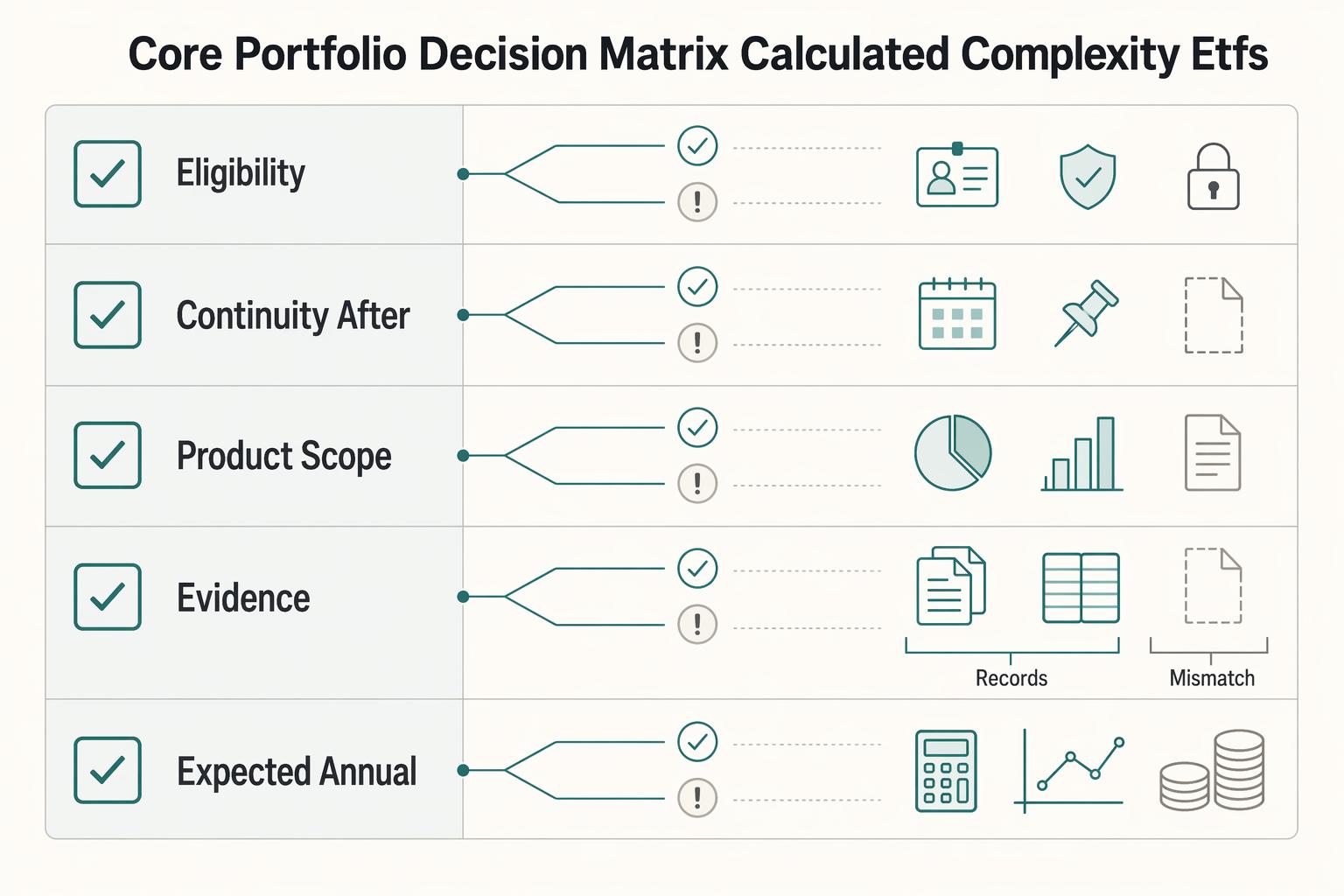
A US Expat's Guide to Investing in UCITS ETFs to Avoid PFIC Issues
The real problem is a two-system conflict. U.S. tax treatment can punish the wrong fund choice, while local product-access constraints can block the funds you want to buy in the first place. For **us expat ucits etfs**, the practical question is not "Which product is best?" It is "What can I access, report, and keep doing every year without guessing?" Use this four-part filter before any trade: