
Quick Answer
Contractors generally use four federal estimated-tax checkpoints: April 15, June 15, Sept. 15, and Jan. 15 of the following year. These are baseline IRS dates tied to four payment periods, but the live deadline can move to the next business day when weekends or legal holidays apply. Keep estimated tax separate from payroll deposits, Form 941 filing dates, and state quarterly reports, then document the source, owner, calculation record, and payment proof for each quarter.
Why this calendar fails in real teams and what this guide fixes#
The main failure is usually not missed reminders. It is treating different obligations as one shared date list. Federal estimated tax, payroll tax deposit and filing work, and state quarterly reports do not belong in one lane. When they sit together, teams can assign the wrong owner, keep the wrong evidence, or lose track of why a date or filing choice changed.
Separate obligations before you discuss due dates#
Separate the obligations first, before you discuss due dates. The IRS does not publish one universal tax calendar. Publication 509 lists three tax calendars and notes that some organizations need more than one. Federal estimated tax for self-employed people follows one payment-period schedule, while employer employment tax follows different deposit schedules and quarterly filing dates.
This is where teams usually get tangled. IRS estimated-tax periods are typically due April 15, June 15, Sept. 15, and Jan. 15 of the following year, with weekend or legal-holiday shifts. Form 941 quarterly returns are due April 30, July 31, Oct. 31, and Jan. 31. If both are labeled "Q2 tax deadline," the wrong task can be completed on time.
Assign ownership by obligation type#
Assign ownership by obligation type, not by whoever touches payouts. Compliance, legal, finance, and risk may each hold different parts of the record: payment proof, worker documentation, classification decisions, and escalation evidence when facts do not fit the default pattern.
Use a simple control. Each calendar line should name one legal entity, one obligation type, one accountable owner, and one reviewer. If you cannot tell within one business day whether a date is estimated tax, payroll deposit or filing, or a state report, pause and escalate before filing.
Build state lanes separately#
Build state lanes separately, even when the dates look familiar. Texas Comptroller and FTB examples show why. The Comptroller sets quarterly report months in April, July, October, and January and applies its own next-business-day rule for weekends or federal legal holidays. FTB separately states quarterly estimated-tax payments and publishes its own yearly deadlines.
Do not infer state timing from federal timing. Similar dates do not prove the same obligation, filing channel, or owner.
Make each quarter auditable#
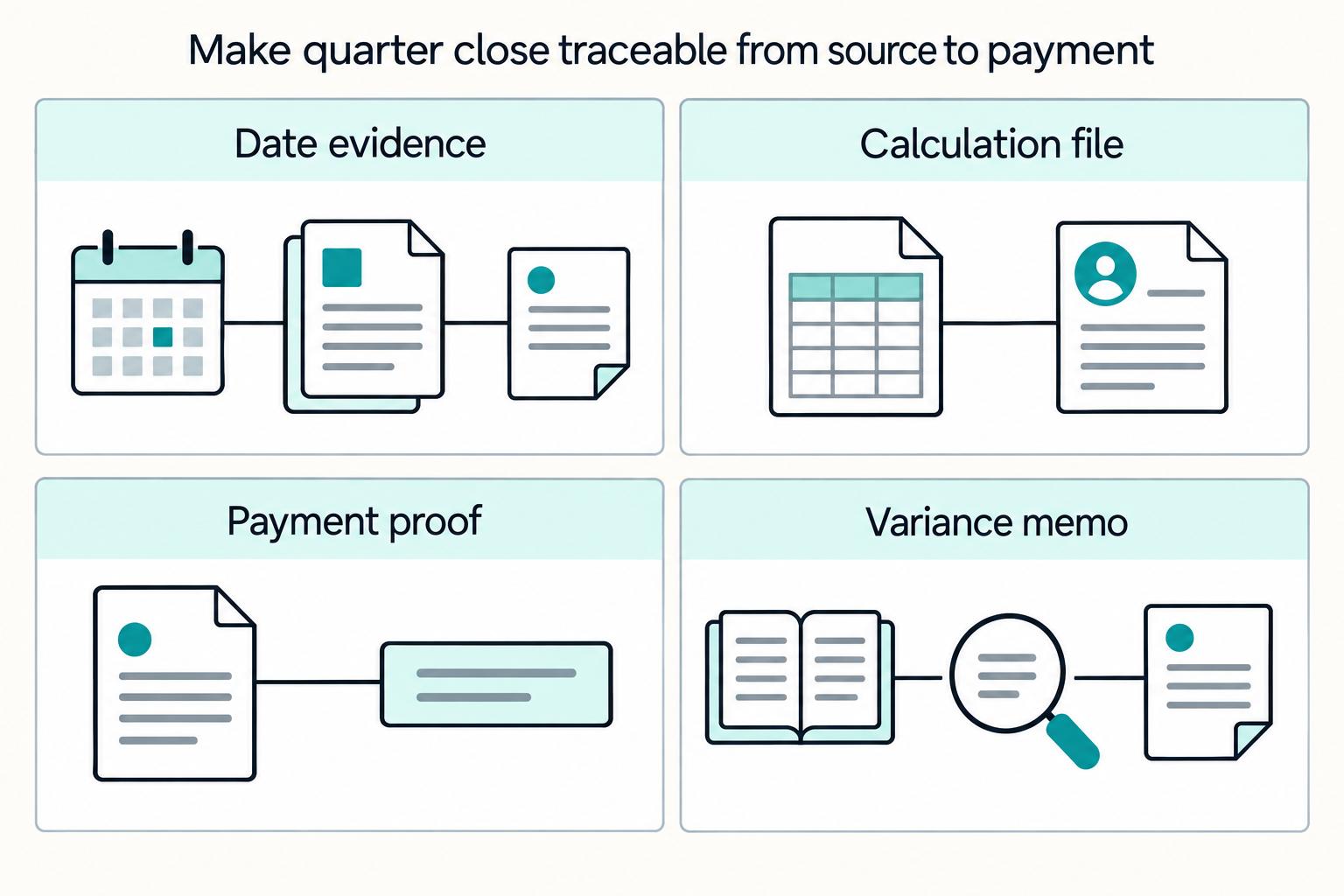
Make each quarter auditable, not just visible. The fix is an evidence-backed tax compliance calendar with an as-of date, owner, reviewer, supporting calculation or filing record, and payment confirmation. That gives you a defensible quarter-close file instead of a copied date list.
Keep an explicit escalation rule for edge cases. IRS guidance says estimated-tax requirements differ for farmers, fishermen, and certain higher income taxpayers. Apply that same control logic anywhere a worker profile, entity structure, or jurisdiction does not fit the base rule.
For a step-by-step walkthrough, see How to Make a 'Safe Harbor' Estimated Tax Payment.
Start by separating the three calendars you are managing#
Before you enter any due date, split the work into the right calendars. If estimated tax, payroll deposits, and state reporting share one list, your team can hit a date and still complete the wrong filing.
Build a one-page lane table first#
Build a one-page comparison table first, then put it at the front of the calendar file. If a task does not fit one row, treat it as not filing-ready.
| Lane | Primary authority to check first | What belongs here | Distinguishing timing detail | Required owner field |
|---|---|---|---|---|
| Quarterly estimated tax payments | Internal Revenue Service (Form 1040-ES and IRS estimated tax FAQs) | Tax on income not subject to withholding | IRS uses four payment periods, including Jan. 1-March 31 due April 15 and April 1-May 31 due June 15, with next-business-day treatment for weekends or legal holidays | Named owner by legal entity or taxpayer population |
| Payroll tax deposit | Internal Revenue Service (Topic No. 757 and quarter tax calendar pages) | Federal employment tax deposits | Deposit schedule is monthly or semiweekly, based on prior employment taxes reported on Forms 941/944 | Payroll or employment-tax owner by employing entity |
| State quarterly tax reports | Texas Comptroller of Public Accounts | Applicable quarterly reports | Quarterly reports are due in April, July, October, and January | Filing owner by legal entity |
| State quarterly obligations | FTB | Business due dates and state-specific quarterly rules where applicable | FTB states business due-date treatment differs from federal. California individual estimated-tax instructions also use a separate threshold and installment structure | Filing owner by legal entity or taxpayer type |
Use Publication 509 and quarter pages for different jobs#
Use Publication 509 and the IRS First Quarter Tax Calendar for different jobs, not as substitutes. Publication 509 separates calendars into General, Employer's, and Excise and notes that some taxpayers may need more than one.
The First Quarter Tax Calendar is useful, but it is mixed. It includes payroll-deposit items and at least one estimated-tax installment item. For each federal row, record both the obligation type and the exact IRS source so the reason for using that source stays clear.
Add state authorities as separate rows#
Add state authorities as separate rows and assign ownership by legal entity. A single "state taxes" lane hides real differences across entities.
The Texas Comptroller and FTB make the point. The Comptroller publishes quarterly report months in April, July, October, and January. FTB explicitly warns that its business due-date treatment differs from federal, and California estimated-tax instructions for individuals use a different threshold and installment structure. Similar timing does not mean the same obligation, return, or owner.
Set a stop rule for unmapped tasks#
Set an internal stop rule: if a task cannot be mapped to one calendar type by your internal cutoff, for example one business day, escalate to tax counsel before filing proceeds. That cutoff is your control choice, not a regulator deadline. Use these red flags:
- A task is labeled only as "Q1 tax deadline" with no obligation type.
- The source is an IRS quarter page, but no one has confirmed whether it is a payroll deposit or estimated tax item.
- A state row uses a federal date pattern without state authority support.
Do not move a row into production until these fields are complete: obligation type, governing source, legal entity, owner, and reviewer.
Gather prerequisites before you calculate anything#
Once each task sits in the right lane, stop before you do any math. Quarterly tax errors can start with bad assumptions about worker status, state footprint, or prior filings, not with the calculation itself.
Pull tax forms and prior reporting records#
Start with payee documentation that matches how payments actually moved. Pull a current Form W-9 for U.S. persons and the relevant W-8 on file for foreign payees, for example Form W-8BEN.
Add prior Form 1099 records, especially Form 1099-NEC outputs, to show what was previously treated as reportable nonemployee compensation. Use that as a consistency check, not a classification shortcut. Worker-status determinations can be complex and fact-specific, so escalate if the forms and the actual service arrangement do not match.
Before you calculate, make sure your file has:
- one current tax form on file per payee
- one documented U.S. or foreign status determination per payee
- one prior reporting record, or a documented reason none exists
Confirm the filing footprint by entity#
Confirm your U.S. filing footprint for this cycle by legal entity and payment flow, not by copying last quarter. State obligations can differ from federal timing and process.
Two state checks are practical examples. The Comptroller says that each taxable entity formed in Texas or doing business there must file and pay franchise tax. Nexus review can change whether an entity belongs on the state calendar. FTB publishes its own estimated-tax worksheet and Form 540-ES process for individuals, so treat that state as a separate check, not a federal mirror.
Reconcile prior-quarter status before new calculations#
Reconcile prior-quarter filing status from both your books and filing channels before you calculate new amounts. Ledger summaries matter, but they do not prove a filing was accepted.
For each obligation, assemble:
- prior return or filing copy
- payment confirmation or transaction reference
- acceptance or acknowledgment evidence from the authority or filing platform, when available
- ledger export with booked amount and date
- variance note for amended, reversed, or duplicate activity
This reduces the risk of double-paying a quarter or carrying forward an unaccepted filing as complete. It also supports income, deduction, or credit items and record retention for the relevant limitations period, generally 3 years.
Assign named owners before numbers go live#
Assign named owners before any date or amount is finalized in the tax compliance calendar. This is your internal control choice, not a regulator-mandated structure. At minimum, assign:
- compliance owner for source and filing review
- finance ops owner for ledger and payment confirmation
- legal or tax reviewer for escalations and edge cases
Do not calculate if ownership is unclear. Missing owners usually mean the obligation definition is still too loose to approve safely.
Set source priority and ownership before date entry#
Set the governing source first, then assign separate maintenance and approval owners before any date goes live.
Build a source hierarchy by obligation type#
Build a source hierarchy by obligation type, not by team habit. For federal rows, start with the IRS source that matches the tax type. Publication 509 separates federal calendars into general, employer, and excise, so estimated-tax and employment-tax dates should not be handled as one lane.
Map each federal row to the correct IRS page:
- estimated-tax rows to IRS estimated-tax payment periods
- employment-tax rows to IRS employment-tax due dates, April 30, July 31, Oct. 31, and Jan. 31
For state rows, use the state authority page next, such as Texas Comptroller due dates or FTB guidance. For estimated tax, FTB ties timing to Form 540-ES materials and notes a separate payment form for each due date. Each row should show the governing authority, exact URL, and an as-reviewed date.
Separate date maintenance from approval#
Have one person maintain dates and a different person approve them before publication. This internal control can reduce copy-forward errors from prior quarters.
Reviewer check:
- obligation type
- jurisdiction
- exact regulator page used
If a row blends April 15 and April 30 logic, recheck the source mapping before approval.
Keep ambiguous dates in draft#
Keep ambiguous dates in draft until the reviewer confirms the governing source and records an artifact. Keep a live link, and add a screenshot when page changes are likely or when you need a dated record of what was posted.
Do not finalize a date with an unclear source trail. The IRS tax calendar points users to form instructions for the latest changes, and IRS forms and publications can receive corrections and updates after release. Escalate before the date enters your calendar.
You might also find this useful: Payment Scheduling for Platforms: How to Build Flexible Payout Calendars for Contractors.
Build the four federal checkpoints with a date-shift rule#
Build the four federal estimated-tax checkpoints as your baseline, then verify and document any live-date shift before publication. IRS baseline dates can move when a due date lands on a weekend or legal holiday, and in certain years a District of Columbia holiday can affect federal deadlines nationwide.
Start from the baseline payment periods#
Start with the IRS payment periods and label each as a baseline date, not a guaranteed live date.
| Payment period | Baseline due date | Calendar label |
|---|---|---|
| Jan. 1 to March 31 | April 15 | Q1 baseline checkpoint |
| April 1 to May 31 | June 15 | Q2 baseline checkpoint |
| June 1 to Aug. 31 | Sept. 15 | Q3 baseline checkpoint |
| Sept. 1 to Dec. 31 | Jan. 15 of the following year | Q4 baseline checkpoint |
Each row should show the payment period, baseline due date, and IRS source used.
Apply weekend and holiday shifts after verification#
Apply the weekend or holiday adjustment rule only after current-year verification. If a due date falls on a Saturday, Sunday, or legal holiday, treat payment as timely on the next non-holiday business day. Then confirm the live date on a current IRS source before you update your calendar.
Use this rule in order:
- Start from the baseline date.
- Check weekend or legal-holiday impact.
- Confirm the live date on a current IRS page or announcement.
- Record why the date moved.
Be especially strict with June and April checks. June can shift in some years. For example, second-quarter 2025 was due Monday, June 16, and D.C. holidays such as Emancipation Day can shift April federal deadlines in some years.
Log an as-of record for every checkpoint#
Log an as-of record for each checkpoint so you can explain date changes after publication. The IRS tax calendar warns users to check forms and instructions for the latest changes, so your evidence trail is part of the control.
At minimum, record:
- baseline due date
- live due date published
- governing IRS page or announcement
- page reviewed date
- internal reviewer
- screenshot or saved PDF when live date differs from baseline
Use a one-sentence deviation note before approval, such as weekend, legal holiday, or D.C. holiday effect. If the reason is unclear, keep the date in draft.
Related reading: How to Calculate the All-In Cost of an International Payment.
Add state overlays without polluting the federal lane#
Lock federal dates first, then layer in state obligations on a separate lane. State rules should never overwrite federal assumptions, even when the months line up.
Create a separate state tab with named fields#
Create a separate tab for State quarterly tax reports with one row per state program, authority, and owner. Keep state data beside the federal lane, not inside it.
At minimum, include:
- state and legal entity
- filing authority
- exact program or form name
- cadence
- acceptance channel
- accountable owner
- reviewer
- source link
- last reviewed date
- conflict red flag
Use exact authority names, for example Texas Comptroller of Public Accounts and FTB, not generic labels. Each state row must map to a named state authority page or form instruction.
Record cadence and channel rules exactly as published#
Record each state's cadence and channel rules exactly as published. Similar timing does not mean identical rules.
The Comptroller shows why. For applicable taxes, quarterly reports are due in April, July, October, and January. Due dates are adjusted for Saturdays, Sundays, and 2026 federal legal holidays. Webfile payments must be submitted by 11:59 p.m. CT on the due date to be timely. If you use TEXNET or EDI, treat them as separate channels with their own guidance.
FTB needs the same separation for a different reason. FTB says personal estimated-tax payments are made once a quarter. For individuals, FTB says to use Form 540-ES. Electronic payments can be made using Web Pay. The 2026 personal estimated-tax deadlines are Apr. 15, Jun. 15, Sep. 15, and Jan. 15, 2027. The 540-ES instructions also say that no installment is due for the 3rd required installment, so "quarterly" does not always mean four even installments.
Add one channel note per row, for example "Texas Webfile, cutoff 11:59 p.m. CT" or "Web Pay under Form 540-ES."
Flag any state rule that breaks a federal assumption#
Add a red-flag field for any state rule that conflicts with a federal assumption, and route those rows to legal or tax review automatically. This is your internal control, not a regulator-mandated process.
Use triggers such as:
- state cadence differs from the federal four-period structure
- state channel rules differ from your assumed payment method
- state form logic changes the installment pattern
- state threshold changes the payment method requirement
For California, 540-ES instructions include mandatory e-pay triggers when an estimate or extension payment exceeds $20,000 or an original return shows total tax liability over $80,000. If your row still shows a non-electronic method after those thresholds, escalate before filing.
Sequence the overlay after federal dates are locked#
Sequence the work in this order: lock federal dates, add state overlays, then run reconciliation checks. Reconciling too early causes cross-lane contamination.
Close-check each row with three questions:
- Does it cite the correct state authority?
- Does the payment channel match the state rule?
- Does any state logic conflict with a federal assumption?
If any answer is unclear, keep the row in draft and escalate.
Need the full breakdown? Read How to Calculate Quarterly Estimated Taxes With US and Foreign Clients.
Define how each quarterly amount is computed and reviewed#
Once dates are locked, control the amount quarter by quarter. Treat each quarter as its own review event tied to Form 1040-ES inputs, not as a roll-forward sheet that reuses assumptions without review.
Build a quarter-specific calculation record#
Build a quarter-specific calculation record for each Quarterly estimated tax payments event. For individual estimated tax, make these inputs explicit: expected adjusted gross income, taxable income, taxes, deductions, and credits.
For internal review, include at minimum:
- quarter and payment period
- income base used
- changes from the prior quarter
- deductions and credits applied
- withholding assumed, if any
- comparison method under IRS estimated-tax rules: 90% of current-year tax, 100% of prior-year tax, or 110% of prior-year tax when prior-year AGI was over $150,000 ($75,000 if married filing separately)
- expected amount due and payment date
- preparer and reviewer sign-off
- supporting file references
A reviewer should be able to trace major inputs to tax documents, ledger support, or prior filed returns.
Tie inputs back to documents already on file#
Tie inputs back to documents already on file. Form W-9 supports the payee TIN for information reporting, prior Form 1099-NEC filings show nonemployee compensation previously reported, and Form W-8BEN supports foreign-status treatment in U.S. withholding and reporting workflows.
Use those documents as evidence inputs, not as a substitute for tax analysis. If payee status, TIN, country claim, or payment pattern changed, flag it before you reuse prior assumptions.
Keep payroll-deposit logic out of estimated-tax math#
Keep payroll-deposit logic out of your estimated-tax math. The two lanes look similar on a calendar, but the calculation logic is different. Employment-tax deposit schedules are driven by prior Forms 941/944 amounts and wage payment dates, not accrual timing.
If the logic depends on payroll dates or Wednesday or Friday semiweekly deposit timing, treat it as payroll deposit work. Estimated-tax due dates follow the payment periods, April 15, June 15, Sept. 15, and Jan. 15 of the following year, with weekend or holiday shifts to the next business day.
Document material changes in writing#
When a material assumption changes, add a short written rationale before approval as an internal control. This helps prevent underpayment risk because penalties can apply by payment period even if the annual return later shows a refund.
Keep the note specific: what changed, why the prior assumption no longer holds, what evidence supports the update, and who approved it. That helps prevent silent spreadsheet drift and leaves a reviewable audit trail.
Related: How to Pay US Subcontractors from Canada.
Connect calendar controls to payout and compliance operations#
Approved quarter math still fails if payout operations run on a separate track. A payment should not be marked ready until the tax record, identity and compliance record, and evidence folder all line up on the worker and payment path.
Gate disbursements where regulatory scope requires it#
Gate disbursements where your regulatory scope requires it. If your entity is subject to AML controls, run the tax-calendar check alongside the relevant KYC, KYB, and AML checks instead of in separate queues. For covered institutions or programs, customer identification procedures are part of AML compliance, and beneficial-ownership checks can apply to legal-entity customers.
Check applicability first. Not every contractor payout platform is automatically in bank or MSB scope. The quarter file should show who confirmed scope, which policy version applies, and whether identity or beneficial-owner review is complete before release. A failure mode to watch for is finance clearing payment on tax completion while compliance still has an unresolved identity or ownership issue.
Tie tax-document collection to payout status#
Tie tax-document collection to payout status, not year-end cleanup. For U.S. payees, Form W-9 provides the correct TIN for IRS information-return reporting. For foreign beneficial owners in the relevant withholding or reporting context, Form W-8BEN is submitted when requested by the payer or withholding agent.
Use a clear operating rule: require valid W-9 or W-8 status before a payee moves from onboarded to payable, then recheck at quarter close when facts change. Keep the document on file, payment channel, and reporting assumption together in the evidence pack. The channel flag matters because some payments are reportable on Form 1099-K rather than Form 1099-NEC. Deferring that classification creates year-end surprises, and Form 1099-NEC has a statutory January 31 filing deadline.
Track cross-border dependencies in a separate lane#
Track cross-border dependencies in a separate lane. Do not merge FBAR, FATCA/Form 8938, and FEIE notes into the same field used for quarterly estimated-tax approval. They are related signals, but they are different obligations and may apply to different filers.
Keep at least these fields for affected cohorts:
- possible FBAR relevance, including whether aggregate foreign financial accounts may exceed $10,000 during the calendar year
- possible Form 8938 relevance, noting thresholds vary, with one example for specified unmarried individuals living in the U.S.: more than $50,000 at year-end or more than $75,000 at any time during the year
- possible FEIE dependency for U.S. persons abroad, while recognizing they are still taxed on worldwide income even when an exclusion may apply
Watch two red flags. FBAR is filed on FinCEN Form 114, not with the IRS. Form 8938 does not replace the FBAR filing obligation. FEIE discussion is not a substitute for quarterly tax review.
Start with a minimal manual control#
Start with a minimal manual control before you add automation: one owner, one reviewer, and one evidence folder per quarter. The owner updates payout readiness and document status. The reviewer confirms that the quarter file ties the tax calculation packet to payee documents and payment channel.
For any released payment, you should be able to show who approved it, what tax-form status was on file, and whether any cross-border escalation was tracked separately. If those answers are not visible in one folder, the control is still too loose.
If you want a deeper dive, read How to Build a Global Contractor Payment Compliance Calendar: Monthly Quarterly and Annual Obligations.
If you are mapping tax-document readiness to payout release controls, use Gruv's docs to model policy gates, status handling, and audit-ready flows.
Set escalation triggers when guidance is incomplete or conflicting#
When the rule set is unclear, stop early. Uncertainty about the governing source, filing type, or cross-border reporting path is a tax review issue, not routine cleanup.
Escalate date conflicts as soon as you find them#
Escalate date conflicts as soon as you find them. IRS calendar guidance can change by form. A mismatch between an IRS page and a state authority page is a tax review issue, not standard ops maintenance.
Use a clear trigger: federal and state timing do not align for the same quarter task. The Comptroller's quarterly timing for applicable taxes is April, July, October, and January, while FTB estimated-tax timing can differ, including June 15, 2026 for second quarter estimated tax. Record the exact source page or screenshot and its as-of date. If two plausible dates remain, escalate.
Escalate filing-type gaps before your internal deadline#
Escalate filing-type classification gaps before your internal deadline. Do not leave items in a generic "tax" bucket. IRS estimated tax uses four payment periods, while employment-tax deposits use monthly or semi-weekly schedules. Depositor labels do not describe employee pay frequency.
Trigger escalation if the quarter file cannot clearly state all three: obligation type, governing authority, and depositor category, when payroll deposit rules apply.
Escalate cross-border scope questions early#
Escalate cross-border cases when Form 8938 or FBAR scope is unclear. IRS says certain U.S. taxpayers with foreign financial assets must report on Form 8938, and that requirement is additional to FBAR, FinCEN Form 114, not a replacement.
Use a conservative trigger. Escalate when documentation suggests possible foreign financial assets near or above the baseline Form 8938 reference threshold, at least $50,000, or when the reviewer cannot determine whether Form 8938, FBAR, or both may apply. Move those cases to specialist review.
Catch common mistakes early and recover fast#
Once you resolve a conflict, fix the calendar at the task level so it does not recur next quarter. Repeat errors often come from copied rows, mixed labels, and missing document gates.
Re-tag copied deadlines before approval#
Re-tag every copied deadline by obligation type before approval. Generic calendars can mix estimated-tax checkpoints, employment-tax deposit rules, and quarterly filing deadlines into one lane.
Rebuild each row with one tag first: federal estimated tax, employment-tax deposit, or quarterly filing. Keep the control logic separate. Estimated-tax payments follow the Publication 509 timing rule, the 15th day of the 4th, 6th, and 9th months, then the 15th day of the 1st month after year-end. Form 941 is generally due by the last day of the month following quarter-end. Payroll deposit schedules depend on prior reported employment taxes on Forms 941 or 944, not payroll frequency. If a row says only "Q2 tax due," treat it as incomplete.
Rebuild state rows from state authority pages#
Build state rows from state authorities, not from federal assumptions. Federal dates are a reference point, not a state template.
For Texas, anchor to the Comptroller schedule. Quarterly reports for applicable taxes are due in April, July, October, and January, and Form 01-117 uses the 20th day after the reporting period rule. For FTB, use dates and structure directly: April 15, 2026; June 15, 2026; September 15, 2026; January 15, 2027, with a 30% / 40% / 0% / 30% installment pattern. If you inherit a state row from a federal sheet without state-source verification, hold it from approval.
Gate quarter close on document readiness#
Gate quarter close on W-8, W-9, and 1099 readiness. Do not wait until close to find missing tax status or TIN data.
Require a valid Form W-9 for U.S. payees and the appropriate W-8, such as W-8BEN when relevant, for foreign-status withholding or reporting context. Confirm payee records can support Form 1099-NEC output ahead of the January 31 filing and furnishing deadline. If required documentation or classification is missing, stop final quarter approval and fix the record before the next payment cycle. Documentation gaps can trigger 24% backup withholding, and deposit failures can trigger 2% / 5% / 10% / 15% failure-to-deposit penalties.
This pairs well with our guide on Tipping and Gratuity Features on Gig Platforms: Payment and Tax Implications.
Verify quarter close with an evidence pack that survives audit#
Quarter close should survive review without anyone relying on memory. The packet should show the due date, how the amount was calculated, and what was paid.
Assemble a quarter-close packet per entity#
Assemble a quarter-close packet per entity. Include the due-date list, quarter-specific calculation sheets, payment confirmations, and any internal reviewer notes you use. For federal estimated tax, keep Form 1040-ES support if you used it, plus payment proof. Each record should identify the payee, amount, date, and proof of payment. For electronic payments, keep the confirmation number and payment method.
Save source snapshots and date-adjustment notes#
Capture source snapshots and due-date adjustment notes. Save the exact IRS and applicable state pages you relied on, with an as-of date. If you applied a weekend/holiday due-date adjustment rule, note the original published date and the adjusted next-business-day date. A snapshot without a capture date or adjustment note is weak evidence, especially because IRS guidance points filers to current form and publication pages for changes.
Reconcile filed amounts to the ledger#
Reconcile filed amounts to the ledger before close. Match each filed or paid amount to the quarter ledger export and document variances before archiving. Texas audit guidance uses return-to-books reconciliation, and a similar control can improve review readiness in other contexts. If the ledger, calculation sheet, and payment confirmation do not tie, add a short variance memo and document internal review where required by your process.
Apply retention tags by jurisdiction and tax type#
Apply retention tags by jurisdiction and tax type. Do not use one blanket retention rule. The IRS notes a general 3-year assessment window, California is usually 4 years, and Texas sales and use records must be kept at least 4 years unless earlier destruction is authorized. Tag each packet by entity, quarter, jurisdiction, tax type, and retention end date so legal, finance, and risk can retrieve it quickly.
Final takeaway and copy-paste checklist#
Use one quarter-close standard: approve each item only after you can prove the obligation type, the governing due-date source, and the evidence behind the amount paid or filed.
- Classify the obligation before setting any date.
Tag each item as Federal estimated tax, Payroll tax deposit, or State quarterly tax reports. Do not treat these as interchangeable. IRS payroll deposits follow separate monthly or semiweekly schedules from estimated-tax checkpoints.
- Confirm dates from the governing authority and keep proof.
Use the Internal Revenue Service for federal estimated-tax periods and baseline dates: April 15, June 15, September 15, and January 15 of the following year. Use the Texas Comptroller of Public Accounts for quarterly report timing: April, July, October, January. Use the California FTB for California estimated-tax dates, and retain the exact page or screenshot used. For mailed 2026 California estimated-tax payments, use Form 540-ES.
- Apply weekend or holiday shifts only when official guidance confirms it.
If a due date falls on a weekend or legal holiday, apply next-business-day treatment only after confirming the rule on the relevant authority page, IRS, the Comptroller, or FTB. Keep both the original date and the adjusted date evidence in the file.
- Approve a quarter-specific calculation packet, not just a payment total.
Include the quarter covered, inputs used, assumptions, and calculation support, and add reviewer sign-off if your process requires it. Document assumption changes from the prior quarter. This control matters because late estimated-tax payments can trigger penalties even if a refund is expected later.
- Check tax-document readiness before quarter close.
Confirm current Form W-9 records for U.S. payees; these are furnished to the requester, not filed by the payee with the IRS. For foreign beneficial owners, confirm whether Form W-8BEN was requested and received. Validate Form 1099 readiness where applicable, including Form 1099-NEC timing by January 31.
- Escalate unresolved timing conflicts and archive an auditable close pack.
Escalate if IRS and state dates conflict or if the team cannot classify the item type. After resolution, archive source snapshots, calculations, payment confirmations, reconciliations, approvals, and any date-adjustment notes so the decision trail is clear later.
When this checklist surfaces process gaps, talk to Gruv to confirm market coverage and design a compliance-first operating model.
Frequently Asked Questions
What are the four quarterly estimated-tax deadlines for contractors in the United States?
The federal baseline dates are April 15, June 15, Sept. 15, and Jan. 15 of the following year. They match four payment periods: Jan. 1 to March 31, April 1 to May 31, June 1 to Aug. 31, and Sept. 1 to Dec. 31. Confirm the live IRS date each year because weekends and legal holidays can shift it.
Why do some calendars show June 15 while others show June 16?
The difference usually comes from the IRS weekend and legal-holiday rule. If the baseline date falls on a Saturday, Sunday, or legal holiday, payment is timely on the next non-holiday business day. That is why one calendar may show June 15 and another June 16.
Is the IRS First Quarter Tax Calendar the same thing as contractor estimated-tax deadlines?
No. The IRS First Quarter Tax Calendar is a broader deadline tool that includes multiple filing actions, while estimated tax is one specific obligation. If you treat them as interchangeable, you can place the wrong task on the calendar.
Do Texas and California quarterly state reports follow the same timing as federal estimated tax?
No. State reporting timelines are state-defined and can differ from federal estimated-tax installment dates. Texas Comptroller quarterly reports for applicable taxes are due in April, July, October, and January. California timing can also differ, and California EDD payroll quarter filing can use quarter-end deadlines such as April 30, 2026.
When should we treat a deadline conflict as a legal or tax escalation instead of an ops fix?
Escalate when you cannot tell whether the item is estimated tax or payroll tax, because those follow different timing rules. Escalate if federal and state authority dates cannot be reconciled, or if a date shift cannot be explained by the weekend or legal-holiday rule. If the difference is only a documented next-business-day shift, it is usually an ops verification issue.
What documents should we require before approving each quarter's payment and filing cycle?
At minimum, keep Form W-9 for U.S. payees or Form W-8BEN for foreign beneficial owners when relevant. Include Form 1099-NEC documentation where nonemployee compensation reporting applies, along with the internal calculation record, payment proof, and approval support. Keep those records together before closing the quarter.
Researched and edited by the Gruv editorial team. Gruv builds cross-border billing, payouts, and finance-operations software for global businesses.
Sources
Educational content only. Not legal, tax, or financial advice.
Related Posts

The Freelance Payment Penalty: A Modeled Audit of Platform Fees, FX Spreads, and Payout Delays
The money rarely disappears through a single, easy-to-spot fee. The real loss is stacked. A marketplace takes its commission, a processor adds a charge for international cards, a bank or payment company converts the currency at a spread, a platform holds the funds before release, and a wire sheds a little to intermediaries on the way in. Each layer looks defensible on its own, but the worker feels the combined result as a smaller deposit and a later payday.

How to Respond to a Subpoena for Business Records
Move fast, but do not produce records on instinct. If you need to **respond to a subpoena for business records**, your immediate job is to control deadlines, preserve records, and make any later production defensible.

A US Expat's Guide to Investing in UCITS ETFs to Avoid PFIC Issues
The real problem is a two-system conflict. U.S. tax treatment can punish the wrong fund choice, while local product-access constraints can block the funds you want to buy in the first place. For **us expat ucits etfs**, the practical question is not "Which product is best?" It is "What can I access, report, and keep doing every year without guessing?" Use this four-part filter before any trade: