
Quick Answer
Start by treating all untaxed worldwide receipts as in scope, then run Form 1040-ES on the same quarterly cadence with updated USD records and saved payment confirmations. Use a prior-year baseline only while current results still track; if income timing becomes uneven, switch to Form 2210 annualized treatment. For foreign clients, rely on verified withholding documents and payer-requested onboarding forms before reducing estimated payments.
Confirm estimated tax applies, then run the same process each period#
If you have U.S. and foreign clients, keep the sequence simple. Confirm whether estimated tax applies, identify which income streams belong in the estimate, and run the same Form 1040-ES payment process each period. Once that foundation is in place, the steps below become a control system rather than a reaction.
Estimated-tax rules generally work the same way whether you live in the U.S. or abroad. If income is not covered by withholding, treat it as in scope until your numbers show otherwise.
Before You Start#
Do not start calculating until you have these items in hand. If you cannot identify your prior-year total tax and current untaxed income by source, pause and gather that first.
- Your most recent filed U.S. return
- A current-year income summary by source
- Records for items you expect to claim on the return, including Form 2555 (FEIE) and Form 1116 (FTC) if applicable
Step 1 Confirm that estimated tax applies#
Use the IRS estimated-tax test for the current filing year. Generally, you start with whether you expect to owe at least $1,000 after withholding and refundable credits, then check whether your withholding and credits meet the applicable safe-harbor level.
For many taxpayers, the safe-harbor check is based on 90% of current-year tax or 100% of prior-year tax (110% can apply for certain higher-income taxpayers). Treat this as a baseline check, not a shortcut. Special cases can apply. If you are close to the threshold, paying on time for the current period is usually safer than waiting. Penalties can apply by payment period.
Step 2 Include worldwide income, not just U.S. client income#
For U.S. citizens and resident aliens, your estimate starts with worldwide income from all sources. That means U.S. client income, foreign client income, and other taxable income that is not already covered by withholding.
As a practical check:
- Bucket income into U.S. client, foreign client, and other taxable sources
- Mark what already has withholding and what still needs estimated-tax coverage
- Model FEIE or FTC in your projected return if relevant, but do not assume they remove the in-year payment obligation by themselves
Step 3 Use Form 1040-ES to calculate and pay on schedule#
Consistency matters more than cleverness. Use Form 1040-ES the same way each period: update year-to-date numbers, project tax, calculate that period's payment, submit it, and save proof.
Verify the current filing-year dates before you rely on them. If a due date falls on a weekend or legal holiday, the deadline shifts to the next business day.
| Period covered | Due date | Action to complete |
|---|---|---|
| Jan. 1 to March 31 | April 15 | Finalize period estimate, calculate payment, submit, save confirmation |
| April 1 to May 31 | June 15 | Update YTD projection, submit second payment, save confirmation |
| June 1 to Aug. 31 | Sept. 15 | Reconcile YTD results, submit third payment, save confirmation |
| Sept. 1 to Dec. 31 | Jan. 15 of the following year | Final true-up estimate, submit fourth payment, save confirmation |
Step 4 Pick your baseline method before optimizing#
Start with the method you can run correctly every quarter, then switch only if your income pattern justifies the extra work.
| Method | Usually safer default when | Main benefit | Main tradeoff |
|---|---|---|---|
| Safe-harbor baseline | You want a simple early-year compliance anchor | Straightforward equal-payment baseline for penalty avoidance | May overpay or underfit a changed year; verify current safe-harbor thresholds before relying on it |
| Annualized-income method | Income is uneven across the year | Can vary payment amounts to better match actual cash flow and may reduce penalty exposure | More tracking and calculation work; use Form 2210 to evaluate underpayment penalty exposure |
If year-to-date results drift away from your baseline assumptions, that is the signal to move toward annualizing in the next section.
If you want a deeper dive, read Do I Have to Pay State Taxes While Living Abroad as a Digital Nomad?.
Pillar 1: Master Dynamic Projections for Volatile Income#
Volatile income is where flat quarterly assumptions break down. Run this as a quarterly operating cycle, not a one-time estimate. Review each payment against what actually happened.
Step 1 Convert every receipt to USD when it hits#
Set this rule early. Amounts reported on your U.S. return are in USD, using the exchange rate in effect when you receive, pay, or accrue the item. For most freelance income tracking, that means the payment receipt date shown in your records.
Use one posted FX source consistently. The IRS does not require a single official rate provider, but switching sources without a clear reason makes records harder to defend.
For each payment, capture the following:
- Payment date
- Client or payee name
- Original currency and amount
- FX source used
- USD amount
- Ledger location
Think of Ledger location as your audit-readiness field, not an IRS label. It should point to the exact journal entry, spreadsheet tab, or accounting export for that line item.
Step 2 Choose the projection mode that matches your income pattern#
Use equal-quarter estimates when your income is steady enough to support a simple baseline. Move to annualized treatment when equal payments stop matching how cash actually arrived.
| Projection mode | Best use case | Risk tradeoff | Required inputs |
|---|---|---|---|
| Baseline estimate | Income is fairly steady, or you need a simple default | Easy to run, but can drift as the year changes | Prior-year tax, expected AGI, taxable income, expected deductions, and credits |
| Annualized method | Income is uneven across periods | Better period matching, but higher recordkeeping burden | Period-by-period income and expense detail, payment dates, estimated payments made, and records supporting Form 2210 Schedule AI |
| Scenario-based planning | Income pipeline is uncertain and you need a range | Better planning visibility, but still needs a filing method underneath | Low, base, and high income cases plus tax inputs |
If you are uncertain early in the year, start with the baseline and move to annualized treatment once the gap between plan and actuals is meaningful.
Step 3 Build each quarterly projection with filing-year inputs#
At each quarter close, update the same IRS input set: expected AGI, taxable income, taxes, deductions, and credits. Then calculate the current payment on Form 1040-ES from that refreshed projection.
Keep FEIE and FTC in scope, but only on assumptions you can support:
- If modeling FEIE, flag Form 2555 and apply the current-year exclusion amount and eligibility guardrails only after verification
- If modeling FTC, flag Form 1116 and track eligible foreign taxes for that model
- Do not model FEIE and FTC on the same excluded income
Step 4 Use Form 2210/Schedule AI when uneven income needs proof#
Use annualized treatment when uneven income materially changes the installment logic and you can document it. The return-time mechanism is Form 2210 with Schedule AI. That is how you show uneven income and uneven estimated payments for underpayment penalty computation.
Keep a quarter-end snapshot with dated receipts, USD translations, estimated payments made, and any projected Form 2555 or Form 1116 effects used in that period. A simple test applies here: can you explain why this installment differs from the last using quarter-dated records alone? If yes, the estimate is ready.
Related: How to Prepare for an IRS Audit.
Pillar 2: Build a Fortified Tax Vault for Automated Savings#
The estimate only works if the cash is there by the deadline. Make this a first-touch cash process. When a payment arrives, allocate tax funds immediately, then move the rest to operating or personal-pay buckets.
Step 1 Route every payment through first-touch allocation#
Because U.S. tax is pay-as-you-go and Form 1040-ES covers income without withholding, move the money as income lands, not weeks later.
Use this sequence on every payment:
- Record payment date, client, original currency, amount, FX source, and USD value at receipt.
- Transfer the tax share to your dedicated vault using the starting allocation rate from your current-year estimate.
- Move the remaining funds to operating and, if relevant, payroll or owner-pay accounts.
- Tag the transfer with the related invoice or receipt ID.
As a control check, each payment should map cleanly to one USD entry and one tax-vault transfer.
Step 2 Use account architecture you can maintain#
A simple setup is usually better, as long as you keep it clearly separated. If you need to support a return position months later, the structure should still make sense at a glance. Use this checklist:
- Dedicated tax account: hold estimated-tax funds only
- Optional multi-currency sub-wallets: use only if you also log USD value at receipt
- Transfer automation: bank rule, sweep, or recurring task on payment day
- Clear naming: labels like
Tax Vault USD,Tax Vault EUR Holding,Operating,Owner Pay - Payment calendar: April 15, June 15, September 15, January 15 for estimated-tax due dates
The labels are for operational clarity, not an IRS naming rule. The real risk is mixing tax cash with day-to-day spending.
| Setup | Operational complexity | FX exposure | Fits best |
|---|---|---|---|
| Single USD tax vault | Low | Can be lower after conversion because reserves are held in USD | You want fewer moving parts and a USD-first ledger |
| Multi-currency vault workflow | Medium to high | Can be higher until conversion, so reserve value may move with exchange rates | You get paid in multiple currencies and actively manage conversion timing |
If you keep multi-currency balances, the key control is still the USD amount at receipt, since U.S. return amounts are reported in USD.
Step 3 Re-tune allocation after each projection cycle#
Do not leave your vault on a fixed percentage if the estimate has changed. After each quarter close, update the allocation rate from your latest projection.
Keep FEIE and FTC boundaries clean while you do it. FEIE may reduce regular income tax, but not self-employment tax, and foreign taxes tied to excluded income are not creditable on Form 1116.
Step 4 Run a monthly control loop and escalate early#
A monthly check helps you catch drift before it becomes a cash problem. Compare the vault balance to year-to-date projected liability and the next due date.
If the vault is consistently short, raise the allocation rate now. If it is consistently overfunded for more than one cycle, lower the rate cautiously after the next projection confirms it.
A practical check is whether your vault can cover the next scheduled payment without pulling from operating cash. If balance and expected payments keep diverging for two cycles, or FX swings repeatedly create shortfalls, involve a tax professional before the next deadline. Scheduling IRS payments ahead helps execution, but it does not fix underfunding.
You might also find this useful: A Deep Dive into the Foreign Tax Credit (Form 1116).
Pillar 3: Implement a Proactive Reconciliation Workflow#
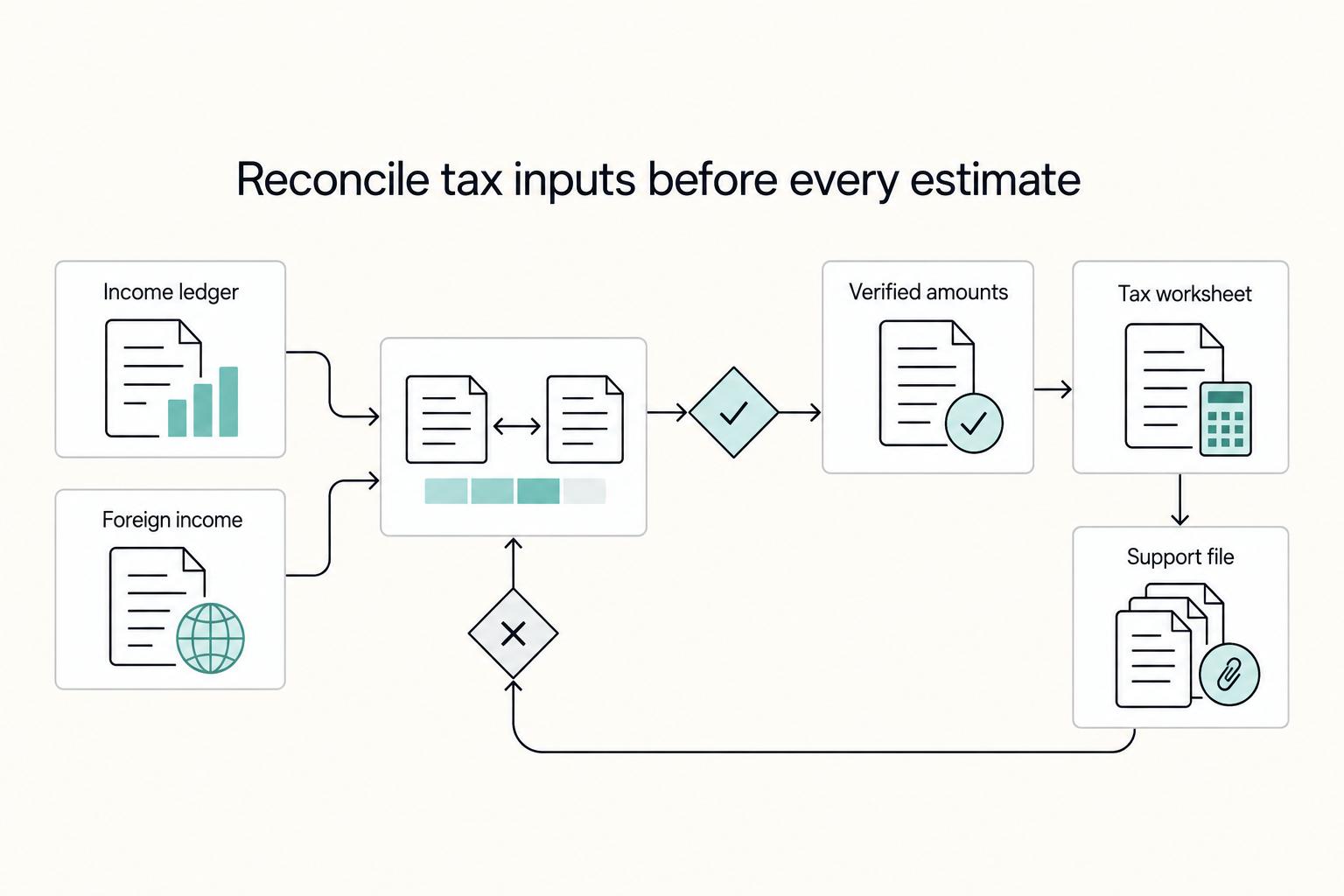
Reconciliation keeps estimates from drifting into fiction. Run this cycle every month, then again right before April 15, June 15, September 15, and January 15 of the following year. Only verified amounts should go into your estimated-tax worksheet and your Form 1116 support file.
Step 1 Build one evidence packet per foreign client#
Keep one packet per client with the invoice, proof of payment, client remittance or payment statement, any withholding certificate or local tax slip, and any treaty or residency paperwork used.
| Form | Guidance |
|---|---|
| Form W-8BEN | Generally not the right form if you are a U.S. citizen or other U.S. person |
| Form 6166 | Certificate sent to the foreign withholding agent or other local party if you need to claim treaty benefits abroad |
| Form 8802 | Used to request Form 6166 |
One correction matters here: if you are a U.S. citizen or other U.S. person, Form W-8BEN is generally not the right form. If you need to claim treaty benefits abroad, the IRS process can involve Form 6166 requested on Form 8802. You then send that certificate to the foreign withholding agent or other local party.
| Route | Cash-flow impact | Documentation burden | Error risk |
|---|---|---|---|
| Prevent withholding upfront with treaty proof | Usually better, because withholding may be reduced or avoided at payment | Higher upfront setup with treaty and residency proof and payer process | Lower later if accepted before payment |
| Accept withholding and claim credit later | Tighter cash flow, because part of payment is withheld | Higher at filing because you must prove what qualifies | Medium to high, because withheld amount is not automatically creditable |
| Unexpected withholding, then remediate | Worst near-term cash flow while you fix treatment | Highest because it requires client follow-up, proof, and possible refund tracking | Highest, because treatment and refunds can change what is creditable |
Step 2 Reconcile invoice, receipt, and withholding evidence#
Do not rely on invoice totals alone. Match each invoice to the actual receipt, confirm the original currency, record the USD value used in your tax records, and match any withholding to the client statement or local tax document. Then close each invoice with one of three statuses:
- Paid gross (no withholding)
- Paid net (with supported withholding)
- Unresolved (do not use in tax-reduction logic yet)
Do not treat invoice-to-receipt gaps as automatically creditable tax. Creditable foreign tax may differ from gross withholding, and refunds reduce what can be treated as creditable.
Step 3 Classify the withholding outcome and take action#
Once the receipt and support match, assign one label per foreign-client payment so the next step is clear:
| Label | What to do |
|---|---|
| Withholding already applied | Record gross, withheld, net, country, payment date, and current treatment detail after verification |
| Treaty reduction applied upfront | Save the proof package used for reduced treatment, including Form 6166 if used, plus payer confirmation |
| Unexpected withholding | Request the legal basis from the client, ask for corrected treatment on future payments, and track any expected refund or reimbursement |
This branch matters because country treatment differs. Some apply reduced treaty rates at payment, while others withhold at a statutory rate first and refund excess later.
Step 4 Map verified amounts into estimates and FTC support#
Once you classify the payment, move only verified figures into your tax file. Map them into:
- Your estimated-tax worksheet
- Your Form 1116 support file
Keep separate fields for potentially creditable tax, pending qualification, expected refunds, and taxes tied to income excluded under FEIE, which are not creditable.
Use this checkpoint before each estimated payment: U.S. tax is pay-as-you-go, and penalties can apply if you underpay by a payment-period deadline. If you annualize uneven income, keep the same verified figures flowing into your Form 2210 Schedule AI process.
For a step-by-step walkthrough, see US Estimated Taxes for Freelancers Abroad With FEIE in the Mix.
If foreign clients ask for your tax form during onboarding, use the form that matches your status and keep your records consistent with the W-8 form generator.
Key Tactical Questions#
Once your receipts, withholding, and foreign-tax support file are clean, two decisions do most of the work: what you send clients before payment, and which estimated-tax method you run.
Should you send Form W-8BEN to a foreign client?#
It depends on the payer process and jurisdiction. Do not auto-send Form W-8BEN just because the client is outside the U.S.
Send the tax-status paperwork the client requests during onboarding or before first payment. Ask the client's AP team which local onboarding forms, TIN details, and residency support they require. The goal is to reduce client-side withholding risk before payment is released, but that does not guarantee reduced withholding in every country or payer process. If payee status cannot be determined, presumption rules generally require the payor to treat the payee as a non-exempt U.S. person. For reportable payments to a U.S. person, backup withholding can apply in specified TIN-related cases, including 24% withholding.
Which estimated-tax approach should you use?#
Start with the method that matches how close this year is to last year. Use a prior-year baseline when this year is tracking close to last year and you want a simpler process. Use a current-year estimate when income or withholding patterns have shifted enough that last year is no longer a reliable anchor.
Before you rely on either route, insert current safe-harbor percentages and the income threshold after verification, and confirm the latest IRS form instructions. If income is uneven across quarters, review whether annualized treatment under Form 2210 is the better fit.
| Approach | When to use | What to monitor |
|---|---|---|
| Prior-year baseline | This year is broadly similar to last year | Insert current safe-harbor percentages and income threshold after verification, confirm latest IRS form instructions, and keep payment dates on time |
| Current-year estimate | Income or verified withholding has changed enough to make last year a weak proxy | Recalculate year-to-date net income and verified withholding each quarter, and confirm latest IRS form instructions |
| Annualized-method review | Income is lumpy, delayed, or concentrated in later periods | Check whether Form 2210 annualized treatment fits better than flat installments |
If your income swings hard, withholding is happening in multiple countries, or FEIE and credit positions overlap, treat that as an escalation point. Review the annualized method and get a cross-border tax pro check before the next payment date.
We covered this in detail in How Much Should a Freelancer Save for Taxes? A Monthly Reserve Rule and Quarterly True-Ups.
A repeatable quarterly cycle for your estimate, tax cash, and support file#
You do not need perfect predictions. You need a repeatable quarterly cycle that keeps your working estimate, tax cash, and support file close enough to reality that you can adjust early.
| Workflow | Cycle | Signal | Action | Verification |
|---|---|---|---|---|
| Forecasting discipline | Update your estimate using year-to-date income and current supporting records against the method you already chose | The current quarter is no longer broadly consistent with your baseline | If it still tracks, keep the method and log the checkpoint; if it does not, rerun the estimate before the next payment and flag it for technical review if needed | Keep a dated note of what changed and why you stayed with or changed approach |
| Tax cash segregation | Move tax cash out of operating funds as payments arrive, then compare reserves to your updated estimate | Your reserved balance is not keeping pace with projected liability | Increase upcoming transfers now instead of waiting for filing season, and confirm any withholding documentation before treating receipts as fully available | Your reserve trend matches your current estimate, not an older assumption |
| Ongoing reconciliation | Reconcile receipts, withholding support, payment confirmations, and your cross-border support file to what you plan to report | Any amount cannot be tied to a document, payer record, or prior estimate | Resolve mismatches in-quarter, not after year-end | Each reporting line maps to support you can produce quickly |
Forecasting discipline#
Keep the estimate honest as the year develops.
- Cycle: Update your estimate using year-to-date income and current supporting records against the method you already chose.
- Signal: The current quarter is no longer broadly consistent with your baseline.
- Action: If it still tracks, keep the method and log the checkpoint. If it does not, rerun the estimate before the next payment and flag it for technical review if needed.
- Verification: Keep a dated note of what changed and why you stayed with or changed approach.
Tax cash segregation#
This keeps a correct estimate from becoming an unfunded one.
- Cycle: Move tax cash out of operating funds as payments arrive, then compare reserves to your updated estimate.
- Signal: Your reserved balance is not keeping pace with projected liability.
- Action: Increase upcoming transfers now instead of waiting for filing season, and confirm any withholding documentation before treating receipts as fully available.
- Verification: Your reserve trend matches your current estimate, not an older assumption.
Ongoing reconciliation#
This ties receipts, withholding records, and filing support back to the numbers you are paying against.
- Cycle: Reconcile receipts, withholding support, payment confirmations, and your cross-border support file to what you plan to report.
- Signal: Any amount cannot be tied to a document, payer record, or prior estimate.
- Action: Resolve mismatches in-quarter, not after year-end.
- Verification: Each reporting line maps to support you can produce quickly.
When your income mix or country mix changes midyear, default to consistency over optimization and keep the same documented cycle unless there is a clear reason to change it.
If complexity grows across multiple reporting requirements, or your confidence in the estimate drops, pause and get cross-border tax review before filing or changing estimated payments.
This pairs well with our guide on Quarterly Taxes in Spain for Freelancers Using Modelo 303 and 130.
Before your next estimated payment, rerun your assumptions so your quarterly plan reflects your current facts, not old ones: FEIE calculator.
Frequently Asked Questions
Should you send Form W-8BEN to a foreign client?
It depends on the payer process and jurisdiction. Do not auto-send Form W-8BEN just because the client is outside the U.S. Send the tax-status paperwork the client requests during onboarding or before first payment. Ask the client's AP team which local onboarding forms, TIN details, and residency support they require. The goal is to reduce client-side withholding risk before payment is released, but that does not guarantee reduced withholding in every country or payer process. If payee status cannot be determined, presumption rules generally require the payor to treat the payee as a non-exempt U.S. person. For reportable payments to a U.S. person, backup withholding can apply in specified TIN-related cases, including 24% withholding.
Which estimated-tax approach should you use?
Start with the method that matches how close this year is to last year. Use a prior-year baseline when this year is tracking close to last year and you want a simpler process. Use a current-year estimate when income or withholding patterns have shifted enough that last year is no longer a reliable anchor. Before you rely on either route, insert current safe-harbor percentages and the income threshold after verification, and confirm the latest IRS form instructions. If income is uneven across quarters, review whether annualized treatment under Form 2210 is the better fit. Approach; When to use; What to monitor Approach: Prior-year baseline; When to use: This year is broadly similar to last year; What to monitor: Insert current safe-harbor percentages and income threshold after verification, confirm latest IRS form instructions, and keep payment dates on time Approach: Current-year estimate; When to use: Income or verified withholding has changed enough to make last year a weak proxy; What to monitor: Recalculate year-to-date net income and verified withholding each quarter, and confirm latest IRS form instructions Approach: Annualized-method review; When to use: Income is lumpy, delayed, or concentrated in later periods; What to monitor: Check whether Form 2210 annualized treatment fits better than flat installments If your income swings hard, withholding is happening in multiple countries, or FEIE and credit positions overlap, treat that as an escalation point. Review the annualized method and get a cross-border tax pro check before the next payment date. We covered this in detail in How Much Should a Freelancer Save for Taxes? A Monthly Reserve Rule and Quarterly True-Ups.
Try a related tool
Researched and edited by the Gruv editorial team. Gruv builds cross-border billing, payouts, and finance-operations software for global businesses.
Sources
Educational content only. Not legal, tax, or financial advice.
Related Posts

Do I Have to Pay State Taxes While Living Abroad as a Digital Nomad?
Living abroad does not end `state income tax` exposure by itself. The first decision is practical: choose a filing position your facts can support, then build records that support the same story all year.
How to Prepare for an IRS Audit
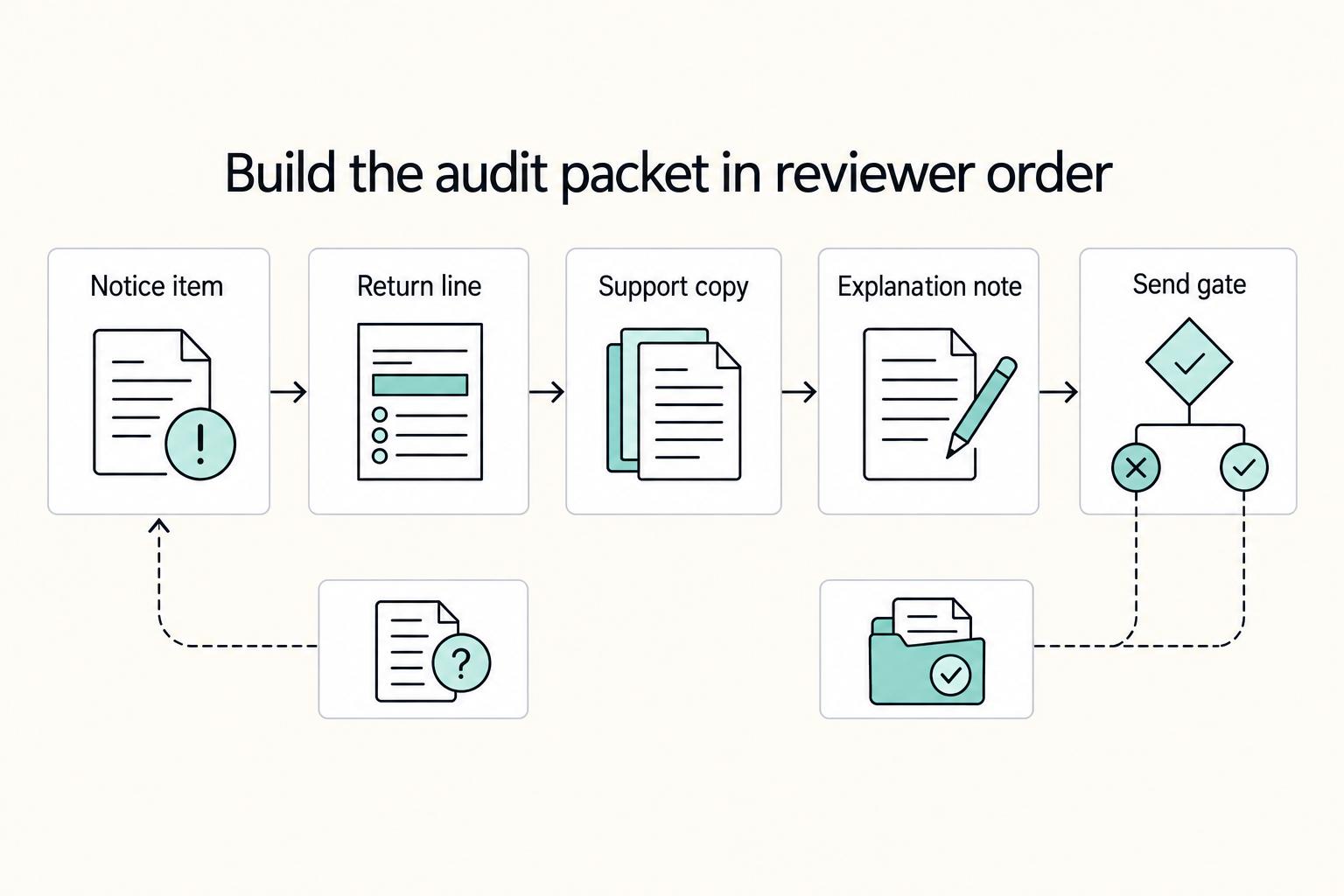
Treat an IRS audit as a records check, not a contest. Your job is to show, item by item, how what you filed ties back to the records behind it.

A Deep Dive into the Foreign Tax Credit (Form 1116)
If you paid qualifying foreign income taxes and still owe U.S. tax, start with the Foreign Tax Credit and Form 1116. A credit usually beats a deduction because it offsets tax dollar for dollar. Do not start entering numbers until you decide whether you are taking a credit, an itemized deduction, or an exclusion. If you use the [Foreign Earned Income Exclusion](https://www.irs.gov/individuals/international-taxpayers/foreign-earned-income-exclusion) or the foreign housing exclusion, remove the excluded income and related foreign taxes from the credit path first.