
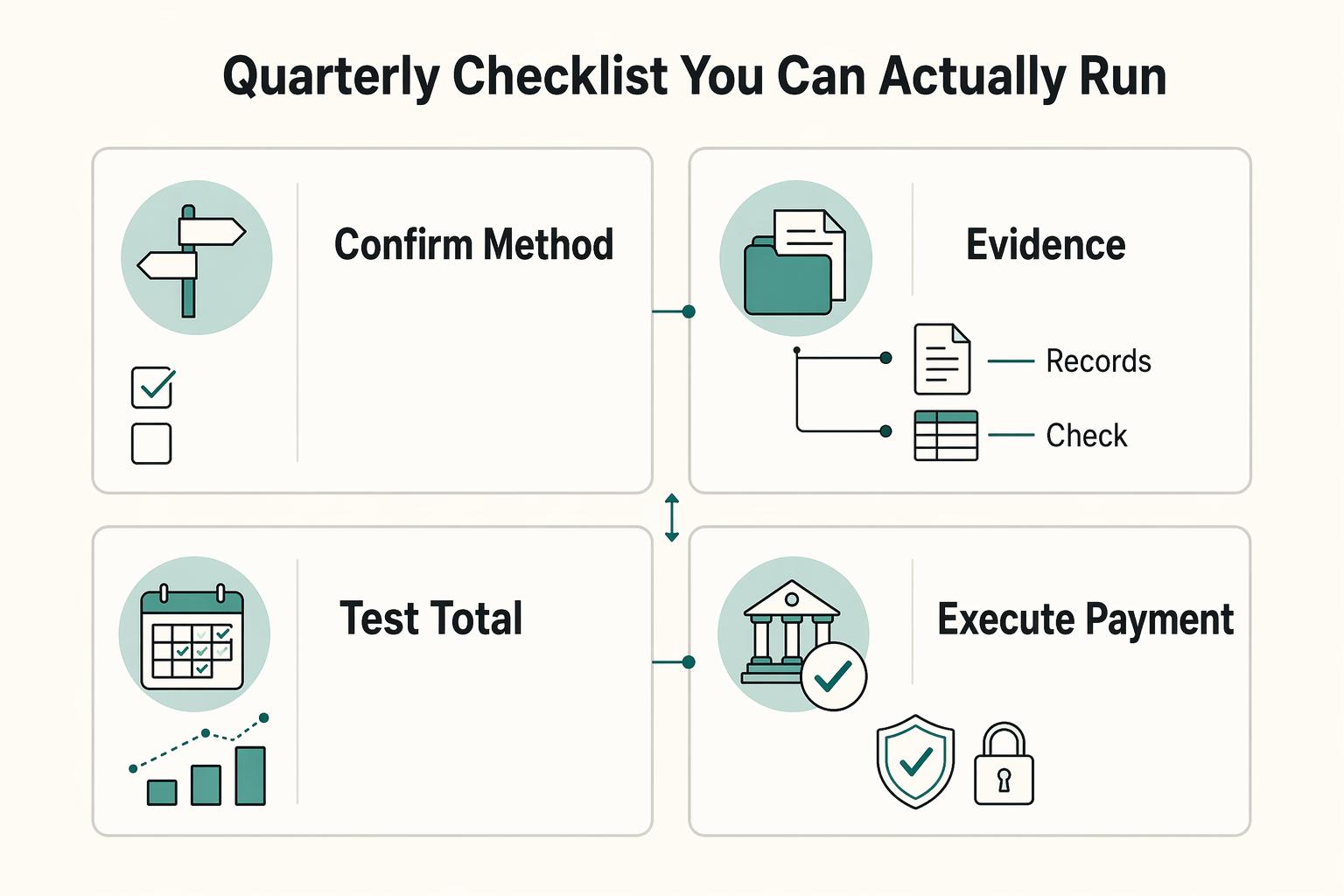
Quick Answer
To make a safe harbor estimated tax payment, pick one method path, set quarterly deadlines, calculate from real records, and keep an audit-ready trail. The article’s core approach is operational: decide between current-year and prior-year safe harbor logic, run a fixed quarterly loop, and document every assumption and payment confirmation so underpayment penalty risk is managed before filing season.
Run a Repeatable Estimated Tax System With On-Time Payments and Clean Records#
Use a safe-harbor estimated-tax system to reduce underpayment-penalty risk through repeatable decisions, on-time payments, and clean records.
Federal tax is pay-as-you-go, so this is not about outsmarting the IRS. It is about running a defensible system for estimated taxes so you avoid underpayment-penalty surprises and stay in control when income shifts. You are the CEO of a business-of-one, and this is one of those operations you need to run on a schedule, not on vibes.
| What you lock in | Why it matters | What you keep |
|---|---|---|
| Method decision | Aligns your safe harbor rule choice with current risk | One-page decision memo |
| Payment execution plan | Keeps estimated tax payments timely and traceable | Calendar, confirmations, payment log |
| Audit-ready trail | Supports your position if questions come up | Assumptions sheet and evidence folder |
-
Choose your method rule first. Decide whether you will target the current-year percentage test or a prior-year safe harbor path, including the 110% prior-year substitution if your AGI crosses the IRS high-income threshold. Deliverable: one method, one rationale, no mid-cycle guessing.
-
Set the payment cadence before you calculate details. Put IRS due dates into your operating calendar, including April 15 and January 15 of the following year. Assign one execution day and one verification day for each cycle. Deliverable: deadlines handled before the math gets noisy.
-
Build assumptions from real inputs. Use your prior-year return as a guide, then update expected income, credits, and self-employment tax exposure with the Form 1040-ES worksheet. Deliverable: an estimate based on records, not memory.
-
Document like an operator. Save every payment confirmation, date-stamp assumption changes, and keep one folder that can answer an IRS question quickly. If you want a structure for that file, use How to Prepare for an IRS Audit. Deliverable: you can explain every move without scrambling.
If your entity setup, residency facts, or cross-border reporting details feel unclear, pause and talk to a qualified pro before the next payment. For example, a consultant adds a new client stream midyear, reruns the worksheet, updates the log, and keeps the system intact.
What Should You Prepare Before You Start?#
Prepare one complete input packet before you run your estimated tax planning method, so your decisions stay consistent and defensible.
The playbook only works if your inputs are clean. Build the packet once, then reuse it through the year so you are not rebuilding assumptions from scratch.
Before you start checklist#
| Step | Key inputs | Deliverable |
|---|---|---|
| Step 1 | Prior-year federal return; current-year adjusted gross income, taxable income, taxes, deductions, and credits projection | One assumptions sheet with your current-year forecast |
| Step 2 | Relevant income records, self-employment bookkeeping records, and Schedule SE (Form 1040) inputs | One complete income evidence folder |
| Step 3 | Form 1040-ES and Publication 505 | A worksheet you can explain line by line |
| Step 4 | Current Form W-9 or Form W-8BEN status, FEIE tracking notes tied to Form 2555, and separate tracking for Form 8938 and FBAR (FinCEN Form 114) | No mixed signals between payer documentation and filing posture |
| Step 5 | One decision memo, one assumptions sheet, one payment log, and one evidence folder | An audit-ready trail you can maintain all year |
-
Step 1. Pull your prior return and planning baseline. Use your prior-year federal return as your starting guide, then project current-year adjusted gross income, taxable income, taxes, deductions, and credits. Deliverable: one assumptions sheet with your current-year forecast.
-
Step 2. Consolidate income-channel documents in one folder. Add your relevant income records and self-employment bookkeeping records. Use
Schedule SE (Form 1040)inputs to track self-employment tax on net earnings.
Keep this practical. Estimated tax can cover income tax, self-employment tax, and alternative minimum tax, so your folder needs to reflect all three areas. Deliverable: one complete income evidence folder.
-
Step 3. Anchor your assumptions to IRS guidance. Open
Form 1040-ESandPublication 505before you calculate. Individuals, including sole proprietors, partners, and S corporation shareholders, generally useForm 1040-ESto figure estimated tax. Deliverable: a worksheet you can explain line by line. -
Step 4. Separate cross-border profile records from payment math. Save your current
Form W-9orForm W-8BENstatus, then keep FEIE tracking notes tied toForm 2555if you may qualify. TrackForm 8938andFBAR (FinCEN Form 114)as separate obligations, since one does not replace the other and FBAR is filed with FinCEN, not with the IRS.
Example: a consultant changes payer profile midyear, updates form status, and logs the change before the next estimate run. Deliverable: no mixed signals between payer documentation and filing posture.
- Step 5. Lock your documentation standard before execution. Create exactly four artifacts: one decision memo, one assumptions sheet, one payment log, and one evidence folder. If you want to pressure-test that package before filing season, use How to Prepare for an IRS Audit. Deliverable: an audit-ready trail you can maintain all year.
Do You Actually Need Estimated Tax Payments?#
Yes, run a quick IRS and state intake first, then choose an estimated-tax path only if your facts support it.
With your input packet ready, make a clean yes-or-no call. This step keeps you from sending payments out of habit or skipping them because you feel fine this month.
Run the intake#
-
Check the federal trigger. Start with the IRS baseline: if you expect to owe at least $1,000 when you file, treat estimated payments as in play. Do not treat a possible refund as protection, because underpayment penalty exposure can still exist even if you receive a refund. Deliverable: a clear federal yes or no.
-
Classify your income by withholding behavior. Split cash flow into withheld wages, consulting revenue, investment income, and other non-withheld streams. This shows where the risk actually sits and where you need tighter controls. Deliverable: one income-mix worksheet with withheld and non-withheld lanes.
-
Tag your business role. Mark whether you operate as a sole proprietor, partner, or S corporation shareholder. IRS guidance explicitly places these profiles in the estimated-tax conversation, so role tagging prevents bad assumptions from generic advice. Deliverable: a role-specific decision note.
-
Add your state checkpoint. If your facts touch New York, remember estimated tax may apply when withholding is missing, and nonresidents with New York source income may also need to pay. If your facts touch California, review the FTB quarterly estimated-payment flow used when withholding is missing or insufficient.
Review state rules separately from federal logic. Deliverable: a state-risk flag. For a deeper state lens, see Do I Have to Pay State Taxes While Living Abroad as a Digital Nomad?.
Assign your risk label#
| Risk label | Use this when | Next action |
|---|---|---|
| Safe default | Federal trigger appears met and records look complete | Proceed to method selection |
| Needs review | Income mix or state facts look mixed or incomplete | Rework assumptions and confirm state exposure |
| Talk to a pro now | Role complexity or cross-state facts create material uncertainty | Escalate before sending payments |
Example: a consultant with part-time wages and new contract income enters both streams. They see thin withholding coverage, flag New York source income, and move from safe default to needs review before paying.
Should You Use 90 Percent Current Year or 100/110 Prior Year?#
Choose the safe-harbor path based on forecast confidence and income volatility. For individuals, IRS guidance frames this as 90% of current-year tax or 100% of prior-year tax, with 110% of prior-year tax for higher AGI taxpayers.
Once estimated payments are in your system, pick the rule that lowers underpayment-penalty risk without forcing constant recalculation. Make the decision, document it, then execute.
Compare the three pathways#
| Pathway | Choose this if | Main tradeoff |
|---|---|---|
| 90% current-year tax | You can forecast this year with high confidence and update quickly | More recalculation work when income shifts |
| 100% prior-year tax | Your income moves around and you want a stable baseline | You may prepay more or less than your final current-year result |
| 110% prior-year tax | Prior-year AGI was greater than $150,000 ($75,000 if married filing separately) | Higher prepay target |
Lock your decision in one page#
-
Score volatility first. Rate income as stable, mixed, or lumpy. Score forecast confidence and cash reserve tolerance. Verification point: you can explain the score in two lines.
-
Select one rule with a simple choose-this-if test. Use prior-year anchoring when forecasting feels weak. Use the 90% current-year path when you can project reliably and review often.
Example: a consultant with uneven retainers picks prior-year anchoring to keep quarterly operations predictable. Verification point: one method selected, no split strategy.
-
Record legal footing. Note that the underpayment framework is in Section 6654 for individuals, including four required installments, and Section 6655 for corporations. Keep Revenue Procedure 95-23 in your memo as historical procedural context tied to both sections. Verification point: your memo names the framework you relied on.
-
Freeze and execute. Lock this method until your next formal review gate, then move to payment execution. If facts change sharply mid-cycle, trigger review instead of switching on instinct.
If you want a clean file structure for that review trail, use How to Prepare for an IRS Audit. Verification point: you can run the next quarter without re-deciding the method.
How to Execute the Payment Plan Step by Step#
Run a fixed quarterly loop for estimated tax payments, verify each payment, and log proof the same day.
A solid method decision is only half the job. For estimated-tax purposes, the year is divided into four payment periods, and penalty risk is tested by each period, not only at filing.
Build your quarterly runbook#
| Checkpoint | Action | Verification point |
|---|---|---|
| Estimate refresh | Recompute current projection using your chosen safe harbor rule path | You can explain the assumptions in one page |
| Payment initiation | Submit via your selected channel using Form 1040-ES workflow | You save the payment confirmation number |
| Payment retention | Add dated evidence to your log and evidence folder | Entry includes amount, method, and timestamp |
- Step 1. Recalculate before each payment period. Start with current income signals and withholding updates. Re-test whether you still sit inside your planned 90% or 100% safe harbor target.
Also re-test whether you still expect to owe at least $1,000 after withholding and refundable credits. A refund at filing does not automatically remove underpayment-penalty risk.
-
Step 2. Initiate payment with one approved channel. Pay by mail, online, phone, or mobile, but pick one primary channel to reduce operational noise. Keep the process consistent.
-
Step 3. Capture proof immediately. Store each confirmation number and payment record in your log. Then check your IRS account at least 48 hours after your requested payment date to confirm posting.
If you schedule in advance, keep a reminder for the change-or-cancel window (within 2 days of a scheduled payment) so you avoid accidental duplicates.
- Step 4. Reconcile withholding changes monthly. If payroll shifts, update Form W-4 assumptions and reflect the change in your forecast. Tie revisions back to
Publication 505, especially when self-employment tax or alternative minimum tax exposure starts drifting.
Apply control checks and escalation gates#
Set reminders that fit your workflow, then run an internal duplicate-prevention check before every submission. Do one monthly variance review between projected and actual cash flow.
Example: a consultant sees a sudden jump in contract income, updates the worksheet, increases the next payment, and logs the reason before closing the month.
Escalate to a tax professional when assumption changes become material, your method no longer fits, or AMT and self-employment tax projections move beyond your confidence range. If you want an audit-ready folder format, use How to Prepare for an IRS Audit. If you want a next step, Browse Gruv tools.
How Do Globally Mobile Freelancers Add Cross-Border Guardrails?#
Separate your estimated-tax workflow from your cross-border reporting workflow, then run both on one calendar.
Quarterly payments are one lane. Cross-border reporting and state exposure are different lanes that still need to run on the same calendar. Keep the boundaries clear so nothing gets mislabeled as "handled."
Split each obligation into its own lane#
| Lane | Action you take | Boundary you enforce |
|---|---|---|
| IRS estimated tax payments | Run your quarterly payment plan | Do not treat payment compliance as FBAR or FATCA compliance |
| Form 8938 | Attach it to your annual return when filing rules apply | Do not assume Form 8938 replaces FBAR |
| FBAR FinCEN Form 114 | File directly with FinCEN when aggregate foreign accounts exceed $10,000 at any time in the year | Do not file FBAR with your IRS return |
| FEIE tracking | Test physical presence and tax home conditions before you rely on FEIE | Do not assume FEIE removes self-employment tax |
Run the guardrail checklist each month#
| Check | What to track | Deliverable |
|---|---|---|
| Residency and reporting matrix | Country presence, tax home status, account reporting flags, filing artifacts, and FEIE checkpoints including 330 full days in a 12 consecutive months period and the foreign tax home requirement | One view that shows what you owe, where, and why |
| Payer profile hygiene | W-8BEN or W-9 records tied to your real filing posture and payer expectations; reconcile when you onboard a client, change entity setup, or shift work location | No mismatch between payer documentation and your compliance record |
| State-residency tripwires | New York statutory residency risk, including permanent abode plus 184 days or more, or remote work for a California employer after relocating | Early state issue detection |
| Conflict escalation | Overlap between FEIE assumptions, FBAR or Form 8938 flags, and state nexus indicators before the next quarter closes | One defensible decision trail across federal, international, and state layers |
-
Step 1. Build a residency and reporting matrix. Track country presence, tax home status, account reporting flags, and filing artifacts in one sheet. Include FEIE checkpoints, including the 330 full days in a 12 consecutive months period, plus the foreign tax home requirement. Deliverable: one view that shows what you owe, where, and why.
-
Step 2. Maintain payer profile hygiene. Keep
W-8BENorW-9records current with your real filing posture and payer expectations. Reconcile this profile whenever you onboard a client, change entity setup, or shift work location. Deliverable: no mismatch between payer documentation and your compliance record. -
Step 3. Set state-residency tripwires. Trigger review if your facts suggest New York statutory residency risk, including permanent abode plus 184 days or more, or if you relocate and keep remote work for a California employer.
Example: you move across borders, keep ties in one state, and continue remote work for a California employer, so you escalate state review before your next payment cycle. Deliverable: early state issue detection.
- Step 4. Escalate when signals conflict. If your matrix shows overlap between FEIE assumptions, FBAR or Form 8938 flags, and state nexus indicators, pause and get professional review before the next quarter closes. For deeper state screening, use Do I Have to Pay State Taxes While Living Abroad as a Digital Nomad?. Deliverable: one defensible decision trail across federal, international, and state layers.
Common Safe Harbor Mistakes and How to Recover Fast#
The fastest way to protect your position is to fix method errors immediately, rebuild evidence, and recheck federal, cross-border, and state layers before the next payment cycle.
Pressure-test the system now, not after you get a notice. When something breaks, you need a recovery sequence that gets you back to a defensible position quickly.
Run this five-step recovery sequence#
| Step | Action | Verification point |
|---|---|---|
| Step 1 | Recalculate remaining payments under IRS estimated-payment rules now instead of trusting a future refund | Your worksheet shows updated payment amounts, dates, and assumptions |
| Step 2 | Rebuild one evidence folder with your method decision, Publication 505 references, payment confirmations, and a revision log | Another operator can trace each decision from input to payment proof |
| Step 3 | Split projections for each role as a sole proprietor, partner, or S corporation shareholder | Each stream has its own assumptions and estimated impact line |
| Step 4 | Track FEIE, FBAR, and Form 8938 in a dedicated compliance lane separate from safe harbor rule execution | You maintain separate checklists for payment compliance and reporting compliance |
| Step 5 | Review California facts and test your state estimate logic under current FTB rules; if FTB bills an underpayment penalty, pay within 15 days | Your file includes a written state-risk decision and next action |
- Step 1. Recalculate instead of trusting a future refund. A refund at filing does not automatically remove penalty risk. Recompute your remaining payments under IRS estimated-payment rules now, then correct the next periods immediately.
The IRS can figure penalties, so do not wait for that outcome. Verification point: your worksheet shows updated payment amounts, dates, and assumptions.
-
Step 2. Rebuild an audit-ready record file. Create one evidence folder that contains your method decision, Publication 505 references, payment confirmations, and a revision log for each assumption change. If you want a clean structure, use How to Prepare for an IRS Audit. Verification point: another operator can trace each decision from input to payment proof.
-
Step 3. Segment income by role before you forecast. Split projections for each role you hold as a sole proprietor, partner, or S corporation shareholder. Keep separate tax-behavior assumptions for each stream, because blended inputs hide risk.
Partners often miss this since partnerships generally do not withhold tax from partner distributions. Verification point: each stream has its own assumptions and estimated impact line.
-
Step 4. Separate safe harbor rule execution from international reporting. Track FEIE, FBAR, and Form 8938 in a dedicated compliance lane. Form 8938 does not replace FBAR, and FEIE does not remove your duty to report qualifying foreign earned income on a U.S. return. Verification point: you maintain separate checklists for payment compliance and reporting compliance.
-
Step 5. Run a California risk check before the next cycle. Review your California facts and test your state estimate logic under current FTB rules. If FTB bills an underpayment penalty, pay within 15 days to avoid additional interest charges. Verification point: your file includes a written state-risk decision and next action.
Example: you move from solo client work into a partnership role while you work abroad. This reset keeps your system current and ready for review.
Run This Checklist Every Quarter and Stay in Control#
Run one repeatable quarterly estimated-tax checklist, then correct gaps immediately so small misses do not become an underpayment penalty bill.
This is the quarterly runbook. Print it, reuse it, and treat each loop like a close process.
Quarterly checklist you can actually run#
-
Step 1. Confirm your method and log the decision. Choose the safe harbor rule path you are using this quarter, then write why it still fits. Keep the decision in plain language: 90% current-year tax, 100% prior-year tax, or 110% prior-year tax if your prior AGI crossed the higher-income threshold. Expected outcome: one current decision note tied to your worksheet.
-
Step 2. Refresh inputs from live records. Update expected AGI, taxable income, taxes, deductions, and credits using current
W-2,1099, and bookkeeping records. Treat wage withholding and non-wage withholding as separate inputs so your forecast stays clean. Verification point: your worksheet reflects this quarter's real inflows, not last quarter's assumptions. -
Step 3. Re-test total tax exposure, not just income tax. Include self-employment tax and alternative minimum tax in your estimate. If you now expect to owe at least $1,000 for 2026 after withholding and refundable credits, treat estimated tax payments as generally required and adjust immediately. Expected outcome: a revised payment amount for the next due date.
-
Step 4. Execute payment and preserve proof. Pay using Form 1040-ES, then store confirmation, your assumptions memo, and your Publication 505 notes in one audit folder. Verification point: another operator can reconstruct your logic without asking for missing files.
| 2026 federal payment checkpoint | Date |
|---|---|
| Q1 | April 15, 2026 |
| Q2 | June 15, 2026 |
| Q3 | Sept. 15, 2026 |
| Q4 | Jan. 15, 2027 |
Escalate early when facts shift#
-
Step 5. Recheck cross-border and state flags. Keep FEIE, FBAR, and Form 8938 in a separate compliance lane. FBAR goes to FinCEN, not the IRS, and Form 8938 does not replace FBAR. FEIE can reduce regular income tax, but it does not reduce self-employment tax.
-
Step 6. Trigger pro review when uncertainty rises. Escalate if your residency, entity structure, or income mix changed materially, or if California facts raise FTB attention. Use Do I Have to Pay State Taxes While Living Abroad as a Digital Nomad? as a state screening step.
Example: you move countries, add new contract income, and keep ties to a prior state, so you pause and review before the next payment cycle.
Frequently Asked Questions
What is the safe harbor rule for estimated taxes in plain English?
The safe harbor estimated tax rule gives you a penalty-avoidance target for estimated tax payments. You can usually avoid underpayment penalty exposure if you owe less than $1,000 at filing after withholding and refundable credits, or if you prepay enough under the 90 percent current-year or 100 percent prior-year test.
How do I avoid an underpayment penalty if my freelance income changes every quarter?
Treat your projection as a recurring refresh, not a once-a-year forecast. Update the worksheet when income changes, then adjust the next payment cycle instead of waiting until filing season. Keep a change log so your payment decisions are explainable.
Should I choose the 90 percent current-year method or the 100/110 prior-year method?
Use the 90 percent current-year path when you trust your forecast and keep your books current. Use the prior-year path when revenue swings make forecasting unreliable. If prior-year adjusted gross income was above $150,000 ($75,000 if married filing separately), use the 110 percent prior-year threshold for that route.
Who must make estimated tax payments according to IRS guidance?
The IRS generally expects estimated tax payments when you expect to owe $1,000 or more when you file. This often affects people whose income is not fully covered by withholding.
Can I still owe an underpayment penalty even if I get a refund at filing?
Yes. A refund does not automatically erase underpayment penalty exposure. Payment timing and payment levels during the year still control the penalty outcome under IRS rules.
What documents should I keep so my safe harbor method is defensible in an IRS audit?
Keep records that support income, deductions, and credits, including receipts, canceled checks, and similar source documents. Operationally, keep one method memo, one assumptions log, and payment confirmations for each payment cycle so your decision trail is complete. If you want a practical structure, use How to Prepare for an IRS Audit.
How do FEIE, FBAR, FATCA, and Form 8938 affect my estimated-tax workflow as a globally mobile freelancer?
Keep them in a separate compliance lane from your safe harbor payment lane. FEIE does not remove return filing or income reporting duties when you claim it. FATCA-related Form 8938 reporting does not replace FBAR, and you file FBAR with FinCEN, not with the IRS. Run both lanes on one calendar so deadlines do not collide.
Try a related tool
Researched and edited by the Gruv editorial team. Gruv builds cross-border billing, payouts, and finance-operations software for global businesses.
Sources
Educational content only. Not legal, tax, or financial advice.
Related Posts

Do I Have to Pay State Taxes While Living Abroad as a Digital Nomad?
Living abroad does not end `state income tax` exposure by itself. The first decision is practical: choose a filing position your facts can support, then build records that support the same story all year.
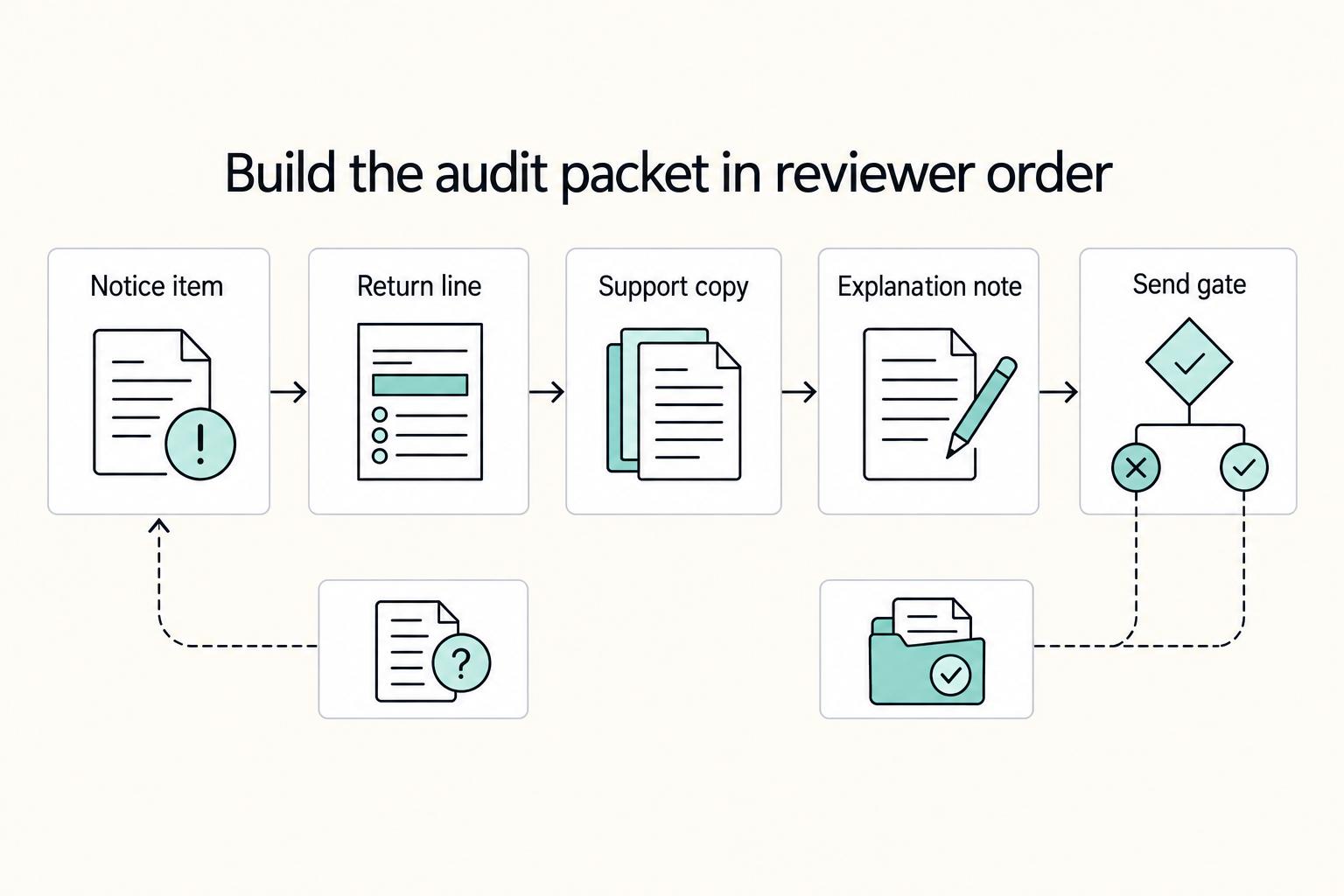
How to Prepare for an IRS Audit
Treat an IRS audit as a records check, not a contest. Your job is to show, item by item, how what you filed ties back to the records behind it.

The Freelance Payment Penalty: A Modeled Audit of Platform Fees, FX Spreads, and Payout Delays
The money rarely disappears through a single, easy-to-spot fee. The real loss is stacked. A marketplace takes its commission, a processor adds a charge for international cards, a bank or payment company converts the currency at a spread, a platform holds the funds before release, and a wire sheds a little to intermediaries on the way in. Each layer looks defensible on its own, but the worker feels the combined result as a smaller deposit and a later payday.