
Quick Answer
Use transaction evidence to explain both service failure and financial impact. Separate technical restoration, unresolved payment outcomes and prevention work. A worked timeout example, failure-to-control table and one-page template show how to turn causal findings into owned, testable changes.
What a Payment Platform Post-Mortem Should Deliver#
Restoring the API does not settle every payment affected by an outage. A payment post-mortem should explain which transactions failed, which succeeded remotely despite local errors, what remains unresolved and which changes reduce recurrence. Bring Engineering, Payments Ops, Finance and customer-support owners into the same review.
Set the bar for what the post-mortem must do#
A post-mortem is a structured review and written record of the incident: impact, mitigation and resolution actions, root cause, and follow-up work to prevent recurrence. In practice, "service is back" is not enough. The record is only useful if another owner can later verify what happened, why it happened, and what changed to reduce repeat risk. A common false finish is stopping at the technical fix without a durable explanation of why the incident happened.
Bring in the people who own impact, not only the people who restored service#
Include the responders, service owners, and product owners who can trace the incident from reported symptoms to service behavior. Keep it blameless from the start. The goal is to understand and fix causes, not assign fault.
Define the output before you begin the review#
Produce a linked recovery timeline, a causal explanation and owned actions. Keep incident resolution, financial reconciliation and prevention follow-up as separate milestones.
| Output | What it should show | Verification checkpoint |
|---|---|---|
| Recovery timeline | What was observed, what actions were taken, and when recovery was confirmed | One agreed incident clock and clear order of events |
| Root cause analysis (RCA) | The trigger, the primary cause, and key contributors | Cause statements are evidence-based, not assumptions |
| Action items | Specific preventive changes | Every item has an owner and is tracked to completion and approval |
Weak follow-up actions are vague, like "monitor closely" or "improve alerts." Strong ones are specific, owned, and easy to verify. For a related walkthrough, read How to Build a Payment Health Dashboard for Your Platform.
What to prepare before you start the post-mortem#
A useful review starts from shared evidence, not memory. Before the meeting, gather the artifacts and assign ownership so you can explain impact, mitigation, cause, and prevention without arguing over what happened first.
Gather the smallest evidence pack that can prove the sequence#
Preserve timeline notes, provider request references, webhook records, deployment changes and balance or ledger extracts. Record the query window and extraction time so later reviewers can reproduce the counts. Use access-controlled evidence and redact sensitive payment and personal data from the broadly shared report.
Every major claim in the post-mortem should point back to a concrete artifact. Recovery can be fast while root-cause understanding stays thin if you do not preserve the evidence.
Align on the timeline before comparing interpretations#
Build a shared incident timeline from the available evidence before you debate conclusions. Confirm key moments such as first observed impact, mitigation actions, and recovery confirmation so the discussion stays focused on sequence and causality.
Assign clear ownership, not just attendees#
A blameless review still needs clear ownership. Decide who owns meeting flow, documentation, and follow-up actions.
Close a specific action when its agreed test passes. Keep unresolved impact and causal questions in separate owned follow-ups rather than making every action depend on complete certainty.
State blameless rules before analysis starts#
State the operating rule clearly before analysis begins: the purpose is learning and prevention, not fault-finding. Once discussion turns into who made a mistake, people get defensive and RCA quality drops. Keep the prompts simple: what evidence shows this happened, what condition allowed it, and what change reduces repeat risk?
Define incident scope in payment terms not just uptime#
Start with user and business impact, then map the technical symptoms to that scope. An uptime-only statement is too thin to support either root cause analysis or prevention work.
Start with payment impact, not system labels#
State the affected outcome, cohort, currencies and time window. Count request attempts, intended obligations and actual executed effects separately. Five retries of one $100 obligation are not automatically $500 of exposure: check whether they reused the same result or created additional payments. Resolve unknown outcomes before quantifying the final duplicate amount.
Separate customer impact from internal processing impact#
Keep one line for what users experienced and another for internal processing impact so you do not declare recovery while impact is still open. If customer impact is active, treat communication as part of scope. During critical incidents, update on a regular cadence, for example every 20 to 30 minutes.
Classify affected areas with evidence, not assumptions#
Use your organization’s severity scale and escalation policy; SEV1–SEV5 is one possible scheme. Base the initial rating on credible impact evidence, including customer reports. A missing internal metric should not prevent escalation while the team investigates.
Add an explicit escalation rule to the template#
Escalate when payment impact is material even if HTTP uptime looks healthy. Define who can declare the incident, pause the affected execution path and approve recovery under your operating policy.
Once scope is set in payment terms, the next job is to prove the sequence with evidence. If you want a deeper dive, read Incident Response for Payment Platforms: How to Handle Outages and Data Breaches.
Build a first-24-hours recovery timeline and evidence pack#
Start the timeline immediately, and treat every entry as unconfirmed until it has linked evidence. If a milestone has no artifact behind it, keep it marked provisional.
Use a causal graph or a short chain of why questions, testing each link against evidence. Stop when the explanation supports a concrete control change; do not force exactly five questions or a single root cause.
Anchor the timeline to observable milestones#
Normalize timestamps to one timezone and record clock or ingestion uncertainty. Capture first observed impact, declaration, mitigation, technical recovery and financial reconciliation separately. Preserve the provider timestamp and local receipt time when delayed messages matter.
For each row, record the timestamp, owner, observed signal, action taken, and evidence link, such as an alert, log query, deploy record, provider notice, trace, or reconciliation artifact. Every milestone should map to at least one artifact another reviewer can open directly.
Record decisions as tested reasoning, not just activity#
The timeline should show what the team believed at each decision point, what hypothesis was tested, and why that action was chosen. A strong RCA captures the quality of that reasoning, not just a list of actions.
Keep abandoned hypotheses in the record, along with the evidence that changed direction. Do not smooth out uncertainty after the fact. If measurement was incomplete, say the conclusion was provisional. Include the responders who handled the incident in the review so the evidence is interpreted in context.
Add dependency checkpoints for external interfaces#
For any affected flow, add explicit checkpoints for the external interfaces it touched. The goal is to establish where signals appeared first, not to assign cause too early.
| Dependency type | Evidence to link | What to verify |
|---|---|---|
| External gateway/API | Error samples, status notices, request success/failure trends | Whether failures appeared before or after internal changes, and whether interface recovery aligned with flow normalization |
| Identity/verification service | Request logs, timeout or rejection patterns, provider communication | Whether checks failed upstream or requests failed before reaching the external service |
| Data feed | Freshness checks, missing update logs, fallback behavior evidence | Whether stale or missing data affected downstream behavior, or fallback handled disruption |
| Downstream processor/system | Response logs, advisories, reconciliation artifacts | Whether external-system behavior changed first and whether stabilization appears across operational and reconciliation records |
Freeze the evidence pack before memory drifts#
Store durable links to the source artifacts so another reviewer can reconstruct why mitigation was judged effective and why recovery was declared. When operational handling affected downstream reconciliation or payouts, pair operational records with the corresponding finance-facing records.
Publish the best supported timeline with unresolved gaps labeled. A dependency can remain degraded while a documented fallback restores the affected customer flow. Record that limitation instead of requiring every dependency to be healthy before the review can proceed.
Worked example: a timeout becomes a duplicate payout#
Illustrative incident: at 09:00 UTC a provider accepted a $100 payout, but the worker timed out before saving the provider ID. At 09:02 a retry used a new action key and created another $100 payout. At 09:10 a balance reconciliation exposed two provider payouts for one intended obligation. Containment paused the affected retry path; outcome lookup resolved the original request before further submissions.
The intended obligation was $100; two executed payouts total $200, leaving $100 of duplicate-payment exposure, not $200 of platform revenue loss. Finance records the duplicate separately and determines recovery or loss treatment from the actual outcome. A provider success response does not itself confirm recipient bank receipt. Track the financial correction even after the retry defect is fixed.
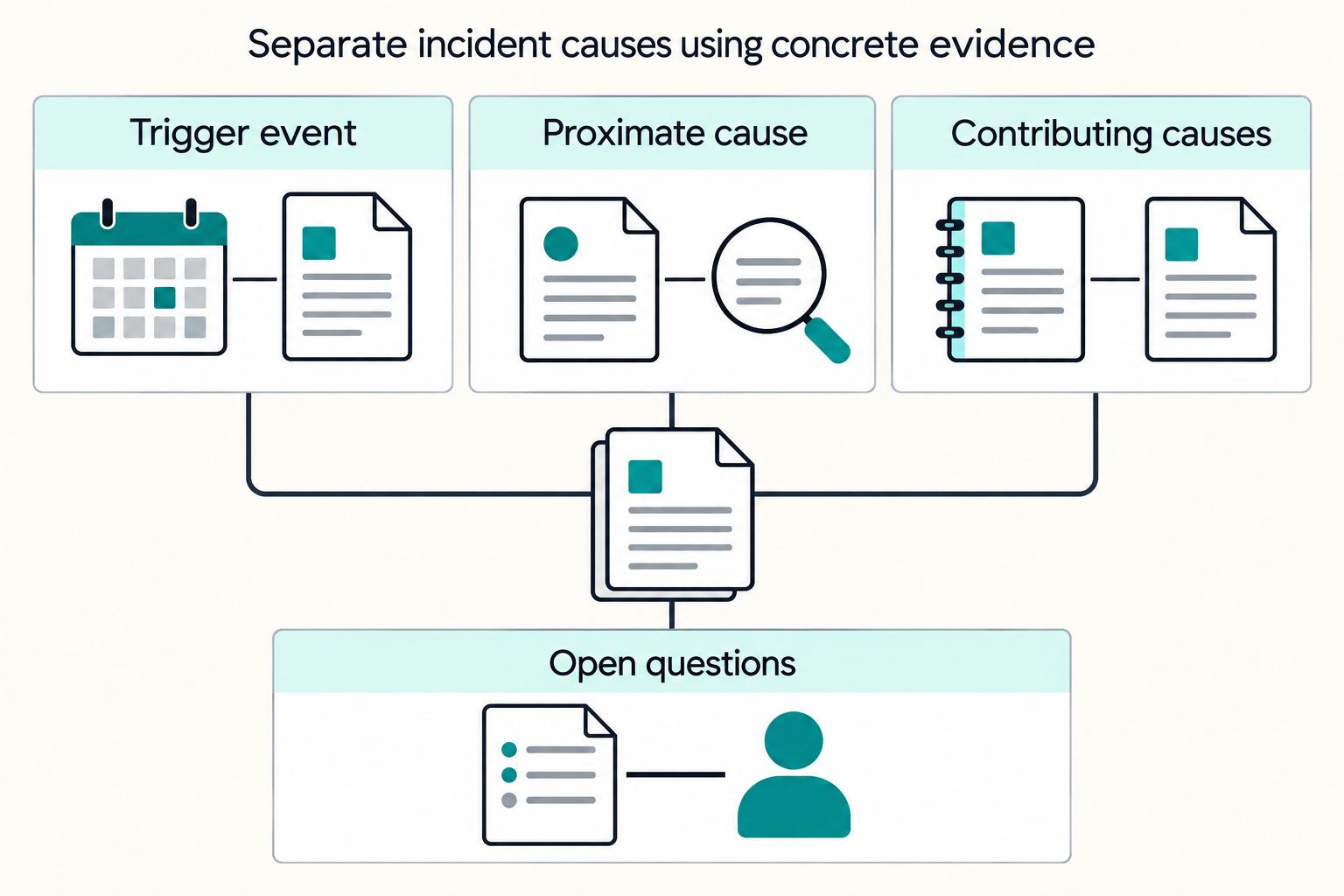
Separate trigger root cause and contributing causes#
If you do not separate what started the incident from what made it possible or worse, the fixes will blur together. This split helps turn an incident review into a prevention tool.
Set working labels for this incident#
Define the labels early and use them consistently in the document.
| Label | Definition | Role in impact |
|---|---|---|
| Trigger event | Event or condition that initiates or exposes the failure | May precede the first visible symptom; causality requires evidence |
| Primary (proximate) cause | Technical condition that directly produced the failure | Directly produced the failure |
| Contributing (systemic) causes | Process or control gaps that increased impact, delayed recovery, or made recurrence more likely | Increased impact, delayed recovery, or made recurrence more likely |
Classify by impact mechanism, not timeline alone#
For each candidate cause, classify it by its role in the impact path, not only by what showed up first. If it directly produced failures, treat it as primary or proximate. If it mostly increased severity or slowed recovery, treat it as contributing or systemic.
That distinction leads to better action design. Direct technical corrections reduce immediate repeat risk. Process and control fixes reduce recurrence across similar incidents. Each cause statement should map to at least one concrete artifact from the incident, such as failover records or the runbook used during response.
Keep categories honest with concrete evidence#
For example, a worker can time out after the provider accepts a payout. If the retry creates a fresh request without checking the first outcome, the proximate duplicate-payment mechanism is the unsafe retry. The timeout is a trigger; missing durable action identity and recovery tests are systemic contributors.
Mark uncertainty and assign ownership#
If evidence is incomplete, state that uncertainty plainly and name the missing artifact or check needed to confirm the cause.
Do not force certainty just to close the document. Weak cause statements can lead to shallow fixes, so track follow-up actions with clear ownership.
Map failure modes to payment controls#
Once the cause structure is clear, turn each candidate failure mode into a control decision you can test. If a row cannot name the customer symptom, measured impact, detection signal, and recovery action, the RCA is still descriptive instead of preventative.
Build a mode-to-control table before debating fixes#
Start from observable evidence: metrics, logs, timelines, events, and traces. Use the table to test incident-specific hypotheses, not to claim a universal ranking of outage causes.
| Failure mode | Customer symptom | Financial impact | Detection signal | Control to validate |
|---|---|---|---|---|
| Provider timeout after acceptance | Local failure message but a payout exists remotely | Unknown outcomes or duplicate payouts if retried unsafely | Request timeout joined to provider payout ID | Retrieve original outcome and deduplicate the intended action before resubmission |
| Webhook processing crash | Provider succeeds but local status remains pending | Delayed release or incorrect reconciliation | Durably received event has no completed effect | Replay stored events with separate delivery and economic-effect deduplication |
| Database contention | Queue age rises while API may remain healthy | Late payouts and missed internal cutoff | Lock waits, worker latency and oldest eligible item | Validate bounded concurrency, queue recovery and exactly one intended payment effect |
| Configuration or schema change | A cohort is rejected or routed incorrectly | Failed or misdirected payment instructions | Failure onset correlated with deployed version and payload differences | Validate rollback compatibility and the affected payload contract |
| Monitoring blind spot | Customer complaint precedes an alert | Longer impact window before containment | Complaint time versus first actionable alert | Add an outcome or queue-age signal tied to a response owner |
Check control tradeoffs before locking actions#
Match the control to the observed mechanism. A circuit breaker can reduce load on an unavailable provider, but it does not determine whether an earlier payout succeeded. Database failover can restore writes while still requiring reconciliation of requests accepted before the failure.
For a step-by-step walkthrough, see How to Build a Deterministic Ledger for a Payment Platform.
Decide which fixes are mandatory now vs scheduled later#
Separate current containment, restoration of the affected payment path and prevention work. Resolve active exposure before normal execution resumes where your policy requires it; track longer-term changes with owners and dates.
Mark mandatory-now items by recurrence risk#
Decide what must be fixed before resuming the affected flow based on active financial exposure, legal or provider requirements and the safety of the available workaround. Schedule remaining prevention work with explicit residual risk, ownership and a deadline. A possible recurrence alone does not make every improvement an immediate restart blocker.
Do not let scheduled items become vague. Open the post-mortem work item during or shortly after resolution, and track follow-ups in the same work-item system you use for completion and approval.
Choose deadlines according to exposure and effort. For an unsafe payout retry, a safe containment or retry guard can precede restart while a broader recovery redesign follows later. Record the interim control and who accepts the remaining risk.
Close only after approval-quality checks are complete#
Approve the post-mortem once the impact assessment, causal findings and action plan are reviewable. Keep open remediation tickets linked and report their status separately. A finished document does not mean every prevention change has shipped.
Declare operational resolution under your recovery criteria; track unresolved financial corrections and prevention work separately. State any residual exposure clearly rather than calling the entire incident either fully finished or perpetually active.
Turn findings into owned action items with closure tests#
This is where the review either becomes operational or stays a document. Each action should be clear enough that another reviewer can verify closure without guessing. A practical template can include owner, due date, closure test, rollback path, and where proof is stored.
Define closure tests tied to the failure mode#
Choose tests that reproduce the failed mechanism without issuing new live payments. For a timeout-after-acceptance failure, require provider lookup and one economic effect for the intended action. Preserve the inputs, expected outcome and actual result.
| Action area | Closure check | Evidence artifact |
|---|---|---|
| Unknown provider outcome | Timeout after remote acceptance, then lookup/retry produces one payout | Request fingerprint, lookup result and provider payout ID |
| Webhook recovery | Crash between durable receipt and application, then replay produces one economic effect | Stored event, effect identity and resulting journal or status record |
| Financial correction | Unique affected transactions tie to the provider and ledger by currency | Affected-ID extract, correction entries and remaining variance |
| Backlog recovery | Recovered workers drain eligible items without duplicates or bypassing holds | Queue-age results, eligibility checks and deduplication evidence |
Drill dependencies and document limits#
If third-party dependencies were part of the incident path, consider running drills at the integration boundary, not only happy-path checks. If a provider sandbox cannot reproduce the failure mode, record that limit as residual risk and keep a follow-up action open for stronger evidence.
Store test evidence, approvals and versioned changes with access controls appropriate to their contents. Use independent review or dual approval for material money-moving changes under your policy, and retain an append-only change trail where available.
Close a remediation when its stated evidence criterion is met. If a test environment cannot reproduce the failure, document the alternative evidence, limitations and authorized risk decision. Link the exact provider states and recovery procedures used by the implementation.
Use a one-page post-mortem template finance ops can audit#
Use this suggested one-page layout, with links to the fuller evidence pack. Label illustrative values and unresolved estimates; a short summary should never conceal incomplete financial reconciliation.
Keep the incident ID, affected flow and current status at the top. The remaining sections should let Finance verify the exposure and Engineering connect the failure to a tested change.
| Section | Record |
|---|---|
| Incident and status | ID, owner, affected flow, severity policy and operational/financial/follow-up statuses |
| Impact | Unique affected transaction IDs, counts and amounts by currency; known versus estimated exposure |
| Timeline | Observed impact, mitigation, technical recovery and reconciliation milestones with evidence links |
| Cause | Trigger, direct mechanism, systemic contributors and confidence or open questions |
| Recovery and correction | Workaround, remaining unknown outcomes, ledger corrections and customer follow-up |
| Actions | Change, owner, due date, test or alternative closure evidence, residual risk and reviewer |
Report measurable claims with their denominator and scope: affected unique payouts out of submitted payouts, amounts by currency, oldest unresolved outcome and reconciliation difference. Define each metric so Finance and Engineering count the same population.
The one-pager should route readers to deeper operating decisions, not replace them. If helpful, link to relevant RCA and response docs. You can include Payout Failure Root Cause Analysis: Separating Bank User and Processor Errors at Scale so reviewers can trace evidence, ownership, and follow-through without guesswork.
Related reading: How to Conduct a Client Post-Mortem and Gather Feedback.
Final checklist before you close the incident review#
Approve the review when the documented impact, causal findings, open questions and owned action plan are clear. Track technical restoration, financial corrections and prevention completion as separate statuses so later work remains visible.
| Checklist item | What to confirm | Evidence or red flag |
|---|---|---|
| Recovery timeline | Full event order with decision timestamps and evidence links | Red flag: gaps with no evidence, or a jump from symptom straight to recovery |
| Root cause analysis (RCA) | Proximate cause is separated from systemic cause | If evidence is incomplete, mark conclusions as provisional and assign validation ownership |
| Incident impact | Customer, operational, and business impact are stated | Red flag: incident metrics are listed, but downstream operational effects or manual correction work are never addressed |
| Action items | Each has an owner, due date and agreed closure evidence | Open actions remain linked after document approval |
| Control tests | Completed actions have evidence; uncompleted tests have owners and deadlines | Do not label a procedure description as a passed test |
| Blameless summary | Summary focuses on conditions, decisions, and system and process learning | Keep named ownership and tracked follow-up until prevention work is complete |
For a broader finance-ops framing, see How to Build a Finance Tech Stack for a Payment Platform: Accounts Payable, Billing, Treasury, and Reporting.
If recurring control gaps involve payout workflows, review payout operations for related process context.
Frequently Asked Questions
What is a payment platform post-mortem, and how is it different from a generic engineering retrospective?
It records the incident’s impact, recovery, causal findings and follow-up actions, with extra attention to money movement. Check remote successes hidden by local timeouts, duplicate effects, delayed payouts and financial corrections as well as technical availability.
What are the most common root causes of payment outages and processing errors?
Typical mechanisms worth investigating include provider timeouts, retry defects, stale state, schema or configuration changes, database contention and missing observability. This is a diagnostic list, not a frequency ranking. Tie the explanation to the transactions and evidence from your incident.
How do we separate trigger, root cause, and contributing factors without over-arguing labels?
A trigger initiates or exposes the failure; a proximate cause explains its direct mechanism; systemic contributors explain why the mechanism was possible or recovery was slow. The first visible symptom is not automatically the trigger. Validate each causal link and leave uncertain findings explicitly provisional.
What should a remediation plan include to prevent repeat incidents in payouts and reconciliation?
Name the affected failure mechanism, intended change, owner, due date and closure test. Include containment and financial corrections as separate actions from prevention work. Approve the review when that plan is complete, then keep the linked actions open until their evidence criteria are met.
Which controls matter most first: Timeout and retry rules, Circuit breaker, or Database failover?
Prioritize the control that addresses the observed mechanism and current exposure. For an unknown payout outcome, lookup and durable deduplication matter before another submission. A circuit breaker controls further requests; failover restores infrastructure. Neither proves the original payment failed.
What is still unknown in the first day of an incident, and what needs deeper validation later?
In the first day, you may know the trigger, the initial timeline, and visible customer impact while still lacking full provider-chain detail, systemic cause confirmation, and complete financial impact. Early milestones can be clear even when causal certainty is not. Treat unresolved items as tracked unknowns and validate them through follow-up analysis.
Researched and edited by the Gruv editorial team. Gruv builds cross-border billing, payouts, and finance-operations software for global businesses.
Sources
Includes 2 external sources outside the trusted-domain allowlist.
Educational content only. Not legal, tax, or financial advice.
Related Posts

The Freelance Payment Penalty: A Modeled Audit of Platform Fees, FX Spreads, and Payout Delays
The money rarely disappears through a single, easy-to-spot fee. The real loss is stacked. A marketplace takes its commission, a processor adds a charge for international cards, a bank or payment company converts the currency at a spread, a platform holds the funds before release, and a wire sheds a little to intermediaries on the way in. Each layer looks defensible on its own, but the worker feels the combined result as a smaller deposit and a later payday.

How to Respond to a Subpoena for Business Records
Move fast, but do not produce records on instinct. If you need to **respond to a subpoena for business records**, your immediate job is to control deadlines, preserve records, and make any later production defensible.
A US Expat's Guide to Investing in UCITS ETFs to Avoid PFIC Issues
The real problem is a two-system conflict. U.S. tax treatment can punish the wrong fund choice, while local product-access constraints can block the funds you want to buy in the first place. For **us expat ucits etfs**, the practical question is not "Which product is best?" It is "What can I access, report, and keep doing every year without guessing?" Use this four-part filter before any trade: