
Quick Answer
Model the payout’s business facts and owners before selecting a broker. Commit local state and publication intent together, protect one external operation with durable identity, verify provider outcomes and reconcile monetary effects. Rebuild projections without execution capabilities; repeated or historical events must not initiate another payment.
Model the payout story before choosing the transport#
Payment event modeling describes the commands, recorded facts and read views that explain a payment over time. For a payout, it should show who approved the obligation, what was submitted, which provider outcome was verified, how money was recorded and what an operator sees when something goes wrong. A message broker can distribute those facts; it cannot supply their business meaning.
Begin with one realistic payout and its failure cases. The design should remain understandable when events repeat, arrive late or disagree with your current view. This article develops a worked payout story, a concrete contract and publication/replay controls. The examples are illustrative architecture choices, not an event catalog or delivery guarantee promised by Gruv.
Separate commands, events and projections#
Event Modeling’s original explanation connects intentions to change a system, recorded events and views along a timeline. Apply that distinction to payments: SubmitPayout is an instruction that can be rejected; PayoutSubmissionRecorded states what was recorded; a contractor’s payment-status screen is a view derived from appropriate evidence. An external callback begins as an input to verify and interpret, rather than automatically becoming a final business fact.
| Element | Illustrative payout example | Question to settle |
|---|---|---|
| Command | Release an approved payout | Who may request it, and which preconditions must hold? |
| Recorded event | Provider acceptance was verified | What exactly is known, from which evidence? |
| Projection | Contractor sees processing | Which facts derive the view, and how stale may it be? |
| External action | Submit the transfer to the provider | Who owns execution and recovery after an unknown result? |
Use precise names and definitions. “Payout completed” may mean a provider created a transfer, a network accepted it or the recipient received usable funds. Pick the meaning you can verify and retain the underlying evidence. Approval is not settlement, and a state label should not imply a financial outcome that the system has not established.
Event-driven architecture means components communicate through events. Event sourcing means the chosen domain’s retained event history is its authoritative state record. Webhooks are a delivery mechanism and can participate in either design. These are overlapping decisions, not three mutually exclusive maturity levels or a ranking where webhook history must be shallow.
Choose history requirements deliberately#
A relational payment record, controlled journal, audit history and outbox can support reliable event-driven integrations without making every domain event-sourced. Evaluate event sourcing when rebuilding domain state and explaining its changes justify the storage, versioning and operational work. Replay or an audit requirement alone does not prove that replacing an existing payment store is necessary.
Microsoft’s event-sourcing pattern describes retained events, projections and the tradeoffs of schema evolution, replay and personal-data handling. A distribution broker is not automatically an event store, and a snapshot is an optimization rather than replacement history. Apply the pattern selectively where its responsibilities fit.
| Decision | Useful when | Work to account for |
|---|---|---|
| Current state plus controlled history and outbox | Existing records already support the required payment controls | Publication reliability, history retention and reconciliation |
| Event sourcing for a selected domain | State reconstruction and change history are central to that domain | Event evolution, rebuilds, concurrency, corrections and privacy |
| Broker distribution | Several consumers need explicit facts independently | Delivery/ordering guarantees, backlog, consumer recovery and access |
Write down which store owns payment state, which journal owns financial postings and which evidence establishes external delivery. If those disagree, investigation is required. Calling an internal store the source of truth does not make an incorrect posting or missing bank confirmation correct.
Worked example: one obligation through acceptance, delivery and return#
Assume a hypothetical platform owes a contractor $100 and has funded that obligation. Approval reserves the intended payment under the platform’s policy; submitting it creates one provider operation. An acceptance response confirms the provider accepted that operation, but does not yet prove recipient receipt. A subsequent verified delivery fact allows the appropriate settlement posting and contractor status under the agreed recognition policy.
| Recorded fact | Financial interpretation | Consumer response |
|---|---|---|
| PayoutApproved | $100 obligation is approved; no external receipt yet | Release owner can evaluate execution prerequisites |
| PayoutSubmissionRecorded | One provider operation is linked; outcome may be pending | Status view shows processing |
| PayoutDeliveryVerified | The required delivery evidence is available | Post the settlement effect once and update the view |
| PayoutReturnVerified | The same transfer later returns $100 | Post the return once; resolve whether the payable reopens |
Suppose PayoutDeliveryVerified is delivered three times. It remains one delivery fact and one $100 settlement effect. The history can record transport attempts without creating three business settlements. A later PayoutReturnVerified is a different occurrence, not a duplicate to discard because it shares the payout ID. If policy reopens the obligation after verified return, record that decision separately and require authorization before any replacement transfer.
For an illustrative funded contractor subledger, the contractor starts with $100 unpaid and the payout account with $100 cash. Verified delivery reduces the payable and cash by $100, leaving each at zero. A verified full return restores the $100 cash and, under this example’s reopening policy, the $100 payable. No fees or other movements are assumed. Repeated delivery or return notifications must not change these amounts again.
Define journal entries under the actual accounting model; operational approval and every callback need not each create a monetary posting. A transfer fee, FX difference or partial return needs its own amount and treatment. Do not force an all-purpose payout-status event to silently cover all of them.
Specify an event envelope and its business meaning#
A shared envelope reduces consumer ambiguity, while each event type still needs its own documented payload. CloudEvents 1.0.2 defines core context including id, source, specversion and type. It provides interoperability conventions, not payment authorization, ordering, exactly-once execution or evidence of settlement. Distinguish the envelope specification version from your payload schema version.
| Field or contract item | Illustrative purpose | Boundary to preserve |
|---|---|---|
| Event ID plus producer/source | Identify the recorded fact and repeat deliveries | Do not treat a transport timestamp as unique identity |
| Type and payload schema version | Interpret PayoutDeliveryVerified correctly | Preserve old payload meaning through version changes |
| Tenant/legal entity and payout reference | Select the authorized business context | Validate scope; never trust a supplied tenant ID alone |
| Operation/provider reference | Trace the financial action and external evidence | Keep logical operation identity across retries |
| Occurrence and recording times | Explain when it happened and when observed | Neither timestamp alone guarantees total order |
| Sequence/revision where authoritative | Track ordered changes for one owned aggregate | Specify its producer and scope; do not invent provider ordering |
| Amount, currency and monetary unit | Explain the affected financial value | Use exact decimal/minor-unit conventions for that currency |
| Evidence/decision references | Find the checked outcome, approver or hold decision | Control access and avoid embedding unnecessary sensitive data |
Define the trigger, producer, required fields, invariant, allowed successors and consumers for each type. Document whether the event states a local decision, a provider observation or a verified financial outcome. Include correction and late-return behavior. Identifiers and schemas should allow an operator to trace the example without searching unrelated logs or relying on event-name intuition.
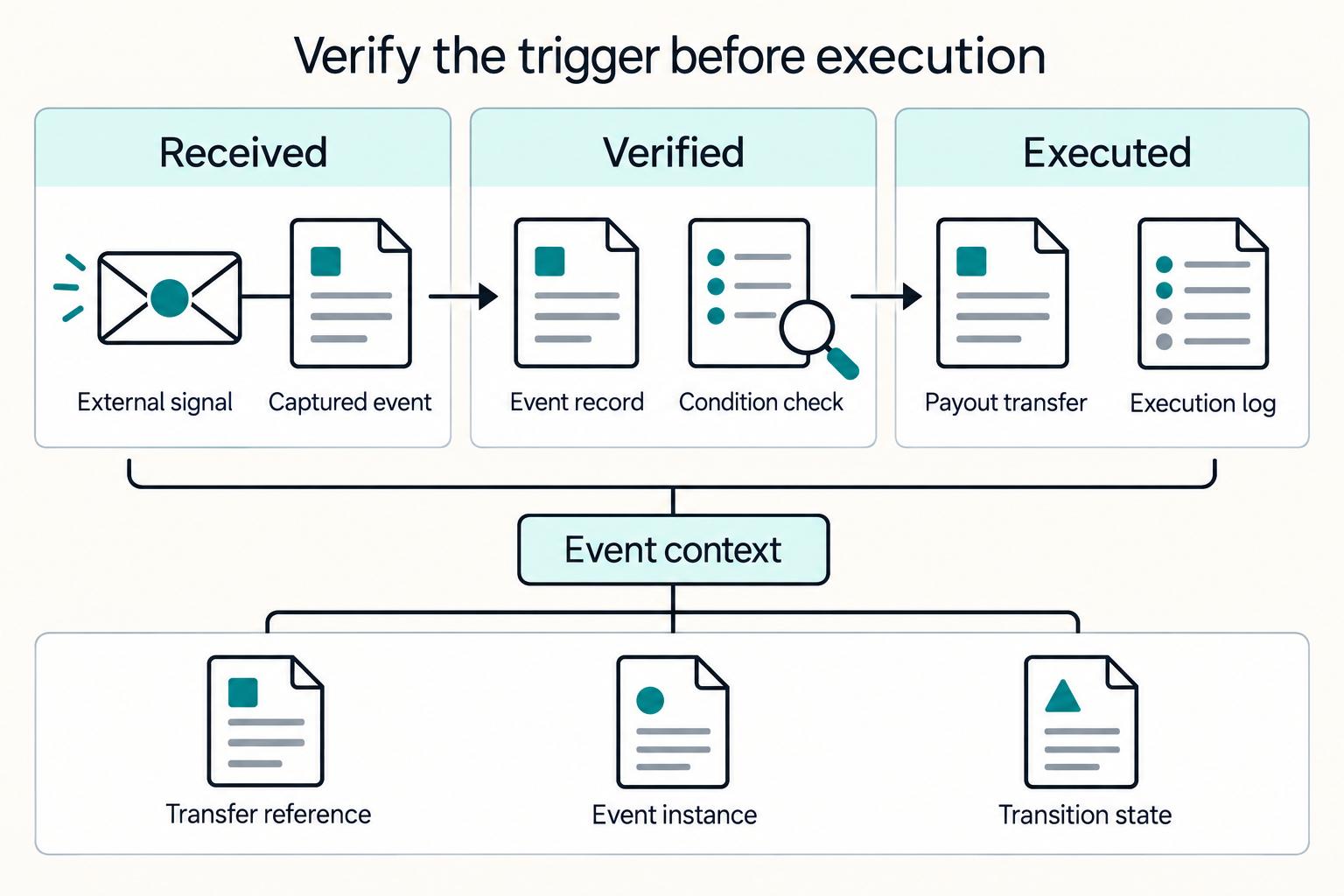
The diagram shows verification before an authorized execution action and retains the transfer, event and transition context. Verification can authorize submission; it does not prove that submission later delivered funds. The model needs that subsequent provider outcome and reconciliation boundary as well. Incoming notifications about an existing transfer should not become instructions to initiate another payout.
Commit the local decision and publication intent together#
A database update followed by a broker publish has a failure gap: the update can commit while the process dies before publishing. Publishing first has the opposite gap if the database transaction rolls back. AWS’s transactional-outbox guidance describes recording the update and outbox entry in the same local transaction, then relaying committed entries separately. The relay can publish duplicates, so consumers still need safe repeat processing.
In the worked example, record the authorized local payout decision and its pending publication atomically within the owning store. A relay retries unfinished publication and tracks progress. Keep the event ID stable across those retries. Preserve required per-payout order through the actual database, relay and broker arrangement; an outbox table alone does not guarantee global ordering or remove every failure mode.
This local transaction does not include an external bank or provider transfer. An execution worker needs a durable operation record, release authority and supported provider recovery. If the provider succeeds but the worker crashes before saving its response, the next attempt must investigate or safely recover the existing operation, not assume the local transaction rolled back the external payment.
When a consumer changes its own database state, make its processed-event marker and relevant local mutation atomic where the store permits. If it then needs to publish another fact, use a corresponding reliable publication boundary. External emails, ledger services and bank actions remain separate effects requiring their own controls; marking an event processed before an unprotected effect can lose the effect, while marking it afterward can duplicate it.
Protect the financial effect beyond transport deduplication#
Delivery identity and business-operation identity solve different problems. Dedupe a repeat delivery by the appropriate source/event key; protect a settlement posting or payout submission by the durable logical effect identity and relevant revision. Two different events can describe the same completed operation, while one payout can also have several legitimate later changes. Avoid permanently discarding everything with the same payout ID or object/type pair.
Stripe’s webhook guide warns that events can repeat and arrive out of order. Verify signatures, retain event IDs and retrieve missing/current objects when needed. These provider facts support robust input handling; they do not grant a consumer permission to apply whatever transition arrived last. Your payout-state model must define which evidence supports each change.
Stripe’s idempotent-request documentation describes reusable request keys with provider-specific parameters and retention. It permits pruning after at least twenty-four hours. A long-lived obligation or reconciliation case therefore needs a durable internal operation record as well; a key that once worked is not a permanent guarantee that a later fresh request cannot pay again.
A duplicate-detection window should cover the relevant transport recovery horizon, but durable protection of a financial operation may need to outlive that cache. Scope identities to the correct tenant/legal entity and operation. Document legitimate new attempts, partial refunds and replacements instead of creating a fresh key solely because a worker timed out.
Handle ordering and concurrency at the owned boundary#
Arrival order is not business order, and equal or skewed timestamps are not a reliable sequence. If your service owns a per-payout revision, use its defined concurrency rule to reject conflicting updates or reload and reevaluate. Do not blindly skip every lower-looking external timestamp: a delayed return may be a valid new fact with real financial consequences.
For facts from different producers, define which source establishes each outcome and how conflicts become exceptions. A provider delivery notification arriving before the submission notification can be linked by the original operation reference and verified appropriately. A cached processing view must not regress a verified delivery merely because it was updated later.
Use deadlines, retry budgets and explicit operator ownership for unresolved results. A dead-letter queue preserves failed processing work; it does not authorize a new payment or prove that money failed to move. Monitor failed publications, consumer lag, unknown operations and unreconciled monetary effects together.
Rebuild projections without repeating external actions#
Treat historical replay as a controlled mode. Rebuild a status or accounting projection from retained, interpretable facts in an isolated target and compare it with the expected record. Disable external execution and notification capabilities in that path, rather than trusting a replay flag to be honored by every consumer. A new consumer with an empty dedupe cache can otherwise turn old approvals into fresh transfers.
Retain the original payload and schema identity where required, and use reviewed transformations to interpret old versions. If a bad fact was recorded, a correction must preserve what happened and identify the approved change. A compensating accounting entry can correct a journal; it cannot recall a bank transfer by itself. Historical data quality and external recovery remain separate responsibilities.
Record rebuild checkpoints, input coverage and versions so the result can be explained. Test repeated and missing events, a late return, conflicting revisions and a crash at each publication/execution boundary. A deterministic replay checks one property; it does not prove the retained history matches provider or bank evidence.
Keep control decisions and sensitive evidence usable#
If a compliance, tax-document or fraud decision holds a payout, record the decision’s scope, effective time, responsible authority, policy/version reference and permitted next action. A current state can still be maintained for efficient gating, with controlled decision history behind it. Not every rule change requires event sourcing or embedding an identity document into an immutable stream.
Model the actual platform and provider requirements. A recipient’s personal foreign-earned-income tax election is not a universal technical gate for paying them. Use relevant approved document and eligibility states without inventing jurisdiction-independent rules. Later revocation or expiry must affect future release checks according to the policy, rather than leaving an old approval permanently sufficient.
Keep personal evidence in appropriately controlled storage and reference it from the event where practical. Define retention, deletion, export and access by the actual requirements; “append-only” is not permission to keep all personal data forever. Carry tenant/legal-entity context through producer, broker, consumer, projection and operator access, and validate it at each authority boundary.
Migrate with one execution owner#
Inventory current callbacks, database changes, CDC feeds, ETL jobs and downstream reports. CDC tells you that stored data changed; it does not automatically tell you why a business payment was authorized. Map the existing meanings and establish a consistent baseline before replacing a transport or consumer.
Compare the new event-derived view against the existing flow without executing both financial paths. Side-effect-free processing, fixture replay and read-only comparison can expose mismatches in amounts, references, timing and late outcomes. A controlled live cohort can then use one authoritative submission path, while old and new read models are compared on the same operations.
Define ownership for every difference and retain recovery access for old operations. Retire an integration only after its required consumers and outstanding cases have a supported route. Rollback changes future routing; it does not undo delivered funds or erase data already written. Use readiness evidence instead of a universal ninety-day schedule or a promise of downtime-free migration.
A useful launch record shows one execution or posting per authorized logical operation, with partial payments, returns and replacements linked and reconciled to the obligation without duplicate discharge. It also shows publication recovery after a crash, safe repeat delivery, late-return handling, a side-effect-free rebuild and provider/bank reconciliation. Review exceptions and aging with engineering and finance before expanding. The API versioning guide complements this work when the consumer contract changes.
Frequently Asked Questions
What is payment event modeling architecture?
It connects payout commands, recorded business facts and read views into an explainable timeline. Define who owns each decision and outcome, what evidence supports it, and how consumers handle duplicates, late changes and failures. A broker distributes events but does not define their payment meaning.
When should we use Event Sourcing for payouts?
Evaluate it for a selected domain when retained change history and state reconstruction justify the operational cost. Reliable event-driven integration can also use current-state records, controlled history and an outbox. Replay or audit needs alone do not require replacing every store with an event-sourced model.
What minimum events should every payout system have?
There is no universal catalog. Cover the facts needed to explain authorization, one external submission, verified outcome, applicable holds, monetary postings and later returns or corrections. Define triggers and evidence for each. The example separates approval, submission, delivery and return without assuming they all create journal entries.
What are the highest-risk failure modes?
Lost publication after a committed update, duplicate financial effects after retries, uncertain external results, misleading status mappings and replay that sends fresh payments are serious risks. Address local publication atomically, preserve durable operation identity, verify provider outcomes and isolate rebuilds from external execution.
How do we migrate from CDC and ETL without breaking ops?
Map the existing authoritative fields, consumers and business meanings first. Compare new projections with current records using side-effect-free processing and representative late/duplicate cases. Move controlled consumers or cohorts with one execution owner, reconcile the same operations and preserve recovery access before retiring old integrations.
How do compliance and tax requirements affect event design?
Record applicable decision scope, time, policy/evidence reference, responsible authority and the permitted next action. Keep current gates and controlled decision history consistent. Requirements depend on the actual flow and jurisdiction; personal tax elections are not universal payout gates, and sensitive documents need appropriate storage, access and retention.
Researched and edited by the Gruv editorial team. Gruv builds cross-border billing, payouts, and finance-operations software for global businesses.
Sources
Includes 4 external sources outside the trusted-domain allowlist.
- docs.stripe.com/webhookstrusted
- docs.stripe.com/api/idempotent_requeststrusted
- docs.aws.amazon.com/prescriptive-guidance/latest/cloud-design-pa...external
- eventmodeling.org/posts/what-is-event-modelingexternal
- github.com/cloudevents/spec/blob/v1.0.2/cloudevents/spe...external
- learn.microsoft.com/en-us/azure/architecture/patterns/event-sour...external
Educational content only. Not legal, tax, or financial advice.
Related Posts

The Freelance Payment Penalty: A Modeled Audit of Platform Fees, FX Spreads, and Payout Delays
The money rarely disappears through a single, easy-to-spot fee. The real loss is stacked. A marketplace takes its commission, a processor adds a charge for international cards, a bank or payment company converts the currency at a spread, a platform holds the funds before release, and a wire sheds a little to intermediaries on the way in. Each layer looks defensible on its own, but the worker feels the combined result as a smaller deposit and a later payday.

How to Respond to a Subpoena for Business Records
Move fast, but do not produce records on instinct. If you need to **respond to a subpoena for business records**, your immediate job is to control deadlines, preserve records, and make any later production defensible.

A US Expat's Guide to Investing in UCITS ETFs to Avoid PFIC Issues
The real problem is a two-system conflict. U.S. tax treatment can punish the wrong fund choice, while local product-access constraints can block the funds you want to buy in the first place. For **us expat ucits etfs**, the practical question is not "Which product is best?" It is "What can I access, report, and keep doing every year without guessing?" Use this four-part filter before any trade: