
Quick Answer
Reliable payment webhook flows need fast authenticated ingestion, queue-backed processing, strict idempotency, replay-safe state transitions, and operator-grade reconciliation evidence.
Why reliable payment webhooks are a platform risk decision not just an integration task#
Reliable webhook handling is a platform risk decision, not just an endpoint integration task. You are not only accepting an HTTP POST and parsing JSON. You are deciding how your system behaves when delivery is imperfect, including replayed events, and whether that behavior still holds up under audit.
That matters in payment infrastructure, where the same stack often supports authorization, settlement, reconciliation, and reporting, often in real time. If the event layer is weak, the impact does not stay inside engineering. It can show up in operations, finance workflows, and audit readiness.
For CTOs and engineering leads, the tradeoff is familiar: ship fast now, or avoid expensive platform debt later. The same pattern shows up across payment architecture. Abstraction layers can speed up launch but limit customization. Direct control gives you flexibility but raises build and maintenance cost. If webhook processing affects core payment workflows, treat it as shared infrastructure early. Because coverage is provider-specific, confirm the exact webhook families your provider exposes before you design downstream consumers, and validate them against provider docs such as Adyen's webhook types reference.
What to prepare before you write a single webhook handler#
Freeze the implementation inputs before you write code. That planning pass cuts security gaps, duplicate-charge risk, and launch-time disruption.
Step 1 Inventory the producers and consumers you actually depend on#
Start by mapping who sends events and who acts on them: your payment provider, internal API producers, and downstream consumers such as finance tooling or ERP exports.
Keep the inventory concrete. A webhook is just an HTTP request sent from one system to another, so list both ends for each dependency and note which event types you actually use, such as charge success, failure, or refund, versus which ones you ignore. Record an owner for each producer and consumer before implementation starts.
Separate inbound event authentication from outbound API credentials. Verify the provider's webhook signing scheme and expected account/environment; an API key or OAuth token used to create a payment does not authenticate an incoming webhook. Keep production and test secrets separate and define rotation and replay-tolerance handling.
Step 2 Define your source of truth objects and IDs#
Do not start parsing payloads until identifier roles are documented. As a starting point, teams often track a provider event ID, an internal payment ID, and an Idempotency Key.
Use each identifier for a single purpose:
- Provider/account/environment plus event ID identifies a received event.
- Internal payment and attempt IDs identify the business object and its execution history.
- Consumer/effect identity guards a specific financial action; an outbound provider key protects only its documented API operation and retention window.
Set a traceability checkpoint now. For any test event, you should be able to identify the received provider event, the mapped internal payment record, and whether the system treated it as new or replayed.
Step 3 Write an evidence pack before coding#
Before anyone writes a handler, build a small evidence pack that the team can review. It should include:
- Expected
JSONpayloads, from docs or sandbox captures - Signature headers used by the sender
- Retry behavior assumptions
- Named owner per event type and downstream consumer
Label assumptions as assumptions. Do not fill signature or retry gaps with guesswork. Webhook behavior is hard to validate across integrations at scale, and weak assumptions here can become production incidents later.
Step 4 Set verification checkpoints before implementation starts#
Define pass or fail checks before implementation begins:
- Test event is accepted
- Invalid signature is rejected
- Duplicate delivery is a no-op
Then verify the accounting mapping for any flow where webhook events trigger accounting updates, so payment and accounting records stay aligned.
Add one more checkpoint at the edge: make sure the request path stays lightweight and heavier work is decoupled. Synchronous processing in the request path can exhaust shared resources during bursts or retries.
- You can set an internal goal that
100%of duplicate test deliveries stay single-write in your business ledger. - Your team should trace
100%of accepted test events from receipt to the internal payment reference before launch. - You should know which consumer can drop to
0%availability without blocking ingress because your edge still acknowledges after durable handoff.
Decide when webhook-only is enough and when to introduce an event bus#
Webhook-only can be enough when the flow is narrow and tightly controlled. Consider introducing a queue and, later, an event bus when the same accepted event needs to drive multiple independent consumers or when ingestion and processing should fail separately.
Step 1 Keep webhook-only for narrow, low-branch flows#
Webhook-only can be enough when one event updates one core payment record and triggers only a small number of follow-on actions that your team owns end to end.
Even a narrow flow needs durable acceptance: verify origin, check basic parseability and required envelope fields, durably store or queue the receipt, then acknowledge according to the sender's protocol. Perform business work afterward. If storage or queue handoff fails, do not acknowledge success.
Use a simple checkpoint: one signed test payload maps to one internal payment record and one expected business effect.
Step 2 Isolate ingestion first when failures must be contained#
If operational isolation matters, put a queue-first handoff in place early. Third-party retry behavior can be inconsistent, and one failing endpoint can stall a payment pipeline.
Your ingestion path should accept valid events quickly after security checks and hand off processing, rather than tying acceptance to downstream service health.
Validate this directly. During a downstream outage, valid signed events should still be accepted and queued, invalid signatures should still be rejected, and request handling should stay lightweight under retry pressure.
Step 3 Add an event bus when fan-out is no longer trivial#
Once the same provider event needs to reach multiple consumers with different owners or cadences, the webhook layer can become the wrong place to manage all of that branching. That is usually a signal to evaluate an event bus. In payment infrastructure, the AWS EventBridge payment-architecture example is a useful reference point for that handoff.
The practical signal is coupling. If every new consumer requires edits in the webhook handler, the handler may be doing too much.
| Pattern | Use it when | Main gain | Main tradeoff |
|---|---|---|---|
| Webhook-only | One narrow action and few consumers | Fastest implementation path | Handler becomes fragile as branches grow |
| Webhook plus queue | Ingestion must stay isolated but one primary processor still owns the business effect | Better failure isolation at the edge | Processing logic can still concentrate in one consumer |
| Webhook plus queue plus event bus | Multiple consumers need the same accepted event on different cadences | Cleaner fan-out and consumer independence | More components to run, trace, and test |
Step 4 Document the decision and define a revisit trigger#
Write the decision into your evidence pack: producers, consumers, ownership, and expected behavior when one consumer is degraded.
Set a revisit trigger up front. A useful one is when the same provider JSON event starts requiring independently retriable processing paths, or when different teams need that event on different timelines. At that point, webhook-only may stop being the simpler operational choice.
Before you lock architecture, review implementation patterns and integration boundaries in the Gruv docs.
Define the event contract and idempotency boundaries before implementation#
Define the contract and the idempotency boundaries before you wire processors together. Financial correctness is an end-to-end design problem, not something you get from a delivery setting.
Step 1 Define a small, stable event contract#
Define a small normalized envelope: provider, account or tenant, test/live environment, event ID and type, payload/API version, provider object ID, occurrence and receipt times, and a reference to the verified source payload. Resolve the internal payment and attempt through trusted mappings. For money-impacting effects, validate amount, currency, object ownership and the relevant state; not every event needs all those fields inline.
The contract should be strict enough to avoid guesswork and loose enough to evolve safely. If two consumers can read the same payload and reach different conclusions, the contract is still underspecified.
Step 2 Set idempotency key scope by operation, not by endpoint#
Distinguish event delivery from business effects. Scope event deduplication by provider, account and environment; scope each consumer effect by the underlying obligation or object and action. Two different event IDs can concern the same successful payment. Keep a durable unique guard for that financial effect, even after a provider API key expires or a new endpoint is used.
Document these boundaries in the contract, not only in handler code. Then replay duplicate deliveries and confirm the second pass is recorded operationally but does not create a second business effect.
Step 3 Add transition guards for out-of-order delivery#
Guard transitions using provider semantics and current object evidence, not a universal stronger-state ranking or arrival timestamp. A delayed pending event must not regress a confirmed success, but a later return, refund or dispute can legitimately change its financial consequences. Record those as linked lifecycle events or adjustments rather than discarding them because paid looked terminal.
Define the allowed progression paths for each object you update. Idempotent handling without transition discipline can still leave you with the wrong financial state.
Step 4 Publish producer and consumer versioning rules#
Version your normalized envelope and the provider payload mapping separately. The Standard Webhooks specification offers signing and message conventions where a sender implements it; it does not replace the provider's event schema or API version policy. Test old payloads and retain the version used to interpret each receipt.
Test contract changes with representative old and new events before release so payload drift does not silently break processors. If the same contract also feeds finance or ERP consumers, align those expectations early, especially if you are also shaping ERP integration architecture.
Related: Contractor Onboarding Best Practices: How to Reduce Drop-Off and Accelerate Time-to-First-Payment.
Build ingestion for fast acknowledgment and deterministic security checks#
Once the contract and idempotency boundaries are set, keep the HTTP POST edge strict and minimal. A common pattern is to authenticate, run a shallow schema check, durably record or hand off, then acknowledge. Keep money-moving side effects out of ingestion.
Step 1 Verify signature before trusting payload#
Treat inbound events from a PSP or PSSP as untrusted until provider-defined signature verification succeeds. Validate using the provider's required request components (often the raw body plus specific headers), not a transformed payload.
If verification fails, handle the event as unauthenticated according to provider guidance and your risk policy (commonly reject and investigate) rather than processing it as trusted.
Use the provider's exact verification inputs. Stripe requires its raw request body and signature header; other webhook families can use different signing fields. Verify origin and bind the provider object to the expected account, environment and internal record before any business effect. Do not log signing secrets.
Step 2 Run schema sanity checks and persist receipt data#
After authentication, run a narrow schema sanity check to confirm the event is parseable and mappable to your contract. Keep that check shallow so the edge does not turn into a full business validator.
Persist receipt data at ingestion or durable handoff so you have evidence of what arrived and how ingress handled it. That matters when you are debugging load-related failures, including dropped or hard-to-trace deliveries.
Step 3 Acknowledge quickly only after durable handoff#
Fast acknowledgment is useful, but tie it to durable handoff after basic authentication and sanity checks in your chosen flow. Do not tie acknowledgment to downstream business processing.
Queue-backed ingestion is a common pattern because it decouples ingress from processing, buffers spikes, and lets consumers scale independently. Keep a hard boundary here: avoid money-moving side effects in the request path before durable handoff.
Step 4 Use Dead-Letter Queue (DLQ) routing with replay context#
Send accepted events to the main queue, and send retry-exhausted failures to a Dead-Letter Queue (DLQ). Treat the DLQ as an operator recovery lane, not a message graveyard.
Capture replay context operators need for recovery, with fields defined by your runbook (for example provider/event IDs, timing, attempt history, and error details).
Keep accepted receipts recoverable when a consumer is unhealthy. Choose retry and retention settings from the actual queue and provider limits; a managed gateway does not remove your responsibility for financial-effect guards and reconciliation.
Process events safely with dedupe ordering retry and replay controls#
Once ingestion is queue-backed, consumer behavior becomes the main reliability control. Deduplicate first, handle uncertain ordering conservatively, and retry through the queue, not in the Webhook request path.
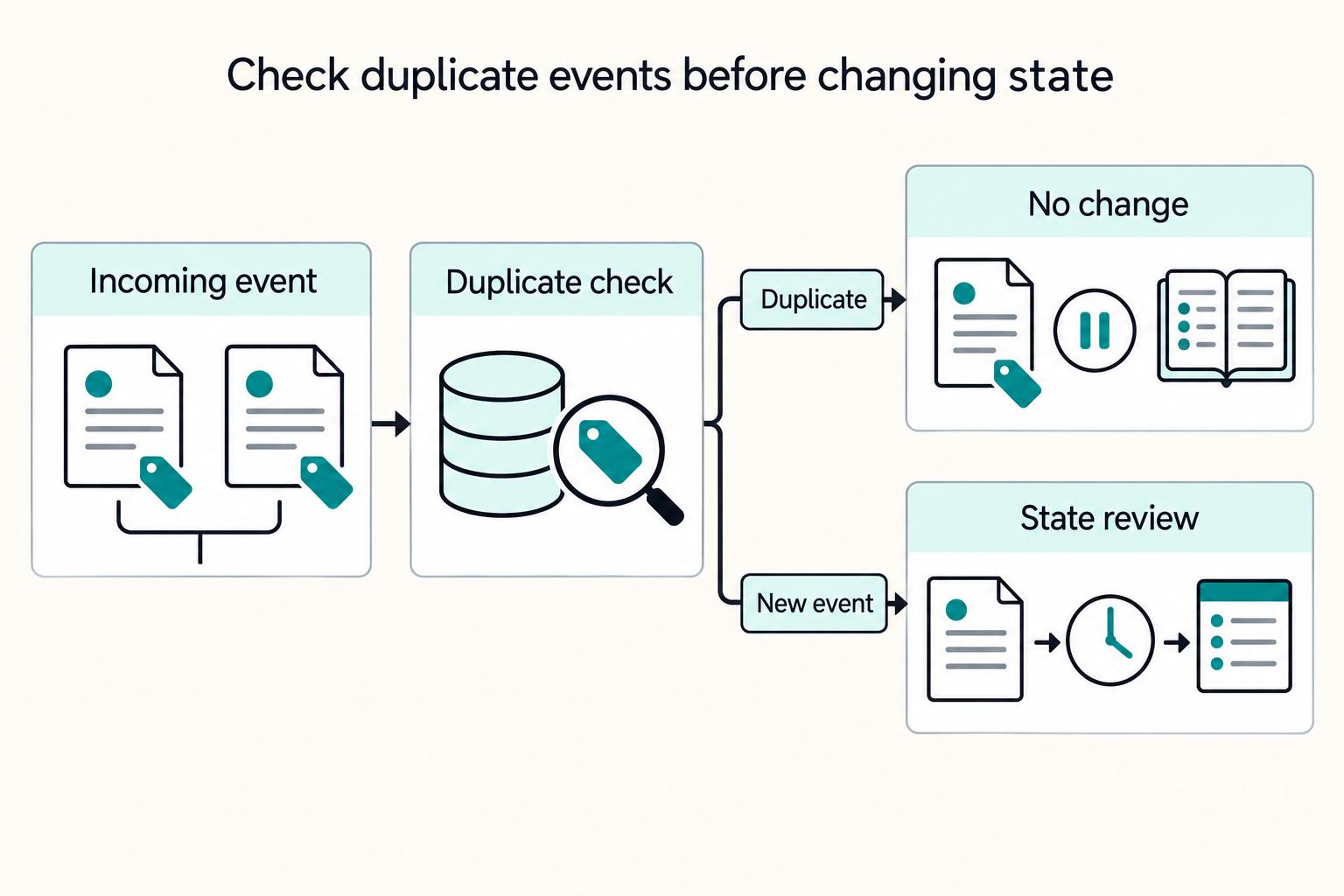
Step 1 Deduplicate before any state change#
An existing receipt is not necessarily a completed effect. Persist Received, Processing, Applied or Failed per consumer, with retry history. A duplicate delivery can acknowledge the existing durable receipt, but the worker must resume unfinished processing instead of skipping it just because the event ID exists. The diagram's no-change path applies to an already-applied guarded effect.
Use the documented provider event ID with account and environment scope. Header names differ by sender; do not invent a generic event_id field. Separate that delivery key from the financial-effect key so two distinct events cannot each credit the same balance or release the same obligation.
For local financial writes, commit the unique effect guard, balance or journal change, audit record and processing result in one database transaction. A check followed by a separate write can race or lose work after a crash. For external actions, persist a guarded intent/outbox, call with the supported provider key and record the outcome; a timeout requires retrieval or investigation, not a fresh-key payment.
Step 2 Handle ordering gaps without forcing writes#
After dedupe, do not force a state write when order is unclear. If an incoming event cannot be applied confidently against current state, hold it for retry or operator review instead of guessing.
The point is simple: avoid regressions, and avoid replaying side effects because an out-of-order event arrived first. Persist enough context to make later replay safe and explainable.
Step 3 Retry from the queue and isolate poison messages#
If a downstream dependency is unavailable, persist and retry from the queue. Do not push business processing back into the Webhook HTTP POST path as a fallback.
Use bounded retries, then route retry-exhausted events to a Dead-Letter Queue (DLQ) for triage. Keep replay context with each DLQ item, including event ID, failure details, and a pointer to the original receipt data, so recovery stays controlled instead of ad hoc.
Step 4 Keep effect and audit trace tied to one internal reference#
Tie effect and audit trace to the same internal object and attempt. As a hypothetical test, deliver two different success events for the same USD 100 payment. They should retain two event receipts while the guarded collection effect posts once. A later USD 20 refund is a distinct linked effect, not a duplicate success and not a second full collection.
Track partial work per consumer or effect. Do not mark the whole event applied when only the ledger update succeeded and another required action is still pending. Retry the unfinished guarded action; avoid repeating completed writes. Reconcile uncertain external execution before replaying any money-moving call.
Need the full breakdown? Read Event Sourcing for Payment Platforms: How to Build an Immutable Transaction Log.
Map synchronous checkout steps to asynchronous payment lifecycle updates#
Interpret an API response according to the operation it actually confirms. Session creation is initiation; a payment API may also report an authoritative current payment state. Webhooks, provider queries and reconciliation supply later evidence. Do not assume the webhook channel alone establishes settlement or beneficiary receipt.
Step 1 Persist checkout initiation as an attempt, not a completed payment#
Store the provider reference and internal attempt before returning checkout information. A created session is not a collected payment. If the API returns a more advanced state, validate and map it using the same guarded transition rules as asynchronous updates; do not keep a confirmed outcome pending merely because its webhook is late.
Step 2 Document evidence checkpoints by certainty#
Document what each API response, event or provider query proves: creation, authorization, capture, failure, refund or settlement as relevant. Keep unresolved states pending and retrieve current provider evidence when an event is missing. Authorization or capture is not automatically bank settlement, and incoming collection is not outgoing contractor receipt.
| Checkpoint | What the synchronous API confirms | What the asynchronous webhook confirms | Operator focus |
|---|---|---|---|
| Initiation | A session or attempt was created. | May add later object progress. | Creation does not prove collection. |
| Payment lifecycle | Current state according to the specific API operation. | A documented lifecycle change, interpreted with current object evidence. | Guard against stale updates and distinguish authorization, capture and failure. |
| Financial consequences | Provider query or report can establish documented outcomes. | Later refunds, disputes or returns may create linked adjustments. | Reconcile each effect; event arrival is not universal settlement proof. |
Step 3 Normalize provider labels into one internal lifecycle model#
At the integration edge, map external provider status labels into one internal lifecycle model. That reduces brittle point-to-point handling and makes schema evolution easier to manage.
Keep the mapping versioned so unmapped events are reviewed instead of silently falling through.
Step 4 Update operator and reconciliation surfaces on every accepted transition#
Each accepted lifecycle transition should update more than customer-facing UI. Use the same internal reference to keep support views, reconciliation hooks, and downstream status artifacts in sync so operations, finance, and product all see the same state.
Add observability and reconciliation checkpoints operators can act on#
Observability only helps if operators can act on it. Start with telemetry you trust, then define the first action for each alert from your own system behavior and baseline.
Step 1 Instrument signals by producer and event type#
Track the signals your team uses to detect stalls and retries, and split them by producer and event type so one noisy stream does not disappear inside an aggregate chart. Before you trust those charts, verify the prerequisites are in place: collector deployment, access permissions, network connectivity, and confirmed telemetry forwarding.
- Track signature failures, durable-handoff failures and oldest unprocessed event by provider/account.
- Set warning thresholds from observed traffic and agreed latency targets; a low-volume money-impacting exception may need immediate review.
- Alert on unmatched financial effects or uncertain external execution, with the record and first investigation action attached.
If this path depends on PostgreSQL-backed metadata, treat monitoring as implementation work with explicit setup checkpoints, such as version and access prerequisites, monitoring users, and collector components, not as a dashboard toggle. Validate with a known test event so you can confirm telemetry lands where expected.
Step 2 Keep one traceable path across handoffs#
Operators need one query path across handoffs, with identifiers kept consistent in structured records. Do not rely on free-text logs for incident response.
Trace provider/account/event ID to receipt, consumer processing, internal payment and attempt, unique financial effect, accounting entry and any external outcome reference. Preserve links through refunds and returns. A missing webhook should lead to a provider query or reconciliation exception, not a replacement payment.
Step 3 Tie each alert to a first action#
Alerts should point to action, not interpretation. Set thresholds from your own baseline data and document the first action for each alert class. Include the exact evidence to inspect for that action so on-call can move immediately instead of reading charts under pressure.
Also account for telemetry quality risk. If collection passes through too many intermediaries, accuracy can drop, so include a collection-path health check when alerts do not match system behavior.
Step 4 Run scheduled drift checks with exception output#
As an operating practice, compare provider objects or reports with internal financial effects and accounting at the chosen cadence. Output missing events, unmatched postings, amount/currency mismatches and unresolved external attempts with owners. State the report period, time zone and availability lag.
Focus on repeat patterns over time, not just one-day counts, so recurring exceptions are escalated before they turn into larger operational problems.
Apply compliance and data minimization controls in the event pipeline#
Payment events can carry customer, merchant, payout, or settlement data. Your pipeline needs enough context to reconcile and investigate, but not enough duplication to turn every retry log into a second system of record.
Step 1 Classify event data before it enters shared tooling#
Classify incoming fields before you persist them: routing identifiers, operator-visible context, and restricted data should not share the same storage or access rules. If you skip this step, debug tooling becomes the easiest place for sensitive data to spread.
Step 2 Minimize what you persist in JSON payloads and logs#
Store the smallest useful event record in your core workflow: event ID, event type, verification result, internal payment reference, processing status, and replay metadata. Keep routine logs masked, and put raw payload access behind restricted tooling rather than spraying full payloads across worker, queue, and alert logs.
| Field class | Core event store | Operator UI or logs | Handling rule |
|---|---|---|---|
| Provider event ID and event type | Yes | Yes | Needed for dedupe, replay, and support |
| Internal payment or payout reference | Yes | Yes | Tie the event to the business object without exposing full payload data |
| Signature verification result and receipt timestamp | Yes | Limited | Preserve trust evidence without storing secret material in wide-open logs |
| Customer, bank, or identity details | Restricted store only when required | No in routine logs | Mask, tokenize, or suppress by default |
Step 3 Separate retention, access, and replay controls#
A replay lane should not become a broad search surface for sensitive payloads. Keep raw captures in restricted storage with time-boxed retention and auditable access, and let replay jobs reference stored payload IDs instead of copying raw JSON blobs into tickets or dashboards.
Step 4 Encode correction handling and immutable audit notes#
When a provider redelivers, corrects, or retries an event, append a new processing record instead of overwriting the old one. Preserve original receipt time, verification result, attempt count, and final disposition so finance, support, and engineering can all explain what happened from the same audit trail.
Recover from duplicate, delayed and partially processed events#
Reliable flows fail less when you treat duplicates and delivery delays as normal operating conditions, not edge cases. In practice, the problem is less about receiving an event once and more about handling retries and recovery safely in production.
Step 1 Enforce idempotency before business-side effects#
Before a financial effect, enforce its durable unique business guard and account/environment mapping. Event-ID deduplication alone cannot stop two distinct events from applying the same effect. For an external payout, retain the attempt and provider-key scope; do not retry unknown execution with a new key or rail.
This failure mode is common enough to take seriously. Teams do see the same payment or downstream action processed more than once when idempotency is weak.
Step 2 Handle delayed or missing events with receipts and reconciliation#
When an expected update is missing, investigate instead of assuming silence means no event. Delivery guarantees vary, and polling can still miss events between checks while consuming compute during quiet periods.
Keep a durable receipt trail for accepted events so operators can trace what was received, what was queued, and what was processed. Use that controlled record during recovery instead of relying on ad hoc resends.
Step 3 Keep retry handling disciplined and observable#
A proven reliability bundle includes fast acknowledgments, queue-first ingestion, idempotent processing, disciplined retries, and real observability.
That combination makes retry-heavy periods easier to operate without duplicating side effects.
Step 4 Fail closed when intake dependencies are unhealthy#
Verify the sender, durably record or queue acceptance, then return the provider's success response before deeper processing. If the durable handoff failed, respond as a failure under the sender's protocol so its retry process can recover the event.
If you cannot durably record intake, do not claim success. Retries are noisy but recoverable; silent acceptance with missing records is much harder to recover safely.
Step 5 Design around webhook reliability tradeoffs#
Webhook integrations can reduce latency compared with polling, but they still require endpoint security and retry handling.
Treat that operational work as part of the design from day one so failures are easier to detect and recover.
Related reading: Key Best Practices for Improving Accounts Payable on a Two-Sided Payment Platform.
Build for replayability now so you do not pay for rewrites later#
Treat this as a replayability gate, not a first-delivery gate. Every accepted HTTP POST event should be verifiable, durably received, safe to reprocess, and traceable during investigation.
At-least-once delivery is normal, so idempotent consumers are mandatory. Mature integrations usually combine webhooks, queues, and event streams instead of forcing everything through one synchronous path.
- Test a crash after receipt but before processing, and a crash after the financial commit before queue acknowledgment.
- Test two different event IDs for the same business effect, plus a later legitimate refund or return.
- Prove that replay retains audit history and resumes unfinished work without repeating a completed financial effect.
Copy/paste launch checklist:
- Event-source verification requirements are documented and enforced before payloads are trusted.
- Queue-backed ingestion is in place: accepted events are queued, and acknowledgment is decoupled from downstream processing where possible.
- Dedupe and idempotency rules are defined per money-moving action, with the protected business effect documented.
- Retry handling and failure-queue behavior are validated with replay scenarios.
- End-to-end traceability is validated across services, with telemetry strong enough for cross-service tracing.
- Compliance and data controls for where-enabled flows are documented, including
KYCorKYBorAMLownership, masking, and access boundaries. - Operator dashboard views and incident actions are defined before cutover, including event-validation failures, retry buildup, failure-queue volume, and trace breaks.
If you want a deeper read on the finance side of this path, see ERP Integration Architecture for Payment Platforms: Webhooks APIs and Event-Driven Sync Patterns.
For a step-by-step walkthrough, see KYC Best Practices for Reducing Money Laundering Risks: A Payment Platform Compliance Guide.
If this guide is part of a payout reliability rollout, compare your replay, idempotency, and status-tracking design against Gruv Payouts.
Frequently Asked Questions
What are the minimum best practices every payment `Webhook` integration needs on day one?
Verify the provider's exact signing scheme and expected account/environment, durably hand off before acknowledgment, and process asynchronously. Track receipt separately from each consumer's applied effects. Add atomic business guards, guarded transitions, bounded queue retries, a recoverable failure queue and provider reconciliation. Test duplicates, crashes and missing events.
What should happen before returning a success response to a webhook sender?
Authenticate the event, check the basic envelope and commit a durable receipt or queue handoff. Only then return the provider's accepted success response. Do not wait for downstream business work; do not claim success if the durable handoff failed. Keep a recorded disposition for deliberately ignored event types.
How do you prevent duplicate payout or balance updates under `At-Least-Once Delivery`?
Guard the specific financial effect atomically with the local update and processing result, using a business key in addition to scoped event IDs. Resume unfinished consumer work after a crash. External calls need a durable intent, supported provider key and outcome reconciliation. An unknown result is investigated before replay or replacement.
When should a team move from webhook-only processing to an `Event Bus` like `Amazon EventBridge`?
There is no hard migration threshold in the provided guidance. Move when webhook-only stops being the simpler operational choice for your reliability and operations needs, and document the tradeoffs before changing architecture.
Which fields are mandatory in a payment event contract for reliable processing?
Provider schemas differ. Your normalized envelope should identify provider/account/environment, event ID and type, payload version, provider object and occurrence/receipt times, plus a verified payload reference. Resolve internal payment/attempt IDs through trusted mappings and validate ownership, amount and currency where a financial effect requires them.
How do you recover safely from a `Dead-Letter Queue (DLQ)` backlog without creating duplicate financial effects?
Identify and fix the cause, then select a bounded set with an operator, consumer version and replay record. Resume failed effects while preserving completed ones and their business guards. Confirm current provider state where ordering or external execution is uncertain. Replaying a receipt must not create a new payout attempt merely because the old request key expired.
Researched and edited by the Gruv editorial team. Gruv builds cross-border billing, payouts, and finance-operations software for global businesses.
Sources
Includes 3 external sources outside the trusted-domain allowlist.
Educational content only. Not legal, tax, or financial advice.
Related Posts
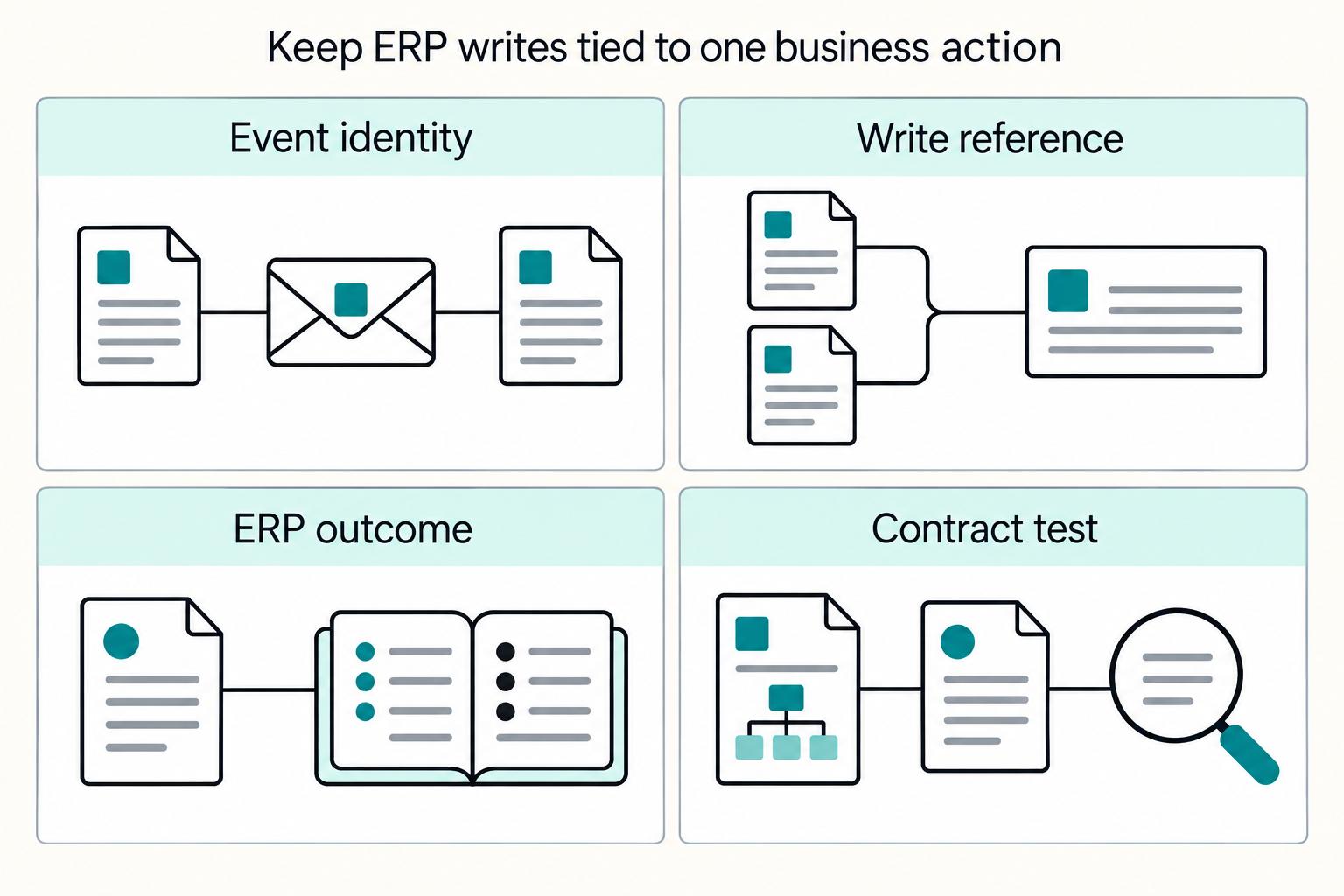
ERP Sync Architecture for Payment Platforms Using Webhooks, APIs, and Event-Driven Patterns
If you run payouts into an ERP, "just use an API and a webhook" is not enough. The design has to survive retries, late events, and finance scrutiny without creating duplicate payouts or broken reconciliation. The real question is not which transport looks modern. It is which pattern keeps postings correct, traceable, and recoverable when delivery gets messy.
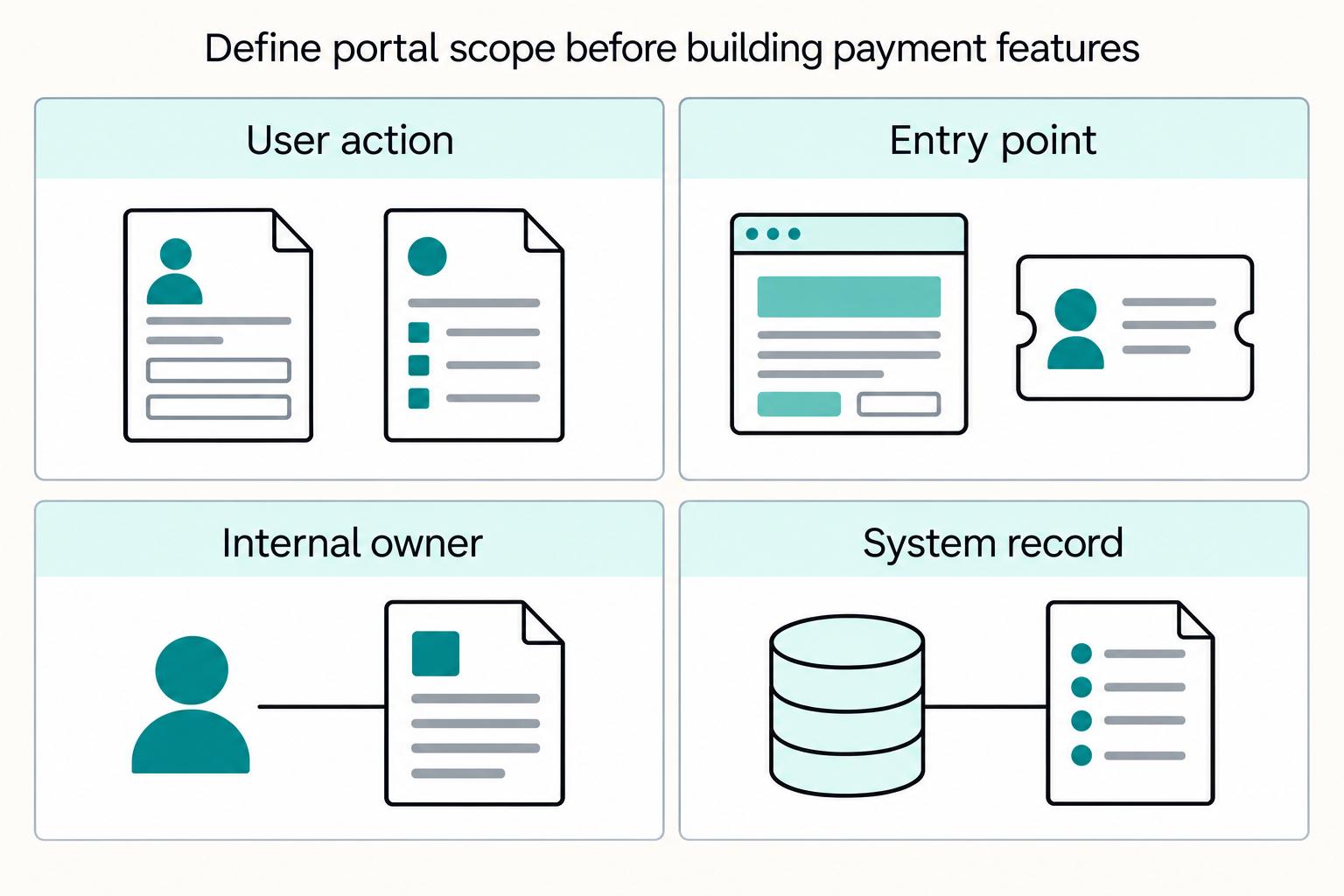
Supplier Portal Best Practices for a Self-Service Contractor Payment Hub
If you are building a **supplier portal self-service contractor payment hub**, the real issue is not terminology. It is whether the portal cuts payment-support load without weakening control or reconciliation.

Reduce Contractor Onboarding Drop-Off Before First Payout
If contractors stall between signup and first earnings, treat onboarding handoffs as an operations issue first, then confirm the causes with your funnel data. Drop-off can occur between applicable identity checks, tax collection, agreement steps, and payout activation, especially when no one owns the full path. A cleaner intake form will not fix a pending provider requirement, missing tax data for a reportable payment, or unfinished payout setup in another tool.