
Quick Answer
Payment platforms reduce money laundering risk by blocking first payout until KYC and acceptance screening are approved, collecting a minimum evidence pack by entity type, and escalating unresolved mismatches. The baseline should separate profile creation from payout permission, apply explicit risk tiers, monitor early activity more closely where risk is higher, and retain clear evidence of each decision, review, and status change.
Why KYC matters for money laundering risk#
Payment-platform teams need controls they can run: clear approval states, review triggers, and retrievable evidence. Start by separating profile creation from permission to move funds. Define the checks required for each program before enabling payouts, then give exceptions a named owner and documented outcome.
KYC and Anti-Money Laundering (AML) obligations are not uniform across jurisdictions. FATF's 40 Recommendations provide an international baseline, and FATF also states that countries cannot all take identical measures because legal, administrative, and financial systems differ. If you run contractor, seller, or creator payouts across multiple countries, expect differences in onboarding checks, recordkeeping, and reporting expectations.
The starting point is the risk-based approach, which FATF describes as the cornerstone of the Recommendations. In practice, that means prioritizing the controls that reduce exposure earliest, defining which cases require manual review, and retaining records that show what happened, when, and why. If a control has no owner, no trigger, and no evidence artifact, it is usually not production-ready.
This guide is organized around three decisions teams often miss:
- What to implement first so obvious risk is addressed before first payout.
- What to escalate when identity details, ownership information, or account behavior no longer match the original profile.
- What to document so reviewers can trace decisions from intake through approval, restriction, or suspicious activity handling.
The cross-market problem is operational, not theoretical. In the United States, some businesses that transfer funds may be treated as money services businesses, and money transmitter status depends on facts and circumstances rather than product labels alone. Where a model is in scope, Bank Secrecy Act duties can include recordkeeping, reporting, and an AML compliance program. In the EU, Directive (EU) 2024/1640 itself notes significant variation in supervisory approaches across Member States.
Use this article as a baseline operating framework, then confirm local requirements before changing production policy. That is especially important when adjusting payout activation rules, evidence collection, or suspicious activity escalation timelines. For banks, some filing timelines are explicit after initial detection of suspicious activity. The objective is not maximum friction. It is putting the right controls in place before activation, during early use, and at escalation so you reduce exposure without turning every onboarding path into a manual case. If you change activation rules, make sure your case reviewers know what evidence must exist before your first payout release. Related reading: Contractor Misclassification at Platform Scale: Legal and Financial Risks.
Who this list is for and how to choose controls#
This list is for teams running cross-border contractor, seller, or creator payouts that need to prioritize higher-risk exposure first, not apply a one-country checklist. It is most useful for compliance, legal, finance, and risk owners working in a centralized operating model where KYC and AML obligations vary by market.
Best fit#
Use this list if you need one operating baseline across business lines, legal entities, and jurisdictions, with local counsel overlays where rules differ. FATF is explicit that countries cannot all take identical measures, so your controls should be designed to operate across markets without assuming uniform legal treatment.
Not a country memo#
This is not jurisdiction-specific legal advice or a country-by-country memo. It is an execution guide for deciding which controls to ship first based on risk, and which to defer until legal interpretation and operational capacity are clear.
How to choose each control#
Choose each control on four dimensions:
- Risk impact: Does it prevent or detect higher-risk activity before first payout or during early use?
- Friction: What onboarding delay or drop-off risk does it add?
- Operational load: Who handles exceptions, and can that team keep up?
- Audit traceability: Can you show what happened, when, by whom, and on what basis?
Each control should have a named owner, a clear trigger, and retained evidence. The U.S. bank rule at 31 CFR 1020.210 includes day-to-day compliance responsibility and ongoing suspicious-transaction monitoring. Use it as a bank-specific example, then map the duties that apply to your own entity and program.
The common failure is optimizing for only one dimension. Teams that optimize only for friction can underbuild KYC and create harder escalations later. Teams that optimize only for audit comfort can over-collect, build manual queues they cannot clear, and run controls that work on paper but not in production. Testing cadence is a good example. FFIEC gives 12-18 months as one possible interval, but the governing principle is proportionality to risk, not a fixed calendar.
Best practice 1 set KYC entry gates before first payout#
Set a payout gate before first disbursement: allow profile creation and onboarding to start, but do not enable payout release until KYC checks and acceptance screening are complete and approved.
This keeps sign-up flexible while controlling the highest-risk moment. A profile can exist without moving funds; first payout is when funds actually move.
Why this gate matters early#
The legal path is jurisdiction-specific, but the control choice is still straightforward. FATF is explicit that countries implement AML/CFT standards through different legal and operational systems, so one onboarding sequence will not fit every market. In EU text, customer due diligence applies when establishing a business relationship, and if CDD cannot be completed, the firm must not proceed with the relationship or transaction. In U.S. bank CIP rules, identity verification is risk-based and can occur within a reasonable period after account opening, which can support account creation before payout activation in some programs.
Keep required identity and sanctions checks connected to the release decision. U.S. bank CIP government-list provisions and OFAC sanctions controls are distinct; a CIP checklist does not substitute for the applicable sanctions review. Record unresolved matches in the payout workflow so operators cannot release funds while another system still shows an open hold.
How to implement it without muddy states#
Separate account existence from payout permission. Use statuses that both product and compliance can act on:
| Status | Definition |
|---|---|
| Profile created | User can enter details, upload documents, and complete onboarding steps. No payout capability. |
| Pending review | Documents received or checks still running. No payout capability and no manual release by operations. |
| Approved for payout | KYC passed, acceptance screening completed, and sanctions checks cleared or resolved. |
| Blocked or escalated | Identity confidence not reached, screening hit unresolved, or required information missing. No payout capability. |
This gives you a checkpoint you can defend later. In U.S. terms, if you cannot form a reasonable belief you know the customer's true identity, treat that as a hard stop for payout enablement.
What to verify and what usually goes wrong#
Do not stop at "screening done." Retain evidence of what was checked, when, and what decision was made. For each payee, keep KYC status, screening result, approval or block timestamp, triggering rule or review reason, and the reviewer or service that made the decision. For legal entity customers, beneficial owner identification and verification may also belong in the pre-payout checkpoint.
One failure mode is an overloaded "active" flag that means too many things. Product may mark active because sign-up finished, operations may see payout details attached, and funds can move while compliance still has unresolved identity questions or an unresolved sanctions hit. Messaging can also create avoidable support load if users are told they are "ready" before payout approval.
If speed matters, start onboarding immediately but hold payout capability until KYC and acceptance screening are complete. If identity confidence is incomplete or a sanctions hit is unresolved, keep the block in place and escalate. Make that payout block visible to the operator so the queue does not depend on memory when it gets busy.
Best practice 2 collect a minimum evidence pack by entity type#
Define one minimum evidence pack per entity type before payout enablement: legal existence, ownership, and tax identity. That gives you enough evidence for a defensible decision without creating avoidable review churn or excess PII risk.
Once payout is gated, document scope becomes the next decision. Standardizing these three evidence classes by entity type can speed review, reduce back-and-forth uploads, and keep CDD evidence more consistent. Over-collection can do the opposite: more sensitive data to handle and more review noise.
What should be mandatory#
Start with the minimum set tied to specific decisions:
- Entity existence documents
For entities, CIP guidance points to records such as certified articles of incorporation, a government-issued business license, a partnership agreement, or a trust instrument.
- Ownership evidence
For legal-entity customers of covered U.S. financial institutions, identify and verify beneficial owners where the CDD rule applies. FinCEN’s February 2026 order permits collection at the first account opening, when facts call prior information’s reliability into question, and as needed under ongoing risk-based procedures. It removes mandatory repeat collection at every additional account opening; it does not eliminate initial due diligence.
- Tax identity records
In U.S. tax workflows, request Form W-9 and the appropriate TIN from a U.S. person where required. Registration country alone does not settle tax classification: a disregarded entity may need documentation from its owner. Foreign entities generally use Form W-8BEN-E and foreign individuals Form W-8BEN, with other forms for specific statuses. Collect an FTIN where the applicable form and rules require it, and document a permitted exception.
A practical baseline by entity type#
| Entity type | Evidence to consider for the applicable program | Key checkpoint |
|---|---|---|
| US registered company | Legal formation record and beneficial ownership information where required; tax form and TIN based on U.S. tax status, including owner documentation for a disregarded entity where applicable | Legal name, tax classification, and documented owner align |
| Non-US entity | Local registration and ownership information where required; applicable W-8 form or other tax documentation, including FTIN or a permitted exception | Tax record includes foreign tax ID or a valid reason it is not legally required |
| Partnership, trust, or licensed entity | Partnership agreement, trust instrument, or government-issued business license, plus ownership documents and the relevant tax form for that entity | Existence document matches the declared entity structure |
This keeps the standard focused: prove the entity exists, identify who owns or controls it where required, and tie the entity to a reportable tax identity.
Keep the pack tight and risk-based#
Do not treat "minimum pack" as "same pack for everyone forever." Regulators explicitly note that customer type alone does not mean uniform AML risk, and FATF emphasizes that jurisdictions implement controls differently. Build a baseline by entity type, then add local overlays and risk-based escalation rules.
Apply data minimisation discipline: collect only data that is adequate, relevant, and necessary for the decision. A practical check is simple: what decision does each required field or document support? If the answer is unclear, it should not be mandatory.
Where teams usually get this wrong#
A common failure mode is mismatch, not missing files. A W-9 may be present, but legal names may not align across documents, or declared structure may conflict with uploaded formation evidence. Route those cases to review before payout.
Avoid repeat ownership collection without a reason. FinCEN’s February 13, 2026 relief applies to covered financial institutions, including credit unions, and preserves first-account identification, refresh when reliability is in question, and risk-based ongoing due diligence. Confirm whether your entity and customer are in scope before using that relief; retain the prior record and the reason for each refresh.
The third failure mode is default over-collection. If stronger evidence is needed for higher-risk cases, make that a triggered escalation, not the default path for every payee.
Use one operating rule: require a complete, internally consistent pack by entity type before payout enablement, and treat gaps or conflicts as blockers rather than compensating with random extra documents later.
Best practice 3 run account acceptance screening before activation#
Do not enable full account activity until acceptance screening is complete and clear. Run OFAC checks plus risk-based identity checks and legal-entity ownership checks, and if OFAC screening is completed shortly after opening, block outgoing activity until the check is complete.
This control reduces avoidable high-risk activations and can keep downstream monitoring cleaner. The tradeoff is false hits. Sanctions and name screening can delay legitimate users unless you define review ownership, decision criteria, and override controls.
What must happen before activation#
For a U.S. bank CIP program, collect the required identifying information before account opening and verify identity under risk-based procedures. For covered legal-entity customers, apply beneficial ownership requirements together with the current FinCEN relief. Platform activation controls should follow the obligations and partner contract for the actual program.
For OFAC timing, screen new accounts before opening or shortly after. If screening completes shortly after opening, prevent outgoing activity until the OFAC check is complete.
What should trigger a hold#
Route cases to manual compliance review before activation when any core evidence is inconsistent or unresolved, including:
| Hold trigger | Stated handling |
|---|---|
| Required customer-identification information is missing or cannot be verified through risk-based procedures | Route to manual compliance review before activation. |
| Beneficial-owner information is incomplete or inconsistent at new-account opening | Route to manual compliance review before activation. |
| An OFAC hit cannot be confidently cleared from evidence on file | Route to manual compliance review before activation. |
| You cannot form a reasonable belief that you know the customer's true identity | Close review with a documented disposition; if you still cannot form a reasonable belief in identity, escalate under a defined path that includes SAR decisioning. |
The failure mode most teams miss#
Treat high false-hit volume as a control-quality signal, not just onboarding friction. FFIEC notes that a high volume of false hits can indicate the interdiction program needs review.
Maintain review records sufficient to support each disposition. Apply this control with jurisdiction-specific overlays rather than a one-size-fits-all template across markets.
We covered this in detail in When Platforms Are Responsible for Contractor Tax Fraud or Money Laundering.
Best practice 4 apply risk classification with explicit triggers#
Risk classification only works when the triggers are explicit enough that different reviewers reach the same decision. Assign a documented customer risk profile from observable signals, then tie that tier to defined controls, monitoring depth, review ownership, and payout permissions.
A risk-based approach means controls should be proportionate to identified risk, not uniform across all customers. Customer type alone is not enough for tiering, so avoid rules like "all creators are low risk" or "all cross-border sellers are high risk."
Define triggers, not vibes#
Use triggers you can evidence from onboarding, due diligence, and live behavior. A practical grouping is three families: KYC evidence quality, AML red flags, and post-onboarding behavior. Document which triggers produce automatic holds and which require manual review.
KYC triggers include incomplete or conflicting identity data, beneficial owner information that conflicts with ownership documents, or required tax information not provided where your policy requires it. For U.S.-regulated bank CIP context, TIN collection is tied to account opening. For platform design, the practical point is to avoid leaving required identity or tax gaps in an indefinite pending state.
AML triggers should be explicit override conditions. If there is suspicion of money laundering or terrorist financing, simplified handling is not appropriate. Refusal to provide required ownership documents or beneficial-owner information, or attempts to route around verification, should trigger escalation review and a market-mapped high-risk control state.
Behavioral triggers apply after onboarding. Ongoing CDD includes monitoring and risk-based customer-information updates. If activity conflicts with the declared business model, reassess the tier instead of leaving the original classification unchanged.
Example operating tiers#
The table below is an operating example, not a universal regulatory template. The goal is consistency: clear triggers, clear owner, clear payout state.
| Risk classification tier | Required controls | Review cadence | Transaction monitoring depth | Escalation owner | Allowable payout actions |
|---|---|---|---|---|---|
| Standard | CIP/KYC completion, beneficial owner capture where required, required onboarding checks complete, evidence pack complete | Onboarding plus trigger-based refresh | Baseline monitoring aligned to declared profile | Operations, with compliance support for exceptions | Payouts allowed after approval |
| Elevated | Enhanced review of inconsistent data, additional document validation, manual ownership or tax evidence review, documented approval rationale | More frequent and event-driven review when risk signals change | Deeper monitoring for profile deviations and unusual payout behavior | Compliance analyst or investigations queue | Payouts limited, delayed, or manually released until review clears |
| High-risk or restricted | Escalation review, enhanced due diligence, senior compliance signoff, documented decision on relationship continuation | Ongoing trigger-based reassessment until resolved | Highest monitoring depth and case priority | Named AML or compliance lead with restriction authority | Payout activation deferred or suspended per policy pending outcome |
The non-negotiable trigger#
If a customer refuses required ownership documents or required tax IDs, treat the case as an immediate escalation trigger and apply the local, policy-mapped consequence for that market. Do not leave the file in indefinite pending while payouts continue unchanged.
If missing information prevents required CDD completion, apply the local legal consequence mapped for that market. In EU AMLD context, inability to complete required CDD links to a no-transaction or no-relationship outcome. Operationally, if you cannot form a reasonable belief in identity or complete required customer-information collection, treat payout enablement as blocked until the case is resolved or exited under local rules.
Make classification auditable#
For each assigned tier, keep a concise evidence note: trigger hit, evidence reviewed, reviewer, decision timestamp, current payout status, and next review condition. Attach the artifacts that drove the decision.
Keep ownership explicit between operations and compliance. Day-to-day AML compliance responsibility should be clearly assigned. If a tier change blocks payouts, a named owner should control release decisions.
Where teams get this wrong#
Weak trigger language creates reviewer drift. Terms like "unusual" or "doesn't look right" need an observable condition, such as a material conflict between declared ownership and the evidence on file.
The second failure is skipping jurisdiction overlays. FATF provides an international baseline, but implementation is local. Use one core model, then map each trigger to local legal consequences before rollout.
Best practice 5 intensify transaction monitoring in the early relationship#
Once acceptance gates and risk tiering are in place, consider increasing transaction monitoring early in the relationship, then step down or maintain intensity based on risk classification. This is not a universal time-box rule. It is a policy-defined early period to confirm that actual payout behavior matches the customer profile established at onboarding.
This is where the onboarding decision meets real behavior. Risk-based ongoing due diligence includes transaction scrutiny through the relationship and, on a risk basis, maintaining and updating customer information over time. Operationally, the key choice is how much scrutiny to apply before enough behavioral history exists to support lower-touch monitoring.
Why early intensity is worth it#
Early activity can reveal mismatches against the onboarding file: stated nature and purpose, expected payout pattern, and current customer-information quality. Reviewing acceptance decisions, KYC records, and first transactions together can support more consistent escalation decisions.
The tradeoff is alert quality. If identical thresholds are applied across all new payees, teams may generate high alert volume with weaker signal. Denser monitoring is usually more useful when thresholds and patterns are tied to expected behavior for that customer profile.
How to apply it without drowning the queue#
Use initial risk assessment and screening outputs to set early monitoring depth. If a payee was approved with elevated conditions, start with tighter review early instead of waiting for a later reassessment.
Use both methods together:
- Rules-based monitoring to flag activity against preset thresholds or patterns for that customer type
- Profiling to compare current behavior with historical customer behavior and, when useful, peer patterns
In a new relationship, rules-based checks are often the first way to flag clear mismatches. Profiling usually becomes more informative as real transaction history builds.
What to verify in each alert#
Each early alert should include the case context needed for review: onboarding KYC status, current risk classification, acceptance screening result, declared nature and purpose of the relationship, and current payout status. Missing context slows investigations and weakens auditability.
Use early conflicts to trigger customer-information refresh, not only transaction review. If activity materially diverges from the onboarding file, reassess both monitoring and customer-data accuracy.
The failure mode to avoid#
Do not treat early monitoring as blanket high-sensitivity mode for every new payee. Monitoring capacity is finite, so prioritization matters. Concentrate tighter early review where the initial file supports additional screening for higher-risk products, services, customers, or geographies.
If a payee enters with elevated or high-risk handling, keep denser monitoring until observed behavior supports a step-down. Onboarding approval allows the relationship to start. It does not by itself validate ongoing behavior.
Best practice 6 define escalation paths for red flags and refusals#
Define the escalation path before the first hard case lands. If a payee refuses required KYC fields, shows an identity mismatch, or triggers suspicious-activity indicators, your team should already know who can suspend payouts, who opens the case, and what evidence is required before restrictions are lifted. If you expect frontline reviewers to improvise, your escalation path is too loose for your risk profile.
A red flag should trigger containment and investigation, not ad hoc debate. Red flags are indicators, not automatic proof, so you need investigation steps before final disposition and documented controls to prevent risky funds movement during review.
Put the if then rules in writing#
Your policy should convert common pressure points into explicit actions:
- If required KYC or ownership documents are refused: suspend payout capability, open a compliance case, record what was requested and refused, and keep restrictions in place until due diligence is completed, a documented exception is approved, or the relationship is declined under applicable rules.
- If identity data conflicts across documents or declared business details: route to manual review before payout release, and document the exact mismatch, source document, and whether the issue is clerical or substantive.
- If activity appears suspicious: contain first, investigate next, then decide whether to close, maintain restrictions, or escalate into formal reporting under the rules that apply to your program.
A useful minimum case file includes the onboarding record, requested ownership documents, stated nature and purpose of the relationship, prior screening results, and timestamps for each status change. Reluctance to provide complete nature-and-purpose information at onboarding is a recognized suspicious-activity indicator and should raise review priority.
Tie each trigger to an owner and a clock#
Handoffs are a common failure point. Operations may detect the issue, but compliance should own disposition, and payments or product operations should own payout controls. If no role has clear authority to stop funds, the rule is not operational.
| Rule context | Threshold or timing | Note |
|---|---|---|
| U.S. bank SAR rule | At least $5,000 for the covered suspicious-transaction provision | Apply 31 CFR 1020.320 to covered banks; other regimes and criminal-violation provisions have different triggers. |
| U.S. bank SAR filing | 30 calendar days | Due within 30 calendar days of initial detection. |
| U.S. bank SAR extension | 60 calendar days | May extend to 60 calendar days only when no suspect is initially identified. |
| Law-enforcement notification | Immediate | Urgent cases require immediate law-enforcement notification in addition to SAR filing. |
| Initial blocked-property report | 10 business days | Report actual blocked property; clearing a false match differs from unblocking property subject to sanctions. |
Where your program falls under a U.S. bank SAR regime, timelines are specific. Suspicious transactions involving or aggregating at least $5,000 can trigger SAR obligations. Filing is due within 30 calendar days of initial detection and may extend to 60 calendar days only when no suspect is initially identified. Urgent cases also require immediate law-enforcement notification in addition to SAR filing. If you operate across markets, use jurisdiction overlays rather than copying one country workflow globally.
Separate an unresolved screening match from property actually blocked under sanctions. Actual blocked property generally cannot be dealt in without applicable authorization; the initial report is due within 10 business days. OFAC guidance also distinguishes property released after mistaken identity or typographical errors from releases under a general or specific license. Have compliance record the applicable basis and reporting requirements rather than treating release as an ordinary payout toggle.
Build an exception path without gutting the control#
Exception handling should be narrow and evidence-based: define approvers, define acceptable cure evidence, and set a deadline for remediation. Use the same case record for refusals, escalations, suspensions, review notes, and final outcomes so the decision trail is defensible if challenged later.
For a step-by-step walkthrough, see How to Build a Deterministic Ledger for a Payment Platform.
Best practice 7 build audit-ready reporting and evidence retention#
Make every material decision reconstructable from retained evidence. If an auditor or regulator cannot quickly see what triggered review, who decided, what evidence supported it, and when it happened, the control is weaker than it looks.
This is one of the simplest ways to reduce regulatory surprises. Customer due diligence is meant to support understanding the nature and purpose of the relationship. Your retention model should connect onboarding, acceptance screening, and transaction monitoring instead of leaving records fragmented across inboxes and vendor tools. Keep the retention map simple enough to retrieve the record set without chasing inbox threads.
Map each control to one retained artifact#
Start with one control log per high-risk case, linked to underlying records rather than duplicated across systems. You do not need a separate record system for each BSA requirement, but you do need consistent retrieval and evidence that each control occurred.
A workable minimum schema is below:
| Control area | What to retain | Verification checkpoint |
|---|---|---|
| Customer due diligence | onboarding record, stated nature and purpose, and required customer records | reviewer, decision date, and document version recorded |
| Account acceptance screening | screening result, match review notes, override or rejection decision | exact screened name or entity, list used, and check timestamp recorded |
| Transaction monitoring | alert details, investigator notes, disposition, supporting transaction evidence | alert creation time, case owner, and closure rationale recorded |
A common evidence failure is a join failure: each document exists, but no stable case ID or customer identifier connects them. Standardize identifiers, status labels, and timestamps early.
Keep the case file complete, including non-filing decisions#
Do not stop at filed reports. FFIEC SAR guidance references documenting decisions not to file a SAR, so the file should clearly state why the case was closed or not escalated under your program rules.
For U.S. BSA recordkeeping, the general baseline is five years for required records, and those duties sit alongside other legal retention duties. For cross-border programs, do not assume one retention rule works everywhere. Apply jurisdiction-specific overlays.
Design for external response, not just internal memory#
Retention is not just storage. It is retrieval under time pressure. Supporting SAR documentation is treated as part of the filing record and must be available to FinCEN or federal, state, or local law enforcement on request. Your log should capture the core investigative fields: who, what, when, where, and why.
Use a simple readiness check: if a high-risk case cannot be rebuilt from the log and linked artifacts in one sitting, it is not audit-ready. Include reviewer name, decision timestamp, evidence label, final disposition, and account-maintenance decisions. If tools are fragmented, prioritize standardizing identifiers and timestamps before adding more reporting fields.
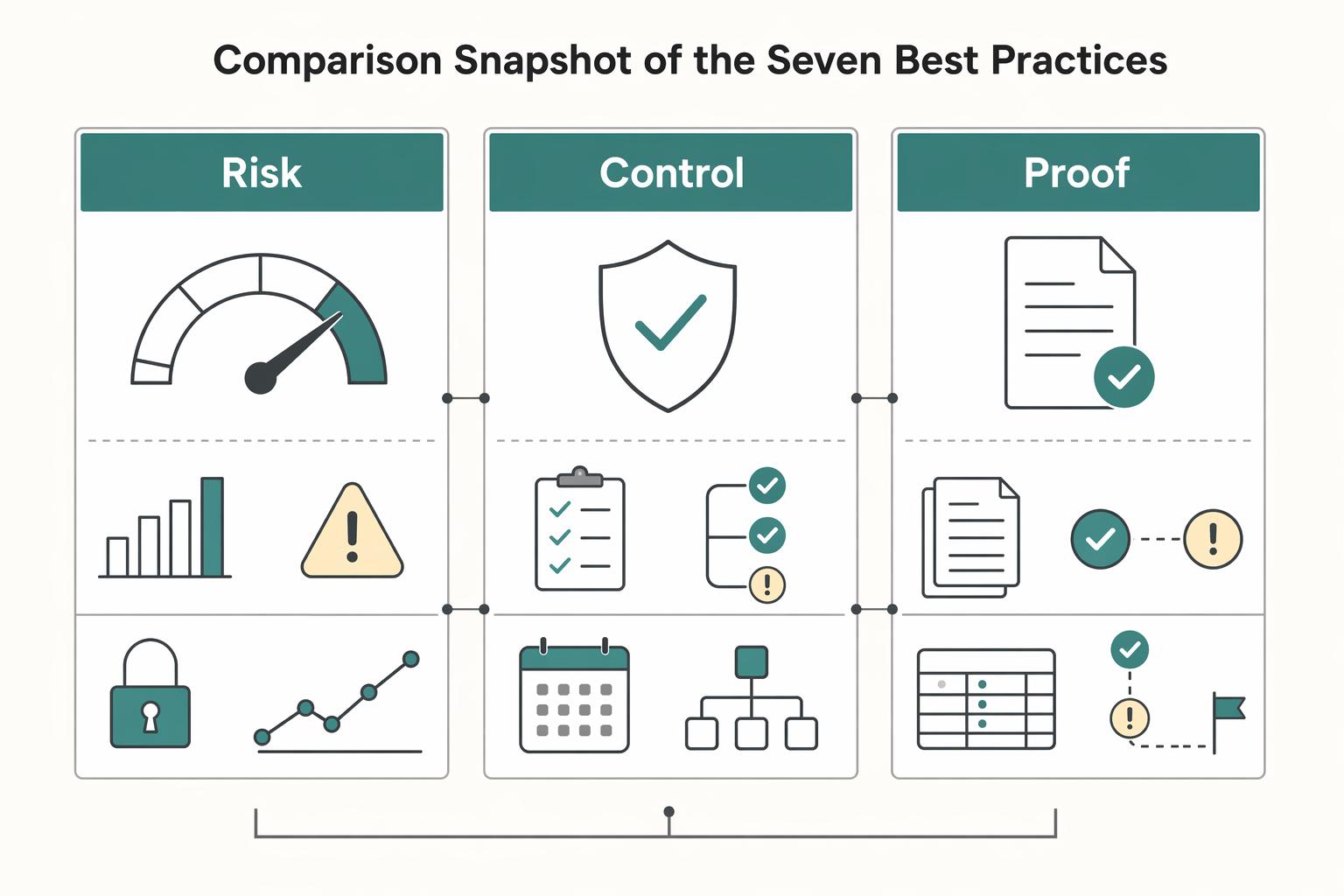
Comparison snapshot of the seven best practices#
Use this table as a sequencing aid, not a universal formula. Start with controls that prevent avoidable exposure before first payout, then add depth as your data quality and legal interpretation mature. Effort, risk value, friction, and decision labels are planning heuristics, not regulator-set scores, and should be adjusted by jurisdiction, license, and risk profile. If you pilot this sequence, adjust it with your own false-positive rates and your actual review capacity.
| Order | Best practice | Effort | Risk value | Friction | Primary owner | Hard checkpoint | Suggested decision (context-specific) |
|---|---|---|---|---|---|---|---|
| 1 | Set KYC entry gates before first payout | Medium | High | High | Compliance + Product/Ops | KYC completion status = approved (where required) before payout enablement | Implement now |
| 2 | Collect a minimum evidence pack by entity type | Medium | High | Medium | Compliance + Onboarding Ops | Required identifying information collected before account opening; for legal entities, beneficial owners identified and verified where required | Implement now |
| 3 | Run account acceptance screening before activation | Medium | High | Medium | Compliance + Vendor Ops | OFAC screening status = cleared or reviewed false positive before activation; name-matching criteria defined | Implement now |
| 4 | Apply risk classification with explicit triggers | Medium | High | Low to Medium | Risk + Compliance | Risk classification assigned with rationale logged | Pilot in one corridor if triggers are still fuzzy |
| 5 | Intensify transaction monitoring in the early relationship | High | High | Low | AML/Investigations | Monitoring activation confirmed at go-live for approved accounts, with suspicious-activity detection/reporting active | Pilot in one corridor |
| 6 | Define escalation paths for red flags and refusals | Low to Medium | High | Medium | Compliance + Support/Ops | Refusal, mismatch, and suspicious-activity escalation routes documented; re-check path defined before reinstatement | Implement now |
| 7 | Build audit-ready reporting and evidence retention | Medium | High | Low | Compliance + Data/Ops | Case ID links KYC, screening, risk classification, and monitoring evidence with timestamps | Implement now |
The key checkpoint is status discipline inside one case record: KYC completion, sanctions-screening disposition, risk classification assignment, and monitoring activation. OFAC Sanctions List Search is a matching aid and does not replace broader due diligence. One failure mode is overbuilding monitoring before upstream controls are stable. Sequence by dependency: gate payout, standardize evidence, clear screening, assign risk classification, then deepen monitoring.
Related: Dunning Management Best Practices for Platform Billing: Maximize Payment Recovery.
Before you lock sequencing, map each control checkpoint to payout statuses and exception handling in your implementation plan using the Gruv docs.
Conclusion#
Build the required control at the step where it can prevent or detect the risk. Keep approval and restriction states explicit, give escalations an owner, and retain one case file linking the evidence and decisions.
Lock the front door before you deepen the stack#
Start with entry gates, minimum evidence-pack standards, and initial screening checks. In many programs, keep payout capability restricted when required identification or verification evidence is incomplete or unresolved. In U.S. bank CIP rules, the baseline principle is explicit: collect minimum customer identifying information before account opening. Even under different program structures, define the exact approval state for activation and log reviewer, timestamp, and supporting records.
Let risk classification set control depth#
After first-gate approval, do not apply the same control intensity to every account. FATF's risk-based model is straightforward: stronger measures for higher risk, simpler measures for lower risk. Use classification to set monitoring depth, update cadence, and escalation ownership. When required information is missing, inconsistent, or raises concern about the relationship's nature and purpose, move the case to a higher-risk path and tighten monitoring early.
Treat evidence retention as part of the control#
A decision is only defensible if the record is complete and retrievable. Preserve decision outcomes, evidence used, screening outputs, and timestamps in systems you can access quickly. The cited U.S. Treasury record-retention benchmark is five years, with records accessible within a reasonable time. Under the cited U.S. bank SAR rule, filing can be time-bound: 30 calendar days after initial detection, up to 60 calendar days when no suspect is identified.
Build entry controls first, then deepen risk classification and monitoring based on observed risk. Document where local requirements or partner responsibilities change the workflow, and show those differences in the rollout plan. If you are validating jurisdiction coverage and payout controls, talk with Gruv.
Frequently Asked Questions
What are the core KYC controls a payment platform must have before first payout?
Before first payout, complete the identifying-information, verification, ownership, and screening steps required by the program. Beneficial ownership duties depend on the entity and customer in scope, including current relief for covered U.S. financial institutions. Keep payout disabled while required checks or material inconsistencies remain unresolved.
How does KYC differ from AML in day-to-day operations?
KYC is the identity and entity verification layer at onboarding. In U.S. regulatory framing, CIP sits inside the AML program, so KYC is part of AML, not a replacement for it. AML operations also include internal controls, ongoing monitoring for suspicious activity, and risk-based updates to customer information over time.
How should tax status affect the documents we request from a company?
In U.S. tax workflows, choose the form from the payee’s tax status and classification, not registration country alone. A U.S. person generally provides Form W-9; a foreign beneficial-owner entity generally provides Form W-8BEN-E, and a foreign individual Form W-8BEN, with other forms for specific statuses. A disregarded entity may require its owner’s documentation. Collect the applicable TIN or FTIN and document any permitted exception. These forms establish tax information; they do not complete identity, ownership, or other AML/KYC checks.
What are immediate red flags during onboarding that should trigger escalation?
Escalate when identification documents appear unusual or suspicious and cannot be readily verified. Also escalate when a business is reluctant to provide complete information about its nature and purpose during account setup. Treat these as triggers for additional scrutiny, not automatic proof of money laundering.
When should risk classification and transaction monitoring begin?
Start risk classification during onboarding, and complete required identity verification before first payout-equivalent account use. For approved accounts, monitoring should start when account activity begins, with customer information maintained and updated on a risk basis over time. If you want more depth on the ongoing side, see Continuous KYC Monitoring for Payment Platforms Beyond One-Time Checks.
How should teams balance onboarding conversion against money laundering risk controls?
Use a risk-based approach so control intensity matches identified risk rather than applying maximum friction to every applicant. Keep the default evidence pack lean, then step up requirements when specific triggers appear. If a field or document does not materially improve an approval, refusal, or escalation decision, reconsider requiring it up front.
Researched and edited by the Gruv editorial team. Gruv builds cross-border billing, payouts, and finance-operations software for global businesses.
Sources
- bsaaml.ffiec.gov/manual/AssessingTheBSAAMLComplianceProgram/03trusted
- bsaaml.ffiec.gov/manual/Appendices/07trusted
- ecfr.gov/current/title-31/subtitle-B/chapter-X/part-1...trusted
- ecfr.gov/current/title-31/subtitle-B/chapter-X/part-1...trusted
- fdic.gov/sites/default/files/2024-03/fil18026a.pdftrusted
- federalreserve.gov/frrs/regulations/joint-statement-on-the-risk...trusted
- federalreserve.gov/frrs/regulations/section-1010100-general-def...trusted
- fincen.gov/system/files/2026-02/FinCEN-Order-CCDExcepti...trusted
Educational content only. Not legal, tax, or financial advice.
Related Posts

The Freelance Payment Penalty: A Modeled Audit of Platform Fees, FX Spreads, and Payout Delays
The money rarely disappears through a single, easy-to-spot fee. The real loss is stacked. A marketplace takes its commission, a processor adds a charge for international cards, a bank or payment company converts the currency at a spread, a platform holds the funds before release, and a wire sheds a little to intermediaries on the way in. Each layer looks defensible on its own, but the worker feels the combined result as a smaller deposit and a later payday.

How to Respond to a Subpoena for Business Records
Move fast, but do not produce records on instinct. If you need to **respond to a subpoena for business records**, your immediate job is to control deadlines, preserve records, and make any later production defensible.
A US Expat's Guide to Investing in UCITS ETFs to Avoid PFIC Issues
The real problem is a two-system conflict. U.S. tax treatment can punish the wrong fund choice, while local product-access constraints can block the funds you want to buy in the first place. For **us expat ucits etfs**, the practical question is not "Which product is best?" It is "What can I access, report, and keep doing every year without guessing?" Use this four-part filter before any trade: