
Quick Answer
Preserve the webhook contract, durably publish events to both paths, and validate the bus in shadow before cutover. Commit event deduplication with local state changes. External money movement needs a durable command and provider idempotency, plus reconciliation for unknown outcomes. Move cohorts only when recovery and reconciliation show no missing or duplicate business effects.
Why webhook delivery needs an event-driven payout architecture#
If payout correctness is business-critical, the upgrade decision is not "webhooks or events" in the abstract. It is how to reduce missed signals, contain duplicate side effects, and give operators proof of what happened without rebuilding everything at once.
- Who this is for
This guide is for CTOs, engineering leads, and solution architects who already have payout traffic moving through a Webhook path and can see the strain. Payment teams hit this earlier than most because reliable webhook processing at scale is both an architecture problem and an operations problem, not just an endpoint problem. If retries, partner callbacks, status changes, and reconciliation already create financial exposure, you are in scope.
- What decision this article helps you make
The goal is to choose the smallest upgrade that materially improves delivery reliability for Platform payout events. Webhook-only handling can struggle as payment complexity grows. Event-driven architecture can add resilience once you have multiple consumers, retries, and failure handling to coordinate. You will see where a hardened webhook layer is still enough, where a dual-write stage makes sense, and where an event bus is worth the added operating cost.
- What "practical" means here
Practical here means checkpoints you can verify before rollout, not aspirational diagrams. For payout traffic, the first checks are simple and non-negotiable: every event needs a stable deduplication key, often an Idempotency key; failed deliveries need an owned Dead-letter queue (DLQ) path; and your Audit trail must show more than "sent." A persisted event log with delivery metrics can support auditable evidence, but it still does not prove the downstream side effect was applied, so reconciliation stays in scope.
That matters because a common failure mode is not a dramatic outage. It is a retry that succeeds twice, or a delivery that exhausts retries and quietly stops. One common webhook pattern is retries for up to 3 days with exponential backoff. That helps resilience, but it also means duplicate deliveries are an expected condition, not an edge case. If your consumers cannot dedupe on arrival, a transport improvement can turn into a payout incident.
So the scope here is intentionally narrow: payout-critical delivery and operations, not generic event theory. We will focus on the controls that change outcomes in production: delivery behavior, Idempotency key handling, DLQ triage, and audit-ready evidence. If you need a broader integration backdrop, ERP Integration Architecture for Payment Platforms: Webhooks APIs and Event-Driven Sync Patterns is a useful companion. For a deeper dive, read Webhook-Driven Payment Automation: How Modern Platforms Handle Real-Time Payment Events.
Who this list is for and how to choose#
This list is for teams where missed or duplicated payout events can create financial exposure, customer-impacting status errors, or reconciliation work. If onboarding, transaction processing, and payout status tracking already share one integration surface, webhook reliability is no longer just an endpoint concern.
- Best fit for payout-critical teams
You are in scope when retries, duplicates, or out-of-order delivery can change money movement or customer state. This often shows up when the same webhook stream carries both compliance and payout lifecycle updates, including KYC decisions, transfer progress, and final payout status. A missed success event is not just an ops nuisance if it leaves a user unpaid or your ledger state unresolved.
- Probably not for low-risk internal notifications
If you only send low-volume internal alerts and delayed or duplicate events are easy to verify manually, a basic Webhook plus minimal Retry policy may still be enough for now. The practical check is whether you can tolerate at-least-once delivery behavior, including duplicates and possible reordering, without creating payout side effects.
- Choose by controls, not architecture labels
Prioritize your reliability target, operational burden, migration risk, compliance gates like KYC, and time-to-value. Because at-least-once delivery implies duplicates, each consumer should persist an event ID or Idempotency key with atomic dedupe semantics before rollout. If payout correctness is business-critical, favor options with Event bus buffering, Consumer contract versioning, and explicit Reconciliation checkpoint ownership so "sent" is not mistaken for "applied."
Related: Events and Ticketing Platform Payments: How to Handle Refunds Payouts and Settlement.
Compare the top upgrade options before you commit#
If you must preserve current webhook contracts, start with dual-write. If consumer sprawl is already high, prioritize a bus-first model and enforce Consumer contract versioning before adding more payout event types.
The right comparison is not which option sounds most modern, but which controls you can operate reliably for payout outcomes, including retries, duplicates, and replay.
| Option | Best for | Key pros | Key cons | Common failure modes | Required controls | Concrete payout use-case and decision rule |
|---|---|---|---|---|---|---|
| Hardened Webhook gateway | One or two consumers, low migration appetite, payout risk is real but sprawl is still contained | Fastest upgrade from a basic endpoint; preserves current contracts; clear for partners already consuming webhooks | Still tightly coupled to current payload shape; weaker fan-out; replay and consumer isolation often need custom work | Retries create duplicates and side effects if the consumer does not persist an Idempotency key before applying changes; delivery marked "sent" but payout state not applied; no queue-backed recovery path | HMAC signing: required at ingress. Retry policy: required, with expected provider backoff/retries. Idempotency key: mandatory with atomic dedupe. DLQ: needed if you want recovery instead of loss. Audit trail: partial unless delivery, apply result, and reconciliation outcome are linked | Fits a single Platform payout events stream, such as payout status updates to the ledger. If your provider retries for up to 3 days, dedupe is mandatory. |
| Dual-write Webhook + Event bus | Brownfield teams that must preserve existing webhook contracts now | Existing consumers stay live while you add buffering and replay on the bus side; rollback is cleaner; side-by-side observability is possible | Temporary complexity; two delivery paths can diverge in timing; correlation can fail | Webhook path applies before bus path and doubles side effects; shared event IDs not propagated; teams assume dual-write alone solved consistency | HMAC signing: keep on webhook ingress. Retry policy: define independently for webhook and bus targets. Idempotency key: shared across both paths. DLQ: needed on bus subscriptions and queue-backed webhook workers. Audit trail: strong only if both paths share correlation ID and reconciliation checkpoint Use a durable publication handoff and side-effect-free shadow consumers. | Use when current contracts cannot break. Start payout status in shadow on the bus while webhook remains authoritative until reconciliation matches. |
| Event-first bus fan-out | High consumer sprawl and multiple downstream teams | Decouples producers from consumers; per-consumer retry/replay is cleaner; new subscribers do not force producer changes | Higher migration effort; ordering assumptions fail easily across many consumers; schema discipline is required | Contract drift breaks one consumer while others pass; no per-consumer DLQ owner; teams assume global ordering and mis-handle out-of-order payout updates | HMAC signing: at external ingress; internal auth for bus consumers. Retry policy: per subscription. Idempotency key: mandatory in every payout-affecting consumer. DLQ: required per consumer. Audit trail: strongest when versions, replay history, and apply state are all recorded | Use for payout lifecycle plus balance, reporting, and support consumers. If sprawl is high, choose this and lock Consumer contract versioning first. |
Managed delivery platforms (Amazon EventBridge and documented webhook destination services) | Lean teams that need routing, retries, and destinations quickly | Faster setup for fan-out and failure handling; managed destinations can target webhook endpoints and event-bus destinations; DLQ support is available in some services | Vendor constraints, portability tradeoffs, and less control over delivery semantics | Teams trust platform retries but skip application-level idempotency; audit evidence stops at delivery logs; destination limits appear late | HMAC signing: required for webhook destinations, or equivalent authenticity checks. Retry policy: EventBridge default is 24 hours and up to 185 retries; tunable ranges include 60 to 86400 seconds event age and 0 to 185 retry attempts. Idempotency key: still required in your application. DLQ: configure it. Audit trail: often strong for delivery, incomplete for applied business state unless you add it | Use when you need payout-status fan-out quickly and can accept managed constraints while contracts stabilize. Do not treat destination delivery as proof downstream state was applied. |
Test first delivery, repeated delivery, concurrent consumption and a crash before acknowledgement. Commit the scoped event record and local state transition together; a check followed by a separate write can race. For external payout calls, persist a command and reuse its provider-supported idempotency identity only within the documented contract. A database transaction cannot atomically commit an external transfer: reconcile an unknown provider outcome before resubmission or alternate routing.
Patchwork reliability fixes tend to miss the underlying scale issue. If schemas are still unsettled, bus-first fan-out is premature; if contracts cannot break, run dual-write first, measure divergence, then shift authority.
Best option for brownfield migration with minimal downtime#
If partner Webhook consumers cannot break this quarter, run the existing webhook path and the Event bus path in parallel, then cut over in small cohorts. This is usually the lowest-risk brownfield move because you keep the current contract live while proving the new path under retries, duplicates, and rollback.
| Step | Action | Gate |
|---|---|---|
| Start with one payout-status slice | Begin with one provider-documented payout or transfer status event; a charge-success event does not establish a payout. | Expand to account and settlement events only after the first slice is stable. |
| Instrument the legacy path | Capture event ID, delivery timestamp, prior delivery-attempt HTTP status, and whether the consumer applied the business change. | Add the Idempotency key contract before expansion; live-mode retries can continue for up to 3 days. |
| Dual write in parallel | Publish new events to both webhook and bus paths, with webhook as leader and bus as follower during validation. | During shadow validation, pause the bus consumer if it degrades. After cutover, reconcile in-flight work and preserve command identities before reversing authority. |
| Gate cutover on reconciliation | Compare webhook delivery, bus consumption, and applied downstream state over a defined period. | If supported, use a 30-day event retrieval window for reconciliation spot checks and backfill verification. |
| Cut over by cohort | Move a small percentage or defined cohort first, then expand. | If duplicate side effects appear, pause expansion and enforce consumer dedupe before adding more payout event types. |
Keep the webhook path authoritative while the bus consumer runs in shadow without money-moving side effects. Persist the source state and publication intent in one database transaction, using a transactional outbox or equivalent durable handoff. A relay publishes to each path and retries independently; direct sequential sends can leave one path missing after a crash.
- Start with one payout-status slice
Start with one documented payout-status family. Define the exact state it proves: initiation, settlement and return are different signals. A charge-success event concerns collection and cannot prove contractor payout completion.
- Instrument the legacy path before broadening bus traffic
Capture per-event evidence on the webhook side first: event ID, delivery timestamp, prior delivery-attempt HTTP status, and whether the consumer applied the business change. Add the Idempotency key contract before expansion, because retries can produce duplicate deliveries and live-mode retries can continue for up to 3 days.
- Dual write in parallel and keep rollback procedural
Publish through the durable handoff to both paths. During shadow validation, the bus computes proposed results without issuing payouts or posting authoritative ledger entries. Cutover changes the authoritative consumer for a cohort; rollback must preserve shared command identities and reconcile in-flight work before either path executes it again.
- Gate cutover on reconciliation, not delivery counts
Before each cohort shift, query missed events over a defined period and compare webhook delivery, bus consumption, and applied downstream state. If your provider supports 30-day event retrieval, use that window for reconciliation spot checks and backfill verification.
- Cut over by cohort and freeze expansion on duplicates
Use canary-style cutover: move a small percentage or defined cohort first, validate, then expand. If duplicate side effects appear, pause expansion and enforce consumer dedupe before adding more payout event types.
This sequence is the practical brownfield path: preserve contracts, prove idempotency, reconcile aggressively, then shift authority by cohort. Keep one rule front and center: do not expand event scope until the first slice survives retry, duplicate delivery, and rollback without payout ambiguity.
Best option for compliance-heavy payouts and audit requirements#
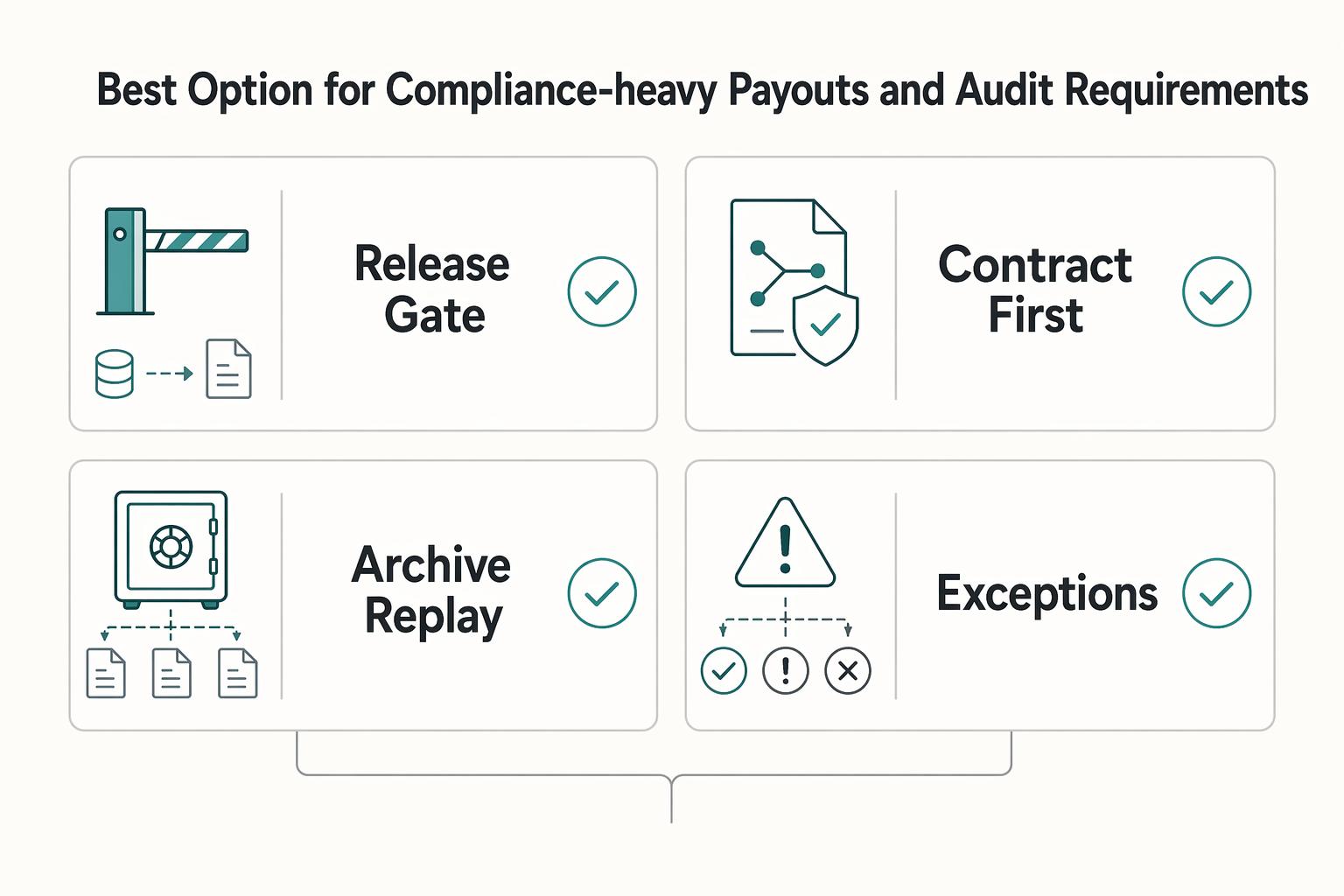
For compliance-heavy payouts, make your event record authoritative and treat Webhook delivery as transport, not the audit trail. This is usually the best fit when KYC gates, approval states, and manual reviews must be explainable later. You get stronger dispute defensibility and traceability, but you also take on stricter event-contract discipline and more governance overhead.
When "sent" is not enough, your record needs to explain the full path: request, eligibility decision, provider response, ledger result, and exception handling.
- KYC-gated payout states
Model eligibility as explicit payout states before any provider call. For connected accounts, KYC requirements must be met before they can accept payments and send payouts, and required verification inputs vary by location, business type, and requested capabilities. In practice, that lets you show why a payout was held with a specific verification reason, instead of reconstructing intent from fragmented logs.
- Contract-first payout events
Define the payout-event contract end to end: request, approval, provider response, ledger posting, and exception outcome. A common format like CloudEvents can improve interoperability; at minimum, keep a stable event ID, payout reference, account reference, event type, timestamp, decision source, and reconciliation status. Shared identifiers across states keep your Reconciliation checkpoint reliable when incidents or disputes happen.
- Archive and replay, without assuming order
If you use Amazon EventBridge, archive payout events so you can replay or resend them for recovery and traceability. That supports near real-time payment/event processing patterns, but replay is not guaranteed to preserve original ingest order. Reconcile by payout/account identity and idempotent processing, not replay sequence.
- Evidence pack with clear exception ownership
Webhook tracking for connected-account payouts is a useful input, not the full audit record. For each payout, tie together request data, KYC or approval decision, provider response, ledger posting outcome, exception record, and Reconciliation checkpoint result, plus named ownership for manual intervention when states diverge. That is what makes payout disputes answerable under pressure.
This pairs well with our guide on Handle ACH Returns and NOCs with One Deterministic Event Pipeline.
Best option for high-throughput marketplace operations#
For high-throughput marketplace payouts, use an event bus for fan-out and stop treating direct Webhook delivery as your primary distribution layer. This scales better as consumers multiply, but it requires tighter control over ordering scope and duplicate handling.
- Bus-first fan-out
Publish payout events to an Event bus so one event can reach multiple downstream targets in parallel without changing producers for each new consumer. This turns scaling into a routing problem, not a producer rewrite. As a checkpoint, require stable identifiers on every payout event - event ID, payout reference, and event type - before publish.
- Separate streams by operational purpose
Split payout lifecycle events from Account balance updates when they need different consumers, retries, or replay behavior. This lets you retry or replay balance-side consumers without accidentally re-driving payout actions.
- Per-entity ordering with strong dedupe
Prefer per-entity ordering over global ordering when throughput is the priority. Kafka total order requires a single partition, and effectively one consumer process per group, while SQS FIFO ordering is scoped to MessageGroupId. Order only what must be ordered. Key by payout/account entity, and make consumers idempotent by recording processed message IDs so duplicate deliveries are safe. If strict global ordering slows delivery, use per-entity sequencing plus Idempotency key checks in downstream writes instead of platform-wide serialization.
For a step-by-step walkthrough, see How to Hedge FX Risk on a Global Payout Platform.
Best option when speed to production matters most#
When speed to production is the priority, managed delivery is usually the practical choice: you can ship payout reliability controls now and defer custom orchestration until event contracts stabilize.
- Amazon EventBridge for fast routing and failure handling
EventBridge gives you managed bus routing, rule-based targeting, and API destinations for HTTPS endpoints without building a custom relay first. It also accelerates readiness with target retries, default: 24 hours and up to 185 times, and a DLQ so failed deliveries are retained for triage. The tradeoff is that this improves delivery operations quickly, but it does not prove a consumer applied the payout event. Producers do not get direct feedback on target invocation success, so you still need downstream confirmation and reconciliation by event ID.
- Evaluate managed webhook services on documented behavior
Managed delivery can reduce relay work, but compare documented authentication, retry limits, retention and failure recovery for the exact service. Your application still owns business idempotency and reconciliation; delivery logs do not prove that a payout completed.
Failure modes that still cause missed or duplicate payouts#
Managed delivery improves transport, but missed or duplicate payouts still happen after delivery: duplicate execution, retries that age out, delivery-success signals without business proof, and contract drift across consumers.
| Failure mode | What happens | Control |
|---|---|---|
| Hidden duplicate execution | The same webhook event can be delivered more than once, and different consumer dedupe behavior can still cause a second ledger write or release action. | Log processed event IDs and run a replay test with the same event ID twice; confirm one applied state change. |
| Silent loss after retry exhaustion | A DLQ preserves eligible failed events but does not recover them. Delivery stops when the configured event-age or retry-attempt limit is reached; EventBridge defaults are 24 hours and 185 attempts. | Treat the DLQ as an operational queue with a clear owner, replay process, and per-event recovery evidence. |
| False confidence from delivery metrics | Delivery success is not application success, and producers do not get direct feedback that target invocation succeeded. | Use a downstream Reconciliation checkpoint tying event ID to payout reference and final applied state, and alert on delivered-but-unreconciled events. |
| Contract drift that breaks consumers quietly | Schema updates can break older consumers while delivery dashboards stay green. | Use Consumer contract versioning, compatibility validation, and replay archived payloads from older versions before release. |
- Hidden duplicate execution
Duplicate receipts can repeat an event ID; distinct events can also describe the same object and event type. Combine scoped receipt deduplication with business-state transition guards. Test concurrent duplicate deliveries and out-of-order updates, checking one legitimate local transition and no second external command.
- Silent loss after retry exhaustion
A DLQ preserves eligible failed events but does not recover them. EventBridge stops retrying when the configured event-age or attempt limit is reached; defaults are 24 hours and 185 attempts. Assign triage ownership, a replay process and per-event recovery evidence before relying on it.
- False confidence from delivery metrics
Delivery success is not application success. AWS states producers do not get direct feedback that target invocation succeeded, and webhook payloads can be outdated, partial, or out of order. Use a downstream Reconciliation checkpoint that ties event ID to payout reference and final applied state, then alert on delivered-but-unreconciled events.
- Contract drift that breaks consumers quietly
Healthy transport can still carry incompatible contract changes. Without Consumer contract versioning and compatibility checks, schema updates can break older consumers while delivery dashboards stay green. Confluent Schema Registry's default compatibility mode is BACKWARD, which is a practical baseline for safer evolution. Gate schema changes with compatibility validation and replay archived payloads from older versions before release.
Conclusion#
Choose the smallest change that removes payout blind spots and gives you proof that state changed, not just a delivery log. For many brownfield integrations, that often means keeping the current Webhook contract alive while you add an event path, strict idempotency, and a reconciliation checkpoint before widening the rollout.
- Start with one payout event family
Choose one documented transfer-status family and define its meaning before migration. An initiation event records an accepted start, not recipient settlement. Trace later updates and returns against the same transfer identity, and reconcile provider state before concluding a payout completed.
- Use incremental brownfield migration instead of big-bang replacement
Webhook-only delivery gets harder to operate as payment complexity grows, but swapping everything at once is usually the wrong risk to take. A staged change, often current Webhook delivery plus event publication into an event-driven payment architecture such as Amazon EventBridge, lets you keep legacy consumers working while you compare what was delivered against what was actually applied. This is often the lower-regret path when partner contracts, support tooling, or finance processes still depend on the existing HTTPS interface. If your current contract cannot break this quarter, keep it, publish in parallel, and judge readiness from reconciliation results rather than transport success.
- Scale only after your proof pack is complete
The operational bar is not "events arrived." It is an evidence pack you can hand to an operator during an incident: event contract, idempotency rule keyed by event ID, reconciliation report, and clear ownership for failed items and replay. If you run on AWS, CloudTrail can help with API activity traceability, but it does not replace payout-level reconciliation. The red flag is false confidence. Messages can be sent, retried, and even routed correctly while payout state is never posted, or gets posted twice, when persistent storage or dedupe is incomplete. If that happens, stop expansion, fix the consumer path, and replay only the affected cohort. Your next step is not a full migration. It is one cutover slice with measurable gates: no missing applied events, no duplicate state transitions, and a recovery path your team can execute without guesswork.
Related reading: Platform Economics 101 for Commission Fees, Payout Costs, and Gross Margin.
Frequently Asked Questions
What is the safest sequence to upgrade webhook delivery for payout events without missing or duplicating payouts?
Harden authenticated, durable ingress first. Publish through a durable handoff and keep the bus in shadow without money-moving effects. Compare proposed and applied states, then change authority by cohort. Test concurrent duplicates, publication crashes, out-of-order updates and unknown external-call outcomes before expansion.
When should we keep both `Webhook` delivery and an `Event bus` instead of moving fully to bus-first?
Keep both when you still have partners or internal consumers that depend on the current HTTPS contract, or when rollback speed matters more than architectural purity. This is also a lower-risk choice if payout status notifications are already tied into customer support, finance, or compliance tools that cannot switch at the same time. Dual delivery can be worth the temporary complexity when breaking the current webhook contract would create payout or operational risk.
What are the minimum reliability controls for payout events before go-live?
Verify authenticity, durably capture events, apply atomic local deduplication and transition checks, and assign recovery ownership. Stripe automatic live-mode retries run for up to three days; manual Dashboard resend is available for 15 days and CLI resend for 30 days after creation. Retain your own recovery records rather than depending solely on provider history.
How should `Idempotency key` logic and `Retry policy` work together for payout state transitions?
Identify receipts by provider, account, environment and event ID. Commit deduplication and the local transition atomically with a uniqueness constraint. Distinct events can describe the same business transition, so also enforce the payout state machine. External payout calls need a durable command and provider-supported idempotency; reconcile unknown outcomes before re-executing. Acknowledge verified events after durable capture, then process asynchronously.
What should happen operationally when events keep failing and land in a `Dead-letter queue (DLQ)`?
A DLQ only helps if someone owns it operationally. In Amazon EventBridge, retries run by default for 24 hours and up to 185 times; after that, failed events can be dropped unless you configured a DLQ. Triage each failed item with the event ID, payout reference, first failure time, latest error, and replay outcome, then manually process undelivered events when recovery cannot wait for automated retries.
How can we prove no payout events were missed using an `Audit trail` and reconciliation process?
Build the Audit trail so each provider event ID maps to arrival time, processing status, payout reference, and final applied state. Then reconcile provider-side event history against your internal applied records and investigate anything delivered but not posted, or posted with no matching event. The proof is not a 2xx log. It is a complete chain from the incoming payout status notification to the recorded business result.
Try a related tool
Researched and edited by the Gruv editorial team. Gruv builds cross-border billing, payouts, and finance-operations software for global businesses.
Sources
Includes 6 external sources outside the trusted-domain allowlist.
- docs.stripe.com/workbench/event-destinationstrusted
- docs.stripe.com/webhookstrusted
- appdirect.com/blog/upgrading-real-time-event-notifications...external
- aws.amazon.com/blogs/industries/beyond-webhooks-event-drive...external
- aws.amazon.com/blogs/compute/sending-and-receiving-webhooks...external
- dev.to/beefedai/designing-scalable-webhook-architec...external
- developer.salesforce.com/docs/atlas.en-us.platform_events.meta/platfo...external
- docs.adyen.com/platforms/payout-to-users/payout-webhooksexternal
Educational content only. Not legal, tax, or financial advice.
Related Posts
ERP Sync Architecture for Payment Platforms Using Webhooks, APIs, and Event-Driven Patterns
If you run payouts into an ERP, "just use an API and a webhook" is not enough. The design has to survive retries, late events, and finance scrutiny without creating duplicate payouts or broken reconciliation. The real question is not which transport looks modern. It is which pattern keeps postings correct, traceable, and recoverable when delivery gets messy.

Webhook Payment Automation for Platforms: Production-Safe Vendor Criteria
This guide is for the teams that carry the operational risk after launch: product, engineering, and finance ops. If you are comparing payment automation platforms built around event callbacks, the real question is not feature breadth. It is whether the platform still holds up when payment events drive status changes, notifications, internal record updates, and accounting workflows. Providers describe this model as HTTPS callbacks, essentially an API call in reverse, and as a way to avoid constant polling. That matters, but it does not make an implementation production-safe by itself.

How Event Platforms Decide Refund and Payout Control Before Expansion
Start with the money movement model, not the demo. In event ticketing, payment, refund, and payout failures often show up after launch. They usually come from unclear refund authority, settlement landing in one account that finance has to reallocate manually, or currency mismatches between checkout, settlement, and reporting.