
Quick Answer
Keep balance changes and retry records within authoritative transactions. Use replicas for lag-tolerant reads, and evaluate sharding or distributed SQL when measured write or data pressure exceeds current capacity. Tested distributed designs can scale authoritative writes while preserving the required guarantees.
Why database architecture matters for payment platforms#
Decide which payment paths require current authoritative state and which can tolerate delayed reads. A relational core can be single-node, sharded or distributed; the key is preserving the transaction guarantees required by each money-changing operation.
A practical rule keeps this simple: keep transaction-critical state on a relational core, then scale non-critical access with the least risky pattern. If you own payout approvals or balance-affecting writes, you should treat database choice as a control decision before it becomes a scale decision. Database choice shapes scalability, reliability, security, and operating cost, and payment workloads make those tradeoffs harder. Relational systems remain a dependable source of truth for financial state because ACID guarantees fit multi-step updates.
- Keep money state on the relational core
Transaction records and writes that change financial state should stay on the relational core path. ACID helps prevent partial outcomes in multi-step financial updates. A practical test is simple: if stale or incorrect data here could change a money decision, keep it on the core.
- Scale reads only where stale data is acceptable
Use secondary read patterns for reporting and visibility where delayed data is acceptable. Any screen or workflow that can influence a financial action needs careful read-path validation before moving off the primary path.
- Treat sharding and distributed writes as boundary choices, not automatic upgrades
Sharding and distributed designs address scale in different ways, but they do not fix weak boundaries around transaction-critical data. They change how data is organized and operated under load. The real question is whether your correctness rules still hold after you distribute the system.
Start with correctness, then measured capacity. Identify the transaction boundary for balance changes and payout transitions. Replicas can serve lag-tolerant reports; shards or distributed SQL can scale the authoritative core if they preserve the guarantees your critical paths require.
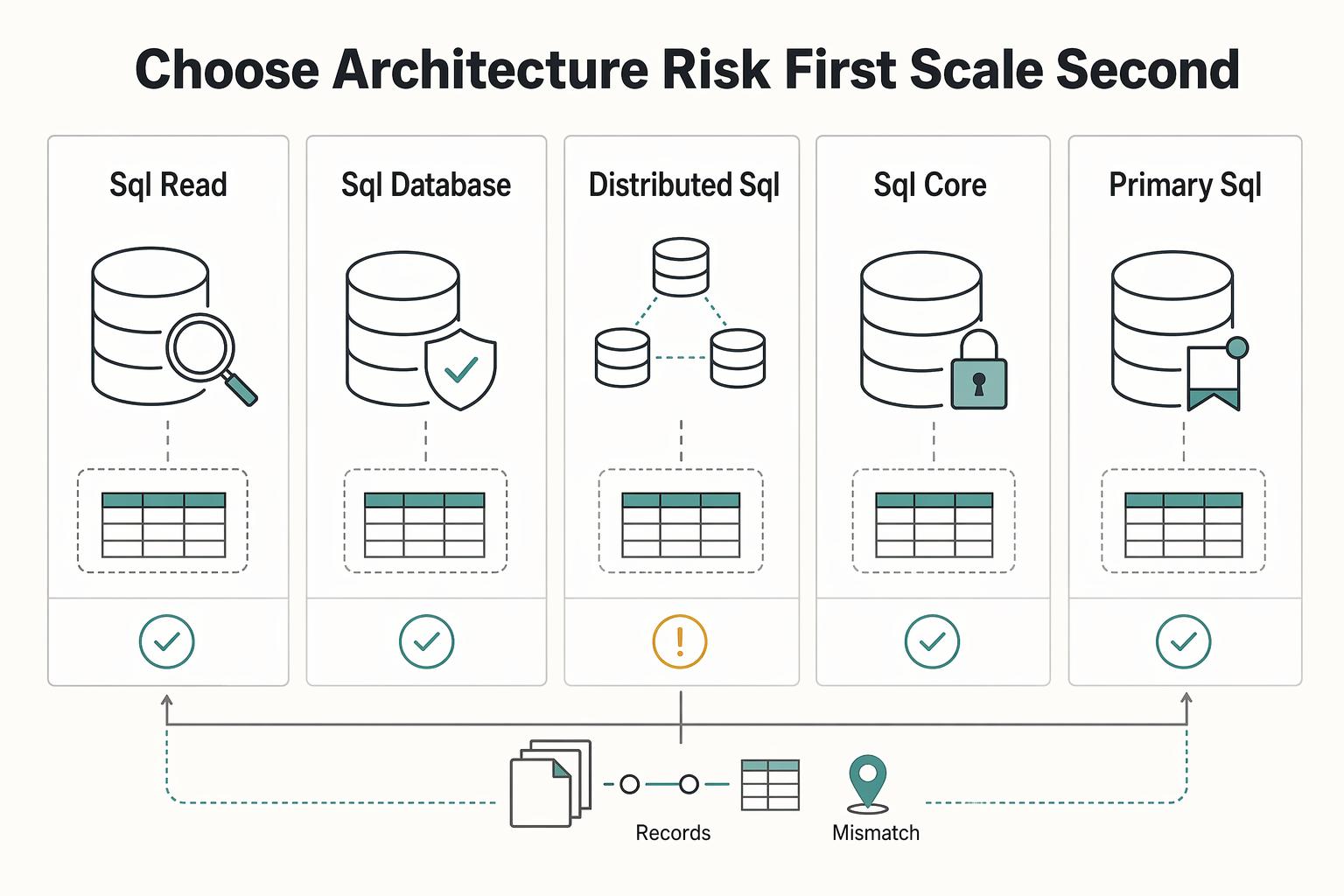
Choose the architecture by risk first and scale second#
For payment systems, database choice is a risk-control decision before it is a scaling decision. If your team owns payments, onboarding, reporting, or payout infrastructure where compliance or approval gates can block or release funds, correctness and failover behavior should lead the decision.
| Pattern | Best fit | Main risk |
|---|---|---|
| SQL with read replicas | One authoritative writer still handles state changes and the main pressure is rising read volume | Critical decisions can become a control problem if teams cannot prove they use authoritative state when required |
| SQL with database sharding | Measured write or data-growth pressure exceeds the tuned authoritative primary’s capacity | Manual sharding and custom failover scripts can become operationally fragile |
| Distributed SQL | Teams need SQL and ACID transactions at higher scale across multiple machines | Distributed coordination and lock contention can add overhead when transactions span multiple machines |
| SQL core plus NoSQL projections | Keep correctness-critical records on SQL and use NoSQL for read-heavy views built around specific access patterns | System roles must stay explicit, and single-node MySQL can struggle at higher scale |
- For teams with financial-state risk
Use a relational core for balance-affecting writes, payout-state transitions, and other decision-critical paths. Structured tables plus primary and foreign keys provide explicit integrity controls, and ACID supports reliable multi-step updates. The key test is whether money-related writes still meet ACID requirements.
- Not for low-consequence apps
If stale reads or duplicate events are mostly operational noise, payout-grade controls may be unnecessary. If incorrect data can affect money movement or create audit-evidence gaps, raise the bar and treat database choice as a risk-control decision.
- Compare options in this order
Start with money-movement correctness: which reads and writes require ACID. Then separate read growth from write growth. Next, review failover behavior under stress, including dependence on custom routing or failover logic. Finally, assess operator burden, because manual sharding and custom failover scripts can become fragile.
- Use this first-pass filter
This table is for elimination, not for picking a universal winner.
| Option | Guarantees on critical paths | Operational complexity | Failure blast radius | Migration difficulty |
|---|---|---|---|---|
| Primary SQL plus read replicas | Full ACID on the primary writer; keep decision-critical transactions on the primary path | Read routing and failover procedures still need disciplined operations | Depends on replica routing and failover design | Can be incremental when a relational core already exists |
| SQL with manual sharding | Guarantees depend on sharding and routing design decisions | Manual sharding adds shard-key, routing, rebalancing, and failover overhead | Custom routing and failover logic can increase fragility | Can require application and data-model changes to become shard-aware |
| Distributed SQL | Keeps SQL semantics and ACID transactions while partitioning data horizontally; many systems use consensus replication for consistent writes and predictable failover | More partitioning and failover behavior moves into the database layer, so cluster operations and query tuning matter | Reduces app-level routing risk, but cluster behavior still matters | Requires careful migration planning and testing on critical money paths |
Before you commit, inventory every endpoint, job, and admin action that can approve, reject, hold, settle, or release funds. For each one, record the read source, write boundary, and expected audit evidence. If those are not clear, you are still optimizing for scale too early.
Best for early and mid-scale platforms using SQL with read replicas#
If a single-writer SQL setup still meets your needs, keep that shape while you evaluate scaling options. It preserves familiar SQL and ACID transaction semantics and avoids introducing application-level sharding logic too early.
- Best fit
Use this pattern when one authoritative writer still handles state changes and the main pressure is rising read volume. The key check is whether your team can clearly separate correctness-critical reads from informational views and validate that split in your own environment.
- Why it works
The main advantage is operational simplicity on the write side: one transaction boundary and fewer moving parts in the application. It also buys time before harder scale choices, such as distributed SQL systems that scale horizontally without manual sharding while still presenting a single SQL interface.
- Main risk
The risk is unclear read-path governance, not the pattern itself. If teams cannot prove that critical decisions use authoritative state when required, a scale optimization can become a control problem.
- Recommended split
Keep correctness-sensitive decision flows on the authoritative data path. Use additional read capacity for informational workloads such as analytics, historical reporting, and bulk exports only after explicit risk review.
- Verification to require
Validate with real traffic, not diagrams. For high-impact endpoints and tools, document which data path they use, the impact of stale or delayed views, and the escalation or fallback procedure.
Related: ERP Integration Architecture for Payment Platforms: Webhooks APIs and Event-Driven Sync Patterns.
Best for write-heavy growth using SQL with database sharding#
Consider sharding when measured write or data-growth pressure exceeds the current core’s capacity after tuning. The goal is to distribute writes while preserving required transaction guarantees. Read replicas are useful for read pressure but are not a prerequisite for sharding.
- Best fit
Consider sharding when measured write pressure or data growth exceeds the tuned primary’s capacity. Read replicas do not distribute writes. Examine indexes, query design and capacity first; the right sequence depends on the bottleneck.
- Why it works
Sharding changes where writes land by distributing data across partitions instead of forcing every hot path through one primary. In distributed SQL systems, that horizontal partitioning is paired with SQL semantics and ACID transactions for critical state.
- Main risk
A major risk is operational fragility when teams depend on manual sharding and custom failover scripts.
- Recommended cut
Prefer architectures that handle horizontal partitioning and replication as built-in behavior, rather than making manual shard routing the default.
- Verification to require
Verify the actual bottleneck and failover behavior in the current design. If replicas are present, check their read load and lag. Test shard routing, hot accounts, cross-shard transactions and recovery before cutover; document operational ownership.
Best for high-scale SQL without owning manual shard operations#
Distributed SQL is worth serious evaluation when you need SQL and ACID transactions at higher scale across multiple machines.
- Best fit
Evaluate this when writes or data volume exceed one machine and your team needs a relational model across nodes. Compare the full operating cost, latency and failure behavior; horizontal scaling is not automatically cheaper.
- Why teams choose it
The main benefit is preserving ACID guarantees for sensitive transactional paths while expanding capacity beyond one machine.
- What the real cost looks like
Cross-node transactions require coordination; the protocol and latency depend on the database. Some systems use two-phase commit. PostgreSQL’s PREPARE TRANSACTION documentation treats prepared transactions as a facility for external transaction managers, not a requirement for every transaction.
Isolation can also become a bottleneck. If locks are held for the full commit-protocol duration, lock contention can rise sharply under concurrency. Evaluate contention behavior under realistic concurrency, not just simple throughput demos.
- How to evaluate it safely
Treat this as an operating-model decision, not just a database switch. Before committing, check how often critical transactions span more than one node and how latency and contention behave when those distributed transactions are common.
If your pain is write concentration and single-node limits, this pattern may fit. If routine money flows still depend on wide cross-node transactions, distributed coordination overhead remains a core constraint.
Best for mixed workloads using SQL core plus NoSQL projections#
For mixed workloads, a common split is to keep correctness-critical writes on SQL and use projections for read shapes that do not fit relational queries cleanly. This gives you strict integrity controls where it matters and more flexible read views where some delay is acceptable.
- Best fit
Use SQL as the authoritative store in this design, with NoSQL projections for read patterns that tolerate delay. This is one architectural choice; some NoSQL systems also offer transactional guarantees.
- Why teams choose it
SQL gives you ACID guarantees and database-level constraints like unique keys, foreign keys, and check constraints for integrity-sensitive data. NoSQL models are typically optimized for specific access patterns rather than general-purpose querying. The split can reduce compromise when one datastore has to serve very different workloads.
- What you must keep explicit
Make system roles explicit: SQL holds correctness-critical state, while NoSQL serves read paths that can tolerate delay.
- Where teams get hurt
The main risk is stale or incomplete projections being treated as current financial state. Define replay, lag monitoring and fallback behavior, then keep money-changing decisions on the authoritative transaction path.
- Concrete use-case
For example, commit a ledger update and an event-outbox record in one transaction. Publish that event to update a support-search projection, deduplicate delivery, and rebuild the projection from retained records if needed. Treat the projection as a derivative view.
Set consistency boundaries before you scale#
Define these tiers before you add replicas, shards, or another datastore. Paths that change transactional state should read and write through the authoritative store, while observational paths can use delayed reads.
1. Put transactional decisions on the authoritative path#
If a path changes or confirms transactional state, it should read from the same authority that commits writes. Use delayed reads for reporting and other non-blocking views so heavy analytics traffic does not burden OLTP systems.
| Path type | Read/write expectation | Preferred read source |
|---|---|---|
| Transactional state changes and verification | Strong | Authoritative transactional SQL path |
| Reporting, BI, and non-blocking dashboards | Eventual | Replica, warehouse, or projection store |
2. Make the boundary explicit in design review#
Do not leave this boundary implied. If you are reviewing a feature, document its required tier, allowed data source, and failure behavior when that source is unavailable. That keeps "faster read" shortcuts from quietly moving eventual reads into transactional paths.
A practical review lens is still partitioning, replication, concurrency control, and consistency guarantees. It forces teams to decide not just whether a feature scales, but whether its read and write path matches the guarantees it needs.
3. Treat retries and traceability as part of the boundary#
For an internal retry, use a stable operation key scoped to the account and operation. Enforce uniqueness and commit the key, ledger effects and recorded result in one transaction. After an uncertain response, query that result rather than blindly posting again. External provider retries need their own idempotency and reconciliation rules.
4. Escalate cross-boundary features#
Features that read from an eventual source and can trigger a transactional write need explicit review. Include failure scenarios for stale reads and source unavailability. If you are evaluating distributed SQL, be clear about where SQL semantics, ACID transactions, horizontal partitioning, and consensus replication can reduce operational burden, and where they do not remove the need for clear boundaries.
Map each critical path to its required read guarantee and test concurrent retries, stale reads and uncertain commit outcomes before changing routing.
Prevent failures at transaction and read boundaries#
The failure to prevent is not just scale trouble. It is architectural ambiguity: when teams add replicas, partitions, or extra stores, they need to restate authority, read guarantees, and transaction boundaries. ACID still applies to transaction properties, but surrounding read paths and multi-store flows need explicit rules.
1. Treat consistency scope as a design decision, not an implementation default#
Before scaling read paths, define which features require stronger consistency and which can tolerate eventual results. Keep that mapping visible in design review so performance optimizations do not quietly change decision-critical behavior.
2. Reduce single-store dependency without creating unclear authority#
For each workflow, identify the authoritative store and derivative stores. More stores add dependencies: document whether a projection outage affects only visibility or blocks a critical action, and test the chosen fallback.
3. Validate data-dispersion choices against real usage, not only lab assumptions#
Review the shard key against real account sizes and access patterns. Test hot accounts, cross-shard transactions and rebalancing before cutover, with measured latency and reconciliation results.
4. Decide detection and rollback evidence before cutover#
Define how you detect projection drift, contain affected actions and prove recovery. Retain the last confirmed transaction and replication position where applicable so rollback decisions have concrete evidence.
| Symptom | User impact | Detection signal | Containment action | Post-incident evidence |
|---|---|---|---|---|
| Read expectation does not match read path | Incorrect or conflicting user-visible state | Design-review mismatch between feature and assigned consistency scope | Move the feature to its defined authoritative path | Review artifact showing corrected boundary |
| Authority is unclear across stores | Conflicting outcomes between systems | Workflow map cannot identify one authoritative store per action | Pause affected action until authority is explicit | Updated authority map and incident decision log |
| Data dispersion no longer matches traffic shape | Uneven performance or operational overhead | Periodic review shows dispersion or cost imbalance | Revisit dispersion plan before peak changes | Before and after architecture review notes |
| Transaction guarantees are assumed beyond scope | Overconfidence in non-transaction paths | Missing documented boundary between ACID transaction scope and surrounding reads | Re-document transaction boundary and dependent paths | Published boundary definition used in runbooks |
Explain compliance claims without overpromising#
Use precise language here. ACID describes transaction behavior inside a database, not full compliance. Keep your compliance wording aligned to your architecture boundaries so reviews stay clear about what is and is not guaranteed.
| Evidence | What to show |
|---|---|
| Transaction boundaries | Atomic ledger effects and recorded operation identity |
| Isolation | Concurrent requests cannot spend the same available balance twice |
| Replication and failover | Expected lag and data-loss behavior under faults |
| Control coverage | Security, access and audit requirements assessed separately from ACID |
- ACID is a database property, not a compliance badge.
ACID concerns database transactions. Security access rules, card-data protection and assurance coverage require separate controls and evidence.
- Design for evidence quality, not compliance slogans.
Keep schema constraints and migration records that show which invariants the database enforces. Test violations and concurrency, not just the happy path.
- Separate policy decisions from financial history.
Record payment-policy decisions separately from immutable financial history, and link each decision to the relevant transaction. Retain the decision version used when funds were released.
- Capture future-change boundaries early.
Document workflows that can change independently from ledger records. A projection or policy upgrade should not silently rewrite prior financial events.
If you keep one rule, use this: state exactly what the database guarantees, then separately state what policy, controls, and evidence processes guarantee.
Roll out in sequence so you do not rebuild six months later#
A safer rollout is phased. If you are still on a single writer, keep the simplest architecture that still protects money-critical behavior, and add complexity only when evidence shows the current phase is the bottleneck.
| Phase | Focus | Verification checkpoint |
|---|---|---|
| Phase 1 | Define explicit transaction-consistency checkpoints and make the tradeoff between data integrity and always-on availability explicit early | Test atomic commit or rollback and the required isolation level. Use a two-phase protocol only where the chosen distributed design calls for one. |
| Phase 2 | Add scale mechanisms only when measured evidence shows the current design is insufficient | Test whether consistency behavior still matches requirements as scale complexity increases, and capture any guarantee changes before moving on |
| Phase 3 | Evaluate Distributed SQL as an operating-model decision, not a marketing decision | Validate how isolation and durability are defined; if the system uses 2PC, confirm the readiness phase and commit phase behavior under fault conditions |
Phase 1. Define explicit transaction-consistency checkpoints#
Start by defining explicit transaction-consistency checkpoints. In financial systems, data integrity and always-on availability can compete, so make the tradeoff explicit early.
Test atomic commit or rollback and the isolation level needed for each invariant. In PostgreSQL, Read Committed does not prevent every concurrency anomaly; use appropriate locking or stronger isolation and handle transaction retries. A local transaction does not need an external two-phase coordinator.
Phase 2. Add scale mechanisms only on measured evidence#
Add scale mechanisms only when measured evidence shows the current design is insufficient. Treat scale claims as hypotheses to verify, not assumptions.
Verification checkpoint: test whether consistency behavior still matches requirements as scale complexity increases, and capture any guarantee changes before moving on.
Phase 3. Evaluate Distributed SQL as an operating-model decision#
Evaluate Distributed SQL as an operating-model decision, not a marketing decision. Keep ACID claims narrow and testable during evaluation.
Verification checkpoint: validate how isolation and durability are defined in the target system, since implementations can vary and still be labeled ACID. If the system uses 2PC, confirm the readiness phase and commit phase behavior under fault conditions.
Conclusion#
The core decision is straightforward: keep money-critical updates inside ACID transaction boundaries, then scale with the least risky next step.
- Protect correctness first.
For multi-step money movement updates, keep them inside ACID transaction boundaries. Anchor those paths in a relational core with a defined schema and enforced primary and foreign key relationships, not loose application logic.
- Classify before you scale.
Map each payment read and write by required consistency and performance, then choose scaling patterns from that map. Before adding new layers, validate behavior during failover and compare user and reporting outputs against relational records.
- Treat architecture as a tradeoff, not a maturity badge.
Database choices affect scalability, reliability, security, and operational cost. They can also affect compliance and disaster recovery outcomes. If deep database operations are not a team strength, managed options can reduce operational burden as you scale.
- Take one concrete next step this week.
Build a short decision sheet with payment path, required read/write guarantee, and failure-mode check, then check your payout approvals, balance-affecting writes, reporting exports, and support views against it.
- If Gruv is in scope, confirm coverage early.
For compliance-gated payout flows, review the docs or talk to sales to confirm market and program coverage before locking architecture decisions.
If you want a design sanity check on payout gating, ledger traceability, and rollout sequencing for your markets, talk to Gruv.
Frequently Asked Questions
Sharding vs read replicas for payment platforms, which comes first?
Use the measured bottleneck. Replicas add read capacity for lag-tolerant work; sharding distributes data and writes. If reads are the pressure, replicas may come first. If write capacity is exhausted, evaluate tuning, partitioning or distributed options against the critical transaction boundaries.
Does ACID compliance mean we are compliant with PCI DSS or SOC 2?
No. ACID describes transaction guarantees. PCI DSS and SOC 2 involve separate security controls, scope and assessment evidence.
Can we serve wallet and balance checks from read replicas safely?
Use a replica for an informational balance only when lag is acceptable and clearly handled. Authorize a spend against authoritative state inside the transaction that commits it; a fresh-looking screen is not the authorization check.
When should we choose Distributed SQL over manual sharding?
Evaluate it when write or data growth needs multiple nodes and the team wants database-managed distribution. Compare cross-node transaction latency, isolation, recovery and operating burden with manual sharding under realistic load.
What is the biggest architecture mistake teams make in payment databases?
Leaving authority and transaction boundaries unclear. A faster read path can quietly introduce stale state into a money-changing decision. Document the invariant and test the failure before routing that path elsewhere.
How do idempotency keys interact with ledger writes during retries?
Use a stable operation key, enforce its uniqueness, and atomically commit the key, ledger effects and result. Concurrent retries must recover the same recorded operation. External payment calls still need provider idempotency and reconciliation; a database key alone does not make them atomic.
What should stay on strongly consistent SQL versus move to NoSQL projections?
Keep ledger effects and decision-critical state on the authoritative transactional path. Use NoSQL projections for search, reports or support views that tolerate delay, with a replay and reconciliation process.
Researched and edited by the Gruv editorial team. Gruv builds cross-border billing, payouts, and finance-operations software for global businesses.
Sources
Includes 2 external sources outside the trusted-domain allowlist.
Educational content only. Not legal, tax, or financial advice.
Related Posts

The Freelance Payment Penalty: A Modeled Audit of Platform Fees, FX Spreads, and Payout Delays
The money rarely disappears through a single, easy-to-spot fee. The real loss is stacked. A marketplace takes its commission, a processor adds a charge for international cards, a bank or payment company converts the currency at a spread, a platform holds the funds before release, and a wire sheds a little to intermediaries on the way in. Each layer looks defensible on its own, but the worker feels the combined result as a smaller deposit and a later payday.

How to Respond to a Subpoena for Business Records
Move fast, but do not produce records on instinct. If you need to **respond to a subpoena for business records**, your immediate job is to control deadlines, preserve records, and make any later production defensible.
A US Expat's Guide to Investing in UCITS ETFs to Avoid PFIC Issues
The real problem is a two-system conflict. U.S. tax treatment can punish the wrong fund choice, while local product-access constraints can block the funds you want to buy in the first place. For **us expat ucits etfs**, the practical question is not "Which product is best?" It is "What can I access, report, and keep doing every year without guessing?" Use this four-part filter before any trade: