
Quick Answer
Payment API rate limiting should start with endpoint mapping, identity scope, enforcement placement, and a clear 429 and Retry-After contract before rollout. Use fail-fast rejection where delay is risky, queue only when delayed completion is acceptable, and stage enforcement so new limits do not break existing integrations.
Protect the API Without Breaking Integrations#
Treat rate limiting and throttling as an early architecture decision, not a late patch. In payment services, rate limiting is a policy control over who can access your API and how much they can request over time. Its job is broader than crash prevention: it supports fairness, stability, secure access, and user experience.
The core risk is simple: without limits, any actor can consume the API as much as they want, whenever they want. They also prevent overload and keep usage fair, and exceeding configured limits can trigger temporary blocking. At scale, a single spike can ripple through connected systems.
A practical way to make these policy decisions is:
- Define what you are protecting. Group endpoints by risk and behavior instead of treating the whole API as one pool.
- Define who is counted. Per user or per system counting can produce different results under the same numeric limit.
- Define what happens at the limit. Decide where to reject, where to slow down, and where temporary blocking is acceptable.
That order helps you avoid a common trap: picking a threshold before scope and enforcement behavior are clear. A number like 5 requests per minute per user might be valid in one context, but by itself it says nothing about whether the identity boundary is right for your integration.
Before you enforce anything, document three items for each important endpoint group: the counted actor, the time window, and the behavior after the limit is exceeded. That baseline keeps policy choices explicit as volume grows from 10K to 10M requests and helps you avoid retrofitting controls under pressure.
Gather prerequisites before touching any limit#
Do not start with the number. Start by making identity boundaries, enforcement ownership, and over-limit evidence explicit. Teams often turn on limits, see HTTP 429 Too Many Requests, and still cannot explain who was counted, where the block happened, or whether the policy reduced abuse instead of breaking an integration.
Identify who you are limiting#
Map the request identity signals you already use to the actor you intend to limit, and document what each signal represents in practice, such as a user, organization, or application.
The operational test is simple: for any blocked request, someone should be able to answer "who is being limited?" without digging through code.
Decide where enforcement starts#
Pick the first enforcement point and assign production ownership before rollout. If multiple layers can enforce limits, record which one enforces first, who can change it, and how support can confirm where a request was rejected or slowed. This avoids slow incident diagnosis when rate-limit behavior differs across systems.
Define success, failure, and evidence#
Define success and failure signals before enabling policies. Track baseline and post-change request volume by actor, 429 volume, and the exact over-limit response clients receive. Clear response behavior matters because blocked requests without a clear diagnosis are hard for integrators to fix.
Capture baseline traffic before changes#
Capture baseline traffic and abuse context before changing limits. Include normal peaks, bursty endpoints, and known misuse patterns such as DDoS attacks that can starve shared capacity. Without that before-state, your first thresholds are mostly guesswork.
For a step-by-step walkthrough, see Guided Buying for Marketplace Operators Enforcing Preferred Vendor and Rate Policies.
Map payment flows and risk surfaces by endpoint#
Map each endpoint before you set limits so policy reflects operational risk, not just raw volume. For each endpoint, record four things: flow shape, delay tolerance, abuse exposure, and downstream dependencies. That map becomes the handoff between policy design and enforcement placement.
Classify flow shape and delay tolerance#
Classify endpoints by flow shape first, then assign a simple throttling-tolerance label. Keep this practical: use labels your team can apply quickly and refine later.
For each endpoint, capture the user-facing effect of delay in plain language. That keeps decisions tied to integration behavior, not internal org charts or URL naming.
Use discovery coverage as the gate before you move forward. Your team should be able to discover and catalog all internet-communicating APIs before policy design moves ahead. If an internet-facing endpoint is missing from the catalog, treat the map as incomplete.
Mark queue candidates and fail-fast paths#
If you plan queue-versus-fail-fast handling, record a provisional candidate state for each endpoint and validate it with service owners before enforcement. You do not need final mechanics yet, but you do need explicit assumptions per endpoint.
Document the business effect of waiting in one sentence per endpoint. When completion visibility or outcome state is unclear, flag that endpoint for additional review before assigning a handling path.
Add abuse and resilience tags#
Add abuse and resilience tags to every mapped flow, even if reliability is your immediate concern. As API usage expands across integration environments, attack surface grows quickly, and a single misconfigured or unmonitored API can expose business logic and sensitive infrastructure.
Keep tags short and repeatable. At minimum, annotate likely choke points for Denial-of-service (DoS) attacks and DDoS attacks, then add visibility and third-party dependency risks where relevant.
Use this step to align management and governance with implementation. Consistent naming, documentation, and versioning keep endpoint risk maps useful during incidents instead of turning them into stale artifacts.
Publish a one-page dependency map#
Publish a one-page dependency map that teams can use during rollout reviews. Show ingress, API gateway path, handling layer, and downstream dependencies touched after the first call.
Make callback paths explicit, including whether they share gateway controls or follow different ingress routes. Complex dependencies and third-party paths are where visibility gaps usually hide. A compact table is usually enough, with columns for Endpoint family, Flow label, Throttling tolerance, Queue/fail-fast candidate, Abuse tags, Dependencies, and Owner.
If security, reliability, and support do not interpret it the same way, tighten the map before you change limits.
Place enforcement where it reduces blast radius#
Once the endpoint map is credible, place enforcement where it contains overload early. Start at the API gateway for coarse containment, then add middleware or service-level controls where endpoint behavior or client policy needs finer control.
Start with coarse control at the gateway#
Put coarse rate limiting and throttling at the gateway first. It protects backend services from excessive request floods and gives you a single enforcement point for internet-facing traffic.
If you can only implement one layer first, choose the gateway. It contains overload earlier and lets ops verify that excess traffic is stopped before backend services absorb it.
A practical check is to run a controlled burst above the configured threshold and confirm the gateway rejects or caps traffic while backend load does not rise with rejected volume.
Add finer rules in middleware or services#
Add endpoint-specific or caller-specific rules in middleware or service-level enforcement once edge controls are in place. Gateway caps are strong for broad protection, but they are not always enough when behavior must differ by caller, endpoint, or procedure.
Keep implementation consistent across paths. Fragmented limiter placement can produce different outcomes under equivalent quotas, which creates operational friction.
Keep changing limits out of broad redeploys#
Keep frequently changing policy limits in a control path that can be updated without broad redeploys. If changing a client limit becomes an infrastructure event, placement is too rigid.
Validate this in nonproduction: change one client limit and count how many components need updates or restarts. Also avoid keeping throttled edge connections open longer than needed, because timeout risk and DoS exposure both increase with long-lived open connections.
For a related operational view, see Churn Rate Benchmarks by Industry for Payment Platforms.
Choose fail-fast versus queueing by endpoint type#
With enforcement placement decided, the next choice is behavior under pressure. A practical default is to use a Rate Limiting policy to reject requests when limits are exceeded, and use a Throttling policy only where delayed completion is acceptable.
Classify by the cost of delay#
Classify endpoints by the operational cost of delay, not just traffic volume. Similar burst patterns can still require different handling. Treat this as a policy template, not a universal rule. Teams use these terms differently, and some sources use "rate limiting" and "request throttling" interchangeably, so define your terms before implementation.
| Endpoint class | Prefer Rate Limiting policy reject | Prefer Throttling policy queue or retry | Retry contract to publish |
|---|---|---|---|
| High-impact write endpoints | Often yes. Return HTTP 429 Too Many Requests when request rate is exceeded. | Only if delayed execution is explicitly acceptable for that endpoint. | Whether Retry-After is sent, plus retry timing expectations |
| Onboarding and profile updates | Yes at a hard ceiling to contain abuse or runaway clients. | Often yes when delayed completion is acceptable. | Retry-After for hard limits, plus retry expectations for deferred work |
| Read-heavy status, reporting, and lookup endpoints | Yes for abusive or noisy callers. | Often yes, since delay is usually lower risk than on writes. | Retry-After and backoff expectations |
| Webhook or async event intake | Yes when a sender overruns shared capacity. | Sometimes, if delayed handling stays operationally clear. | Retry timing expectations |
Publish the reject contract for fail-fast paths#
For fail-fast paths, make HTTP 429 Too Many Requests the explicit signal that the current request was not accepted at the present limit. Then publish the retry contract for each endpoint group:
| Contract item | What to publish |
|---|---|
| Limit scope | Whether limits are server-wide or per resource |
| Identity | Whether identity is by IP, authenticated user, or authorized application |
| Quota variation | Whether limits differ by tier, subscription, authentication method, or role |
| Retry-After | Whether a Retry-After header is included on 429 responses |
Queue only when delay stays operationally clear#
Queue only when lateness is acceptable and visible to clients. If delay changes what the client or operator should do next, reject. If it mainly affects completion time, queueing can be reasonable.
If you allow queueing, document delayed behavior as clearly as reject behavior. Otherwise clients may retry in incompatible ways, and a misconfigured client can consume shared capacity.
Test both paths with deliberate bursts#
Validate behavior with deliberate burst tests before publishing policy. Use an API client or automated runner to send rapid requests and confirm runtime behavior matches the documented contract.
For fail-fast groups, confirm threshold crossings return 429 responses and include Retry-After when your contract says they should. For queued groups, confirm deferred behavior matches documentation. Save sample responses, headers, request counts, and endpoint classifications so support and engineering can debug client reports quickly.
Pick the algorithm and window for burst behavior#
Choose the algorithm based on how you want legitimate spikes to behave, not just on a fixed request count. Use Token Bucket when short bursts are normal and acceptable. Use Sliding Window when stricter accuracy over time matters most.
Match algorithm behavior to traffic shape#
Choose the algorithm based on the traffic shape you expect. The core tradeoff is burst tolerance versus stricter, more even enforcement.
| Algorithm | Where it fits | Main tradeoff | Verification point |
|---|---|---|---|
| Token Bucket | Endpoints with legitimate short spikes, such as sync bursts | More burst flexibility, because short bursts are intentionally tolerated | Send a short burst, then sustained traffic. Confirm bursts are accepted until burst capacity is exhausted, then over-limit requests return 429 and include Retry-After when provided |
| Sliding Window | Shared endpoints where consistent enforcement over time matters most | Less burst flexibility than token bucket | Send traffic across adjacent time ranges and confirm enforcement stays consistent over time |
| Fixed ceiling per window | Coarse starting point only, not a default for bursty behavior | Simple, but often too blunt for real traffic | Check whether a "reasonable" ceiling still rejects normal spikes |
A fixed threshold can look reasonable and still mis-handle integrations. For example, 100 requests per minute can block a legitimate burst like 30 requests in 2 seconds. Meanwhile, 150 requests per minute may be the pattern you actually want to constrain.
Choose based on failure cost#
If short, legitimate spikes are common, token bucket is usually the safer fit. If stricter accuracy over time matters more than burst accommodation, sliding window is usually the better fit.
Test at least two patterns before finalizing. Simulate a brief spike, for example 200 requests in 10 seconds. Then simulate sustained pressure, for example 500 requests in 60 seconds. This lets you confirm that both burst behavior and over-limit behavior are intentional. A bad threshold can become an incident by flooding origin systems with legitimate traffic.
Publish the algorithm and window per endpoint group#
For each endpoint group, document the algorithm, whether burst headroom exists, and the response contract: 429 and Retry-After behavior. Keep one sample over-limit response and one burst-test result with each policy version so engineering and support can verify behavior quickly.
Borrow precedent, not someone else's numbers#
Borrow the operational pattern of explicit rate behavior and clear protection priorities. Then set limits for your own endpoint risk and traffic shape.
If an incident occurs, algorithm choice is only part of the response. You may still need load shedding so lower-priority traffic is dropped and critical requests continue to get through.
If you want a deeper dive, read Rate Limiting and Throttling for High-Volume Payout APIs.
Set tenant and plan granularity without hidden coupling#
After you choose burst behavior, make scope and commercial overrides explicit. This is where limit behavior can become hard to explain under load.
Set identity scope clearly per endpoint group#
Define the scope key used by each endpoint policy. If more than one scope can apply, define precedence in writing. That way, a 429 Too Many Requests can be traced to a specific scope key.
Make plan-based limits auditable#
Limits can vary by tier, subscription, authentication method, or role, so state exactly which attribute changes quota or enforcement behavior. For each throttle dispute, your logs should show the scope key, the applicable rate plan or quota, and measured consumption in that window.
Keep enforcement stable when dependencies are stressed#
Quota enforcement depends on continuously tracking consumption against quota, so treat that path as operationally critical. Validate it with rapid-request tests from an API client or automated runner, and confirm over-limit behavior remains consistent, including 429 responses.
Treat rate-limit changes as client-visible#
Treat rate-limit changes as client-visible contract changes. When a policy changes, publish what changed and the expected client-visible outcome, including when requests should receive 429. If you need a broader versioning pattern, see How to Version Your Payment API: Strategies for Backward-Compatible Changes.
Related reading: Payment Decline Rate Benchmarks for Platform Operations.
Publish a client contract that makes retries safe#
Once plan rules are clear, publish one retry contract that tells clients when to retry, when to wait, and when to stop. Clear rules here reduce retry amplification during incidents and help limit duplicate side effects.
Return one over-limit shape#
Use one over-limit response shape across every enforcement layer. For exceeded request limits, return HTTP 429 Too Many Requests consistently and document the response fields and client actions you expect for that condition.
Consistency is the point. Clients should not see different 429 payloads for the same over-limit condition depending on whether enforcement happened in gateway or application code. Document the expected client action for each response class, and keep permanent client request errors from looking retryable.
Make money-moving retries replay-safe#
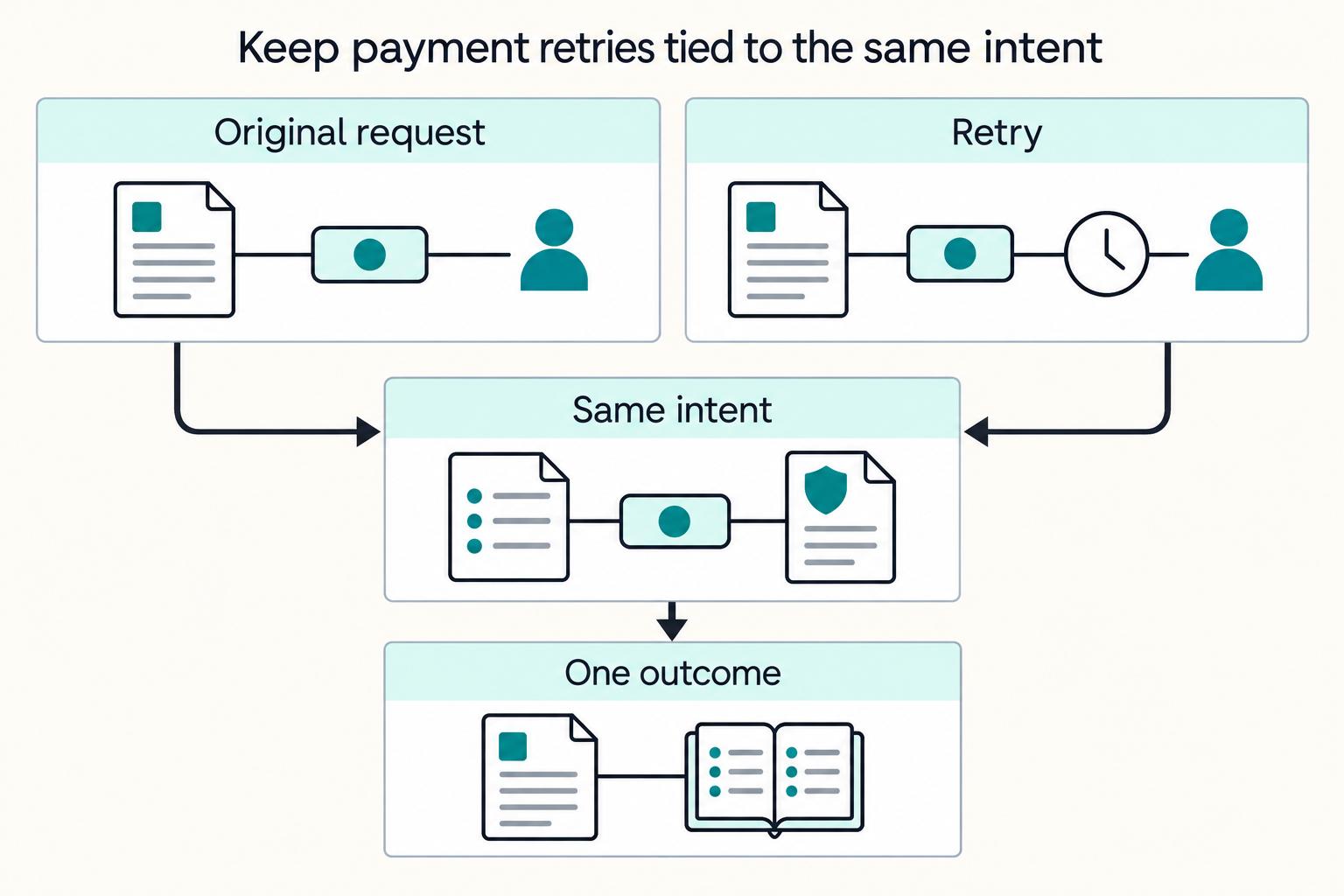
Treat retries on money-moving writes as replays of the same intent, not new instructions. Your contract should state which write operations are safe to retry and what replay-protection behavior applies so a retried request does not create a second side effect.
Be explicit about transient retry paths after 429 and server-side transient errors like 500, 502, 503, and 504. During outages, aggressive retries can overload systems further, so verify that repeated submissions of the same intent resolve to one business outcome.
Define retry and stop rules by auth mode#
Publish retry guidance for both API key and JWT bearer token integrations. If you support both identity models, say clearly whether retry behavior is identical or differs by endpoint group.
| Status | Retry guidance | Class |
|---|---|---|
| 429 | Retry candidate | Over-limit |
| 500 | Retry candidate | Transient 5xx |
| 502 | Retry candidate | Transient 5xx |
| 503 | Retry candidate | Transient 5xx |
| 504 | Retry candidate | Transient 5xx |
| 400 | Do not retry | Client request error |
| 401 | Do not retry | Client request error |
| 403 | Do not retry | Client request error |
| 404 | Do not retry | Client request error |
A practical baseline is to treat 429 and transient 5xx as retry candidates, while treating 400, 401, 403, and 404 as non-retryable client request errors. Document backoff and stop conditions in the contract so retry behavior is explicit and usable under load.
Before you lock the retry contract, align your 429, replay-protection, and webhook handling details with the implementation references in Gruv Docs.
Roll out new policies without breaking existing integrations#
Treat a new limit as a migration, not a switch flip. Stage enforcement, compare old and new decisions side by side, and pause cutover if reliability worsens.
Start in observe-only mode#
Start with a non-blocking evaluation phase so you can see impact before clients receive real 429 responses. Log what the new policy would do by tenant, app, endpoint, and auth mode, then enforce in stages only after that picture is clear.
| Phase | What changes | What you verify | Stop signal |
|---|---|---|---|
| Observe only | New policy evaluates but does not block | Would-be 429 volume by tenant and endpoint | Critical flows would have been rejected unexpectedly |
| Soft enforcement | Real enforcement for a small cohort or low-risk routes | Error trends, support tickets, retry behavior | Reliability degrades or retries spike |
| Partial hard enforcement | Wider enforcement, still scoped by cohort, route, or plan | Stable success rates and no money-movement regressions | High-value tenants or sensitive routes regress |
| Full enforcement | New policy becomes default | Legacy override use falls toward zero | Rollback trigger fires on reliability or support load |
This staged pattern is not a universal provider mandate, but there is clear precedent for it. One provider re-enforced limits on August 10, 2024, turned them off on August 16, 2024 to analyze impact, and planned re-enablement for November 18, 2024. The practical lesson is simple: even documented limits can surface integrations that are already out of bounds.
Compare legacy and candidate limits in parallel#
During migration, keep legacy and candidate policy decisions visible in parallel, even if only one is enforcing. This matters most for critical endpoints, where limit-behavior changes can look like contract breaks to older clients.
| Example limit | Measured constraint | Scope |
|---|---|---|
| 500 requests per minute | requests per minute | per realm ID |
| 10 concurrent requests in one second | concurrent requests in one second | per realm ID and app |
| 40 batch requests per minute | batch requests per minute | per realm ID |
| 30 payloads max per batch request | payloads max per batch request | per batch request |
Do not assume all limit dimensions behave the same. 500 requests per minute, per realm ID, 10 concurrent requests in one second per realm ID and app, 40 batch requests per minute, per realm ID, and 30 payloads max per batch request measure different constraints. A client can pass one dimension and still fail another.
At minimum, log these comparisons:
- legacy allow, new deny
- legacy deny, new allow
- same allow/deny outcome, different reason (for example, rate vs concurrency)
That last case is easy to miss and can still change client retry behavior under 429, increasing the risk of delayed syncs, partial writes, duplicate retries, and stale reporting.
Pause hard cutover when soft enforcement hurts reliability#
If soft enforcement worsens reliability, pause hard cutover. Adjust enforcement behavior first, for example by scoping cohorts, tuning concurrency settings, or adding temporary exemptions for critical flows, before changing client contracts.
Then push targeted mitigations based on observed failure patterns: reduce unnecessary fetches, pace calls more evenly, and use webhook or CDC-style syncs where appropriate. If affected clients do not revise code, the same throttling errors can reappear when limits are re-enabled.
Before widening enforcement, prepare a cohort-level evidence pack with tenant IDs, endpoint groups, request counts, would-be versus actual 429 rates, and retry patterns. Notify impacted developers directly instead of relying only on broad release notes.
Tie behavior changes to API versioning notes#
Document limit-behavior changes in API versioning notes so older clients can quickly tell whether their integration will be affected and when. For each version, include effective date, scoped endpoints, changed limit dimensions, and whether the over-limit response shape stays the same.
Also state whether older versions keep legacy behavior for a grace period or only until a defined cutoff. For a cleaner way to handle the versioning side, see How to Version Your Payment API: Strategies for Backward-Compatible Changes. For the documentation side, see Payment API Documentation for Reliable Integration Decisions.
Instrument operations and keep an audit trail#
If your team cannot quickly explain why a request was allowed, delayed, queued, or rejected for a specific tenant and endpoint, the rollout is not operationally complete.
Propagate request context across decision points#
Use a consistent request identifier through throttling decision points so incidents can be traced across systems. Carry it through the API gateway and middleware, and extend it to downstream async paths where your platform supports it.
Then verify it on a real over-limit case. The identifier should appear across ingress, enforcement, application, and follow-up records where those records exist. Otherwise support gets fragments instead of a usable timeline.
Record decisions at gateway and service layers#
Log enforcement decisions at both the gateway and service layers. Gateway policies are evaluated before requests reach backend services. Gateway logs should show what fired and what action was taken at resource or method scope, including outcomes such as HTTP 429 when applicable.
Also log service-side decisions so business context is preserved. For each event, keep a consistent field set: tenant identifier, endpoint or method, auth mode, timestamp, action, policy name/version, and request identifier.
Build an evidence pack for incident review#
Do not rely on one log source. Build an evidence pack that combines throttle event logs, retry outcomes, and reconciliation notes. Incident review should be able to explain the decision, the follow-on behavior, and the final operational outcome.
Treat this as deliberate operational work, not an automatic byproduct of throttling features. If you operate in PCI DSS scope, this aligns with monitoring and incident-response coverage in PCI DSS v4.0.
Separate abuse triage from organic growth analysis#
Keep abuse triage and growth analysis separate in observability views. Credential stuffing and Brute-force attacks may resemble demand spikes if you look only at rate-limit volume.
Use additional context beyond request counts, and do not assume throttling telemetry alone can classify intent. Separate views can reduce misclassification and help ops respond faster.
Recover from the mistakes teams make most often#
Once you can explain individual decisions, fix the design errors that keep repeating instead of tuning one global number. Split controls by endpoint criticality, replay risk, and entitlement logic so limits reflect real capacity and known failure modes.
Split endpoint classes before tuning thresholds#
If one Rate Limiting policy still covers all endpoints, fix that first. Read-heavy checks, delayed-tolerant operations, and high replay-risk writes should not share the same treatment.
Use softer throttling where clients can adapt, and reserve hard rejection for cases where delayed execution is riskier than a clear failure. A practical check is that a burst on a read endpoint should not consume the same budget as a money-moving write.
Gate queued writes behind idempotent handling#
Queueing writes without idempotent handling can lead to duplicate operations. Recover by tightening the Throttling policy so queued writes are only allowed when the same operation can be recognized and resolved to one business outcome.
Use a consistent request-identity approach for write paths before enabling queueing or automatic retries. If that control is not in place, prefer a clear failure over silently queueing riskier writes.
Keep Billing-aware rate limiting from amplifying outages#
Billing-aware rate limiting can align limits to plan entitlements, but only when identity, plan lookup, and enforcement are explicit: identify the caller, for example via API key or JWT, retrieve current plan state, then enforce at gateway or middleware.
Use plan differences deliberately. A free-tier and enterprise spread, such as 10 requests/minute versus 1,000 requests/minute, is only useful when it matches capacity and entitlement intent.
Give support tenant-level evidence#
Teams often launch limits before support tooling, which leaves partners with opaque failures. Recover by giving support tenant-level diagnostics, with complete error handling and logging, so teams can explain what happened without engineering log archaeology.
Include enough context to trace the decision quickly: tenant, endpoint or method, time, enforcement layer, and action taken. If support cannot explain a real over-limit event in minutes, the rollout is not operationally complete.
Copy-paste launch checklist and next step#
Do not widen rollout until the over-limit contract is explicit, observable end to end, and support can explain a 429 event without reading application code.
Confirm scope#
Launch only when relevant endpoints are mapped to a documented Rate Limiting policy or Throttling policy. Check for partial coverage so non-obvious routes are not left outside policy by accident.
If your flow depends on API monetization prerequisites, confirm they are complete before launch, for example connected Stripe account setup or completed custom interface work for a non-Stripe billing engine.
Confirm contract#
When a client exceeds allowed request volume in a defined window, return HTTP 429 Too Many Requests and document that it is a temporary protection measure.
If a Retry-After header is present, clients should use it to schedule retries. If it is missing, clients should fall back to exponential backoff.
For write paths, document idempotency expectations so retries do not create duplicate actions or corrupted data. Run at least one intentional over-limit test and verify the real status, headers, and error body match published docs.
Confirm rollout#
Before expanding traffic, confirm a limited production rollout shows stable integration behavior. If retries become unstable or 429 handling is unclear in real client behavior, pause expansion and fix contract gaps first.
Treat documentation and testing as launch criteria, not post-launch cleanup.
Confirm ops readiness#
Operations should be able to produce a usable incident evidence pack for an over-limit event before broader rollout. At minimum, verify you can capture request/response logs, the HTTP 429 Too Many Requests response, the Retry-After header when present, and idempotency signals for relevant writes.
Also confirm logging and error handling are sufficient to investigate traffic spikes and repeated over-limit events.
Start with a limited cohort#
Next step: release to a narrow production cohort, keep behavior stable, and monitor integration stability and retry behavior.
Expand only after the cohort remains stable and incident evidence is clear enough to diagnose and resolve 429 events quickly. Related: API Rate Limiting and Error Handling Best Practices.
When your policy table is ready for a limited production cohort, validate it against real payout flow behavior in Gruv Payouts.
Frequently Asked Questions
What is the practical difference between payment `API rate limiting` and `API throttling`?
Teams often use the terms interchangeably. A useful distinction is that rate limiting sets the request cap for a time window, while throttling describes what happens after that cap is exceeded, such as delay or rejection. Define the terms once so clients and support interpret 429 responses consistently.
When should a payment API return `HTTP 429 Too Many Requests` instead of queueing?
Return HTTP 429 Too Many Requests when the client has exceeded the allowed request rate for the period. Queueing is the delay-style enforcement path, while 429 is the rejection path. Choose the behavior deliberately per endpoint so over-limit handling stays predictable.
How should we use the `Retry-After header` for client retries?
Use Retry-After on 429 responses when you want to tell clients how long to wait before retrying. It is optional and does not have to appear on every 429. The wait value should match your policy.
Which is better for payout bursts: `Token Bucket Algorithm` or `Sliding Window Counter`?
Use Token Bucket when burst flexibility is the priority. Use Sliding Window when stricter accuracy over time matters more. The better fit depends on endpoint behavior, not on a universal winner.
How does `Billing-aware rate limiting` work with `Subscription tier` and `Payment status`?
Key limits to client identity, such as a user, IP, or authorized application, then vary allowances by tier, subscription, authentication method, or role. Higher tiers can receive larger allowances when that matches capacity and entitlement intent. Treat payment status as a separate business rule and document it explicitly.
How do we introduce `SLA-based rate limiting` without breaking older client integrations?
Keep client-visible behavior explicit and stable, especially what a 429 means, whether Retry-After is present, and how SLA-tier allowances change behavior. Stage rollout in observe-only and soft enforcement phases before widening enforcement, and pause hard cutover if reliability worsens. If the change affects client behavior, align it with your API change-management and versioning approach.
Researched and edited by the Gruv editorial team. Gruv builds cross-border billing, payouts, and finance-operations software for global businesses.
Sources
Includes 6 external sources outside the trusted-domain allowlist.
- pmc.ncbi.nlm.nih.gov/articles/PMC12939948trusted
- sec.gov/Archives/edgar/data/1477333/0001193125192443...trusted
- apidog.com/blog/fintech-api-retry-logicexternal
- blog.axway.com/learning-center/apis/api-design/api-quotaexternal
- blog.postman.com/what-is-api-rate-limitingexternal
- celigo.com/blog/api-security-best-practicesexternal
- confluent.io/blog/how-to-build-real-time-data-monetizationexternal
- datadome.co/bot-management-protection/what-is-api-rate-l...external
Educational content only. Not legal, tax, or financial advice.
Related Posts

The Freelance Payment Penalty: A Modeled Audit of Platform Fees, FX Spreads, and Payout Delays
The money rarely disappears through a single, easy-to-spot fee. The real loss is stacked. A marketplace takes its commission, a processor adds a charge for international cards, a bank or payment company converts the currency at a spread, a platform holds the funds before release, and a wire sheds a little to intermediaries on the way in. Each layer looks defensible on its own, but the worker feels the combined result as a smaller deposit and a later payday.

How to Respond to a Subpoena for Business Records
Move fast, but do not produce records on instinct. If you need to **respond to a subpoena for business records**, your immediate job is to control deadlines, preserve records, and make any later production defensible.

A US Expat's Guide to Investing in UCITS ETFs to Avoid PFIC Issues
The real problem is a two-system conflict. U.S. tax treatment can punish the wrong fund choice, while local product-access constraints can block the funds you want to buy in the first place. For **us expat ucits etfs**, the practical question is not "Which product is best?" It is "What can I access, report, and keep doing every year without guessing?" Use this four-part filter before any trade: