
Quick Answer
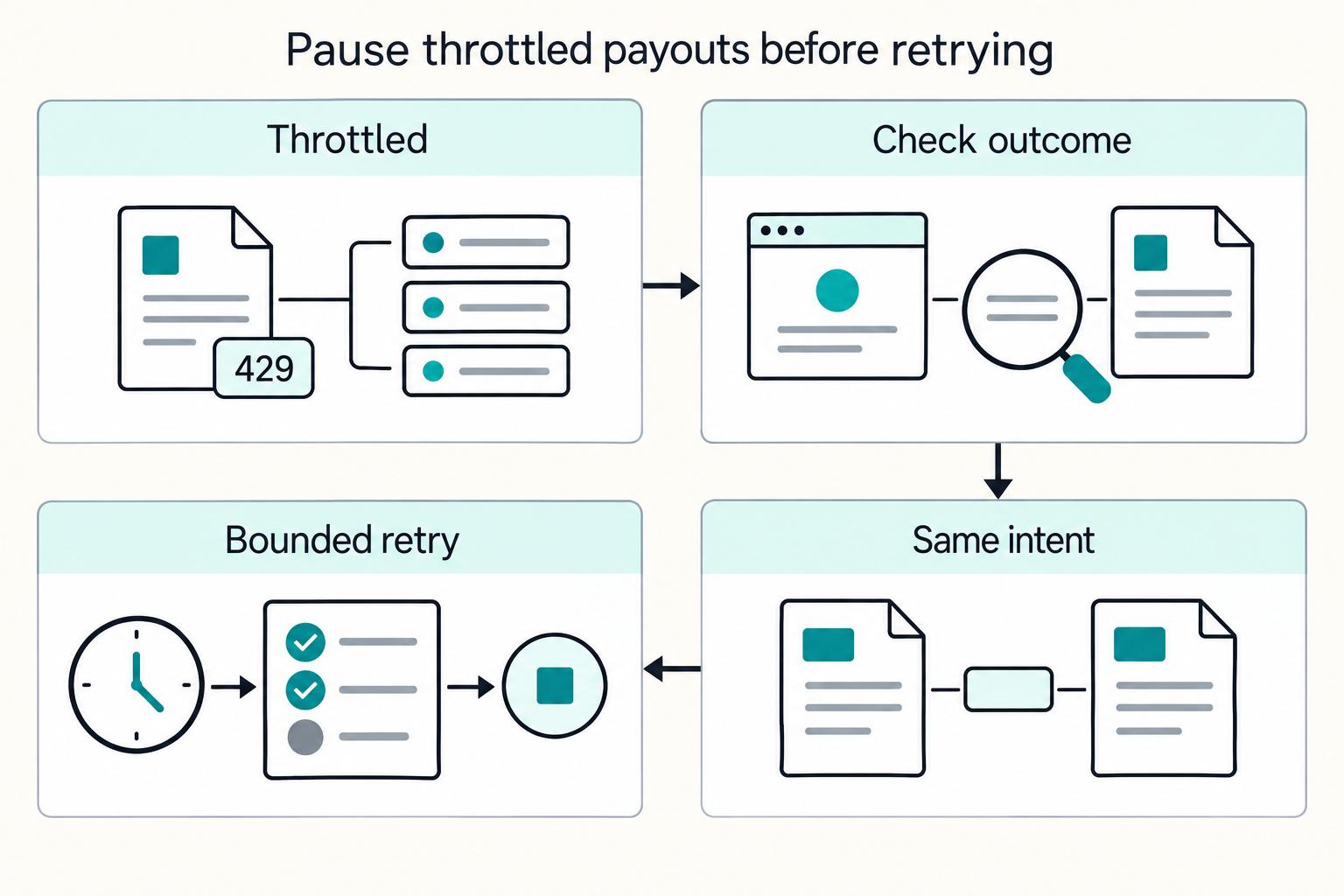
Separate rate, burst capacity and concurrency. Queue payout work fairly with bounded waiting, preserve durable intent and attempt identities, and resolve unknown submissions before replacement. Load-test internally with provider mocks, then expand only on observed recovery and reconciliation evidence.
Why Rate Limits Matter in High-Volume Payout APIs#
High-volume payouts do not always fail in one obvious, dramatic way. Failures often show up in the seams. A burst of legitimate traffic slows the API, retries pile up, one integration can eat shared capacity, and what looked like a small tuning issue turns into reconciliation pain and duplicate risk later. If you treat rate limiting and request throttling as something to sort out after launch, you can bake debt into the part of the integration you least want to revisit.
At the simplest level, a rate limiter controls how many requests a client can make in a specific timeframe. That sounds straightforward until payouts enter the picture. In a payout flow, slowing traffic is not just about protecting uptime. It also keeps request handling clear, because changes in request pace and retry timing affect how teams track what was accepted, what is pending, and what needs attention.
Sudden traffic increases can degrade service quality and can even lead to outages for all users. These controls also matter for abuse resistance. Rate limiting is commonly used to protect API availability from accidental heavy use, malicious bot traffic, and DDoS-related slowdowns. In practice, the limit policy is doing two jobs at once: shaping legitimate throughput and absorbing bad or noisy traffic before it degrades the service for everyone else.
Rate limiting shapes when an instruction can be submitted. It does not prove whether an earlier instruction moved money. Keep traffic admission, payout intent and financial outcome as separate records, so adding workers cannot create a second payment for the same obligation.
Before you ship, verify the exact details that matter in your provider's current docs and contracts, not from memory, snippets, or an old sandbox test. Check what the provider says about request caps and traffic shaping. A common failure mode is hardcoding assumptions from early tests, then finding at go live that production behavior, review requirements, or commercial limits are not what the team designed around.
So keep the scope grounded. Limits, recovery behavior, and compliance controls vary by provider and market. Use this article to make the right architecture choices early, then validate every provider-specific assumption before you put real payout volume through it.
Related: Integrated Payouts vs. Standalone Payouts: Which Architecture Is Right for Your Platform?.
Build the mental model before picking limits#
Separate request rate, burst capacity and concurrency. Rate measures requests over time; burst capacity permits a short surge; concurrency counts calls still in flight. Provider terminology varies, so record the actual behavior rather than relying on the words rate limiting and throttling.
This is not only a throughput topic. Rate limiting is also a key part of API security and is used to reduce the impact of a DDoS attack, so your design should account for both normal spikes and hostile traffic.
A common limit signal is HTTP 429 Too Many Requests. Treat 429 handling as a normal integration path, and verify your provider's real response format in testing instead of assuming behavior from memory or a generic SDK.
Also avoid the simplistic recovery pattern of fixed sleep() delays. That can reduce immediate pressure, but it is still brittle if retry behavior is not coordinated.
For broader payout platform design guidance, see Payout API Design Best Practices for a Reliable Disbursement Platform.
Choose the limit algorithm by payout traffic shape#
Pick the algorithm based on the traffic pattern you need to handle under pressure, then verify it with real traffic replay before you commit. A limiter's core job is the same in every case: when a request arrives, decide whether to allow it now, delay it, or block it. For payout APIs, that decision has to hold up under bursty traffic and aggressive retries while still matching real processing capacity.
| Algorithm | Behavior | Payout tradeoff |
|---|---|---|
| Fixed window | Count requests in each fixed interval. | Two adjacent windows can admit a boundary burst; size downstream capacity accordingly. |
| Sliding window log | Count timestamps in the trailing interval. | More precise window enforcement needs more per-request state. |
| Token bucket | Spend tokens per request; refill at a set rate up to capacity. | Allows a bounded burst but needs separate concurrency control. |
| Leaky bucket queue | Drain admitted work at a configured pace. | Smooths traffic, but bounded capacity and maximum waiting age are essential. |
For an illustrative internal token bucket, set capacity to 20 and refill to 5 tokens/second. With a full bucket, a simultaneous 30-request wave admits 20 and queues 10; ignoring other traffic and concurrency limits, the remaining 10 need at least 2 seconds of refill. These are design assumptions, not a provider quota. A separate four-call concurrency cap can still keep most admitted work waiting. AWS API Gateway also uses token buckets, but its throttles are best-effort targets rather than guaranteed ceilings.
Before finalizing, run a controlled test and answer three questions:
- Under burst and retry load, what was allowed now, delayed, and blocked?
- Did limiter decisions stay aligned with
Concurrency limits, queue depth, and in-flight payout creation? - Did any tenant or partner consume a disproportionate share near the threshold?
If you cannot explain those answers clearly, the algorithm choice is not production-ready yet.
Set policy layers by tenant tier and risk controls#
Do not put all payout traffic behind one shared cap. Use layered limits across global account, tenant, endpoint class, and actor role so one noisy integration cannot degrade everyone else.
A global limit protects platform capacity, but it does not guarantee fairness between tenants. Layered limits are the practical baseline for multi-tenant APIs: keep a global ceiling, then add tenant, endpoint, and actor-level controls so policy reflects both service tier and risk level.
Tiering should be explicit. Premium partners can have higher allowances, while lower-trust or higher-risk traffic stays tighter, especially on sensitive endpoint classes. That lets you differentiate commercially without silently overriding risk controls.
A starter matrix you can operate#
Use one matrix to define burst and sustained limits by tier and endpoint class. Limits are commonly expressed in fixed windows or requests-per-second formats, and even a compact table makes fairness and operations easier to review.
| Scope | Illustrative internal policy | Override |
|---|---|---|
| Provider/account write budget | Choose rate and concurrency below the contracted downstream capacity. | Time-limited approval with monitoring and expiry. |
| Standard tenant payout creates | Capacity20tokens, refill 5/second; fair queue per tenant. | Reduce pressure before requesting a higher limit. |
| Read/status traffic | Separate budget and polling interval; retain shared provider-account ceiling. | Prefer events or grouped lookups before raising polling. |
| Premium tenant | Larger approved share within the same global ceiling. | Cannot bypass risk controls or starve the base tier. |
| Sensitive actor/action | Additional role and risk checks; tighter admission policy. | Named reviewer and expiry, with the control decision logged. |
Separate tenant queues prevent one tenant from consuming every available slot. Use a bounded queue, maximum age and explicit admission-failure response; accepting unlimited work merely converts429s into invisible delay. In a distributed limiter, specify how atomic admission is enforced and how store outages behave. Gateway limits alone are unsuitable as a hard financial-spend cap.
Handle 429 responses without duplicate payouts#
Treat HTTP 429 Too Many Requests as a controlled pause, and treat any payout-create result you cannot confirm as unresolved. That is the safest way to avoid duplicate payout attempts under load.
Make 429 a bounded, observable event#
A 429 needs diagnosis, bounded backoff and jitter. Honor Retry-After when supplied; RFC 6585 makes that header optional. Keep the original payout intent while waiting, and stop automatic attempts at a documented limit. A timeout or an unclassified intermediary response does not establish that no payment was created.
Build replay safety into create calls#
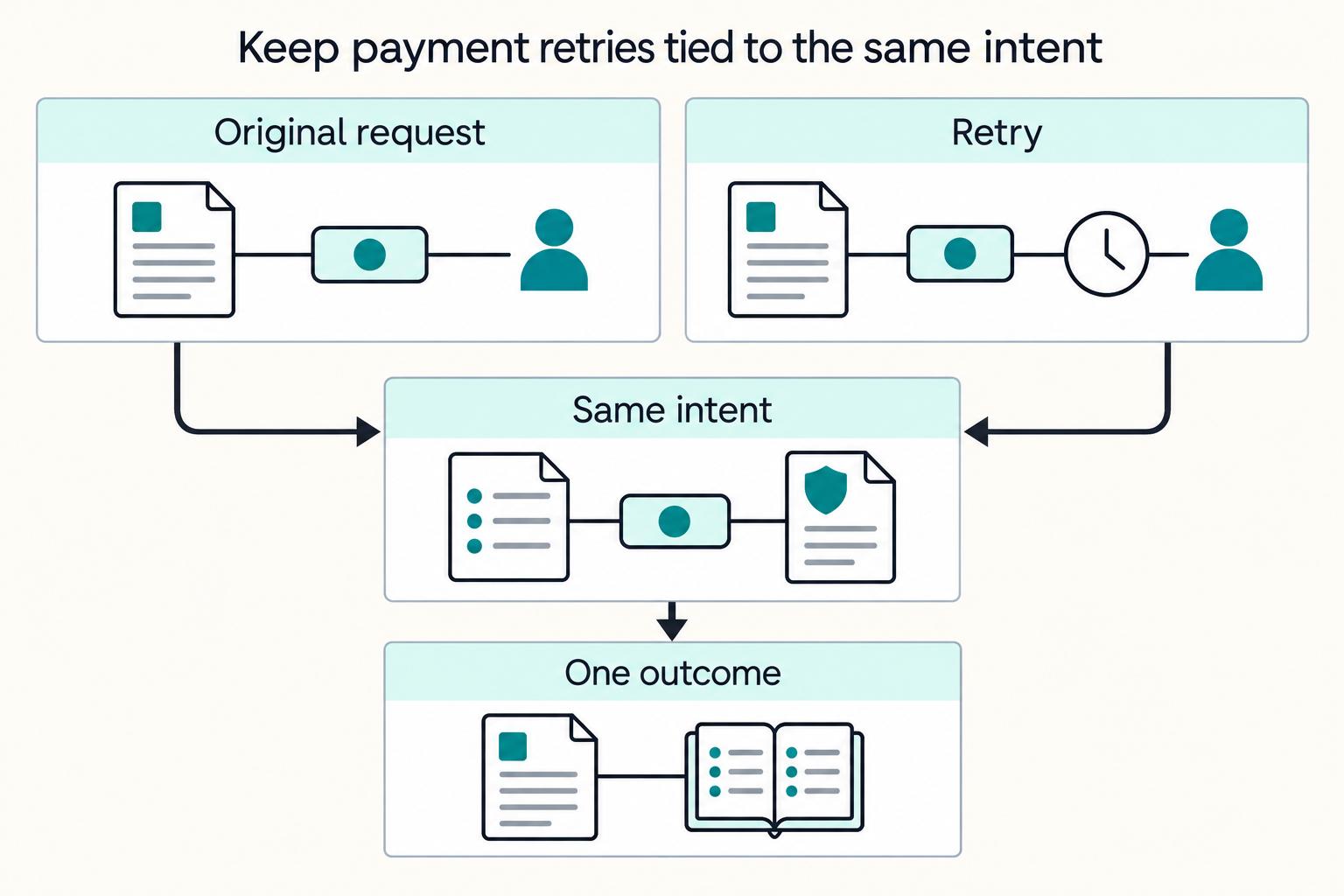
Persist one business intent plus each provider attempt before submission. Bind the idempotency key to provider, account, environment, operation and unchanged parameters; enforce uniqueness and worker ownership locally. Provider retention is finite: Stripe can prune keys after at least 24 hours and reusing a pruned key can create a new operation. It also caches the first executed result, including 500 responses. Repeating a cached error is not proof that the payment failed.
Resolve uncertain outcomes before sending a fresh create#
Resolve an unknown create result through provider objects, request references and reconciliation before replacing it or switching routes. A key expiry or an exhausted retry budget does not resolve uncertainty. If the supported lookup cannot establish the outcome, keep the obligation unresolved with an owner rather than creating a fresh payment. A later return is a new financial movement, not a reason to erase the original attempt.
For a deeper look at client error behavior, see API Rate Limiting and Error Handling Best Practices. For policy design that does not disrupt integrators, read Payment API Rate Limiting: How to Design Throttling Policies That Do Not Break Integrations.
Sequence rollout from sandbox to production without surprises#
Start narrow, promote on evidence, and confirm provider specifics early so rollout assumptions do not fail at production volume.
Load-test your own scheduler and workers against a provider mock with realistic latency and injected 429s, timeouts and delayed events. Use provider sandboxes for permitted functional checks. Stripe explicitly discourages using its sandbox for load tests because its limits and latency differ from live mode. A small approved live cohort can then establish real operating behavior before a gradual ramp.
Promote by gates, not by calendar#
Advance phases only when pre-defined gates are met and both engineering and operations sign off. Use gates such as:
| Gate | Requirement |
|---|---|
| Error rate | Stays within your agreed phase threshold |
| HTTP 429 Too Many Requests recovery | Works as designed, including Retry-After handling and bounded retries |
| Reconciliation | Passes at the target rate for the cohort |
For the article’s hypothetical rollout, replay known instructions only in the mock or an approved non-money test environment. In production, reconcile existing instructions and observe a small cohort of new obligations; replaying a paid batch can send real money twice. Match API attempts, authenticated events and financial postings by their distinct identities.
Validate provider specifics early#
For Stripe, inspect Stripe-Rate-Limited-Reason to distinguish rate, concurrency and resource limits. A 429 without that header may be a lock timeout. Payouts also have a documented concurrency cap, so adding workers can worsen pressure without increasing throughput. Check the selected account and endpoint contract before tuning.
Verify operations with failure drills and observability checkpoints#
Verify failure behavior, not just happy-path throughput. Your goal is to prove that traffic controls, alerts, and reconciliation checks still work when load spikes, responses degrade, or consumers lag.
Keep core request handling centralized with an API gateway policy (or equivalent) so traffic control is enforced before backend payout logic. When these controls are scattered across services, security, validation, logging, and traffic control become harder to maintain and diagnose consistently.
Run synthetic tests in Postman (or an equivalent runner) across burst traffic, sustained traffic, and mixed concurrency contention. Check for operational signals you can act on quickly: exact HTTP status behavior, retry handling, and traceability across request IDs and idempotency keys.
Authenticate events and commit a durable inbox with discoverable work before acknowledging under the provider contract. Recover unfinished work; commit local financial effects with their applied markers. Deduplicating receipt alone cannot prevent a crash from losing an acknowledged event or repeating a posting. Record actual money movement even if a control failed, and handle new-instruction permissions separately.
Run failure drills on purpose and repeat them on a regular cadence. Test provider slowdown, retry-storm scenarios, and degraded queue consumers, then confirm alerts fire early enough to act before backlog impact is visible to customers.
Use a fixed weekly checkpoint:
- top
HTTP 429 Too Many Requestssources - tenant hot spots
- idempotency replay counts
- unresolved reconciliation exceptions
Keep HTTP status codes intact in telemetry so response behavior stays practical for operators, especially when your API versioning model is designed around clear status signaling.
Catch architecture red flags early#
Use this section as an early warning check: if assumptions are implicit, rate-pressure failures will look random later even when the design risk was visible up front.
A shared limiter across very different endpoints and tenants is a risk signal worth testing, not an automatic failure. Verify whether polling or one noisy tenant can consume the same budget used by create calls, and make sure gateway logs can break throttling down by endpoint and tenant so fairness issues are visible.
A vague API contract is another early warning sign. Contract-first design should make throttling and error behavior explicit, including your 429 response shape and whether guidance like Retry-After or idempotency handling is supported. If those behaviors live only in client conventions, integrations can diverge under stress. Use chaos testing to compare what the contract says against what the gateway actually returns, especially when enforcement becomes inconsistent.
A final red flag is scaling traffic before exception-handling workflows can keep up. KYC/AML review, support escalation, and reconciliation still define system resilience during incidents, so treat them as part of the same layered control set rather than a separate operational concern.
For a step-by-step walkthrough, see OpenAPI Specification for Payment Platforms: How to Document Your Payout API.
Conclusion#
Before expanding volume, trace one throttled instruction from its durable intent through the original provider attempt, waiting policy and resolved financial outcome. The same intent should survive the pause; a new key or route needs evidence that the earlier attempt cannot pay.
Keep the token bucket, queue and in-flight limits visible together. If rejected traffic falls but waiting age rises, the queue may be hiding overload. If extra workers increase lock or concurrency errors, reduce in-flight work rather than raising every quota.
Increase volume only when the scheduler stays fair, waiting time stays bounded, uncertain attempts have owners and reconciliation accounts for original payments and later returns. Save the operating assumptions and observed failures so the next capacity change has evidence to build on.
Frequently Asked Questions
What is rate limiting in a payout API, and why is it different from generic API limiting?
A payout API rate limit restricts request volume over time. Payouts also need durable intent and attempt records: traffic admission does not prove whether money moved. Define the provider/account/endpoint scope, burst capacity, concurrency and how queued work expires.
What happens when payout limits are exceeded, and how should clients react to `HTTP 429 Too Many Requests`?
Pause immediate retries, diagnose the provider response and honor Retry-After when supplied. Use bounded backoff with jitter. Retain the original intent and supported idempotency context; resolve uncertain outcomes before a replacement payment.
How is request throttling different from API rate limiting in production payout flows?
Terminology varies. Specify what your system actually does: reject above a rate, allow a bounded burst, or queue and pace work. Keep a separate in-flight concurrency cap and bounded waiting time.
Which algorithm should we pick first for high-volume payouts: `Token bucket`, `Sliding window`, or another option?
Choose from the traffic shape: token buckets allow short bursts, fixed windows can burst at boundaries, sliding logs enforce a trailing window, and paced queues smooth arrivals. Test fairness and resource cost against your own workloads before picking thresholds.
Are payout APIs usually constrained by both request volume and `Concurrency limits`?
Yes, some providers document both. Stripe documents rate limits and a separate Payouts API concurrency limit. Verify the actual endpoint and account scope; a request-rate budget does not replace an in-flight cap.
Can limits vary by tenant tier, role, or partner type without breaking fairness?
Yes, but a larger allowance does not itself guarantee fairness. Use separate tenant queues or a documented scheduling policy within the shared global ceiling, and ensure premium traffic cannot bypass risk checks.
What details are still unknown before launch and must be confirmed directly with the provider?
Confirm limit scope, rate/burst/concurrency, error signals, Retry-After behavior, idempotency retention and request-resolution tools. Define the queue age, retry budget and unknown-outcome owner internally. Use mocks for load tests and provider-approved environments for functional checks.
Try a related tool
Where Gruv fits
Researched and edited by the Gruv editorial team. Gruv builds cross-border billing, payouts, and finance-operations software for global businesses.
Sources
Includes 2 external sources outside the trusted-domain allowlist.
Educational content only. Not legal, tax, or financial advice.
Related Posts

API Rate Limiting Error Handling for Payout and Webhook Integrations
If your team is integrating a Payouts API, onboarding flow, or reporting endpoint, a lone `setTimeout` is rarely a real answer once `HTTP 429 Too Many Requests` starts showing up. It may quiet the immediate error. It does not tell you whether you hit a provider limit, whether you should wait for `Retry-After`, or whether the final outcome will arrive later through `webhooks` instead of the original response.
Payment API Rate Limiting: How to Design Throttling Policies That Do Not Break Integrations
Treat rate limiting and throttling as an early architecture decision, not a late patch. In payment services, rate limiting is a policy control over who can access your API and how much they can request over time. Its job is broader than crash prevention: it supports fairness, stability, secure access, and user experience.
Integrated Payouts vs Standalone Payouts for Platform Architecture Decisions
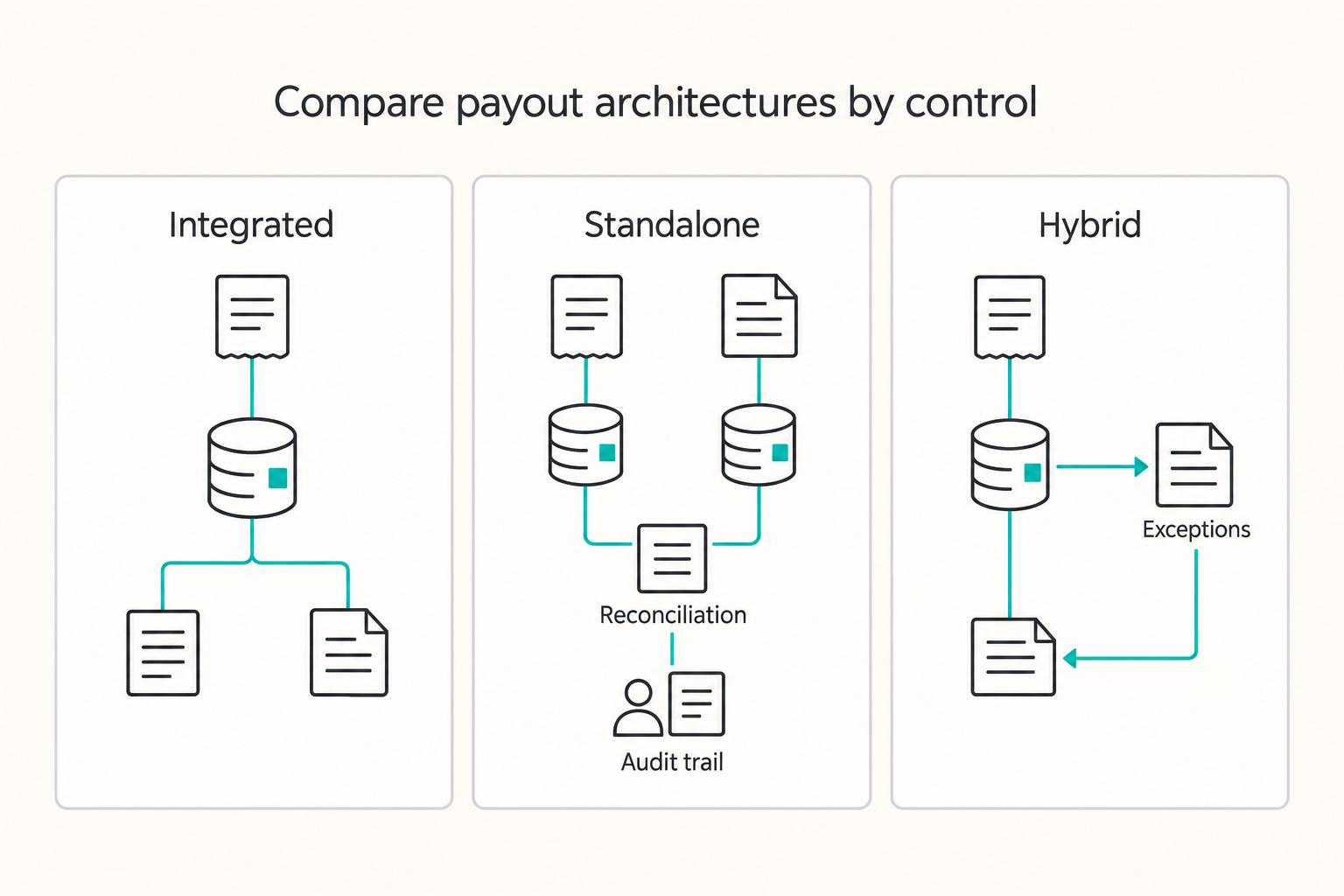
Here, integrated means a provider supports both collection and payout in the platform’s funds flow. Standalone means a separate provider executes disbursements, funded from your platform or another payment system. Hybrid means multiple governed routes. These are working architecture definitions, not universal vendor product categories.