
Quick Answer
Use payout data to classify payment experience and operating needs. Measure due obligations, receipt timing, repair burden and evidence coverage; separate platform/provider causes from contractor-attributable issues. Publish an operating band and a separate action-specific eligibility status. Payout history alone does not establish work quality.
Use Payout Data to Segment Contractors and Spot Top Performers#
Payout data shows the experience of getting paid: timing, repairs and unresolved obligations. It does not by itself establish the quality of a contractor’s work. Use it to segment payment operations and service needs; combine it with separately evidenced delivery or customer-quality measures before naming someone a top performer.
Start with observable behavior, not only broad profile buckets. A practical starting point is to group people by what their history shows about consistency, exceptions, and change over time. That gives operators something they can actually use.
Compare like-for-like payment conditions: corridor, method, currency, promised receipt deadline and provider incident exposure. Keep payer approval delays and platform or bank failures visible. Raw payment-experience bands diagnose where service needs improvement; they do not authorize a work-quality demotion or reduced contractor benefits.
Define top performer in terms teams can defend. A strong segment is not a vanity label. It should answer an operating question: who qualifies for expanded benefits, who should get incentives, and who needs tighter controls before you expand support. If you cannot tie a segment to a decision, the scoring logic is too abstract.
Start with a simple check. Take a small sample and ask cross-functional stakeholders to explain why each case belongs in a segment. If the explanations drift, your rules are still too loose. Write the logic in plain English, lock the scoring version used, and keep enough evidence attached that someone can retrace why someone moved up, down, or stayed put.
Build for auditability before you automate. This guide is about practical execution, not clever modeling. The goal is to turn raw data into segments you can trust, with explicit scoring rules, clear promotion and demotion logic, and decision records that hold up when someone asks for proof.
The common failure mode is blending performance, risk concerns, and business preference into one opaque score. Once that happens, teams stop trusting the output, and every exception turns into a manual argument. A better starting point is simpler and more defensible: separate what drives value from what blocks eligibility, review changes on a fixed cadence, and store the reason each case landed where it did. That's the sequence: prep work, scoring logic, publishing steps, and follow-through you need to act with confidence.
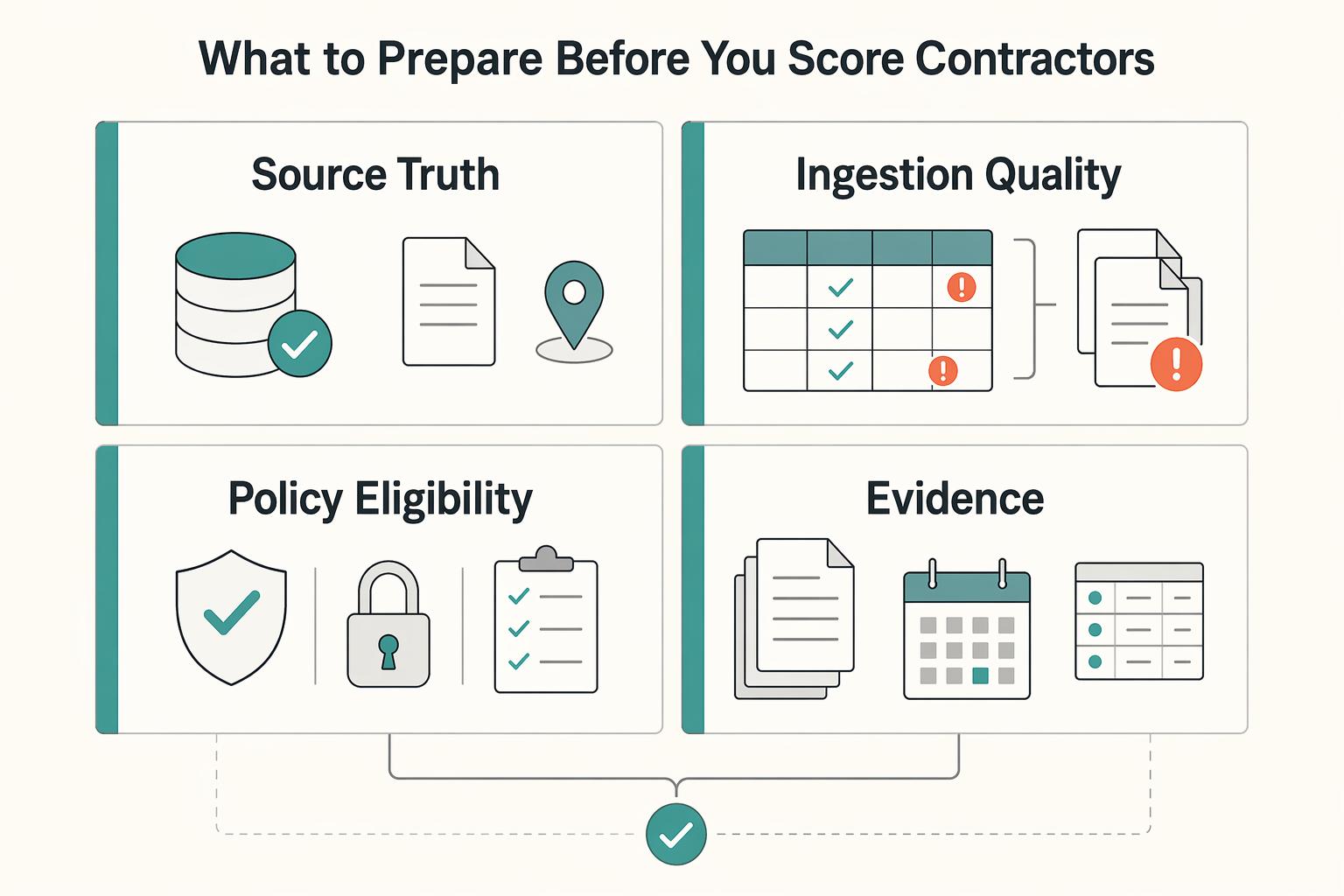
What to prepare before you score contractors#
Do not score contractors until ownership, policy gates, and evidence are explicit. That prep is what keeps a ranking defensible when Finance, Risk, and Ops review the same decision.
| Prep area | What to confirm | Why |
|---|---|---|
| Source of truth | Which records represent final payout outcomes and event timing, and one owner per critical field | So two reviewers can pull the same history for one contractor |
| Ingestion quality | Retries, duplicates, and late events are handled consistently; reconcile a small sample from raw events to posted records | So scoring is based on trusted data, not raw volume alone |
| Policy eligibility | Mandatory compliance and documentation gates stay outside the score, with statuses such as blocked or pending | So strong operational performance does not mask missing controls |
| Evidence pack | Save the data extract hash, scoring version, exception list, and Audit trail link on every refresh | So segment changes can be retraced and defended |
Confirm one source of truth and one owner per critical field. Define which records represent final payout outcomes and event timing, then assign clear ownership in Finance Ops or Data. If two reviewers cannot pull the same history for one contractor, fix that before scoring.
Validate ingestion quality before you trust volume. Check that retries, duplicates, and late events are handled consistently across your ingestion path, then reconcile a small sample from raw events to posted records. Keep the mismatch list as part of your controls.
Keep policy eligibility separate from performance rank. Define mandatory compliance and documentation gates outside the score, and use clear statuses such as blocked or pending when requirements are not met. This prevents strong operational performance from masking missing controls.
Save a minimum evidence pack on every refresh. Keep the extract hash, cohort cutoff, metric definitions, scoring version, data-quality exceptions and a link to your own decision history.
Before you move on, align the team on which record you will defend in a dispute. Tailor the process to your operating context, and treat examples as guidance rather than a substitute for your governing rules.
For a step-by-step walkthrough, see GDPR for Marketplace Platforms: How to Handle Contractor and Seller Personal Data Compliantly.
Define top performer with payout and risk signals#
Use separate records for the operating band, cause attribution and action-specific eligibility. If the business also wants a work-performance ranking, add independent delivery evidence. A high payout amount or an eligible account alone does not establish that someone is a top performer.
Separate operating experience from attribution and eligibility. Measure obligation-level receipt timing, cycle-time spread and repair burden. Record whether an issue came from contractor-supplied details, payer approval, platform funding, provider processing or an unresolved cause. Keep action-specific eligibility checks in a separate record; a payout delay is not automatically evidence of contractor misconduct or poor delivery.
For each band, preserve the measured inputs, scoring version and attributable causes alongside the current eligibility record. Keep any delivery-quality evidence separately identifiable so reviewers can see which facts actually support a service or incentive decision.
Use observed behavior before prediction. Publish measurable definitions and comparable cohorts first. When adding a predictive model, evaluate it on a later holdout period and review false positives by corridor and experience level. Historical restrictions can reflect past policies or operational failures; they are not neutral labels of contractor quality.
Apply the actual action gate outside the score. Record the requirement, evidence, owner, expiry and affected action for each hold. Repeated returns may trigger a bank-detail review rather than a blanket ban. Missing tax documentation needs the payer’s applicable withholding/reporting treatment, not a universal no-payment rule. W-9 and W-8BEN have different tax purposes and scopes; determine the appropriate form and treatment from payer, payee and payment facts.
Name the model’s scope. Label the output payment-operations band, with a separate eligibility status and cause attribution. Keep delivery quality, commercial value and marketing profiles distinct. Restrict access to personal data and give reviewers enough evidence to correct an inaccurate input or classification.
For a related read, see How to Use Payout Speed as a Competitive Advantage to Attract Top Contractors.
Build score bands and segment rules your teams can execute#
Make segmentation rules simple enough that Ops, Finance, and Risk can explain the same decision the same way. Start with a rules-based scorecard, then map contractors into fixed bands tied to clear actions.
Define each KPI, denominator and cutoff. Score payout obligations rather than API attempts, because one obligation can have retries, partial payments or returns. Record the agreed receipt endpoint and deadline. Keep pending or overdue obligations in the cohort and show their ages; do not improve the score by excluding unresolved cases. Compare trend only across equivalent windows and payment conditions.
A practical scorecard can include:
- On-time receipt rate: obligations fully received by their agreed deadline divided by all obligations due in the observation window
- Completion: fully discharged obligations as of the cutoff, with late, partial, returned and pending states separately reported
- Cycle-time stability: median and p95 timing at the defined endpoint for comparable routes, with pending ages alongside completed-case times
- Exception burden: obligations needing manual repair and support minutes, separated by accountable cause
- Trend: movement across comparable windows under the same definitions and policy version
- Evidence coverage: sample size, missing outcomes and receipt-proof coverage; insufficient data remains unrated
Keep eligibility gates outside any score. A required document or restriction can block a specific benefit or action while the payment-operations band remains visible. Preserve both records so a policy restriction cannot be mistaken for a low performance score.
Set weights only when you can defend the commercial reason for each one, and lock tie-break logic before refreshes so edge cases do not turn into ad hoc debate.
Define fixed segment bands with entry and exit rules. Teams execute categories better than decimal ranks.
| Segment | Enter when | Leave when | Observation rule |
|---|---|---|---|
| Top | Meets published reliability, repair and evidence rules across enough comparable observations | Rules no longer met after review | Keep eligibility as a separate overlay |
| Strong | Meets the baseline operating rules | Improves to Top or falls to Watch after review | Avoid promotion on one small sample |
| Watch | Observed reliability or repair burden needs investigation | Verified improvement across the required windows | Show cause attribution and correction owner |
| Unrated | Too little history or missing evidence | Evidence meets published minimum coverage | No-data is not zero performance |
Worked example: obligations, attempts and an illustrative band#
Take a hypothetical cohort of 100 obligations whose receipt deadlines have all passed. At the cutoff, 98 were fully received on time, one completed late and one is still pending. The on-time rate is 98/100 = 98%; completion is 99/100 = 99%. If retries generated 120 API attempts, that does not change either denominator. Keep the pending obligation and its age visible. If three obligations needed manual repair, the repair rate is 3/100 = 3%, even if one required four support contacts.
For an illustrative policy, Top requires at least 100 due obligations in each of two successive 30-day windows, on-time receipt at least 98%, attributable repair rate at most 2% and complete obligation/outcome and repair-cause coverage in both. Strong requires at least 95% on time and at most 5% attributable repair with the same sample, windows and coverage requirements; below those rules is Watch, while incomplete coverage, unresolved repair causes or too little history is Unrated. These thresholds are example choices, not validated industry benchmarks. Suppose the first window’s three repairs consist of one verified contractor-detail error and two platform funding errors. Its contractor-attributable repair rate is 1%, while total operational repair remains 3%. Even if it meets the Top metrics, one window cannot earn Top under this policy. A separate bank-detail restriction can still block a particular payout action without erasing the band. The raw timeliness thresholds classify the payment experience, including platform/provider delays. Use those bands to investigate and improve service. Any reduction in contractor benefits or work-performance ranking requires separate review of contractor-attributable and delivery evidence; raw lateness alone cannot justify it.
Document entry, exit and correction rules. Specify minimum sample size, observation windows, metric thresholds, tie-breaks and the responsible reviewer. Publish a separate eligible, pending-review or restricted status for each affected action. A change in eligibility does not rewrite the operating band; new evidence can correct it through a logged decision.
For reducing avoidable payment friction, read Invisible Payouts: How to Remove Payment Friction for Contractors Without Sacrificing Compliance.
Implement the data path from payout event to visible segment#
Your segmentation flow should be auditable before it is fast: every visible segment change must be traceable to a documented input, rule set, and publish step.
Keep one versioned transformation path. Link contractor and obligation IDs to attempts, provider movements and receipt evidence. Authenticate incoming events and process duplicates safely. As Stripe’s webhook guidance illustrates, deliveries may be repeated or arrive out of order; a delivery ID is not the same thing as a unique financial movement. Reconcile actual movements before marking an obligation discharged.
Make a refresh reproducible. The same extract, cutoff, policy version and transformation should reproduce the same result. Append late evidence with both effective and ingestion timestamps and create a new refresh or explicit correction; do not silently replace the published history.
Publish enough context for action. A reviewer should be able to see, in one place, the current segment, the scoring version, any active block, and what changed since the prior refresh. If those answers require stitching multiple tools together, the workflow is too fragile for scale.
Treat freshness and auditability as a paired control. Faster updates only help if teams can still explain why a segment changed. Keep each refresh tied to its rule version and exception state, and make late-arriving updates clearly visible in the change history.
Version discipline is the safeguard here: when Ops, Finance, and Risk are looking at the same version and status view, they can resolve edge cases quickly instead of arguing over moving targets. Related: How Platforms Can Use Payout Data to Predict Contractor Churn.
Turn segments into monetization decisions that improve margin#
Segments improve margin only when each band drives a specific action, and every action still passes eligibility controls.
Keep the decision order clear: use payment bands to improve operations, separately review attributable and delivery evidence for contractor treatment, then apply the specific action’s eligibility requirements.
| Segment signal | Default action focus | Guardrail |
|---|---|---|
| High commercial value + reliable payment experience | Prioritize retention and maintain dependable service | Fee or incentive changes need separately reviewed commercial and delivery evidence |
| High exception burden | Investigate causes and reduce platform/provider or contractor-detail rework | Raw exceptions do not justify reduced benefits; any adverse treatment needs reviewed contractor-attributable evidence |
| Mixed or deteriorating payment experience | Trigger service outreach and cause review | Avoid automatic rewards, penalties or work-quality demotions |
| Active action-specific restriction | Hold only the specifically restricted action or benefit until the required re-review clears it | Other actions retain their own eligibility; keep the operating band visible |
Use each segment as an operating decision with expected impact, steps and an owner. If using Gruv or another payout provider, confirm that the approved product, market and account support the proposed service level and fee treatment. A segmentation label does not create a payment capability or change the platform’s regulated role.
Keep the finance math visible before rollout: expected margin lift, operating cost, and downside risk for each action set. That is how you protect retention where it matters without quietly subsidizing avoidable friction. We covered this in detail in Spend Analytics for Platforms That Turns Payout Data Into Cost Decisions.
Validate model impact and recalibrate on a fixed cadence#
A segmentation model is only working if it improves decisions you can explain and defend, not just scores you can generate.
Validate decision impact first. Check whether each diagnostic band produces its intended service investigation or improvement. For changes to contractor fees, benefits or work access, verify the separately reviewed attributable and delivery evidence, rather than using raw payment delays as the reason. Confirm restrictions remain limited to their specified actions.
Compare affected cohorts with an appropriate baseline or holdout, keeping route mix and observation windows comparable. Record operating cost and support burden as well as retention. If an action produces no measurable benefit or unfairly shifts provider failures onto contractors, adjust the rule or remove the action.
Check coverage and friction. Inspect missing receipt evidence, low sample sizes, unresolved cause attribution and outcomes by corridor. Recalibration is about definitions and data quality as well as score math. Fix a faulty input promptly; a scheduled policy review is not a reason to leave a known error affecting someone’s treatment.
Use each cadence review to scan:
- segment churn
- common block reasons
- repeated exception patterns
- whether your evidence pack still explains segment movement clearly
If teams cannot explain outcomes in plain English, simplify the model before adding complexity. Related reading: Payout Error Rates in Contractor Payroll Teams Can Actually Reduce.
Common mistakes and how to recover fast#
The fastest way to improve contractor segmentation is to separate control status from performance rank and keep the model tied to repeatable behavior.
| Mistake | Recovery |
|---|---|
| Treating volume or provider delays as contractor quality | Separate commercial volume, payment experience, cause attribution and delivery evidence |
| Blending controls and ranking into one opaque score | Split output into two tracks: a performance band and a separate control status |
| Promoting or demoting on short-term noise | Require a pattern across multiple observations before changing tiers so movement reflects signal, not one-off events |
| Overbuilding before definitions are stable | Start with clear behavioral definitions, then add more advanced methods only after labels and outcomes are consistent |
| Copying GTM segmentation logic into payout operations | Rebuild around payout-native KPIs and decision steps, then keep exception handling explicit and limited |
Mistake 1: Treating payout volume or provider reliability as contractor performance. Volume can matter commercially, but timing can reflect your own funding or banking path. Recovery: retain raw experience metrics, separate causes and compare similar routes. Use independently evidenced delivery measures before awarding a work-performance label.
Mistake 2: Blending controls and ranking into one opaque score. When control checks and performance are mixed, reviewers cannot tell whether a contractor is high-performing, out of policy, or both. Recovery: Split output into two tracks: a performance band and a separate control status. This improves decision clarity and trust.
Mistake 3: Promoting or demoting on short-term noise. Single-cycle swings create unstable segments and constant debate. Recovery: Require a pattern across multiple observations before changing tiers so movement reflects signal, not one-off events.
Mistake 4: Overbuilding before definitions are stable. Jumping to AI-predictive methods before base definitions are clear creates complex scores teams do not trust. Recovery: Start with clear behavioral definitions, then add more advanced methods only after labels and outcomes are consistent.
Mistake 5: Copying GTM segmentation logic into payout operations. GTM frameworks, for example firmographic or technographic segmentation, answer different questions than payout execution. Recovery: Rebuild around payout-native KPIs and decision steps, then keep exception handling explicit and limited.
For onboarding-related causes, read Contractor Onboarding Optimization: How to Reduce KYC Drop-Off and Get to First Payout Faster.
Conclusion#
A useful model starts with comparable obligations, clear receipt deadlines, reliable evidence and attributable causes. Publish a payment-operations band and a separate action-specific eligibility status. Use the payout record to improve service and repairs; use additional delivery evidence for decisions about work quality.
Keep each refresh reproducible and each action explainable. Review errors, unresolved causes and low-sample cases before changing treatment. Then compare outcomes with the expected benefit so segments guide operational improvements rather than simply relabeling provider or platform failures.
Frequently Asked Questions
Should high volume ever outweigh a control block?
No. In this framework, value/performance and control/risk status stay separate on purpose. High volume may matter to a commercial decision, but it should not override unresolved risk flags.
Can we start with `AI-predictive segmentation` instead of observed behavior?
Start with explainable observed payment metrics and explicit cause attribution. Evaluate predictive features against a later holdout and inspect false positives. Keep human review of decisions affecting access, fees or service treatment, and provide a way to correct faulty source data.
Why not keep everything in one score?
Because one score hides too much. Teams need to see whether an account is high-value, high-risk, or both. A single number makes it harder to tell which factor drove the outcome.
What should appear in the evidence pack every time?
Keep source inputs, segmentation definitions, scoring/model version, and any data-quality exceptions. That is the minimum record that lets someone retrace why an account moved, stayed put, or was held.
How often should we refresh the segments?
Choose a cadence that matches payout volume and your team’s ability to review evidence. Show an as-of time on every publication. Resolve action-specific eligibility changes when current evidence arrives; correct known data errors promptly and version rule changes at the scheduled review.
When should an account move out of Restricted?
Resolve the specific restriction with the required evidence and accountable reviewer. Recheck the affected action’s eligibility, then review the existing operating band on its own evidence. Clearing a restriction does not automatically promote the band, and the band should not have disappeared while the restriction was active.
Try a related tool
Researched and edited by the Gruv editorial team. Gruv builds cross-border billing, payouts, and finance-operations software for global businesses.
Sources
Includes 1 external source outside the trusted-domain allowlist.
Educational content only. Not legal, tax, or financial advice.
Related Posts
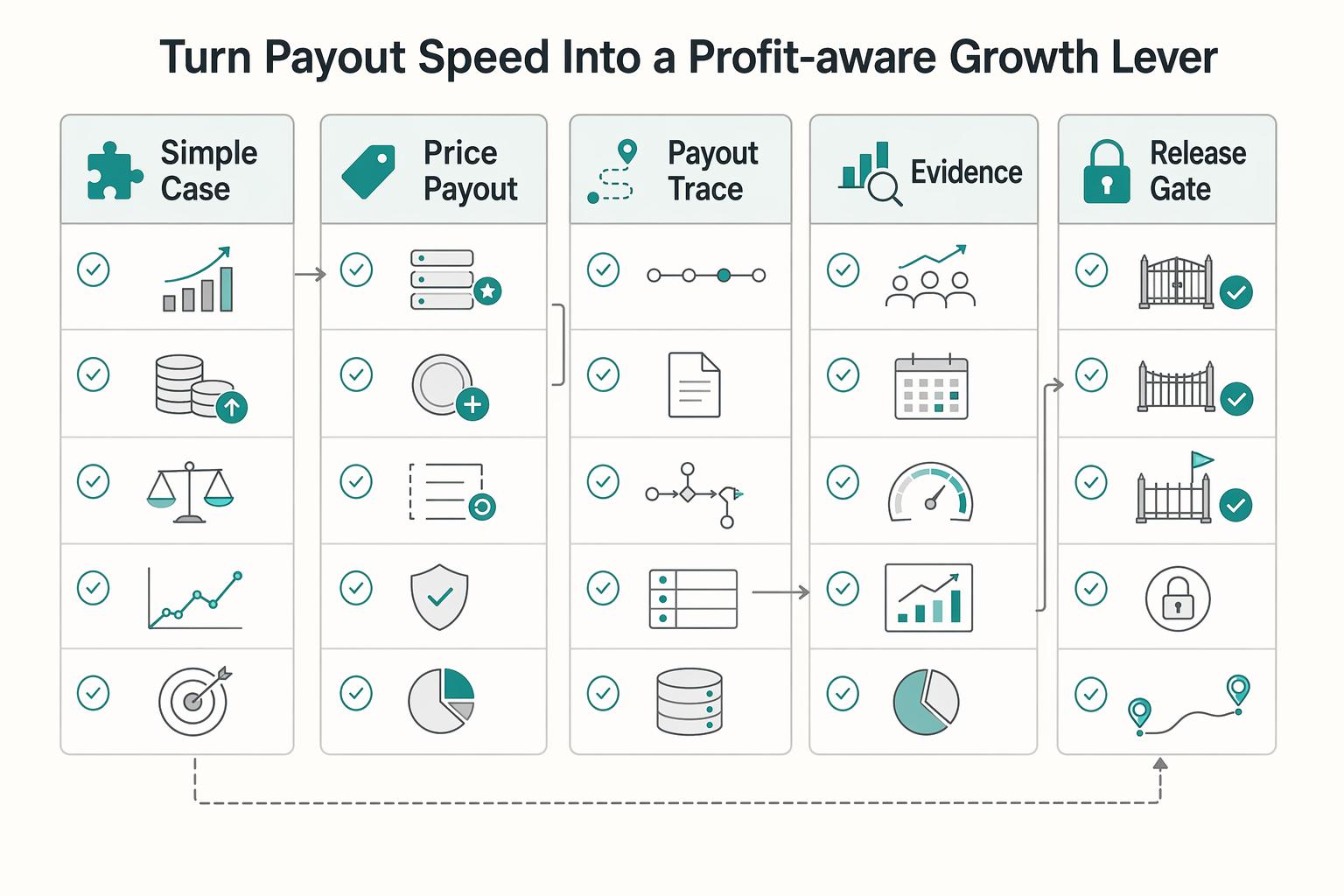
How to Use Payout Speed as a Competitive Advantage to Attract Top Contractors
Payout speed can help you attract independent contractors, but only if you treat it as a pricing and operations decision, not a blanket perk. The real question is not whether faster pay sounds attractive. It is where speed should be free, where it should be paid, and where your current process is too slow for a faster rail to matter.
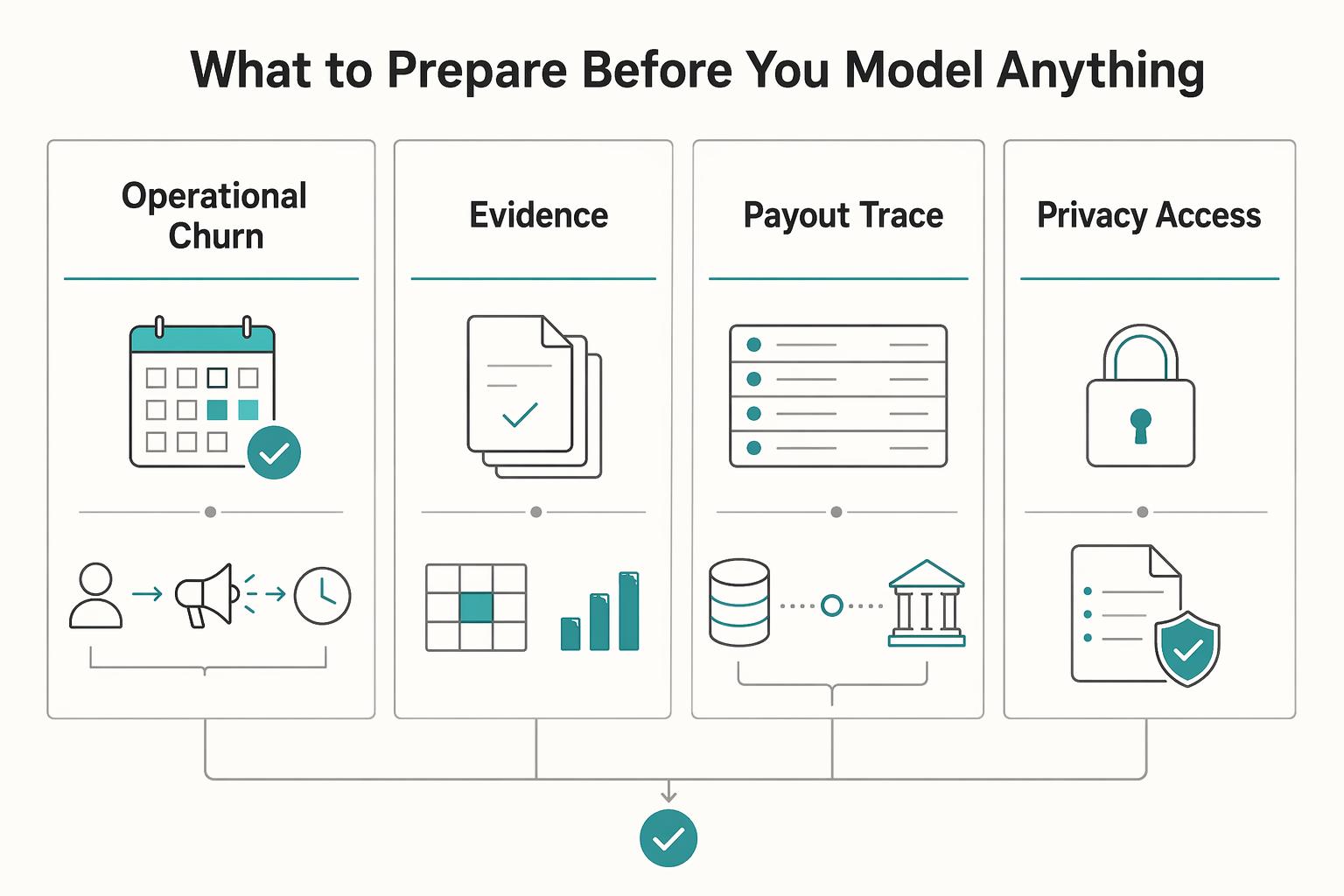
How Platforms Can Use Payout Data to Predict Contractor Churn
Treat contractor churn as a supply problem first, with payments as a potentially useful early signal. If your payout signals cannot trigger a concrete save action or margin decision, they are analytics, not useful prediction.
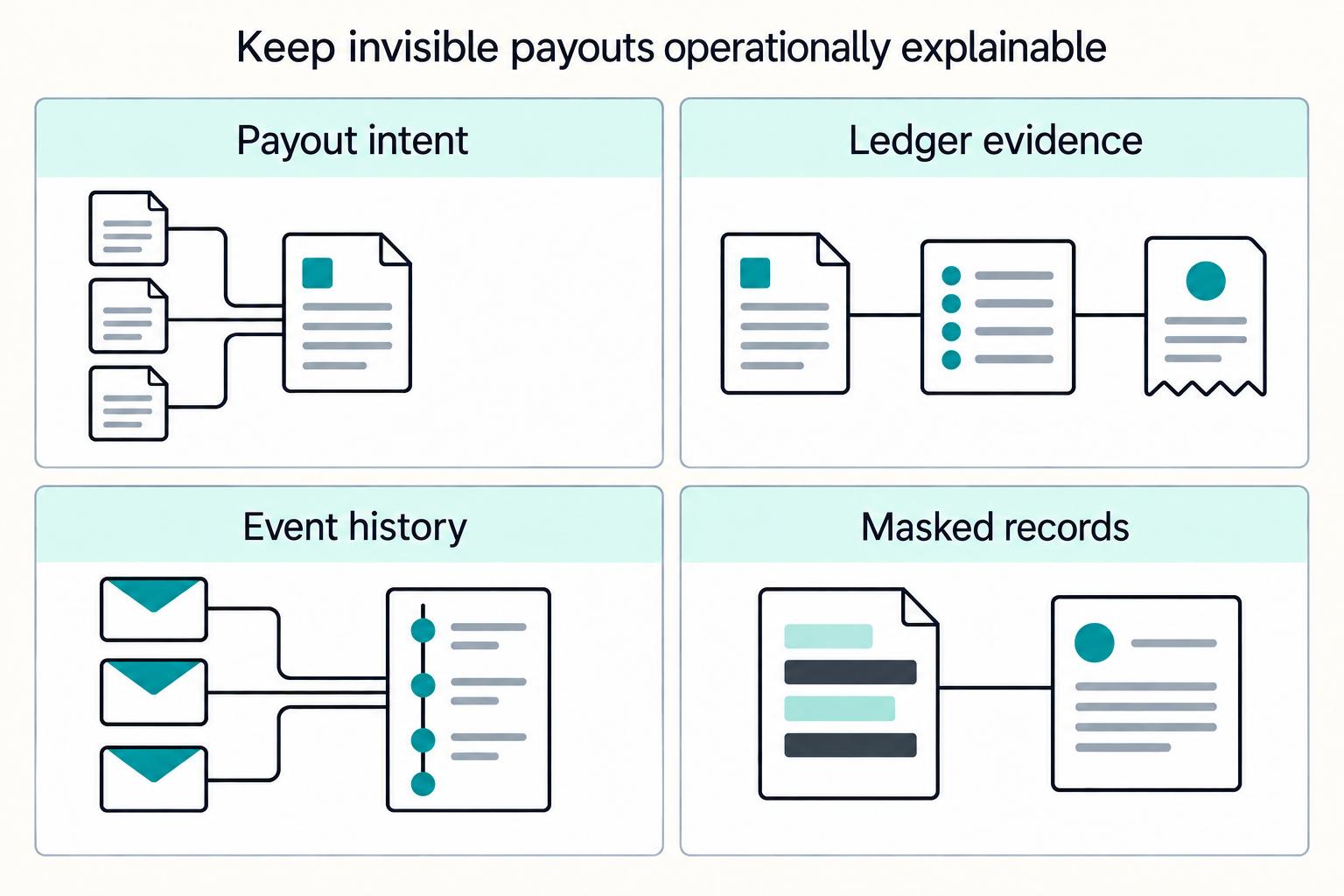
Invisible Payouts: How to Remove Payment Friction for Contractors Without Sacrificing Compliance
Invisible payouts should make life easier for contractors without hiding the controls your team needs. Contractors should get a predictable, low-friction flow, while internal teams can still enforce and document payout decisions when needed. If you run contractor payouts at scale, you need both outcomes at once. We recommend treating every easy payout as a controlled release path your team can replay later.