
Quick Answer
Describe payout operations, schemas, permissions, lifecycle states, errors, idempotency, timeout recovery, webhook processing, reconciliation, and version policy in one maintained contract. Separate OpenAPI format and document versions from deployed API versions. Test one approved obligation through normal completion and uncertain-outcome recovery before controlled release.
Why most payout API docs fail in production#
Payout API docs often fail in production when they describe endpoints, not obligations. If you want teams to integrate and operate a payout API with confidence, treat the OpenAPI specification as the production contract from day one, not a side artifact generated after code ships.
| Check | Signal | Meaning |
|---|---|---|
| Spec format | openapi: 3.1.2, for example | Format version, separate from document and deployed API versions |
| Spec format | swagger: 2.0 | Older format with known limitations compared with OpenAPI 3 |
| Request-body detail | Request bodies do not define actual properties | Consumers cannot reliably tell what the API expects or how it behaves |
| Tooling usability | Incomplete specs | Can block validation, analysis, mocking, testing, and SDK generation |
This guide develops a payout contract that an engineer can implement and an operator can investigate. OpenAPI describes the HTTP interface; lifecycle, replay, and reconciliation behavior still need explicit definitions and tests. The examples below are proposed contract choices, not Gruv endpoints or guarantees supplied by OpenAPI.
Use three fast checks before you debate endpoint count:
- Confirm the spec format in the header.
The openapi field identifies the specification format; info.version identifies the document version, and neither automatically selects the deployed API version. As of October 2026, OpenAPI 3.2.1 is published. Choose a version your validators and generators support; the examples here use 3.1 conventions. Swagger 2.0 is an older format with different capabilities.
- Check request-body property detail.
If request bodies do not define actual properties, consumers cannot reliably tell what the API expects or how it behaves.
- Check tooling usability, not just readability.
Incomplete specs can block validation, analysis, mocking, testing, and SDK generation. That is usually where contract gaps get expensive.
For CTOs and engineering leads, the real risk is hidden ambiguity, not cosmetic docs. When the contract is vague, teams fill in the gaps differently, and those differences show up later during integration and operations. This guide assumes the specification is your source of truth from the start.
Define the payout contract before you write endpoints#
The first useful split is not by resource name. It is by obligation. Initiation, retrieval, and exception handling are different surfaces, so treat them that way before you expand endpoints.
- Separate initiation from retrieval.
Keep payout submission and payout lookup as distinct operations. eBay's GET /sell/finances/v1/payout/{payout_Id} makes this explicit: retrieval depends on a specific payout identifier in the path, and that lookup contract should stand on its own.
- Treat exceptions as first-class API actions.
Expose review or remediation outcomes that your operating model actually supports. Adyen’s deprecated staged Payout API required confirmation or decline after submission. That historical model illustrates acceptance versus release; it does not establish a mandatory reviewer step for every payout API.
- Use provider docs as signals, not templates.
Provider artifacts can show quality patterns, but they also encode provider-specific lifecycle choices. For example, Adyen marks storeDetailAndSubmitThirdParty as deprecated for new integrations and positions the Transfers API to handle multiple payout use cases. Use that as lifecycle and migration input, not a shape to copy as-is.
- Write scope boundaries early.
State what your external payout API covers and what it does not. If you do not set that boundary up front, teams will infer different responsibilities and the contract will drift.
Gather prerequisites and evidence before drafting the spec#
Do not start drafting until ownership, runtime choices, and source evidence are clear. A short decision pack up front saves churn later because the spec reflects confirmed decisions instead of assumptions.
| Step | What to capture | Grounded details |
|---|---|---|
| Step 1 | API goal, intended users, whether scope is internal or external, and operational ownership | Include developer onboarding, authentication, permissions, and support; decide where routing and enforcement live |
| Step 2 | Prior OpenAPI or Swagger files, auth details, endpoint descriptions, error guidance, and support-facing integration guides | Label each artifact as current, legacy, external example, or confirmed unknown; record owner, last validation date, and whether it matches current auth, endpoint, and error behavior |
| Step 3 | Reliability, traceability, or compliance controls | Record them as explicit requirements with clear owners and mark unresolved details as open items |
| Step 4 | Drafting acceptance criteria | Core integration paths can be exercised in a test environment; auth, endpoint, and error behavior are documented clearly enough for engineering and operations to use |
Step 1. Write the decision pack before you open Swagger#
Define what you are building and for whom before anyone compares tools or endpoint shapes. Start with four inputs: the API goal, intended users, whether scope is internal or external, and operational ownership.
For an external API, include developer onboarding, authentication, permissions, rate limits, and support in scope. Decide where authorization, throttling, and routing are enforced. An API gateway can provide some of those controls, but it is an architecture choice rather than an OpenAPI prerequisite.
Check that engineering, payments operations, and finance can describe the same scope and ownership. Resolve disagreements before freezing the contract: for example, who owns an accepted request whose provider result is still unknown?
Step 2. Collect the truth sources you already have#
Start with existing artifacts before you write new contract text. Gather prior OpenAPI or Swagger files, auth details, endpoint descriptions, error guidance, and any support-facing integration guides already in use.
If you review external API references, use them as comparison inputs, not templates to copy. Label each artifact clearly as current, legacy, external example, or confirmed unknown.
For each source, record the owner, last validation date, and whether it matches current auth, endpoint, and error behavior. As APIs get more complex, this becomes operationally necessary. OpenAPI and Swagger automation can help keep docs consistent and current, but you still need to validate docs against current behavior.
Step 3. Name the non negotiables now#
Lock non-negotiable controls before endpoint design begins. If reliability, traceability, or compliance controls are in scope, record them as explicit requirements with clear owners now.
Keep each requirement and owner visible, and mark unresolved details as open items for later sections. Do not rely on "we will clarify in prose later" for controls that affect reliability or compliance.
Step 4. Freeze acceptance criteria for drafting readiness#
Set drafting acceptance criteria before you write path objects. A practical baseline is simple: core integration paths can be exercised in a test environment, and auth, endpoint, and error behavior are documented clearly enough for engineering and operations to use.
Ask for evidence, not opinions. Confirm that a generated client or test harness can call a sandbox or mock without manual patching, and confirm that operations can trace behavior to documented request and response records. If those checks are not ready, close the gap first.
For SAP-specific integration handoffs, see SAP Integration for Payment Platforms: How to Connect Your Payout Infrastructure to SAP ERP.
Map payout lifecycle states and sync versus async boundaries#
Map the payout lifecycle before freezing schemas. Define states from your actual platform and provider behavior, and explain what a synchronous response establishes. HTTP 202 means accepted for processing, not completed. Even HTTP 201 creates a resource; it does not by itself establish that the recipient was paid.
Step 1. Define your state vocabulary as a contract choice#
Define payment states such as requested, processing, paid, failed, and returned separately from review_status. Manual review is a decision process, not necessarily a payment lifecycle state. For each state, record its entry evidence, permitted transitions, owner, and whether a later return can change the financial result.
If engineering, ops, and support would classify the same payout differently from logs and events, tighten the definitions before you touch schema design.
Step 2. Declare the sync versus async boundary in client-operable terms#
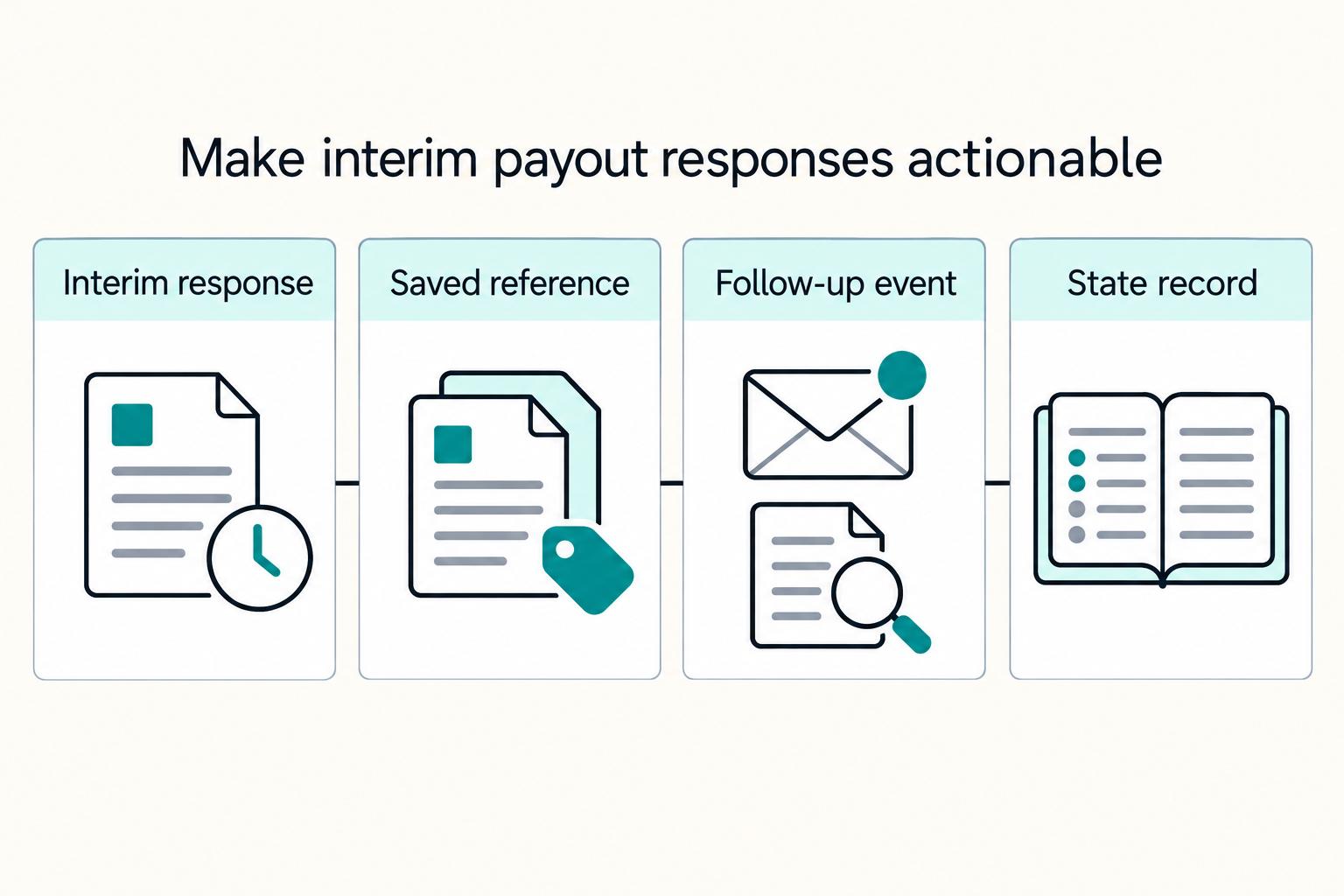
Decide which responses are interim and which are terminal. Then document the next observable step for each interim response. State the identifier the client must persist and whether follow-up happens through Webhook, status retrieval, or both.
For example, an accepted response can identify payout_id=po_123 and client_reference=invoice_42 while payment remains processing. A timeout before the caller receives that ID leaves an unknown outcome. Publish lookup by the client reference or a supported same-key recovery path so the caller can investigate without submitting a new payment intent.
Step 3. Publish a compact state review table before freezing schemas#
Use a review table as a release gate, not filler. For each state, record the operational action, user-facing status text, and retry behavior so those choices are explicit and testable.
A simple table is enough:
| State | Operational action | User-facing status text | Retry behavior |
|---|---|---|---|
| requested | Persist instruction and verify required gates | Request received; not yet sent | Recover original intent; do not submit a new key |
| processing | Query provider status and retain reservation | Payment processing | Wait or poll within documented limits; no replacement while unknown |
| paid | Record provider evidence and reconcile | Provider reports payment completed | Do not recreate; monitor applicable return events |
| failed | Classify failure and check funds/provider outcome | Payment failed; action depends on reason | Replacement only after confirmed failure and approved remediation |
| returned | Record return as a new financial event | Payment returned | Reconcile original and returned funds before deciding on replacement |
Step 4. Mark rail and market variability explicitly#
For each supported rail and market, publish eligibility, cutoff/time-zone rules, expected timing, and return or recall behavior confirmed by your program. Keep platform acceptance separate from provider submission and rail settlement. A rail name alone does not establish your API’s processing or recovery contract.
Each exposed state and async path should map to one confirmed operational meaning and one observable next step.
Related: FedNow vs. RTP: What Real-Time Payment Rails Mean for Gig Platforms and Contractor Payouts.
Design endpoint and schema structure for long-term compatibility#
This is more a contract-stability decision than a naming exercise. Keep endpoint, request, response, error, and data-type definitions in one OpenAPI artifact.
Step 1. Keep endpoints minimal and clearly scoped#
A proposed minimal surface is POST /payouts to submit an instruction, GET /payouts/{payout_id} to retrieve it, and GET /payouts?client_reference=... to recover an uncertain submission. Add cancellation or review actions only where supported, with eligibility rules and race outcomes. These illustrative paths are design examples.
Use a simple test: each endpoint should answer one client question. If one endpoint mixes initiation, overrides, and exception handling, the surface is doing too much.
Step 2. Keep schema representations aligned from one source#
Keep request and response schemas, required fields, reusable errors, and examples in the same versioned contract. A proposed creation request includes client_reference, beneficiary_id and beneficiary_version, amount_minor, currency, and an approved obligation reference. Define amount_minor as an integer with currency-specific exponent and range; for USD, 100000 means $1,000.00. Never let a floating-point example silently define financial precision.
Before release, verify that names, enums, nullability, and timestamp formats match across generated artifacts. Small endpoint or schema edits can break previously working integrations, so treat naming and structure cleanup as a pre-release compatibility decision.
Step 3. Treat errors as contract elements#
Define stable machine-readable errors and next actions. RFC 9457 provides application/problem+json with fields such as type, title, status, detail, and instance; domain codes or request IDs can be documented extensions. Keep the HTTP status consistent with the problem status. Distinguish validation rejection from an uncertain execution result: a timeout or 5xx does not establish that no payment occurred.
A proposed error matrix uses 401 for missing/invalid authentication, 403 for insufficient permission, 409 for an idempotency-payload conflict, and 422 for a validly encoded but unacceptable instruction. Document 429 retry guidance and distinguish temporary unavailability from business failure. These choices need implementation tests. Redact sensitive details and direct unknown execution outcomes to status recovery before any replacement.
Step 4. Tie extensibility to versioning rules#
Leave room for future optional attributes, but do not assume that alone prevents breaking changes. Compatibility comes from disciplined change rules and explicit versioning.
Publish compatibility rules for your document, deployed API, and SDK separately. Adding a response enum value can break exhaustive client code, while a new required request field or changed amount semantics can break existing calls. SemVer is useful only with a documented compatibility definition and tests; a minor label does not prove a change is safe.
Run CI checks for breaking spec diffs before rollout so incompatible changes fail before production.
Specify authentication and replay safety as contract requirements#
Authentication and replay behavior should be written into the API contract, not left to onboarding folklore. When those rules live outside the spec, integrations can become brittle and drift as real behavior changes.
Step 1. Document authentication as testable contract behavior#
Declare supported security schemes and apply security requirements to operations; describing a scheme alone does not require it. Document credential provisioning, rotation, permissions, environment separation, and failure responses. Test that a credential cannot read or release another tenant’s payouts. Keep secrets out of examples and logs.
Include real-system checks alongside mocks: one successful authenticated call and one failed-auth call with the expected response shape. This helps catch auth-behavior drift that frozen mocks can miss.
Step 2. Define replay and idempotency semantics in contract language#
Specify supported endpoints, key format, scope, retention, equivalent-payload rules, and concurrent-request behavior. Keep the same key for the same immutable intent; changed amount, currency, or beneficiary details must follow documented conflict handling. Define whether failed validation consumes a key, whether execution errors are replayed, and how callers retrieve an original result after a timeout.
Here is a proposed recovery flow: the client sends key invoice_42_v1 for USD 100000 minor units to beneficiary ben_7 version 3, then loses the response. It queries client_reference=invoice_42 and finds po_123 processing. It keeps that attempt and reservation rather than creating a new key. If no result is found, the contract must distinguish a definitive rejection from still-uncertain processing before allowing replacement.
Step 3. Make mismatch handling explicit and deterministic#
For this proposed contract, reuse of invoice_42_v1 with USD 110000 returns a documented conflict and creates no second payment. State which fields are compared and whether normalization matters. Concurrent calls for the same approved obligation must not independently reserve and release funds, even if callers supply different keys.
Also define what makes two requests equivalent for replay purposes. Without that boundary, teams cannot reliably distinguish valid retries from changed instructions.
Step 4. Use real-system checks for production-critical flows#
Use provider-approved sandbox checks for authentication, authorization, same-key retries, changed-input conflicts, concurrent workers, and unknown outcomes. Mocks can verify client handling but cannot prove provider execution semantics. Separate the tests you can run safely in a sandbox from any approved production verification.
Record the request, response or timeout, recovered provider reference, and local financial effect for each case. A safe retry test succeeds when one approved obligation produces one intended payment and one posting, including when a worker crashes between provider execution and local persistence.
Document compliance and tax gates without leaking sensitive data#
Document compliance and tax gating only to the level your active program rules and API responses support. If you cannot show the relevant action, returned state, and owning policy in your system, keep the wording general instead of implying a universal rule.
Step 1. Document the action and returned contract state#
Write each gate as testable API behavior, not shorthand. For every gate you expose, state which action it affects and what response shape the integrator receives.
For a proposed beneficiary_verification_required response, document that creation is rejected without a payment attempt, link an authorized remediation route, and say when submission becomes eligible again. If your system instead accepts the request and holds it, expose the payout ID and held state. Those two models need different client recovery behavior.
Step 2. Keep tax-profile references bounded to what your API actually exposes#
Separate payout lifecycle behavior from tax-profile signals. If you surface tax-document status, describe only what your contract returns and where that state is maintained.
Do not let readers infer a universal prerequisite model. If a tax signal is not exposed in this surface, say that plainly.
Step 3. Make sensitive-data handling explicit in contract notes and examples#
Use tokenized beneficiary references and masked bank details where your actual response supports them. Document field access, retention, and log redaction, and prohibit full tax IDs, bank credentials, or signing secrets in examples and diagnostics. A masked API field does not prove every log or webhook is also redacted.
A practical check is consistency: schema names, examples, and operational guidance should describe the same data-exposure behavior.
Step 4. Qualify scope in plain language#
If your active program documentation defines market or program differences, qualify scope directly in the spec and point integrators to your supported discovery method. Clear qualifiers reduce false assumptions in client logic.
Version program eligibility and gate rules with the contract. A generic or retired draft cannot establish which suppliers, markets, documents, or checks your production program requires. Link current program documentation and give clients a supported way to discover actionable eligibility.
Make webhook and reconciliation contracts impossible to misread#
The first question this section should answer is simple: what can an integrator rely on, and what is intentionally unspecified? If that line is fuzzy, webhook handling and reconciliation drift into manual interpretation.
Step 1. Write delivery behavior as guarantees or explicit non-guarantees#
Publish signature algorithm and raw-body verification, timestamp tolerance, secret rotation, delivery attempts, acknowledgement rules, ordering limits, duplicates, and recovery retention. Where your service makes no ordering guarantee, require consumers to tolerate stale events. A proposed handler verifies and durably stores an event before acknowledgement, then processes it asynchronously with event-ID and financial-effect deduplication.
In OpenAPI 3.1, top-level webhooks describe provider-initiated requests independent of an earlier operation; callbacks describe requests tied to an operation. Choose the representation that matches your subscription model. If you expose subscription CRUD, document endpoint ownership, permissions, destination verification, event selection, and disablement separately.
Step 2. Define recovery paths for callback gaps and mismatches#
Document operator handling for three cases: missing callbacks, late callbacks, and mismatched provider references. For each case, name the authoritative fallback surface, for example status API, event history, or reconciliation export, and the identifier used during investigation.
For history and backfill, publish timestamp format and time zone, filter semantics, cursor or page rules, retention, and a resumable recovery example. Do not assume page 1 or Link-header pagination unless the API uses them. Preserve event_id, payout_id, client_reference, provider_reference, occurred_at, and an ordering/version field where available.
Step 3. Add a reconciliation table template that maps events to finance evidence#
Use a compact table next to event schemas so operators and finance teams apply the same rules without interpretation.
| Event or category | Contract behavior to define | Finance artifact to name | Escalation trigger to define |
|---|---|---|---|
| payout.processing (illustrative) | Instruction exists; outcome remains pending | Open attempt and reserved amount | Unknown beyond the documented operating window |
| payout.paid (illustrative) | Provider completion evidence; define any later-return behavior | Payment allocation, provider reference, gross amount, fees, net and ledger posting | Missing bank evidence or bill allocation |
| payout.returned (illustrative) | Return is a distinct financial effect | Original payment link, returned amount, fees and corrective entry | Return cannot be matched or original was incorrectly recreated |
Step 4. Tie webhook outcomes to month-end close#
Reconcile obligations, payment attempts, allocations, and bank/ledger movements rather than raw webhook counts. For an illustrative $1,000 obligation with a $10 separately agreed transfer fee, specify whether the supplier receives $1,000 and the platform pays $1,010, or receives $990 after deduction. State currency, gross/net definitions, fee bearer, and rounding so finance can reproduce the result.
Control versioning and deprecation before your first external release#
Set your versioning and deprecation approach before launch so integrators can predict how the payout API will change and what support window they have.
Step 1. Choose one versioning style and apply it everywhere#
Choose a deployed API versioning style, such as path or header, and document routing, discovery, and caching behavior. Keep it consistent in examples and SDK configuration. The OpenAPI format version and document info.version remain separate; neither automatically changes server routing.
If you use Semantic Versioning for contract releases, define breaking, compatible-addition, and fix categories explicitly. Review enum expansion, nullability, permissions, error meaning, and financial precision against real clients; a version label alone does not ensure compatibility.
Step 2. Define deprecation as a lifecycle, not a one-off announcement#
Define version states in the contract: active, deprecated, and retired. In deprecated state, keep the version available but stop adding new features. Plan for overlap, because multiple versions can be active at the same time during migration.
Publish a clear notice window and migration guidance in release communications. An 18-month deprecation-to-retirement window is one provider benchmark, but your policy should be explicit for your platform.
Step 3. Audit impact before release#
Review a representative usage window, for example 30–90 days, plus infrequent clients and scheduled year-end jobs that may not appear in it. Produce a release-risk report and migration priority list with affected operations, owners, and retirement dates. Treat the window as a planning choice, not proof that all consumers were found.
When a change is not backward-compatible, treat it as a major version change.
Related reading: Payment Benchmarking for Platforms That Need Defensible Payout Decisions.
Move from sandbox to production with explicit verification gates#
A clean sandbox run helps, but it is not enough on its own for production readiness. Set explicit pass or fail gates before launch.
| Gate | Detail | Check |
|---|---|---|
| Environment targeting | Your documented sandbox and production server URLs | Separate configuration and credentials; no accidental live release |
| Authentication | Actual provider scheme and required permissions | Success, invalid credentials, insufficient permission, rotation |
| Token/session behavior | Published lifetime and renewal semantics, if applicable | Expired access, renewal, tenant separation, and retry of the same intent |
| Controlled production stage | Observe real environment targeting and auth behavior | Expand only after results are stable |
| Shared readiness pack | Spec version, generated client output, auth test logs, and reconciliation examples | Stakeholders review the same evidence |
| Rollback gates | Measurable internal symptoms that indicate loss of control | Pause or roll back when those symptoms appear |
Step 1. Gate environment targeting and authentication first#
Verify the server URLs documented for your own sandbox and production environments, with separate credentials and configuration. Make tests fail if a sandbox run could release live funds. Generic payment-provider hostnames are not substitutes for your payout API’s actual servers.
Test the actual authentication scheme, permission boundaries, credential rotation, and token expiry or renewal if tokens are used. A renewal after a timed-out payout must recover the original intent rather than resubmit with a new key. Record expected failure responses without including secrets in the readiness pack.
For replay checks, record both provider outcome and local obligation/ledger outcome. One HTTP response per test does not prove a single payment when requests or events race.
Step 2. Use an initial controlled production stage#
Use an initial controlled production stage. Observe real environment targeting and auth behavior, and expand only after results are stable.
Focus on failure classes that directly affect launch safety: environment mismatches, token issuance or use failures, and integration states you cannot trace through your payment flow.
Step 3. Use a shared readiness pack for stakeholder review#
Use a shared readiness pack so stakeholders review the same evidence. Keep it lightweight, but include artifacts that show traceability from API activity to internal records.
A practical pack can include spec version, generated client output, auth test logs, and reconciliation examples. If your team needs to tighten system handoffs, ERP Integration Architecture for Payment Platforms: Webhooks APIs and Event-Driven Sync Patterns is the adjacent design problem.
Step 4. Define rollback gates before you ramp traffic#
Define measurable gates such as unexplained duplicate payments, unresolved unknown outcomes, failing signature verification, or unreconciled financial effects. Pause affected new releases and preserve records for investigation. Rolling back application code does not undo funds already sent; recover those attempts through the documented provider process.
Document what sandbox testing proves and does not prove in your release record, and revisit those limitations after your first production stage.
If your team wants a concrete reference for webhook, idempotency, and status-driven integration patterns, review the Gruv developer docs.
Common mistakes and how to recover fast#
The fastest recoveries usually come from fixing meaning before polish. If integrators cannot tell what your API does and why it is useful, cleaner endpoint docs alone will not remove the ambiguity.
Step 1. Document behavior meaning before you regenerate docs or clients#
Document behavior meaning before you regenerate docs or clients. A common mistake is publishing endpoints and schemas without clearly saying what each visible status means and what should happen next.
Recover by defining those semantics first, then regenerate references and SDK artifacts from that source. Keep it practical: include plain-language technical writing plus code samples and examples so a new engineer can trace one integration flow without asking for interpretation.
Step 2. Validate that documentation matches real integration behavior before release#
Treat Swagger or OpenAPI generation as documentation support, not proof of production operability. Reliable developer experience starts with an API teams trust to integrate with, not just valid shapes and generated clients.
Recover by validating that documentation matches real integration behavior before release. Keep a small evidence set that ties documented requests and examples to observed outcomes.
Step 3. Avoid vague wording and make behavior explicit#
Avoid vague wording in docs. Phrases like "subject to review" create uncertainty for integrators and support teams.
Recover by making behavior explicit: document likely outcomes and the partner's next action when automation cannot proceed. Keep the language clear and implementation-aware without exposing sensitive details.
Step 4. Mark deprecations and explain behavior-impacting changes#
Do not hide behavior changes. If meaning changes without clear communication, documentation stops being accurate and up to date.
Recover with a formal deprecation and migration approach: mark deprecated fields and endpoints, explain behavior-impacting changes in plain language, and include before-and-after examples for changes that affect integration behavior.
Copy and use this launch checklist#
Use this as a release gate. If any item is ambiguous, pause broad rollout and fix the contract before more integrators build on it.
Step 1. Make scope explicit in the spec and the prose#
Make scope explicit in both the machine-readable spec and the human guidance. Your OpenAPI or Swagger contract should clearly cover payout initiation, status, and exceptions, while the prose explains ownership boundaries between API behavior and internal operations.
A practical check: a generated REST client can create a payout and retrieve status without verbal clarification, and the conceptual docs explain architecture-level behavior, especially auth and webhooks, that reference docs alone do not.
Step 2. Prove replay safety with real sandbox requests#
Prove replay safety with tests, not policy text. Document how Idempotency-Key handling behaves for retries and for key reuse with changed input.
Run real sandbox requests and compare first and repeated responses side by side, including key-reuse scenarios. Watch for drift across environments, payload shapes, or payment methods.
Step 3. State webhook verification, retry, and ordering expectations#
Treat async reliability as reconciliation, not just event delivery. Your Webhook docs should state verification expectations, retry handling expectations, ordering assumptions, and how event identifiers map back to payout and reporting records.
Readiness check: payments ops can trace one payout from request acceptance to final status using API responses, webhook payloads, and reporting or ledger references without spreadsheet cleanup. If you want a deeper pattern, see event-driven sync guidance.
Step 4. Represent compliance gates without exposing sensitive data#
Represent compliance gates clearly without exposing sensitive data. Integrators should be able to tell when compliance checks are blocking progress, and what action is expected next.
Validate examples, not just schema shape: include blocked-state responses, masked-field patterns in logs and events, and clear operator-versus-platform resolution paths.
Step 5. Publish versioning and deprecation policy before broad adoption#
Publish versioning and deprecation policy before broad external adoption. Keep versioning behavior consistent across spec files, generated SDK artifacts, changelog, and migration guidance.
A new engineer should be able to find the current API version, document revision, breaking-change notice, retirement date, and migration example. An OpenAPI format label such as 3.1.2 establishes the description format, not the deployed API version or payment behavior.
Step 6. Agree cross-team readiness and controlled release#
Consider one cross-team readiness review and, when appropriate, a limited production cohort before full ramp. Align engineering, payments ops, and finance on validation ownership for generated clients, auth, retries, exception handling, traceability, and reconciliation from source calculations through disbursement status and ledger postings.
Confirm prerequisites for the specific provider program before implementation. For example, Mastercard’s OAuth 1 signer repository documents a developer project, consumer key, and private signing key. That signature model is program-specific; do not assume every Mastercard product or payout provider uses the same authentication or onboarding process.
When you are ready to validate your payout contract against real operational constraints, explore Gruv Payouts.
Frequently Asked Questions
What is the minimum a payout-focused OpenAPI Specification must include beyond endpoint definitions?
Include supported operations and permissions, amount and currency rules, beneficiary references, lifecycle and review states, errors, idempotency scope and retention, timeout recovery, webhook verification and recovery, reconciliation fields, and version/deprecation policy. Pair schemas with one normal flow and at least one uncertain-outcome example.
How is documenting a payout API different from documenting a general payment API?
Payout documentation must make the outgoing obligation, beneficiary, authorization, funding/reservation, provider submission, completion evidence, and returns traceable. General payment APIs may share those concerns, but payout acceptance must not be mistaken for recipient receipt. Define those distinctions for your actual platform.
How do Idempotency-Key rules prevent duplicate payouts in real integrations?
A supported idempotency key associates an unchanged request with an earlier attempt within its scope and retention. Document mismatched-payload and concurrent-call behavior, and keep application-level obligation controls. After a timeout, recover the original reference/status before any replacement: a fresh key can create a fresh payout.
What should be synchronous versus asynchronous in payout flows, and why?
Return immediate validation and acceptance information synchronously, including a stable reference when a resource is created. Publish processing, completion, failure, and return outcomes through documented retrieval and events as applicable. A 202 response indicates accepted processing, not successful delivery; tell callers exactly how to follow it.
How should teams version payout APIs without breaking existing integrators?
Define compatibility policy, separate format/document/API versions, and test changed schemas and behavior against existing consumers. Publish deprecation and retirement dates with before/after examples and an overlap period. Do not assume new enum values or changed error meaning are harmless because fields remain present.
What webhook guarantees should we require before trusting status updates?
Require documented authenticity verification, delivery/retry behavior, duplicates, ordering limits, event IDs, and a fallback status/history surface. Persist verified events durably, process each financial effect once, and reconcile against authoritative payout and bank evidence. Webhook arrival alone does not prove final settlement.
What should we verify in provider docs when payout details are incomplete or ambiguous?
Verify supported endpoint and version, recipient/rail eligibility, permissions, amount/currency rules, acceptance versus completion, idempotency retention/scope, timeout lookup, return handling, and reconciliation fields. Get ambiguous financial behavior resolved before using it in release logic; record remaining operational limitations.
Researched and edited by the Gruv editorial team. Gruv builds cross-border billing, payouts, and finance-operations software for global businesses.
Sources
Includes 8 external sources outside the trusted-domain allowlist.
- developer.ebay.com/api-docs/sell/finances/resources/payout/meth...external
- developer.payments.jpmorgan.com/api/versioningexternal
- docs.adyen.com/api-explorer/Payout/67/post/storeDetailAndSu...external
- github.com/Adyen/adyen-openapiexternal
- github.com/Mastercard/oauth1-signer-goexternal
- rfc-editor.org/rfc/rfc9110.htmlexternal
- rfc-editor.org/rfc/rfc9457.htmlexternal
- spec.openapis.org/oas/v3.2.1.htmlexternal
Educational content only. Not legal, tax, or financial advice.
Related Posts

The Freelance Payment Penalty: A Modeled Audit of Platform Fees, FX Spreads, and Payout Delays
The money rarely disappears through a single, easy-to-spot fee. The real loss is stacked. A marketplace takes its commission, a processor adds a charge for international cards, a bank or payment company converts the currency at a spread, a platform holds the funds before release, and a wire sheds a little to intermediaries on the way in. Each layer looks defensible on its own, but the worker feels the combined result as a smaller deposit and a later payday.

How to Respond to a Subpoena for Business Records
Move fast, but do not produce records on instinct. If you need to **respond to a subpoena for business records**, your immediate job is to control deadlines, preserve records, and make any later production defensible.

A US Expat's Guide to Investing in UCITS ETFs to Avoid PFIC Issues
The real problem is a two-system conflict. U.S. tax treatment can punish the wrong fund choice, while local product-access constraints can block the funds you want to buy in the first place. For **us expat ucits etfs**, the practical question is not "Which product is best?" It is "What can I access, report, and keep doing every year without guessing?" Use this four-part filter before any trade: