
Quick Answer
Document five non-negotiables before coding: idempotent write retries, webhook 2xx acknowledgment, response/error mapping, sandbox limits, and live cutover checks. Put provider specifics in flow docs, such as PayPal-Request-Id on supported POST calls and post-timeout replay rules, so engineers verify final payment state instead of trusting one HTTP response. This is the fastest way to reduce duplicate charges and launch surprises.
What to Look for in Payment API Documentation#
Payment API docs are most useful when they make failure behavior and operating boundaries clear before implementation starts. Endpoint and field references matter, but teams also need explicit rules for retry safety, asynchronous events, response and error handling, sandbox limits, and live cutover steps.
A strong guide explains response codes and expected outcomes, not just endpoint names. It should also define duplicate protection for write requests and the webhook acknowledgment behavior your service must follow. If you are writing docs for your own integration team, we recommend making those rules explicit before anyone starts coding. Without those details, teams have to resolve key behaviors during implementation instead of during design.
Idempotency is the first checkpoint. Stripe documents idempotency as a way to retry requests without performing the same operation twice, with keys up to 255 characters. Adyen documents idempotency keys as valid for a minimum period of 7 days after first submission. Treat those as provider-specific contract details, and confirm your timeout and retry behavior before coding.
Webhooks are the second checkpoint because payment outcomes can arrive asynchronously. Stripe points teams to webhooks for asynchronous events, and PayPal defines webhooks as HTTPS posts to your server when an event occurs. PayPal also requires a 2xx response for successful receipt and can retry non-2xx deliveries up to 25 times over 3 days. That means acknowledgment behavior belongs in the core integration design.
Test environments matter, but they do not replace live-readiness checks. PayPal describes sandbox as a virtual environment that simulates production, and Stripe test mode does not affect live data or banking-network interactions. Adyen separately documents that test setup is not copied to live, with live configuration spanning account, finance, risk and compliance, API communication, and webhooks.
Before wiring requests, confirm these five items in the docs:
- Write paths have a documented retry and idempotency story.
- Webhook handling rules and acknowledgment expectations are explicit.
- Response parameters and error codes are documented.
- Sandbox or test-mode limits are clearly named.
- Live go-live checks are listed as separate operational work.
Define what good payment API documentation must do#
Good payment API documentation defines outcomes and failure behavior, not just endpoints and fields. In practice, that means the guide should cover the payment lifecycle across initiation, status updates, and confirmation or reconciliation so engineers can see how state changes over time. If you own the integration handoff, we recommend making that lifecycle visible before your team writes the first retry loop.
Useful documentation also separates required integration behavior from optional enhancements. Teams should be able to ship a thin, reliable version first, then add clearly marked optional steps later, as in Google Pay's "Step 10 (optional): Set up Authorize Payments."
Use one money-moving write path as your first checkpoint. The docs should let you answer, in one pass:
- What state changes after the request.
- What response or event confirms the outcome.
- What identifier you must persist.
- What retry rule applies if the client times out.
If idempotency is required, for example PayPal-Request-Id on supported PayPal POST APIs, that rule should be in the main integration flow, not buried. PayPal warns that omitting it can duplicate a request.
Webhooks are the second checkpoint. The docs should explicitly state acknowledgment requirements (2xx), duplicate-delivery handling, storage-before-processing expectations, and retry or redelivery windows. Adyen requires accepting webhooks with a 2xx status code, storing the message, and then processing it. Stripe notes duplicate events can occur and retries undelivered events for up to three days. If those rules are missing, treat the documentation as incomplete. In practice, teams can get burned when idempotency is left implicit.
Map docs to the merchant payment processing lifecycle#
Once you know what good looks like, organize the docs by the work your team actually has to do, not by endpoint groups. In practice, an internal guide can use five working phases: discover, integrate, validate, launch, and operate. We recommend using the same owner-and-evidence structure your delivery team will use in launch reviews.
PayEngine is a strong model for this structure. Its docs are explicitly organized as lifecycle-phase sections in the merchant payment journey. Navigation covers onboarding, processing payments, and reporting. Its V2.5 orchestration overview also describes support across every phase of the merchant lifecycle. Use that pattern as the shape, then make ownership explicit in your own docs so handoffs are testable. We recommend naming the owner, evidence, and exit check in the same section your engineers will actually use.
| Phase | Example owner | Example entry criteria | Example evidence artifacts | Example exit check | Example risk focus (not exclusive) |
|---|---|---|---|---|---|
| Discover | Product | Use case, markets, payment methods, and integration path are defined | Architecture note, scope decision, provider capability gaps | Team can explain the chosen integration path before endpoint work starts | Functional breakage |
| Integrate | Engineering | Auth, core write path, identifiers, and response-code handling are understood | Sequence diagram, endpoint matrix, persisted IDs, retry notes | One money-moving flow works end to end with known success and failure states | Functional breakage |
| Validate | Engineering + Ops | Sandbox access, test scenarios, webhook endpoint, and expected events are ready | Simulated transaction tests, webhook verification, payment-flow tests | Happy path and failure path pass in sandbox | Functional breakage, financial mismatch |
| Launch | Ops + Product sign-off | Go-live checklist, live credentials, support plan, and rollback path exist | Production checklist, approved config, contact roster, launch window plan | Live settings and controls are verified before first real traffic | Compliance hold |
| Operate | Ops | Alerts, reconciliation path, incident path, and support surfaces are in place | Reconciliation output, status-page links, escalation matrix, reporting checks | Team can detect, explain, and resolve anomalies without guesswork | Support escalation, financial mismatch |
Use phase gates that are grounded in provider guidance. Global Payments says integration planning starts by choosing an integration path. Stripe's testing guidance calls for simulating transactions, verifying webhooks, and testing payment flows in a safe environment before go-live, and Stripe provides a go-live checklist. Adyen's launch checklist adds concrete live configuration areas: account, finance, risk and compliance, API communication, and webhooks.
For launch sequencing, keep operational timing in view. Adyen notes Mastercard 3D Secure enrollment can take up to 12 hours. For operate-phase controls, pair transaction-level reconciliation artifacts, for example Adyen Settlement details reporting, with API outcome signals, such as J.P. Morgan response codes, and an external status surface, such as Worldline's status page. That helps teams separate provider incidents from integration defects faster.
If you apply one rule, apply this one in your own docs: each phase should end with a documented owner, a clear exit check, and explicit evidence. That is what turns documentation into an execution plan instead of a reference dump.
For authentication tradeoffs in payment APIs, read Choosing OAuth 2.0, JWT, or API Keys for Production APIs.
Choose your integration architecture before endpoint work#
Choose the integration shape first, then wire endpoints. If you need speed and lower maintenance, start with the highest abstraction you can accept. If you need deep checkout control, plan for more frontend, state, and operational ownership. We recommend writing that tradeoff down in your design note so your team is not rediscovering it during implementation.
Provider docs show the same pattern. Stripe recommends Checkout Sessions for most integrations, while Payment Intents is for building your own checkout flow and requires the most coding. Global Payments labels direct API integration as high-code. Adyen positions Drop-in as a pre-built UI option. Worldpay supports both hosted and API-based approaches, and Integrated Commerce allows using hosted and direct methods in combination.
| Integration shape | Best fit | What your team owns | Main tradeoff |
|---|---|---|---|
| Hosted payment gateway flow | Fast launch, lower frontend scope, standard checkout is acceptable | Redirect or embedded handoff, basic session creation, return handling | Less checkout UX control and less control over some payment behavior |
| Direct API integration | Custom checkout, tighter UX control, specialized flow requirements | UI, validation, payment state handling, failure paths, maintenance | Highest coding effort and ongoing maintenance |
| Hybrid for platform payments | Mixed requirements across merchants, channels, or rollout stages | Clear routing rules across hosted, prebuilt UI, and direct paths | Can add routing, fallback, and state-consistency complexity |
Use abstraction by default until a real requirement breaks it#
A hosted path is usually the safest starting point when launch risk and maintenance load matter. Integrated Commerce describes Hosted Payment Pages as a quick, secure way to add card acceptance on provider-hosted pages. Stripe Checkout similarly uses prebuilt UI and supports more than 100 local payment methods in that flow.
Choose direct API integration when the requirement is explicit, not assumed. Stripe's docs are clear that custom checkout means you build checkout features yourself and take on ongoing maintenance. That shifts more ownership to your team for checkout logic, error handling, and operational maintenance.
Hybrid can be the right platform-payments model, but only with explicit boundaries. If hosted, Drop-in, and direct paths all serve overlapping journeys without documented routing rules, support and reconciliation risk can rise.
Checkout UX decisions change by surface#
Document the path per surface before build. Do not assume one Web Payments API behavior across Android, iOS, and browser surfaces.
| Surface | Key note | Threshold / minimum |
|---|---|---|
| Android | Google Pay direct integration is restricted to PCI DSS-compliant merchants, and third parties acting as gateway or processors for merchants are not eligible for that direct path | Confirm Android publishing requirements for your integration |
| Browser | Google Pay provides separate web guidance, and MDN notes Payment Request API support is limited across browsers and available only in secure contexts (HTTPS) | Contact support before planning more than 50 fully qualified domains, including subdomains |
| iOS / Safari web | Apple documents Safari-specific JavaScript APIs for Apple Pay on the web | Payment Request API: iOS 11.3+, macOS 10.12.6+, Safari 11.1+; Apple Pay JS: iOS 10+, macOS 10.12+ |
For Android, Google Pay provides separate app guidance and restricts direct integration to PCI DSS-compliant merchants. Third parties acting as gateway or processors for merchants are not eligible for that direct path.
For browser checkout, Google Pay provides separate web guidance and asks teams planning more than 50 fully qualified domains, including subdomains, to contact support beforehand. MDN also notes Payment Request API support is limited across browsers and available only in secure contexts (HTTPS), so cross-browser assumptions should be validated early.
For iOS and Safari web checkout, Apple documents Safari-specific JavaScript APIs for Apple Pay on the web. Apple lists Payment Request API minimums of iOS 11.3+, macOS 10.12.6+, Safari 11.1+, while Apple Pay JS minimums are iOS 10+ and macOS 10.12+.
Name potential debt triggers before they spread#
A common risk here is undocumented branching. Call out likely trouble spots early: custom routing, duplicated state models, and fallback logic.
If routing varies by merchant type, payment method, geography, or surface, write the rules before endpoint implementation. If frontend or provider states and backend states can diverge, define one canonical payment state owner and the identifiers that must be persisted. If Payment Request API support is unavailable, Google Pay direct is ineligible, or a wallet is unsupported, document the fallback path explicitly. Do not leave it to ad hoc client logic.
A practical pre-build checkpoint is a one-page architecture note covering four items: integration shape by surface, eligibility constraints, canonical payment-state owner, and fallback path. Related: A Deep Dive into Wise's API for Automated Payments.
Specify idempotency and retry behavior as a contract#
Treat idempotency, retries, and duplicate handling as required contract rules on every money-moving write path. If a create-payment or payout path does not have a clear replay story, treat it as a go-live risk and close that gap before launch.
| Provider | Key detail | Retry / conflict note |
|---|---|---|
| Stripe | Keys can be up to 255 characters and can be pruned after at least 24 hours | Same-key retries return the same result, including 500 errors; parameter mismatches error |
| Adyen | Keys can be up to 64 characters and are valid for a minimum of 7 days after first submission | You can safely retry with the same idempotency header after timeout or no response |
| PayPal | PayPal-Request-Id applies on supported POST APIs, but not all APIs support it | Omitting it on supported calls can duplicate the request; a second simultaneous request might fail |
| Checkout.com | One concurrent request can be processed | In-progress duplicates can return 409 Conflict; follow the API’s documented retry handling |
A timeout is an unknown outcome, not a failed payment. Stripe documents idempotency for safe retries and returns the same result for repeated requests with the same key, including 500 errors. Adyen also states you can safely retry with the same idempotency header after timeout or no response.
Define the contract fields, not just the concept#
Document these fields centrally, then repeat the critical parts on each write endpoint:
- where the idempotency key is sent, for example
PayPal-Request-Id - which endpoints support idempotency and which do not
- provider key limits where documented, Stripe
255 characters, Adyen64 characters - key-retention notes where documented, Stripe notes keys can be pruned after at least
24 hours - behavior when the same key is reused with different parameters
- expected duplicate or conflict responses
Be explicit about misuse and support gaps. Stripe compares parameters and errors on mismatches. PayPal notes not all APIs support PayPal-Request-Id, and omitting it on supported calls can duplicate the request.
Give a retry order engineers can implement#
- Client timeout or lost response: treat status as unknown.
- Replay with the same idempotency key: only where that endpoint supports replay.
- Handle duplicate or in-progress conflicts: Checkout.com can return
409 Conflictfor an in-progress duplicate. Follow the selected endpoint’s documented retry behavior. - Verify final state from the payment resource: do not finalize from HTTP response alone. Check object status.
Do not document one universal duplicate pattern. Provider behavior differs: Checkout.com returns explicit conflict responses in this scenario, while PayPal says a second simultaneous request might fail.
Show what this means on real paths#
| Path | What to document | Red flag |
|---|---|---|
| Create payment | Idempotency key or header requirements (where supported), same-key replay rule after timeout, parameter-mismatch behavior, and final status check before order confirmation | Marking an order paid from the first attempt result without verifying final payment status |
| Payout initiation | Whether create-payout supports idempotent replay, duplicate or conflict behavior, and which payout ID must be persisted for reconciliation | Retrying with a new key after an uncertain timeout and creating a second payout |
| Status refresh | Polling guidance, terminal vs non-terminal statuses, and provider limits where documented | Treating PENDING as terminal or polling faster than the selected API permits |
Before launch, require evidence from testing. Include one timeout case, one same-key replay case, one concurrent-duplicate case, and one final-state verification trace with stored request ID, idempotency key, and provider object ID.
Use this checkpoint as a go-live readiness check, then map each retry and webhook rule to implementation details in Gruv's API docs.
Document webhooks like distributed system events#
Document webhooks as at-least-once distributed events, not one-time callbacks. Your contract should make four things explicit: signature verification, delivery semantics, unsafe ordering assumptions, and provider-specific retry behavior.
Define the event contract, not just the endpoint#
Start with the rules your handler must follow, not just the URL shape:
| Provider | Verification / ack rule | Retry or delivery note |
|---|---|---|
| Stripe | Validate the Stripe-Signature header with constructEvent() | Retries undelivered events for up to 3 days; sandbox differs with 3 retries over a few hours |
| PayPal | Return a 2xx response for successful receipt and verify sender authenticity | Retries non-2xx deliveries up to 25 times over 3 days |
| Adyen | Requires HMAC verification and a successful 2xx response; store the message and then process it | Expects a successful response within 10 seconds, then marks failing and queues retries; use timestamps for chronological processing |
- Authenticity check: verify signatures before trusting payload data. Adyen requires HMAC verification, and Stripe recommends validating the
Stripe-Signatureheader withconstructEvent(). - Delivery semantics: assume events can be delayed, retried, duplicated, or missed.
- Ordering assumptions: do not treat arrival order as business order. Adyen advises using timestamps for chronological processing.
- Retry policy by provider: document each provider separately, not as one universal rule.
Compare handling models#
| Handling model | At-least-once assumption | Dedupe strategy | Reconciliation fallback |
|---|---|---|---|
| Push-only consumer | Same business event may arrive more than once | Persist receipt before acknowledgment; commit completion with local effects, or use a durable retryable workflow for external effects | Weak alone. Missed events can leave state behind |
| Timestamp-aware consumer | Delivery can be duplicated and out of order | Dedupe by event ID, then compare event timestamp to current object state | Requery provider events when sequence is unclear |
| Reconciliation-backed consumer | Duplicates, delay, and some delivery gaps are expected | Idempotent event handling plus object-level dedupe | Query missed events and reconcile with internal records. Stripe supports querying missed events from the last 30 days |
Name failure modes and required behavior#
If webhook docs do not describe failure modes, they are not finished. Document these cases explicitly:
- Missed event: do not wait indefinitely. Query provider events and reconcile.
- Late event: compare timestamp and current object state before applying side effects.
- Duplicate event: handle idempotently. Stripe advises ignoring already processed events and returning success to stop retries.
- Partial outage: treat intermittent failures and timeouts as risky. They can hide delivery degradation.
Do not trigger irreversible fulfillment actions from webhook arrival alone.
Require a reconciliation checkpoint#
A webhook is not complete just because the endpoint returned 200. It is complete when the event ties back to reconciliation outcomes. Require a checkpoint record with:
- provider event ID
- provider object ID
- internal payment or payout ID
- processing decision (
applied,ignored,held) - reconciliation result
Tie monitoring to incident response#
Define when webhook degradation becomes an incident and who responds first. Use provider delivery status views where available, for Stripe: Delivered, Pending, Failed in Workbench. Then confirm whether failures are signature-related, app-processing-related, or delivery-related. If retries persist or reconciliation shows unmatched money movement, escalate and pause actions that depend on webhook arrival alone until reconciliation confirms final state.
Plan sandbox to production cutover with clear gates#
Once webhook logic is stable, cutover risk often shifts to environment risk. Treat the sandbox environment as complete only when you have evidence your integration handles normal flows, bad inputs, and webhook retries, not just 200 responses.
Define what sandbox complete actually means#
A sandbox is an isolated test environment, so use it to prove behavior end to end. Mark sandbox complete only after you record:
- happy-path API calls and the expected webhook outcomes
- failure-path tests with incomplete, invalid, and duplicate data
- webhook replay or retry handling, including how duplicate deliveries are handled
If your handler only succeeds on first delivery, testing is incomplete. Stripe can automatically resend undelivered events for up to three days. Your test evidence should show what was retried and how replayed events were handled without duplicate side effects.
Gate the production environment before traffic moves#
Make production environment gates explicit before launch:
| Gate | What to verify | Common miss |
|---|---|---|
| Live credentials and domains | Replace test credentials with live credentials and confirm traffic targets live domains, for PayPal, paypal.com, not sandbox.paypal.com | Requests still routed to sandbox |
| Webhook endpoint | Register the live HTTPS webhook endpoint and validate live event delivery and handling | Events are delivered but not processed |
| Monitoring and health alerts | Enable provider alerts for failures, volume anomalies, and latency issues | No early signal when payment flows degrade |
| Environment-specific setup | Recreate live configuration where test setup is not copied | Team assumes sandbox setup exists in live |
Square explicitly notes credentials and resources are environment-specific. Adyen also notes test Customer Area setup is not copied to live.
Sequence cutover in controlled stages#
Do not flip everything at once. Where available, validate behavior in production or limited production before broad launch, then expand traffic only after live payment and webhook behavior is stable on real-world data.
Document environment gaps before full launch#
Do not assume sandbox and live parity across providers. Stripe says going live is mostly a key swap, but other providers document missing or different sandbox behavior. Keep a short gap log with: affected flow, known difference, launch risk, and decision owner.
Include concrete timing caveats when they matter. For example, Adyen notes Mastercard 3D Secure enrollment can take up to 12 hours after live activation, which can affect early live checks.
Build observability and reconciliation into the docs#
After cutover gates are defined, a common risk is silent failure. Your docs should make traceability, reconciliation, and incident ownership required operating controls.
Make traceability a required field set#
Make four controls mandatory on write and webhook paths: provider request ID capture, provider event ID persistence, idempotency key usage where supported, and dashboard telemetry for latency and error rates. This is the minimum chain that lets ops confirm what was sent, what the provider processed, what event was emitted, and whether processing happened once or more than once.
Be explicit about where each field comes from. If a provider returns a request ID in response headers, document the exact header location, for Stripe, Request-Id. Require webhook handlers to persist provider event IDs so events can be retrieved and audited later. For Stripe, event retrieval is limited to the last 30 days.
For money-moving writes, document idempotency per endpoint or API family, not just once in a general auth section. Where supported, require a unique key on create or update calls and log it with the outcome. Stripe allows idempotency keys up to 255 characters and notes keys can be removed after they are at least 24 hours old. Also call out support gaps clearly: not every API supports the same idempotency-header behavior, and PayPal explicitly notes not all APIs support its idempotency header.
Set a dashboard minimum that is specific and testable:
- error rate over time
- latency at p50, p95, and p99
If a failed transaction cannot be tied to a request ID, event ID, and idempotency key when supported, the observability docs are incomplete.
Define reconciliation as a scheduled control#
Treat reconciliation as a scheduled control, not a cleanup task. Require a daily check against provider financial records, and define any intraday checks according to your own risk and volume model.
For the daily check, name both the source report and its selected timezone. Stripe’s balance and payout-reconciliation report data normally arrives by noon the following day, subject to reporting exceptions such as automatic-payout data. PayPal’s Balance Report detail section supports reconciliation of daily balance changes. Adyen’s daily and monthly finance reports provide account-balance and transaction views.
Document the reconciliation evidence pack your operators must produce, such as internal totals, provider totals, unmatched transaction IDs, fee or refund deltas, and the report-date window used. Also define what counts as a material mismatch for escalation in your organization.
Add triage steps and name the owners#
When anomalies appear, the docs should tell teams exactly who investigates, who owns correction decisions under your policy, and who communicates status. Add a severity ladder and define how actions change by severity.
PagerDuty's model is a useful shape: lower-numbered severities are more urgent, and its example guidance treats incidents above SEV-3 as major incidents. You do not need to use that exact threshold, but you should publish your own thresholds and owners.
| Decision area | What the docs must name |
|---|---|
| Initial investigation | The role or team that gathers request IDs, event IDs, logs, and reconciliation deltas |
| Correction approval | The role that can approve ledger adjustments, replays, or account corrections under your policy |
| Status communication | The owner for stakeholder updates, customer messaging, and timeline notes |
| Major-incident command | The Incident Commander, or equivalent, for high-severity incidents |
For major incidents, assign an Incident Commander explicitly, since that role is the decision maker during major response. Cross-functional participation is normal across incident management, product engineering, and SRE. Your docs should still make one owner accountable for decisions and evidence quality before replaying transactions or booking corrections.
Document versioning and deprecation so teams can plan change#
Unplanned change can create avoidable outages, so treat versioning and deprecation as part of your API contract, not release-notes cleanup.
Use Semantic Versioning on customer-facing surfaces so compatibility expectations are explicit: MAJOR.MINOR.PATCH, with incompatible API changes in major versions and backward-compatible changes in smaller releases. This aligns with how some providers separate potentially breaking major upgrades from backward-compatible release tracks.
Make your deprecation policy planning-grade. At minimum, publish:
- notice window
- migration steps
- hard stop or support sunset
Publish the notice period, migration deadline, and support sunset for each affected API. Tie them to the provider’s current policy and your customer contract so teams can plan the work.
What every change notice should name#
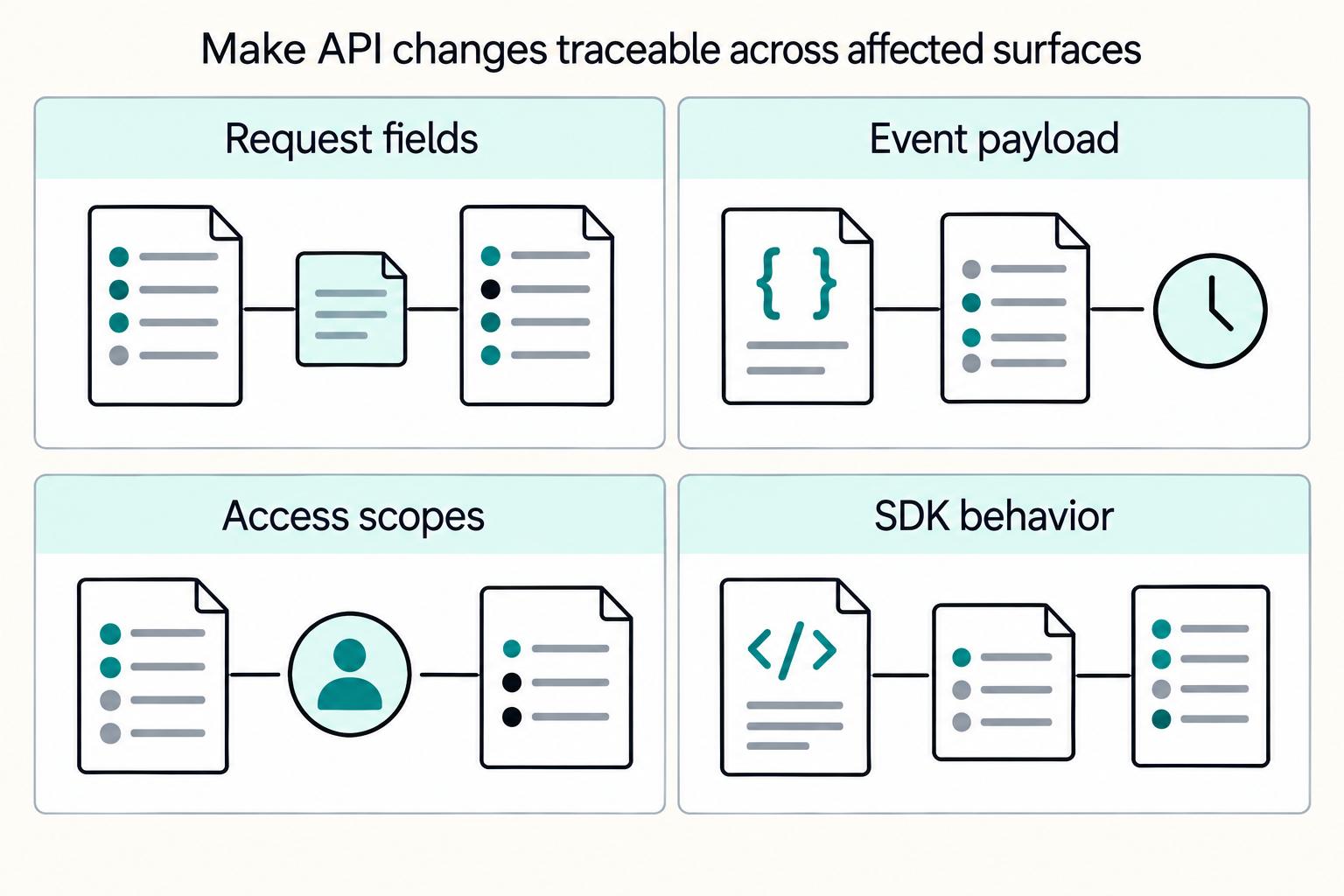
For each version or deprecation notice, map impact to specific surfaces:
- affected endpoints and parameter changes
- webhook or event payload changes
- auth scope changes for impacted calls
- SDK behavior or library-version impact
Keep this explicit because version changes can affect more than request parameters. They can also affect webhook object structure and SDK-exposed behavior.
For breaking changes, set a clear release policy: require migration guidance and a test-environment plan before approval. Before publishing, verify the change log links to affected endpoints, events, scopes, and SDKs, and that teams can validate behavior in an isolated test environment before production.
For versioning policies and change management, read A Guide to Semantic Versioning for Software Releases.
Call out compliance and program variability without vague language#
Your docs should assume onboarding, payouts, and risk controls are conditional, not uniform. Mark behavior where it changes with clear labels like "where supported," "when enabled," and "coverage varies by market/program," and tie each condition to a specific country, product, or onboarding model.
Availability is often tiered. PayPal Payouts defines 4 country feature levels, and some programs are market-limited, for example Venmo only in the US. Adyen also shows payment-method availability through country or region, processing currency, settlement currency, feature, and integration filters. Avoid broad statements like "payouts supported" without country or program qualifiers.
Where to be explicit#
Policy-gated flows need explicit branch logic in your docs. In Stripe Connect, onboarding options differ: some automatically handle new compliance requirements, while API onboarding requires integration changes. Call that out directly so teams know who owns future compliance updates.
For payout and risk states, define blocked actions in plain language. A paused payout means transfers to external destinations cannot proceed, and a blocked payment means the account cannot receive payments through the platform. For Stripe, payout availability varies by industry and country. Stripe also says initial live payout scheduling is typically 7-14 days after the first successful payment, so teams do not assume uniform timing.
What to confirm before launch#
Before each country or program launch, require confirmation of:
- exact country or region support for the product or program
- whether your PSP supports the payment method you plan to implement
- onboarding model and who handles new compliance requirements
- payout features and methods available for that country or program
- policy conditions that can pause payouts or block payments
Stripe Connect’s connected-account pause controls are not enforced in sandbox; the documented pause workflow also excludes Accounts v2. Test your own restriction logic and confirm the live account configuration separately. Keep evidence of country coverage, verification requirements, account status changes, and launch approvals.
If ACH is part of your scope, read ACH API Integration to Programmatically Initiate and Track Transfers in Your Platform.
Conclusion#
Use a simple standard: if your guide cannot tell an engineer what to do after a timeout, a duplicate webhook, or a live-key cutover, it is not ready. Strong payment API documentation reduces integration risk when it captures decisions, constraints, and operating checks, not just endpoint syntax.
Provider docs show what that looks like in practice. Documentation can include guides, explainers, and references, with response codes and versioning treated as contract details. Architecture choice also belongs up front, since providers may offer different integration shapes, such as direct API and checkout SDK paths.
Two high-impact contract details are idempotency and webhook handling. Idempotent requests are for safe retries without duplicate side effects, and Stripe notes keys are retained for at least 24 hours before pruning. PayPal defines webhooks as HTTPS posts, requires verification to validate sender authenticity, and notes non-2xx responses can trigger retries up to 25 times over 3 days. Those rules should drive your retry, deduplication, and incident-handling guidance directly.
Treat go-live as a gated decision, not a date on the calendar. Classify launch items as hard requirements versus strong best practices, then require evidence for production gates before approval.
If you are auditing your current API developer guide, close gaps in this order:
- Architecture choice: state the integration path and ownership boundaries.
- Retry contract: define replay safety, idempotency-key handling, and failure-state checks.
- Webhook contract: define verification, non-2xx consequences, and duplicate or late-event handling.
- Launch controls: separate hard requirements from best practices, and require proof for each gate.
This sequence is not a universal rule for every provider, but it is a disciplined way to reduce preventable mistakes before expanding scope.
If you want to confirm architecture fit, cutover gates, and operational coverage before launch, talk to Gruv.
Frequently Asked Questions
What should a payment API developer guide include before go-live?
Before go-live, document architecture choice, retry behavior for money-moving writes, webhook handling, cutover gates, logging, and reconciliation. Require edge-case testing with incomplete, invalid, and duplicate data, and confirm error handling before production. If the guide does not explain how to verify final state after a timeout on money-moving writes, it is not launch-ready.
How should teams sequence payment API integration to avoid platform debt?
Start with architecture, because it sets how much integration logic your team owns. Adyen’s Web Drop-in is positioned as the quickest path, while Web Components gives lower-level control with custom form logic. Then define lifecycle phases, implement idempotent writes and webhook consumers, and set explicit cutover criteria before switching to live traffic.
What are the minimum docs needed for safe retries?
Define idempotency key rules, replay behavior, duplicate handling, timeout handling, and final-state verification. Stripe documents same-key same-result behavior, including 500s, with keys up to 255 characters and pruning after at least 24 hours. Adyen also supports timeout retry with the same idempotency header, with a 64-character maximum. If docs do not state when to reuse a key versus create a new one on money-moving writes, block go-live.
How should webhook docs define delivery guarantees?
Describe provider delivery semantics, signature verification, retry behavior, ordering limits, and consumer deduplication duties. Stripe retries live deliveries for up to three days and can deliver duplicates or events out of order. Acknowledge after durable receipt; mark processing complete only when local effects commit or a recoverable workflow owns external effects. Return success for completed duplicates. Document recovery too: Stripe's List Events API covers the last 30 days.
What criteria should CTOs use to compare payment API documentation quality?
Compare operational completeness, not endpoint count. Strong docs make failure handling, cutover, version boundaries, and run-state visibility explicit, and they include request identifiers plus payout reconciliation reporting so teams can trace support and finance mismatches. Change-management quality is higher when compatibility expectations are clear, whether through Semantic Versioning or provider version boundaries such as Stripe’s major-release model and webhook version notes like 2024-09-30.acacia.
What is missing when docs only explain endpoints?
Endpoint-only docs miss the operating layer where production risk usually appears. Teams lose guidance for timeout retries, webhook failure recovery, and payout reconciliation when bank and internal records diverge. They also lose the evidence trail support and finance need, such as request IDs, idempotency keys, and payout reconciliation reports.
Try a related tool
Researched and edited by the Gruv editorial team. Gruv builds cross-border billing, payouts, and finance-operations software for global businesses.
Sources
Includes 4 external sources outside the trusted-domain allowlist.
- developer.paypal.com/api/rest/webhookstrusted
- developer.paypal.com/api/rest/reference/idempotencytrusted
- docs.stripe.com/api/idempotent_requeststrusted
- docs.stripe.com/webhooks/process-undelivered-eventstrusted
- blog.pragmaticengineer.com/distributed-architecture-concepts-i-have-lea...external
- developer.apple.com/documentation/applepayontheweb/payment-reque...external
- developer.citi.com/apidocs/outgoing-payments/payments/payments-...external
- developer.huntington.com/enterprisepayments/docs/api-versioning-depre...external
Educational content only. Not legal, tax, or financial advice.
Related Posts

The Freelance Payment Penalty: A Modeled Audit of Platform Fees, FX Spreads, and Payout Delays
The money rarely disappears through a single, easy-to-spot fee. The real loss is stacked. A marketplace takes its commission, a processor adds a charge for international cards, a bank or payment company converts the currency at a spread, a platform holds the funds before release, and a wire sheds a little to intermediaries on the way in. Each layer looks defensible on its own, but the worker feels the combined result as a smaller deposit and a later payday.

How to Respond to a Subpoena for Business Records
Move fast, but do not produce records on instinct. If you need to **respond to a subpoena for business records**, your immediate job is to control deadlines, preserve records, and make any later production defensible.

A US Expat's Guide to Investing in UCITS ETFs to Avoid PFIC Issues
The real problem is a two-system conflict. U.S. tax treatment can punish the wrong fund choice, while local product-access constraints can block the funds you want to buy in the first place. For **us expat ucits etfs**, the practical question is not "Which product is best?" It is "What can I access, report, and keep doing every year without guessing?" Use this four-part filter before any trade: